

Tag: Common
-

CEO Reflects as the Common App Marks 50 Years
Ever since 15 private colleges and universities teamed up to launch the Common App 50 years ago, the college admissions form has shifted practices and technology to meet the changing needs of institutions and students.
For instance, the latest iteration of the application, which opened Aug. 1 for the 2026–27 academic year, has what the organization calls a “refreshed look” and a new question that allows students to share their experiences with working at a paid job or taking care of their siblings. Common App, the nonprofit that runs the portal, piloted the Responsibilities and Circumstances question over the last three years, which showed in part “the importance of giving students space—beyond the personal essay—to share how these factors have shaped their high school experience,” the organization wrote in its innovation guide.
Common App is continuing to build out its Direct Admissions program, in which eligible students get an admissions offer before they actually apply. In its second year, 119 institutions have participated in the initiative and more than 700,000 students received offers.
Nearly 1.5 million first-time applicants completed the Common App in the 2024–25 cycle, submitting more than 10 million applications, according to a report released this week. That included just over 571,000 first-generation students—a 14 percent increase compared to the previous cycle. The Common App is aiming to continue to increase the number of applicants who are first-generation and from low- or middle-income households as it seeks to close equity gaps.
For this current cycle, more than 1,100 institutions are participating in the Common App, which includes 10 community colleges—yet another change for the organization aimed at ensuring students know about the available opportunities.
As the organization marks its 50th anniversary, CEO Jenny Rickard sat down with Inside Higher Ed to talk about how the Common App has changed over the years and what’s next. The conversation has been edited for clarity and length.
Q: How has the founding and the history of Common App influenced the organization today?
Jenny Rickard has led Common App since 2016.
A: The thing about Common App that is unique is how its mission actually has not changed over the 50 years of history. It still is an organization that is governed by our members. The mission has always been to simplify the admission process to enable more students to gain access to higher education. So the idea of trying to simplify the college application process by collaborating and working with all the different stakeholders in the admission process—that include students, applicants, school counselors and, obviously, admission officers—is how we go about developing this application, and it’s critically important that we listen to all of those different constituencies. Over the 50 years of Common App, what has changed is technology and the demand for higher education has continued to grow over that time. Just as the times have changed, we’ve expanded the types of institutions that we serve. As a result of that, the students and the different high schools or secondary schools that we’re able to reach.
Q: As the demographics of who is attending college have changed, Common App has made an effort to adjust to that, such as working to better serve financially independent students. So what are the biggest demographic shifts happening now and that you see coming in the applicant pool over the next few years? And how are you looking to accommodate and invest in those changes?
A: I think one of the main challenges over the past 50 years has actually been reaching different socioeconomic groups. So our moon shot that we launched to close our gap in the income bands of students using Common App shined a light on the access challenges that higher ed has faced. And some of the initiatives that we have launched are to address that gap—70 percent of the students using Common App to apply to college are from above the national median income and 30 percent are below. And that’s something that has been pretty constant in the college admissions space. We’re working through some of the initiatives that we’ve launched to reach out to more low- and middle-income students who may not think that college is something that’s possible for them, to let them know it is possible and you can go to college, and colleges would love to see you there.
So it’s trying to go beyond addressing some of what I’d call the logistical barriers that students face to apply to college and get to some of the social and economic barriers that students face in applying to college. The main theme of what we’re trying to accomplish these days is expanding access to students who have felt that higher education may not be attainable for them.
Q: One of those initiatives is direct admissions. Why is that something you wanted to invest in and how’s the program going?
A: There are students who won’t even create a Common App account because they fear that rejection. And so one of the things that we’re working on is, how do we give students the positive reinforcement that you are going to be able to find a college? There are colleges that would love to enroll you. That can then inspire them to not only perhaps apply to some of the colleges that are reaching out to them, but also maybe think more broadly about where they might want to go to school and understand that they have some agency in this process.
How we went about doing our direct admission work was inspired by the state of Idaho that had launched a program to let high school students know about the state institutions that they could get into. And we looked at that and thought, “Wow, what could Common App do nationally to help students in states that may not have a direct admission program, but also be able to expose them to the 1,100 colleges and universities that are members of this nonprofit membership association?”
We did three different pilots to email students. We worked on the language and tried to understand from the student perspective what they were experiencing. We worked with our member colleges to understand the process from their vantage point as well as school counselors to see what might work best for their students and how to support them in this effort. And after the three pilots, we decided we could scale it and also enhance the technology so that we went beyond an email notification.
Once they’re in Common App, they can now have a dashboard to see which schools would already admit them if they just continued in the process with those institutions. Every year, we make enhancements to the process as we learn from all the different stakeholders about which aspects are supporting students the best and which are supporting the institutions the best.
Q: And the number of institutions participating in the direct admissions program is going to increase to more than 200 this fall, correct?
A: I found it overwhelming, in a really great way, that we reached out to over 700,000 individual students with direct admission offers last year. Thinking about the scale that we have and being able to provide that positive reinforcement to help encourage students to continue in the admission process and be able to attain higher education is really exciting.
Q: Certain elements of the admissions process are under scrutiny, such as concerns about standardized tests. I recently wrote about a report led by a Common App researcher that found letters of reference for some minority groups tend to skew shorter. What do you make of those debates and how do you think college admissions will change over the next several years?
A: As technology changes and institutions look at their own way of doing their admission processes, we will continue to work with our members to understand what they are experiencing and what they are wanting in order to enroll the classes of students that they want and who will thrive on their campuses. We have a common platform, but there is also flexibility by institutional type, as well as a section for colleges to have their own questions beyond what’s on the common form. That format has provided the flexibility for us to be able to have a very diverse group of members, and also in welcoming associate’s degree–granting community colleges to the platform.
We’ve been constantly evolving as the higher education environment has evolved, as technology has evolved. When you look back at Common App 50 years ago, its technology inspiration was the photocopier, and the idea was a really great idea of admissions deans seeing that they were asking some similar questions, maybe they could streamline this process for students. And then floppy disks came along, and admissions officers and college counselors said, “We need to move into this floppy disk area.” And they quickly pivoted when the internet came out, and in 1998 launched the first online application. So we will continue to evolve. Obviously, with artificial intelligence, we’re looking into how this can assist in the process.
Q: Common App has reams of data about students’ applications, and the organization has worked to make that information more easily available. What do you see as Common App’s role in the world of higher ed research?
A: We were very grateful to the Gates Foundation who, over five years ago, awarded us a grant to create a data warehouse so that we could share nationally about trends in the college application process and help shine a light on areas where there are differences across institutions and across students. So you pointed to that research about how recommendations for some populations of students aren’t as strong as others. What does that mean? And is that a reflection of the students? Is it a reflection of the secondary schools that they might attend?
Because when you think about the great diversity of colleges, the diversity of secondary schools is that much more, and the opportunities that students have [are] so different, and being able to really highlight what that means from a student access perspective is critically important for all of us to try to make sure that students have the same level of opportunities.
So investing in that data warehouse—and that investment from the Gates Foundation—is something that has really transformed us, not just only from the research reports that we’re able to do but also during COVID, we were able to see right away that first-generation college students’ applications had really dropped off. And we were able to alert all of our members that COVID was really having an impact on first-generation college students and [look into] what we could all do to try to mitigate that negative impact.
It also has been important for us to be able to understand how students are persisting within the Common App, and to help us enhance the system to try to ensure that students are not only able to start an application but to complete the application. And we’ve been able to collaborate with organizations like the National Student Clearinghouse to see if students are persisting in college. We have been able to add the texture that the admission application provides to the clearinghouse data to understand more about student behavior, not only in Common App but also in college.
I see that as all critical in terms of informing our broad community about the kinds of changes we might need to make or things that we might want to stop doing because it’s not helping the situation. The data has really just shined a light on a number of the challenges in the admission process and informed us about ways that we might be able to mitigate those challenges. Direct admission is one of those.
-

Common Sense Media releases AI toolkit for school districts
Key points:
Common Sense Media has released its first AI Toolkit for School Districts, which gives districts of all sizes a structured, action-oriented guide for implementing AI safely, responsibly, and effectively.
Common Sense Media research shows that 7 in 10 teens have used AI. As kids and teens increasingly use the technology for schoolwork, teachers and school district leaders have made it clear that they need practical, easy-to-use tools that support thoughtful AI planning, decision-making, and implementation.
Common Sense Media developed the AI Toolkit, which is available to educators free of charge, in direct response to district needs.
“As more and more kids use AI for everything from math homework to essays, they’re often doing so without clear expectations, safeguards, or support from educators,” said Yvette Renteria, Chief Program Officer of Common Sense Media.
“Our research shows that schools are struggling to keep up with the rise of AI–6 in 10 kids say their schools either lack clear AI rules or are unsure what those rules are. But schools shouldn’t have to navigate the AI paradigm shift on their own. Our AI Toolkit for School Districts will make sure every district has the guidance it needs to implement AI in a way that works best for its schools.”
The toolkit emphasizes practical tools, including templates, implementation guides, and customizable resources to support districts at various stages of AI exploration and adoption. These resources are designed to be flexible to ensure that each district can develop AI strategies that align with their unique missions, visions, and priorities.
In addition, the toolkit stresses the importance of a community-driven approach, recognizing that AI exploration and decision-making require input from all of the stakeholders in a school community.
By encouraging districts to give teachers, students, parents, and more a seat at the table, Common Sense Media’s new resources ensure that schools’ AI plans meet the needs of families and educators alike.
This press release originally appeared online.
 Latest posts by eSchool News Staff (see all)
 -
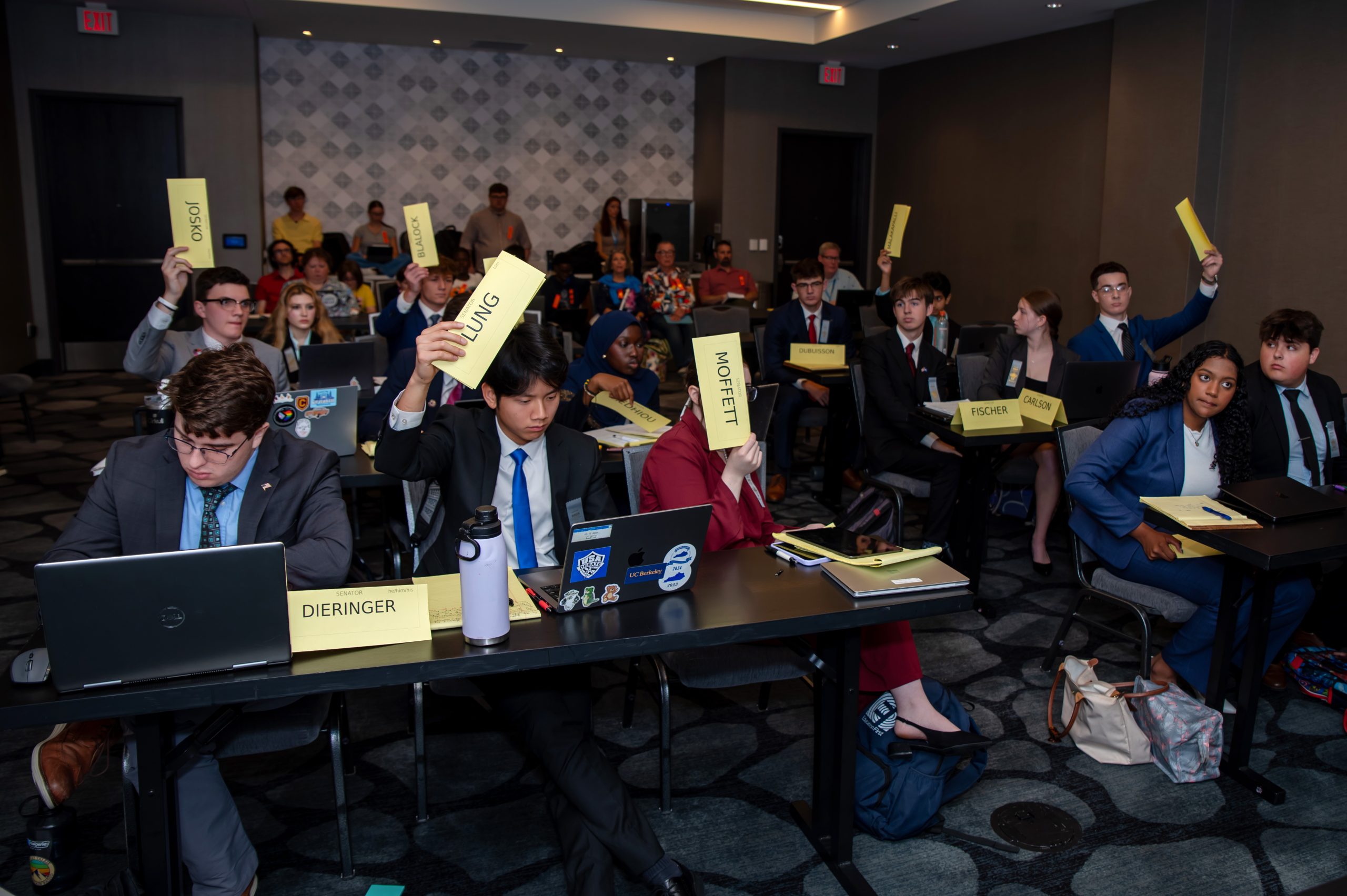
High school speech and debate allows students to find common ground
This story about high school speech and debate was produced by The Hechinger Report, a nonprofit, independent news organization focused on inequality and innovation in education. Sign up for the Hechinger newsletter.
DES MOINES, Iowa — Macon Smith stood in front of a nearly empty classroom 1,000 miles from home. He asked his opponent and the two judges in the room if they were ready to start, then he set a six-minute timer and took a deep breath.
“When tyranny becomes law, rebellion becomes duty,” he began.
In front of Macon, a 17-year-old high school junior, was a daunting task: to outline and defend the argument that violent revolution is a just response to political oppression.
In a few hours, Macon would stand in another classroom with new judges and a different opponent. He would break apart his entire argument and undo everything he had just said.
“An eye for an eye makes the whole world blind,” Macon started.
It doesn’t really matter what opinion Macon holds on violence or political oppression. In this moment in front of the judges, he believes what he’s saying. His job is to get the judges to believe with him.
Related: A lot goes on in classrooms from kindergarten to high school. Keep up with our free weekly newsletter on K-12 education.
Macon was one of more than 7,000 middle and high school students to compete in the National Speech and Debate Tournament this summer in Iowa, run by an organization that is celebrating a century in existence.
In that time, the National Speech and Debate Association has persevered through economic and social upheaval. It is entering its next era, one in which the very notion of engaging in informed and respectful debate seems impossible. The organizers of this event see the activity as even more important in a fracturing society.
“I don’t think there’s an activity in the world that develops empathy and listening skills like speech and debate,” said Scott Wunn, the organization’s president. “We’re continuing to create better citizens.”
Macon Smith, a rising senior from Bob Jones Academy in South Carolina, competes in the third round of the Lincoln-Douglas Debate at the National Speech and Debate Tournament in Iowa this summer. Credit: Meenakshi Van Zee for The Hechinger Report Though the tournament is held in different cities around the country, for the 100th anniversary, the organizers chose to host it in Des Moines, where the association’s headquarters is based.
Preparing for this competition was a year in the making for Macon, who will be a senior at Bob Jones Academy, a Christian school in Greenville, South Carolina, this fall. Students here compete in more than two dozen categories, such as Original Oratory, in which they write and recite their own 10-minute speeches, or Big Questions, where they attempt to argue broad, philosophical ideas.
Macon’s specialty, the Lincoln-Douglas Debate, is modeled after a series of public, three-hour debates between Abraham Lincoln and Sen. Stephen Douglas in 1858. In this event, two students have just 40 minutes to set up their arguments, cross-examine each other and sway the judges.
“Even if I don’t personally believe it, I can still look at the facts and determine, OK, this is a good fact, or it’s true, and argue for that side,” Macon said.
Debaters often have to tackle topics that are difficult, controversial and timely: Students in 1927 debated whether there was a need for a federal Department of Education. In 1987, they argued about mandatory AIDS testing. In 2004, they debated whether the United States was losing the war on terror. This year, in the Public Forum division, students debated whether the benefits of presidential executive orders outweigh the harms.
Related: Teaching social studies in a polarized world
While the speech and debate students practiced for their national event, adults running the country screamed over each other during a congressional hearing on state sanctuary policies. A senator was thrown to the floor and handcuffed during a press conference on sending the National Guard to immigration enforcement protests in Los Angeles. Most Americans feel political discourse is moving in the wrong direction — both conservatives and progressives say talking politics with someone they disagree with has become increasingly stressful and frustrating.
Speech and debate club, though, is different.
“First of all, it gives a kid a place to speak out and have a voice,” said Gail Nicholas, who for 40 years has coached speech and debate at Bob Jones Academy alongside her husband, Chuck Nicholas, who is Macon’s coach. “But then also learn to talk to other people civilly, and I think that’s not what’s being modeled out there in the real world right now.”

Macon Smith, a rising senior from Bob Jones Academy in South Carolina, shows off the notes that he took during debates at the National Speech and Debate Tournament in Iowa. Credit: Meenakshi Van Zee for The Hechinger Report On the second day of the competition in a school cafeteria in West Des Moines, Macon was anxiously refreshing the webpage that would show the results of his rounds to learn whether he would advance to semifinals.
For most of the school year, Macon spent two days a week practicing after school, researching and writing out his arguments. Like many competitors, he has found that it’s easy to make snap judgments when you don’t know much about an issue. Decisively defending that view, to yourself and to others, is much harder.
“I tend to go in with an opinion and lose my opinion as the topic goes on,” said Daphne DiFrancesco, a rising senior from Cary Academy in Cary, North Carolina.
Traveling for regional events throughout the school year means Macon has become friends with students who don’t always share his conservative views. He knows this because in debate, discussing politics and religion is almost unavoidable.
“It doesn’t make me uncomfortable at all,” Macon said. “You don’t want to burn down a bridge before you make it with other people. If you stop your connection with a person right at their political beliefs, you’re already cutting off half of the country. That’s not a good way to conduct yourself.”
Macon, and other students in the clubs, said participating has made them think more deeply about their own beliefs. Last year, Macon debated a bill that would defund Immigration and Customs Enforcement, an agency he supports. After listening to other students, he developed a more nuanced view of the organization.
“When you look at the principle of enforcing illegal immigration, that can still be upheld, but the agency that does so itself is flawed,” he said.
Related: ‘I can tell you don’t agree with me’:’ Colleges teach kids how to hear differing opinions
Henry Dieringer, a senior from L.C. Anderson High School in Austin, Texas, went into one competition thinking he would argue in favor of a bill that would provide work permits for immigrants, which he agrees with. Further research led him to oppose the idea of creating a federal database on immigrants.
“It made me think more about the way that public policy is so much more nuanced than what we believe,” Henry said.
On the afternoon of the second day of the national tournament, Macon learned he didn’t advance to the next round. What’s sad, he said, is he probably won’t have to think this hard about the justness of violent revolution ever again.
“There’s always next year,” Macon said.
Callista Martin, 16, a rising senior from Bainbridge High School in Washington state, also didn’t make the semifinals. Callista and Macon met online this year through speech and debate so they could scrimmage with someone they hadn’t practiced with before. It gave them the chance to debate someone with differing political views and argument styles.
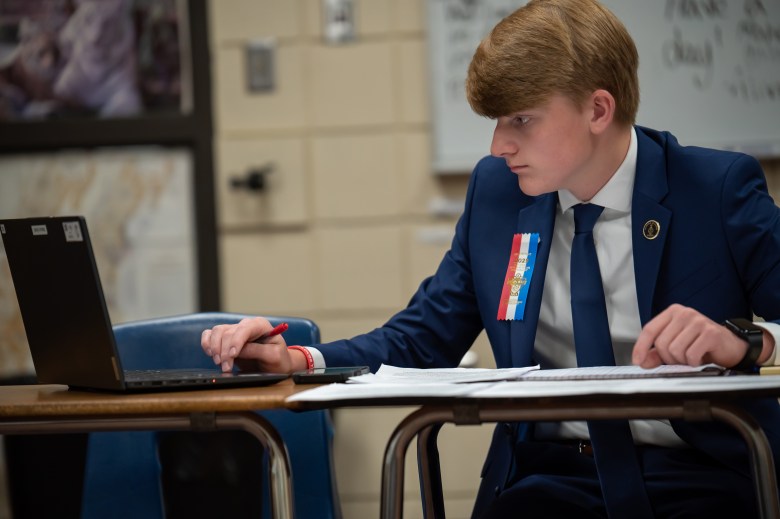
Macon Smith, a rising senior from Bob Jones Academy in South Carolina, takes notes during a round of the Lincoln-Douglas Debate at the National Speech and Debate Tournament in Iowa. Credit: Meenakshi Van Zee for The Hechinger Report “In the rounds, I’m an entirely different person. I’m pretty aggressive, my voice turns kind of mean,” Callista said. “But outside of the rounds, I always make sure to say hi to them before and after and say things I liked about their case, ask them about their school.”
Talking to her peers outside of rounds is perhaps the most important part of being in the club, Callista said. This summer, she will travel to meet with some of her closest friends, people she met at debate camps and tournaments in Washington.
Since Callista fell in love with speech and debate as a freshman, she has devoted herself to keeping it alive at her school. No teacher has volunteered to be a coach for the debate club, so the 16-year-old is coaching both her classmates and herself.
A lack of coaches is a common problem. Just under 3,800 public and private high schools and middle schools were members of the National Speech and Debate Association at the end of this past school year, just a fraction of the tens of thousands of secondary schools in the country. The organization would like to double its membership in the next five years.
That would mean recruiting more teachers to lead clubs, but neither educators nor schools are lining up to take on the responsibility, said David Yastremski, an English teacher at Ridge High School in New Jersey who has coached teams for about 30 years.
It’s a major time commitment for teachers to dedicate their evenings and weekends to the events with little supplemental pay or recognition. Also, it may seem like a risk to some teachers at a time when states such as Virginia and Louisiana have banned teachers from talking about what some call “divisive concepts,” to oversee a school activity where engaging with controversial topics is the point.
“I primarily teach and coach in a space where kids can still have those conversations,” Yastremski said. “I fear that in other parts of the country, that’s not the case.”
Related: A school district singled out by Trump says it teaches ‘whole truth history’
Dennis Philbert, a coach from Central High School in Newark, New Jersey, who had two students become finalists in the tournament’s Dramatic Interpretation category, said he fears for his profession because of the scrutiny educators are under. It takes the fun out of teaching, he said, but this club can reignite that passion.
“All of my assistant coaches are former members of my team,” Philbert said. “They love this activity [so much] that they came back to help younger students … to show that this is an activity that is needed.”
On the other side of Des Moines, Gagnado Diedhiou was competing in the Congressional Debate, a division of the tournament that mimics Congress and requires students to argue for or against bills modeled after current events. During one round, Gagnado spoke in favor of a bill to shift the country to use more nuclear energy, for a bill that would grant Puerto Rico statehood, and against legislation requiring hospitals to publicly post prices.
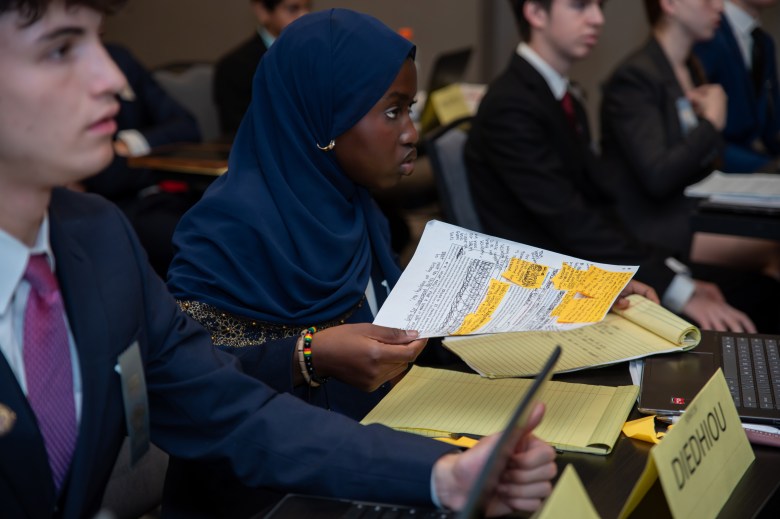
Gagnado Diedhiou, a senior from Eastside High School in South Carolina, competing in the first round of the Congressional Debate at the National Speech and Debate Tournament in Iowa in June. Credit: Meenakshi Van Zee for The Hechinger Report Just like in Congress, boys outnumbered girls in this classroom. Gagnado was the only Black teenager and the only student wearing a hijab. The senior, who just graduated from Eastside High School in Greenville, South Carolina, is accustomed to being in rooms where nobody looks like her — it’s part of the reason she joined Equality in Forensics, a national student-led debate organization that provides free resources to schools and students across the country.
“It kind of makes you have to walk on eggshells a little bit. Especially because when you’re the only person in that room who looks like you, it makes you a lot more obvious to the judges,” said Gagnado, who won regional Student of the Year for speech and debate in her South Carolina district this year. “You stand out, and not always in a good way.”
Camille Fernandez, a rising junior at West Broward High School in Florida, said the competitions she has participated in have been dominated by male students. One opponent called her a vulgar and sexist slur after their round was over. Camille is a member of a student-led group — called Outreach Debate — trying to bridge inequities in the clubs.
“A lot of people think that debate should stay the same way that it’s always been, where it’s kind of just — and this is my personal bias — a lot of white men winning,” Camille said. “A lot of people think that should be changed, me included.”
Despite the challenges, Gagnado said her time in debate club has made her realize she could have an influence in the world.
“With my three-minute speech, I can convince a whole chamber, I can convince a judge to vote for this bill. I can advocate and make a difference with some legislation,” said Gagnado, who is bound for Yale.
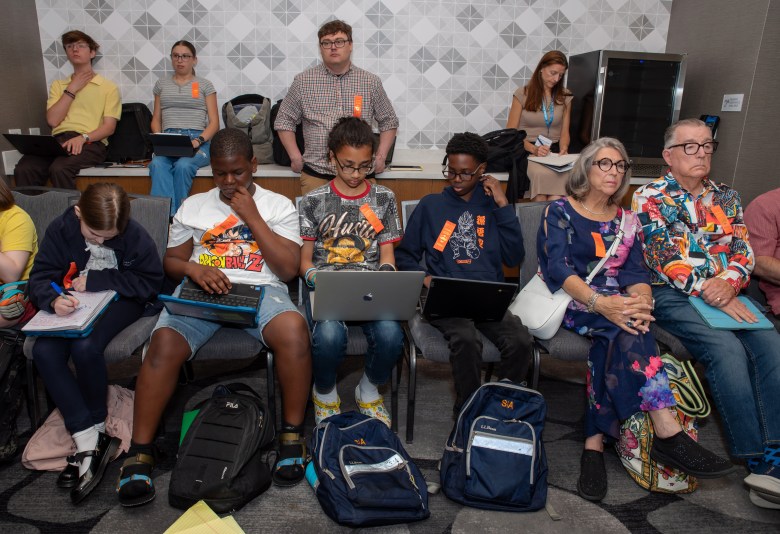
About 10,000 people attended the National Speech and Debate Tournament in Iowa this June during the organization’s centennial anniversary. Credit: Meenakshi Van Zee for The Hechinger Report A day before the national tournament’s concluding ceremony, a 22-year-old attendee rushed the stage at the Iowa Event Center in Des Moines during the final round of the Humorous Interpretation speech competition, scaring everyone in the audience. After he bent down to open his backpack, 3,000 people in the auditorium fled for the exits. The man was later charged with possession of a controlled substance and disorderly conduct. For a brief moment, it seemed like the angry discourse and extreme politics from outside of the competition had become a part of it.
In response, the speech and debate organization shifted the time of some events, limited entrances into the building and brought in metal detectors, police officers and counselors. Some students, Gagnado among them, chose not to return to the event.
Still, thousands of attendees stayed until the end to celebrate the national champions. During the awards ceremony, where therapy dogs roamed the grounds, Angad Singh, a student from Bellarmine College Preparatory in California competing in Original Oratory, took the national prize for his speech on his Sikh identity and the phrase “thoughts and prayers” commonly repeated by American leaders after a tragedy, titled “Living on a Prayer.”
“I’ve prayed for change,” Singh told the audience. “Then I joined speech and debate to use my voice and fight for it.”
This story about high school speech and debate was produced by The Hechinger Report, a nonprofit, independent news organization focused on inequality and innovation in education. Sign up for the Hechinger newsletter.
-

Will Trump’s school discipline order drive wider disparities or ‘restore common sense’?
This audio is auto-generated. Please let us know if you have feedback.A new White House executive order calling for “common sense” in school discipline policies by removing practices based on “discriminatory equity ideology” will drive even wider racial disparities in discipline than currently exist, critics say.
Rather than being common sense, the directive would “permit school discipline practices that target and punish students of color and students with disabilities at disproportionate rates,” said Denise Forte, president and CEO of EdTrust, in a statement Thursday, a day after President Donald Trump signed the order. EdTrust, a nonprofit, works with school systems to close opportunity gaps for students of color and students from low-income backgrounds.
Additionally, EdTrust in a separate Thursday statement to K-12 Dive said, “When the dust settles from the education chaos being created by Trump administration, students — especially students from low-income backgrounds, students of color, students with disabilities, English learners, and students in rural areas — will be worse off, and the Trump administration wants to make sure we don’t have the data and research to prove it.”
Dan Losen, senior director of education at the National Center for Youth Law, said the Trump administration is creating a false dichotomy that schools either need harsh discipline practices or they deal with out-of-control and unsafe student behaviors.
The reality, Losen said, is that well-trained educators and administrators have many approaches to reducing student misconduct that are evidence-based. “Many schools and superintendents are aware that the best antidote to violence, to drug involvement, to gang involvement, is to try to find ways to keep more kids in school,” Losen said.
Closing racial gaps in school discipline has been a priority at the local, state and national levels for many years. Schools have also shunned strict zero-tolerance discipline policies in favor of responsive and restorative practices and other approaches that help students examine their behavior and make amends to those harmed.
Supporters of alternatives to suspending or expelling students — or what’s called “exclusionary discipline” — say those different approaches help keep students connected to school and reduce the school-to-prison pipeline. They also note that alternative strategies help reduce racial disparities in school discipline.
The U.S. Department of Education’s Civil Rights Data Collection found that even though Black students represented 15% of K-12 student enrollment in the 2021-22 school year, they accounted for 19% of students who were secluded and 26% who were physically restrained. And while Black children accounted for 18% of preschool enrollment, 38% received one or more out-of-school suspensions, and 33% were expelled.
In the years following the COVID-19 pandemic, schools have reported an uptick in mental health and disruptive behaviors in students. In fact, 68% of respondents said behavioral disruptions have increased since the 2019-20 school year in an EAB survey of school employees published in 2023.
At the same time, schools said they lack the funding and staffing to adequately address students’ mental health needs. Furthermore a 2024 Rand Corp. report found that challenging student behaviors contribute to teacher burnout.
On Thursday, the departments of Education, Homeland Security, Justice, and Health and Human Services issued a resource for K-12 threat assessment practices to help prevent school violence and create a safe school environment.
The order’s expectations
Student discipline policies are set at the school or district level. However, the federal government can issue guidance and hold schools accountable for discriminatory practices.
The executive order signed by President Donald Trump on Wednesday lays out a timeline of expectations for U.S. Education Secretary Linda McMahon. In one month, McMahon, along with the U.S. attorney general, is to issue school discipline guidance that reminds districts and states of their obligations under Title VI to protect students against racial discrimination. Title VI of the Civil Rights Act prohibits discrimination based on race, color or national origin in federally funded programs.
In two months, McMahon and the U.S. attorney general are required to begin working with states to prevent racial discrimination in school discipline. By late July, the U.S. Department of Defense is to issue a revised school discipline code to guide the school experiences of children from military-service families.
Lastly, by late August, McMahon, along with leaders from various federal agencies, is to submit a report on the “status of discriminatory-equity-ideology-based school discipline and behavior modification techniques in American public education.”
Rep. Tim Walberg, R-Mich., chair of the House Education and Workforce Committee, praised the executive order in a statement on Wednesday, “The Left’s fixation on ‘disparate impact’ has led to a profound failure in many schools to address disruptions or behavioral problems in the classroom, negatively impacting all students as a result.”
Walberg added, “The Trump administration is restoring common sense in schools by working to remove racialized notions of DEI and saying unequivocally: All students must be treated equally.”
Trump also signed a broader executive order on Wednesday, not restricted to education programs, that calls for the elimination of “disparate-impact liability in all contexts to the maximum degree possible.” The order says that the U.S. should be a “colorblind society” without “race- or sex-based favoritism.”
-
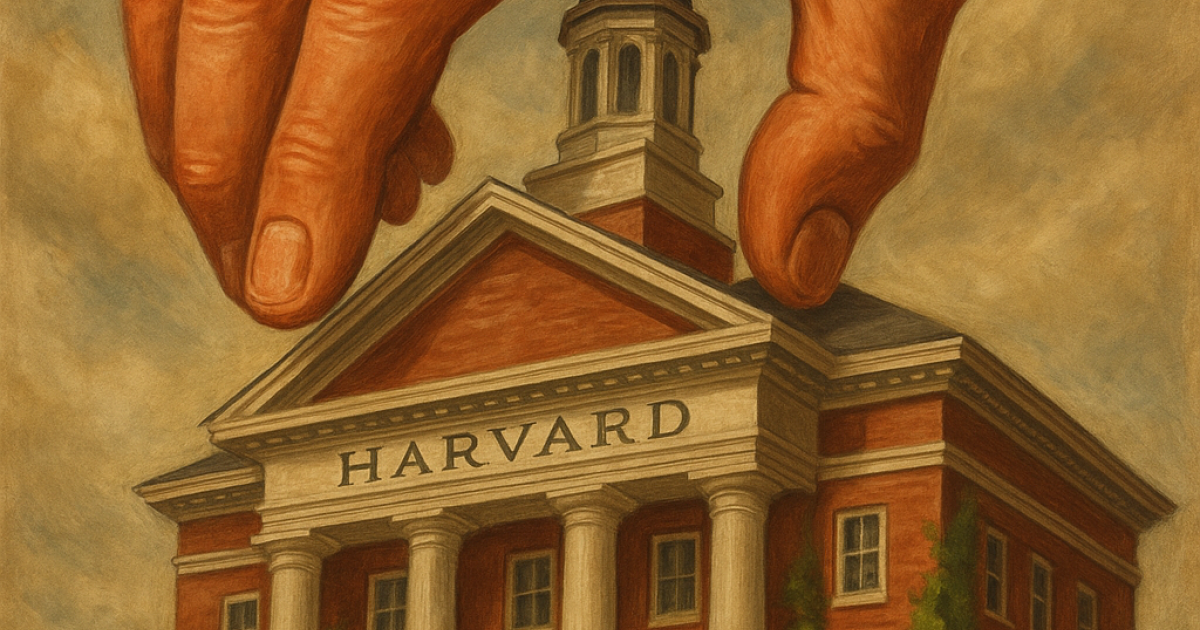
FAQ: Responding to common questions about the fight between Harvard and the Trump administration
On April 21, 2025, Harvard University filed a lawsuit against the Trump administration after the federal government froze $2.2 billion in federal research funding with threats of more cuts to come. The administration claimed Harvard failed to address anti-Semitism on campus, especially in the aftermath of Hamas’ attack against Israel on Oct. 7, 2023, and issued a list of demands in exchange for lifting the freeze.
These demands included adopting an ideological litmus test for foreign students, a comprehensive mask ban, an audit of disfavored academic departments, mandated reforms to the university’s internal governance structure, and eliminating diversity programs. Harvard argued that these demands and the funding cuts that followed violated its institutional autonomy and constitutional right free speech and academic freedom. In the lawsuit, the university is asking the court to restore its funding and block the government from imposing such requirements in the future.
FIRE agrees that the Trump administration’s approach is unlawful. Below are answers to some common questions we have received about the situation.
Harvard isn’t entitled to federal funds. Why is FIRE defending it?
You’re right. Harvard isn’t entitled to federal funding. No institution is.
But Harvard — just like you (or FIRE, or any person or organization) — is entitled to a federal government that follows the law. And just as the law gives us certain protections, it also says the government can’t cancel funding on a whim, like the administration did last week.
Let’s take a closer look.
The vast majority of colleges and universities receive federal funds. These funds mostly consist of financial aid, like Pell grants, and grants for scientific and medical research. Of the $9 billion reportedly under review by the Trump administration, the Harvard Crimson estimates over $6 billion comes in the form of funding for five regional hospitals associated with the university, along with $2.7 billion in research funding at the university itself.
To be eligible to receive federal funding, institutions pledge to follow federal anti-discrimination laws. Those laws include Title VI, the federal law that prohibits colleges and universities from discriminating on the basis of race, color, and national origin. Since the George W. Bush administration, the federal government has interpreted Title VI as prohibiting anti-Semitic discrimination, too.
So far, so good. Colleges get government funding for students and research. The federal government in return gets (among other things) a commitment that those colleges won’t engage in or tolerate discrimination. That’s the deal.
And the deal has rules to protect colleges, the government, and the taxpayers who foot the bill from being negatively affected by arbitrary decisions. Before the federal government can pull funds from an institution, it has to take a series of steps.
First, the Department of Education must investigate complaints about discrimination. If it finds problems, ED is required to work with an institution to address those problems “by informal means whenever possible.” This is the most common process, where the department’s Office for Civil Rights enters into a “resolution agreement” with an institution to ensure compliance with Title VI.
If that doesn’t work, for whatever reason, here’s what happens next. In order to strip federal funding, the department must give notice to the institution again and provide an opportunity for an administrative hearing where the institution can challenge the determination. If the determination stands, ED then has to report this to Congress and give 30 days’ notice before it actually terminates funding to the affected programs. ED may also refer the matter to the Department of Justice for litigation.
In short, one way or another, the federal government is going to have to provide evidence and prove its case if it wants to pull out of the deal.
Those are a lot of steps, but they’re important. They protect students by making sure colleges live up to their obligations. And they protect colleges by making sure they have an opportunity to contest the allegations as well as a chance to make things right.
These rules are also important because they provide a safeguard against political bias, risk of error, and governmental overreach.
Even the federal government acknowledges the role of due process and following existing statute. In a federal court filing earlier this month, the government wrote, “But ED’s only power is to withhold funding from institutions receiving federal funding, after a robust process required by statute and aimed at ensuring compliance.” In that same court filing, the government reiterated that point, writing that “by statute and regulation, numerous steps aimed at ensuring compliance must occur before ED may withdraw funding.”
Without these rules, an administration could, for example, decide to dramatically expand the definition of “sexual harassment” to include core protected speech and to remove due process protections from sexual misconduct hearings, using the threat of federal funding to force schools to go along with it. That’s exactly what happened under President Obama — and FIRE fought back.
And without these rules, nothing prevents the federal government from arbitrarily declaring a university in violation of federal law, yanking federal funding, and demanding fealty and censorship.
That’s what President Trump is doing now. And again, FIRE is fighting back.
Is FIRE saying that what happened to Jewish students at Harvard and other colleges is OK?
No. As FIRE has consistently noted, some campus protests veered into violations of both campus rules and the law. Examples include when protesters took over buildings, blocked access and exit to and from areas of campus, disrupted classes, or committed acts of violence against Jewish students.
In responding to these incidents — or failing to respond — Harvard, Columbia, and other colleges may well have been in violation of their obligations under Title VI. If they refused to correct their mistakes as the process played out, revoking their funding might have been justified and legal.
But the process matters.
What FIRE is saying is that the law is important. Following it isn’t optional. It protects all of us — students, faculty, administrators, families, scientists, hospitals, and the entire country. The administration can’t just decide unilaterally to skip steps.
If you support President Trump — or just don’t like Harvard — remember this: Any power the president seizes to ignore the law now won’t magically disappear when he leaves office. It will be wielded by his successors, too. And this time, it might well target schools or other organizations you like.
Didn’t Harvard rank last for free speech on your list?
It sure did — two years in a row, in fact.
But one of the reasons we created our rankings was to give colleges and universities an incentive to do better. Protecting expressive rights on campus is a big part of our mission, and Harvard has a long way to go. Indeed, Harvard (like Columbia) makes a politically popular target precisely because so many people resent its years of engaging in the kind of behavior towards dissenting students and faculty that FIRE was founded to combat.
But lately Harvard has been making an effort, and we won’t succeed by writing schools off. And we definitely won’t succeed by allowing the federal government to take them over, trading one dominant ideology for another.
You can’t censor your way to free speech.
-

Carousel Digital Signage Integrates with CrisisGo to Empower Safer School Communities
MINNEAPOLIS, MINNESOTA – Carousel Digital Signage announces a new technology partnership with CrisisGo that enables K-12 schools and businesses to deliver emergency alerts and other safety messages to digital displays with immediacy. The integration is enabled through an open API that triggers visual alerts, interactive maps and more to Carousel Cloud digital signage networks via the Common Alerting Protocol (CAP), a global standard that supports the digital exchange of emergency alerts and public warnings over multiple networks.
CrisisGo’s Safety iResponse platform offers a comprehensive suite of advanced alerting software and tools that empower school districts to create safer and more secure learning environments. Its features include real-time alerting, incident management and parent notification, all of which combine to help schools respond to emergencies in an efficient and effective manner. The platform also immediately shares emergency alerts with local law enforcement when police assistance is needed.
Direct integration of the two software platforms on a common IT network ensures consistent monitoring of incoming triggers from Safety iResponse to Carousel Cloud. Upon recognizing an incoming alert, Carousel Cloud disseminates the active alert as a priority for instant takeover of all targeted screens. Upon resolution, Carousel Cloud immediately removes the alert and resumes normal operations, eliminating the need to schedule expiration times or manually clear the system. That accelerates the important process of reunification to ensure all students, teachers and other staff members are accounted for and safe.
“Carousel Cloud’s ability to recognize an all-clear message is a differentiator from other digital signage solutions that we have evaluated,” said Jacob Lewis, Chief Security Officer, CrisisGo. “Carousel Cloud will also recognize the type of event our system is addressing and exactly where the alerts need to go, which could be select screens, schoolwide, or across an entire multi-campus network. This seamless interoperability represents an important step in our multimodal strategy for mass notification, which also includes delivery to all computers and mobile devices that are connected to our software.”
The CrisisGo partnership represents the latest technology integration between Carousel Digital Signage and emergency alerting platforms aimed at strengthening school safety in K-12 environments. Lewis says that while K-12 remains the top priority for CrisisGo’s integrated solution with Carousel, he anticipates potential expansion into other verticals including corporate enterprise and manufacturing.
“Our collaboration with CrisisGo represents the next step in our efforts to keep students and faculty informed, safe and resilient across all grade levels,” said Eric Henry, SVP of Business Architecture, Carousel Digital Signage. “Carousel Cloud’s open platform enables clean and reliable interoperability with CrisisGo, and our common integration with the CAP protocol ensures immediate dissemination of important visual alerts that will help school districts keep all campuses safe and secure.”
About Carousel Digital Signage
Carousel is Digital Signage Content Management Software that is easy to use, scalable, and reliable. With a deep feature set and strong technology partnerships Carousel gives you the most value in digital signage. Carousel Digital Signage is a division of Tightrope Media Systems. You can reach the Carousel team at (866) 866-4118, or visit www.carouselsignage.com.
About CrisisGo
CrisisGo has been leading the K-12 industry since 2013, setting the standard for school safety. Our comprehensive emergency and safety management platform empowers schools with real-time alerting, incident management, visitor management, threat and behavioral intervention features, and reunification solutions. CrisisGo also offers comprehensive training to equip staff and teachers with handling emergencies. CrisisGo consistently innovates to enhance K-12 security, partnering with educators and administrators to create safe and nurturing learning environments and redefining school safety for a brighter future in education.
Latest posts by eSchool News Staff (see all) -

The Common App welcomes community colleges
The Common App allows students to submit applications to more than 1,100 higher ed institutions. But until now, none of its members were community colleges focused on granting associate degrees.
The organization announced a first-of-its-kind partnership with the Illinois Community College Board last week, adding Sauk Valley Community, Rend Lake, Carl Sandburg and Black Hawk Colleges to its ranks. Three more two-year institutions will join next admissions cycle: Lincoln Land Community, Oakton and Triton Colleges.
When the Common App launched 50 years ago, it offered high school students a streamlined application path to 15 private institutions. Since then, hundreds of others have signed on, most of them fairly selective four-year colleges and universities. The new move raises a question: What do open-access institutions, which accept all students, stand to gain from joining the application platform?
Brian Durham, executive director of the Illinois Community College Board, said most importantly, it boosts their visibility.
Starting this year, the Common App is partnering with the Illinois Board of Higher Education to support its direct admissions program to eight public universities in the state. As a part of the partnership, eligible high school students who apply to any college through the Common App will be notified of their direct admissions offers from these universities. Durham wants those students to receive notice about their local community college choices, too.
“We want to make sure that community colleges are seen as an option on that list”—even “potentially a first choice for students,” Durham said. “It’s ultimately about exposing them to that as an option.” He added that students who gain admission to universities sometimes realize later that “they can’t afford it, or it’s not right choice for them.” This way, if they come to that conclusion after filling out the Common App, they’ll know which community colleges are “right there” and ready to serve them.
Research suggests the move could offer community colleges an enrollment bump. The National Bureau of Economic Research published a paper in 2019 that found that institutions that joined the Common App enjoyed on average a 12 percent increase in admissions compared to the years before they joined, according to an analysis of Common App data from 1990 to 2015.
Durham hopes that eventually all 45 of the state’s public two-year colleges offer a Common App application route in addition to their in-house application systems.
A Decade-Long Effort
Jenny Rickard, president and CEO of the Common App, said that the organization has been working toward representing a broader swath of higher ed institutions for a decade.
In 2014, the organization stopped requiring member colleges to use a “holistic admissions” process—assessing students beyond test scores—in order to open up the platform to more institutions. The Common App also got rid of its requirement that applications include essays and recommendations. Then, in 2018, the organization launched a new application for transfer students applying to four-year universities.
All those moves “opened the door for us to be able to welcome two-year and four-year public institutions into the membership,” Rickard said. She noted that, as of the 2022–23 application cycle, 77 percent of current Common App members admitted over 50 percent of their fall first-year applicants, a sign that the organization has moved away from serving only more selective institutions.
The Common App also set a “moonshot” goal in 2023 to substantially increase its applicants from low- and middle-income communities, Rickard said. The organization aims to bring in 650,000 additional applicants from those backgrounds by 2030.
Rickard said teaming up with community colleges is the organization’s most recent step toward diversifying both its member institutions and its applicant pool.
“Bringing a greater diversity of college and university members into the Common App helps us pursue that mission, and it also helps students from all different backgrounds be able to see the great diversity of institutions in the United States and the world,” she said. “Most students go to more open-access and less selective institutions,” yet too often “we focus on the places that nobody can get into.”
Durham agreed that the move could expand the Common App’s “footprint,” given applicants to community colleges are disproportionately low-income and first-generation students.
“More underserved students are naturally going to go to community college for all the reasons we know: affordability, location,” he said. So, working with community colleges offers the Common App a new “opportunity to reach those students.”
Steps for the Future
As much as Durham would like to see more community colleges join the Common App’s ranks, he believes the platform will need to change to serve community colleges at a larger scale.
Currently the platform is designed for high school students, he said, but many community college applicants are adult learners or attend college part-time. Those types of students are more likely to enroll directly at a college rather than find themselves on the Common App platform like high school seniors applying to multiple institutions with guidance from college counselors.
“How do you get a 34-year-old guy who wants to go into welding to go through that application?” Durham said. For now, he expects participating Illinois community colleges will maintain their own “parallel” application systems “until we can work that out down the road.”
Rickard acknowledged the organization has work to do to optimize its platform for a more diverse set of institutions. She hopes that onboarding this initial cohort of community colleges will help the Common App figure out its blind spots.
“We know that we need to learn more about how our platform can continue to evolve to meet their needs more effectively,” she said.
-

Common App adds first community college members
Common App is adding its first ever community college members, the organization announced in a press release Thursday.
The seven new partner institutions are all members of the Illinois Community College system. Four of them—Sauk Valley Community, Rend Lake, Carl Sandburg and Black Hawk Colleges—are joining the platform immediately; another three institutions, Lincoln Land Community, Oakton and Triton Colleges, will join next admissions cycle.
Common App has a few members that technically include community colleges, like Miami-Dade College in Florida, but those institutions also offer baccalaureate degrees. The new members offer associate degree programs only.
In the press release, Common App CEO Jenny Rickard said she hoped the move would help promote college access and ease struggling community colleges’ recruitment efforts.
“To close the gap in low- and middle-income students applying, we need to expand the types of institutions students can connect with,” she wrote.
-
Building common ground in higher education
Welcome to year four of the “Beyond Transfer” blog on Inside Higher Ed. We’re humbled by and thankful for the lively and passionate community this has become. We continue to be impressed with the levels of readership, the exemplary work that various authors describe, the connections that are made as people respond to one another’s work and the dedication to students that jumps off the page. We begin 2025 feeling truly grateful to all those working hard every day to ensure fair treatment of students and their learning. Thank you for all you do.
Each year, we kick off the “Beyond Transfer” blog with some reflections on what we’ve learned from you and all our partners on the ground and what that means for the year ahead. We are excited to welcome Sova’s new partner Marty Alvarado to this endeavor. Marty has a long history of leading impactful transfer and learning mobility work, and while she’s new to Sova, her insights have long guided our work.
In 2024, Sova’s transfer and learning mobility team was far-flung and working deeply in many contexts. As a result, we begin 2025 midstride on a variety of fronts:
- In states: The Sova team is embedded in truly consequential transfer and learning mobility work in several states. This hard, on-the-ground work includes facilitating state-level, cross-sector leadership tables, providing technical assistance for institutional collaborations, supporting implementation of legislatively mandated reforms and serving as a thought partner to state agencies and system offices in diverse political and governance contexts.
- In partnerships: In 2024, we joined forces with key organizations to amplify impacts and advance the field, including the American Association of Collegiate Registrars and Admissions Officers, Public Agenda, Educate Texas, the National Institute for the Study of Transfer Students, Middle States Commission on Higher Education, Southern Association of Colleges and Schools Commission on Colleges, WASC Senior College and University Commission and more.
- In national groups: Sova continues to facilitate the Beyond Transfer Policy Advisory Board and in 2024 also launched in collaboration with AACRAO the new national Learning Evaluation and Recognition for the Next Generation Commission.
- In cross-sector regional collaborations: We’re embedded with P-20 collaborations in a few states, focused on important workforce and community needs such as system-to-system applicability of credit and data interoperability. We’re also moving the needle on mapping and implementing pathways for dual-enrollment students that meet high school graduation requirements, ensure students complete an associate degree and meet the transfer requirements of the bachelor’s programs in the region.
- In technology: Sova is also partnering with the American Association of Community Colleges; Zachary Pardos, associate professor of education and director of the University of California at Berkeley’s Computational Approaches to Human Learning research lab; and the Association of Public and Land-Grant Universities to build the AI Transfer and Articulation Infrastructure Network. ATAIN aims to create a network of institutions nationwide using a software platform called CourseWise that will generate AI-informed course equivalencies and provide individualized program mapping and course selection guidance for students.
The new year is a time when people reflect on the year that passed and make commitments for the year ahead. This year, we thought we’d play on that theme by sharing some reflections on the past year and what that means for our team’s commitments in the year ahead.
You may have heard that Merriam-Webster’s 2024 Word of the Year was “polarization,” which Merriam-Webster defined as “division into two sharply distinct opposites; especially, a state in which the opinions, beliefs or interests of a group or society no longer range along a continuum but become concentrated at opposing extremes.” For anyone who lived through the 2024 U.S. presidential election, the selection of this word of the year probably comes as no surprise.
This led us to reflect on a hard lesson we have learned through our transfer and learning mobility work, which is that this, too, is a space that can quickly lead to polarization. So often, we hear blame placed on receiving institutions for not taking enough credits or on sending institutions for not preparing students well enough. We see examples of administration pitted against faculty for control over decision-making related to transfer credits. We even see the needs of transfer students held up against the needs of students who started and stayed at an institution. Sound familiar?
So our first commitment for 2025 is to practice the art of depolarization. What do we mean by that? In many ways, this feels like a recommitment to values we already hold, but (being human) sometimes don’t fully live up to. We will welcome hard conversations. We will actively listen, with the goal of building understanding and empathy. We will begin hard conversations with a reminder to honor the perspectives and expertise of all present. We will focus on the human dimensions of change, which includes recognizing that people bring the beauty of their identities and experiences to the work alongside fear of loss, discomfort with conflict and differing styles. We will actively find ways to include all participants. We will transparently document differing perspectives. We will avoid overgeneralizations and stereotypes. We will remember that we work with educators who care about students and welcome being invited into collaborative problem-solving. And when we fall short of these recommitments, we will be open to others holding us accountable.
Another commitment we have for 2025 is the work of finding and expanding the common ground. This too flows from an interest in depolarization and our shared conviction that common ground exists but can be easily drowned out amid the din of partisan hostility.
We know that transfer touches many learners—in fact, likely more learners than we previously thought. New data from a survey of a nationally representative sample of Americans, conducted in a partnership between Public Agenda and Sova for “Beyond Transfer,” found that four in 10 respondents tried to transfer some type of credit toward earning an associate degree, bachelor’s degree or certificate. Moreover, those respondents shared that their credit transfer journeys took many forms, including seeking credit transfer for military experience, work-based learning and dual-credit courses in high school. Despite their different journeys, many shared the common experience of credit loss, with 58 percent of respondents indicating they had lost some number of credits when transferring. These data points demonstrate there is a large and diverse population of mobile learners that we should bring into the conversation to build awareness of the high incidence of transfer and generate support for policy action.
While there are many contentious issues in higher education—including how to improve affordability and how to address ballooning student loan debt—transfer is an area with bipartisan support that, if we can improve, can generate downstream improvements in other areas, such as completion and affordability.
In the same Public Agenda survey, respondents of all political backgrounds expressed strong support for a variety of policy ideas intended to improve credit transfer. Credit mobility and transfer might well be an issue around which Republicans, Democrats and Independents prove they are capable of agreement and joint action. Improving transfer stands to offer a triple bottom line for learners, institutions and taxpayers:
- For learners: Recognizing more of their hard-earned credit is the fair thing to do, and research makes clear it will also advance their success by increasing retention and shortening time and cost to completion.
- For institutions: Public appetite for transparency and accountability clearly cuts across political identities, and institutions would be well served by paying attention to this growing appetite and its relationship to the ongoing decline of public confidence in the value of higher education.
- For taxpayers: Maximizing the credits earned for students will ensure taxpayer dollars are used to best effect.
As we dive into 2025, we’ll keep working to dial down the finger-pointing and blaming, cut across silos and divides of our own making, and expand the common ground that already exists on transfer. We hope you’ll join us in finding ways to come together across multiple fronts—within institutions and systems, with government and policymakers at all levels, with accreditors and associations—to serve our students. They deserve it.
Want to share your commitments for 2025? Please send your thoughts to [email protected] by Feb. 15. We will synthesize your thoughts and reflect them in an upcoming post.