Tag: community college

  • I earned my associate degree while still in high school, and it changed my life

    I earned my associate degree while still in high school, and it changed my life

    by Maxwell Fjeld, The Hechinger Report
    December 1, 2025

    Earning an associate degree alongside my high school diploma was an ambitious goal that turned into a positive high school experience for me. By taking on the responsibilities of a college student, I further prepared myself for life after high school.  

    I needed to plan out my own days. I needed to keep myself on task. I needed to learn how to monitor and juggle due dates, lecture times and exams while ensuring that my extracurricular activities did not create conflicts. 

    All of this was life-changing for a rural Minnesota high school student. Dual enrollment through Minnesota’s PSEO program saved me time and money and helped me explore my interests and narrow my focus to business management. After three years of earning dual credits as a high school student, I graduated from community college and was the student speaker at the commencement earlier this year in May — one month before graduating from high school. 

    As a student earning college credits while still in high school, I gained exposure to different career fields and developed a passion for civic engagement. At the beginning of my senior year, while taking courses at the local community and technical college, I was elected to serve as that school’s first cross-campus student body president. 

    Related: A lot goes on in classrooms from kindergarten to high school. Keep up with our free weekly newsletter on K-12 education.  

    While most states have dual-enrollment programs, Minnesota’s support for its PSEO students stands out. As policymakers consider legislative and funding initiatives to strengthen dual enrollment in other states, I believe that three features of our program could provide a blueprint for states that want to do more. 

    First, the college credits I earned are transferable and meet degree requirements.  

    Second, the PSEO program permitted me to take enough credits each semester to earn my associate degree. While the number of dual-enrollment credits high school students can earn varies by state and program, when strict limitations are set on those numbers, the program can become a barrier to higher education instead of an alternate pathway.  

    Third, Minnesota’s PSEO program limits the cost burden placed on students. With rising costs and logistical challenges to pursuing higher education credentials, the head start that students can create for themselves via loosened restrictions on dual-enrollment credits can make a real financial impact, especially for students like me from small towns. 

    Dual-enrollment costs vary significantly from state to state, with some programs charging for tuition, fees, textbooks and other college costs. In Minnesota, those costs are covered by the Department of Education. In addition, if families meet income requirements, the expenses incurred by students for education-related transportation are also covered.  

    If I did not have state support, I would not have been able to participate in the program. Financial support is a crucial component to being a successful dual-enrollment student. When the barrier of cost is removed, American families benefit, especially students from low-income, rural and farming backgrounds.  

    Early exposure to college helped me choose my major by taking college classes to experiment — for free. When I first started, I was interested in computer science as a major. After taking a computer science class and then an economics class the following semester, I chose business as my major.  

    The ability to explore different fields of study was cost-saving and game-changing for me and is an opportunity that could be just as beneficial for other students. 

    Targeted investments in programs like this have benefited many students, including my father in the 1990s. His dual-enrollment experience allowed him to get a head start on his education and gain valuable life skills at a young age and is a great example of dual enrollment’s potential generational impact. 

    Related: STUDENT VOICE: I’m thriving in my dual-enrollment program, but it could be a whole lot better 

    When dual-enrollment students receive guidance and support, it can be transformational. Early exposure to college introduced me to college-level opportunities. As student government president, I went to Washington, D.C., to attend a national student summit. I was able to meet with congressional office staffers and advocate for today’s students and for federal investment in dual-enrollment programs, explaining my story and raising awareness. 

    The daily life of high school is draining for some and can be devastating for others. I had many friends who came to believe that the bullying, peer-pressure and culture they experienced in high school would continue in college, so they deemed higher education “not worth it.” 

    Through dual enrollment, I saw the difference in culture; students who face burnout from daily high school life can refocus and feel good about their futures again. 

    Congress can help state legislatures by establishing strong dual-enrollment programs nationwide. With adequate government support, dual-enrollment programs can help students from all walks of life and increase college graduation rates. If all states offer access to the same opportunities that I had in high school, our next generation will be better prepared for the workforce and more successful. 

    Maxwell Fjeld is pursuing his bachelor’s degree at the University of Minnesota Twin Cities’ Carlson School of Management after earning an associate degree upon high school graduation through dual enrollment. He is also a student ambassador fellow at Today’s Students Coalition. 

    Contact the opinion editor at [email protected]. 

    This story about dual-enrollment programs was produced by The Hechinger Report, a nonprofit, independent news organization focused on inequality and innovation in education. Sign up for Hechinger’s weekly newsletter. 

    This <a target=”_blank” href=”https://hechingerreport.org/student-voice-i-earned-my-associate-degree-while-still-in-high-school-and-it-changed-my-life/”>article</a> first appeared on <a target=”_blank” href=”https://hechingerreport.org”>The Hechinger Report</a> and is republished here under a <a target=”_blank” href=”https://creativecommons.org/licenses/by-nc-nd/4.0/”>Creative Commons Attribution-NonCommercial-NoDerivatives 4.0 International License</a>.<img src=”https://i0.wp.com/hechingerreport.org/wp-content/uploads/2018/06/cropped-favicon.jpg?fit=150%2C150&amp;ssl=1″ style=”width:1em;height:1em;margin-left:10px;”>

    <img id=”republication-tracker-tool-source” src=”https://hechingerreport.org/?republication-pixel=true&post=113590&amp;ga4=G-03KPHXDF3H” style=”width:1px;height:1px;”><script> PARSELY = { autotrack: false, onload: function() { PARSELY.beacon.trackPageView({ url: “https://hechingerreport.org/student-voice-i-earned-my-associate-degree-while-still-in-high-school-and-it-changed-my-life/”, urlref: window.location.href }); } } </script> <script id=”parsely-cfg” src=”//cdn.parsely.com/keys/hechingerreport.org/p.js”></script>

    Source link

  • Colleges build environmental lessons into degrees

    Colleges build environmental lessons into degrees

    by Olivia Sanchez, The Hechinger Report
    November 5, 2025

    LA JOLLA, Calif. — On a Thursday this fall, hundreds of students at the University of California, San Diego, were heading to classes that, at least on paper, seemed to have very little to do with their majors. 

    Hannah Jenny, an economics and math major, was on their way to a class on sustainable development. Angelica Pulido, a history major who aspires to work in the museum world, was getting ready for a course on gender and climate justice. Later that evening, others would show up for a lecture on economics of the environment, where they would learn how to calculate the answer to questions such as: “How many cents extra per gallon of gas are people willing to pay to protect seals from oil spills?”

    Although most of these students don’t aspire to careers in climate science or advocacy, the university is betting that it’s just as important for them to understand the science and societal implications of climate change as it is for them to understand literature and history, even if they’re not planning to become writers or historians. UCSD is perhaps the first major public university in the country to require all undergraduate students to take a class on climate change to earn their degree. 

    The requirement, which rolled out with first-year students last fall, came about because UCSD leaders believe students won’t be prepared for the workforce if they don’t understand climate change. Around the globe, global warming is already causing severe droughts, water scarcity, fires, rising sea levels, flooding, storms and declining biodiversity; leaders at UCSD argue every job will be affected. 

    And even as President Donald Trump dismisses climate change as a hoax and cancels funding for research on it, other colleges are also exploring how to ensure students are knowledgeable about the subject. Arizona State University began requiring that students take a class in sustainability last year, while San Francisco State University added a climate justice class requirement to begin this fall. 

    “You can’t avoid climate change,” said Amy Lerner, a professor in the urban planning department at UCSD. “You can’t escape it in the private sector. You can’t escape it in the public sector. It’s just everywhere.” Students, she said, must be made ready to engage with all of its likely consequences.

    Related: Want to read more about how climate change is shaping education? Subscribe to our free newsletter.

    UCSD, a public university that serves roughly 35,000 undergraduate students, is not demanding that everyone sign up for Climate Change 101. Instead, students can fulfill the requirement by taking any of more than 50 classes in at least 23 disciplines across the university, including sustainable development, the course Jenny is taking. 

    There’s also psychology of the climate crisis, religion and ecology, energy economics, and several classes in the environmental science and oceanography departments, among others. And leaders at the university are working to develop more classes that satisfy the requirement, including one on the life cycle of a computer.

    Bryan Alexander, an adjunct professor at Georgetown University and author of a book on higher education and the climate crisis, said that while colleges have long taught about climate change in classes related to ecology, climatology and environmental science, it’s only been in the last decade or so that he’s seen other disciplines tackle the topic. 

    Climate change, Alexander said, “is the new liberal arts” — and colleges should take it seriously. 

    K. Wayne Yang, a UCSD provost who served on the original group that advocated for the requirement, said every industry and career field will experience the effects of climate change in some way. Health care providers need to know how to treat people who have been exposed to extreme heat or wildfire smoke; psychologists need to understand climate anxiety; and café owners need to know how the price of coffee changes in response to droughts or other natural disasters in coffee-growing regions.  

    Jenny, the senior taking a class on sustainable development, is eager to get answers to a question that has, in their three years as an economics and mathematics major, become difficult not to ponder: How can economic growth be the silver bullet of societal change if it has so many negative consequences for the planet?

    “It’s definitely my hope that this is a class that will teach me something new about how to consider humanity’s path forward without destroying this earth, without destroying each other, without sacrificing quality of life for any person on this planet,” Jenny said. 

    Jenny isn’t subject to the requirement because they entered college before it rolled out. But they said they like the idea of encouraging students to step outside their comfort zones and fields of study and, in many cases, consider their future career paths in the context of the changing climate.

    Other students, like junior Pulido, don’t see a specific link between climate change and their future careers. Pulido, who has spent the last few years working in the visitors center at San Diego’s Balboa Park and aspires to work in museums, said she signed up for the gender and climate justice class simply because it sounded interesting to her. She believes climate change is important, and she’s hoping that taking this class will help give her a better idea of how its role in history and might play into her career.

    Related: How colleges can become ‘living labs’ for combating climate change  

    Colleges are taking different approaches to teaching their students about climate change, with some requiring a course in sustainability, a broad discipline that goes beyond the specific scientific phenomenon of climate change.

    At Arizona State, sustainability classes can cover anything about how human, social, economic, political and cultural choices affect human and environmental well-being generally, said Anne Jones, the university’s vice provost for undergraduate education.

    Dickinson and Goucher colleges have had such requirements since 2015 and 2007, respectively. 

    At San Francisco State University, leaders said they instead chose to require climate justice for all students, beginning with the class of 2029, because of the urgency of understanding how climate change affects communities differently. 

    Students need to understand broader systems of oppression and privilege so that they can address the unequal effects of climate change for “communities of color, low-income communities, global south communities and other marginalized communities,” said Autumn Thoyre, co-director of Climate HQ, the university’s center for climate education, research and action.

    Yang and other UCSD leaders believe that, despite the increased politicization of climate change under Trump, they’ve received little pushback on the new requirement because of the university’s reputation as a climate-concerned institution. (It descended from the Scripps Institution of Oceanography, initially founded in 1903.) But this model may not work as well on other campuses. 

    In communities where people’s livelihoods depend on activities that contribute to climate change, like coal mining or oil production, educators may have to modify their approach so as to not come off as offensive or threatening, said Jo Tavares, director of the California Center for Climate Change Education at West Los Angeles College. 

    “Messaging is so important, and education cannot be done in a way that just forces facts upon people,” Tavares said. 

    Related: One state mandates teaching about climate change in almost all subjects — even PE

    At UCSD, to meet the graduation requirement, a course must be at least 30 percent about climate change: For example, a class that meets twice a week for a 10-week term must have at least six of its 20 sessions be about climate change. And the course syllabus must address at least two of the following four categories: the scientific aspects; human and social dimensions; project-based learning; or solutions.

    The first time Lerner, the urban studies professor, applied for her sustainable development course to count toward the requirement, in July 2024, the committee told her she needed to better explain how the class addressed climate change. It wasn’t enough to simply have “sustainable” in the course name, committee members told her; she had to better articulate the role of climate change in sustainable development, a course she’s been teaching some version of for nearly 20 years. 

    Her students helped her go through the syllabus and identify all the points where she was teaching about how development contributes to climate change, even if she wasn’t explicitly putting those words to paper. After Lerner revised the descriptions of the class topics and made a few additions, the class was approved, she said. 

    On that fall Thursday, Lerner walked around her large glass-walled classroom while discussing development and globalization with the 65 undergraduate students in her sustainable development class. They covered how to balance equity, economy and environment in development, as well as various ways to measure the well-being of societies, including gross national income, food security, birthrate and infant mortality, happiness, fertility, education and lifespan. Lerner peppered her lecture with jokes and relatable examples, asking, for example, how many siblings students had before explaining the role of fertility and birth rate in a healthy society. (One student had 12, but the average was closer to two.)

    Lerner, who now chairs the committee that decides which classes meet the requirement, said most of her students come in with the understanding that climate change is caused by rising levels of carbon dioxide entering the atmosphere, and some have even used an online tool to calculate their own carbon footprints. Often, their education has been focused on the hard science aspect of climate change, but they haven’t learned about what society has experienced as a result of climate change, she said. 

    When she asks them what can be done about climate change, she said, “they’re deer in the headlights.”

    Related: Changing education could change the climate

    Across campus, economics professor Mark Jacobsen teaches a lecture class every Thursday night on the economics of the environment. It meets the climate change requirement, but it also covers a core economics idea, he said: achieving efficiency. 

    Jacobsen is teaching students the formulas and methods they’ll need to answer questions like whether it’s worth it to spend $1 billion now to build renewable energy sources to avoid $10 billion in natural disaster cleanup in 30 years.

    Though Jenny hasn’t taken Jacobsen’s class, this is exactly the type of dilemma they’re worried about. 

    Jenny, a public transit enthusiast so dedicated that they got a commercial driver’s license just to drive for Triton Transit, the campus bus system, said the requirement encourages students to face the climate crisis rather than shy away from it. 

    “It can be easy to kind of put your head down and be like, ‘That is too big for me to think about, and too scary,’” Jenny said. But it’s imperative, they added, that students be “forced to reckon with it and think about it and talk about it, to have that knowledge kind of swirling around in your head.” 

    Contact staff writer Olivia Sanchez at 212-678-8402 or [email protected]

    This story about climate literacy was produced by The Hechinger Report, a nonprofit, independent news organization focused on inequality and innovation in education. Sign up for our climate and education newsletter and for our higher education newsletter. Listen to our higher education podcast.

    This <a target=”_blank” href=”https://hechingerreport.org/climate-change-is-the-new-liberal-arts-colleges-build-environmental-lessons-into-degrees/”>article</a> first appeared on <a target=”_blank” href=”https://hechingerreport.org”>The Hechinger Report</a> and is republished here under a <a target=”_blank” href=”https://creativecommons.org/licenses/by-nc-nd/4.0/”>Creative Commons Attribution-NonCommercial-NoDerivatives 4.0 International License</a>.<img src=”https://i0.wp.com/hechingerreport.org/wp-content/uploads/2018/06/cropped-favicon.jpg?fit=150%2C150&amp;ssl=1″ style=”width:1em;height:1em;margin-left:10px;”>

    <img id=”republication-tracker-tool-source” src=”https://hechingerreport.org/?republication-pixel=true&post=113195&amp;ga4=G-03KPHXDF3H” style=”width:1px;height:1px;”><script> PARSELY = { autotrack: false, onload: function() { PARSELY.beacon.trackPageView({ url: “https://hechingerreport.org/climate-change-is-the-new-liberal-arts-colleges-build-environmental-lessons-into-degrees/”, urlref: window.location.href }); } } </script> <script id=”parsely-cfg” src=”//cdn.parsely.com/keys/hechingerreport.org/p.js”></script>

    Source link

  • Explore the earnings for graduates of beauty schools, other certificate programs

    Explore the earnings for graduates of beauty schools, other certificate programs

    Schools that train hairstylists, dental assistants and health aides will be able to keep getting federal student loan dollars even if the professionals they turn out don’t end up earning any more than a high school graduate.

    That’s because programs like those, which don’t end in a college degree, were granted an exemption from new accountability measures under President Donald Trump’s ”big, beautiful bill.” 

    A Hechinger Report analysis of federal data found at least 1,280 such certificate programs could have been at risk of their students losing access to federal student loans — but a successful lobbying effort excluded them from the accountability measures. 

    Related: Become a lifelong learner. Subscribe to our free weekly newsletter featuring the most important stories in education. 

    Under the new law, most graduates of associate, bachelor’s and graduate degree programs must earn at least as much as someone who has only a high school diploma. If programs fail to hit that benchmark for two out of three years, their students will no longer be eligible for federal student loans. (And the schools must warn students of this possibility if they miss the mark for just one year). Without that borrowing power, many students could not afford to attend. And without those students, some of the schools might not survive. 

    Using the table below, see which certificate programs might have been flagged under the Trump law if not for the exemption. If graduates of a particular program ended up earning less than adults with only a high school diploma, that program could have faced losing eligibility for federal student loans under the Trump law.

    Methodology

    What exactly does the “big, beautiful bill” call for?

    The legislation requires the Department of Education to compare earnings of working adults who have only a high school diploma to the earnings of adults four years after they complete a degree program or graduate certificate. If a postsecondary program’s graduates fail to outearn adults with only high school degrees for two out of three years, students can no longer obtain federal student loans to attend that program. 

    The law also sets up an appeals process and a way for programs to apply to regain eligibility for federal student loans.

    What data was analyzed? 

    The law directs the education secretary to use census data to calculate median earnings for working adults with only a high school degree in the state where a program is located. The Department of Education will release regulations that spell out exactly how to do that math. For example, the law does not spell out whether it will look at census data averaged out over 12 months or a longer period of time. 

    For earnings data for high school graduates, The Hechinger Report relied on calculations from the Department of Education, which were derived from the 2022 American Community Survey 5-Year Estimates Public Use Microdata Sample from the U.S. Census Bureau.

    To calculate median earnings for graduates, the law directs the Education Department to put together earnings data for a cohort of at least 30 graduates who received federal student aid for postsecondary education — which typically includes grants, loans or work-study. Graduates are excluded if they’re currently enrolled in another higher education program. If there are fewer than 30 students in a cohort, the Education Department can lump together several years of data to get to 30 students.

    To get earnings data for graduates of certificate programs, Hechinger used a federal database known as College Scorecard. We downloaded field of study data for the 2022-23 school year. From this data, The Hechinger Report extracted information about certificate programs, at their main campuses, and included only programs that had median earnings data. The federal database suppresses earnings data for small programs. That left 4,431 currently operating certificate programs. 

    How was a program determined to be at possible risk of failing the accountability measure?

    For each program, The Hechinger Report compared median graduate earnings to the high school graduate earnings data of the state where the program was located. If the graduates earned less, the program was considered to be at risk.  

    Under the law, postsecondary programs that don’t meet the earnings benchmark for one year have to inform all current students that they are at risk of losing their eligibility for federal student loans. 

    Are there any limitations to the data? 

    The “big, beautiful bill” takes online programs into account by considering whether students live in the same state where their academic program is based. Under the law, student earnings are compared with national data rather than state data when fewer than half of enrolled students live in the state where the school is located, which may be the case for online programs. 

    The Hechinger Report’s analysis instead compares every program with state earnings. That’s because the College Scorecard field of study data set is limited and only includes information about graduates employed within the same state as the institution, not whether enrolled students live in the same state as the program. In addition, College Scorecard data provides earnings data for all graduates without a breakdown for whether they receive federal aid.

    Also, the Hechinger database looks at the available median earnings of all students four years after graduation for the school year 2022-23, regardless of the number of graduates. Though College Scorecard suppresses data on smaller programs, median earnings data is available for programs with 16 or more working graduates. The “big, beautiful bill” directs the Department of Education to instead lump together years of data to create cohorts of at least 30 students.

    Contact investigative reporter Marina Villeneuve at 212-678-3430 or [email protected] or on Signal at mvilleneuve.78

    This story about beauty schools was produced by The Hechinger Report, a nonprofit, independent news organization focused on inequality and innovation in education. Sign up for the Hechinger newsletter.

    The Hechinger Report provides in-depth, fact-based, unbiased reporting on education that is free to all readers. But that doesn’t mean it’s free to produce. Our work keeps educators and the public informed about pressing issues at schools and on campuses throughout the country. We tell the whole story, even when the details are inconvenient. Help us keep doing that.

    Join us today.

    Source link

  • Cosmetology schools and other certificate programs got exemption from rules on graduates’ earning levels

    Cosmetology schools and other certificate programs got exemption from rules on graduates’ earning levels


    Remiah Ward’s shift at the SmartStyle salon inside Walmart was almost over, and she’d barely made $30 in tips from the haircuts she’d done that day. It wasn’t unusual — a year after her graduation from beauty school, tips plus minimum wage weren’t enough to cover her rent.

    She scarcely had time to eat and sleep before she had to drive back to the same Walmart in central Florida to stock shelves on the night shift. That job paid $14 an hour, but it meant she sometimes spent 18 hours a day in the same building. She worked six days a week but still struggled to catch up on bills and sleep. 

    The admissions officer at the American Institute of Beauty, where she enrolled straight out of high school, had sold her on a different dream. She would easily earn enough to pay back the $10,000 she borrowed to attend, she said she was told. Ward had no way of knowing that stylists from her school earn $20,200 a year, on average, four years after graduating. Seven years later, her debt, plus interest, is still unpaid.

    In July, Republicans in Congress pushed through policies aimed at ensuring that what happened to Ward wouldn’t happen to other Americans on the government’s dime; colleges whose graduates don’t earn at least as much as someone with a high school diploma will now risk losing access to federal student loans. But one group managed to slip through the cracks — thousands of schools like the American Institute of Beauty were exempt. 

    Remiah Ward worked two jobs while trying to make it as a hair stylist but never made enough to pay her all her bills and has had to put her dream career on hold. Credit: Courtesy Remiah Ward

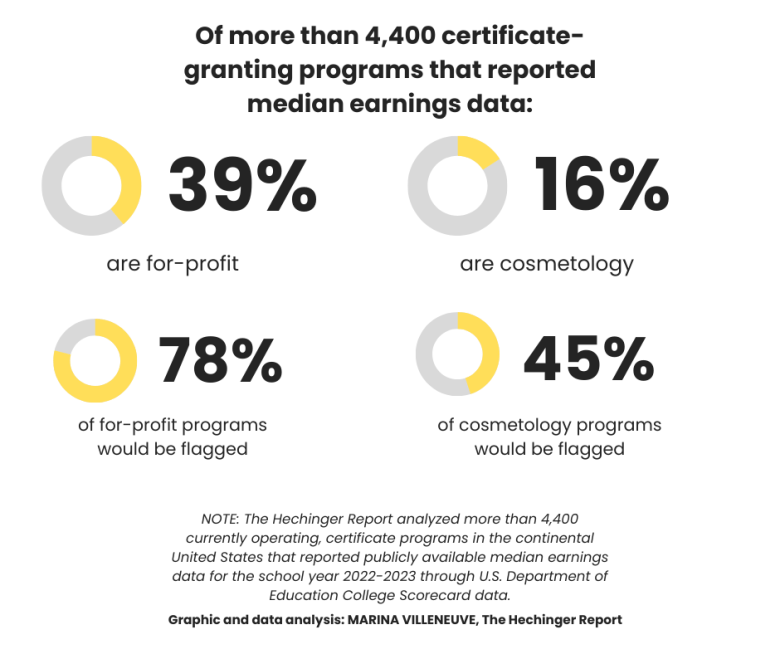
    Certificate schools succeeded in getting a carve-out. The industry breathed a collective sigh of relief, and with good reason. At least 1,280 certificate-granting programs, which enrolled more than 220,000 students, would have been at risk of losing federal student loan funding if they had been included in the bill, according to a Hechinger Report analysis of federal data. [See table.] About 80% of those are for-profit programs, and 45 percent are cosmetology schools.

    “There is this very strange donut hole in accountability where workforce programs are held accountable, two-year degree programs are held accountable, but everything in between gets off without any accountability,” said Preston Cooper, a senior fellow at the conservative think tank American Enterprise Institute.

    The schools spared are known as certificate programs and, with their promise of an affordable and relatively quick path to economic security, are the fastest growing part of higher education. They usually take about a year to complete and train people to be hair-stylists, welders, medical assistants and cooks, among other jobs.

    As with traditional colleges, there are big differences in quality among certificate programs. Some hair stylists can make a middle-class living if they work in a busy salon. But for people who have to pay back hefty student loans, the low wages for stylists in the early years can be an insurmountable obstacle.

    Ward found herself facing that dilemma. When she could no longer sustain the lack of sleep from her double shifts at Walmart, she pressed pause on her styling career and took a job with Amazon, loading and unloading planes. She wasn’t ready to give up her dream career, though, so in addition to her 10-hour days moving boxes, she took part-time gigs at local hair salons. She didn’t have family to help pay rent, not to mention loan payments, so she couldn’t afford to work fulltime at a salon, which is essential to build up a regular clientele — and bigger tips. Without that, she couldn’t get much beyond minimum wage. 

    A representative from the American Institute of Beauty denied that Ward was told she would easily repay her loan.

    “No admissions representative, not at AIB or elsewhere, would ever make such a statement,” Denise Herman, general counsel and assistant vice president of AIB, said in an email. 

    The high cost of many for-profit cosmetology schools — tuition can be upward of $20,000, usually for a one-year program  — can leave former students mired in debt. In May, the government released data showing 850 colleges where at least a third of borrowers haven’t made a loan payment for 90 days or more, putting them on track to default. About 42 percent of those were for-profit cosmetology and barbering schools (including AIB).

    Brittany Mcnew says she loves working as a stylist but that her income takes a hit when traffic is slow in her salon in Bethlehem, Pennsylvania. Credit: Meredith Kolodner/The Hechinger Report

    Herman blamed the Biden administration policy that after the pandemic let borrowers forgo payments without any penalty.

    “Debtors became ‘comfortable’ not making payments,” said Herman. “AIB provides the graduate with the information graduates need to make their payments. What that graduate decides to pay, or not pay, is not influenced by AIB.”

    Under the “big beautiful bill” passed in July, two- and four-year colleges must ensure that, after four years, graduates on average make at least as much as someone in their state who has only a high school diploma. The colleges must inform students if they fail that test, and if it happens for two out of three years, the college will be ineligible to receive federal loan funds.

    Some for-profit certificate schools lobbied hard for an exemption. The American Association of Career Schools, which represents proprietary cosmetology schools, spent $120,000 lobbying the Education Department and Congress, including on the “big beautiful bill,” in the first six months of this year. At the group’s major lobbying event in April, Sen. Bill Cassidy, chairman of the Senate Health, Education, Labor and Pensions Committee, was the keynote speaker.

    Cassidy declined to answer questions about why certificate programs were excluded, but a fact sheet from his committee noted that they are already covered by something else, the gainful employment rule, which is also being challenged by the for-profit cosmetology industry.

    That federal gainful employment regulation, updated in 2023, requires in essence that graduates from career-oriented schools earn enough to be able to pay back their loans and earn more than a high school graduate. It also requires that consumers, like Ward, be given more information about how graduates from all colleges fare in the workplace.

    The rule posed an existential threat to a huge swath of cosmetology schools.

    In 2023, the American Association of Career Schools sued to block the gainful employment rule. 

    “AACS supports fair and reasonable accountability measures,” Cecil Kidd, the AACS’s executive director, said in an email. “However, we strongly object to arbitrary or discriminatory policies such as the US Department of Education’s Gainful Employment rule, which unfairly targets career schools while exempting many public and private non-profit institutions that fail to meet comparable outcomes.”

    He pointed to public comments in which AACS has argued that the rule imposes an unfair burden on cosmetology schools since stylists are predominantly women, who are more likely to have “personal commitments” that affect their earnings, and who rely on tips that are often pocketed as unreported income.

    Cameron Vandenboom is a successful hair stylist but says the high cost of her private beauty school wasn’t worth thousands of dollars in student debt: “I absolutely should have gone to community college.” Credit: Courtesy Shanna Kaye Photo

    In a twist that surprised advocates on both sides, the Education Department in May asked the court to effectively dismiss AACS’ lawsuit. 

    If the court rules in favor of the cosmetology schools, certificate programs will be free of all accountability requirements on their graduates’ earning levels, because they got the carveout in July. 

    Even if the court rules against cosmetology schools, advocates are pessimistic that the Trump administration will implement the gainful rules. The first Trump administration got rid of the original rules back in 2019 and Nicholas Kent, now the U.S. undersecretary of education, was previously the chief policy officer for Career Education Colleges and Universities, or CECU, the trade group that represents for-profit colleges, including certificate programs. He is a well-known critic of the rule.

    “I would be very surprised, if the unlikely scenario plays out that the Biden rule is upheld, that this Department of Education would just say, OK, the court has spoken,” said Jason Altmire, CECU’s executive director. “We are not opposed to accountability for certificate programs, so long as it’s fair to everybody and we have a voice in how you’re measuring programs.”  

    Altmire said CECU didn’t lobby for certificate programs to be carved out of Congress’ bill, but did argue against the earnings formula that Congress landed on. Altmire said it doesn’t take into account part-time work and the gender gap in wages.

    One objection from AACS, raised by CECU as well, is that the earnings measured don’t include tips, which are crucial to hair stylists’ income. Analyzed without including tips, 576 of 724 cosmetology schools in the Hechinger Report analysis would fail Congress’ earnings test. But even if tips were included and raised stylists’ income by 20 percent, 526 cosmetology schools would still fail.

    Earlier this year, Remiah Ward made the difficult decision to leave Florida and move to Kentucky, where the cost of living was more forgiving. She’s working from 7 p.m. to 7 a.m. at an aluminum factory for $19.50 an hour. 

    One day, she might go back to styling after her debt is paid off. Like many former beauty school students, she wishes she’d had more information when she decided to enroll.

    “They really sugar-coated it. I was 18 years old, and I needed a trade that I was already pretty good at,” said Ward, who is now 26. “Everybody thinks they’re going to make a high return, and it’s just not the reality.”

    Marina Villeneuve contributed data analysis to this story. 

    This story about cosmetology schools produced by The Hechinger Report, a nonprofit, independent news organization focused on inequality and innovation in education. Sign up for the Hechinger higher-education newsletter.

    The Hechinger Report provides in-depth, fact-based, unbiased reporting on education that is free to all readers. But that doesn’t mean it’s free to produce. Our work keeps educators and the public informed about pressing issues at schools and on campuses throughout the country. We tell the whole story, even when the details are inconvenient. Help us keep doing that.

    Join us today.

    Source link

  • Colleges struggle to make manufacturing training hot again

    Colleges struggle to make manufacturing training hot again

    ELYRIA, Ohio — Nolan Norman had no idea what microelectronic manufacturing entailed when his adviser at Midview High suggested he take the school’s new class on it last year. 

    Yet once he started fusing metal to circuit boards, he says he was hooked. “When I was little, I thought that wizards made these things,” the 18-year-old joked of the electronics he’s now able to assemble. Despite long “hating” the idea of college, he was motivated to enroll in the microelectronic manufacturing bachelor’s degree program at nearby Lorain County Community College this fall. He’s spent the summer working in a job in the field that gives him both college credit and pays $18 an hour. Said Norman: “Now I’m seeing the path to get to be one of these wizards.” 

    Norman’s path wasn’t accidental: Two years ago, Lorain County Community College partnered with Midview High to create the course, one of several ways the college is trying to recruit and train more young people for jobs in manufacturing. 

    Nationally, more than 400,000 manufacturing jobs are going unfilled, many of them in advanced manufacturing, which requires the sort of high-tech skills and postsecondary credentials that Norman is working toward. President Donald Trump is leveraging tariffs in part, he has said, to grow manufacturing jobs in the United States, including those that involve machinery or robotics and training after high school.

    Nolan Norman, 18, an incoming freshman at Lorain County Community College, observes a circuit board under a microscope on Aug. 6 in Elyria, Ohio. Credit: Dustin Franz for The Hechinger Report

    Yet as it is, colleges have struggled to add and revise their training based on employer input and prepare students for tomorrow’s jobs, not just today’s. In the area surrounding Lorain County Community College, officials estimate that they’d have to teach four times the number of students to meet today’s unfilled manufacturing jobs.

    Gogebic Community College, in rural Michigan, suspended its 22-year-old manufacturing technology program this spring because of low enrollment. “We could not get people into it,” registrar Karen Ball said, speaking in her personal capacity and not on behalf of the institution. “The needs in manufacturing are evolving so quickly, that to stay on top of it is too difficult.”

    And then there is the history of manufacturing in communities like Norman’s, where so many factories moved to other countries in recent decades. The manufacturing workforce in the Great Lakes region shrunk by 35 percent between 2000 and 2010, a loss of 1.6 million jobs. But nationwide manufacturing has seen some recovery since then, rising from 11.5 million manufacturing jobs in 2010 to 12.9 million today, according to an analysis by the Economic Innovation Group. 

    “If your family experienced tumultuous layoffs in steel or automotives, they may see manufacturing as a risky pathway rather than a solid pathway,” said Marisa White, vice president for enrollment management and student services at Lorain County Community College. “Individuals are like, ‘I don’t want my kids to go into something like that.’”

    Related: Interested in more news about colleges and universities? Subscribe to our free biweekly higher education newsletter.

    White and other Lorain officials, though, have been slowly making strides in adding more students in recent years — and in trying to keep up with the needs of companies. 

    Printed circuit boards before components are attached in a lab at Lorain County Community College in Elyria, Ohio. Credit: Dustin Franz for The Hechinger Report

    In addition to partnering with Midview High, staff from the college set up tables at food banks and Boys and Girls Clubs where they answer questions about its manufacturing degree and certificate programs, and even partner with a nearby manufacturing nonprofit that uses holograms and a robot dog to get the attention of high school students. That is paying off, officials say. The college now produces 120 graduates each year in advanced manufacturing — a category that includes industrial engineering tech, mechanical engineering tech, welding, automation and microelectronics — compared to 43, a decade ago.

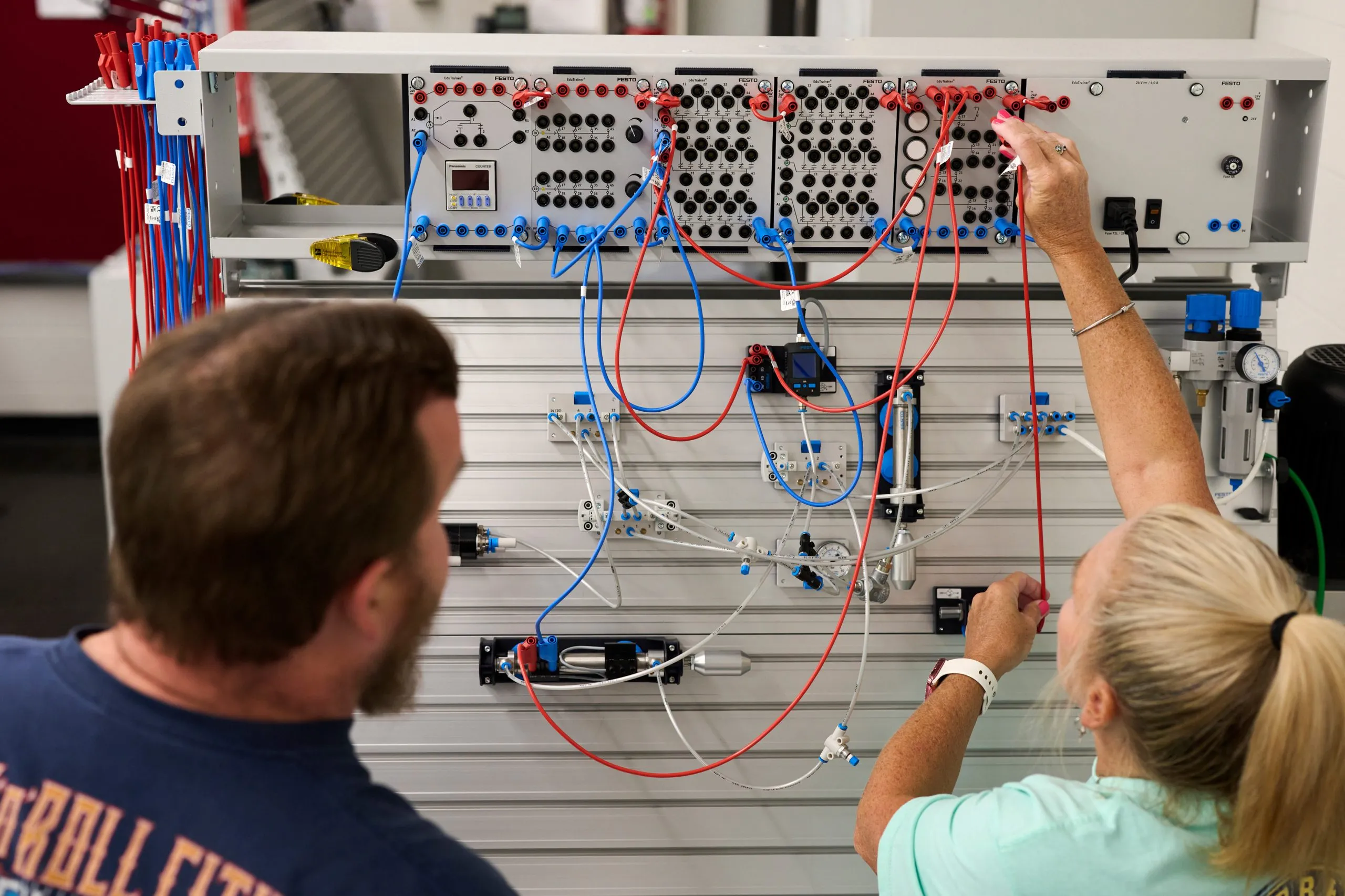
    It has also cultivated a large network of local employers and a system to do market research before launching certificate programs. In some cases, it partners with companies that pay for employees to get training at Lorain college. In a classroom on a recent Wednesday, one of those electrician apprentices, Tyler Tector, 25, had rigged a series of plastic tubes to a small air pump. He hoped it would generate enough suction to keep its grip on his lab partner’s smartphone, which dangled precariously in the air (and already had a cracked screen from some previous misadventure).

    The assignment was part of a class in practical applications of fluid power. Tector’s employer, Ford Motor Co., was sending him and a small group of other apprentice electricians to take this class once a week, so they could better work with the growing number of robots at the local engine plant.

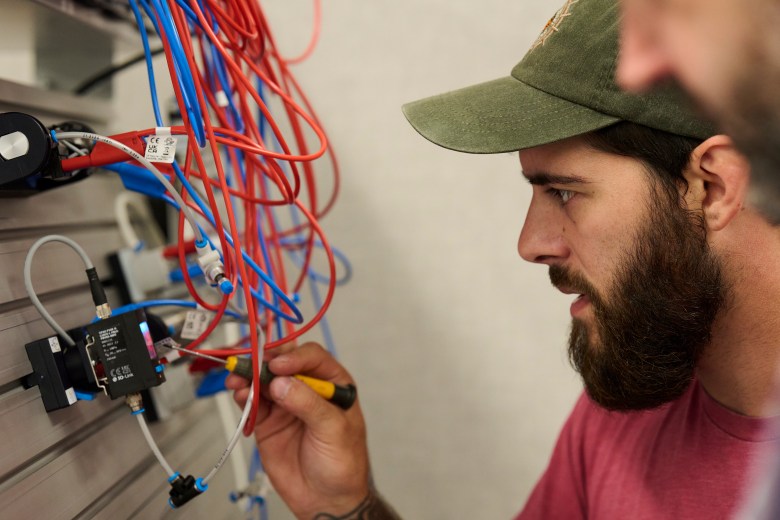
    Nick Wade, an electrical apprentice for Ford Motor Co., works on a circuitry exercise during professor Brian Iselin’s practical applications of fluid power course at Lorain County Community College in Elyria, Ohio. Credit: Dustin Franz for The Hechinger Report

    “Robots are the best co-workers,” joked Tector, who added that he’s not worried about bots putting him out of a job because so many humans are needed to fix them. “They do exactly what you tell them to do. They don’t ask questions. They don’t yell and complain.” They are finicky though, he added. If anything in a robot’s area gets bumped out of place even a fraction of an inch, that could throw the machine off and require reprogramming.

    So many employers told college officials they need technicians with basic knowledge across a range of trades that the college is starting a new associate degree program in the fall called Multicraft Industrial Maintenance that will include lessons like the one Tector is doing but in a condensed format. 

    “Because of the high-tech nature of things, employers don’t want students siloed into trades anymore,” said Brian Iselin, an assistant professor in manufacturing who is leading the effort. 

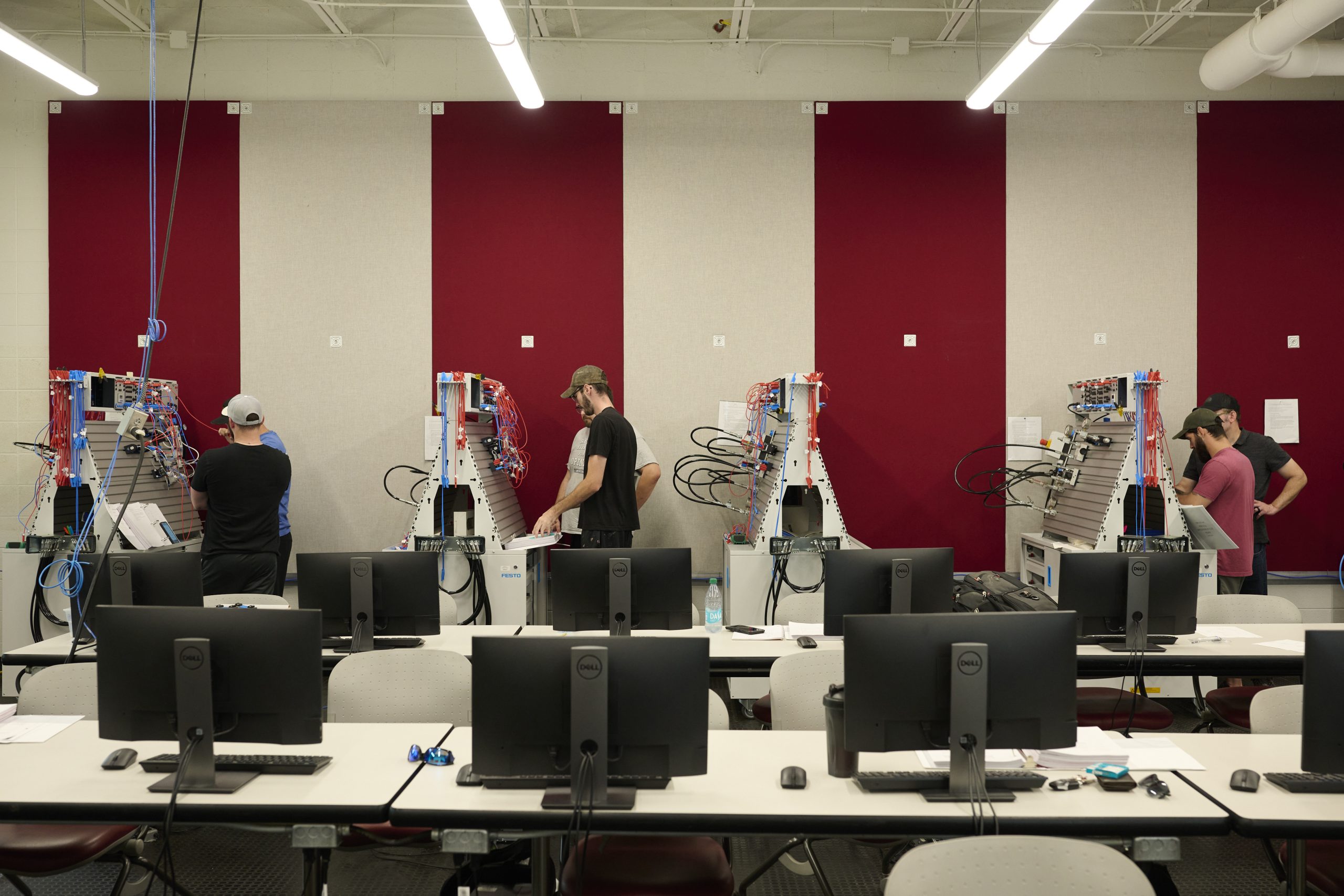
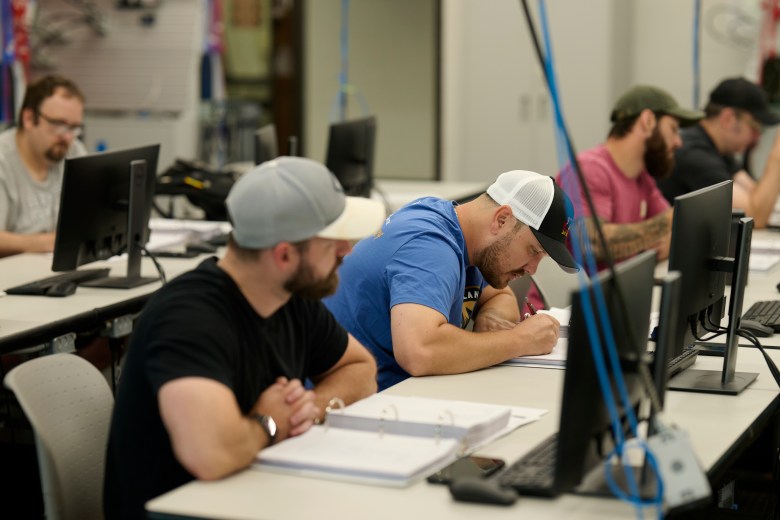
    Johnny Vanderford, who leads the college’s microelectronic manufacturing degree program, often spends part of his lunch break scouring LinkedIn for the latest job postings by local employers to see what skills they are looking for. His program’s model involves finding every student a paid internship, and students can take classes two days a week or in the evening to have the rest of the time free for paid work in the field. 

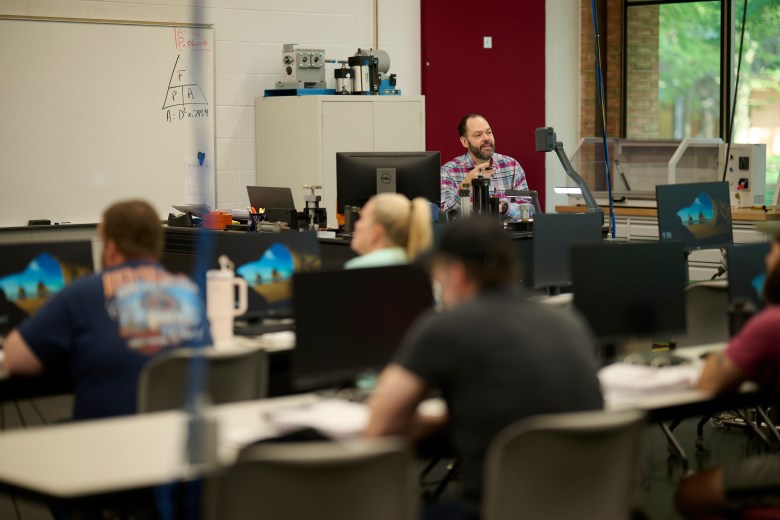
    Professor Brian Iselin teaches a course to employees of Ford’s Cleveland Engine Plant No. 1 at Lorain County Community College in Elyria, Ohio. Credit: Dustin Franz for The Hechinger Report

    Vanderford pointed to a PowerPoint slide showing more than 90 manufacturing companies in the area he said the college has worked with: “We basically tailor our curriculum to meet their workforce needs.” In some cases that means wedging into a class syllabus training on some specialized machine that might be used at only a handful of employers.

    Rather than simply having advisory committees with a few large companies that meet occasionally, today Lorain and many other colleges follow a model that involves frequent discussions with company leaders, instructors directly participating in those meetings and a greater focus on the skills employers need. 

    “Those relationships take time,” said Shalin Jyotishi, managing director of the Future of Work and Innovation Economy Initiative at the think tank New America. He says that it is hard for other community colleges to replicate best practices from Lorain because they are labor-intensive to enact.

    Employers also have a tendency to change their plans. For instance, when Tesla pledged to build an electrical vehicle plant in Flint, Michigan, the local Mott Community College started an EV program, said Jyotishi. But the plant never came. “The college still has a Tesla sign,” he said.

    Related: After its college closes, a rural community fights to keep a path to education open 

    The numbers no longer add up at Gogebic Community College, in Michigan’s Upper Peninsula. 

    When the college suspended its program in manufacturing technology in May, it had just three students.

    As with many programs at the college, a single employee was charged with administering and teaching. Doing all that plus staying on top of nearby companies’ workforce needs was “unsustainable,” said Ball, the registrar.

    The few small manufacturers in the area all say they have different needs, rather than one clear set of skills, she said, noting that “you can’t be a generalist in manufacturing.” Even when the college does identify a needed skill to teach, it takes at least six months to a year to get the program approved by college leaders and the accreditor. By then, companies might need something different. 

    And the pay offered by small manufacturers is often low, despite an expectation of training beyond a high school diploma, said Ball.

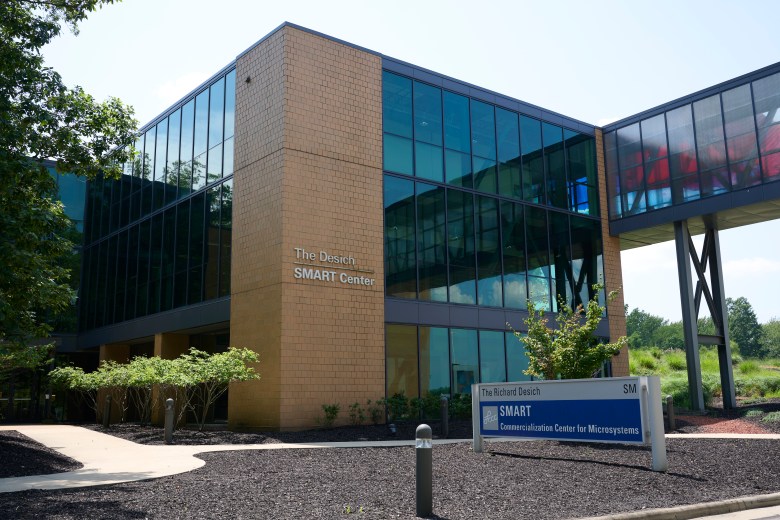
    The Richard Desich SMART Center at Lorain County Community College in Elyria, Ohio, houses the microelectronic manufacturing systems program, which teaches students about the manufacture of semiconductors. Credit: Dustin Franz for The Hechinger Report

    Nationwide, automation has reduced the earning power for many manufacturing jobs, said Jyotishi of New America. “For a long time manufacturing was the bedrock of the middle class,” said Jyotishi. “That wage premium for manufacturing has actually gone away.” 

    And there’s a danger that as colleges aim to please employers, they will create programs that are too narrow, argues Davis Jenkins, senior research scholar at Columbia University’s Community College Research Center. (Editor’s note: The Hechinger Report, which produced this story, is an independent unit of Columbia’s Teachers College.) “You don’t want specific skills training — you don’t want to just train students to work in a fab,” he said, referring to a facility where microchips and other electronics are produced. “Whenever schools buy a lot of specific equipment for training, I worry a lot. What students really need are broader skills.”

    Even Lorain doesn’t always find the right fit. During the pandemic, the college started what it calls fast-track programs, which typically run 16 weeks, across a range of professional fields (not just manufacturing). But because of mixed success attracting students, officials recently slimmed the list from 60 to 13, said Tracy Green, vice president of strategic and institutional development at Lorain County Community College. And the college recently started winding down a program in industrial safety because of a lack of student interest, even though there are still a large number of job postings by local companies for jobs with those skills, said Iselin. 

    One provision in Trump’s new “one big, beautiful bill” promises a boost to manufacturing education, however. For the first time, the law will allow low-income students to use federal Pell Grants for short-term certificate programs, in what is known as Workforce Pell. It’s a change many community college leaders have been calling for for years as they have created more short-term programs in response to demand by students and employers who want to quickly gain new skills in fast-changing areas, including manufacturing. But that program won’t be up and running until the 2026-27 academic year. 

    Related: Colleges partnered with an EV battery factory to train students and ignite the economy. Trump’s clean energy war complicates their plans

    The promise of a big new employer moving to town can galvanize student interest in manufacturing. 

    In Ohio, the talk for years has been a $28 billion Intel chip manufacturing plant under construction in Columbus. The facility is expected to bring some 3,000 jobs to the area, and the company has committed $50 million to workforce education in the state, including $2 million to Lorain County Community College, which it used to buy new classroom equipment, support student scholarships, and pay for program development and instructor training.

    Chris Dukles, 36, an electrician apprentice for Ford Motor Co., takes notes during a course taught by Brian Iselin at Lorain County Community College. Credit: Dustin Franz for The Hechinger Report

    The top graduates in Lorain County Community College’s microelectronic manufacturing program each year typically get internships at Intel’s closest existing plant, which is in Chandler, Arizona, a suburb of Phoenix. It’s a motivator to work hard in their classes, some students say.

    Lia Douglas, a student in the microelectronic manufacturing program at Lorain, scored one of those slots and headed to Arizona last summer. The experience, though, was sobering. 

    “My plan really was to make a good impression with my internship, get a job maybe in Arizona even if it was for a year or two, and then try to move back to Ohio when they have an Ohio plant,” she said. 

    But one day last July, all the employees were unexpectedly summoned to an all-hands call where the company announced a wave of layoffs and reductions in some benefits that had interested Douglas, including a sabbatical program. This year, Intel announced that the opening of the Ohio plant has been delayed until 2030. 

    “I learned I had a little too much faith in a company and the promises of a company,” she said. “And it reminded me that at the end of the day, the company has to make money.”

    She’s still glad she chose Lorain’s program, which has landed her several local internships and opened her eyes to the many small and mid-sized manufacturers in the area. 

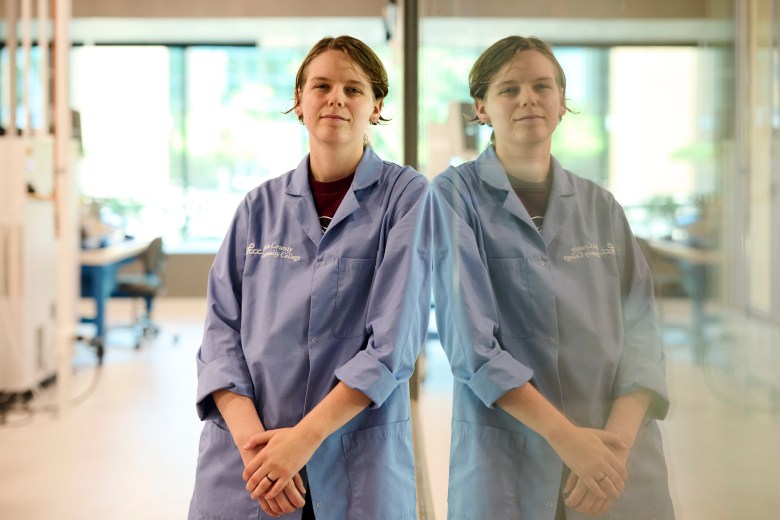
    Lia Douglas is a student in the microelectronic manufacturing program at Lorain County Community College. Credit: Dustin Franz for The Hechinger Report

    And she has been hooked on a career in making things ever since she was in middle school and a family friend taught her a bit of welding. Her hero was Adam Savage, co-host of the TV show “MythBusters,” who she even got to meet at a comic book convention in Cleveland.

    Douglas complains that students are told in high school that they either have to choose a trade for hands-on work or an academic track to prepare for a career behind a desk that might involve design and project management. She says that as manufacturing changes, there’s plenty of room to do both. In fact, she says, when a group of doctoral students from Kent State University recently visited the college’s clean room, she was amused to see them struggle with some of the tools the students routinely use in the microelectronic manufacturing program.

    “It takes as much brainpower to figure out what is the right tool for the right process as getting a Ph.D.,” she said. 

    Contact editor Caroline Preston at 212-870-8965, via Signal at CarolineP.83 or on email at [email protected]

    This story about manufacturing jobs was produced by The Hechinger Report, a nonprofit, independent news organization focused on inequality and innovation in education. Sign up for the Hechinger newsletter.

    The Hechinger Report provides in-depth, fact-based, unbiased reporting on education that is free to all readers. But that doesn’t mean it’s free to produce. Our work keeps educators and the public informed about pressing issues at schools and on campuses throughout the country. We tell the whole story, even when the details are inconvenient. Help us keep doing that.

    Join us today.

    Source link

  • ¿Qué ha pasado desde que Texas eliminó las matrículas estatales para los estudiantes indocumentados?

    ¿Qué ha pasado desde que Texas eliminó las matrículas estatales para los estudiantes indocumentados?

    SAN ANTONIO — Ximena tenía un plan. 

    La joven de 18 años de Houston iba a comenzar clases este otoño en la Universidad de Texas en Tyler, donde le habían concedido una beca de 10.000 dólares al año. Esperaba que eso le permitiera alcanzar su sueño: un doctorado en Química, seguido de una carrera como profesora o investigadora.

    “Y entonces se produjo el cambio en la matrícula estatal, y fue entonces cuando supe con certeza que tenía que dar un giro”, dijo Ximena. (The Hechinger Report se refiere a ella solo por su nombre de pila porque ella teme represalias por su situación migratoria).

    Aunque Ximena pasó sus primeros años en el norte de México, la mayoría de sus recuerdos son de después de mudarse a Estados Unidos con su padre. Ha asistido a escuelas en Estados Unidos desde el jardín de infancia y, para ella, el 12.º grado consistió principalmente en explicar conceptos avanzados de química a sus compañeros de clase y dirigir laboratorios como asistente de enseñanza.

    Pero en junio, los sueños de Ximena se vieron truncados cuando la oficina del fiscal general de Texas y la administración Trump colaboraron para poner fin a las disposiciones de una ley estatal que ofrecía a miles de estudiantes indocumentados como ella tasas de matrícula más bajas en las universidades públicas de Texas. Los funcionarios estatales y federales argumentaron con éxito ante los tribunales que la política vigente desde hacía mucho tiempo discriminaba a los ciudadanos estadounidenses de otros estados que pagaban una tasa más alta. Ese razonamiento se ha replicado ahora en demandas similares contra Kentucky, Oklahoma y Minnesota, como parte de una ofensiva más amplia contra el acceso de los inmigrantes a la educación pública.

    En la UT Tyler, la matrícula y las tasas estatales para el próximo año académico ascienden a un total de 9.736 dólares, frente a los más de 25.000 dólares que pagan los estudiantes de fuera del estado. Ximena y su familia no podían permitirse el elevado coste de la matrícula, por lo que la joven se retiró. En su lugar, se matriculó en el Houston Community College, donde los costos para los estudiantes de fuera del estado son de 227 dólares por hora semestral, casi tres veces más que la tarifa para los residentes en el distrito. La escuela solo ofrece clases básicas de química de nivel universitario, por lo que, para prepararse para un doctorado o para trabajar en investigaciones especializadas, Ximena seguirá necesitando encontrar la manera de pagar una universidad de cuatro años en el futuro.

    Su difícil situación es precisamente lo que los legisladores estatales de ambos partidos políticos esperaban evitar cuando aprobaron la Texas Dream Act o Ley de Sueños de Texas, una ley de 2001 que no solo abrió las puertas de la educación superior a los estudiantes indocumentados, sino que también tenía por objeto reforzar la economía y la mano de obra de Texas a largo plazo. Con esa ley, Texas se convirtió en el primero de más de dos docenas de estados en aplicar la matrícula estatal a los estudiantes indocumentados, y durante casi 24 años, esta política histórica se mantuvo intacta. Los legisladores conservadores propusieron repetidamente su derogación, pero a pesar de los años de control de un solo partido en la legislatura estatal, no hubo suficientes republicanos que apoyaran la derogación, incluso esta primavera, días antes de que la oficina del fiscal general de Texas y el Departamento de Justicia federal decidieran ponerle fin.

    Ahora, a medida que se acerca el semestre de otoño, los estudiantes inmigrantes están sopesando si darse de baja de sus cursos o esperar a que se aclare cómo les afecta el acuerdo de consentimiento firmado por el estado y el Departamento de Justicia. Los defensores de los inmigrantes temen que las universidades de Texas estén excluyendo a posibles alumnos que se encuentran en situación legal y siguen reuniendo los requisitos para pagar la matrícula estatal a pesar de la sentencia judicial, incluidos los beneficiarios del programa de Acción Diferida para los Llegados en la Infancia (DACA), los solicitantes de asilo y los que tienen Estatus de Protección Temporal o TPS, porque el personal de la universidad carece de conocimientos sobre inmigración y no ha recibido directrices claras sobre quién debe pagar exactamente la matrícula más alta.

    En el Austin Community College, que presta servicio a un área tan grande como el estado de Connecticut, los miembros del consejo de administración no están seguros de cómo aplicar correctamente la sentencia judicial. Mientras esperan respuestas, hasta ahora han decidido no enviar cartas a sus estudiantes solicitándoles información confidencial para determinar las tasas de matrícula.

    Una valla publicitaria que promociona el Austin Community College en español se encuentra en una autopista que conduce a Lockhart, Texas. Credit: Sergio Flores for The Hechinger Report

    “Esta confusión perjudicará inevitablemente a los estudiantes, porque lo que vemos es que, ante la falta de información y la presencia del miedo y la ansiedad, los estudiantes optarán por no continuar con la educación superior o se esconderán en las sombras y se sentirán como miembros marginados de la comunidad”, afirmó Manuel González, vicepresidente del consejo de administración del ACC.

    Por su parte, los expertos en políticas públicas advierten de que la mano de obra de Texas podría verse afectada, ya que los jóvenes con talento, muchos de los cuales han cursado toda su educación en el sistema de escuelas públicas del estado, ya no podrán permitirse los títulos de asociado y licenciatura que les permitirían seguir carreras que ayudarían a impulsar sus economías locales. En virtud de la Ley Texas Dream, los beneficiarios estaban obligados a comprometerse a solicitar la residencia permanente legal lo antes posible, lo que les daba la oportunidad de mantener puestos de trabajo relacionados con sus títulos. Sin la condición de residentes, es probable que sigan trabajando, pero en empleos peor remunerados y menos visibles.

    Relacionado: ¿Te interesa recibir más noticias sobre universidades? Suscríbete a nuestro boletín quincenal gratuito de educación superior.

    “Es una visión muy cortoplacista en lo que respecta al bienestar del estado de Texas”, afirmó Barbara Hines, antigua profesora de Derecho que ayudó a los legisladores a redactar la Ley Texas Dream.

    A principios de siglo, casi dos décadas después de que los niños indocumentados obtuvieran el derecho a asistir a la escuela pública en Estados Unidos, los estudiantes inmigrantes y sus defensores seguían frustrados porque la universidad seguía estando fuera de su alcance.

    Para el mayor general retirado de la Guardia Nacional del Ejército Rick Noriega, un demócrata que en ese momento formaba parte de la Legislatura de Texas, esa realidad le tocó de cerca cuando se enteró de que un joven trabajador de su distrito quería matricularse en el community college local para estudiar mecánica aeronáutica, pero no podía permitirse pagar la matrícula fuera del estado.

    Noriega llamó a la oficina del rector de la escuela, que pudo proporcionar fondos para que el estudiante se inscribiera. Pero esa experiencia le llevó a preguntarse: ¿cuántos niños más de su distrito se enfrentaban a las mismas barreras para acceder a la educación superior?

    Así que colaboró con un sociólogo para encuestar a los estudiantes de las escuelas secundarias locales sobre el problema, que resultó ser muy frecuente. Y el distrito de Noriega no era una excepción. En un estado que durante mucho tiempo ha tenido una de las mayores poblaciones de inmigrantes no autorizados del país, los políticos de todos los partidos conocían a electores, amigos o familiares afectados y querían ayudar. Una vez que Noriega decidió proponer la legislación, un republicano, Fred Hill, pidió ser coautor del proyecto de ley.

    Para los defensores de la Ley Texas Dream, el mejor argumento a favor de la matrícula estatal para los estudiantes indocumentados era de carácter económico. Después de que el estado ya hubiera invertido en estos estudiantes durante la educación pública K-12, tenía sentido seguir desarrollándolos para que, con el tiempo, pudieran ayudar a satisfacer las necesidades de mano de obra de Texas.

    “Habíamos gastado todo ese dinero en estos jóvenes, y ellos habían hecho todo lo que les pedimos —en muchos casos, eran superestrellas, los mejores de su promoción y cosas por el estilo— y luego se topaban con este obstáculo, que era la educación superior, cuyo costo era prohibitivo”, dijo Noriega.

    La legislación fue aprobada fácilmente por la Cámara de Representantes de Texas, que en ese momento estaba controlada por los demócratas, pero el Senado, liderado por los republicanos, se mostró menos complaciente.

    “Ni siquiera pude conseguir una audiencia. Me dijeron rotundamente: “No, esto no va a salir adelante””, afirmó Leticia Van de Putte, la entonces senadora estatal que patrocinó la legislación en su cámara.

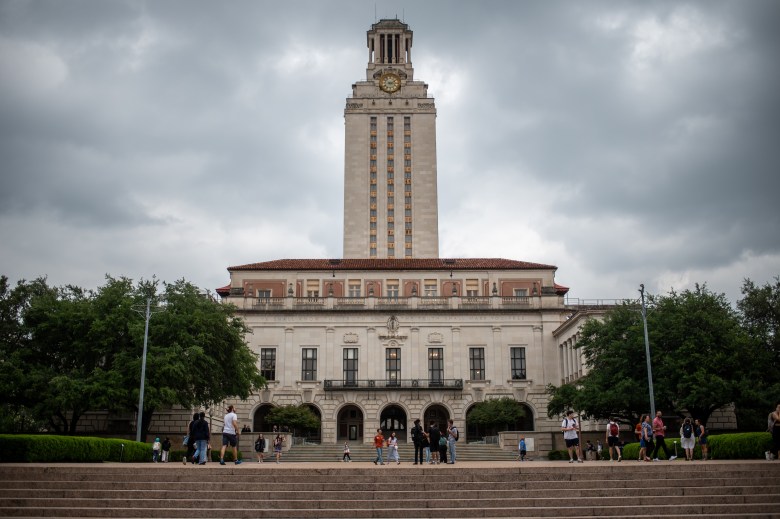
    Las nubes cubren el cielo detrás de la torre de la Universidad de Texas en Austin. Credit: Sergio Flores for The Washington Post via Getty Images

    Para persuadir a sus colegas republicanos, añadió varias restricciones, entre ellas la de exigir a los estudiantes indocumentados que vivieran en Texas durante tres años antes de terminar la escuela secundaria o recibir un GED. (Se estimó que tres años era el tiempo medio que tardaría una familia en pagar suficientes impuestos estatales para compensar la diferencia entre la matrícula estatal y la matrícula fuera del estado). También incluyó la cláusula que obligaba a los estudiantes indocumentados que accedían a la matrícula estatal a firmar una declaración jurada en la que se comprometían a solicitar la tarjeta de residencia tan pronto como pudieran.

    Van de Putte también recurrió a los grupos empresariales de Texas para insistir en los argumentos económicos a favor del proyecto de ley. Y convenció a la comunidad empresarial para que pagara los autobuses que llevarían a pastores evangélicos conservadores latinos de Dallas, San Antonio, Houston y otras zonas del estado a Austin, para que pudieran llamar a las puertas en apoyo de la legislación y rezar con los senadores republicanos y su personal.

    Después de eso, la Ley Texas Dream fue aprobada por abrumadora mayoría en el Senado estatal en mayo de 2001, y el entonces gobernador Rick Perry, republicano, la promulgó como ley al mes siguiente.

    Relacionado: El College Board cancela programa de premios para estudiantes negros y latinos de alto rendimiento 

    Sin embargo, en 2007, incluso cuando los defensores de los derechos de los inmigrantes, los grupos religiosos y las asociaciones empresariales formaron una coalición para defender a los inmigrantes contra las políticas estatales perjudiciales, la legislatura de Texas comenzó a presentar una serie de propuestas generalmente contrarias a los inmigrantes. En 2010, las encuestas sugerían que los tejanos se oponían de manera abrumadora a que los estudiantes indocumentados pagaran las tasas de matrícula estatales.

    En 2012, un nuevo grupo de políticos de derecha fue elegido para ocupar cargos públicos, muchos de ellos opuestos filosóficamente a la ley y muy críticos al respecto. La defensa de la política por parte de Perry se volvió en su contra durante las primarias presidenciales republicanas de 2012, cuando su campaña fue objeto de críticas después de que, durante un debate, dijera a los oponentes de la igualdad en las matrículas: “No creo que tengan corazón”.

    Aún así, ninguno de los muchos proyectos de ley presentados a lo largo de los años para derogar la Ley Texas Dream tuvo éxito. E incluso el gobernador Greg Abbott, un republicano partidario de la línea dura en materia de inmigración, se mostró en ocasiones ambiguo sobre la política, y su portavoz afirmó en 2013 que Abbott creía que “el objetivo” de la matrícula estatal independientemente del estatus migratorio era “noble”.

    Los observadores legislativos afirman que algunos republicanos del estado siguen apoyando la política. “Es una cuestión bipartidista. Hay republicanos que apoyan la matrícula estatal”, afirmó Luis Figueroa, director de asuntos legislativos de la organización sin fines de lucro Every Texan, dedicada a la investigación y la defensa de políticas públicas. “Pero no pueden decirlo públicamente”.

    Mientras tanto, a medida que el tema se volvía más controvertido políticamente en Texas, la Texas Dream Act acabó amplificando un debate más amplio que finalmente condujo a la creación del DACA, el programa de la era Obama que ha dado a algunos inmigrantes indocumentados acceso a protecciones contra la deportación y permisos de trabajo.

    Relacionado: Las amenazas de deportación de Trump pesan sobre los grupos que ofrecen ayuda con la FAFSA 

    Incluso antes del DACA, muchos inmigrantes trabajaban, y los que siguen sin papeles a menudo siguen haciéndolo, ya sea como contratistas independientes para empleadores que hacen la vista gorda ante su estatus migratorio o creando sus propios negocios. Un estudio de mayo de 2020 reveló que los residentes no autorizados constituyen el 8,2 % de la población activa del estado y que, por cada dólar gastado en servicios públicos para ellos, el estado de Texas recuperaba 1,21 dólares en ingresos.

    Pero sin el permiso legal inmediato para trabajar, los graduados universitarios indocumentados que se habían beneficiado de la Ley Dream de Texas se vieron limitados a pesar de sus títulos. A medida que la lucha por la equidad en las matrículas se extendía a otros estados, también lo hacía la lucha por una solución legal que apoyara a los estudiantes beneficiados.

    Cuando estos jóvenes, cariñosamente apodados “soñadores o dreamers”, pasaron a primer plano para defenderse más públicamente, su difícil situación despertó simpatía. En 2017, el mismo año en que Trump comenzó su primer mandato, las encuestas dieron un giro y mostraron que la mayoría de los tejanos apoyaba las matrículas estatales para los estudiantes indocumentados. Más recientemente, las investigaciones han indicado una y otra vez que los estadounidenses apoyan una vía para que los residentes indocumentados traídos a Estados Unidos cuando eran niños obtengan la residencia legal.

    Pero los argumentos en contra de la matrícula estatal, independientemente del estatus migratorio, también ganaron popularidad: los críticos sostenían que la política es injusta para los ciudadanos estadounidenses de otros estados que tienen que pagar tasas más altas, o que los estudiantes indocumentados están ocupando plazas en escuelas competitivas que podrían ser ocupadas por estadounidenses.

    El Departamento de Justicia se apoyó en una retórica similar en la demanda que acabó con la igualdad en las matrículas en Texas, alegando que la ley estatal queda invalidada por la legislación federal de 1996 que prohíbe a los inmigrantes indocumentados acceder a la matrícula estatal basada en la residencia. Ese argumento se ha convertido en un modelo, ya que la administración Trump ha presentado demandas para desmantelar las políticas de matrícula estatal de otros estados para los residentes indocumentados.

    En Kentucky, el fiscal general del estado, el republicano Russell Coleman, ha seguido los pasos de Texas y ha recomendado que el consejo estatal que supervisa la educación superior retire su normativa que permite el acceso a la matrícula estatal en lugar de luchar por defenderla en los tribunales.

    Al mismo tiempo, la administración Trump ha encontrado otras formas de recortar las oportunidades de educación superior para los estudiantes indocumentados, revocando una política que les había ayudado a participar en programas de formación profesional, técnica y para adultos, e investigando a las universidades por ofrecerles becas.

    Relacionado: Universidades recurren estudiantes hispanos para compensar disminución en la matrícula

    En Texas, el repentino cambio de política con respecto a las matrículas estatales está causando caos. Las dos universidades más grandes del estado, Texas A&M y la Universidad de Texas, están utilizando diferentes directrices para decidir qué estudiantes deben pagar las tasas fuera del estado.

    “Creo que las universidades son las que se encuentran en esta situación realmente difícil”, dijo Figueroa. “No son expertos en inmigración. Han recibido muy poca orientación sobre cómo interpretar el decreto de consentimiento”.

    En medio de tanta confusión, Figueroa predijo que es probable que surjan futuras demandas. Los estudiantes y organizaciones afectados ya han presentado mociones ante los tribunales para defender tardíamente la Ley Texas Dream contra el Departamento de Justicia.

    Mientras tanto, los jóvenes estudiantes se enfrentan a decisiones difíciles. Una estudiante, que pidió permanecer en el anonimato debido a su condición de inmigrante indocumentada, estaba leyendo las noticias en su teléfono antes de acostarse cuando vio un titular sobre el resultado del caso judicial del Departamento de Justicia.

    “Me eché a llorar porque, como alguien que ha luchado por salir adelante en sus estudios, ahora que estoy en la educación superior, ha sido una bendición”, dijo. “Así que lo primero que pensé fue: “¿Qué voy a hacer ahora? ¿Hacia dónde va mi futuro? ¿Los planes que tenía para mí tendrán que detenerse por completo?””.

    La joven, que vive en San Antonio desde que tenía 9 meses, se había matriculado en seis cursos para el otoño en la Universidad Texas A&M-San Antonio y no estaba segura de si abandonarlos. Sería su último semestre antes de obtener sus títulos en psicología y sociología, pero no podía imaginar pagar la matrícula fuera del estado.

    “Estoy en el limbo”, dijo, como “muchos estudiantes en este momento”.

    Comunícate con la editora Caroline Preston al 212-870-8965 o [email protected]

    Esta historia sobre los estudiantes indocumentados fue producida por The Hechinger Report, una organización de noticias independiente y sin fines de lucro que se centra en la desigualdad y la innovación en la educación. Suscríbase al boletín informativo del Hechinger.

    The Hechinger Report provides in-depth, fact-based, unbiased reporting on education that is free to all readers. But that doesn’t mean it’s free to produce. Our work keeps educators and the public informed about pressing issues at schools and on campuses throughout the country. We tell the whole story, even when the details are inconvenient. Help us keep doing that.

    Join us today.

    Source link

  • What’s happened since Texas killed in-state tuition for undocumented students

    What’s happened since Texas killed in-state tuition for undocumented students

    SAN ANTONIO — Ximena had a plan. 

    The 18-year-old from Houston was going to start college in the fall at the University of Texas at Tyler, where she had been awarded $10,000 a year in scholarships. That, she hoped, would set her up for her dream: a Ph.D. in chemistry, followed by a career as a professor or researcher.

    “And then the change to in-state tuition happened, and that’s when I knew for sure that I had to pivot,” said Ximena, who was born in Mexico but attended schools stateside since kindergarten. (The Hechinger Report is referring to her by only her first name because she fears retaliation for her immigration status.) 

    In June, the Texas attorney general’s office and the Trump administration worked together to end the provisions in a state law that had offered thousands of undocumented students like her lower in-state tuition rates at Texas public colleges. State and federal officials successfully argued in court that the long-standing policy discriminated against U.S. citizens from other states who paid a higher rate. That rationale has now been replicated in similar lawsuits against Kentucky, Oklahoma and Minnesota — part of a broader offensive against immigrants’ access to public education. 

    At UT Tyler, in-state tuition and fees for the upcoming academic year total $9,736, compared to more than $25,000 for out-of-state students. Ximena and her family couldn’t afford the higher tuition bill, so she withdrew. Instead, she enrolled at Houston Community College, where out-of-state costs are $227 per semester hour, nearly three times the in-district rate. The school offers only basic college-level chemistry classes, so to set herself up for a doctorate or original research, Ximena will still need to find a way to pay for a four-year university down the line. 

    Her predicament is exactly what state lawmakers from both political parties had hoped to avoid when they passed the Texas Dream Act, 2001 legislation that not only opened doors to higher education for undocumented students but was also meant to bolster Texas’s economy and its workforce long-term. With that law, Texas became the first of more than two dozen states to implement in-state tuition for undocumented students, and for nearly 24 years, the landmark policy remained intact. Conservative lawmakers repeatedly proposed to repeal it, but despite years of single-party control in the state legislature, not enough Republicans embraced repeal even as recently as this spring, days before the Texas attorney general’s office and the federal Department of Justice moved to end it. 

    Now, as the fall semester approaches, immigrant students are weighing whether to disenroll from their courses or await clarity on how the consent agreement entered into by the state and DOJ affects them.

    Immigration advocates are worried that Texas colleges and universities are boxing out potential attendees who are lawfully present and still qualify for in-state tuition despite the court ruling — including recipients of the Deferred Action for Childhood Arrivals program, asylum applicants and Temporary Protected Status holders — because university personnel lack immigration expertise and haven’t been given clear guidelines on exactly who needs to pay the higher tuition rate

    At Austin Community College, which serves an area as large as Connecticut, members of the board of trustees are unsure how to accurately implement the ruling. As they await answers, they’ve so far decided against sending letters asking their students for sensitive information in order to determine tuition rates. 

    “This confusion will inevitably harm students because what we find is that in the absence of information and in the presence of fear and anxiety, students will opt to not continue higher education,” said Manuel Gonzalez, vice chair of the ACC board of trustees.

    A billboard promoting Austin Community College in Spanish sits on a highway that leads to Lockhart, Texas. Credit: Sergio Flores for The Hechinger Report

    Policy experts, meanwhile, warn that Texas’s workforce could suffer as talented young people, many of whom have spent their entire education in the state’s public school system, will no longer be able to afford the associate’s and bachelor’s degrees that would allow them to pursue careers that would help propel their local economies. Under the Texas Dream Act, beneficiaries were required to commit to applying for lawful permanent residence as soon as possible, giving them the opportunity to hold down jobs related to their degrees. Without resident status, it’s likely they’ll still work — just more in lower-paying, under-the-radar jobs.  

    “It’s so short-sighted in terms of the welfare of the state of Texas,” said Barbara Hines, a former law school professor who helped legislators craft the Texas Dream Act. 

    Related: Become a lifelong learner. Subscribe to our free weekly newsletter featuring the most important stories in education. 

    By the turn of the century, almost two decades after undocumented children won the right to attend public school in the U.S., immigrant students and their champions remained frustrated that college remained out of reach. 

    For retired Army National Guard Maj. Gen. Rick Noriega, a Democrat who served in the Texas Legislature at the time, that reality hit close to home when he learned of a young yard worker in his district who wanted to enroll at the local community college for aviation mechanics but couldn’t afford out-of-state tuition. 

    Noriega called the school chancellor’s office, which was able to provide funding for the student to attend. But that experience led him to wonder: How many more kids in his district were running up against the same barriers to higher education? 

    So he worked with a sociologist to poll students at local high schools about the problem, which turned out to be widespread. And Noriega’s district wasn’t an outlier. In a state that has long had one of the nation’s largest unauthorized immigrant populations, politicians across the partisan divide knew affected constituents, friends or family members and wanted to help. Once Noriega decided to propose legislation, a Republican, Fred Hill, asked to serve as a joint author on the bill. 

    To proponents of the Texas Dream Act, the best argument in support of in-state tuition for undocumented students was an economic one. After the state had already invested in these students during K-12 public schooling, it made sense to continue developing them so they could eventually help meet Texas’ workforce needs. 

    “We’d spent all this money on these kids, and they’d done everything that we asked them to do — in many instances superstars and valedictorians and the like — and then they hit this wall, which was higher education that was cost prohibitive,” said Noriega. 

    The legislation easily passed the Texas House of Representatives, which was Democratic-controlled at the time, but the Republican-led Senate was less accommodating. 

    “I couldn’t even get a hearing,’” said Leticia Van de Putte, the then-state senator who sponsored the legislation in her chamber. 

    To persuade her Republican colleagues, she added several restrictions, including requiring undocumented students to live in Texas for three years before finishing high school or receiving a GED. (Three years was estimated as the average time it would take a family to pay enough in state taxes to make up the difference between in-state and out-of-state tuition.) She also included the clause mandating that undocumented students who accessed in-state tuition sign an affidavit pledging to pursue green cards as soon as they were able.   

    Van de Putte also turned to Texas business groups to hammer home the economic case for the bill. And she convinced the business community to pay for buses to bring Latino evangelical conservative pastors from Dallas, San Antonio, Houston and other areas of the state to Austin, so they could knock on doors in support of the legislation and pray with Republican senators and their staff. 

    After that, the Texas Dream Act overwhelmingly passed the state Senate in May 2001, and then-Gov. Rick Perry, a Republican, signed it into law the following month.

    Related: How Trump is changing higher education: The view from four campuses

    Yet by 2007, even as immigrant rights advocates, faith-based groups and business associations formed a coalition to defend immigrants against harmful state policies, the Texas legislature was starting to introduce a wave of generally anti-immigrant proposals. In 2010, polling suggested Texans overwhelmingly opposed allowing undocumented students to pay in-state tuition rates. 

    By 2012, a new slew of right-wing politicians was elected to office, many philosophically opposed to the law — and loud about it. Perry’s defense of the policy had come back to haunt him during the 2012 Republican presidential primary, when his campaign was dogged by criticism after he told opponents of tuition equity during a debate, “I don’t think you have a heart.” 

    Still, none of the many bills introduced over the years to repeal the Texas Dream Act were successful. And even Texas Gov. Greg Abbott, a Republican border hawk, at times equivocated on the policy, with his spokesperson saying in 2013 that Abbott believed “the objective” of in-state tuition regardless of immigration status was “noble.”

    Legislative observers say that some Republicans in the state continue to support the policy. “It’s a bipartisan issue. There are Republicans in support of in-state tuition,” said Luis Figueroa, senior director of legislative affairs at the public policy research and advocacy nonprofit Every Texan. “They cannot publicly state it.”

    Meanwhile, as the topic became more politically charged in Texas, the Texas Dream Act ended up amplifying a larger conversation that eventually led to the creation of DACA, the Obama-era program that has given some undocumented immigrants access to deportation protections and work permits. 

    Even before DACA, many immigrants worked, and those who remain undocumented often still do, either as independent contractors for employers that turn a blind eye to their immigration status or by starting their own businesses. A study from May 2020 found that unauthorized residents make up 8.2 percent of the state’s workforce, and for every dollar spent toward public services for them, the state of Texas recouped $1.21 in revenue. 

    But without the immediate legal permission to work, undocumented college graduates who had benefited from the Texas Dream Act found themselves limited despite their degrees. As the fight for tuition equity spread to other states, so did the fight for a legal solution to support the students it benefited. 

    When these young people — affectionately dubbed Dreamers — took center stage to more publicly advocate for themselves, their plight proved sympathetic. By 2017, the same year Trump began his first term, polling had flipped to show a plurality of Texans in support of in-state tuition for undocumented students. More recently, research has indicated time and time again that Americans support a pathway to legal status for undocumented residents brought to the U.S. as children. 

    But arguments against in-state tuition regardless of immigration status also grew in popularity: Critics contended that the policy is unfair to U.S. citizens from other states who have to pay higher rates, or that undocumented students are taking spots at competitive schools that could be filled by documented Americans. 

    The DOJ leaned on similar rhetoric in the lawsuit that killed tuition equity in Texas, saying the state law is superseded by 1996 federal legislation banning undocumented immigrants from getting in-state tuition based on residency. That argument has become a template as the Trump administration has sued to dismantle other states’ in-state tuition policies for undocumented residents.

    In Kentucky, state Attorney General Russell Coleman, a Republican, has followed in Texas’ footsteps, recommending that the state council overseeing higher education withdraw its regulation allowing for access to in-state tuition instead of fighting to defend it in court. 

    At the same time, the Trump administration has found other ways to cut back on higher education opportunities for undocumented students, rescinding a policy that had helped them participate in career, technical and adult education programs and investigating universities for offering them scholarships. 

    Related: Which schools and colleges are being investigated by the Trump administration? 

    Back in Texas, the sudden policy change regarding in-state tuition is causing chaos. Even the state’s two largest universities, Texas A&M and the University of Texas, are using different guidelines to decide which students must pay out-of-state rates. 

    Clouds fill the sky behind the tower at the University of Texas. Credit: Sergio Flores for The Washington Post via Getty Images

    “Universities, I think, are the ones that are put in this really difficult position,” Figueroa said. “They are not immigration experts. They’ve received very little guidance about how to interpret the consent decree.” 

    Amid so much confusion, Figueroa predicted, future lawsuits will likely crop up. Already, affected students and organizations have filed motions in court seeking to belatedly defend the Texas Dream Act against the DOJ.

    In the meantime, young scholars are facing difficult choices. One student, who asked to remain anonymous because of her undocumented immigration status, was scrolling through the news on her phone before bed when she saw a headline about the outcome of the DOJ court case. 

    “I burst in tears because, you know, as someone who’s been fighting to get ahead in their education, right now that I’m in higher education, it’s been a complete blessing,” she said. “So the first thing that I just thought of is ‘What am I going to do now? Where is my future heading?’ The plans that I have had going for me, are they going to have to come to a complete halt?’” 

    The young woman, who has lived in San Antonio since she was 9 months old, had enrolled in six courses for the fall at Texas A&M-San Antonio and wasn’t sure whether to drop them. It would be her final semester before earning her psychology and sociology degrees, but she couldn’t fathom paying for out-of-state tuition. 

    “I’m in the unknown,” she said, like “many students in this moment.”

    Contact editor Caroline Preston at 212-870-8965, via Signal at CarolineP.83 or on email at [email protected].

    This story about the Texas Dream Act was produced by The Hechinger Report, a nonprofit, independent news organization focused on inequality and innovation in education. Sign up for the Hechinger newsletter.

    The Hechinger Report provides in-depth, fact-based, unbiased reporting on education that is free to all readers. But that doesn’t mean it’s free to produce. Our work keeps educators and the public informed about pressing issues at schools and on campuses throughout the country. We tell the whole story, even when the details are inconvenient. Help us keep doing that.

    Join us today.

    Source link

  • This school built high-end career and technical education training sites on campus to prepare students for local skilled jobs

    This school built high-end career and technical education training sites on campus to prepare students for local skilled jobs

    This story is part of Hechinger’s ongoing coverage about rethinking high school. See our articles about a new diploma in Alabama, a “career education for all” model in Kentucky, and high school apprenticeships in Indiana

    BELOIT, Wis. — As Chris Hooker eyed a newly built piece of ductwork inside Beloit Memorial High School, a wry smile crept over his face. “If you worked for me,” he told a student, considering the obviously crooked vent, “I might ask if your level was broken.”

    Hooker, the HVAC manager of Lloyd’s Plumbing and Heating Corp. in nearby Janesville, was standing inside a hangar-sized classroom in the school’s advanced manufacturing academy, where students construct full-size rooms, hang drywall and learn the basics of masonry. His company sends him to the school twice a week for about two months a year to help teach general heating, venting and air conditioning concepts to students. 

    “I cover the mountaintop stuff,” he said, noting that at a minimum students will understand HVAC when they become homeowners.

    But the bigger potential payoff is that these students could wind up working alongside Hooker after they graduate. If his firm has an opening, any student recommended by teacher Mike Wagner would be a “done deal,” Hooker said. “Plus, if they come through this class, I know them.” 

    Manufacturing and construction dominate the business needs inside Beloit, a small city of 36,000 just minutes from the Illinois border. Sitting at the nexus of two major highways, and within 100 miles of Chicago, Milwaukee and Madison, Beloit is home to a range of businesses that include a Frito-Lay production plant, an Amazon distribution center and a Navy subcontractor. In the next two years, a $500 million casino and hotel complex is scheduled to open. 

    But staffing these companies into the future is a major concern. Across the country, the average age of manufacturing workers is increasing, and one in four of these workers is age 55 or older, according to U.S. Bureau of Labor Statistics’ 2021 figures, the most recent available. In many other jobs the workforce is aging, too. Wisconsin is one of several states looking to boost career and technical education, or CTE, as a possible solution to the aging and shrinking workforce. 

    Having industry standard machines is a key part of Beloit Memorial High School’s manufacturing program; here a student uses a JET metalworking machine to create precise cuts for his project. Credit: Wayne D’Orio for The Hechinger Report

    While the unemployment rate of Rock County, which includes Beloit, is 3.6 percent, only slightly higher than the state’s 3.2 percent, there’s a worker mismatch in the city, according to Drew Pennington, its economic development director.

    Every day, 14,000 city residents travel outside of Beloit to work, while the same number commute into the city to fill mostly higher-paying jobs, said Pennington. 

    So when Beloit decided to revamp its public high school in 2018, CTE and work-based learning were at the forefront of the transformation. 

    The 1,225-student school now has three academies that cover 13 different career paths. After ninth grade, students choose to concentrate in an area, which means taking several courses in a specific field. Students also have the option to do work-based learning, which can mean internships, a youth apprenticeship or working at high-end simulated job sites inside the school. 

    “This creates not just a pipeline to jobs but also to career choices,” said Jeff Stenroos, the district’s director of CTE and alternative education.

    Related: A lot goes on in classrooms from kindergarten to high school. Keep up with our free weekly newsletter on K-12 education.

    “There are a lot of really good-paying jobs in this area. Students don’t need to leave, or go earn a four-year degree,” Stenroos said. An auto mechanic can “earn six figures by the age of 26 and that’s more than an educator with a master’s degree,” he said.

    Beloit’s effort is a shift in high school emphasis similar to the extensive CTE programs being run in other places, notably Indiana, Kentucky and Alabama. In 2024, 40 states enacted 152 CTE-related policies, the biggest push in five years, according to Advance CTE, a nonprofit group that represents state CTE officials. Nationwide, about 20 percent of high school students take a concentration of CTE courses, it says, adding that the high school graduation rate for students who concentrate in CTE is 90 percent, 15 percentage points higher than the national average. 

    Three years ago, Wisconsin called for 7 percent of its high school students to be in workplace learning programs by 2026. Beloit’s progress puts it far ahead of that target. In Beloit Memorial, nearly 1 in 3 students meet this designation today, Stenroos said. 

    The high school features a cavernous construction area where students build full-scale rooms, learn masonry and complete plumbing and electrical wiring projects. The metal shop offers 16 welding stations and a die-cutter machine that allows students to create customized pieces to fit projects. Down the street, the school runs an eight-bay car repair center, a space it took over when a Sears autobody shop left town.

    These spaces are “better than a lot of technical colleges,” Stenroos said.

    In addition to their high school courses, Beloit Memorial students pile up industry-recognized certifications, Stenroos said. More than 40 percent of its students graduate with at least one certification, and 1 in 4 of them has multiple certifications. 

    Related: Schools push career ed classes for all, even kids heading to college

    While some simple certifications, such as OSHA Workplace Safety, can be accomplished in just 10 hours, others, such as those for the American Welding Society, require up to 500 hours of student work, he added. The state has called for 9 percent of graduating high school students to have earned at least one certification by next year. To incentivize schools to offer these opportunities, the state’s Department of Workforce Development pays schools for each student who earns a certification; in 2024, Beloit received $85,000 through this program, Stenroos said.

    One of the school’s best automotive students, Geiry Lopez, graduated this year with five Automotive Service Excellence certifications. Standing less than 5 feet tall, Lopez said she is not bothered that she might not look like a typical mechanic. “I know I can do this,” she said, adding that she hopes to work on heavy machinery such as tractor trailers after she graduates.

    She’s worked on her own car, with some fellow students, replacing the brakes, a front axle, rotors and wheel bearings at the school’s garage, she said, although she still hasn’t been able to drive it.

    “My dad is taking forever to teach me how to drive,” she said. 

    The garage operates like an actual business, but the only customers are teachers and other Beloit staffers and students. Students estimate work costs, order parts and communicate with customers before any repairs take place. While oil changes and brake replacements are common, some students are totally rebuilding an engine in one car. 

    Over in the welding room, rising senior Cole Mellom was putting the finishing touches on a smoker he built in less than a month’s time. He said he loved the creativity of finding a plan, cutting the metal and building something that he could sell, all while in school. Plus, he knows that welding is a key skill needed for his dream job, race-car fabrication.

    Officials revamped the Beloit Memorial High School in 2018 to funnel students into academies that are connected to jobs in the area and the state. Credit: Wayne D’Orio for The Hechinger Report

    In the past, students created a custom-made protective plate that the city’s police use on a bomb squad vehicle.

    The welding program has 125 students this year and had to turn away 65 more because of space limitations, Stenroos said; last year, 17 of the school’s welding academy graduates enlisted in the armed forces to specialize in welding. 

    These programs are designed to help meet the future needs of the state’s workforce. More than one-third of Wisconsin jobs will require education beyond high school but less than a bachelor’s degree by 2031, according to the Association for Career and Technical Education. For the last four years, the state has had more job openings than people on unemployment.

    “There’s more jobs than there are people to fill them right now,” said Deb Prowse, a former career academy coach at Beloit Memorial who now works at Craftsman with Character, an area nonprofit that helps train students for careers in skilled trades.

    Hooker, the Lloyd’s Plumbing HVAC manager, agreed. “Every project we work on has a delay, from a multimillion-dollar mansion to a three-bedroom spec,” he said. “There aren’t enough workers.”

    The main reason Beloit Memorial has been able to zoom past state and national goals for both CTE and work-based learning is the school’s single-minded focus since 2018 on helping to ensure that its graduates will understand what businesses need and giving them a head start toward gaining those skills.

    High school officials actually pared back the program from 44 pathways to 13, Stenroos said, part of an effort to tie each pathway to specific jobs. About 75 percent of pathways target area jobs, with the remaining quarter highlighting prominent professions within the state, he added. 

    Even though three straight budget referendum defeats have left the district with a $6.2 million funding gap, Stenroos said he’s been able to keep the CTE equipment modernized through donations and strategic allocation of the school’s federal Perkins grant and the state reimbursement for student certifications. In one instance, the school recently bought a $20,000 scanner for its automotive program; the machine can not only help diagnose a car problem, but also connect students to garages throughout the country that have successfully fixed the specified problem. 

    “It’s an expensive piece of equipment,” Stenroos said, “but it’s industry-certified and will give students real-life experience.”

    Each of the three academies has an advisory board of teachers and industry professionals who work out how to embed practical lessons in classroom curriculum. “We ask business people, ‘What do you need, and how can we help our kids get there?’” said Stenroos.

    Related: A new kind of high school diploma trades chemistry for carpentry

    “It’s really cool how receptive the school is to feedback,” said Heather Dobson, the business development manager at Corporate Contractors, Inc., a 200-person general contracting firm.

    She explained that the district has incorporated small changes over the years, such as having students work in Microsoft programs instead of Google Classroom apps and teaching them how to write a professional email.

    “Rarely is there an idea presented that they don’t embrace,” said Celestino Ruffini, the CEO of Visit Beloit, a nonprofit that promotes tourism of the city. The school is expanding its hospitality program because of the expected influx of jobs connected to the new casino and hotel, he said. 

    All the changes aren’t at the high school, however. In order to employ Beloit Memorial students, Frito-Lay had to alter its corporate policy of not allowing anyone under 18 to work in its plants, according to Angela Slagle, a supply chain manager there. The company now hires Beloit Memorial students for its career exploration youth apprenticeship program, she added. 

    The connection to area businesses goes beyond the school’s leaders. Each year, about 10 teachers complete an externship in which they spend one week of their summer at a local business. Teachers are paid $1,000 for the 20 hours, and they not only learn about what jobs a company may have but also find ways to incorporate real-world problems into their classroom lessons.

    A few summers back, math teacher Michelle Kelly spent a week at Corporate Contractors. She was searching for different ways to use construction-based math problems with her students. In addition to using math to estimate a bid for a project or calculate the surface area of a job, she realized that complex math is needed to build a truss, the framework used to support a roof or bridge.

    Because the triangular truss is supported by different lengths of wood inside its structure, Kelly said, building one requires the calculation of angles, total area, how much wood is needed and more. Since all her algebra students were in the school’s construction academy, she partnered with those teachers to go beyond blueprints and have the 10th graders build trusses, a collection of which sit in the back of her classroom.

    A student’s detailed outline for creating a truss in Michelle Kelly’s 10th grade algebra class at Beloit Memorial High School, which is embracing career and technical education. Credit: Wayne D’Orio for The Hechinger Report

    She sees this work as one way to help counter the chronic absenteeism that has existed since Covid. Teaching with this kind of hands-on work makes students see the relevance of algebra, she said. “Would it be easier to just have them take a test? Yes.” 

    Beloit Memorial Principal Emily Pelz said the school’s work is paying off. In the last four years, the school’s four-year graduation rate has ticked up slightly, from 83.4 percent in 2021-22 to 85.2 percent in 2024-25, while its attendance went from 78.5 percent to 84.8 percent in the same period, Pelz said. 

    Related: ‘Golden ticket to job security’: Trade union partnerships hold promise for high school students

    Rik Thomas, a rising senior who already has his own business repairing and modifying cars, said this work has definitely made him more interested in school. While he thought the academy would merely explain what a construction career might include, “It’s nice to find out how to do the work.” His father works in construction and, Thomas added, “He loves that I take this program.” 

    Thomas and his classmates built a wooden shed earlier this year and were able to sell it for $2,500, with the money going to pay for more materials. Likewise, the first smoker created in the welding class was bought by Stenroos; the students are looking forward to posting the second one for sale after they determine how much they should charge. 

    While the school’s construction and other trade-related fields have drawn the most attention, its three academies also offer career paths in healthcare, education, business, the arts, hospitality and more. 

    For example, rising senior Tayvon Cates said he hopes to study pre-med at a historically Black college or university on his way to becoming a cardiology radiologist. Cates, who is in the school’s health and education academy, said, “If you want to do something, the school can help you do it.”

    This story about career and technical education was produced by The Hechinger Report, a nonprofit, independent news organization focused on inequality and innovation in education. Sign up for Hechinger’s weekly newsletter.

    The Hechinger Report provides in-depth, fact-based, unbiased reporting on education that is free to all readers. But that doesn’t mean it’s free to produce. Our work keeps educators and the public informed about pressing issues at schools and on campuses throughout the country. We tell the whole story, even when the details are inconvenient. Help us keep doing that.

    Join us today.

    Source link

  • El Paso Community College Helps Design State Program for Adults Without High School Diplomas – The 74

    El Paso Community College Helps Design State Program for Adults Without High School Diplomas – The 74


    Get stories like this delivered straight to your inbox. Sign up for The 74 Newsletter

    Kurt Micklo lost interest in academics after he failed to make the basketball team as a sophomore at Chapin High School. Soon after, he fathered a son and began to work full time, which put him further behind in his studies.

    A counselor finally advised him during his junior year that he should withdraw and try to earn a GED. He dropped out and – through hard work – found professional success as a general manager of a subcontracting logistics company. However, the lack of a high school diploma haunted him. He wants one to give his family – especially his mother – another reason to be proud of him.

    A busy work and family schedule have kept him from returning to school, but the flexibility of a new state program aimed at people aged 18 and older without a high school diploma will allow him to earn a diploma and a college career and technical education, or CTE, credential for programs such as health care, welding or computer science at the same time.

    The concept of Opportunity High School Diploma was part of House Bill 8, which the state Legislature passed in 2023. The state funneled about $2 million into this program to help the approximately 4.3 million Texans as of 2023, including about 30,000 adult El Pasoans, without a diploma to earn the academic credits most of them will need to acquire higher-paying jobs. The program is scheduled to launch in spring 2026.

    “If I could juggle it, I’d be pretty interested” in the program, said 34-year-old Micklo, a father of three ages 15, 10 and 5. He is the general manager of three warehouses, two in El Paso and one in Laredo, Texas, as well as four sites near the international ports of entry with Mexico in El Paso, Tornillo and Santa Teresa, New Mexico, were commodities are offloaded.. “It would make my stepfather (a retired educator) and my mother happy if I earned my high school diploma.”

    El Paso Community College is one of five community college districts in the state selected for the design and implementation phases of this program. The other institutions in the design phase are Alamo Colleges District, Austin Community College, Dallas College and San Jacinto College near Houston.

    They work under the direction of the Texas Higher Education Coordinating Board. The board will review the instructional outcomes and performance expectations that the college collaborators created during an October meeting. Once finalized, the college faculty will begin to work with school districts to design the curriculum.

    The program is flexible for students who probably work full time and have family obligations. Courses would have suggested timelines, but students would turn in assignments as their schedule allowed through the end of the term.

    Micklo, a Northeast resident, said the promised flexibility is the only reason he might consider the program. As for his credential, he said he would need to review EPCC’s career and technical education options. The college offers more than 100 career programs such as HVAC, or heating, ventilation and air conditioning, and electrical, automotive or diesel technologies.

    Students will be co-enrolled in competency-based high school curriculum such as math, civics, sciences and communication, and a career and technical workforce program. Competency based courses are focused more on a students’ mastery of a skill or subject than the amount of time spent in a classroom.

    Isela Castañón Williams

    Isela Castañón Williams, professor and coordinator of EPCC’s teacher preparation programs, is in charge of the college’s 13-member team. She called the project a “monumental task” because of its scope and uniqueness. She said her team, and its counterparts, played a critical role in the design phase.

    “Faculty at EPCC are very innovative,” she said. “I think that my colleagues have approached this process with a great deal of enthusiasm. We’re always looking to provide better services and educational experiences to the community we serve.”

    EPCC faculty advocated for the program to be designed to accommodate English Second Language and English Language Learner populations, a THECB spokesman said in a July 1 statement. He said last year that the board selected EPCC for the project’s design phase because of its border insights, and because its CTE degrees and credentials are in line with the program.

    While the state wants to attract students aged 18 and older, EPCC officials will aim for people 25 and older so as to not compete with K-12 school districts that have their own dropout recovery programs. EPCC, which will offer the program at its five campuses, expects some of the program’s younger students to come from rural areas outside El Paso.

    Steven E. Smith

    Steven E. Smith, vice president of Instruction and Workforce Education at EPCC, said the state will provide funds to the colleges to cover tuition for initial cohorts. He expects the first groups will range from 30 to 50 students and scale up from there.

    “We think this is a big market in El Paso, and I think once the word starts to get out, that will grow tremendously,” Smith said.

    The administrator said that he would work on ways to market the program later this month with the college’s External Relations, Communication & Development Division. He said the college would work with school district partners to build lists of potential OHSD students.

    “As you might imagine, that is a pretty difficult population to identify and reach out to because they are not in the system anymore,” Smith said.

    This article first appeared on El Paso Matters and is republished here under a Creative Commons Attribution-NoDerivatives 4.0 International License.


    Get stories like these delivered straight to your inbox. Sign up for The 74 Newsletter

    Source link

  • Let’s remove the roadblocks to four-year STEM degrees for community college transfer students

    Let’s remove the roadblocks to four-year STEM degrees for community college transfer students

    In the nearly two years since the U.S. Supreme Court struck down race-conscious admissions, there have been repeated calls for universities to address the resulting decline in diversity by recruiting from community colleges.  

    On the surface, encouraging students to transfer from two-year colleges sounds like a terrific idea. Community colleges enroll large numbers of students who are low-income or whose parents did not attend college. Black and Latino students disproportionately start college at these institutions, whose mission for more than 50 years has been to expand access to higher education. 

    But while community colleges should be an avenue into high-value STEM degrees for students from low-income backgrounds and minoritized students, the reality is sobering: Just 2 percent of students who begin at a community college earn a STEM bachelor’s degree within six years, our recent study of transfer experiences in California found.  

    There are too many roadblocks in their way, leaving the path to STEM degrees for community college students incredibly narrow. A key barrier is the complexity of the process of transferring from a community college to a four-year institution. 

    Related: Interested in innovations in higher education? Subscribe to our free biweekly higher education newsletter. 

    Many community college students who want to transfer and major in a STEM field must contend with three major obstacles in the transfer process: 

    1. A maze of inconsistent and often opaque math requirements. We found that a student considering three or four prospective university campuses might have to take three or four different math classes just to meet a single math requirement in a given major. One campus might expect a transfer student majoring in business to take calculus, while another might ask for business calculus. Still another might strongly recommend a “calculus for life sciences” course. And sometimes an institution’s website might list different requirements than a statewide transfer site. Such inconsistencies can lengthen students’ times to degrees — especially in STEM majors, which may require five- or six-course math sequences before transfer.  

    2. Underlying math anxiety. Many students interviewed for the study told us that they had internalized negative comments from teachers, advisers and peers about their academic ability, particularly in math. This uncertainty contributed to feelings of anxiety about completing their math courses. Their predicament is especially troubling given concerns that required courses may not contribute to success in specific fields. 

    3. Course scheduling conflicts that slow students’ progress. Two required courses may meet on the same day and time, for example, or a required course could be scheduled at a time that conflicts with a student’s work schedule. In interviews, we also heard that course enrollment caps and sequential pathways in which certain courses are offered only once a year too often lengthen the time to degree for students. 

    Related: ‘Waste of time’: Community college transfers derail students 

    To help, rather than hinder, STEM students’ progress toward their college and professional goals, the transfer process needs to change significantly. First and foremost, universities need to send clear and consistent signals about what hoops community college students should be jumping through in order to transfer.  

    A student applying to three prospective campuses, for example, should not have to meet separate sets of requirements for each. 

    Community colleges and universities should also prioritize active learning strategies and proven supports to combat math anxiety. These may include providing professional learning for instructors to help them make math courses more engaging and to foster a sense of belonging. Training for counselors to advise students on requirements for STEM pathways is also important.  

    Community colleges must make their course schedules more student-centered, by offering evening and weekend courses and ensuring that courses required for specific degrees are not scheduled at overlapping times. They should also help students with unavoidable scheduling conflicts take comparable required courses at other colleges. 

    At the state level, it’s critical to adopt goals for transfer participation and completion (including STEM-specific goals) as well as comprehensive and transparent statewide agreements for math requirements by major. 

    States should also provide transfer planning tools that provide accurate and up-to-date information. For example, the AI Transfer and Articulation Infrastructure Network, led by University of California, Berkeley researchers, is using artificial intelligence technology to help institutions more efficiently identify which community college courses meet university requirements. More effective tools will increase transparency without requiring students and counselors to navigate complex and varied transfer requirements on their own. As it stands, complex, confusing and opaque math requirements limit transfer opportunities for community college students seeking STEM degrees, instead of expanding them. 

    We must untangle the transfer process, smooth pathways to high-value degrees and ensure that every student has a clear, unobstructed opportunity to pursue an education that will set them up for success. 

    Pamela Burdman is executive director of Just Equations, a California-based policy institute focused on reconceptualizing the role of math in education equity. Alexis Robin Hale is a research fellow at Just Equations and a graduate student at UCLA in Social Sciences and Comparative Education.  

    Contact the opinion editor at [email protected]. 

    This story about community college transfers was produced by The Hechinger Report, a nonprofit, independent news organization focused on inequality and innovation in education. Sign up for Hechinger’s weekly newsletter. 

    The Hechinger Report provides in-depth, fact-based, unbiased reporting on education that is free to all readers. But that doesn’t mean it’s free to produce. Our work keeps educators and the public informed about pressing issues at schools and on campuses throughout the country. We tell the whole story, even when the details are inconvenient. Help us keep doing that.

    Join us today.

    Source link