Tag: community college

  • What’s happened since Texas killed in-state tuition for undocumented students

    What’s happened since Texas killed in-state tuition for undocumented students

    SAN ANTONIO — Ximena had a plan. 

    The 18-year-old from Houston was going to start college in the fall at the University of Texas at Tyler, where she had been awarded $10,000 a year in scholarships. That, she hoped, would set her up for her dream: a Ph.D. in chemistry, followed by a career as a professor or researcher.

    “And then the change to in-state tuition happened, and that’s when I knew for sure that I had to pivot,” said Ximena, who was born in Mexico but attended schools stateside since kindergarten. (The Hechinger Report is referring to her by only her first name because she fears retaliation for her immigration status.) 

    In June, the Texas attorney general’s office and the Trump administration worked together to end the provisions in a state law that had offered thousands of undocumented students like her lower in-state tuition rates at Texas public colleges. State and federal officials successfully argued in court that the long-standing policy discriminated against U.S. citizens from other states who paid a higher rate. That rationale has now been replicated in similar lawsuits against Kentucky, Oklahoma and Minnesota — part of a broader offensive against immigrants’ access to public education. 

    At UT Tyler, in-state tuition and fees for the upcoming academic year total $9,736, compared to more than $25,000 for out-of-state students. Ximena and her family couldn’t afford the higher tuition bill, so she withdrew. Instead, she enrolled at Houston Community College, where out-of-state costs are $227 per semester hour, nearly three times the in-district rate. The school offers only basic college-level chemistry classes, so to set herself up for a doctorate or original research, Ximena will still need to find a way to pay for a four-year university down the line. 

    Her predicament is exactly what state lawmakers from both political parties had hoped to avoid when they passed the Texas Dream Act, 2001 legislation that not only opened doors to higher education for undocumented students but was also meant to bolster Texas’s economy and its workforce long-term. With that law, Texas became the first of more than two dozen states to implement in-state tuition for undocumented students, and for nearly 24 years, the landmark policy remained intact. Conservative lawmakers repeatedly proposed to repeal it, but despite years of single-party control in the state legislature, not enough Republicans embraced repeal even as recently as this spring, days before the Texas attorney general’s office and the federal Department of Justice moved to end it. 

    Now, as the fall semester approaches, immigrant students are weighing whether to disenroll from their courses or await clarity on how the consent agreement entered into by the state and DOJ affects them.

    Immigration advocates are worried that Texas colleges and universities are boxing out potential attendees who are lawfully present and still qualify for in-state tuition despite the court ruling — including recipients of the Deferred Action for Childhood Arrivals program, asylum applicants and Temporary Protected Status holders — because university personnel lack immigration expertise and haven’t been given clear guidelines on exactly who needs to pay the higher tuition rate

    At Austin Community College, which serves an area as large as Connecticut, members of the board of trustees are unsure how to accurately implement the ruling. As they await answers, they’ve so far decided against sending letters asking their students for sensitive information in order to determine tuition rates. 

    “This confusion will inevitably harm students because what we find is that in the absence of information and in the presence of fear and anxiety, students will opt to not continue higher education,” said Manuel Gonzalez, vice chair of the ACC board of trustees.

    A billboard promoting Austin Community College in Spanish sits on a highway that leads to Lockhart, Texas. Credit: Sergio Flores for The Hechinger Report

    Policy experts, meanwhile, warn that Texas’s workforce could suffer as talented young people, many of whom have spent their entire education in the state’s public school system, will no longer be able to afford the associate’s and bachelor’s degrees that would allow them to pursue careers that would help propel their local economies. Under the Texas Dream Act, beneficiaries were required to commit to applying for lawful permanent residence as soon as possible, giving them the opportunity to hold down jobs related to their degrees. Without resident status, it’s likely they’ll still work — just more in lower-paying, under-the-radar jobs.  

    “It’s so short-sighted in terms of the welfare of the state of Texas,” said Barbara Hines, a former law school professor who helped legislators craft the Texas Dream Act. 

    Related: Become a lifelong learner. Subscribe to our free weekly newsletter featuring the most important stories in education. 

    By the turn of the century, almost two decades after undocumented children won the right to attend public school in the U.S., immigrant students and their champions remained frustrated that college remained out of reach. 

    For retired Army National Guard Maj. Gen. Rick Noriega, a Democrat who served in the Texas Legislature at the time, that reality hit close to home when he learned of a young yard worker in his district who wanted to enroll at the local community college for aviation mechanics but couldn’t afford out-of-state tuition. 

    Noriega called the school chancellor’s office, which was able to provide funding for the student to attend. But that experience led him to wonder: How many more kids in his district were running up against the same barriers to higher education? 

    So he worked with a sociologist to poll students at local high schools about the problem, which turned out to be widespread. And Noriega’s district wasn’t an outlier. In a state that has long had one of the nation’s largest unauthorized immigrant populations, politicians across the partisan divide knew affected constituents, friends or family members and wanted to help. Once Noriega decided to propose legislation, a Republican, Fred Hill, asked to serve as a joint author on the bill. 

    To proponents of the Texas Dream Act, the best argument in support of in-state tuition for undocumented students was an economic one. After the state had already invested in these students during K-12 public schooling, it made sense to continue developing them so they could eventually help meet Texas’ workforce needs. 

    “We’d spent all this money on these kids, and they’d done everything that we asked them to do — in many instances superstars and valedictorians and the like — and then they hit this wall, which was higher education that was cost prohibitive,” said Noriega. 

    The legislation easily passed the Texas House of Representatives, which was Democratic-controlled at the time, but the Republican-led Senate was less accommodating. 

    “I couldn’t even get a hearing,’” said Leticia Van de Putte, the then-state senator who sponsored the legislation in her chamber. 

    To persuade her Republican colleagues, she added several restrictions, including requiring undocumented students to live in Texas for three years before finishing high school or receiving a GED. (Three years was estimated as the average time it would take a family to pay enough in state taxes to make up the difference between in-state and out-of-state tuition.) She also included the clause mandating that undocumented students who accessed in-state tuition sign an affidavit pledging to pursue green cards as soon as they were able.   

    Van de Putte also turned to Texas business groups to hammer home the economic case for the bill. And she convinced the business community to pay for buses to bring Latino evangelical conservative pastors from Dallas, San Antonio, Houston and other areas of the state to Austin, so they could knock on doors in support of the legislation and pray with Republican senators and their staff. 

    After that, the Texas Dream Act overwhelmingly passed the state Senate in May 2001, and then-Gov. Rick Perry, a Republican, signed it into law the following month.

    Related: How Trump is changing higher education: The view from four campuses

    Yet by 2007, even as immigrant rights advocates, faith-based groups and business associations formed a coalition to defend immigrants against harmful state policies, the Texas legislature was starting to introduce a wave of generally anti-immigrant proposals. In 2010, polling suggested Texans overwhelmingly opposed allowing undocumented students to pay in-state tuition rates. 

    By 2012, a new slew of right-wing politicians was elected to office, many philosophically opposed to the law — and loud about it. Perry’s defense of the policy had come back to haunt him during the 2012 Republican presidential primary, when his campaign was dogged by criticism after he told opponents of tuition equity during a debate, “I don’t think you have a heart.” 

    Still, none of the many bills introduced over the years to repeal the Texas Dream Act were successful. And even Texas Gov. Greg Abbott, a Republican border hawk, at times equivocated on the policy, with his spokesperson saying in 2013 that Abbott believed “the objective” of in-state tuition regardless of immigration status was “noble.”

    Legislative observers say that some Republicans in the state continue to support the policy. “It’s a bipartisan issue. There are Republicans in support of in-state tuition,” said Luis Figueroa, senior director of legislative affairs at the public policy research and advocacy nonprofit Every Texan. “They cannot publicly state it.”

    Meanwhile, as the topic became more politically charged in Texas, the Texas Dream Act ended up amplifying a larger conversation that eventually led to the creation of DACA, the Obama-era program that has given some undocumented immigrants access to deportation protections and work permits. 

    Even before DACA, many immigrants worked, and those who remain undocumented often still do, either as independent contractors for employers that turn a blind eye to their immigration status or by starting their own businesses. A study from May 2020 found that unauthorized residents make up 8.2 percent of the state’s workforce, and for every dollar spent toward public services for them, the state of Texas recouped $1.21 in revenue. 

    But without the immediate legal permission to work, undocumented college graduates who had benefited from the Texas Dream Act found themselves limited despite their degrees. As the fight for tuition equity spread to other states, so did the fight for a legal solution to support the students it benefited. 

    When these young people — affectionately dubbed Dreamers — took center stage to more publicly advocate for themselves, their plight proved sympathetic. By 2017, the same year Trump began his first term, polling had flipped to show a plurality of Texans in support of in-state tuition for undocumented students. More recently, research has indicated time and time again that Americans support a pathway to legal status for undocumented residents brought to the U.S. as children. 

    But arguments against in-state tuition regardless of immigration status also grew in popularity: Critics contended that the policy is unfair to U.S. citizens from other states who have to pay higher rates, or that undocumented students are taking spots at competitive schools that could be filled by documented Americans. 

    The DOJ leaned on similar rhetoric in the lawsuit that killed tuition equity in Texas, saying the state law is superseded by 1996 federal legislation banning undocumented immigrants from getting in-state tuition based on residency. That argument has become a template as the Trump administration has sued to dismantle other states’ in-state tuition policies for undocumented residents.

    In Kentucky, state Attorney General Russell Coleman, a Republican, has followed in Texas’ footsteps, recommending that the state council overseeing higher education withdraw its regulation allowing for access to in-state tuition instead of fighting to defend it in court. 

    At the same time, the Trump administration has found other ways to cut back on higher education opportunities for undocumented students, rescinding a policy that had helped them participate in career, technical and adult education programs and investigating universities for offering them scholarships. 

    Related: Which schools and colleges are being investigated by the Trump administration? 

    Back in Texas, the sudden policy change regarding in-state tuition is causing chaos. Even the state’s two largest universities, Texas A&M and the University of Texas, are using different guidelines to decide which students must pay out-of-state rates. 
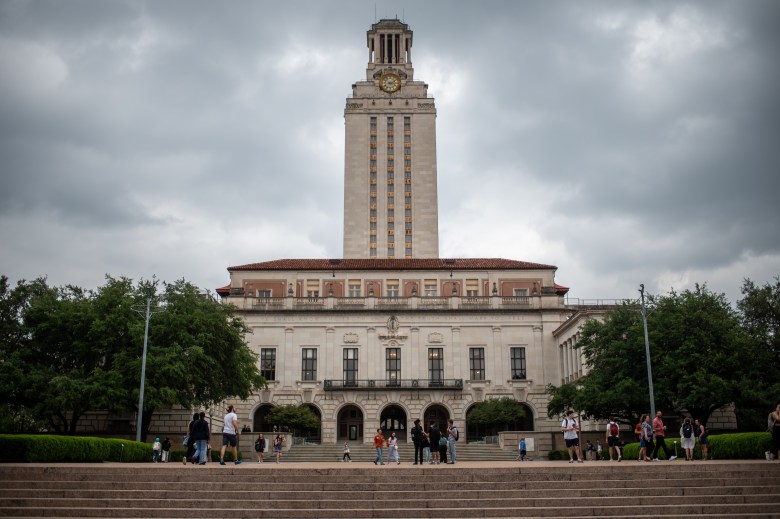
    Clouds fill the sky behind the tower at the University of Texas. Credit: Sergio Flores for The Washington Post via Getty Images

    “Universities, I think, are the ones that are put in this really difficult position,” Figueroa said. “They are not immigration experts. They’ve received very little guidance about how to interpret the consent decree.” 

    Amid so much confusion, Figueroa predicted, future lawsuits will likely crop up. Already, affected students and organizations have filed motions in court seeking to belatedly defend the Texas Dream Act against the DOJ.

    In the meantime, young scholars are facing difficult choices. One student, who asked to remain anonymous because of her undocumented immigration status, was scrolling through the news on her phone before bed when she saw a headline about the outcome of the DOJ court case. 

    “I burst in tears because, you know, as someone who’s been fighting to get ahead in their education, right now that I’m in higher education, it’s been a complete blessing,” she said. “So the first thing that I just thought of is ‘What am I going to do now? Where is my future heading?’ The plans that I have had going for me, are they going to have to come to a complete halt?’” 

    The young woman, who has lived in San Antonio since she was 9 months old, had enrolled in six courses for the fall at Texas A&M-San Antonio and wasn’t sure whether to drop them. It would be her final semester before earning her psychology and sociology degrees, but she couldn’t fathom paying for out-of-state tuition. 

    “I’m in the unknown,” she said, like “many students in this moment.”

    Contact editor Caroline Preston at 212-870-8965, via Signal at CarolineP.83 or on email at [email protected].

    This story about the Texas Dream Act was produced by The Hechinger Report, a nonprofit, independent news organization focused on inequality and innovation in education. Sign up for the Hechinger newsletter.
    The Hechinger Report provides in-depth, fact-based, unbiased reporting on education that is free to all readers. But that doesn’t mean it’s free to produce. Our work keeps educators and the public informed about pressing issues at schools and on campuses throughout the country. We tell the whole story, even when the details are inconvenient. Help us keep doing that.

    Join us today.

    Source link

  • This school built high-end career and technical education training sites on campus to prepare students for local skilled jobs

    This school built high-end career and technical education training sites on campus to prepare students for local skilled jobs

    This story is part of Hechinger’s ongoing coverage about rethinking high school. See our articles about a new diploma in Alabama, a “career education for all” model in Kentucky, and high school apprenticeships in Indiana

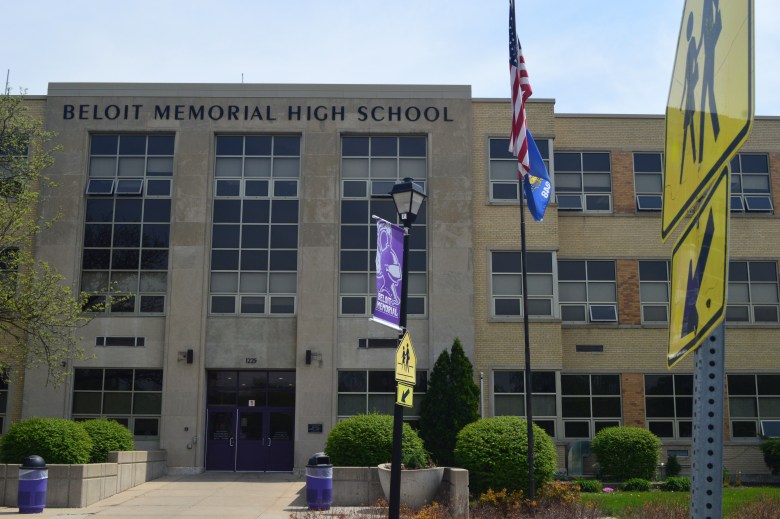
    BELOIT, Wis. — As Chris Hooker eyed a newly built piece of ductwork inside Beloit Memorial High School, a wry smile crept over his face. “If you worked for me,” he told a student, considering the obviously crooked vent, “I might ask if your level was broken.”

    Hooker, the HVAC manager of Lloyd’s Plumbing and Heating Corp. in nearby Janesville, was standing inside a hangar-sized classroom in the school’s advanced manufacturing academy, where students construct full-size rooms, hang drywall and learn the basics of masonry. His company sends him to the school twice a week for about two months a year to help teach general heating, venting and air conditioning concepts to students. 

    “I cover the mountaintop stuff,” he said, noting that at a minimum students will understand HVAC when they become homeowners.

    But the bigger potential payoff is that these students could wind up working alongside Hooker after they graduate. If his firm has an opening, any student recommended by teacher Mike Wagner would be a “done deal,” Hooker said. “Plus, if they come through this class, I know them.” 

    Manufacturing and construction dominate the business needs inside Beloit, a small city of 36,000 just minutes from the Illinois border. Sitting at the nexus of two major highways, and within 100 miles of Chicago, Milwaukee and Madison, Beloit is home to a range of businesses that include a Frito-Lay production plant, an Amazon distribution center and a Navy subcontractor. In the next two years, a $500 million casino and hotel complex is scheduled to open. 

    But staffing these companies into the future is a major concern. Across the country, the average age of manufacturing workers is increasing, and one in four of these workers is age 55 or older, according to U.S. Bureau of Labor Statistics’ 2021 figures, the most recent available. In many other jobs the workforce is aging, too. Wisconsin is one of several states looking to boost career and technical education, or CTE, as a possible solution to the aging and shrinking workforce. 

    Having industry standard machines is a key part of Beloit Memorial High School’s manufacturing program; here a student uses a JET metalworking machine to create precise cuts for his project. Credit: Wayne D’Orio for The Hechinger Report

    While the unemployment rate of Rock County, which includes Beloit, is 3.6 percent, only slightly higher than the state’s 3.2 percent, there’s a worker mismatch in the city, according to Drew Pennington, its economic development director.

    Every day, 14,000 city residents travel outside of Beloit to work, while the same number commute into the city to fill mostly higher-paying jobs, said Pennington. 

    So when Beloit decided to revamp its public high school in 2018, CTE and work-based learning were at the forefront of the transformation. 

    The 1,225-student school now has three academies that cover 13 different career paths. After ninth grade, students choose to concentrate in an area, which means taking several courses in a specific field. Students also have the option to do work-based learning, which can mean internships, a youth apprenticeship or working at high-end simulated job sites inside the school. 

    “This creates not just a pipeline to jobs but also to career choices,” said Jeff Stenroos, the district’s director of CTE and alternative education.

    Related: A lot goes on in classrooms from kindergarten to high school. Keep up with our free weekly newsletter on K-12 education.

    “There are a lot of really good-paying jobs in this area. Students don’t need to leave, or go earn a four-year degree,” Stenroos said. An auto mechanic can “earn six figures by the age of 26 and that’s more than an educator with a master’s degree,” he said.

    Beloit’s effort is a shift in high school emphasis similar to the extensive CTE programs being run in other places, notably Indiana, Kentucky and Alabama. In 2024, 40 states enacted 152 CTE-related policies, the biggest push in five years, according to Advance CTE, a nonprofit group that represents state CTE officials. Nationwide, about 20 percent of high school students take a concentration of CTE courses, it says, adding that the high school graduation rate for students who concentrate in CTE is 90 percent, 15 percentage points higher than the national average. 

    Three years ago, Wisconsin called for 7 percent of its high school students to be in workplace learning programs by 2026. Beloit’s progress puts it far ahead of that target. In Beloit Memorial, nearly 1 in 3 students meet this designation today, Stenroos said. 

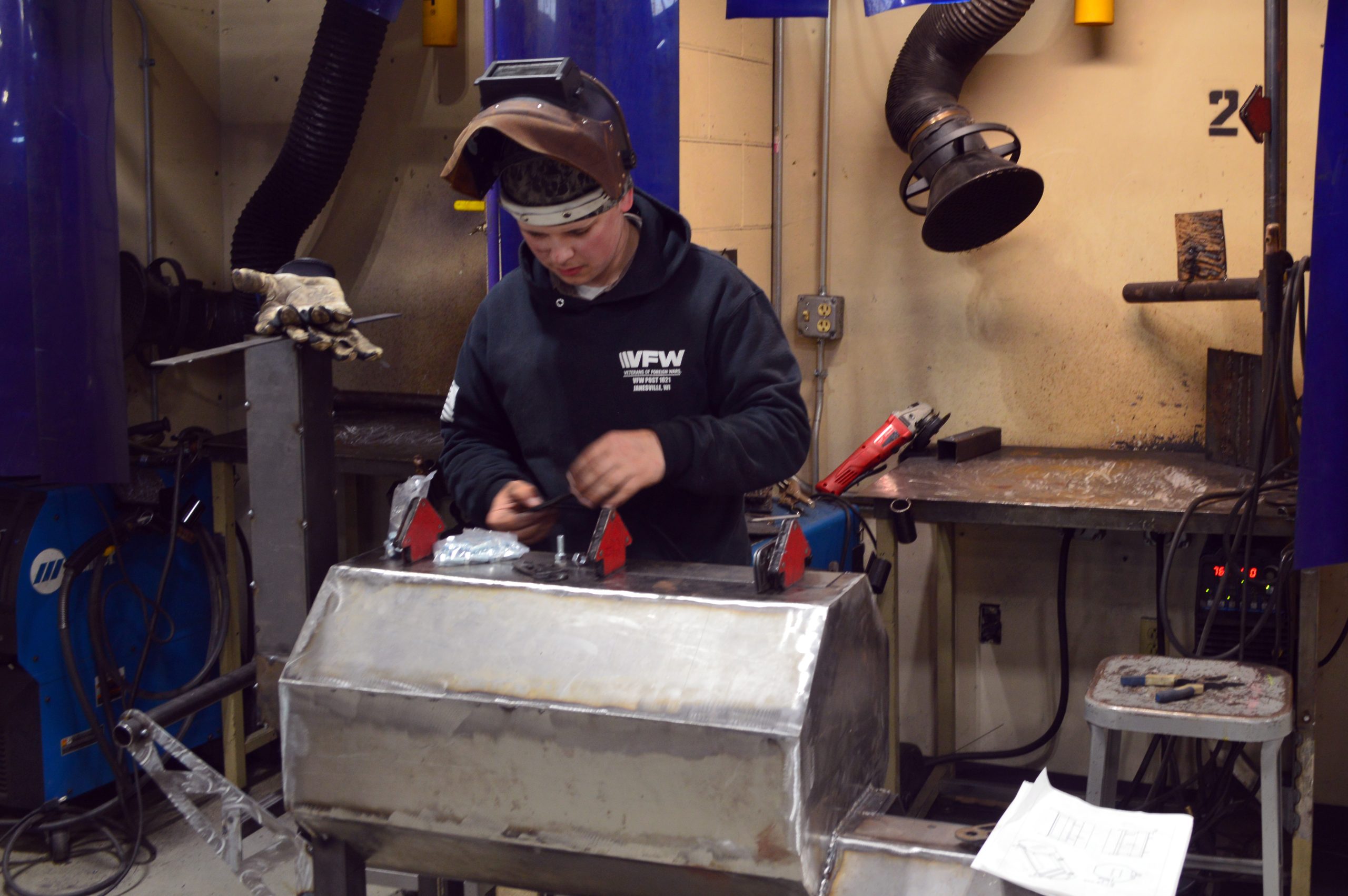
    The high school features a cavernous construction area where students build full-scale rooms, learn masonry and complete plumbing and electrical wiring projects. The metal shop offers 16 welding stations and a die-cutter machine that allows students to create customized pieces to fit projects. Down the street, the school runs an eight-bay car repair center, a space it took over when a Sears autobody shop left town.

    These spaces are “better than a lot of technical colleges,” Stenroos said.

    In addition to their high school courses, Beloit Memorial students pile up industry-recognized certifications, Stenroos said. More than 40 percent of its students graduate with at least one certification, and 1 in 4 of them has multiple certifications. 

    Related: Schools push career ed classes for all, even kids heading to college

    While some simple certifications, such as OSHA Workplace Safety, can be accomplished in just 10 hours, others, such as those for the American Welding Society, require up to 500 hours of student work, he added. The state has called for 9 percent of graduating high school students to have earned at least one certification by next year. To incentivize schools to offer these opportunities, the state’s Department of Workforce Development pays schools for each student who earns a certification; in 2024, Beloit received $85,000 through this program, Stenroos said.

    One of the school’s best automotive students, Geiry Lopez, graduated this year with five Automotive Service Excellence certifications. Standing less than 5 feet tall, Lopez said she is not bothered that she might not look like a typical mechanic. “I know I can do this,” she said, adding that she hopes to work on heavy machinery such as tractor trailers after she graduates.

    She’s worked on her own car, with some fellow students, replacing the brakes, a front axle, rotors and wheel bearings at the school’s garage, she said, although she still hasn’t been able to drive it.

    “My dad is taking forever to teach me how to drive,” she said. 

    The garage operates like an actual business, but the only customers are teachers and other Beloit staffers and students. Students estimate work costs, order parts and communicate with customers before any repairs take place. While oil changes and brake replacements are common, some students are totally rebuilding an engine in one car. 

    Over in the welding room, rising senior Cole Mellom was putting the finishing touches on a smoker he built in less than a month’s time. He said he loved the creativity of finding a plan, cutting the metal and building something that he could sell, all while in school. Plus, he knows that welding is a key skill needed for his dream job, race-car fabrication.

    Officials revamped the Beloit Memorial High School in 2018 to funnel students into academies that are connected to jobs in the area and the state. Credit: Wayne D’Orio for The Hechinger Report

    In the past, students created a custom-made protective plate that the city’s police use on a bomb squad vehicle.

    The welding program has 125 students this year and had to turn away 65 more because of space limitations, Stenroos said; last year, 17 of the school’s welding academy graduates enlisted in the armed forces to specialize in welding. 

    These programs are designed to help meet the future needs of the state’s workforce. More than one-third of Wisconsin jobs will require education beyond high school but less than a bachelor’s degree by 2031, according to the Association for Career and Technical Education. For the last four years, the state has had more job openings than people on unemployment.

    “There’s more jobs than there are people to fill them right now,” said Deb Prowse, a former career academy coach at Beloit Memorial who now works at Craftsman with Character, an area nonprofit that helps train students for careers in skilled trades.

    Hooker, the Lloyd’s Plumbing HVAC manager, agreed. “Every project we work on has a delay, from a multimillion-dollar mansion to a three-bedroom spec,” he said. “There aren’t enough workers.”

    The main reason Beloit Memorial has been able to zoom past state and national goals for both CTE and work-based learning is the school’s single-minded focus since 2018 on helping to ensure that its graduates will understand what businesses need and giving them a head start toward gaining those skills.

    High school officials actually pared back the program from 44 pathways to 13, Stenroos said, part of an effort to tie each pathway to specific jobs. About 75 percent of pathways target area jobs, with the remaining quarter highlighting prominent professions within the state, he added. 

    Even though three straight budget referendum defeats have left the district with a $6.2 million funding gap, Stenroos said he’s been able to keep the CTE equipment modernized through donations and strategic allocation of the school’s federal Perkins grant and the state reimbursement for student certifications. In one instance, the school recently bought a $20,000 scanner for its automotive program; the machine can not only help diagnose a car problem, but also connect students to garages throughout the country that have successfully fixed the specified problem. 

    “It’s an expensive piece of equipment,” Stenroos said, “but it’s industry-certified and will give students real-life experience.”

    Each of the three academies has an advisory board of teachers and industry professionals who work out how to embed practical lessons in classroom curriculum. “We ask business people, ‘What do you need, and how can we help our kids get there?’” said Stenroos.

    Related: A new kind of high school diploma trades chemistry for carpentry

    “It’s really cool how receptive the school is to feedback,” said Heather Dobson, the business development manager at Corporate Contractors, Inc., a 200-person general contracting firm.

    She explained that the district has incorporated small changes over the years, such as having students work in Microsoft programs instead of Google Classroom apps and teaching them how to write a professional email.

    “Rarely is there an idea presented that they don’t embrace,” said Celestino Ruffini, the CEO of Visit Beloit, a nonprofit that promotes tourism of the city. The school is expanding its hospitality program because of the expected influx of jobs connected to the new casino and hotel, he said. 

    All the changes aren’t at the high school, however. In order to employ Beloit Memorial students, Frito-Lay had to alter its corporate policy of not allowing anyone under 18 to work in its plants, according to Angela Slagle, a supply chain manager there. The company now hires Beloit Memorial students for its career exploration youth apprenticeship program, she added. 

    The connection to area businesses goes beyond the school’s leaders. Each year, about 10 teachers complete an externship in which they spend one week of their summer at a local business. Teachers are paid $1,000 for the 20 hours, and they not only learn about what jobs a company may have but also find ways to incorporate real-world problems into their classroom lessons.

    A few summers back, math teacher Michelle Kelly spent a week at Corporate Contractors. She was searching for different ways to use construction-based math problems with her students. In addition to using math to estimate a bid for a project or calculate the surface area of a job, she realized that complex math is needed to build a truss, the framework used to support a roof or bridge.

    Because the triangular truss is supported by different lengths of wood inside its structure, Kelly said, building one requires the calculation of angles, total area, how much wood is needed and more. Since all her algebra students were in the school’s construction academy, she partnered with those teachers to go beyond blueprints and have the 10th graders build trusses, a collection of which sit in the back of her classroom.

    A student’s detailed outline for creating a truss in Michelle Kelly’s 10th grade algebra class at Beloit Memorial High School, which is embracing career and technical education. Credit: Wayne D’Orio for The Hechinger Report

    She sees this work as one way to help counter the chronic absenteeism that has existed since Covid. Teaching with this kind of hands-on work makes students see the relevance of algebra, she said. “Would it be easier to just have them take a test? Yes.” 

    Beloit Memorial Principal Emily Pelz said the school’s work is paying off. In the last four years, the school’s four-year graduation rate has ticked up slightly, from 83.4 percent in 2021-22 to 85.2 percent in 2024-25, while its attendance went from 78.5 percent to 84.8 percent in the same period, Pelz said. 

    Related: ‘Golden ticket to job security’: Trade union partnerships hold promise for high school students

    Rik Thomas, a rising senior who already has his own business repairing and modifying cars, said this work has definitely made him more interested in school. While he thought the academy would merely explain what a construction career might include, “It’s nice to find out how to do the work.” His father works in construction and, Thomas added, “He loves that I take this program.” 

    Thomas and his classmates built a wooden shed earlier this year and were able to sell it for $2,500, with the money going to pay for more materials. Likewise, the first smoker created in the welding class was bought by Stenroos; the students are looking forward to posting the second one for sale after they determine how much they should charge. 

    While the school’s construction and other trade-related fields have drawn the most attention, its three academies also offer career paths in healthcare, education, business, the arts, hospitality and more. 

    For example, rising senior Tayvon Cates said he hopes to study pre-med at a historically Black college or university on his way to becoming a cardiology radiologist. Cates, who is in the school’s health and education academy, said, “If you want to do something, the school can help you do it.”

    This story about career and technical education was produced by The Hechinger Report, a nonprofit, independent news organization focused on inequality and innovation in education. Sign up for Hechinger’s weekly newsletter.

    The Hechinger Report provides in-depth, fact-based, unbiased reporting on education that is free to all readers. But that doesn’t mean it’s free to produce. Our work keeps educators and the public informed about pressing issues at schools and on campuses throughout the country. We tell the whole story, even when the details are inconvenient. Help us keep doing that.

    Join us today.

    Source link

  • El Paso Community College Helps Design State Program for Adults Without High School Diplomas – The 74

    El Paso Community College Helps Design State Program for Adults Without High School Diplomas – The 74


    Get stories like this delivered straight to your inbox. Sign up for The 74 Newsletter

    Kurt Micklo lost interest in academics after he failed to make the basketball team as a sophomore at Chapin High School. Soon after, he fathered a son and began to work full time, which put him further behind in his studies.

    A counselor finally advised him during his junior year that he should withdraw and try to earn a GED. He dropped out and – through hard work – found professional success as a general manager of a subcontracting logistics company. However, the lack of a high school diploma haunted him. He wants one to give his family – especially his mother – another reason to be proud of him.

    A busy work and family schedule have kept him from returning to school, but the flexibility of a new state program aimed at people aged 18 and older without a high school diploma will allow him to earn a diploma and a college career and technical education, or CTE, credential for programs such as health care, welding or computer science at the same time.

    The concept of Opportunity High School Diploma was part of House Bill 8, which the state Legislature passed in 2023. The state funneled about $2 million into this program to help the approximately 4.3 million Texans as of 2023, including about 30,000 adult El Pasoans, without a diploma to earn the academic credits most of them will need to acquire higher-paying jobs. The program is scheduled to launch in spring 2026.

    “If I could juggle it, I’d be pretty interested” in the program, said 34-year-old Micklo, a father of three ages 15, 10 and 5. He is the general manager of three warehouses, two in El Paso and one in Laredo, Texas, as well as four sites near the international ports of entry with Mexico in El Paso, Tornillo and Santa Teresa, New Mexico, were commodities are offloaded.. “It would make my stepfather (a retired educator) and my mother happy if I earned my high school diploma.”

    El Paso Community College is one of five community college districts in the state selected for the design and implementation phases of this program. The other institutions in the design phase are Alamo Colleges District, Austin Community College, Dallas College and San Jacinto College near Houston.

    They work under the direction of the Texas Higher Education Coordinating Board. The board will review the instructional outcomes and performance expectations that the college collaborators created during an October meeting. Once finalized, the college faculty will begin to work with school districts to design the curriculum.

    The program is flexible for students who probably work full time and have family obligations. Courses would have suggested timelines, but students would turn in assignments as their schedule allowed through the end of the term.

    Micklo, a Northeast resident, said the promised flexibility is the only reason he might consider the program. As for his credential, he said he would need to review EPCC’s career and technical education options. The college offers more than 100 career programs such as HVAC, or heating, ventilation and air conditioning, and electrical, automotive or diesel technologies.

    Students will be co-enrolled in competency-based high school curriculum such as math, civics, sciences and communication, and a career and technical workforce program. Competency based courses are focused more on a students’ mastery of a skill or subject than the amount of time spent in a classroom.

    Isela Castañón Williams

    Isela Castañón Williams, professor and coordinator of EPCC’s teacher preparation programs, is in charge of the college’s 13-member team. She called the project a “monumental task” because of its scope and uniqueness. She said her team, and its counterparts, played a critical role in the design phase.

    “Faculty at EPCC are very innovative,” she said. “I think that my colleagues have approached this process with a great deal of enthusiasm. We’re always looking to provide better services and educational experiences to the community we serve.”

    EPCC faculty advocated for the program to be designed to accommodate English Second Language and English Language Learner populations, a THECB spokesman said in a July 1 statement. He said last year that the board selected EPCC for the project’s design phase because of its border insights, and because its CTE degrees and credentials are in line with the program.

    While the state wants to attract students aged 18 and older, EPCC officials will aim for people 25 and older so as to not compete with K-12 school districts that have their own dropout recovery programs. EPCC, which will offer the program at its five campuses, expects some of the program’s younger students to come from rural areas outside El Paso.

    Steven E. Smith

    Steven E. Smith, vice president of Instruction and Workforce Education at EPCC, said the state will provide funds to the colleges to cover tuition for initial cohorts. He expects the first groups will range from 30 to 50 students and scale up from there.

    “We think this is a big market in El Paso, and I think once the word starts to get out, that will grow tremendously,” Smith said.

    The administrator said that he would work on ways to market the program later this month with the college’s External Relations, Communication & Development Division. He said the college would work with school district partners to build lists of potential OHSD students.

    “As you might imagine, that is a pretty difficult population to identify and reach out to because they are not in the system anymore,” Smith said.

    This article first appeared on El Paso Matters and is republished here under a Creative Commons Attribution-NoDerivatives 4.0 International License.


    Get stories like these delivered straight to your inbox. Sign up for The 74 Newsletter

    Source link

  • Let’s remove the roadblocks to four-year STEM degrees for community college transfer students

    Let’s remove the roadblocks to four-year STEM degrees for community college transfer students

    In the nearly two years since the U.S. Supreme Court struck down race-conscious admissions, there have been repeated calls for universities to address the resulting decline in diversity by recruiting from community colleges.  

    On the surface, encouraging students to transfer from two-year colleges sounds like a terrific idea. Community colleges enroll large numbers of students who are low-income or whose parents did not attend college. Black and Latino students disproportionately start college at these institutions, whose mission for more than 50 years has been to expand access to higher education. 

    But while community colleges should be an avenue into high-value STEM degrees for students from low-income backgrounds and minoritized students, the reality is sobering: Just 2 percent of students who begin at a community college earn a STEM bachelor’s degree within six years, our recent study of transfer experiences in California found.  

    There are too many roadblocks in their way, leaving the path to STEM degrees for community college students incredibly narrow. A key barrier is the complexity of the process of transferring from a community college to a four-year institution. 

    Related: Interested in innovations in higher education? Subscribe to our free biweekly higher education newsletter. 

    Many community college students who want to transfer and major in a STEM field must contend with three major obstacles in the transfer process: 

    1. A maze of inconsistent and often opaque math requirements. We found that a student considering three or four prospective university campuses might have to take three or four different math classes just to meet a single math requirement in a given major. One campus might expect a transfer student majoring in business to take calculus, while another might ask for business calculus. Still another might strongly recommend a “calculus for life sciences” course. And sometimes an institution’s website might list different requirements than a statewide transfer site. Such inconsistencies can lengthen students’ times to degrees — especially in STEM majors, which may require five- or six-course math sequences before transfer.  

    2. Underlying math anxiety. Many students interviewed for the study told us that they had internalized negative comments from teachers, advisers and peers about their academic ability, particularly in math. This uncertainty contributed to feelings of anxiety about completing their math courses. Their predicament is especially troubling given concerns that required courses may not contribute to success in specific fields. 

    3. Course scheduling conflicts that slow students’ progress. Two required courses may meet on the same day and time, for example, or a required course could be scheduled at a time that conflicts with a student’s work schedule. In interviews, we also heard that course enrollment caps and sequential pathways in which certain courses are offered only once a year too often lengthen the time to degree for students. 

    Related: ‘Waste of time’: Community college transfers derail students 

    To help, rather than hinder, STEM students’ progress toward their college and professional goals, the transfer process needs to change significantly. First and foremost, universities need to send clear and consistent signals about what hoops community college students should be jumping through in order to transfer.  

    A student applying to three prospective campuses, for example, should not have to meet separate sets of requirements for each. 

    Community colleges and universities should also prioritize active learning strategies and proven supports to combat math anxiety. These may include providing professional learning for instructors to help them make math courses more engaging and to foster a sense of belonging. Training for counselors to advise students on requirements for STEM pathways is also important.  

    Community colleges must make their course schedules more student-centered, by offering evening and weekend courses and ensuring that courses required for specific degrees are not scheduled at overlapping times. They should also help students with unavoidable scheduling conflicts take comparable required courses at other colleges. 

    At the state level, it’s critical to adopt goals for transfer participation and completion (including STEM-specific goals) as well as comprehensive and transparent statewide agreements for math requirements by major. 

    States should also provide transfer planning tools that provide accurate and up-to-date information. For example, the AI Transfer and Articulation Infrastructure Network, led by University of California, Berkeley researchers, is using artificial intelligence technology to help institutions more efficiently identify which community college courses meet university requirements. More effective tools will increase transparency without requiring students and counselors to navigate complex and varied transfer requirements on their own. As it stands, complex, confusing and opaque math requirements limit transfer opportunities for community college students seeking STEM degrees, instead of expanding them. 

    We must untangle the transfer process, smooth pathways to high-value degrees and ensure that every student has a clear, unobstructed opportunity to pursue an education that will set them up for success. 

    Pamela Burdman is executive director of Just Equations, a California-based policy institute focused on reconceptualizing the role of math in education equity. Alexis Robin Hale is a research fellow at Just Equations and a graduate student at UCLA in Social Sciences and Comparative Education.  

    Contact the opinion editor at [email protected]. 

    This story about community college transfers was produced by The Hechinger Report, a nonprofit, independent news organization focused on inequality and innovation in education. Sign up for Hechinger’s weekly newsletter. 

    The Hechinger Report provides in-depth, fact-based, unbiased reporting on education that is free to all readers. But that doesn’t mean it’s free to produce. Our work keeps educators and the public informed about pressing issues at schools and on campuses throughout the country. We tell the whole story, even when the details are inconvenient. Help us keep doing that.

    Join us today.

    Source link

  • Hard up for students, more colleges are offering college credit for life experience, or ‘prior learning’

    Hard up for students, more colleges are offering college credit for life experience, or ‘prior learning’

    PITTSBURGH — Stephen Wells was trained in the Air Force to work on F-16 fighter jets, including critical radar, navigation and weapons systems whose proper functioning meant life or death for pilots.

    Yet when he left the service and tried to apply that expertise toward an education at Pittsburgh’s Community College of Allegheny County, or CCAC, he was given just three credits toward a required class in physical education.

    Wells moved forward anyway, going on to get his bachelor’s and doctoral degrees. Now he’s CCAC’s provost and involved in a citywide project to help other people transform their military and work experience into academic credit.

    What’s happening in Pittsburgh is part of growing national momentum behind letting students — especially the increasing number who started but never completed a degree — cash in their life skills toward finally getting one, saving them time and money. 

    Colleges and universities have long purported to provide what’s known in higher education as credit for prior learning. But they have made the process so complex, slow and expensive that only about 1 in 10 students actually completes it

    Many students don’t even try, especially low-income learners who could benefit the most, according to a study by the Western Interstate Commission for Higher Education and the Council for Adult and Experiential Learning, or CAEL.

    “It drives me nuts” that this promise has historically proven so elusive, Wells said, in his college’s new Center for Education, Innovation & Training.

    Stephen Wells, provost at the Community College of Allegheny County in Pittsburgh. An Air Force veteran, Wells got only a handful of academic credits for his military experience. Now he’s part of an effort to expand that opportunity for other students. Credit: Nancy Andrews for The Hechinger Report

    That appears to be changing. Nearly half of institutions surveyed last year by the American Association of Collegiate Registrars and Admissions Officers, or AACRAO, said they have added more ways for students to receive these credits — electricians, for example, who can apply some of their training toward academic courses in electrical engineering, and daycare workers who can use their experience to earn degrees in teaching. 

    Related: Interested in innovations in higher education? Subscribe to our free biweekly higher education newsletter.

    The reason universities and colleges are doing this is simple: Nearly 38 million working-age Americans have spent some time in college but never finished, according to the National Student Clearinghouse Research Center. Getting at least some of them to come back has become essential to these higher education institutions at a time when changing demographics mean that the number of 18-year-old high school graduates is falling.

    “When higher education institutions are fat and happy, nobody looks for these things. Only when those traditional pipelines dry up do we start looking for other potential populations,” said Jeffrey Harmon, vice provost for strategic initiatives and institutional effectiveness at Thomas Edison State University in New Jersey, which has long given adult learners credit for the skills they bring.

    Being able to get credit for prior learning is a huge potential recruiting tool. Eighty-four percent of adults who are leaning toward going back to college say it would have “a strong influence” on their decision, according to research by CAEL, the Strada Education Foundation and Hanover Research. (Strada is among the funders of The Hechinger Report, which produced this story.)

    The Center for Education, Innovation & Training at the Community College of Allegheny County in Pittsburgh. The college is part of a citywide effort to give academic credit for older students’ life experiences. Credit: Nancy Andrews for The Hechinger Report

    When Melissa DiMatteo, 38, decided to get an associate degree at CCAC to go further in her job, she got six credits for her previous training in Microsoft Office and her work experience as everything from a receptionist to a supervisor. That spared her from having to take two required courses in computer information and technology and — since she’s going to school part time and taking one course per semester — saved her a year.

    “Taking those classes would have been a complete waste of my time,” DiMatteo said. “These are things that I do every day. I supervise other people and train them on how to do this work.”

    On average, students who get credit for prior learning save between $1,500 and $10,200 apiece and nearly seven months off the time it takes to earn a bachelor’s degree, the nonprofit advocacy group Higher Learning Advocates calculates. The likelihood that they will graduate is 17 percent higher, the organization finds.

    Related: The number of 18-year-olds is about to drop sharply, packing a wallop for colleges — and the economy 

    Justin Hand dropped out of college because of the cost, and became a largely self-taught information technology manager before he decided to go back and get an associate and then a bachelor’s degree so he could move up in his career.

    He got 15 credits — a full semester’s worth — through a program at the University of Memphis for which he wrote essays to prove he had already mastered software development, database management, computer networking and other skills.

    “These were all the things I do on a daily basis,” said Hand, of Memphis, who is 50 and married, with a teenage son. “And I didn’t want to have to prolong college any more than I needed to.”

    Meanwhile, employers and policymakers are pushing colleges to speed up the output of graduates with skills required in the workforce, including by giving more students credit for their prior learning. And online behemoths Western Governors University and Southern New Hampshire University, with which brick-and-mortar colleges compete, are way ahead of them in conferring credit for past experience.

    “They’ve mastered this and used it as a marketing tool,” said Kristen Vanselow, assistant vice president of innovative education and partnerships at Florida Gulf Coast University, which has expanded its awarding of credit for prior learning. “More traditional higher education institutions have been slower to adapt.”

    It’s also gotten easier to evaluate how skills that someone learns in life equate to academic courses or programs. This has traditionally required students to submit portfolios, take tests or write essays, as Hand did, and faculty to subjectively and individually assess them. 

    Related: As colleges lose enrollment, some turn to one market that’s growing: Hispanic students

    Now some institutions, states, systems and independent companies are standardizing this work or using artificial intelligence to do it. The growth of certifications from professional organizations such as Amazon Web Services and the Computing Technology Industry Association, or CompTIA, has helped, too.

    “You literally punch [an industry certification] into our database and it tells you what credit you can get,” said Philip Giarraffa, executive director of articulation and academic pathways at Miami Dade College. “When I started here, that could take anywhere from two weeks to three months.”

    Data provided by Miami Dade shows it has septupled the number of credits for prior learning awarded since 2020, from 1,197 then to 7,805 last year.

    “These are students that most likely would have looked elsewhere, whether to the [online] University of Phoenix or University of Maryland Global [Campus]” or other big competitors, Giarraffa said.

    Fifteen percent of undergraduates enrolled in higher education full time and 40 percent enrolled part time are 25 or older, federal data show — including people who delayed college to serve in the military, volunteer or do other work that could translate into academic credit. 

    “Nobody wants to sit in a class where they already have all this knowledge,” Giarraffa said. 

    At Thomas Edison, police academy graduates qualify for up to 30 credits toward associate degrees. Carpenters who have completed apprenticeships can get as many as 74 credits in subjects including math, management and safety training. Bachelor’s degrees are often a prerequisite for promotion for people in professions such as these, or who hope to start their own companies.

    Related: To fill ‘education deserts,’ more states want community colleges to offer bachelor’s degrees

    The University of Memphis works with FedEx, headquartered nearby, to give employees with supervisory training academic credit they can use toward a degree in organizational leadership, helping them move up in the company.

    The University of North Carolina System last year launched its Military Equivalency System, which lets active-duty and former military service members find out almost instantly, before applying for admission, if their training could be used for academic credit. That had previously required contacting admissions offices, registrars or department chairs. 

    Among the reasons for this reform was that so many of these prospective students — and the federal education benefits they get — were ending up at out-of-state universities, the UNC System’s strategic plan notes.

    “We’re trying to change that,” said Kathie Sidner, the system’s director of workforce and partnerships. It’s not only for the sake of enrollment and revenue, Sidner said. “From a workforce standpoint, these individuals have tremendous skill sets and we want to retain them as opposed to them moving somewhere else.”

    Related: A new way to help some college students: Zero percent, no-fee loans

    California’s community colleges are also expanding their credit for prior learning programs as part of a plan to increase the proportion of the population with educations beyond high school

    “How many people do you know who say, ‘College isn’t for me?’ ” asked Sam Lee, senior advisor to the system’s chancellor for credit for prior learning. “It makes a huge difference when you say to them that what they’ve been doing is equivalent to college coursework already.”

    In Pittsburgh, the Regional Upskilling Alliance — of which CCAC is a part — is connecting job centers, community groups, businesses and educational institutions to create comprehensive education and employment records so more workers can get credit for skills they already have.

    That can provide a big push, “especially if you’re talking about parents who think, ‘I’ll never be able to go to school,’ ” said Sabrina Saunders Mosby, president and CEO of the nonprofit Vibrant Pittsburgh, a coalition of business and civic leaders involved in the effort. 

    Pennsylvania is facing among the nation’s most severe declines in the number of 18-year-old high school graduates. 

    “Our members are companies that need talent,” Mosby said. 

    There’s one group that has historically pushed back against awarding credit for prior learning: university and college faculty concerned it might affect enrollment in their courses or unconvinced that training provided elsewhere is of comparable quality. Institutions have worried about the loss of revenue from awarding credits for which students would otherwise have had to pay.

    That also appears to be changing, as universities leverage credit for prior learning to recruit more students and keep them enrolled for longer, resulting in more revenue — not less. 

    “That monetary factor was something of a myth,” said Beth Doyle, chief of strategy at CAEL.

    Faculty have increasingly come around, too. That’s sometimes because they like having experienced students in their classrooms, Florida Gulf Coast’s Vanselow said. 

    Related: States want adults to return to college. Many roadblocks stand in the way 

    Still, while many recognize it as a recruiting incentive, most public universities and colleges have had to be ordered to confer more credits for prior learning by legislatures or governing boards. Private, nonprofit colleges remain stubbornly less likely to give it.

    More than two-thirds charge a fee for evaluating whether other kinds of learning can be transformed into academic credit, an expense that isn’t covered by financial aid. Roughly one in 12 charge the same as it would cost to take the course for which the credits are awarded. 

    Debra Roach, vice president for workforce development at the Community College of Allegheny County in Pittsburgh. The college is working on giving academic credit to students for their military, work and other life experience. Credit: Nancy Andrews for The Hechinger Report

    Seventy percent of institutions require that students apply for admission and be accepted before learning whether credits for prior learning will be awarded. Eighty-five percent limit how many credits for prior learning a student can receive.

    There are other confounding roadblocks and seemingly self-defeating policies. CCAC runs a noncredit program to train paramedics, for example, but won’t give people who complete it credits toward its for-credit nursing degree. Many leave and go across town to a private university that will. The college is working on fixing this, said Debra Roach, its vice president of workforce development.

    It’s important to see this from the students’ point of view, said Tracy Robinson, executive director of the University of Memphis Center for Regional Economic Enrichment.

    “Credit for prior learning is a way for us to say, ‘We want you back. We value what you’ve been doing since you’ve been gone,’ ” Robinson said. “And that is a total game changer.”

    Contact writer Jon Marcus at 212-678-7556, [email protected] or jpm.82 on Signal.

    This story about credit for prior learning was produced by The Hechinger Report, a nonprofit, independent news organization focused on inequality and innovation in education. Sign up for our higher education newsletter. Listen to our higher education podcast.

    The Hechinger Report provides in-depth, fact-based, unbiased reporting on education that is free to all readers. But that doesn’t mean it’s free to produce. Our work keeps educators and the public informed about pressing issues at schools and on campuses throughout the country. We tell the whole story, even when the details are inconvenient. Help us keep doing that.

    Join us today.

    Source link

  • Help us tell the story of how the Trump administration is changing higher education

    Help us tell the story of how the Trump administration is changing higher education

    Since January, President Donald Trump has taken countless steps to transform the nation’s colleges and universities. His administration has cut scientific and medical research, ended efforts to promote diversity equity and inclusion (DEI), introduced newly aggressive policies on loan repayment, revoked visas for international students, and more. While Trump’s battles with Harvard and Columbia have received the most attention, the administration’s actions have had consequences far beyond those two universities.  

    We want to know how the Trump administration is affecting higher education and life on your campus. What, if any, changes are you seeing at your college or university because of federal policy shifts? In what ways do you see higher education changing?

    If you prefer, you can also email us directly at [email protected]. Contact editor Lawrie Mifflin at [email protected] or 212-678-4078. Contact editor Caroline Preston at 212-870-8965, via Signal at CarolineP.83 or on email at [email protected].

    This story about higher education was produced by The Hechinger Report, a nonprofit, independent news organization focused on inequality and innovation in education. Sign up for our newsletters.

    The Hechinger Report provides in-depth, fact-based, unbiased reporting on education that is free to all readers. But that doesn't mean it's free to produce. Our work keeps educators and the public informed about pressing issues at schools and on campuses throughout the country. We tell the whole story, even when the details are inconvenient. Help us keep doing that.

    Join us today.


    Source link

  • Clean energy workforce training hub a ‘gamechanger’ in this struggling factor town

    Clean energy workforce training hub a ‘gamechanger’ in this struggling factor town

    Decatur, Illinois, has been losing factory jobs for years. A training program at a local community college promises renewal and provides training for students from disenfranchised communities

    This story is part of a collaboration between the Institute for Nonprofit News’ Rural News Network and Canary Media, South Dakota News WatchCardinal News, The Mendocino Voice and The Maine Monitor, with support from Ascendium Education Group. It is reprinted with permission. 

    DECATUR, IL. — A fistfight at a high school football game nearly defined Shawn Honorable’s life.

    It was 1999 when he and a group of teen boys were expelled and faced criminal charges over the incident. The story of the “Decatur Seven” drew national headlines and protests led by the Rev. Jesse Jackson, who framed their harsh treatment as blatant racism. The governor eventually intervened, and the students were allowed to attend alternative schools.

    Honorable, now 41, was encouraged by support “from around the world,” but he said the incident was traumatizing and he continued to struggle academically and socially. Over the years, he dabbled in illegal activity and was incarcerated, most recently after a 2017 conviction for accepting a large amount of marijuana sent through the mail.

    Today, Honorable is ready to start a new chapter, having graduated with honors last week from a clean energy workforce training program at Richland Community College, located in the Central Illinois city of Decatur. He would eventually like to own or manage a solar company, but he has more immediate plans to start a solar-powered mobile hot dog stand. He’s already chosen the name: Buns on the Run.

    “By me going back to school and doing this, it shows my nephews and my little cousins and nieces that it is good to have education,” Honorable said. “I know this is going to be the new way of life with solar panels. So I’ll have a step up on everyone. When it comes, I will already be aware of what’s going on with this clean energy thing.”

    Shawn Honorable graduated with honors last week from Richland Community College’s clean energy workforce training program in Decatur, Illinois, part of a network of hubs funded by the state’s 2021 Climate and Equitable Jobs Act. Credit: Lloyd DeGrane/Canary Media

    After decades of layoffs and factory closings, the community of Decatur is also looking to clean energy as a potential springboard.

    Located amid soybean fields a three-hour drive from Chicago, the city was long known for its Caterpillar, Firestone Tire, and massive corn-syrup factories. Industrial jobs have been in decline for decades, though, and high rates of gun violence, child poverty, unemployment, and incarceration were among the reasons the city was named a clean energy workforce hub funded under Illinois’ 2021 Climate and Equitable Jobs Act (CEJA).

    Decatur’s hub, based at Richland Community College, is arguably the most developed and successful of the dozen or so established statewide. That’s thanks in part to TCCI Manufacturing, a local, family-owned factory that makes electric vehicle compressors. TCCI is expanding its operations with a state-of-the-art testing facility and an on-site campus where Richland students will take classes adjacent to the manufacturing floor. The electric truck company Rivian also has a factory 50 miles away.

    “The pieces are all coming together,” Kara Demirjian, senior vice president of TCCI Manufacturing, said by email. “What makes this region unique is that it’s not just about one company or one product line. It’s about building an entire clean energy ecosystem. The future of EV manufacturing leadership won’t just be on the coasts — it’s being built right here in the Midwest.”

    Powering Rural Futures: Clean energy is creating new jobs in rural America, generating opportunities for people who install solar panels, build wind turbines, weatherize homes and more. This five-part series from the Rural News Network explores how industry, state governments and education systems are training this growing workforce.

    Related: Want to read more about how climate change is shaping education? Subscribe to our free newsletter.

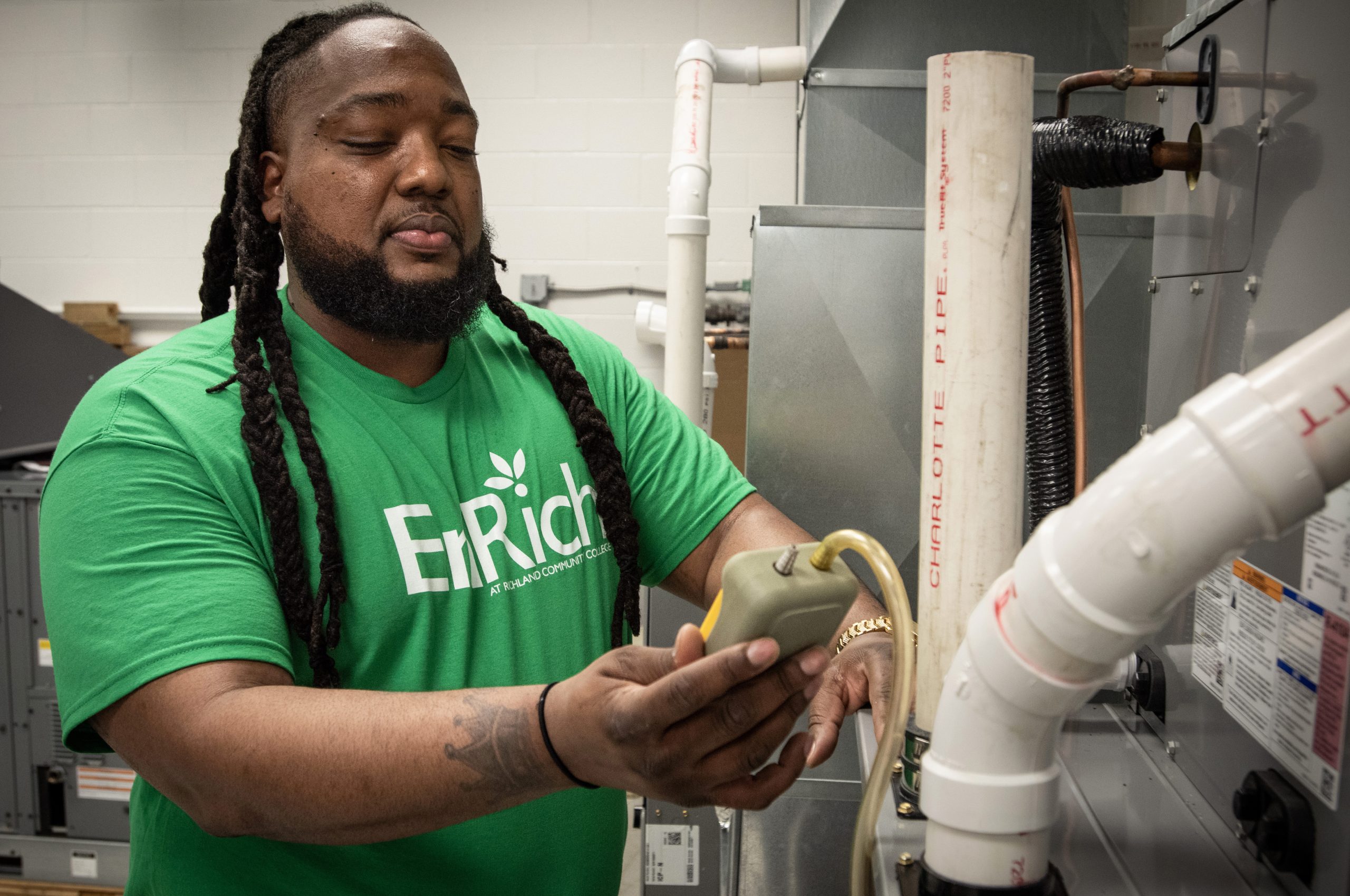
    The Decatur CEJA program has also flourished because it was grafted onto a preexisting initiative, EnRich, that helps formerly incarcerated or otherwise disenfranchised people gain new skills and employment. The program is overseen by the Rev. Courtney Carson, a childhood friend of Honorable and another member of the Decatur Seven.

    “So many of us suffer significantly from our unmet needs, our unhealed traumas,” said Carson, who was jailed as a young man for gun possession and later drag racing. With the help of mentors including Rev. Jackson and a college basketball coach, he parlayed his past into leadership, becoming associate pastor at a renowned church, leading a highway construction class at Richland, and in 2017 being elected to the same school board that had expelled him.

    Carson, now vice president of external relations at the community college, tapped his own experience to shape EnRich as a trauma-informed approach, with wraparound services to help students overcome barriers — from lack of childcare to PTSD to a criminal record. Carson has faith that students can overcome such challenges to build more promising futures, like Decatur itself has done.

    “We have all these new opportunities coming in, and there’s a lot of excitement in the city,” Carson said. “That’s magnificent. So what has to happen is these individuals who suffered from closures, they have to be reminded that there is hope.”

    Richland Community College’s clean energy jobs training starts with an eight-week life skills course that has long been central to the larger EnRich program. The course uses a Circle of Courage practice inspired by Indigenous communities and helps students prepare to handle stressful workplace situations like being disrespected or even called a racial slur.

    “Being called the N-word, couldn’t that make you want to fight somebody? But now you lose your job,” said Carson. “We really dive deep into what’s motivating their attitude and those traumas that have significantly impacted their body to make them respond to situations either the right way or the wrong way.”

    The training addresses other dynamics that might be unfamiliar to some students — for example, some male students might not be prepared to be supervised by a woman, Carson noted, or others might not be comfortable with LGBTQ+ coworkers.

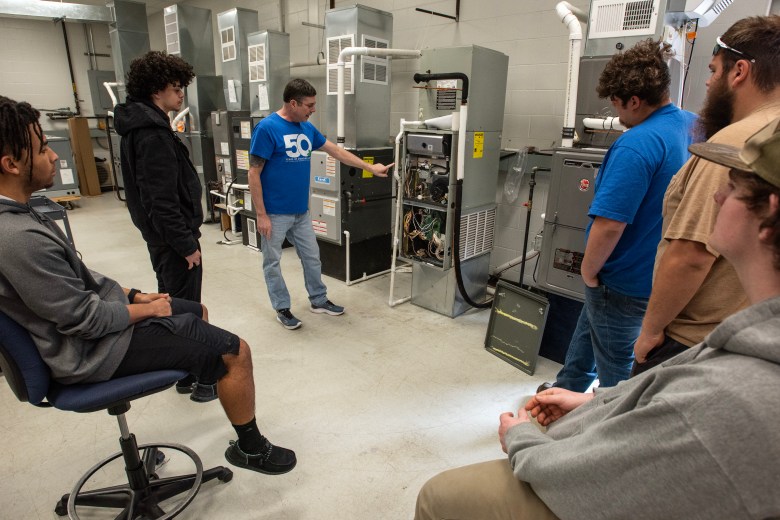
    Karl Evans instructs Richland Community College students on the inner workings of a gas furnace. Credit: Lloyd DeGrane/Canary Media

    Life skills are followed by a construction math course crucial to many clean energy and other trades jobs. During a recent class, 24-year-old Brylan Hodges joked with the teacher while converting fractions to decimals and percentages on the whiteboard. He explained that he moved from St. Louis to Decatur in search of opportunity, and he hopes to become a property manager overseeing solar panel installation and energy-efficiency upgrades on buildings.

    Students take an eight-hour primer in clean energy fields including electric vehicles, solar, HVAC, and home energy auditing. Then they choose a clean energy track to pursue, leading to professional certifications as well as a chance to continue at Richland for an associate degree. Under the state-funded program, students are paid for their time attending classes.

    Related: Students partnered with an EV battery factory to train students and ignite the economy. Trump’s clean energy war complicates their plans

    Marcus James was part of the first cohort to start the program last October, just days after his release from prison.

    He was an 18-year-old living in Memphis, Tennessee, when someone shot at him, as he describes it, and he fired back, with fatal consequences. He was convicted of murder and spent 12 years behind bars. After his release he made his way to Decatur, looking for a safer place to raise his kids. Adjusting to life on the outside wasn’t easy, and he ended up back in prison for a year and a half on DUI and drug possession charges.

    Following his release, he was determined to turn his life around.

    “After I brought my kids up here, I end up going back to prison. But at that moment, I realized, man, I had to change,” James told a crowd at an event celebrating the clean jobs program in March.

    The Rev. Courtney Carson, vice president of external relations at the community college. Credit: Lloyd DeGrane/Canary Media

    James said that at first, he showed up late to every class. But soon the lessons sank in, and he was never late again. He always paid attention when people talked, and he gained new confidence.

    “As long as I put my mind to it, I can do it,” said James, who would like to work as a home energy auditor. Richland partners with the energy utility Ameren to place trainees in such positions.

    “I like being out in the field, learning new stuff, dealing with homes, helping people,” James said, noting he made energy-efficiency improvements to his own home after the course.

    Related: To fill ‘education deserts,’ more states want community colleges to offer bachelor’s degrees

    Illinois’ 2017 Future Energy Jobs Act (FEJA) launched the state’s clean energy transition, baking in equity goals that prioritize opportunities for people who benefited least and were harmed most by the fossil fuel economy. It created programs to deploy solar arrays and provide job training in marginalized and environmental justice communities.

    FEJA’s rollout was rocky. Funding for equity-focused solar installations went unspent while workforce programs struggled to recruit trainees and connect them with jobs. The pandemic didn’t help. The follow-up legislation, CEJA, expanded workforce training programs and remedied snafus in the original law.

    Melissa Gombar is principal director of workforce development programs for Elevate, a Chicago-based national nonprofit organization that oversaw FEJA job training and subcontracts for a Chicago-area CEJA hub. Gombar said many community organizations tasked with running FEJA training programs were relatively small and grassroots, so they had to scramble to build new financial and human resources infrastructure.

    “They have to have certain policies in place for hiring and procurement. The influx of grant money might have doubled their budget,” Gombar said. Meanwhile, the state employees tasked with helping the groups “are really talented and skilled, trying their best, but they’re overburdened because of the large lift.”

    CEJA, by contrast, tapped community colleges like Richland, which already had robust infrastructure and staffing. CEJA also funds community organizations to serve as “navigators,” using the trust and credibility they’ve developed in communities to recruit trainees.

    Richland Community College received $2.6 million from April 2024 through June 2025, and the Community Foundation of Macon County, the hub’s navigator, received $440,000 for the same time period. The other hubs similarly received between $1 million and $3.3 million for the past year, and state officials have said the same level of funding will be allocated for each of the next two years, according to the Illinois Clean Jobs Coalition.

    CEJA hubs also include social service providers that connect trainees with wraparound support; businesses like TCCI that offer jobs; and affiliated entrepreneur incubators that help people start their own clean energy businesses. CEJA also funded apprenticeship and pre-apprenticeship programs with labor unions, which are often a prerequisite for employment in utility-scale solar and wind.

    “The sum of the parts is greater than the whole,” said Drew Keiser, TCCI vice president of global human resources. “The navigator is saying, ‘Hey, I’ve connected with this portion of the population that’s been overlooked or underserved.’ OK, once you get them trained, send their resumes to me, and I’ll get them interviewed. We’re seeing a real pipeline into careers.”

    The hub partners go to great lengths to aid students — for example, coordinating and often paying for transportation, childcare, or even car repairs.

    “If you need some help, they always there for you,” James said.

    Related: Losing faith: Rural, religious colleges are among the most endangered

    In 1984, TCCI began making vehicle compressors in a Decatur plant formerly used to build Sherman tanks during World War II. A few decades later, the company began producing compressors for electric vehicles, which are much more elaborate and sensitive than those for internal combustion engines.

    In August 2023, Gov. JB Pritzker joined TCCI President Richard Demirjian, the Decatur mayor, and college officials for the groundbreaking of an Electric Vehicle Innovation Hub, which will include a climatic research facility — basically a high-tech wind tunnel where companies and researchers from across the world can send EV chargers, batteries, compressors, and other components for testing in extreme temperatures, rain, and wind.

    A $21.3 million capital grant and a $2.2 million electric vehicle incentive from the state are funding the wind tunnel and the new facilities where Richland classes will be held. In 2022, Pritzker announced these investments as furthering the state goal of 1 million EVs on the road by 2030.

    Far from the gritty industrial environs that likely characterized Decatur workplaces of the past, the classrooms at TCCI feature colorful decor, comfortable armchairs, and bright, airy spaces adjacent to pristine high-tech manufacturing floors lined with machines.

    “This hub is a game changer,” said Keiser, noting the need for trained tradespeople. “As a country, we place a lot of emphasis on kids going to college, and maybe we’ve kind of overlooked getting tangible skills in the hands of folks.”

    A marketing firm founded by Kara Demirjian – Richard Demirjian’s sister – and located on-site with TCCI also received clean energy hub funds to promote the training program. This has been crucial to the hub’s success, according to Ariana Bennick, account executive at the firm, DCC Marketing. Its team has developed, tested, and deployed digital billboards, mailers, ads, Facebook events, and other approaches to attract trainees and business partners.

    “Being a part of something here in Decatur that’s really leading the nation in this clean energy initiative is exciting,” Bennick said. “It can be done here in the middle of the cornfields. We want to show people a framework that they can take and scale in other places.”

    With graduation behind him, Honorable is planning the types of hot dogs and sausages he’ll sell at Buns on the Run. He said Tamika Thomas, director of the CEJA program at Richland, has also encouraged him to consider teaching so he can share the clean energy skills he’s learned with others. The world seems wide open with possibilities.

    “A little at a time — I’m going to focus on the tasks in front of me that I’m passionate about, and then see what’s next,” Honorable said. He invoked a favorite scene from the cartoon TV series “The Flintstones,” in which the characters’ leg power, rather than wheels and batteries, propelled vehicles: “Like Fred and Barney, I’ll be up and running.”

    The Hechinger Report provides in-depth, fact-based, unbiased reporting on education that is free to all readers. But that doesn’t mean it’s free to produce. Our work keeps educators and the public informed about pressing issues at schools and on campuses throughout the country. We tell the whole story, even when the details are inconvenient. Help us keep doing that.

    Join us today.

    Source link

  • San Jose Middle School Offers College Class to 13-Year-Olds – The 74

    San Jose Middle School Offers College Class to 13-Year-Olds – The 74


    Get stories like this delivered straight to your inbox. Sign up for The 74 Newsletter

    This story was originally published by CalMatters. Sign up for their newsletters.

    By 2:45 p.m. the regular school day at August Boeger Middle School had already ended, but one class is about to start. More than 20 eighth graders drop their backpacks and settle into desks — not for extra credit but for college credit.

    These 13- and 14-year-old students in East San Jose are taking their first college course, an entry-level class on career planning. This middle school is one of the first in the state to offer a college-level course. In the coming years, the San Jose Evergreen Community College District wants all middle school students in this school district to be able to complete three college courses before they start high school, and soon, the district plans to offer other courses, such as sociology and ethnic studies, said Beatriz Chaidez, the chancellor for the community college district.

    Middle schoolers have long been eligible to enroll in college classes in California, though only a few, high-achieving students actually do it. By offering a college class at a middle school — especially one in a high-poverty area — the community college district is looking to make that enrollment easier. The class is taught by a middle school staff member, and it’s reserved exclusively for middle school students.

    But with so few programs, there is little research about whether students are benefitting, and the local faculty union is worried middle school students might not be ready.

    Chaidez disagrees. “Navigating (college) as early as middle school is unheard of in their community,” she said. “So when they experience success, it really motivates them to continue.”

    California is increasingly pushing high schools to offer community college classes directly to students during the regular school day, a set-up known as “dual enrollment.” Unlike AP classes, which include expensive exams and are limited to certain subjects and high-performing students, these community college classes cover a range of topics and are open to all students. By 2030, California Community Colleges Chancellor Sonya Chiristian wants all high school students to graduate with at least four college courses completed.

    Chaidez wants to go further. She wants every local high school student to be able to complete about 20 college courses by the time they graduate — enough to earn an associate’s degree.

    CalMatters reached out to the college district’s faculty union, which was surprised to learn the district is offering classes at a middle school.

    “This opens up some problems,” said Jessica Breheny, an English professor and the union’s vice president. “I’m sure there are 12-year-olds that are college-ready, but there are just less of them and it’s less likely. Developmentally, they have other things going on.”

    Research shows that high schoolers who take college classes are more likely to attend college and graduate, but there’s little research on how middle school students fare, said John Fink, a senior researcher at Columbia University’s Community College Research Center. “Nationally, and in most states, this is very, very rare, and in many states this is not allowed.” Instead, he said the focus is typically on enrolling more 10th, 11th and 12th graders in college courses.

    A college-level course, with a few middle school games

    About 10% of California’s high school students took a community college class in the 2021-22 school year, according to an analysis by professors at UC Davis using the most recent data. California’s community college system doesn’t track how many middle school students take college courses.

    So far, the Mount Pleasant Elementary School District, which includes August Boeger Middle School, offers only one college course, called “Career Planning,” and it’s almost indistinguishable from any other class on its campus. The college course is taught in a regular middle school classroom, and the professor, Oscar Lamas, already works at the middle school, where he’s a counselor. Perhaps the only noticeable difference is the timing: The middle school day ends at 2:30 p.m. and Lamas’ course starts at 2:45. He’s paid separately by the community college to teach the course.

    Career Planning helps students learn about career paths, practice resume-writing and learn psychological theories related to professional success. A governing board of college district professors, known as the Academic Senate, sets the objectives for each college course, but Lamas has broad discretion in teaching it. The Academic Senate responsible for setting the parameters of Lamas’ course did not respond to multiple requests for comment.

    The dean of the community college’s counseling department, Victor Garza, refused an interview request from CalMatters but issued a written statement. Garza said the middle school class is akin to other dual enrollment courses, which maintain the college’s “academic rigor.”

    “Some adjustments might be needed to cater to the unique needs and experiences” of students, he added.

    On a Thursday before spring break, Lamas tries to make his class more fun by breaking the students into five teams to play a Jeopardy-style quiz game on the topic of the day, Maslow’s Hierarchy of Needs.

    Natalie Mendoza, 14, becomes the default spokesperson of her team, named the “Tacos R Us Club,” but she answers the first question wrong, putting her team back 300 points and prompting her classmates to burst into chatter and analyze their mistakes.

    As part of the class, she has to study a career, write a short essay about it and present it at a career fair. She picked intellectual property law. “A lot of people say I’m assertive,” she said. “I think that’s a really good trait for a lawyer, and I think it’d be fun to fight for people who have created stuff.”

    Natalie said she’d be the first in her family to attend college but she’s already planning to go and has a few schools in mind, including UC Berkeley and San Jose State. If she does attend one of those schools, her grade in this counseling class would be part of her official college transcript.

    Breheny, with the union, said she’s concerned about the quality of the classes, especially once the college district begins teaching other subjects, such as ethnic studies.

    “Faculty designed their courses for adult learners,” Breheny said. An ethnic studies class may cover topics such as sexual violence and genocide, she added — topics that may be difficult to convey to a middle schooler. “Some of the material assumes a certain knowledge about the world, about politics, which you may not have at 11, 12, 13 years old.”

    High schools offer few dual enrollment classes

    August Boeger Middle School sits at the base of the Diablo Range mountains, tucked between the ranch-style homes and strip malls that color East San Jose. Teachers and staff greet each other with mucho gusto instead of hello. All around the open-air campus, murals tell the story of the region’s multi-cultural heritage, especially its Mexican and Chicano roots.

    That celebration of culture is a direct response to a history of adversity, Lamas said. “East San Jose has always been a marginalized, disadvantaged environment.” As a result, schools in the community contend with education disparities, he said, such as a high dropout rate and a high teen pregnancy rate.

    Offering a college class to these middle school students allows them to “see a possibility for their future that doesn’t exist within these walls here” and can inspire them to reach for a higher goal, said Marisa Peña, a school advisor.

    Male students, Black and Latino students and students from rural areas are underrepresented in the community college courses offered at California’s school districts. California lawmakers have signed numerous bills in the hopes of expanding access but certain regions in the state, such as Los Angeles, enroll a higher percentage of students.

    Natalie said she hopes to continue taking college courses when she starts at Mount Pleasant High School this fall, which is just around the corner from her middle school. But her options are limited.

    Mount Pleasant High School offers just three community college courses, which serve about 10% of the school’s roughly 1,000 students, said Kyle Kleckner, the school district’s director of instructional services. All of the classes are in “multimedia” studies, he said, which teaches students how to create their own podcasts or YouTube channels, along with other digital marketing skills. 

    Although Mount Pleasant High School’s dual enrollment is about on par with the state average, it trails other districts in the region. Less than 20 miles away, at high schools in the Milpitas Unified School District, roughly 25% of students enrolled in a community college class in 2021-22, according to the UC Davis analysis.

    Finding professors to teach middle school

    Part of the dual enrollment challenge is finding qualified college professors who are willing and able to work at a high school or middle school. Existing middle and high school teachers are allowed to teach college courses but they have to meet the qualifications, which usually include a master’s degree in the area of instruction. Most of California’s high school and middle school instructors lack a master’s degree, according to a study by the Public Policy Institute of California.

    “We have graduation requirements that students have to accomplish,” Kleckner said. “The trick is finding that community college course that also fulfills those requirements and also finding a teacher who can teach it.” He said Mount Pleasant High School is committed to expanding the number of college courses but noted that it’s smaller and therefore has fewer teachers who meet the requirements to teach a college course.

    In turn, many college professors lack experience teaching children, said Breheny, who teaches at San Jose City College. “We have had some problems already with dual enrollment where faculty have gone to different (high schools) to teach and have dealt with classroom management issues that they wouldn’t have in a college course.” In one case, she said a college faculty member saw bullying in a high school classroom but didn’t feel equipped to respond.

    Lamas has a master’s degree, which is required for most school counselors. He’s gentle with the middle school students in his class, occasionally awarding points in the Jeopardy game even when the answer isn’t perfect. Lamas had two quiz games planned that day, each one covering a different topic, but the first game took up almost all of the class time.

    He ends class by taking questions about the upcoming final project. Although spring break is minutes away, the students sit still through the final minutes, except for the occasional joke and bursts of laughter. Not a single phone was in sight.

    Once class ends, however, chatter ensues, the students pull out their phones, and staff escort them to the parking lot. While they may be taking a college course, they still must wait for their parents to pick them up.

    This article was originally published on CalMatters and was republished under the Creative Commons Attribution-NonCommercial-NoDerivatives license.


    Get stories like these delivered straight to your inbox. Sign up for The 74 Newsletter

    Source link

  • To fill “education deserts,” some states want community colleges to offer bachelor’s degrees

    To fill “education deserts,” some states want community colleges to offer bachelor’s degrees

    MUSCATINE, Iowa — The suspect moved menacingly toward her, but Elexiana Oliva stood her ground, gun drawn and in a half crouch as she calmly tried to talk him down.

    The confrontation wasn’t real, and neither was the gun. But the lesson was deadly serious.

    Oliva is a criminal justice major at Muscatine Community College in this largely agricultural community along the Mississippi River. She was in a simulation lab, with that scenario projected on a screen as classmates watched, spellbound.

    Just 18, Oliva is determined to become a police detective, a plan that includes earning a bachelor’s degree after she finishes her associate degree here. But she’ll have to go somewhere else to do it — likely, in her case, to a university in Texas.

    Oliva and her classmates here are among the 13 million adults across the country who the American Council on Education estimates live beyond a reasonable commute from the nearest four-year university — a problem getting worse as private colleges in rural places close, public university campuses merge or shut down and rural universities cut majors and programs.

    “It’s not our fault that we grew up in a place where there’s not a lot of big colleges and big universities,” Oliva said.

    Related: Interested in innovations in higher education? Subscribe to our free biweekly higher education newsletter.

    Iowa has joined a growing number of states that are considering letting community colleges like this one offer bachelor’s degrees, or where community colleges have already started adding them, as a way of filling these so-called rural higher education deserts and training workers in rural places for jobs in fields where there are growing shortages.

    “It would be a big game-changer, especially for those who have a low income or a medium income and want to go and further our education,” Oliva said.

    Downtown Muscatine, Iowa. About an hour from the nearest public university, Muscatine could benefit from a proposal to let community colleges offer bachelor’s degrees. Credit: Mike Rundle for The Hechinger Report

    About half of states allow community colleges to offer bachelor’s degrees. In Iowa, which is among the half that don’t, lawmakers have commissioned a study to determine whether it should add bachelor’s degrees in some programs at the state’s 15 community colleges. An interim report is due in May.

    A similar proposal in Illinois is backed by that state’s governor, JB Pritzker, who has said the move would make it easier and more affordable for residents to get degrees — “particularly working adults in rural communities.” Three-quarters of community college students in Illinois said they would pursue bachelor’s degrees if they could do it on the same campus, according to a survey released by Pritzker’s office.

    Kentucky’s legislature is considering converting one technical and community college into a four-year institution offering both technical and bachelor’s degrees. Some Wyoming community colleges have also added a limited number of bachelors degrees.

    And in Texas, Temple College will open a center in June where students at the two-year public institution will be able to earn bachelor’s degrees through partner Texas A&M University-Central Texas, including in engineering technology with a concentration in semiconductors.

    “When you can offer university classes on community college campuses, that makes a world of difference” to rural students, said Christy Ponce, the president of Temple.

    What’s been blocking many of these students from continuing their educations, Ponce said, “is the sheer distance. There’s not a public university option within an hour or more away. And affordability and transportation barriers are huge issues.”

    Fewer than 25 percent of rural Americans hold bachelor’s degrees or higher, according to the National Center for Education Statistics, compared to the national average of 33 percent. And the gap is getting wider, the U.S. Department of Agriculture finds in its most recent analysis of this.

    Related: ‘Easy to just write us off’: Rural students’ choices shrink as colleges slash majors

    Significantly fewer students in rural places than in urban areas believe that they can get degrees, a Gallup survey for the Walton Family Foundation found, citing the lack of nearby four-year universities as a principal reason.

    In those states that already allow community colleges to offer bachelor’s degrees, they’re often limited to certain high-demand fields, such as teaching and nursing. Even as this idea has spread, America’s 960 public community colleges collectively confer only about 1 percent of bachelor’s degrees each year, the American Association of Community Colleges reports.

    In many places, what’s stopping them from giving out more is opposition from four-year universities and colleges, many of which are increasingly hard up for students as the number of 18-year-olds begins to fall — a phenomenon enrollment managers have dubbed the demographic cliff.

    That Illinois proposal, for example, is stalled in committee after several public and private university presidents issued a statement opposing it. Negotiations are continuing.

    While community colleges in California have been allowed since 2021 to offer bachelor’s degrees, several have been blocked from adding four-year programs that the California State University System contends it already offers. An independent mediator has been brought in to resolve the impasse.

    Related: Fewer students and fewer dollars mean states face closing public universities and colleges 

    And while the two-year, public College of Western Idaho will launch a bachelor’s degree in business administration in the fall, it’s doing so only over the objections of Boise State University, which said it “could hurt effective and efficient postsecondary education in Idaho, cannibalizing limited resources available to postsecondary education and duplicating degree offerings.”

    Community colleges also need more students; their enrollment declined by 39 percent from 2010 to 2021, and they face that same impending demographic cliff. Those that add bachelor’s degrees increase their full-time enrollment from 11 percent to 16 percent, research conducted at the University of Michigan has found.

    The Norbert F. Beckey Bridge, seen from the Mark Twain Overlook in Muscatine, Iowa, which links Muscatine with Rock Island County, Illinois, across the Mississippi River. Credit: Mike Rundle for The Hechinger Report

    The principal impetus for the largely bipartisan push to offer bachelor’s degrees at community colleges, however, is to train more workers for those fields in which there are shortages.

    “What I think is misunderstood is that, in general, these are not like the baccalaureates that conventional four-year institutions offer,” said Davis Jenkins, a senior research scholar at the Community College Research Center at Teachers College, Columbia University. (The Hechinger Report, which produced this story, is an independent unit of Teachers College.)

    Related: In this tiny and shrinking Mississippi county, getting a college degree means leaving home behind

    Bachelor’s degrees at community colleges, said Jenkins, “meet an economic need for bachelor’s degree graduates that isn’t being met by other institutions.”

    That includes by helping rural workers move up in their jobs without leaving home. “It’s all about serving our workforce needs,” said Iowa state Rep. Taylor Collins, Republican chair of Iowa’s House Committee on Higher Education, who requested the study into whether bachelor’s degrees should be offered at community colleges in that state. “It’s a way to upskill our workforce.”

    In his own district, south of Muscatine, “we’re kind of on an island where we only have the community college” — especially since the closing of nearby private Iowa Wesleyan University in 2023. “There are a lot of students who are place-bound. There are a lot of students who want to live locally” and not move away to get a bachelor’s degree.

    That’s a focus of the ongoing study, said Emily Shields, executive director of Community Colleges for Iowa, which is conducting it. “Sometimes people have ties, responsibilities, jobs, family things, where moving to where there is a degree available isn’t an option for them,” Shields said.

    Sure, she said, rural students can take courses online. But “you’re not getting the student services, you’re not getting activities, you’re not getting the other sort of enrichment support and belonging that a lot of our students, I think, are looking for.” 

    Many also say they’re looking for the kind of individual attention they get in their hometown and at a community college such as the one in Muscatine, which has an enrollment of 1,800.

    Related: Tribal colleges win reprieve from federal staff cuts

    Shiloh Morter stayed in his hometown of Muscatine, Iowa, to go to community college. Among the advantages, he says: “The sunsets here are pretty nice. I can tell you, there’s not a whole lot of other places that have clouds like we do.” Credit: Mike Rundle for The Hechinger Report

    Shiloh Morter bikes to campus on all but the very coldest days. He plans to become an engineer, but “figured I would save the money and go to community college and try and branch out and develop better habits” first, said Morter, who is 20.

    In the automotive technology garage off the main corridor of the small school, cars were lined up neatly with their hoods popped. Nursing students worked on anatomically correct crash test dummy-style “patients.”

    Twenty-year-old Mykenah Pothoff enrolled at the college when it debuted a registered nursing program, saving herself money on tuition and a nearly hourlong drive, each way, to the University of Iowa. She also was worried about “just, like, finding my way around” the university, which has more than 30,000 students.

    Jake Siefers is majoring in psychology at an Iowa community college. If he could stay and get his bachelor’s degree in the same place, “it would be huge,” he says. “There’s a lot of untapped human potential” in rural places that could benefit from more access to higher education. Credit: Mike Rundle for The Hechinger Report

    Jake Siefers, 32, is a psychology major planning to go on to get bachelor’s and master’s degrees. Siefers said he hopes to help other people who, like him, are recovering from alcoholism, and for whom he said there are too few services in Iowa. So he came home to Muscatine to start working toward an associate degree at the community college.

    I could afford it, and it was close and I actually know a lot of people that work here,” said Siefers. “It’s great coming in here and being, like, ‘Hey, I went to high school with you, and you work in the office.’ I mean, that’s everyone in Iowa, right?”

    If he could stay and get his bachelor’s degree in Muscatine, “it would be huge,” he said. “There’s a lot of untapped human potential” in rural places that could benefit from the kind of access to a higher education that is now more limited, said Siefers. 

    Letting students like them finish bachelor’s degrees near where they live “would make it easier for everybody,” said Jaylea Perez, 19, another psychology major who also plans to earn one.

    Jaylea Perez is enrolled in community college in Iowa but eventually hopes to earn a bachelor’s degree in psychology. Adding bachelor’s degrees at community colleges “would make it easier for everybody,” she says. Credit: Mike Rundle for The Hechinger Report

    Simply having bachelor’s degrees available would make rural students aspire to them who otherwise might not, said Naomi DeWinter, president of Muscatine Community College.

    “Everything opens up to them,” said DeWinter, in a coffee shop across the highway from the Walmart.

    She sees the most potential among people already working, such as paraprofessionals in schools who want to become teachers; a state job board lists nearly 1,000 vacancies in Iowa for teachers.

    DeWinter recalled a graduate so exemplary that he was featured in a promotional video, who after earning his associate degree started substitute-teaching while commuting in his free time to the University of Iowa to get his bachelor’s degree — one course at a time.

    “He said, ‘That’s how I’m juggling my work, my family and the affordability,’ ” she said. “His whole career is going to be over before he’s a [full-time] teacher. I feel as though we failed him.”

    Like the substitute teacher, students said they want to stay in Muscatine, despite those limits. They like the peace and quiet compared to cities — hardly anyone ever honks, they noted — and the sense of community evident among the friends who run into each other at the Hy-Vee.

    “We don’t have the best view of the Milky Way, but we for sure definitely don’t have a bad one,” said Shiloh Morter, ticking down a list of advantages to living on the sweeping plain carpeted with cultivated fields and dotted with barns and silos. “And, yeah, the sunsets here are pretty nice. I can tell you, there’s not a whole lot of other places that have clouds like we do.”

    Contact writer Jon Marcus at 212-678-7556 or [email protected].

    This story about rural higher education and community college bachelor’s degrees was produced by The Hechinger Report, a nonprofit, independent news organization focused on inequality and innovation in education. Sign up for our higher education newsletter. Listen to our higher education podcast.

    The Hechinger Report provides in-depth, fact-based, unbiased reporting on education that is free to all readers. But that doesn't mean it's free to produce. Our work keeps educators and the public informed about pressing issues at schools and on campuses throughout the country. We tell the whole story, even when the details are inconvenient. Help us keep doing that.

    Join us today.


    Source link

  • What borrowers need to know

    What borrowers need to know

    After a five-year pause, the Trump administration is bringing back financial penalties for the many millions of borrowers who are too far behind on their student loan payments. It’s led to confusion and financial uncertainty. 

    At least 5 million people are in default, meaning they have failed to make payments on their loans for at least nine months — and millions more are projected to join them in the coming months.

    The Hechinger Report spoke to student loan experts about what to expect and how to prepare, as well as about a separate effort in Congress to adjust how student loans work.

    The Biden administration restarted loan repayments in October 2023. That came without any consequences, however, for about a year. But interest, which had also been frozen since the start of the pandemic, has been piling up for some borrowers since the fall of 2023.

    All told, about 43 million federal student loan borrowers owe a total of $1.6 trillion in debt. Starting May 5, those in default face having tax refunds withheld and wages garnished if they don’t start making regular payments.

    A college degree can be a path to long-term financial security, but the process of repaying loans can lead to financial hardship for many borrowers. About half of all students with a bachelor’s degree graduate with debt, which averages more than $29,000. And although average debt tends to be lower for graduates of public universities (about $20,000), close to half of people who attend those schools still leave with debt.

    Related: Interested in more news about colleges and universities? Subscribe to our free biweekly higher education newsletter.

    The student loan landscape is likely to change in some way over in the coming months: The Trump administration is expected to push the limits on aggressive collection practices, while Republicans in Congress are determined to adjust repayment options. Here’s what we know about what the Trump administration’s actions mean for student borrowers.

    If you have questions we haven’t answered here, tell us: [email protected]. Or reach us securely and privately using options on this page.

    What happens if I don’t start repaying my loan?

    Once you’ve failed to make a loan payment in 270 days, you will probably enter into default. That means, as of May 5, the government can take your federal tax refund and apply it to your debt. Starting in June, the government can also withhold up to 15 percent of any money you receive from Social Security, including disability payments. And later this summer, officials said, they will start the process of taking a cut of your paycheck, although borrowers have the right to appeal. Going into default can also harm your credit score, which can make it harder to rent an apartment or borrow money for other reasons, like buying a car.

    Can I go back to school to avoid repaying my loans?

    Some influencers on social media have recommended enrolling in school as a way to delay making payments. It’s true that most loans are deferred while you’re in school, meaning you wouldn’t have to pay while you’re taking classes, but you may also add to what you already owe if you spend more time in college. Unless you’re confident a new certificate or degree will boost your income, delaying repayment and increasing what you owe could make paying off your loans even more difficult. 

    I can’t afford to repay my loan. What should I do?

    There are other options. One type links your monthly payments to what you earn. These income-based repayment plans can shrink your monthly loan bill. There is also a graduated repayment plan that can lower your payments initially, after which they increase every two years. A third option is an extended repayment plan, which lowers your monthly payments but adds months or years to the time it will take to pay off your loans. The government’s Loan Simulator is one way to find options available to you. 

    Where can I go if I need help?

    The Education Department’s Default Resolution Group can help provide advice for borrowers who are already in default. The Federal Student Aid call center is set up to answer questions. Borrowers can also reach out to their loan servicers for guidance.

    Related: The Hechinger Report’s Tuition Tracker helps reveal the real cost of college

    What’s the difference between loan deferment, loan forbearance and default?

    • Loan deferment: The Education Department may grant a loan deferment for several reasons, including when a borrower is experiencing an extreme economic hardship or is unemployed. That means the borrower can temporarily stop paying off the loan without any financial penalties; in the case of subsidized undergraduate loans, interest doesn’t keep accruing during that time. 
    • Forbearance: A loan forbearance also allows a borrower to stop payments, or make smaller ones, without any penalties. However, interest usually keeps building on all loans during that time. 
    • Default: If a borrower is in default, it means they have failed to make payments for at least 270 days without permission. That’s when the government can begin to garnish tax refunds, Social Security benefits and wages, and a borrower’s credit score will drop.

    I’ve heard income-driven repayment plans are in trouble. Is that true?

    There are several types of income-driven repayment plans, which are meant to keep payments affordable. The Biden administration’s Saving for a Valuable Education (SAVE) plan is on hold because of legal challenges from Republican-led states. That plan previously offered eligible borrowers a repayment plan with lower monthly payments and a quicker path to loan forgiveness than other previously available options. But borrowers can still enroll in the Pay As You Earn (PAYE) plan and other income-based repayment options, in which payments are capped at 10 percent of a borrower’s income, or the Income-Contingent Repayment Plan, which requires payments of up to 20 percent of income and allows full repayment more quickly. Congressional Republicans hope to eliminate several of these plans in favor of just one income-based repayment plan, but it’s unclear if that bill will pass the Senate.

    Related: College Uncovered: The Borrowers’ Lament 

    What’s happening with the court cases challenging the SAVE program? 

    Courts have effectively paused the SAVE plan. The 8 million borrowers who are enrolled don’t have to make payments, and interest will not be added while the court decides the case. With those payments paused, borrowers in this group who are intending to seek loan forgiveness for working in public service are also not making progress toward that goal. If Congress eliminates the SAVE program or the courts officially kill it, those borrowers would need to enroll in a different repayment plan.

    Does Public Service Loan Forgiveness (PSLF) still exist?

    Yes, the Public Service Loan Forgiveness program is still available. Borrowers should still be eligible if they are in an income-driven repayment plan and make regular payments for 10 years. They must work for the federal, state or local government — teachers and firefighters are eligible, for example — or for qualifying nonprofit organizations, such as some health care clinics or foster care agencies. The goal of PSLF is to encourage graduates to pursue careers that may pay less than jobs with private companies but which benefit their communities or the country as a whole. 

    The Trump administration issued an executive order in March aimed at limiting which organizations’ jobs could qualify for PSLF — for instance, a nonprofit could be excluded if the government decides it is “supporting terrorism,” engaging in civil disobedience or aiding undocumented immigrants in violation of federal law. So far, it’s unclear what the effect will be.

    Related: Student loan borrowers misled by colleges were about to get relief. Trump fired people poised to help

    What other changes might be in store for student loans?

    As part of the federal budget process, congressional Republicans have proposed a slew of changes to student loans that some policymakers worry will make borrowing more expensive for students — especially those in graduate programs. 

    The proposals include changes to: 

    • Subsidized loans: Congressional Republicans want to get rid of subsidized loans for undergraduates, which would mean interest would accrue while a student was in college. They also want to cap total undergraduate borrowing at $50,000. 
    • Grad Plus: They also want to end the Grad Plus program, which allows students to borrow money to cover the cost of graduate school. Student advocates worry that this would push more students into the private student loan market, which has fewer protections for borrowers. 
    • Income-driven repayment: One proposal would simplify income-driven repayment into one option and prevent interest from causing student debt to balloon for students in income-driven repayment plans. 

    The proposed changes are included in the federal budget bill and may undergo many revisions as Congress figures out its spending priorities for the year.

    Contact senior investigative reporter Meredith Kolodner at 212-870-1063 or [email protected] or on Signal at merkolodner.04

    This story about student loan repayment was produced by The Hechinger Report, a nonprofit, independent news organization focused on inequality and innovation in education. Sign up for the Hechinger newsletter.

    The Hechinger Report provides in-depth, fact-based, unbiased reporting on education that is free to all readers. But that doesn’t mean it’s free to produce. Our work keeps educators and the public informed about pressing issues at schools and on campuses throughout the country. We tell the whole story, even when the details are inconvenient. Help us keep doing that.

    Join us today.

    Source link