Tag: Compact

  • Alabama HBCU Shows Interest in Trump’s Compact

    Alabama HBCU Shows Interest in Trump’s Compact

    Oakwood University supports the Trump administration’s controversial compact for higher education that would require signatories to make changes to their policies in order to receive a potential edge in federal funding, Religion News Service (RNS) reported.

    The historically Black university in Alabama wrote a Nov. 18 letter to the Education Department about its interest in the compact. Oakwood is the second HBCU to show interest in signing on. Like the other HBCU, Saint Augustine’s University, Oakwood officials say the compact needs to change for them to actually sign it. 

    Of concern for the HBCUS are provisions that would cap undergraduate international student enrollment at 15 percent, require a five-year tuition freeze and limit the use of race in admissions and other decisions.

     “While we strongly support the Compact’s overarching goals, several provisions of the draft framework raise important concerns that, if left unaddressed, could unintendedly hinder HBCUs’ ability to participate fully or effectively,” Oakwood President Gina Brown wrote in the letter, according to RNS. “Absent a mission-based exemption, HBCUs would face an untenable choice between compliance and fulfilling their congressionally mandated purpose.”

    Oakwood is affiliated with the Seventh Day Adventist Church, and RNS noted that faith-based institutions would still be able to consider religion in admissions and hiring.

    The Trump administration invited nine universities to give feedback on the proposed compact. Most of that group declined outright to sign it, saying that federal funding should be based on merit, not adherence to a president’s priorities. Since then, New College of Florida, Valley Forge Military College and Saint Augustine’s have indicated interest in joining the compact.

    Source link

  • St. Augustine’s Offers to Help Shape Trump’s Compact

    St. Augustine’s Offers to Help Shape Trump’s Compact

    Saint Augustine’s University

    Saint Augustine’s University, a historically Black college in North Carolina, has expressed interest in signing the Trump administration’s higher ed compact, Fox News reported, joining New College of Florida and Valley Forge Military College.

    However, Verjanis Peoples, the interim president of Saint Augustine’s University, and board chair Sophie Gibson wrote in a letter to the Education Department that several provisions of the proposed compact are not “compatible with the statutory mission and federal mandate under which HBCUs operate.” Those include restrictions on the use of race in admissions or for financial support. 

    “As noted in our institutional analysis, such provisions would unintentionally force HBCUs to choose between compliance and survival, a position that is neither feasible nor consistent with congressional intent,” wrote Peoples and Gibson in a letter posted by Fox News. 

    Other requirements that raise concerns include a cap on international students and a five-year tuition freeze. “Without mission-sensitive accommodations, these sections risk unintended consequences that would impede our ability to serve students effectively,” they added.

    Saint Augustine’s has struggled in recent years amid declining enrollment and financial challenges. The university had 175 students as of October 2024; more recent enrollment figures aren’t available. Late last year, Saint Augustine’s lost its accreditation, though a federal court overturned that decision. Classes were held online this fall. 

    The 158-year-old university is the first HBCU to show interest in the compact, which would require colleges to make a number of changes to their policies and practices in exchange for potential benefits such as an edge in federal grant competitions. The Trump administration first invited nine universities to give feedback on the document, and none in the group decided to sign on. Since the proposal was made public in early October, several universities have rejected it, arguing the federal funding should be based on merit—not adherence to a president’s priorities.

    The administration has initially aimed to finalize the compact by Nov. 21, but that deadline has reportedly been extended.

    Peoples and Gibson wrote that they support the compact’s goal to strengthen academic excellence, accountability and transparency in higher ed, and they see alignment between Saint Augustine’s historic mission and the administration’s proposal.

    Despite their other reservations, “Saint Augustine’s University remains eager to participate as a constructive partner and early-engagement institution,” they wrote. They asked the department to work with HBCUs to shape a final agreement that upholds “both the letter and spirit of the Compact while safeguarding our statutory purpose.”

    Source link

  • Public Universities Don’t Want to Discuss the Compact

    Public Universities Don’t Want to Discuss the Compact

    As the stated deadline to sign the “Compact for Academic Excellence in Higher Education” arrived Friday, multiple universities have already rejected the deal while only a few institutions have expressed interest.

    But among the public universities that were either formally invited to sign the compact or that participated in a call with the White House to provide feedback on higher education issues, none are willing to discuss their deliberations about the proposal or interactions with federal officials.

    Last month, Inside Higher Ed sent public records requests to Arizona State University, the University of Arizona, the University of Kansas, the University of Texas at Austin and the University of Virginia, seeking emails, text messages, internal presentations and other documents related to how presidents, trustees and other officials discussed the compact.

    As of Friday, none had provided those records. Only the University of Kansas indicated a willingness to do so, but it requested an up-front $100 fee for staff time to conduct the search. However, officials said they could not guarantee the requested records would be provided.

    Texas, meanwhile, has appealed to the state attorney general to avoid releasing the requested records. Now uncertainty abounds about what UT Austin will do on the day of the initial deadline, though conservative media has reported the Trump administration could push that date back (which officials did not confirm Thursday) as it struggles to find signatories.

    Texas

    Some public universities, such as Arizona and Virginia, have rejected the compact outright, but others, like Arizona State, have noted they never received a formal invitation to join and therefore they have nothing to decline. But UT Austin has remained silent about whether it will sign the compact.

    Although University of Texas system Board of Regents chairman Kevin P. Eltife issued an early statement saying that he welcomed the “the new opportunity presented to us and we look forward to working with the Trump Administration on it,” officials have said little since then.

    In response to an Oct. 22 public records request from Inside Higher Ed, UT Austin shared only the initial emails exchanged by federal and university officials inviting the university to consider the compact, a copy of the proposal itself, and Eltife’s statement. The rest it wants to keep private.

    UT system officials argued in a letter sent Tuesday to the attorney general’s office that the requested records are protected by attorney-client privilege and should not be disclosed.

    “In the information at issue, University and UT System attorneys are providing legal counsel, gathering information in order to provide legal counsel, or their clients are seeking legal advice from the attorneys and include the necessary background information so that counsel will be able to render an opinion on a given situation,” UT system attorney Jennifer Burnett wrote in the letter. “From the text of the communications, it is evident that the University and UT System attorneys for were [sic] involved in providing legal counsel to employees of the University.”

    Now the attorney general’s office has 10 business days to make a determination on the request.

    Gunita Singh, a staff attorney for the Reporters Committee for Freedom of the Press, told Inside Higher Ed by email that the university “is within its rights to argue that the records are privileged but they need to make a particularized showing that that is the case,” proving the requested documents “pertain to the provision of legal advice” and have been confidential at all times.

    Virginia

    The University of Virginia has yet to provide documents requested Oct. 22 in what appears to be a pattern of delayed responses, according to others who sought records from the public university in recent months.

    UVA’s student newspaper, The Cavalier Daily, reported that it has submitted 25 public records requests to the university, but UVA officials have reportedly not provided records since July 1. Other journalists across the commonwealth have taken to social media to note that they have struggled to get information on athletic staffing and internal communications.

    State Senator Creigh Deeds, a Democrat who has represented the Charlottesville area for more than two decades, also struggled to get public records out of the university related to the resignation of former UVA president Jim Ryan, who stepped down in June under federal pressure. Deeds initially reached out to the university Aug. 1 seeking information, which he only obtained after submitting a public records request and paying $4,500 for the documents.

    Chris Seaman, a law professor at Washington and Lee University, requested public records related to costs for outside legal counsel on July 2. But Seaman still has not “received a substantive response from UVA regarding my FOIA request,” he told Inside Higher Ed by email. In an August email exchange shared by Seaman, a UVA official noted a delay in processing his request and wrote that “in the last few weeks, our office has received an unusually large volume of requests with limited staff to process them.” They also promised to “expedite handling” of his request, but more than three months later, Seaman said, he is still awaiting those documents.

    UVA spokesperson Brian Coy did not address the pattern of delays in a response to Inside Higher Ed, writing that the university “has received this request and is processing it in accordance with Virginia law” and is “preparing an estimate of anticipated costs” for review.

    Arizona and Arizona State

    Public records requests at Arizona State and the University of Arizona also remain unfulfilled after 30 days.

    Arizona State spokesperson Jerry Gonzalez said that he would check on the state of the request but noted that ASU was not invited to sign the compact, and so “there is nothing for the university to accept, reject, or negotiate.” (However, President Michael Crow has said he’s had discussions with Education Secretary Linda McMahon and other officials about higher education issues.)

    University of Arizona spokesperson Mitch Zak said that Inside Higher Ed’s public records request “remains in process” and “response time varies.” He noted that factors such as “the specificity of the request, the volume of requests received, and the time required to locate, review, and redact materials subject to disclosure” all shape public records response times.

    Arizona law does not specify how long public entities have to hand over documents but instructs that they do so “promptly.” Singh, the RCFP attorney, pointed to past legal cases in which Arizona courts found that 24 business days “satisfied the promptness standard” but that “a delay of 49 days, or 34 working days, did not meet the promptness standard” outlined in state law.

    Currently, she said, Arizona and Arizona State are “inching toward noncompliance territory.”

    Source link

  • St. Augustine’s expresses interest in Trump compact — with big caveats

    St. Augustine’s expresses interest in Trump compact — with big caveats

    This audio is auto-generated. Please let us know if you have feedback.

    Dive Brief:

    • Saint Augustine’s University told the U.S. Department of Education that it wants to “participate in and help shape” the Trump administration’s proposed compact that seeks to control a range of academic and operational policies in exchange for preferential access to federal funding.
    • However, leaders from the historically Black institution caveated their support over concerns that aspects of the compact as written “risk unintended consequences that would impede our ability to serve students effectively.”
    • “Despite these concerns, Saint Augustine’s University remains eager to participate as a constructive partner and early-engagement institution,” the leaders of the private North Carolina university said in a letter obtained by Fox News. They requested “a dialogue process” with the Education Department to facilitate “mission-sensitive accommodations” for HBCUs.

    Dive Insight:

    Last month, the Trump administration offered nine high-profile research colleges a deal — priority for federal grants in exchange for enacting a wide range of policies aligning with the president’s higher education goals.

    Some of the compact’s terms, while unprecedented, are straightforward, such as freezing tuition rates for five years, requiring standardized testing for undergraduate applicants, and capping international students’ share of undergraduate enrollment at 15%. 

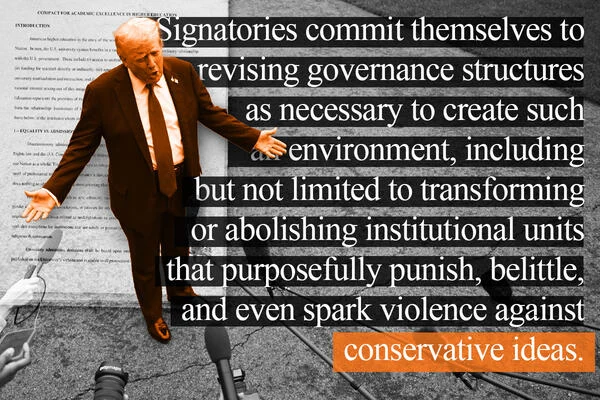
    Others go beyond cut-and-dry policy changes, such as publicly auditing the viewpoints of employees and students and potentially changing or ending campus units that purposefully “punish” or “belittle” conservative ideas.

    Seven of the initially invited colleges rejected the deal, and, as of Thursday afternoon, the remaining two have yet to publicly accept or decline the offer.

    But a few colleges have sought to take their place after President Donald Trump appeared to open the compact offer to all higher ed institutions. 

    Saint Augustine’s letter makes it the third college — and the first HBCU — to publicly express interest in the bargain.

    The New College of Florida — in a move in line with its conservative makeover under Florida Gov. Ron DeSantis — became the first college to publicly volunteer to sign the compact on Oct. 27. The following day, Valley Forge Military College offered to accept the deal as well, according to The Philadelphia Inquirer.

    But unlike New College and the military college, Saint Augustine’s did not give the proposed compact a full-throated endorsement.

    Neither the Education Department nor the university responded to questions Thursday.

    Verjanis Peoples, the university’s newly appointed interim president, and Sophie Gibson, chair of its board of trustees, warned that the compact as written is “not compatible with the statutory mission and federal mandate under which HBCUs operate.”

    “Because our mission is not ornamental but foundational, we cannot implement requirements that would directly conflict with our identity as a Historically Black University or undermine our ability to serve the populations for whom we were created,” they wrote in their letter, which Fox News reported as being sent to the Education Department on Wednesday.

    Peoples and Gibson cited a handful of the compact’s provisions, including one requiring signatories to not consider race, sex, religion and other characteristics “explicitly or implicitly” in admissions or financial aid. 

    The pair said the restriction, “while well intentioned,” conflicts with Title III of the Higher Education Act, which in part provides colleges grant funding and establishes a program meant to strengthen HBCUs. The Trump administration’s proposed deal would also run contrary to “the explicit purpose of HBCUs to expand access for Black students and historically marginalized communities,” they said.

    The compact said it would grant exceptions for religious and single-sex institutions to limit admissions based on religious belief and sex, respectively, but did not address HBCUs.

    Other elements of the Trump administration’s proposal could also hinder HBCUs, Peoples and Gibson said. 

    These colleges typically maintain smaller endowments and would have a difficult time absorbing the costs of a tuition freeze. A cap on international enrollment would disproportionately hit HBCUs, which have “global partnerships across the African diaspora,” they said.

    Saint Augustine’s leaders also flagged a compact provision that would require colleges to adopt definitions of gender and sex in step with Trump’s executive order saying the federal government would only recognize two sexes, male and female, that cannot be changed. These definitions have been rebuked by the scientific and medical communities.

    HBCUs could face operational challenges if they adopt this language given their “inclusive campus policies shaped by both community needs and regulatory frameworks,” the letter said.

    “Such provisions would unintentionally force HBCUs to choose between compliance and survival, a position that is neither feasible nor consistent with congressional intent,” Peoples and Gibson said.

    Should the Trump administration take Saint Augustine’s up on its offer, the embattled university could gain a financial lifeline amidst ongoing operational turmoil.

    In recent years, Saint Augustine’s has had its accreditation revoked, then reinstated, then revoked again. The university is operating as an accredited institution this fall because of a preliminary court injunction temporarily reversing the latest revocation.

    The university’s accreditor, Southern Association of Colleges and Schools Commission on Colleges, has raised concerns over its finances and governance.

    Saint Augustine’s has attempted different tactics to address its ongoing budget issues, including pursuing land lease deals, taking out loans and drastically cutting its workforce.

    Source link

  • UNC Chapel Hill Won’t Sign Compact

    UNC Chapel Hill Won’t Sign Compact

    The University of North Carolina at Chapel Hill made clear Friday that it won’t sign the federal “Compact for Academic Excellence in Higher Education” that has been extended to all institutions after seven of the original nine universities invited rejected the offer, WRAL reported

    Last month the Trump administration floated a plan for preferential treatment on federal funding in exchange for universities overhauling admissions and hiring practices, freezing tuition for five years, capping international enrollment at 15 percent, and making various other concessions that many critics have warned will undermine academic freedom.

    UNC Chapel Hill chancellor Lee Roberts said Friday that while the university has not received a formal invitation from the Trump administration, he is not interested in the arrangement.

    “There are some parts of the compact that we are already doing and there are some parts that would be difficult or impossible,” Roberts said in a faculty council meeting, according to WRAL. “There’s no way we can sign the compact as written and we don’t plan to.”

    Invitations to the compact were initially sent to Brown University, Dartmouth College, the Massachusetts Institute of Technology, the University of Arizona, the University of Pennsylvania, the University of Southern California, the University of Texas at Austin, the University of Virginia and Vanderbilt University. All but two declined—Vanderbilt said it would provide feedback and Texas has yet to offer a public response.

    Multiple others also announced pre-emptive rejections after the initial invitation went out, including Emory University, Pennsylvania State University, Syracuse University and the University of Kansas. So far, only two institutions have announced intentions to sign the compact: New College of Florida and Valley Forge Military College in Pennsylvania.

    Source link

  • Securing educational excellence may demand a new leadership compact

    Securing educational excellence may demand a new leadership compact

    When education leaders describe their institutions as being in “existential crisis” or on a “wartime footing,” you know that something important is happening.

    A new report, “Securing educational excellence in higher education at a time of change,” from Wonkhe and Advance HE, based on roundtable discussions with 11 institutional leaders, 15 principal fellows of Advance HE, and three student representatives held in March 2025, explores institutional interpretation of and responses to change, and asks what measures should be taken to secure educational excellence for what could be quite a different future.

    While institutions are understandably focused on managing their immediate pressures, with, in some cases, institutional survival at stake, sustainability means little without the long-term mission of inclusive, high-quality learning that prepares students for their future lives. While financial security would help, the changes higher education is navigating require a deeper consideration of how institutions make decisions, deploy expertise, and engage their communities.

    The report maps four critical tensions that leaders are navigating across the political, economic, social and technological domains: public trust versus sector autonomy; public good versus private return on investment; traditional academic community versus new student models; pace of technological change versus institutional capacity. A fifth tension emerges from this complex environment: a need for distributed leadership that allows for a deep knowledge of the issues versus clear lines of accountability for decisions. These tensions play out daily in everything that higher education institutions do.

    A wave of change

    In the political dimension, higher education is implicated in broader losses of confidence in institutions. Though not technically public services, universities occupy a distinctive position in British civic life: historically connected to the state, still partly publicly funded, yet operating with considerable autonomy. That hybrid status leaves higher education uniquely vulnerable to simultaneous public and policymaker scrutiny.

    Higher education institutions are not insulated from the broader political landscape. Student representatives in the research raised questions about institutional awareness: “Universities believe that students are exempt from the effects of public austerity…they believe we are creating a community of highly educated people, therefore they cannot fall for the tricks and stories that the media or certain political parties are trying to tell.”

    The economic tension is similarly complex. Universities are expected to deliver public benefits without reliable public funding, creating what one participant called a “competing interest” space where higher education struggles for resources against health and compulsory education. Meanwhile, students increasingly question whether their investment yields genuine value. “Students are being taught how to meet learning objectives, but they’re not being taught how to transfer the skills that they get during their time at university, or sometimes it feels like they’re not even being taught the skills that they need just by meeting the learning objectives,” one student representative observed.

    Principal fellows echoed some of this anxiety: “Students, particularly those from a widening participation background, can put generational money into getting an education which then doesn’t give them a job.” When the compact between investment and outcome seems to break down, trust may fracture, not just between students and institutions but also between society and the higher education project.

    Socially, traditional higher education campus communities are under pressure, with students increasingly time-poor, working to afford their studies, and many commuting rather than living on campus. Participants observed that many students approach higher education more transactionally – not necessarily because they’re mercenary, but possibly because they’re exhausted. As one principal fellow observed, “student” seems to have shifted from being a core identity to something people do alongside other things.

    Meanwhile, technology raises a host of strategic questions, not only in mustering the “right” response to generative AI but also in confronting how the pace of technological change reshapes the collective imaginary of how humans and machines interact in physical and digital spaces. This has implications for curriculum and pedagogy, equity and inclusion, and infrastructure and resources.

    Staff communities appear to have fractured, too. Professional services are “somewhere else in the university,” quick informal conversations have disappeared, and academics feel “fed up and tired and exhausted.” One principal fellow described what they saw as a vicious cycle: “We do not have communities in our universities anymore, and that then impacts the students as well…we don’t have engagement from the students. But also we don’t have engagement from the academics, because they’re in a mood all the time.”

    This fragmentation has strategic implications. When communities fragment, institutions may lose the collective capacity to sense problems, develop solutions, and sustain change. Everyone risks becoming reactive rather than proactive, protective rather than collaborative.

    Change as a capability

    Rather than seeking solutions or silver bullets, our conversations explored the institutional capabilities required to navigate these complex tensions and map out a sustainable way forward.

    One key insight emerging was about the diversity and richness of knowledge and expertise held within institutions that may not be routinely accessed in efforts to think about the future. Small executive teams may struggle to retain a grip on every aspect of the changing landscape or simply become bogged down in maintaining the day-to-day flow of decisions that keep institutions running. Under this kind of pressure, it might not be surprising that, as one principal fellow put it, “Leaders often talk too much and listen too little.”

    The report suggests leaders need to become curators of inclusive processes rather than authorities on every challenge. This would require the confidence to admit when situations are difficult and to seek help – a cultural shift that, if modelled from the top, could potentially reduce pressure on others to hide their struggles.

    Student representatives echoed this sense that efforts to consult or engage, if not well conceived, can sometimes be more alienating than empowering. One student leader suggested involving students in shaping the collective understanding of problems from the beginning, at which their experience and knowledge are most likely to make a meaningful contribution, rather than asking student representatives to comment on pre-developed expert solutions. The same principle could apply to higher education staff and stakeholders.

    There were also clear themes of the need for authenticity when professing an appetite for change and a pragmatic approach to resourcing it. Participants noted that institutions advertise for “innovators” and “change agents” but may not truly want them, or don’t adequately support them when they arrive. Change might require investment: stable contracts, professional development, and time for pedagogic innovation. “You can’t shift pedagogy if you don’t create time,” observed one principal fellow.

    In the technological domain, where there may be a belief that the issues are fundamentally about resourcing and retaining technical expertise, part of the question has to be about how technology reshapes staff and student experience and sustains or fragments human connection. One principal fellow observed that higher education’s “killer service” might be personal connection, not consumer-grade content production in an attention economy. However, delivering that would require investing in people, not just platforms.

    A question of purpose

    Among education leaders, there was a real recognition that higher education staff are “the most precious resource,” as one put it. Yet the changing landscape for higher education seems to be broadening the range of possible purposes for higher education, along with the range of stakeholders who feel entitled to a view about what educational excellence looks like.

    It is not hard to see how this changing dynamic can alienate academics working in disciplines who may perceive some of their core “knowledge stewardship” values and purposes as being under threat from political, economic, social, and technological changes in the external landscape driving different expectations of higher education.

    With an unknowable future, the answer is less about seeking certainties to cling to as about finding collective ways to navigate uncertainty. That might open up some uncomfortable propositions: that higher education’s purpose itself may need rearticulating; that trade-offs between competing goods must be explicitly managed; that excellent pedagogy might require resource investment even when budgets are tight; and that sustainable change may emerge more from dialogue than from executive decision-making.

    The full report repays careful reading, not just for its PEST analysis framework, which could help guide your own institutional conversations about change, but for the candour of participants grappling with genuine complexity. Higher education may face a “pivot point” – though the sector’s breadth, diversity, and expertise remain a considerable strength. Weathering the changes here right now and those on the horizon will depend to no small degree on institutional leadership capability to draw on that expertise to build a shared and collectively owned sense of educational excellence.

    This article is published in association with Advance HE. You can read and download the full Securing educational excellence at a time of change report here.

    Source link

  • Valley Forge Military College Wants to Sign Compact

    Valley Forge Military College Wants to Sign Compact

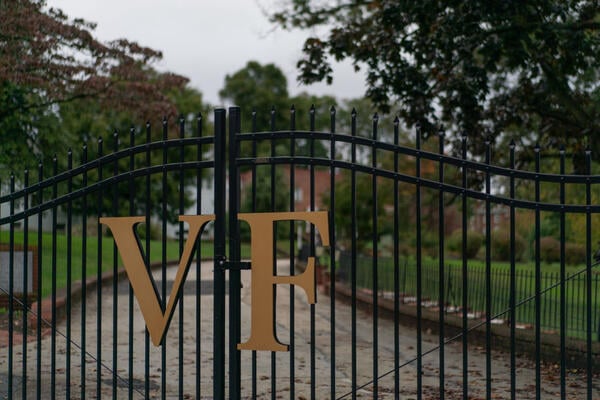
    While seven of the nine universities originally invited to join the Trump administration’s “Compact for Academic Excellence in Higher Education” have formally rejected the agreement, Valley Forge Military College wants to sign on to the proposal, as first reported by Fox News.

    President Donald Trump extended the invitation to all colleges after initial rejections from institutions that objected to provisions in the compact that would limit academic freedom.

    The compact would require universities to suppress criticism of conservatives on campus, cap international enrollment at 15 percent, freeze tuition, overhaul admissions and hiring practices, and make various other changes in return for preferential treatment on federal research funding.

    Now Valley Forge, a private two-year college in Pennsylvania, wants in on the compact.

    “Participation in the Compact would provide valuable opportunities for collaboration, shared learning, and continuous improvement. We are particularly eager to contribute to discussions on leadership education, student resilience, and pathways from two-year programs to four-year institutions,” officials wrote to the Education Department. “These are areas in which Valley Forge has developed effective practices and measurable outcomes that could benefit peer institutions.”

    Universities in the initial invitation were all research-focused, and the appeal from U.S. Education Secretary Linda McMahon emphasized the benefits of signing on, which would include “allowance for increased overhead payments where feasible, substantial and meaningful federal grants, and other federal partnerships.”

    It is unclear how Valley Forge, which does not have a research focus, would benefit. The college is also much smaller than the first invitees, enrolling 86 students in fall 2023, according to federal data.

    Valley Forge is now the third institution to publicly express interest in signing the compact since the invitation was expanded, following Grand Canyon University and New College of Florida.

    Source link

  • More College Leaders Speak Out Against Trump’s Compact

    More College Leaders Speak Out Against Trump’s Compact

    More universities are signaling opposition to the Trump administration’s compact for higher education, which would require institutions to make changes to their policies and practices in order to receive an unspecified edge in grant funding.

    In comments to faculty groups and student journalists, a handful of university leaders have made clear that they won’t sign on to the compact in its current form. But those comments don’t amount to a formal rejection of the agreement, several university spokespeople told Inside Higher Ed. Each said that because their institution hasn’t been formally asked to sign, they haven’t officially considered the administration’s proposal.

    For instance, at Miami University in Ohio, Provost Chris Makaroff told the University Senate that “right now, there is no appetite to even consider joining it,” according to the Miami Student.

    “The administration is totally against it in every way possible, and probably the only way that it would possibly go through is if somehow or another, they threaten to cut off all funding to the university,” Makaroff added.

    When asked about those comments and whether that constituted a rejection, Seth Bauguess, the university’s senior director of communications, noted that Miami wasn’t part of the first group of universities asked to sign, so “therefore we have not formally considered it.”

    When the administration initially invited nine universities to give feedback on the document, Trump officials sent each institution a signed cover letter and a copy of the agreement. Another three universities were invited to an Oct. 17 White House meeting to discuss the compact.

    Beyond those overtures, President Donald Trump wrote on social media platform he owns, Truth Social, that universities that prefer to “return to the pursuit of Truth and Achievement” are “invited to enter into a forward looking Agreement with the Federal Government to help bring about the Golden Age of Academic Excellence in Higher Education.” Officials, speaking on condition of anonymity, told media outlets that the post was an invitation to all colleges to sign on to the compact.

    So far, nearly a dozen universities have publicly rejected the deal, and White House officials are reportedly planning to update the document in response to the feedback from universities. Only New College of Florida has said that it’s ready to sign, though it hasn’t yet been formally asked. The White House hasn’t said how interested universities can join, but officials have threatened the federal funding of institutions that don’t sign the compact.

    Jon Fansmith, senior vice president for government relations and national engagement at the American Council on Education, said the mixed messages from universities likely stem from “the general confusion around how the administration is handling this.”

    “Even the statement by New College raises the question of how would anyone actually sign up if they wanted to?” he said, adding that the compact’s terms don’t appear to be final and there’s no form or website where colleges and universities can go to sign it.

    Fansmith said he’s not surprised that some campus leaders are seeking to make their concerns clear while not definitively turning down something they haven’t been offered.

    “Why pick an unnecessary fight?” he said.

    The growing cohort of presidents and leaders speaking out about the compact includes Arizona State University president Michael Crow, who told the State Press on Oct. 24 that the compact is no “longer a viable thing” and that he’s “been trying to guide people in a different direction.”

    Crow was invited to the Oct. 17 White House meeting to discuss the compact, which also included representatives from Dartmouth College, the University of Arizona, the University of Kansas, the University of Texas at Austin, the University of Virginia, Vanderbilt University and Washington University in St. Louis. After that meeting, an ASU spokesperson said the university was engaging in dialogue with Trump’s team.

    After the State Press published its interview with Crow, Inside Higher Ed followed up to see if “no longer a viable thing” meant “no.”

    “It’s important to note that ASU has not been asked to sign the Compact for Academic Excellence in Higher Education,” an ASU spokesperson responded. “So we can’t be ‘reviewing’ or ‘negotiating’ or ‘weighing’ it. ASU has long been a voice for change in higher education, something the university has been pushing for more than 20 years. If the administration looks for new and innovative approaches to serve the needs of the country, ASU is likely one to be consulted. President Crow is happy to share his vision for the future of higher education with anyone, if asked, whether they’re students, parents, alums, members of the public, or the administration.”

    But some universities, including Emory and Syracuse, have chosen to reject the compact before receiving a formal ask. And on Thursday, University of Kansas provost Barbara Bichelmeyer told The Kansan, “Fundamentally, there’s no way, with the compact as it is written and sent out to other institutions, that KU could sign that.”

    Bichelmeyer also noted that KU wasn’t asked to sign the compact.

    Brendan Cantwell, a higher education professor at Michigan State University, said there’s no reason for colleges to say no at this moment.

    “The basic tenet of college administration is don’t make a decision until you have to,” he said. “No one is forcing their hand right now … and they don’t want to antagonize the administration, particular donors or state officials. If I wasn’t explicitly invited, I wouldn’t explicitly decline to participate.”

    Cantwell added that the president’s social media post and other communications from Trump officials have created a lot of ambiguity, and institutions are using that to their advantage.

    “What the president has said, by saying that anyone can apply, but not specifically inviting anyone beyond the 12, has created an opportunity for campuses to message ‘no’ to students and ‘not yes’ to everyone else,” he said.

    Source link

  • New College of Florida says it will ‘happily be the first’ to sign Trump’s higher ed compact

    New College of Florida says it will ‘happily be the first’ to sign Trump’s higher ed compact

    This audio is auto-generated. Please let us know if you have feedback.

    Dive Brief:

    • New College of Florida has publicly volunteered to be the first institution to adopt the Trump administration’s higher education compact. 
    • The institution — which has undergone a right-wing transformation since 2023 at the direction of Republican Gov. Ron DeSantis — said in a news release Monday that it would “happily be the first” to formally embrace President Donald Trump’s vision for higher education.
    • Most universities directly offered the compact have rejected the sweeping proposal, which promises priority for federal grants in return for implementing far-reaching policies favored by the administration.

    Dive Insight:

    At the beginning of October, Trump administration officials outlined a potential deal that it first brought to nine major research universities. 

    In return for special consideration in research and other federal funding, the universities were asked to implement a wide-ranging slate of policies. Those included a five-year tuition freeze, a standardized test requirement for applicants, an institutional position of neutrality on political and social events, and a commitment to potentially dissolve units deemed anti-conservative.

    Seven of the universities rejected the compact outright. Two others, Vanderbilt University and the University of Texas at Austin, have yet to formally accept or reject the deal. In October, Trump appeared to open the compact up to all colleges via a social post. At least three other institutions have declined the compact since.

    Many of the rejecting institutions cited concerns about academic freedom and independence. But NCF said Monday that it has already implemented policies reflecting many of the principles in the compact. The college has nixed diversity, equity and inclusion efforts, dismantled its gender studies department, and eliminated “discrimination in admissions.”

    Before 2023, NCF had a reputation as a LGBTQ+ friendly campus and one of the most progressive institutions in the state. But that year, DeSantis appointed a new slate of trustees at the liberal arts college, kicking off a turbulent transformation into a conservative model of public education. 

    The governor publicly advocated for a vision for NCF as a “Hillsdale of the South,” referring to Hillsdale College in Michigan, a conservative Christian institution.  

    The American Association of University Professors’ governing council voted unanimously in 2024 to sanction NCF over noncompliance with the faculty group’s standards for shared governance. 

    The AAUP called NCF’s changes an “unprecedented politically motivated takeover” citing findings from its 2023 report on political interference in higher ed in Florida. At NCF that included course changes, tenure decisions and faculty dismissals following DeSantis remaking of NCF’s board, according to the report. 

    The board of trustees and administration thoroughly restructured the college’s academic offerings without meaningful faculty involvement and denied academic due process to multiple faculty members during their tenure applications and renewals,” the AAUP said in announcing the censure.

    More recently, Republican state lawmakers and DeSantis have reportedly eyed an expansion of NCF, which could include diverting other public institutions’ resources to NCF’s control. 

    For its part, the college said Monday that it has reformed around principles such as merit and free thought. 

    We have no affirmative action or DEI, and we have been building a campus where open dialogue and the marketplace of ideas are at the forefront of everything we do,” said NCF President Richard Corcoran, formerly the Republican speaker for the Florida House and the education commissioner under DeSantis

    Initially, the Trump administration offered the compact to research powerhouses that take on large numbers of federal contracts, such as the Massachusetts Institute of Technology, University of Southern California and UT-Austin. 

    The smaller NCF only reported $381,509 in federal grants in fiscal 2024.

    Source link

  • How Universities Are Responding to Trump’s Compact

    How Universities Are Responding to Trump’s Compact

    In the weeks since Trump officials asked university leaders to give feedback on their plan to ensure that colleges are adhering to the administration’s priorities, several of those leaders and others in higher ed have made clear that the proposal is a nonstarter—at least in its current form.

    So far, leaders at 11 universities have publicly said they won’t sign the current draft of the “Compact for Academic Excellence in Higher Education,” according to an Inside Higher Ed database. Two others have said they are providing feedback. Universities will be added to the map and table below as they make public statements.

    The wide-ranging proposal would require universities to ban consideration of race or sex in hiring and admissions, freeze tuition, commit to not considering transgender women to be women and shut down departments that “punish, belittle” or “spark violence against conservative ideas,” among other provisions. Trump officials say universities that sign on could get access to some benefits such as preferential treatment for grant funding. But those that don’t want to adhere to the agreement are free to “forego [sic] federal benefits.”

    Higher ed leaders and observers see the compact as the Trump administration’s blueprint for overhauling America’s colleges and universities. Trump officials view it as an opportunity for the “proactive improvement of higher education for the betterment of the country.” Critics have urged institutions to reject the proposal, arguing it undermines institutions’ independence and carries steep penalties.

    Nine universities were initially asked Oct. 1 to give “limited, targeted feedback” by Oct. 20 on the document that Trump officials said was “largely in its final form.” President Trump said in mid-October that any college that wants to “return to the pursuit of Truth and Achievement” could sign on but didn’t explain how interested institutions could do so. No college has publicly taken Trump up on his offer. The administration is reportedly planning to update the document in response to the feedback and send out a new version in November.

    Source link