Tag: Compact

  • Reading Between the Lines on Compact Responses

    Reading Between the Lines on Compact Responses

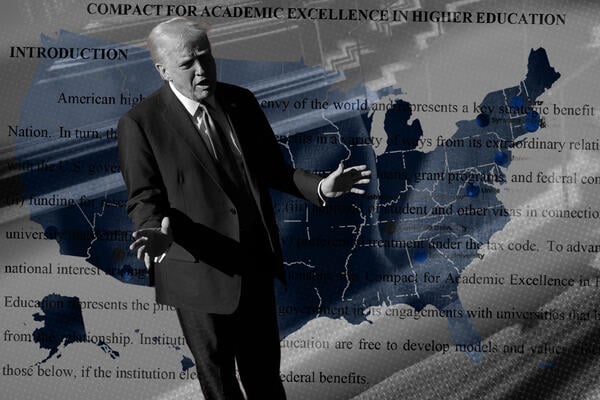
    Multiple universities have rejected President Trump’s proposed Compact for Academic Excellence in Higher Education, but they have taken different approaches to turning down the commander in chief. Some have declined pointedly, while others struck a more delicate balancing act.

    To be sure, leaders of the institutions invited to sign the compact have found themselves squeezed by both internal and external forces, under pressure from the federal government to approve the deal and from faculty and other campus constituents to reject it. Both public and private universities have also faced political pressure from state lawmakers, who in some cases urged them to sign and in others have threatened to strip funding if they do.

    Most of the nine universities originally invited to join the compact rejected it on or before the Oct. 20 deadline to provide feedback—well ahead of Nov. 21, the final date for making a decision. Their responses, released to the public, ranged from pointed to demure; in some cases, institutional leaders emphasized their core values in rebutting the proposal, which promised to grant preferential treatment in exchange for freezing tuition, capping international enrollment and suppressing criticism of conservatives, among other demands from the U.S. Department of Education.

    The Road to ‘No’

    Here are links to each institution’s response, in the order in which they were posted publicly:

    Together these statements offer insights into how institutions are responding to an unprecedented demand from the federal government: that they subscribe to President Trump’s culturally conservative vision of higher education in exchange for financial gain.

    Key Themes

    Experts note that while most institutions declined the deal, some statements stood out more than others.

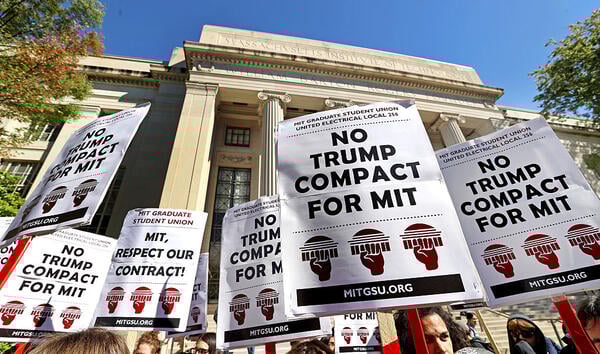
    Brian Rosenberg, president emeritus of Macalester College, highlighted the Massachusetts Institute of Technology’s statement as the clearest rejection. Unlike some of the other responses, it doesn’t promise future engagement on the federal government’s concerns and is a clear, resounding no based on MIT’s principles, he said.

    The first to reject the compact, MIT president Sally Kornbluth highlighted areas of agreement, such as an emphasis on merit in hiring, admissions and more, but she also argued that the proposal was “inconsistent with our core belief that scientific funding should be based on scientific merit alone.”

    Lisa Corrigan, a communications professor at the University of Arkansas and an expert on rhetoric and political communication, flagged the University of Southern California’s statement as a notable response. She pointed out that while USC highlighted its commitment to promoting civil discourse, as many others did, it also emphasized its “commitment to ROTC and veterans.” (Brown and Arizona were the only other institutions to mention veterans in their responses.)

    “I thought USC really did a strong job in articulating exactly what values they are using to guide their decision-making in rejecting the compact,” Corrigan told Inside Higher Ed.

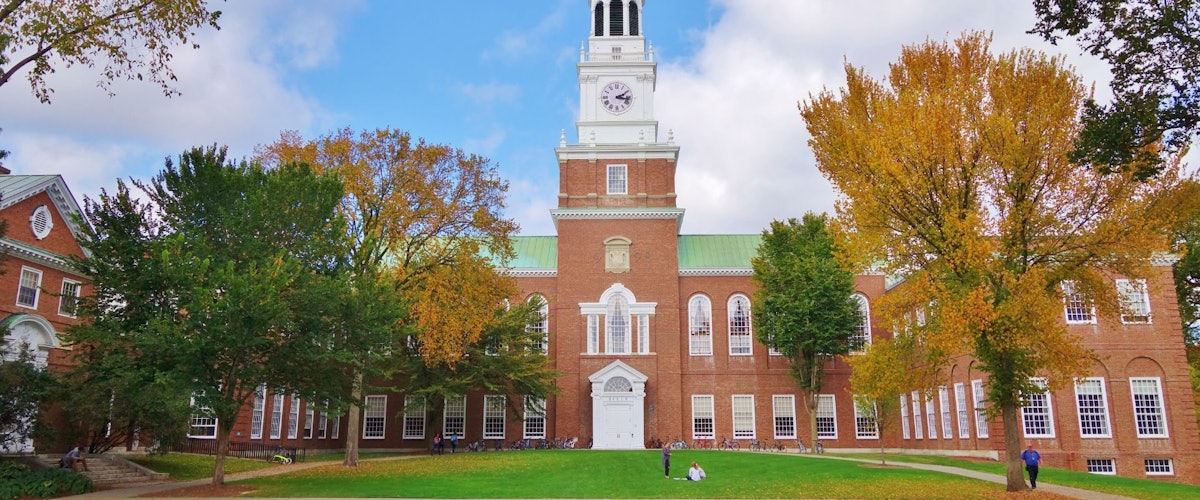
    Erin Hennessy, vice president at TVP Communications, flagged both the Dartmouth and Penn statements as notable for different reasons. With Dartmouth, Hennessy said she was struck by the brevity of the statement, which clocked in at about 230 words. And for Penn, she pointed out that it was the only university that did not share the rejection letter it sent to Education Secretary Linda McMahon along with its public statement. Every other institution that rejected the deal posted both a statement and the letter.

    (Asked for a copy of its response to the Department of Education, Penn declined to provide it.)

    Experts noted a number of other observations from the collective letters and accompanying statements—including how many presidents emphasized merit, which is mentioned in every response except Dartmouth’s. Altogether the word “merit” appears 15 times in the nine published university responses, and “meritocracy” is cited once.

    Hennessy posited that the focus on that specific word is an attempt to “push back on the perception of certain folks in the MAGA sphere that believe any program, or any consideration of race or class or ethnic background, is diametrically in conflict with the concept of merit.”

    Rosenberg suggested that universities are trying to turn the government’s argument against it. By emphasizing merit, universities are seizing on a “logical inconsistency in the position of the federal government,” he said. While the Trump administration is demanding merit in admissions, hiring and other areas, it also has signaled a willingness to provide preferential treatment on federal research funding based not on merit but a willingness to conform to political priorities.

    Many of the responses also mentioned institutional neutrality policies.

    USC, Virginia, Vanderbilt and WashU all cited the concept, though only USC and Virginia submitted clear rejections; WashU sent a mixed message, and Vanderbilt has committed only to offering feedback on the proposal. Dartmouth, which also has an institutional neutrality policy, did not mention it.

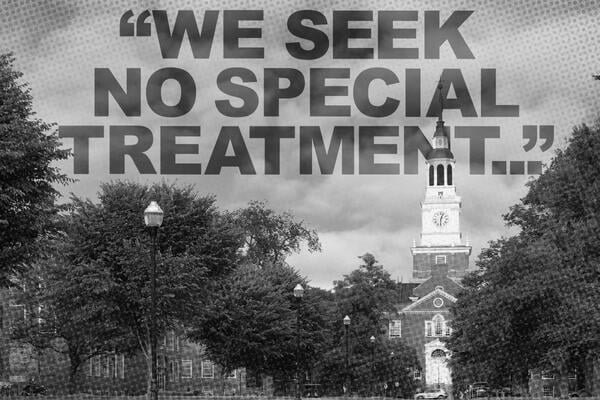
    Both Arizona and Virginia used a similar turn of phrase to reject the compact’s promise of preferential status in exchange for signing, with officials writing, “We seek no special treatment” in connection to advancing their missions.

    One word, however, is notably absent among all the responses: Trump. And only Dartmouth referenced political affiliation in its response to the federal government. President Sian Beilock wrote that she did not believe “the involvement of the government through a compact—whether it is a Republican- or Democratic-led White House—is the right way to focus America’s leading colleges and universities on their teaching and research mission.”

    WashU’s Muddled Messaging

    Though Washington University in St. Louis agreed to provide feedback to the federal government, administrators also appeared to tacitly reject the compact proposal. The university’s initial statement on Monday noted concerns about the compact but stopped short of an outright rejection; Chancellor Andrew Martin wrote that providing feedback does not mean “we have endorsed or signed on” to the proposal.

    But in a Tuesday email to faculty members, Martin wrote he “can confirm that we won’t sign the proposed Compact for Academic Excellence in Higher Education … or any document that undermines our mission or our core values.” Martin added WashU will provide feedback, emphasizing the importance of “having our voice at the table for these potentially consequential conversations.”

    WashU, however, has been reluctant to publicly call that a rejection.

    Asked by Inside Higher Ed about the authenticity of the email, first published by another news outlet, and whether it amounts to a rejection, a university spokesperson only confirmed it was official.

    Corrigan suggested that both WashU and Vanderbilt are trying to buy time “to see which universities are going to be in the next round, if any.” She added, “They want the opportunity to return to the conversation when there’s more political cover for them to potentially say no.”

    Institutional Silence

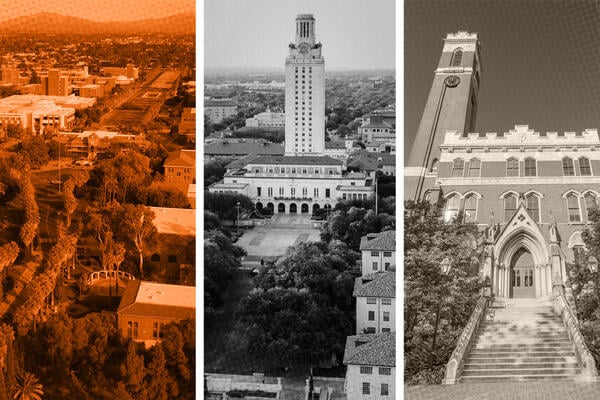
    While most universities invited to join the compact responded publicly by the deadline, both the University of Texas at Austin and the University of Kansas have remained silent on the matter.

    Neither has issued publicly shared feedback or other statements about the compact, though University of Texas system board leadership initially responded positively to the invitation to join.

    “For institutions that haven’t responded publicly yet, the questions I would be asking are, is there division between the president and the board on how to move forward on this? Is there division between the president and the faculty on how to move forward on this?” Hennessy said.

    To her, that silence signals that internal negotiations are likely at play, potentially involving debates over strategy, language and other points. She believes nonresponders are more likely to sign the compact and may be “trying to figure out how to make a yes more palatable” to critics.

    Rosenberg suggests there are likely legal concerns being discussed.

    “Like virtually everything else coming out of the government right now, it’s going to face a legal challenge once someone signs, because the limitations on free speech for members of the community are pretty severe,” he said. “Once someone signs, it’s going to end up in the courts.”

    Source link

  • Rejecting the Compact Is an Opportunity (opinion)

    Rejecting the Compact Is an Opportunity (opinion)

    The Trump administration’s initial effort to convince universities to join its “Compact for Academic Excellence” did not go well. Of the original nine colleges and universities, so far none has signed it, and seven—Brown University, Dartmouth College, the Massachusetts Institute of Technology and the Universities of Arizona, Pennsylvania, Southern California and Virginia—have loudly and forcefully rejected it, citing “our core belief that scientific funding should be based on scientific merit alone” (MIT) and “the government’s lack of authority to dictate our curriculum or the content of academic speech” (Brown).

    The Trump administration made more headway with its earlier efforts to force a “deal” on one university at a time. But that was never going to be enough. An authoritarian needs to establish control over the entire higher education sector, not just a handful of institutions. But the truth is, this government does not have the legal leverage or even the staff to negotiate bespoke agreements with the thousands of colleges and universities in the United States.

    The compact is an effort to overcome that problem. But it is also a gift. It has flipped the default: Now collective action does not necessarily require affirmative acts like banding together to file a lawsuit (although several are warranted). Collective action can simply take the form of nonacquiescence. All university leaders need to do is … nothing.

    Last week, the Trump administration—apparently unafraid to look desperate—decided to open the compact to any American college or university that will accept its terms. Suddenly, literally anyone affiliated with any college or university—faculty, staff, students, parents, alumni, trustees, donors—has the opportunity to use their voice to help persuade their institution not to sign, as their counterparts at the original nine invitees have been doing rather vociferously and, in six cases so far, successfully. By opening the compact so broadly, the government is risking, or inviting, an equally broad response: a recognition throughout the vast American higher education sector that the integrity and value of our whole enterprise depend on independence from government control.

    Regardless of their politics, every university leader should reject this compact. University leaders have a fiduciary responsibility to plan ahead on a time scale longer than three years. As Sally Kornbluth, the president of MIT, explained, “America’s leadership in science and innovation depends on independent thinking and open competition,” not special “preferences” for institutions that submit to government control. Future federal governments are much more likely to embrace Kornbluth’s view than Trump’s. It does not put a university in a strong position to compete for future faculty and students if the university enthusiastically agrees to toe one administration’s political line.

    To sign the compact is to invite a breathtaking degree of federal government control. Colleges signing it agree that in the future, if the Department of Justice—perhaps acting on orders from the president—“finds” that the university is disobeying any one of the compact’s many ambiguous commands, the department can take away all the university’s federal funding for a year or more. That includes not only scientific research grants but also student loans or Pell Grants, potentially even the university’s 501(c)(3) status—and not only future funds but also, incredibly, funds already spent that must somehow be returned.

    The ambiguous rules that signing institutions must avoid transgressing are numerous. Signing universities must “abolish” or “transform” academic departments that “belittle” “conservative ideas.” They must screen out foreign students with “anti-American values” and those with “hostility” toward any of America’s “allies.” They must punish students or faculty whose speech, in the DOJ’s opinion, “support[s]” any group the government deems a terrorist group, which would include “antifa” as well as Hamas (and the government has a long recent record of defining “support for Hamas” extremely broadly, so that it encompasses much pro-Palestinian speech).

    They must commit to “defining” and “interpreting” gender in the government’s preferred way, which denies that transgender people exist. Signing institutions must obtain, to the DOJ’s satisfaction, “a broad spectrum of viewpoints” not only in the university as a whole, but “within every field, department, school, and teaching unit.” They must admit students on the basis of sufficiently “objective” criteria. Leaders of signing universities must avoid speaking out about “societal and political events” beyond those that directly affect the university.

    Not a single one of those terms is self-defining. The arbiter of whether a university is fulfilling these vague promises is a Department of Justice that has a record of acting in bad faith and takes orders from a notoriously mercurial president. No university leader or trustee can truthfully say that it fulfills their fiduciary responsibility to sign their school up for this.

    The compact is also blatantly illegal. The Trump administration has cited no statutes that give it the authority to boss universities around in this way, because there aren’t any. Many of the compact’s provisions listed above—and others—violate the First Amendment. Clear black-letter law holds that what the government cannot impose by law, it also cannot impose as a condition of receiving government funds.

    It is crucial to keep in mind the larger context here: the rise of an authoritarian regime that seeks to undermine the independence of many types of civil society institutions, not just universities. The national governments in both Turkey and Hungary have increased political control over their universities as part of their consolidation of power, but neither has gone as far as this compact would go in putting universities under the government’s thumb. To sign the compact is to participate in an authoritarian project.

    Any university leaders still inclined to join the compact should consider a final argument: The dollars and cents simply don’t add up. The compact requires, among many other things, a five-year tuition freeze. In the high-inflation environment of the second Trump administration, this is very costly. (At today’s 3 percent inflation rate, it amounts to a 16 percent cut in real terms over five years; if inflation continues to rise, that could easily become a 20 to 25 percent cut.)

    The government offers a vague, nonbinding promise that it will give signing institutions extra research grants, but such grants do not easily make up for lost tuition in an environment of rising costs. The grants require doing the research; that eats up most of the money. Any college that becomes dependent on extra grants, beyond those they would have been qualified to receive without the compact, is going to be in big fiscal trouble down the line.

    This compact has vast implications, which deserve careful study. For faculty, staff, students, parents, donors and alumni hoping for a no but willing to settle for silence, time is your friend; inaction is your goal. A faculty committee would certainly be in order. If you do nothing, and most other universities do nothing, the government will have no more leverage over your institution than over any other, and academic freedom and the pursuit of knowledge and truth will continue for another day.

    Source link

  • Arizona Rejects Compact, Others Leave Options Open

    Arizona Rejects Compact, Others Leave Options Open

    The University of Arizona is the latest institution to reject an offer to sign on to the Trump administration’s “Compact for Academic Excellence in Higher Education,” issuing its response on the same day feedback on the proposal was due.

    While some universities have rejected the compact outright, Arizona president Suresh Garimella announced the decision in a message to the campus community that sent mixed signals. “The university has not agreed to the terms outlined in the draft proposal,” Garimella wrote. He emphasized the need to preserve “principles like academic freedom, merit-based research funding, and institutional independence.”

    At the same time, he said that some of the compact’s provisions “deserve thoughtful consideration as our national higher education system could benefit from reforms that have been much too slow to develop,” noting that many were already in place at Arizona. He added that the federal government said it was “seeking constructive dialogue rather than a definitive written response.”

    Indeed, in a letter to Education Secretary Linda McMahon, Garimella indicated an openness to further engagement. “We have much common ground with the ideas your administration is advancing on changes that would benefit American higher education and our nation at large,” he wrote.

    Still, he took issue with the administration’s promise of giving signatories preferential treatment in research funding. “A federal research funding system based on anything other than merit would weaken the world’s preeminent engine for innovation, advancement of technology, and solutions to many of our nation’s most profound challenges,” he wrote to McMahon. “We seek no special treatment and believe in our ability to compete for federally funded research strictly on merit.”

    Arizona was one of nine universities the Trump administration reached out to on Oct. 1 offering preferential treatment for federal research funding if they agreed to a compact that would overhaul admissions and hiring, cap international enrollment at 15 percent, revise academic offerings, suppress criticism of conservatives, freeze tuition for five years, and more.

    Amid some rejections from the original nine, the federal government sent additional invitations earlier this month.

    Institutions initially invited to join were Brown University, Dartmouth College, the Massachusetts Institute of Technology, the University of Arizona, the University of Pennsylvania, the University of Southern California, University of Texas at Austin, the University of Virginia and Vanderbilt University. Invitations were later sent to Arizona State University, the University of Kansas and Washington University in St. Louis.

    Six of the original invitees have declined to sign: MIT was the first to reject the compact, followed by Brown, Dartmouth, Penn, USC and Virginia.

    The Trump administration has since opened the compact to any institution that wishes to join.

    As of Monday, none of the invited institutions had agreed to the deal, despite a recent push from the White House, which included a meeting with several universities last week. Institutions have until Nov. 21 to make a final decision about whether to sign, according to a letter McMahon sent with the proposal.

    Washington University in St. Louis officials indicated Monday they remain open to the idea.

    Chancellor Andrew Martin announced that the university would provide feedback, or, as he put it, “participate in a conversation about the future of higher education” with the Trump administration. Martin emphasized the importance of having “a seat at the table” for such discussions but said those talks did not equate to signing the compact.

    “It’s important for you to know that our participation in this dialogue does not mean we have endorsed or signed on to the Compact for Academic Excellence in Higher Education presented to us for feedback by the federal administration. We have not done that. In addition, this decision was not made to advantage ourselves or gain any type of preferential benefit,” Martin wrote. “We firmly believe meaningful progress will best be achieved through open, ongoing dialogue.”

    An Arizona State spokesperson also left open the option to join the compact, writing to Inside Higher Ed by email, “ASU has long been a voice for change in higher education and as President Trump’s team seeks new and innovative approaches to serve the needs of the country, ASU has engaged in dialogue and offered ideas about how to do so.”

    Vanderbilt chancellor Daniel Diermeier noted in an email to the campus community that the university intended to offer feedback on the proposal.

    “Despite reporting to the contrary, we have not been asked to accept or reject the draft compact,” Diermeier wrote. “Rather, we have been asked to provide feedback and comments as part of an ongoing dialogue, and that is our intention.”

    But other universities stayed silent on the day of the initial deadline.

    University of Texas system officials initially announced they were “honored” that the flagship was invited to join, but Austin officials did not have an update on where that invitation stands. Kansas did not respond to requests for comment.

    Source link

  • Dartmouth Joins Growing List of Elite Universities Rejecting White House Academic Compact

    Dartmouth Joins Growing List of Elite Universities Rejecting White House Academic Compact

    Dartmouth CollegeFile photoDartmouth College has declined to sign the Trump administration’s “Compact for Academic Excellence in Higher Education,” becoming the latest prestigious institution to prioritize institutional autonomy over preferential federal funding access.

    In a statement released Saturday, Dartmouth President Dr. Sian Beilock firmly articulated the college’s position ahead of Monday’s deadline, emphasizing that governmental oversight—regardless of political affiliation—represents an inappropriate mechanism for directing the mission of America’s top research universities.

    “I do not believe that the involvement of the government through a compact—whether it is a Republican- or Democratic-led White House—is the right way to focus America’s leading colleges and universities on their teaching and research mission,” Beilock stated.

    The compact, extended to nine select institutions, promised enhanced access to federal research dollars in return for compliance with several administration policy mandates. These requirements included adopting the administration’s gender definitions for campus facilities and athletics, eliminating consideration of race, gender and various demographic factors from admissions decisions, and restricting international student enrollment.

    Despite rejecting the compact’s terms, Beilock expressed openness to dialogue, indicating her willingness to explore how to strengthen the traditional federal-university research partnership while maintaining higher education’s focus on academic excellence.

    The decision followed significant campus pressure, with nearly 500 Dartmouth faculty members and graduate students signing a petition advocating for rejection, according to the Valley News.

    In her statement, Beilock emphasized the fundamental principle at stake: “Universities have a responsibility to set our own academic and institutional policies, guided by our mission and values, our commitment to free expression, and our obligations under the law.”

    She framed institutional independence as essential to rebuilding public confidence across political lines and preserving American higher education’s global preeminence.

    Dartmouth’s decision aligns with rejections announced last week by peer institutions including the Massachusetts Institute of Technology, Brown University, the University of Pennsylvania and the University of Southern California, suggesting a coordinated defense of academic autonomy among elite research universities.

    Source link

  • UVA the Fifth University to Reject Trump Higher Ed Compact

    UVA the Fifth University to Reject Trump Higher Ed Compact

    Daxia Rojas/AFP via Getty Images

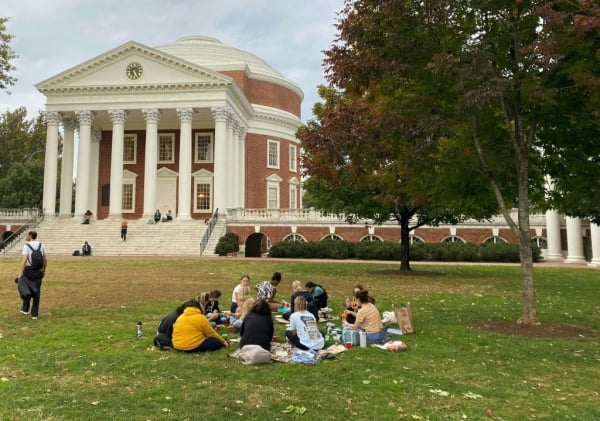
    On a day of campus demonstrations urging officials to reject the Trump administration’s “Compact for Academic Excellence in Higher Education,” the University of Virginia announced Friday that it opposes the president’s offer of yet-unrevealed special funding benefits in exchange for signing.

    “The integrity of science and other academic work requires merit-based assessment of research and scholarship,” interim president Paul Mahoney wrote in a message Friday to Education Secretary Linda McMahon, which he shared with the university community. “A contractual arrangement predicating assessment on anything other than merit will undermine the integrity of vital, sometimes lifesaving, research and further erode confidence in American higher education.”

    The compact asks colleges to agree to overhaul or abolish departments “that purposefully punish, belittle, and even spark violence against conservative ideas,” without further defining what those terms mean. It also asks universities, among other things, to commit to not considering transgender women to be women; reject foreign applicants “who demonstrate hostility to the United States, its allies, or its values”; and freeze “effective tuition rates charged to American students for the next five years.”

    In exchange for these agreements, the White House has said signatories would “be given [funding] priority when possible as well as invitations to collaborate with the White House.” But the administration hasn’t revealed how much extra funding universities would be eligible for, and the nine-page compact doesn’t detail the potential benefits. The compact, as well as a Thursday statement from the White House, can also be read as threatening colleges’ current federal funding if they don’t sign.

    Mahoney told McMahon that his university agrees “with many of the principles outlined in the Compact, including a fair and unbiased admissions process, an affordable and academically rigorous education, a thriving marketplace of ideas, institutional neutrality, and equal treatment of students, faculty, and staff in all aspects of university operations.”

    “Indeed,” Mahoney wrote, “the University of Virginia leads in several of these areas and is committed to continuous improvement in all of them. We seek no special treatment in exchange for our pursuit of those foundational goals.”

    The decision makes UVA the fifth of the nine initial institutions presented with the deal to publicly turn it down. It’s also the first public university and first Southern institution to reject it. The Massachusetts Institute of Technology was the first of the nine to turn it down, on Oct. 10, followed by Brown University and the Universities of Pennsylvania and Southern California.

    UVA’s rejection of the compact comes after the Trump administration successfully pressured then–UVA president James Ryan to step down in June. The Justice Department had demanded he step down. The UVA Board of Visitors voted to dissolve the university’s diversity, equity and inclusion office in March, but multiple conservative alumni groups and legal entities complained that Ryan failed to eliminate DEI from all corners of campus.

    A coalition of groups opposed to the compact, including the UVA chapter of the American Association of University Professors, praised the rejection in a Friday news release.

    “Today’s events demonstrate the power of collective organizing and action to defeat tyranny,” the statement said. “We hope that we serve as an example to the other public universities that received the ‘Compact’—the University of Texas, Austin, and the University of Arizona—giving them the courage and clarity not to buckle.”

    UVA faculty groups had overwhelmingly urged university leaders to reject the compact. And hundreds of demonstrators showed up to the anti-compact rally Friday on the UVA campus in Charlottesville, Cville Right Now reported.

    Dartmouth College and Vanderbilt University also haven’t revealed their decisions. But after MIT announced its refusal of the compact, Trump offered it to all U.S. colleges and universities to sign.

    White House officials met Friday with some universities about the proposal. The Wall Street Journal reported that UVA, Arizona, Dartmouth, UT Austin and Vanderbilt were invited, along with universities that weren’t part of the original nine: Arizona State University, the University of Kansas and Washington University in St. Louis.

    White House spokesperson Liz Huston compared the compact in a statement to calls from former Presidents George Washington, Abraham Lincoln, Teddy Roosevelt and John F. Kennedy, who she said “called on our universities to be of greater service to the nation.”

    “President Trump has called on universities to do their part in returning America to its economic and diplomatic successes of the past: a nation of full employment, pioneering innovations that change the world, and committed to merit and hard work as the ingredients to success,” she said, adding the administration hosted “a productive call” with several universities. 

    A White House official said UVA and the other seven invited universities participated in the call.

    “They now have the baton to consider, discuss, and propose meaningful reforms, including their form and implementation, to ensure college campuses serve as laboratories of American greatness,” Huston said. 

    Source link

  • UVA, Dartmouth Reject Trump Compact

    UVA, Dartmouth Reject Trump Compact

    The University of Virginia and Dartmouth College have become the latest higher ed institutions to publicly reject the Trump administration’s “Compact for Academic Excellence in Higher Education.” Now just three of the nine institutions that the federal government originally presented with the document have yet to announce whether they will sign.

    UVA announced Friday that it opposes the offer of yet-unrevealed special funding benefits in exchange for signing the compact. The statement came the day of an on-campus demonstration urging university leaders not to sign. Dartmouth unveiled its response Saturday morning. Both rejections came despite the universities attending a meeting Friday with White House officials about the deal.

    “As I shared on the call, I do not believe that the involvement of the government through a compact—whether it is a Republican- or Democratic-led White House—is the right way to focus America’s leading colleges and universities on their teaching and research mission,” Dartmouth president Sian Leah Beilock wrote in a message to Education Secretary Linda McMahon, which the president also shared with her community.

    “Our universities have a responsibility to set our own academic and institutional policies, guided by our mission and values, our commitment to free expression, and our obligations under the law,” Beilock wrote. “Staying true to this responsibility is what will help American higher education build bipartisan public trust and continue to uphold its place as the envy of the world.”

    Beilock hasn’t been a publicly outspoken opponent of Trump; at a Heterodox Academy conference in June, she said, “It’s really a problem to say just because the administration, with many things that we all object to, is suggesting something inherently means it’s wrong.” But she also said back then that “we shouldn’t have the government telling us what to do.”

    In a message Friday to McMahon, also shared with the community, UVA interim president Paul Mahoney wrote that “the integrity of science and other academic work requires merit-based assessment of research and scholarship. A contractual arrangement predicating assessment on anything other than merit will undermine the integrity of vital, sometimes lifesaving, research and further erode confidence in American higher education.”

    The compact asks colleges to agree to overhaul or abolish departments “that purposefully punish, belittle, and even spark violence against conservative ideas,” without further defining what those terms mean. It also asks universities, among other things, to commit to not considering transgender women to be women; reject foreign applicants “who demonstrate hostility to the United States, its allies, or its values”; and freeze “effective tuition rates charged to American students for the next five years.”

    In exchange for these agreements, the White House has said signatories would “be given [funding] priority when possible as well as invitations to collaborate with the White House.” But the administration hasn’t revealed how much extra funding universities would be eligible for, and the nine-page compact doesn’t detail the potential benefits. The compact, as well as a Thursday statement from the White House, can also be read as threatening colleges’ current federal funding if they don’t sign.

    Mahoney told McMahon that his university agrees “with many of the principles outlined in the Compact, including a fair and unbiased admissions process, an affordable and academically rigorous education, a thriving marketplace of ideas, institutional neutrality, and equal treatment of students, faculty, and staff in all aspects of university operations.”

    “Indeed,” Mahoney wrote, “the University of Virginia leads in several of these areas and is committed to continuous improvement in all of them. We seek no special treatment in exchange for our pursuit of those foundational goals.”

    The decisions make UVA the fifth and Dartmouth the sixth of the nine initial institutions presented with the deal to publicly turn it down. UVA is also the first public university and first Southern institution to reject it. The Massachusetts Institute of Technology was the first of the nine to turn it down, on Oct. 10, followed by Brown University and the Universities of Pennsylvania and Southern California.

    UVA’s rejection of the compact comes after the Trump administration successfully pressured then–UVA president James Ryan to step down in June. The Justice Department had demanded he step down. The UVA Board of Visitors voted to dissolve the university’s diversity, equity and inclusion office in March, but multiple conservative alumni groups and legal entities complained that Ryan failed to eliminate DEI from all corners of campus.

    A coalition of groups opposed to the compact, including the UVA chapter of the American Association of University Professors, praised the rejection in a Friday news release.

    “Today’s events demonstrate the power of collective organizing and action to defeat tyranny,” the statement said. “We hope that we serve as an example to the other public universities that received the ‘Compact’—the University of Texas, Austin, and the University of Arizona—giving them the courage and clarity not to buckle.”

    UVA faculty groups had overwhelmingly urged university leaders to reject the compact. And hundreds of demonstrators showed up to the anticompact rally Friday on the UVA campus in Charlottesville, Cville Right Now reported.

    Alongside Arizona and UT Austin, Vanderbilt University also hasn’t revealed its decision. But after MIT announced its refusal of the compact, Trump offered it to all U.S. colleges and universities to sign.

    White House officials met Friday with some universities about the proposal. The Wall Street Journal reported that UVA, Dartmouth, Arizona, UT Austin and Vanderbilt were invited, along with universities that weren’t part of the original nine: Arizona State University, the University of Kansas and Washington University in St. Louis.

    White House spokesperson Liz Huston compared the compact in a statement to efforts from former presidents George Washington, Abraham Lincoln, Teddy Roosevelt and John F. Kennedy, who she said “called on our universities to be of greater service to the nation.”

    “President Trump has called on universities to do their part in returning America to its economic and diplomatic successes of the past: a nation of full employment, pioneering innovations that change the world, and committed to merit and hard work as the ingredients to success,” she said, adding the administration hosted “a productive call” with several universities. 

    A White House official said UVA and the other seven invited universities participated in the call.

    “They now have the baton to consider, discuss, and propose meaningful reforms, including their form and implementation, to ensure college campuses serve as laboratories of American greatness,” Huston said. 

    Source link

  • White House to Meet With Universities Regarding Compact

    White House to Meet With Universities Regarding Compact

    Brendan Smialowski/AFP/Getty Images

    After four universities rejected the Trump administration’s compact for higher education, the White House is planning to meet Friday afternoon with the remaining five that have yet to respond.

    A White House official confirmed plans of the meeting to Inside Higher Ed but didn’t say what the purpose of the gathering was or which universities would attend. Nine universities were asked to give feedback on the wide-ranging proposal by Oct. 20.

    The virtual meeting will likely include May Mailman, a White House adviser, and Vincent Haley, director of the White House’s Domestic Policy Council, according to a source with knowledge of the White House’s plans. Mailman, Haley and Education Secretary Linda McMahon signed the letter sent to the initial nine about the compact.

    So far, the Massachusetts Institute of Technology, Brown University, the University of Pennsylvania and the University of Southern California have publicly rejected the deal. Dartmouth College, the University of Arizona, the University of Texas at Austin, the University of Virginia and Vanderbilt University haven’t said whether they’ll agree to the compact. Trump officials have said that the signatories could get access to more grant funding and threatened the funding of those that don’t agree.

    After USC released its letter rejecting the proposal, Liz Huston, a White House spokesperson, told the Los Angeles Times that “as long as they are not begging for federal funding, universities are free to implement any lawful policies they would like.”

    Following the first rejection from MIT last Friday, President Trump posted on Truth Social that all colleges could now sign on. The White House has said that some institutions have already reached out to do so.

    The source with knowledge of the White House’s plans said that the meeting “appears to be an effort to regain momentum by threatening institutions to sign even though it’s obviously not in the schools’ interest to do so.”

    The Wall Street Journal reported that Arizona State University, the University of Kansas and Washington University in St. Louis were also invited. According to the Journal, the goal of the meeting was to answer questions about the proposal and to find common ground with the institutions.

    Former senator Lamar Alexander, a Tennessee Republican and trustee at Vanderbilt, wrote in a Wall Street Journal op-ed that the compact was an example of federal overreach akin to previous efforts to impose uniform national standards on K–12 schools.

    “Mr. Trump’s proposed higher education compact may provoke some useful dialogue around reform,” he wrote. “But the federal government shouldn’t try to manage the nation’s 6,000 colleges and universities.”

    Inside Higher Ed reached out to the remaining five institutions as well as the new invitees, but they haven’t responded to a request for comment or to confirm whether they’ll attend the meeting.

    Source link

  • White House Meets With Universities Regarding Compact

    White House Meets With Universities Regarding Compact

    After four universities rejected the Trump administration’s compact for higher education, the White House met Friday with some universities about the proposal. 

    A White House official confirmed plans of the meeting to Inside Higher Ed but didn’t say what the purpose of the gathering was or which universities would attend. Nine universities were asked to give feedback on the wide-ranging proposal by Oct. 20.

    The virtual meeting planned to include May Mailman, a White House adviser, and Vincent Haley, director of the White House’s Domestic Policy Council, according to a source with knowledge of the White House’s plans. Mailman, Haley and Education Secretary Linda McMahon signed the letter sent to the initial nine about the compact.

    So far, the Massachusetts Institute of Technology, Brown University, the University of Pennsylvania and the University of Southern California have publicly rejected the deal. Dartmouth College, the University of Arizona, the University of Texas at Austin, and Vanderbilt University haven’t said whether they’ll agree to the compact. UVA said late Friday afternoon that it wouldn’t agree to the proposal.

    The Wall Street Journal reported that Arizona State University, the University of Kansas and Washington University in St. Louis were also invited. According to the Journal, the goal of the meeting was to answer questions about the proposal and to find common ground with the institutions.

    Inside Higher Ed reached out to the universities, but none confirmed whether they attended the meeting.

    The nine-page document would require universities to make a number of far-reaching changes from abolishing academic departments or programs that “purposefully punish, belittle, and even spark violence against conservative ideas” to capping international undergraduate enrollment at 15 percent. Institutions also would have to agree to freeze their tuition and require standardized tests for admissions, among other provisions.

    Trump officials have said that the signatories could get access to more grant funding and threatened the funding of those that don’t agree. The Justice Department would enforce the terms of the agreement, which are vague and not all defined.

    After USC released its letter rejecting the proposal, Liz Huston, a White House spokesperson, told the Los Angeles Times that “as long as they are not begging for federal funding, universities are free to implement any lawful policies they would like.”

    Following the first rejection from MIT last Friday, President Trump posted on Truth Social that all colleges could now sign on. The White House has said that some institutions have already reached out to do so.

    The source with knowledge of the White House’s plans said that the meeting “appears to be an effort to regain momentum by threatening institutions to sign even though it’s obviously not in the schools’ interest to do so.”

    Former senator Lamar Alexander, a Tennessee Republican and trustee at Vanderbilt, wrote in a Journal op-ed that the compact was an example of federal overreach akin to previous efforts to impose uniform national standards on K–12 schools.

    “Mr. Trump’s proposed higher education compact may provoke some useful dialogue around reform,” he wrote. “But the federal government shouldn’t try to manage the nation’s 6,000 colleges and universities.”

    A Joint Warning

    The American Council on Education and 35 other organizations warned in a joint statement released Friday that “the compact’s prescriptions threaten to undermine the very qualities that make our system exceptional.”

    The organizations that signed requested the administration withdraw the compact and noted that “higher education has room for improvement.” 

    But “the compact is a step in the wrong direction,” the letter states. “The dictates set by it are harmful for higher education and our entire nation, no matter your politics.”

    The letter is just the latest sign of a growing resistance in higher ed to the compact. Faculty and students at the initial group of universities rallied Friday to urge their administrators to reject the compact. According to the American Association of University Professors, which organized the national day of action, more than 1,000 people attended the UVA event. 

    And earlier this month, the American Association of Colleges and Universities released a statement that sharply criticized the compact. The statement said in part that college and university presidents “cannot trade academic freedom for federal funding” and that institutions shouldn’t be subject “to the changing priorities of successive administrations.” Nearly 150 college presidents and associations have endorsed that statement.

    The joint statement from ACE and others, including AAC&U, was a way to show that the associations, which the letter says “span the breadth of the American higher education community and the full spectrum of colleges and universities nationwide,” are united in their opposition.

    “The compact offers nothing less than government control of a university’s basic and necessary freedoms—the freedoms to decide who we teach, what we teach, and who teaches,” the statement reads. “Now more than ever, we must unite to protect the values and principles that have made American higher education the global standard.” 

    But not everyone in the sector signed on. 

    Key groups that were absent from the list of signatories include the Association of Public and Land-grant Universities, the Association of American Universities, the American Association of State Colleges and Universities, the National Association of Independent Colleges and Universities, Career Education Colleges and Universities, and the American Association of Community Colleges.

    Inside Higher Ed reached out to each of those groups, asking whether they were invited to sign and, if so, why they chose not to do so. Responses varied.

    AAU noted that it had already issued its own statement Oct. 10. AASCU said it was also invited to sign on and had “significant concerns” about the compact but decided to choose other ways to speak out.  

    “We are communicating in multiple ways with our member institutions and policymakers about the administration’s request and any impact it might have on regional public universities,” Charles Welch, the association’s president, said in an email.

    Other organizations had not responded by the time this story was published.

    Jessica Blake contributed to this article.

    Source link

  • University of Pennsylvania rejects Trump’s higher education compact

    University of Pennsylvania rejects Trump’s higher education compact

    This audio is auto-generated. Please let us know if you have feedback.

    The University of Pennsylvania on Thursday became the third institution to publicly reject the Trump administration’s sweeping higher education compact that promises priority for federal research funding in exchange for policy changes. 

    In an online message, Penn President J. Larry Jameson said he informed the U.S. Department of Education that the university “respectfully declines” to sign the compact. 

    “At Penn, we are committed to merit-based achievement and accountability. The long-standing partnership between American higher education and the federal government has greatly benefited society and our nation. Shared goals and investment in talent and ideas will turn possibility into progress,” he said. 

    Jameson also provided the agency feedback, as requested by the Trump administration, “highlighting areas of existing alignment as well as substantive concerns.” But he did not expand on why the university rejected the compact in his message. Penn did not provide more information about the concerns he mentioned in responding to a request for comment Thursday.

    The Ivy League institution follows the Massachusetts Institute of Technology and Brown University in rejecting the administration’s offer. Those institutions raised concerns that the proposed compact would infringe on their independence and freedom. 

    The compact’s wide-ranging terms include freezing tuition for five years, placing caps on international enrollment, changing or eliminating campus units that “purposefully punish” and “belittle” conservative viewpoints, and requiring undergraduate applicants to take standardized tests. 

    Although federal officials initially invited nine high-profile institutions to sign the compact, President Donald Trump appeared to extend that invitation to all colleges in a recent social media post. Neither the White House nor the U.S. Education Department immediately responded to a request for comment Thursday. 

    Pennsylvania Gov. Josh Shapiro praised Penn’s move in a statement Thursday, saying the university “made the right decision to maintain its full academic independence and integrity.”

    “The Trump Administration’s dangerous demands would limit freedom of speech, the freedom to learn, and the freedom to engage in constructive debate and dialogue on campuses across the country,” Shapiro said.

    As governor, Shapiro is a nonvoting member of Penn’s board, but he has wielded that influence at the private university as few of his predecessors have, according to The Chronicle of Higher Education. 

    He said Thursday that he had “engaged closely with university leaders” on the Trump administration’s compact.

    Shapiro isn’t the only Democratic lawmaker in Pennsylvania who has raised concerns about the compact. Two state representatives have also moved to bar colleges that receive state funding from signing the proposed agreement.

    Penn’s rejection of the compact comes after the university cut a deal with the Trump administration earlier this year to restore some $175 million in suspended research funding. Federal officials had cut off the funding over Penn’s prior policies allowing transgender women to compete in women’s sports. 

    Under that deal, struck in July, Penn agreed to adopt the Trump administration’s interpretation of Title IX, the civil rights law barring federally funded institutions from discriminating on the basis of sex. 

    The university also agreed to award athletic titles to cisgender women on Penn’s swimming team who had lost to transgender women, according to the Education Department. And the university said it would send personal apology letters to affected cisgender women.

    Source link

  • Penn, U of Southern California Reject Trump Compact

    Penn, U of Southern California Reject Trump Compact

    Photo illustration by Justin Morrison/Inside Higher Ed | Jumping Rocks/Universal Images Group/Getty Images | Mario Tama/Getty Images

    The Universities of Pennsylvania and Southern California have now refused to sign the Trump administration’s “Compact for Academic Excellence in Higher Education,” making them the third and fourth of the nine initial institutions that were presented the deal to publicly turn it down. No institution has agreed to sign so far.

    Both announcements came Thursday, a few days before the Oct. 20 deadline to provide feedback on the proposal. Beong-Soo Kim, interim president of the University of Southern California, shared his message to Education Secretary Linda McMahon, which outlined how USC already seems to adhere to the compact.

    “Notwithstanding these areas of alignment, we are concerned that even though the Compact would be voluntary, tying research benefits to it would, over time, undermine the same values of free inquiry and academic excellence that the Compact seeks to promote,” Kim wrote. “Other countries whose governments lack America’s commitment to freedom and democracy have shown how academic excellence can suffer when shifting external priorities tilt the research playing field away from free, meritocratic competition.”

    Kim added that the compact does raise issues “worthy of a broader national conversation to which USC would be eager to contribute its insights and expertise.”

    California governor Gavin Newsom, a possible Democratic presidential contender in 2028, had threatened that any university in his state that signed the compact would “instantly” lose billions of state dollars.

    Over at Penn, President J. Larry Jameson wrote in a message to his community Thursday that his university “respectfully declines to sign the proposed Compact.” He added that his university did provide feedback to the department on the proposal.

    Penn spokespeople didn’t say Thursday whether the university would sign any possible amended version of the compact that addressed the university’s concerns, nor did they provide Inside Higher Ed a copy of the feedback provided to the Trump administration. (Penn is the only university of the four that didn’t provide its response to McMahon.)

    The White House also didn’t provide a copy of Penn’s feedback, but it emailed a statement apparently threatening funding cuts for universities that don’t sign the compact.

    “Merit should be the primary criteria for federal grant funding. Yet too many universities have abandoned academic excellence in favor of divisive and destructive efforts such as ‘diversity, equity, and inclusion,’” spokesperson Liz Huston said in the statement. “The Compact for Academic Excellence embraces universities that reform their institutions to elevate common sense once again, ushering a new era of American innovation. Any higher education institution unwilling to assume accountability and confront these overdue and necessary reforms will find itself without future government and taxpayers support.”

    Brown University announced it had rejected the compact Wednesday, and the Massachusetts Institute of Technology did the same last Friday. Following MIT’s rejection, the Trump administration said the compact was open to all colleges and universities that want to sign it.

    The compact is a boilerplate contract asking colleges to voluntarily agree to overhaul or abolish departments “that purposefully punish, belittle, and even spark violence against conservative ideas,” without further defining what those terms mean. It also asks universities to, among other things, commit to not considering transgender women to be women, to reject foreign applicants “who demonstrate hostility to the United States, its allies, or its values” and to freeze “effective tuition rates charged to American students for the next five years.”

    In exchange for these agreements, the White House has said signatories would “be given [funding] priority when possible as well as invitations to collaborate with the White House.” But the White House hasn’t revealed how much extra funding universities would be eligible for, and the nine-page compact doesn’t detail the potential benefits. The compact, and the Thursday statement from the White House, can also be read as threatening colleges’ current federal funding if they don’t sign. Multiple higher ed organizations have allied in calling on universities to reject the compact.

    Jameson said in his statement that “at Penn, we are committed to merit-based achievement and accountability.”

    Earlier this year, the Trump administration said that Penn violated Title IX of the Education Amendments of 1972 when it allowed a transgender woman to swim on the women’s team in 2022, and officials issued several demands to the university. Penn ultimately conceded to those demands over the summer, a decision that the administration said restored about $175 million in frozen federal funds.

    Marc Rowan, a Penn graduate with two degrees from its Wharton School of Business who’s now chief executive officer and board chair for Apollo Global Management, wrote in The New York Times that he “played a part in the compact’s initial formulation, working alongside an administration working group.” Rowan argued that the compact doesn’t threaten free speech or academic freedom.

    Apollo has funded the online, for-profit University of Phoenix. AP VIII Queso Holdings LP—the previous name for majority owner of the University of Phoenix—was the successor of Apollo Education Group, which went private in 2017 in a $1.1 billion deal backed by Apollo Global Management Inc. and the Vistria Group.

    AP VIII Queso Holdings LP was recently renamed Phoenix Education Partners as part of a new deal to take the company public once again. Phoenix Education Partners, now owner of the University of Phoenix and backed by both Apollo and Vistria, started trading on the stock market last week and was valued at about $1.35 billion after the first day.

    Source link