Tag: Company

  • My new consulting company! | Teacherrogers

    My new consulting company! | Teacherrogers

    On July 1, 2025, I founded Futurescape Instructional Design, LLC. This was the day after I lost my job. I had wanted to create a consulting company after retirement, but the job loss jump-started this venture! This is my third company, so I’m not a novice. I collaborated with generative AI (GenAI) to come up with a name that reflected both my instructional design background and futures thinking training. I also relied on GenAI to help me write the outline for my business plan. I was thrilled with the outcome. This blog describes my new company.


    Executive Summary

    Futurescape Instructional Design, LLC, founded by Dr. Sandra Rogers, is dedicated to transforming teaching and learning to meet tomorrow’s needs. We offer comprehensive instructional design services and foresight-building workshops, informed by futures thinking strategies, for academic institutions, education nonprofits, educational technology corporations, and individual educators. Our dual-focus approach enables individuals and organizations to deliver high-quality learning experiences today while also anticipating and shaping the future of education.

    Mission Statement

    Our company’s mission is to support educators and institutions in their efforts to enhance teaching and learning practices and environments in the short term, ultimately improving students’ long-term learning outcomes through research-based instructional design and future-focused thinking.

    Goals

    1. By improving their course designs, course material, and built-in learner support (e.g., orientation modules, learning strategy guides, help page), our instructional design services will positively impact our clients’ teaching methods and learning environments.
    2. By training them on futures thinking strategies and practices, our clients will become meta-aware of signals and drivers of possible futures. They will learn how to analyze, manipulate, prioritize, and act on them to prepare for digital transformations and related changes now and on the horizon.

    Instructional Design Overview

    Our instructional design services draw upon 30 years of educational experience, advanced academic credentials, and research-based best practices. We serve K-16 institutions, education nonprofits, education technology companies, and individual educators to help them build accessible, effective, inclusive, and engaging learning experiences. The service includes a client intake survey, a memorandum of understanding, timelines, a feedback process, and accessibility compliance guidelines.

    Services Offered

    The following services address the myriad of instructional design work. They can be provided singly or in combination. The client must complete an intake survey and provide sample content and syllabus before the initial meeting. For on-site work, the client will cover travel expenses and per diem.

    • Prep Time – The designer’s review of content, context, and stakeholders’ needs takes place in advance of the initial meeting. It relies on information and material provided during the initial point of contact and via the Client Intake Survey.
    • Course Design Consultations – One-on-one or whole group consultation for instructional design and related aspects to build high-quality, research-based courses. Guidance, per client request, could include structuring content, optimizing instructional strategies, integrating technology, creating a community of inquiry, designing for equity and inclusion, and aligning objectives with desired outcomes.
    • Course Design and Development – First, the designers will consult with the client to understand desired outcomes for the course design. Course material will be collected; the syllabus will be used as a plan of action. Second, backwards mapping of course outcomes to assessments, content (including media plans), and strategies will be a collaborative process. Prototyping of a course module will be shared for feedback and approval before the actual course design begins. Course design generally takes six months because it involves work from both the instructor and the designer. Fast-track builds can be created in three months if the instructor has the time.
    • Course Redesigns – Revitalize existing courses to improve access, engagement, equity, inclusion, learning outcomes, and relevance. The designer will meet with the client to understand project parameters and provide recommendations before starting the project. Course redesigns can include items listed separately in services offered (e.g., quality review, course remediation, or custom course document creation). Course redesigns can be accomplished in 1-3 months, depending on how much time the instructor has available.
    • Quality Assurance Reviews – Clients will provide or otherwise select a rubric for quality assurance (QA) reviews. The review consists of a comprehensive course evaluation for instructional alignment, usability, inclusion, effectiveness, and compliance with accessibility standards. A QA review also checks to see if links are broken and whether the link title matches the linked content. Feedback is shared via a QA checklist. Items approved for revision or replacement are discussed.
    • Content and Course Remediation for WCAG 2.1 AA Compliance – Ensure courses are accessible to learners and compliant by remediating course pages and materials to meet Web Content Accessibility Guidelines (WCAG) 2.1 AA standards per ADA Title II regulations. The new regulations require courses to be 100% accessible by April 2026. The designer can remediate content and share standards to avoid facing similar issues with new material or course designs. Content remediation is a lengthy process. For example, one PDF can take 10 minutes if it doesn’t include a lot of images. However, a PowerPoint with numerous images can take an hour.
    • Job Aids – This service provides custom creations of course documents (e.g., guides, rubrics, syllabi) and/or ancillary videos (e.g., virtual tours, tutorials, explainers). Creating material requires a consultation with the client before production. Media production is a lengthy process. For example, a 3-minute video could take an hour to produce the final version. Clients will be invited to share feedback on document and video creation for guidance and approval.

    To learn more, especially about the futures thinking workshops, visit my new company website. I’m happy to share that I have my first client and a few prospective ones. Reach out if you’re interested!

    Source link

  • FIRE Statement on City of Clarksdale v. Delta Press Publishing Company (Clarksdale Press Register)

    FIRE Statement on City of Clarksdale v. Delta Press Publishing Company (Clarksdale Press Register)

    Below is a statement from FIRE attorney Adam Steinbaugh on the restraining order against the Clarksdale Press Register:

    The city of Clarksdale, Mississippi, thinks it knows better than the Founders. Clarksdale asked a court to order a local newspaper to remove an editorial asking why the city was not being more transparent about a proposed tax increase. As a result of the city’s lawsuit, a court ordered the Clarksdale Press Register to delete the online editorial. 

    That’s unconstitutional. In the United States, the government can’t determine what opinions may be shared in the public square. A free society does not permit governments to sue newspapers for publishing editorials. 

    The Foundation for Individual Rights and Expression (FIRE), a nonprofit organization dedicated to protecting First Amendment rights, is exploring all options to aid The Press Register in defending these core expressive rights.

    Source link

  • PeopleAdmin A PowerSchool Company

    PeopleAdmin A PowerSchool Company

    Professional development is a huge factor in retention, but getting faculty and staff to engage with professional learning can be tough.

    Creating professional development learning communities (PLCs) within higher education institutions can lead to increased employee engagement, improved retention, enhanced collaboration, and personalized learning. Below, check out a few strategies to help your institution create effective PLCs that faculty and staff are eager to be a part of:

    Build Strong Relationships and Encourage Reflective Practices

    PLCs are designed to build stronger relationships between team members through regular meetings and a shared commitment to student learning. These communities encourage reflection on instructional practices and student progress, which can lead to a more cohesive and collaborative environment.

    Establish Clear Communication and Social Presence

    Effective communication is the backbone of any community. In an online setting, it’s crucial to create a plan for communication that includes real-time meetings and opportunities for information and expertise sharing. This helps in establishing a social presence and a sense of belonging among members.

    Engage Through Shared Goals and Interests

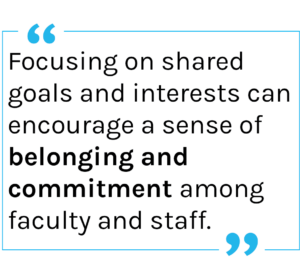
    Research suggests that participation in learning communities is more related to student engagement than to educational outcomes. Therefore, focusing on shared goals and interests can encourage a sense of belonging and commitment among faculty and staff, which is essential for retention and engagement.
    Emphasize Collaborative Learning and Professional Growth

    Learning communities should emphasize collaborative partnerships between students, faculty, and staff. They provide opportunities for professional growth outside the classroom in a supportive and non-judgmental environment, which can lead to improved teacher satisfaction and lower turnover rates.

    Utilize Collaborative Learning Techniques

    Incorporate collaborative learning techniques to allow members to share ideas and work on common professional issues. This not only enhances the learning experience but also encourages members to become more invested in their work and the community.

    Support Continuous Improvement

    PLCs should provide continual improvement opportunities, encouraging ongoing professional development rather than one-time-learning. Continuing growth and learning is crucial for keeping faculty and staff engaged and up-to-date with the latest educational practices.

    Prioritize Personalized Learning

    Personalized learning within PLCs can cater to the individual needs and interests of faculty and staff, making the community more appealing. By allowing members to pursue their unique professional development paths, PLCs can enhance individual engagement and contribute to the overall success of the community.

    Conclusion

    Building learning communities that faculty and staff want to join requires a strategic approach that focuses on fostering strong relationships, clear communication, shared goals, collaborative learning, and continuous improvement. By creating an environment that values professional growth and personalized learning, institutions can ensure that their PLCs are engaging and beneficial for all members. If you’re interested in a tool that supports engaged professional development and learning at your institution, check out PeopleAdmin’s software or reach out to our team.

    Source link

  • PeopleAdmin A PowerSchool Company

    PeopleAdmin A PowerSchool Company

    Why PeopleAdmin? Hear from David Cullen at the Community College of Philadelphia

    David Cullen, Talent Acquisition Specialist at the Community College of Philadelphia, spoke recently to the PeopleAdmin team about how he leverages PeopleAdmin. David highlighted the customizability, time-saving features, and wide range of integrations as some of his favorite aspects of the tool. Hear more from David below!


    Source link

  • PeopleAdmin A PowerSchool Company

    PeopleAdmin A PowerSchool Company

    It’s time to start leveraging data to improve your recruitment strategy.

    In today’s competitive higher education landscape, attracting and retaining top talent is more challenging than ever. Fortunately, data can be a powerful tool to inform and improve your recruitment strategy. By leveraging data analytics, HR professionals in higher education can make more informed decisions, target the right candidates, and ultimately, enhance the quality of their hires. In this blog post, we will explore how data can be used to refine recruitment strategies in the higher education sector.

    The Power of Data in Recruitment

    Data analytics can provide valuable insights into the effectiveness of your recruitment efforts. By analyzing metrics such as candidate sources, application-to-hire ratios, and time-to-fill, HR professionals can identify which channels and methods are most successful in attracting qualified candidates. This information can help in allocating resources more effectively and focusing on the most productive recruitment strategies.

    By analyzing metrics such as candidate sources, application-to-hire ratios, and time-to-fill, HR professionals can identify which channels and methods are most successful in attracting qualified candidates.Utilizing Predictive Analytics

    Predictive analytics can be particularly valuable in higher education recruitment. By analyzing historical data on successful hires, predictive models can be used to identify the characteristics and qualifications that are most likely to lead to a successful hire. This can help in creating more targeted job descriptions, screening criteria, and interview questions, leading to a more efficient and effective recruitment process.

    Enhancing Diversity and Inclusion

    Data can also play a crucial role in promoting diversity and inclusion in recruitment. By tracking and analyzing demographic data throughout the recruitment process, HR professionals can identify potential biases and disparities. This information can be used to implement targeted strategies to attract a more diverse pool of candidates and ensure a fair and inclusive recruitment process.

    Leveraging Technology

    In the digital age, there is no shortage of tools and technologies to help HR professionals collect and analyze recruitment data. Applicant tracking systems, job board analytics, and candidate relationship management platforms are just a few examples of the technologies that can provide valuable data insights. By leveraging these tools, HR professionals can make more data-driven decisions and continuously refine their recruitment strategies.

    Final Thoughts

    In conclusion, data can be a game-changer in the higher education recruitment landscape. By harnessing the power of data analytics and predictive models, HR professionals can make more informed, efficient, and inclusive recruitment decisions. As the competition for top talent continues to intensify, those who embrace data-driven recruitment strategies will be best positioned to attract and retain the best and brightest in their fields.

    Source link

  • PeopleAdmin A PowerSchool Company

    PeopleAdmin A PowerSchool Company

    As we dive into the challenges of 2024, there are some lessons we can take with us from 2023.

    In our recent webinar, Lessons from 2023 for a Bright 2024, panelists reflected on what was top of mind as they wrapped up 2023, including job advertising, the candidate experience during the hiring process, and HigherEd workforce trends. Attendees heard from Andy Boom (JobElephant), Ircka West (PeopleAdmin), and Lucas Del Priore (PeopleAdmin) as they shared their valuable insights—check out some key takeaways below.

    JobElephant’s Innovation in Job Board Optimization

    Did you know that on average, 40% of job advertising spend is wasted? Andy Boom, Director of Business Development at JobElephant, noted that his team sees this budget waste frequently because customers want to “spread the net as far and wide as possible, adding multiple publications to a campaign, which might make sense—but it all depends on the specific job description.” The reality that not all job boards are created equal, and not all are going to have the right audience for every job description. JobElephant tracks every ad they post for their customers, and has seen that some publications fail to drive traffic and lack optimization. Andy’s team utilizing machine learning and AI to curate the top ten options for specific searches. By analyzing keywords, JobElephant ensures that job descriptions are matched with the boards that promise the best potential return, reducing ad spending waste.

    Elevating the Candidate Experience

    Ircka West, Solution Engineer at PeopleAdmin, spoke about improving the candidate experience as a top trend from 2023. She emphasized the power of presentation in attracting candidates—creating excitement about the workplace begins with focusing on the candidate experience. Reflecting the candidate’s values and interests is crucial, and your team can take advantage of existing information by linking to pages that show off the institutional experience. Ircka recommended re-evaluating the application process by streamlining lengthy forms and implementing two-step application processes can encourage completion. “To get feedback on the application process, there are a few different ways,” said Ircka. “One would be to use your reporting capabilities and seeing what their actions do. What parts of the application process are they stopping at? Where are you losing them in the process? That’s a more passive way to find out some answers. Another way is to remember that everyone who works at your institution went through the application process at some point. You can reach out to your staff and get feedback from what they remember.”

    Adapting to Workforce Trends

    Lucas Del Priore, Product Manager at PeopleAdmin, spoke about the evolving landscape of workforce trends in higher education. One major trend that Lucas thought institutions should focus on is the continued normalization of hybrid and remote work, which presents a number of opportunities for growth. While hybrid work isn’t new in 2023, there are still a lot of improvements to be made with digitization and automation. “The implication is a big cultural shift of engagement, where engagement is becoming problematic for faculty and staff,” said Lucas. “The most concrete example is how to reconfigure every task and event to fit in that digital format. Not everything converts clearly, and we’re continuing to learn and understand how to implement tools that work for hybrid models and continue to encourage engagement.” In 2024, HigherEd teams should focus on institution resilience, purposeful and innovative digitization, and providing meaningful opportunities for faculty development are key strategies to navigate these changes successfully.

    Final Thoughts

    The world of HigherEd is becoming increasingly complex, and staying informed about the latest trends and leveraging innovative tools is essential. From optimizing job boards with JobElephant’s data-driven approach to enhancing the candidate experience and adapting to a digital workforce, there is a lot to learn from 2023 as we launch the strategies of 2024. Check out this webinar on-demand for more insights.

    Source link

  • PeopleAdmin A PowerSchool Company

    PeopleAdmin A PowerSchool Company

    2023 in Blogs: Key Topics and Top Tips for HigherEd

    As 2023 comes to a close, here at PeopleAdmin, we’re looking back at some of the top resources we shared this year! From onboarding to compliance, from retention to employee development, from recruitment marketing to candidate experience, we covered so many topics. Check out some of our favorite reads below!

    Hiring across campus roles

    HigherEd hiring processes are unique for many reasons, but one key reason is the different types of positions found on campus. Position types can include faculty, staff, student workers, temporary seasonal workers, hourly workers, and more, and often, each of these categories has different requirements, approvals, forms, and hiring steps. Our customers are tackling this challenge thanks to Position Management and Applicant Tracking System, and they have some tips for others to get started. Read more!

    Can digitized onboarding really make that much of a difference?

    The answer is yes! In this competitive hiring market, and with many universities facing retention challenges, onboarding is key, and digitized onboarding is the standard that organizations need to meet today. Read more from HigherEd institutions who are saying “no” to onboarding paperwork and bringing an engaging onboarding process to every new hire.

    What’s an employer brand?

    If you’re wondering what an employer brand is, you’re probably not leveraging recruitment marketing techniques to your advantage! Creating a cohesive employer brand is an important aspect of building a talent pool today. Learn more about employer branding, and check out some of our top tips to get your hiring teams to start thinking like marketers.

    Search committees don’t have to be slow

    Your team has probably dealt with the challenge of creating effective search committees, and you might have struggled to get those committees to adopt new and efficient technology. Well, our customers have tackled that challenge too. Hear from the University of Alabama – Birmingham about how they successfully leveled up their search committee experience.

    Connecting your systems

    In a PeopleAdmin poll, HigherEd institutions were asked “How connected are the various systems on your campus?” 30% responded “Not connected—we have to manually enter data in multiple systems; there’s no data flow,” while 36% responded “connected but could be better.” Notably, no one chose the option: “Very connected—there are few issues that impact my team.” With interoperability still a key issue on campus, building seamless data flow and integrating your technology should be a top priority for your team. Check out some key takeaways from a webinar about interoperability, and hear from customers about how they’re leveraging integrations.

    Career advancement impacts retention

    44% of HigherEd employees disagreed that they have opportunities for advancement, and 34% disagree that their institution invests in their career development. According to the Harvard Business Review, 86% of professionals would change jobs for more professional development opportunities—clearly, career growth is something today’s workers care about. For more, check out this post about the link between retention and career growth.

    Final thoughts

    These are just a few of the topics that we researched and wrote about here at PeopleAdmin this year! Check out more resources on our website, and dive into our Annual Report on the State of HigherEd for an in-depth look at the challenges of 2023!

    Source link

  • PeopleAdmin A PowerSchool Company

    PeopleAdmin A PowerSchool Company

    Recent Product Highlights

    In December, PeopleAdmin rolled out new features and updates to support effective academic workflows, enhance integrations, and make teams across campus more efficient. 

    Here are highlights of what’s new: 


    Faculty Information System: 

    • Enhanced reporting for course evaluations  
      • At-a-glance data and survey health statuses for administrators 
      • Deep insights through course and instructor reports 
    • Course and instructor reports are now automatically available in faculty dossiers and in Promotion and Tenure packets 


    Marketplace of Connectors: 

    • JobElephant: Now available to help your team better manage job postings! 
      • With this connector, your team can more easily manage your job postings, save time with less manual work, and maximize your ROI. 
        • Automatically connect open positions and publication subscriptions with a single click 
        • Post on multiple job boards from one source 
        • Eliminate the need to manually email JobElephant with each new posting 
        • Keep postings accurate and up-to-date without duplicates or the need to re-enter information 
        • Have full control over where postings are shared, with HR oversight to track response rates and sources of all recruitment ads
      • New features include: 
        • Ability to add more publications after submitting an initial job campaign 
        • Applicant and application status data shared to improve the accuracy of JobElephant recommendations 
        • Holistic view of all posting ad campaigns in ATS 
    • Improvements to Banner Ethos connector and Accurate connector to increase efficiency for users 
    • Reach out to your customer support manager for more information about launching any connectors at your institution. 


    Source link

  • PeopleAdmin A PowerSchool Company

    PeopleAdmin A PowerSchool Company

    Are you ready to tackle the HigherEd HR challenges coming in 2024?

    As we approach 2024, the landscape of higher education human resources is poised to encounter a new set of challenges. Anticipating and preparing for these challenges is crucial for HR departments to navigate the evolving demands of the workforce. In this blog, we’ll dive into some of the challenges your team should anticipate, as well as innovative solutions to tackle them head-on.

    Anticipated HR Challenges in 2024

    1. Talent Acquisition in a Competitive Market

    The competition for top talent is expected to intensify in 2024, making it challenging for higher education institutions to attract skilled professionals, especially in niche industries. To address this challenge, institutions should consider investing in employer branding, providing growth opportunities, and offering attractive compensation packages. Leveraging technology like AI-driven recruitment platforms can streamline the hiring process and help in identifying and attracting top talent.

    2. Remote Work Management and Hybrid Models

    The shift towards remote work and hybrid models isn’t going anywhere, and will continue to pose challenges in managing and maintaining a cohesive workforce. HR departments should focus on developing policies and practices that support remote work, ensure effective communication, and foster a sense of belonging among remote and on-site employees.

    3. Reskilling and Upskilling the WorkforceQuote: Institutions should invest in continuous learning and development programs to equip employees with the skills needed to adapt to technological disruptions, on-campus changes, and retention challenges.

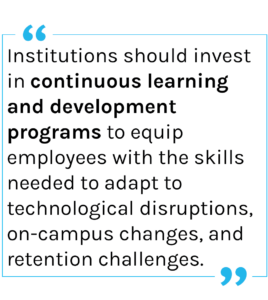
    Technology is continuing to disrupt industries, including HigherEd, making it important that your team focuses on reskilling and upskilling of the workforce to stay competitive. Institutions should invest in continuous learning and development programs to equip employees with the skills needed to adapt to technological disruptions, on-campus changes, and potential retention challenges.

    4. Managing a Multigenerational Workforce

    Your campus is already a multigenerational space, and the on-campus workforce is no exception. With Gen Z joining the workforce, and a tough economy that might discourage retirement, your faculty and staff come from multiple generations with unique work and communication styles and preferences. This can be a challenge, because it’s tough to please everyone, but embracing flexibility and dynamic communication styles can help create a positive work environment for everyone.

    How to Prepare for 2024

    As you consider the challenges to come, don’t get overwhelmed—there’s a lot your team can to do prepare. Here are a few ways to get started.

    1. Embrace Technology and Innovation

    Investing in HR technology solutions that facilitate talent acquisition, remote work management, and skills development will be crucial for higher education HR departments. Leveraging hiring and recruitment platforms, learning management systems, and communication tools can streamline processes and make your workforce more agile.

    2. Prioritizing Leader and Manager Development

    According to Gartner’s annual HR Priorities survey, leader and manager development tops the list of 2024 priorities for HR leaders. Institutions should focus on developing leadership capabilities to navigate the evolving work environment, build a talent pipeline, drive succession planning, and empower organizational success.

    3. Build a Culture of Continuous Learning

    In response to the need for reskilling and upskilling, higher education institutions should prioritize continuous learning and development programs. This includes offering relevant courses, workshops, and certifications to ensure that employees are equipped with the skills needed to adapt to technological disruptions

    Final thoughts

    HigherEd HR departments must take a proactive approach to the challenges of 2024, and that can make all the difference for their campuses. By embracing technology, prioritizing leader and manager development, creating a culture of continuous learning, and listening to the needs of employees, institutions can navigate the evolving HR landscape and ensure a resilient and adaptable workforce.


    Source link

  • PeopleAdmin A PowerSchool Company

    PeopleAdmin A PowerSchool Company

    Tips and Best Practices for Higher Ed HR Compliance

    Compliance is a key and complicated part of the role of human resources teams, and this is especially true in higher education. The HigherEd industry is highly regulated, at both the state and federal levels, making the job even more complicated for HR teams that work on a college or university campus. Noncompliance, even when unintentional, can have serious negative consequences for an institution, ranging from legal and financial (including fines and penalties) to reputational. That’s why ensuring compliance is such an important part of the role of higher education human resources teams. Read on below for some top tips and best practices for ensuring higher ed HR compliance.

    Challenges faced by Higher Ed

    There are several HR challenges faced by HigherEd that are unique, making the world of compliance even more complicated. They include:

    1. Regulatory complexity: Higher education institutions must navigate a web of federal and state regulations, including Title IX, FLSA, and ADA, which can be particularly intricate in an academic setting. Teams must navigate these human resources rules, regulations, and procedures to remain compliant.
    2. Faculty and staff diversity: Ensuring compliance with equal employment opportunity laws while managing a diverse workforce of faculty and staff presents unique challenges.
    3. Student employment: Compliance with regulations related to student employment, such as work-study programs and internships, adds another layer of complexity.
    4. Varying types of employees: Colleges and universities may have to deal with different regulations for faculty, staff, part-time faculty, hourly workers, summer employees, and more—campuses have a greater variety of types of workers than many other organizations.

    Higher Education HR Compliance Best Practices

    1. Stay informed about regulations: Regularly monitor federal and state regulations to ensure compliance with labor laws, as they often evolve in response to changes in the workforce.
    2. Document policies and procedures: Properly document all company policies and procedures, and ensure easy access for employees. This includes creating an accessible and easy-to-navigate employee handbook.
    3. Regularly audit HR policies: Conduct regular HR audits to ensure that HR policies, such as leave policy, non-discrimination policy, and compensation policy, are compliant.
    4. Establish specialized HR departments: Consider establishing specialized HR departments within colleges to address theQuote: Modern, digitized workflows can streamline the hiring process, improve data security, and facilitate compliance with regulations. unique objectives of different divisions.

    5. Promote diversity, equity, and inclusion: Initiate regular conversations on campus among staff and departments to promote diversity and inclusion, enabling the institution to move into a more inclusive environment.
    6. Leverage technology: Use HR compliance software to track regulatory requirements and obligations. Modern, digitized workflows can streamline the hiring process, improve data security, and facilitate compliance with regulations. HR compliance software can centralize and automate compliance-related tasks, such as tracking employee certifications and managing leave policies, thereby reducing the risk of non-compliance.
    7. Standardization: Standardize hiring and interviewing procedures to ensure fair hiring.
    8. Training and education: Provide thorough orientation for new hires that includes their responsibilities for HR compliance and clearly explains policies for reporting noncompliance. Provide ongoing training to HR staff, faculty, and supervisors on compliance requirements and best practices. Create higher education compliance checklists to stay on top of things.
    9. Get leadership involved: Encourage executive leaders to champion ethics and compliance, and provide ways for employees to report unethical activity.
    10. Collaboration across departments: Encourage collaboration between HR, legal, and academic departments to ensure a comprehensive approach to compliance.

    The Role of Technology in Higher Ed HR Compliance

    When it comes to HigherEd HR compliance, the right technology is key. A platform built for your HR needs supports your team in so many ways, including:

    1. Efficiency and streamlining: Technology removes administrative burdens, eliminates duplicate processes, and centralizes information, making data insights more accessible. This streamlines communication, increases security, and automates tasks, thereby saving time for HR professionals.
    2. Data management: HR technology allows for the centralization and management of vast amounts of information related to faculty and staff recruitment, onboarding, compensation, performance management, and compliance training. This helps HR professionals find more insight into information like retention, growth, and historical data about positions and job duties, and keep that information secure and accessible for compliance purposes.
    3. Strategic role of HR: By leveraging technology, HR professionals can engage in more strategic work, such as employerQuote: By leveraging technology, HR professionals can engage in more strategic work. branding to attract talent, and providing insights into retention and growth, rather than being bogged down by manual processes and administrative tasks.
    4. Data-driven decision making: HR technology provides access to critical data, which is essential for financial forecasting, succession planning, and staff performance management, enabling HR teams to make informed, data-driven decisions.

    Luckily, PeopleAdmin has the technology your team needs to keep track of employee information, stay audit-ready, and manage your employees. Built just for HigherEd, PeopleAdmin’s tools have the customizable, flexible workflows you need to tackle any HR challenge. Check out:

    • Employee Records: With all documents in one portal and visibility into processes, you’ll ensure compliance and reduce time-consuming records management tasks. Plus, digital forms management means all faculty and staff have self-service, mobile-friendly access to HR forms like change-of-address to FMLA documents without requesting them in person or via email.
    • Applicant Tracking System: In our powerful ATS, real-time dashboards with easy-to-understand visuals make it easy to interpret your data. Standard reports help you stay EEO compliant and audit-ready based on federal and state regulations. Customizable reports can be automated so you can share information with key stakeholders on your own schedule.
    • Insights: Insights helps you uncover key insights into EEO compliance, budget planning, balanced hiring, faculty and staff hiring and retention, and more. And with automated reporting, you can easily schedule specific, easy-to-understand reports for institution leaders and key stakeholders — empowering data-based decision making across the institution.

    Source link