Tag: complaints

  • Course changes spark student complaints – Campus Review

    Course changes spark student complaints – Campus Review

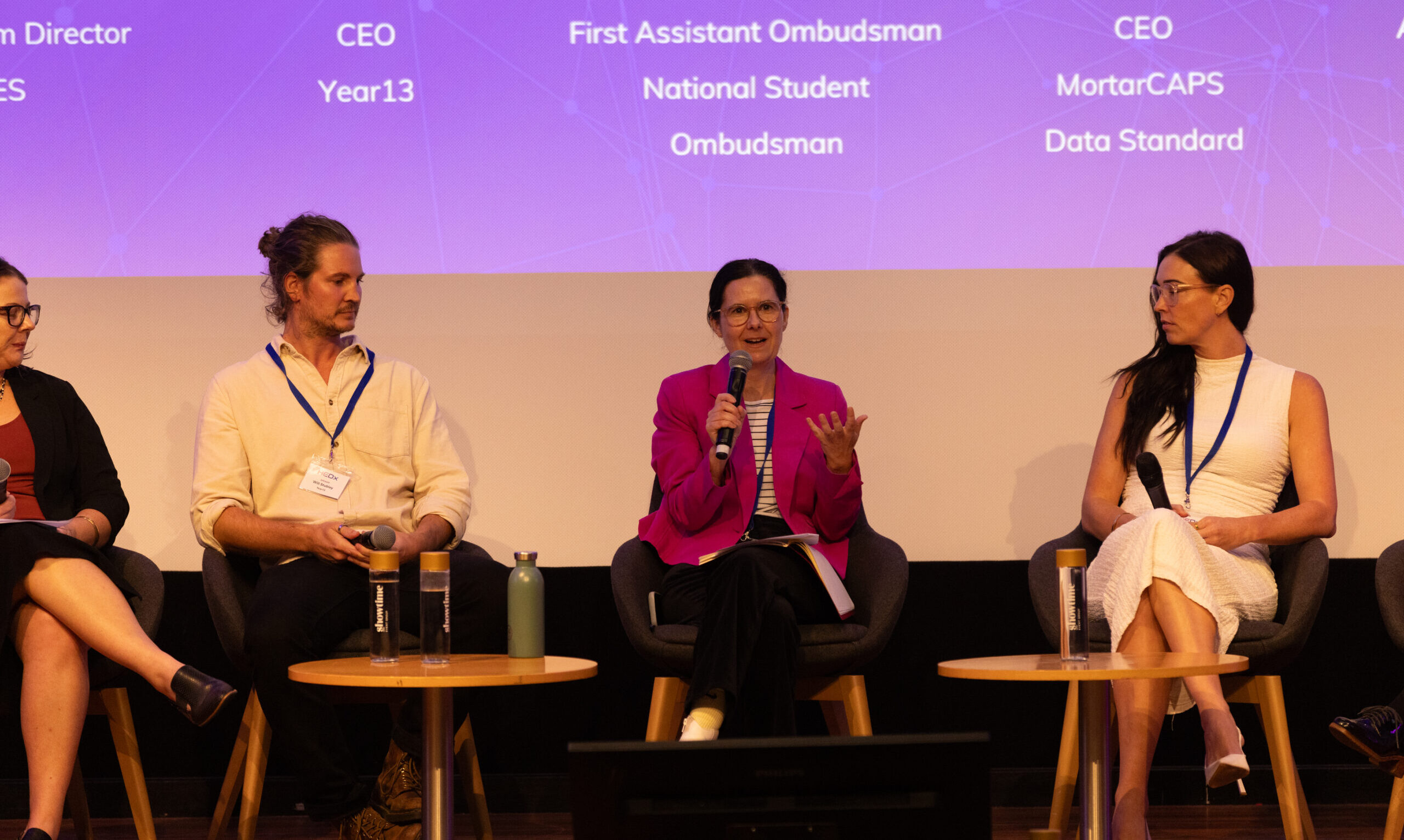
    Almost a third of student complaints received by the National Student Ombudsman (NSO) in its first seven months were related to course changes and design, NSO First Assistant Ombudsman Sarah Bendall said.

    Please login below to view content or subscribe now.

    Membership Login

    Source link

  • It’s More Difficult to File Student Aid Complaints, Dems Say

    It’s More Difficult to File Student Aid Complaints, Dems Say

    Alex Wong/Getty Images

    Massachusetts senator Elizabeth Warren and four of her fellow Democrats asked Education Secretary Linda McMahon in a letter Monday why her department has made it more difficult to file complaints about federal student aid and demanded her staff remove any extra steps that have been added to the process.

    “ED is covering up its attempts to make [the Office of Federal Student Aid] less responsive to millions of students, families, and borrowers who rely on the agency to lower the cost of attending college and protect them from loan servicer misconduct,” the senators wrote. “We urge you to immediately act on our findings by streamlining the ‘Submit a Complaint’ process and restoring FSA’s workforce so borrowers can get the help they need.”

    Who Signed the Letter?

    Richard Blumenthal (Conn.), Mazie Hirono (Hawaii), Jeff Merkley (Ore.), Chris Van Hollen (Md.), Elizabeth Warren (Mass.)

    In the letter, Warren states that she told FSA in March that the button for submitting online complaints had been “hidden.” The department responded in April that the button had just been moved from the top of the webpage to the footer and relabeled as “submit feedback.”  The department added that no employees who handle technical functions of the aid applications of loan servicing had been laid off, and while some employees that handle complaints were, the remaining employees will “still be responding” to future complaints. 

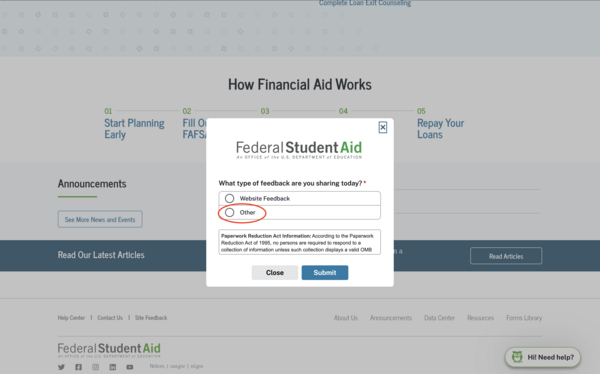
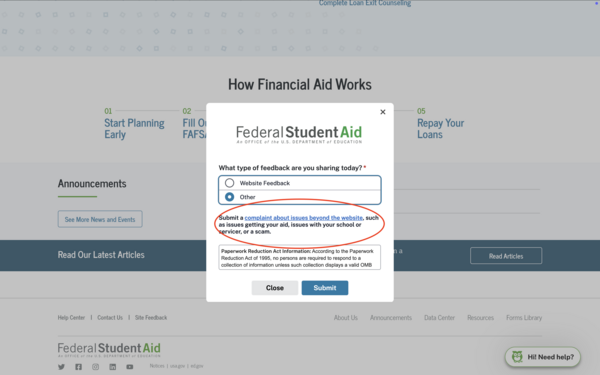
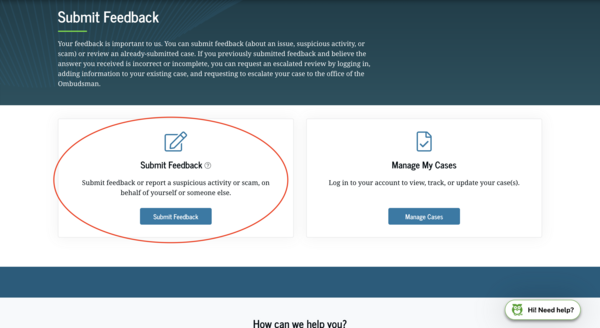
    But the Democrats say they tested those claims and found the department’s reassurances were misleading. Although the department did move and rename the complaint button, it also added a series of four extra navigation clicks that must be made before the user actually reaches the webpage where they can file a complaint. (Inside Higher Ed checked the website and verified these steps. You can see screenshots of the process below.)

    “Via an unintuitive, multi-step process,” the department is “making it more difficult for borrowers to let ED know when they are experiencing issues with their student loan servicer,” the letter reads.

    The senators argue that this change was geared toward increasing the difficulty of filing complaints, citing an email sent by a senior department staff member and obtained by Politico. According to a report published by the department at the end of the Biden presidency, more than 289,000 complaints were filed with FSA in 2024 alone.

    In the email obtained by Politico, the official wrote, “I believe this change would help decrease contact center volume and the number of complaints … so an overall win.”

    Step two FSA complaint process, click other
    Step three of FSA complaint process, click complaint about issues beyond website
    Step four of FSA complaint process, select submit feedback

    Source link

  • Complaints About Federal Student Aid Office Rise Sharply

    Complaints About Federal Student Aid Office Rise Sharply

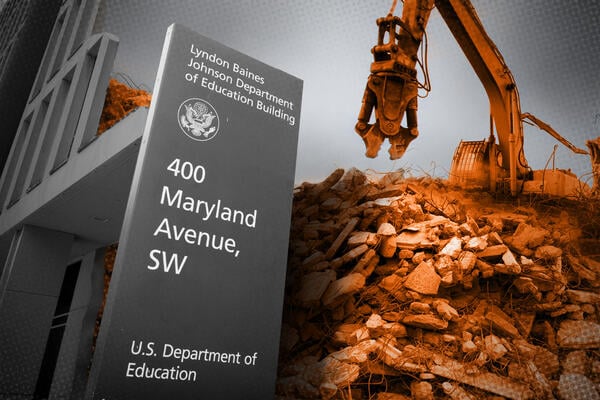
    Photo illustration by Justin Morrison/Inside Higher Ed | Marvin Joseph/The Washington Post/Getty Images | MauMyHaT/iStock/Getty Images | subtik/E+/Getty Images

    Complaints about the Office of Federal Student Aid’s operations have increased significantly over the past few months, according to the latest edition of a survey from the National Association of Student Financial Aid Administrators. Challenges that were once just kinks behind the scenes are evolving to become student-facing issues on the front line, the association says.

    The share of institutions reporting disruptions to communication, responsiveness or processing timelines rose from 59 percent in May to 72 percent in July. Meanwhile, the share of aid offices reporting student confusion about the process increased from 32 percent to 51 percent.

    The report, which is based on responses from financial aid officers at more than 500 NASFAA member institutions across the country, builds upon a similar survey conducted in May. It shows rising frustration with the FSA, despite the agency’s attempt to rehire about 50 of the more than 300 employees laid off earlier this year.

    “I wasn’t overly surprised” by the data, said NASFAA president Melanie Storey. “But it was largely a disappointment that the trajectory is moving in the wrong direction.”

    She added that the new loan caps and repayment plan changes detailed in President Trump’s One Big Beautiful Bill Act could compound the damage, creating long-term consequences for college attainment rates.

    Given the “fissures and cracks around trust in higher education, we need to eliminate barriers and support students clearly and consistently—and that includes helping them figure out how they’re going to finance their higher education,” Storey said. “If this trajectory continues, I’m really concerned about the decisions that students and families are going to be able to make to enroll in postsecondary education.”

    An Education Department official called the NASFAA report inaccurate and accused the organization of “peddling a false narrative to preserve the status quo.”

    “It is an embarrassment for NASFAA to release a ‘survey’ that blatantly parrots falsehoods and is not representative of the higher education community nor the American people’s overwhelming charge for change,” deputy press secretary Ellen Keast said in an email to Inside Higher Ed. “While NASFAA stands idly by ready to see us fail, the Trump Administration has just launched the earliest FAFSA form ever, which they are well aware of and decided to ignore.”

    Storey responded that NASFAA has tried repeatedly to partner with the administration in their “shared goal of serving students,” applauding efforts such as FAFSA beta testing.

    But to dismiss the survey results as “fabricated or political undermines the expertise of those working directly with students every day, eager to deliver on the promise of postsecondary education, and shows that the administration is not interested in working with experts in the field to achieve the best results for students; instead, it is focused on advancing its own agenda,” she said.

    Worsening Outcomes

    It’s been an eventful few months for the FSA. Mass layoffs throughout the department, first announced in March, quickly faced legal challenges; in May, a district court temporarily blocked the executive action. But any hopes that the staffing shortage would be resolved were squashed when the Supreme Court overturned the lower court’s ruling in July. And while the justices have yet to hear the full case or issue a final ruling, the order allows Education Secretary Linda McMahon to proceed with the pink slips.

    Storey said that some of the increased frustration and concern higher ed officials expressed in the survey may be related to timing; the district court ruling spurred cautious optimism in May, which had largely tanked by July. Similarly, the repercussions of staffing shortages were not necessarily evident in May but are now becoming clear. She also noted that the mounting discontent could simply be a reflection of the cyclical nature of student aid and the imminent start of the new academic year.

    Either way, the survey suggests that FSA operations are flagging, and many NASFAA members say it’s preventing them from properly processing aid. For example, 63 percent of institutions that have submitted their E-App—a form that must be completed and approved in order to receive federal aid—said their submission had yet to be processed in July.

    Department officials argue that this data is biased due to NASFAA’s survey method. They point specifically to the sample size, saying that the 500 institutions represented are predominantly nonprofit or public institutions, reflecting only a sliver of the more than 5,000 that FSA works with—and are the ones most likely to harbor anti-Trump sentiments.

    The department also described the survey’s questions as biased toward the negative and said it was conducted just as the department finished updating its Partner Connect Portal to address various complaints, meaning the results don’t accurately reflect the new changes.

    But Storey stood by her view that most of the challenges financial aid offices face today are the same as those they reported in May, only worse, and with longer delays in response time.

    For example, previous Inside Higher Ed reporting shows that when students hit a wall and cannot log in to the FAFSA application portal, college advisers struggle to reach the central processing system that manages user IDs. While a department spokesperson said all help lines remain fully open, multiple college and NASFAA representatives say they have been unable to get through at certain times.

    The latest survey shows this is still a major problem. More than half of institutions reported issues with federal call centers, and more than 40 percent cited problems with the National Student Loan Data System. In addition, over a third flagged disruptions with student loan servicing. Collectively, the NASFAA report said, these failures affect colleges’ ability to resolve aid issues for students in real time.

    Once the delays start to hit students—which is happening more and more often, according to NASFAA’s report—it could leave them without access to loans and therefore unable to pay their bills and stay enrolled. Although colleges can grant students extensions for tuition payments or on-campus housing fees, they can’t change when off-campus rent or childcare payments are due. Situations like these often force students to take a job and attempt to pay off their debt with some college but no degree.

    So unless FSA addresses its shortcomings, Storey said, the impact could be far-reaching.

    “It’s a compounding of issues and uncertainties that I think could have a long-lasting and significant impact on postsecondary enrollment and financing,” she said.


    Source link

  • Trump’s OCR steps up pace for dismissing complaints

    Trump’s OCR steps up pace for dismissing complaints

    This audio is auto-generated. Please let us know if you have feedback.

    As public complaints continue to pile up at the U.S. Department of Education’s Office for Civil Rights, the agency is dismissing them at a pace that is alarming former OCR employees.

    From the time of the agency’s reduction in force on March 11 until June 27, OCR dismissed 3,424 complaints, according to court documents filed by Rachel Oglesby, who has been chief of staff at the Education Department since January. By comparison, the office dismissed 2,527 cases in the three-month period between November 2024 and January 2025 under the Biden administration, according to Catherine Lhamon, who led the agency under the last presidency. 

    A similar contrast can be seen in the agency’s other benchmarks. 

    The Trump administration’s OCR opened 309 complaints for investigation in the March-June period, compared to 674 during the Biden administration’s final three months between Nov. 1, 2024, and Jan. 1, 2025. The Trump Education Department recently resolved 290 complaints with voluntary agreements, OCR-mediated settlements and technical assistance, while Lhamon said the previous administration, around the same three-month period, resolved 595 through mediation or voluntary resolution alone. 

    The contrast “reflects a shocking diminution of work output from the office,” Lhamon said by text message on Monday.  

    “A dismissal rate this high suggests a fundamental shift in how OCR is triaging and processing complaints,” said Jackie Gharapour Wernz, an education civil rights attorney who worked for the OCR under the Obama and first Trump administrations. “It raises serious concerns about whether civil rights issues are being meaningfully evaluated and whether the agency is adhering to its own case processing manual and relevant law in dismissing cases.”

    An Education Department spokesperson, however, strongly defended the agency’s work.

    In dismissing complaints, OCR is taking actions according to federal law, regulations and the OCR case processing manual, which outlines the steps the agency must take to process complaints, said Julie Hartman, an Education Department spokesperson, in an email to K-12 Dive late Monday. 

    Hartman also pointed to the agency’s work with the Department of Justice, which it partnered with to expedite climbing sex-based discrimination claims.

    “OCR has taken unprecedented steps to streamline its functions according to demand,” said Hartman. “OCR’s daily accomplishments under the Trump Administration disprove the rampant fear-mongering by the media” and makes clear that “OCR is vigorously upholding its responsibilities to protect all Americans’ civil rights.”

    The high number of case dismissals comes after the department let go of hundreds of its OCR employees and shut down seven of its 12 regional offices. The moves prompted concerns from civil rights advocates that the agency wouldn’t be able to fulfill its duties to protect students — especially those from traditionally marginalized groups. 

    Those layoffs came amid historic high OCR caseloads, which had prompted the Biden administration to advocate for increased funding to beef up the office’s investigative staff. Lhamon at the time had said investigators were juggling “untenable” caseloads of upward of 40 cases per person.

    Since the mass layoffs, existing investigative staff have been juggling nearly double that workload. And the Trump administration has proposed slashing the office’s funding for fiscal year 2026 by $49 million compared to the $140 million appropriated in 2024.

    The concerns led to a lawsuit, Victim Rights Law Center v. U.S. Department of Education, filed by Victim Rights Law Center. In a ruling last month, U.S. District Judge Myong Joun said the mass terminations and closure of multiple OCR offices meant the office had “abdicated its enforcement duties” and ordered that OCR be restored to its status quo. 

    Source link

  • How AI agents can lower student complaints – Episode 167 – Campus Review

    How AI agents can lower student complaints – Episode 167 – Campus Review

    In this episode, vice-chancellor of La Trobe University Theo Farrell explains how artificial intelligence (AI) agents can serve the entire lifecycle of a university student.

    Please login below to view content or subscribe now.

    Membership Login

    Source link

  • Melbourne uni received 44 sexual misconduct complaints last year – Campus Review

    Melbourne uni received 44 sexual misconduct complaints last year – Campus Review

    A dozen staff members, employed by Australia’s leading tertiary institution, were investigated last year following allegations of sexual misconduct and harassment, a new report has revealed.

    Please login below to view content or subscribe now.

    Membership Login

    Source link

  • Body cams, staff to carry ID, change of culture: TEQSA draft rules for protests, student complaints

    Body cams, staff to carry ID, change of culture: TEQSA draft rules for protests, student complaints

    Security stand in front of a pro-Israel protest at the University of Sydney on May 3, 2024. Picture: David Swift

    Universities will be expected to publish de-identified complaints data publicly, make student complaints processes clearer, and analyse the data twice a year if the university regulator’s interim guidelines for student complaints mechanisms are adopted.

    Please login below to view content or subscribe now.

    Membership Login

    Source link

  • Ombudsman receives 170 complaints in first two weeks

    Ombudsman receives 170 complaints in first two weeks

    O-Week at university.

    The new National Student Ombudsman (NSO) is bracing for a slew of complaints from this year’s O-Week celebrations after it was revealed it received 170 complaints in just the first two weeks of operation.

    Please login below to view content or subscribe now.

    Membership Login

    Source link

  • Here’s how institutions are faring in handling harassment and sexual misconduct complaints

    Here’s how institutions are faring in handling harassment and sexual misconduct complaints

    Evidence suggests that significant numbers of students experience or are affected by harassment and sexual misconduct each year. Yet student complaints to the Office of the Independent Adjudicator (OIA) about harassment and sexual misconduct have historically formed a very small proportion of our overall caseload.

    The number of complaints about harassment and sexual misconduct we have received has been rising slowly but steadily in recent months. This may in part be a result of greater visibility at providers about mechanisms to disclose, such as “report and support” tools. This is a positive step, but there is more to be done to raise students’ confidence in how their providers can respond to reports.

    Today we have published ten case summaries and a casework note on harassment and sexual misconduct, highlighting some key issues for providers to consider when addressing complaints. Although these examples focus on sexual misconduct, the broad principles of good practice can apply across other forms of harassment.

    Taking reports seriously

    Our recent casework shows that some providers are demonstrating, via the disciplinary action they take against students reported for harassment and sexual misconduct, how seriously they view breaches of their codes of conduct. We’ve seen providers taking swift action to investigate, make findings and apply penalties. In some cases, we have seen well-reasoned and documented decisions and clearly explained outcomes.

    However, we have upheld a high proportion of the complaints we have reviewed about harassment and sexual misconduct. We have identified procedural errors and unfairness that have significantly undermined the value of the process for reporting students, and the validity of findings made against reported students.

    Overall, providers seem to have more confidence in addressing the disciplinary aspect of these complaints. Disciplinary processes are usually well established and are supported by guidance and tools such as classification of the severity of any breaches of a code of conduct and accompanying tariffs of penalties.

    There is less certainty and consistency of approach across the sector in responding to the reporting student. There may be fine nuances between a disclosure, a report or a complaint about harassment and sexual misconduct, and the manner of response to each might be slightly different. Many providers intend to be led by the reporting student’s needs, which is an admirable principle – but not always effective if the student has not been clearly informed about the options available to them and the differences between these routes.

    Sharing an outcome

    In several cases, providers haven’t understood that informing a reporting student that a disciplinary process has taken place is not a complete outcome.

    Providers need to consider how they can support students and lessen the impact upon them of the harassment or sexual misconduct they have experienced. This is especially important when the report concerns the conduct of a member of staff. In our experience, providers have tended to be more transparent about incidents between two students than they have been when a member of staff is involved.

    While providers have particular responsibilities to their employees that may be different to the obligations they have towards students, the imbalance of power makes it even more important that students understand how their complaint has been investigated and what will happen next.

    Gathering and probing evidence

    We recognise that complaints about harassment and sexual misconduct are often complex, and may involve events that unfold over a period of time, multiple incidents or involve numerous individuals. There can be constraints because of concurrent police action, which may not result in a clear outcome for several months. Cases may involve claims and counter-complaints, or turn on the credibility of the parties on nuanced issues such as consent.

    Our experience suggests that in some cases, decision makers have not fully understood the importance of moving carefully through a process that genuinely gives all parties an opportunity to tell their own story and allows for gaps and inconsistencies to be explored. It is right that all parties in these processes must be treated with respect, with kindness, and with an awareness of the impact that re-visiting an experience of harassment or sexual misconduct may have.

    But panel members who must test evidence appear to feel constrained in asking questions. Trying to re-examine or gather additional evidence at a later date can place an undue burden on all parties and prevent individuals from moving forward.

    Consultation on a new section of the Good Practice Framework

    The increased focus on tackling harassment and sexual misconduct across the sector – including the new E6 OfS regulatory condition that applies to some of the providers in our membership – is to be welcomed. The emphasis on clear information that is easy to access, and on well-resourced training for both staff and students may go some way to addressing some issues we have seen in complaints.

    In 2025, we will consult on a new section of the Good Practice Framework addressing these complex issues. It will build on the learning we have identified from our rising volume of casework. Our intention will be to draw together in one place the principles that apply to complaints about harassment and misconduct.

    We look forward to engaging with the sector to benefit from the extensive expertise of hands-on practitioners, to make this as useful a resource as possible. If you’d like to feed in at an early stage, please get in touch with us at [email protected].

    Source link