Tag: Compliance

  • Top Hat Unveils AI-Powered Content Enhancer to Fuel Title II Accessibility Compliance

    Top Hat Unveils AI-Powered Content Enhancer to Fuel Title II Accessibility Compliance

    New capabilities in Top Hat Ace enable educators to quickly and easily transform static course materials into accessible, interactive content.

    TORONTO – October 28, 2025 – Top Hat, the leader in student engagement solutions for higher education, today announced the launch of a powerful new accessibility tool in its AI-powered assistant, Ace. Ace Content Enhancer gives faculty the ability to upload existing course materials into Top Hat and receive actionable guidance to meet WCAG 2.1 AA accessibility standards with minimal effort.

    Following the U.S. Department of Justice’s 2024 Title II ruling, public colleges and universities must ensure all digital content meets WCAG 2.1 AA standards as early as April 2026, depending on institution size. But for most professors, the path to compliance is anything but clear. The rules are highly technical, and without dedicated time or training, it can be challenging to ensure materials are fully compliant. Ace Content Enhancer removes this burden by scanning materials in Top Hat in seconds, identifying issues, and providing recommendations to help content meet the standards for accessibility outlined under Title II.

    “We’re helping educators meet this moment by simplifying compliance and making it easier to create learning experiences that serve all students,” said Maggie Leen, CEO of Top Hat. “More than meeting a mandate, this is an opportunity to create content that’s more engaging, and ultimately more effective in supporting student success.”

    A faster, simpler path to compliant courseware

    With Ace’s AI-powered Content Enhancer, faculty can:

    • Scan materials for accessibility issues instantly. Uploaded or existing content in Top Hat is analyzed in seconds, with specific accessibility concerns in text and images flagged for quick review.
    • Remediate with ease. Recommendations and features like auto-generated alt-text remove guesswork and save time.
    • Improve clarity for all learners. Suggested tone helps make content easier to understand and more effective.
    • Make content more relevant. Use Ace to generate real-world examples tailored to students’ interests, academic goals, or backgrounds to boost engagement.
    • Reinforce learning through practice. Ace will suggest interactive, low-stakes questions to deepen understanding and support active learning.

    “Educators retain full control of their content, while Ace eliminates the guesswork, making accessibility improvements fast, intuitive, and aligned with instructional goals,” said Hong Bui, Chief Product Officer at Top Hat. “We’re providing a guided path forward so that accessibility doesn’t come at the expense of interactivity, creativity, or sound pedagogy.”

    The launch of Ace Content Enhancer reflects Top Hat’s broader commitment to accessibility. It builds on existing capabilities—like automatic transcription of slide content—and reinforces the company’s focus on ensuring all student-facing tools and experiences, across web and mobile, meet WCAG 2.1 AA standards, including readings, assessments, and interactive content.

    About Top Hat

    As the leader in student engagement solutions for higher education, Top Hat enables educators to employ evidence-based teaching practices through interactive content, tools, and activities in in-person, online and hybrid classroom environments. Thousands of faculty at more than 1,500 North American colleges and universities use Top Hat to create personalized, engaging and accessible learning experiences for students before, during, and after class. To learn more, please visit tophat.com.

    Source link

  • From improvement to compliance – a significant shift in the purpose of the TEF

    From improvement to compliance – a significant shift in the purpose of the TEF

    The Teaching Excellence Framework has always had multiple aims.

    It was partly intended to rebalance institutional focus from research towards teaching and student experience. Jo Johnson, the minister who implemented it, saw it as a means of increasing undergraduate teaching resources in line with inflation.

    Dame Shirley Pearce prioritised enhancing quality in her excellent review of TEF implementation. And there have been other purposes of the TEF: a device to support regulatory interventions where quality fell below required thresholds, and as a resource for student choice.

    And none of this should ignore its enthusiastic adoption by student recruitment teams as a marketing tool.

    As former Chair and Deputy Chair of the TEF, we are perhaps more aware than most of these competing purposes, and more experienced in understanding how regulators, institutions and assessors have navigated the complexity of TEF implementation. The TEF has had its critics – something else we are keenly aware of – but it has had a marked impact.

    Its benchmarked indicator sets have driven a data-informed and strategic approach to institutional improvement. Its concern with disparities for underrepresented groups has raised the profile of equity in institutional education strategies. Its whole institution sweep has made institutions alert to the consequences of poorly targeted education strategies and prioritised improvement goals. Now, the publication of the OfS’s consultation paper on the future of the TEF is an opportunity to reflect on how the TEF is changing and what it means for the regulatory and quality framework in England.

    A shift in purpose

    The consultation proposes that the TEF becomes part of what the OfS sees as a more integrated quality system. All registered providers will face TEF assessments, with no exemptions for small providers. Given the number of new providers seeking OfS registration, it is likely that the number to be assessed will be considerably larger than the 227 institutions in the 2023 TEF.

    Partly because of the larger number of assessments to be undertaken, TEF will move to a rolling cycle, with a pool of assessors. Institutions will still be awarded three grades – one for outcomes, one for experience and one overall, but their overall grade will simply be the lower of the two other grades. The real impact of this will be on Bronze-rated providers who could find themselves subject to a range of measures, potentially including student number controls or fee constraints, until they show improvement.

    The OfS consultation paper marks a significant shift in the purpose of the TEF, from quality enhancement to regulation and from improvement to compliance. The most significant changes are at the lower end of assessed performance. The consultation paper makes sensible changes to aspects of the TEF which always posed challenges for assessors and regulators, tidying up the relationship between the threshold B3 standards and the lowest TEF grades. It correctly separates measures of institutional performance on continuation and completion – over which institutions have more direct influence – from progression to employment – over which institutions have less influence.

    Pressure points

    But it does this at some heavy costs. By treating the Bronze grade as a measure of performance at, rather than above, threshold quality, it will produce just two grades above the threshold. In shifting the focus towards quantitative indicators and away from institutional discussion of context, it will make TEF life more difficult for further education institutions and institutions in locations with challenging graduate labour markets. The replacement of the student submission with student focus groups may allow more depth on some issues, but comes at the expense of breadth, and the student voice is, disappointingly, weakened.

    There are further losses as the regulatory purpose is embedded. The most significant is the move away from educational gain, and this is a real loss: following TEF 2023, almost all institutions were developing their approaches to and evaluation of educational gain, and we have seen many examples where this was shaping fruitful approaches to articulating institutional goals and the way they shape educational provision.

    Educational gain is an area in which institutions were increasingly thinking about distinctiveness and how it informs student experience. It is a real loss to see it go, and it will weaken the power of many education strategies. It is almost certainly the case that the ideas of educational gain and distinctiveness are going to be required for confident performance at the highest levels of achievement, but it is a real pity that it is less explicit. Educational gain can drive distinctiveness, and distinctiveness can drive quality.

    Two sorts of institutions will face the most significant challenges. The first, obviously, are providers rated Bronze in 2023, or Silver-rated providers whose indicators are on a downward trajectory. Eleven universities were given a Bronze rating overall in the last TEF exercise – and 21 received Bronze either for the student experience or student outcomes aspects. Of the 21, only three Bronzes were for student outcomes, but under the OfS plans, all would be graded Bronze, since any institution would be given its lowest aspect grade as its overall grade. Under the proposals, Bronze-graded institutions will need to address concerns rapidly to mitigate impacts on growth plans, funding, prestige and competitive position.

    The second group facing significant challenges will be those in difficult local and regional labour markets. Of the 18 institutions with Bronze in one of the two aspects of TEF 2023, only three were graded bronze for student outcomes, whereas 15 were for student experience. Arguably this was to be expected when only two of the six features of student outcomes had associated indicators: continuation/completion and progression.

    In other words, if indicators were substantially below benchmark, there were opportunities to show how outcomes were supported and educational gain was developed. Under the new proposals, the approach to assessing student outcomes is largely, if not exclusively, indicator-based, for continuation and completion. The approach is likely to reinforce differences between institutions, and especially those with intakes from underrepresented populations.

    The stakes

    The new TEF will play out in different ways in different parts of the sector. The regulatory focus will increase pressure on some institutions, whilst appearing to relieve it in others. For those institutions operating at 2023 Bronze levels or where 2023 Silver performance is declining, the negative consequences of a poor performance in the new TEF, which may include student number controls, will loom large in institutional strategy. The stakes are now higher for these institutions.

    On the other hand, institutions whose graduate employment and earnings outcomes are strong, are likely to feel more relieved, though careful reading of the grade specifications for higher performance suggests that there is work to be done on education strategies in even the best-performing 2023 institutions.

    In public policy, lifting the floor – by addressing regulatory compliance – and raising the ceiling – by promoting improvement – at the same time is always difficult, but the OfS consultation seems to have landed decisively on the side of compliance rather than improvement.

    Source link

  • ICEF launches new AI-powered compliance platform

    ICEF launches new AI-powered compliance platform

    The platform has been designed to:

    • provide five layers of compliance checks; regulatory, financial social media monitoring, physical verifications and liveness detection
    • monitor selected agent activity 24 hours a day using AI scanning software set to provide real-time risk alerts
    • enable institutions to perform due diligence on agent partners – and vice versa, as agents research private institutions they may seek to represent in market.

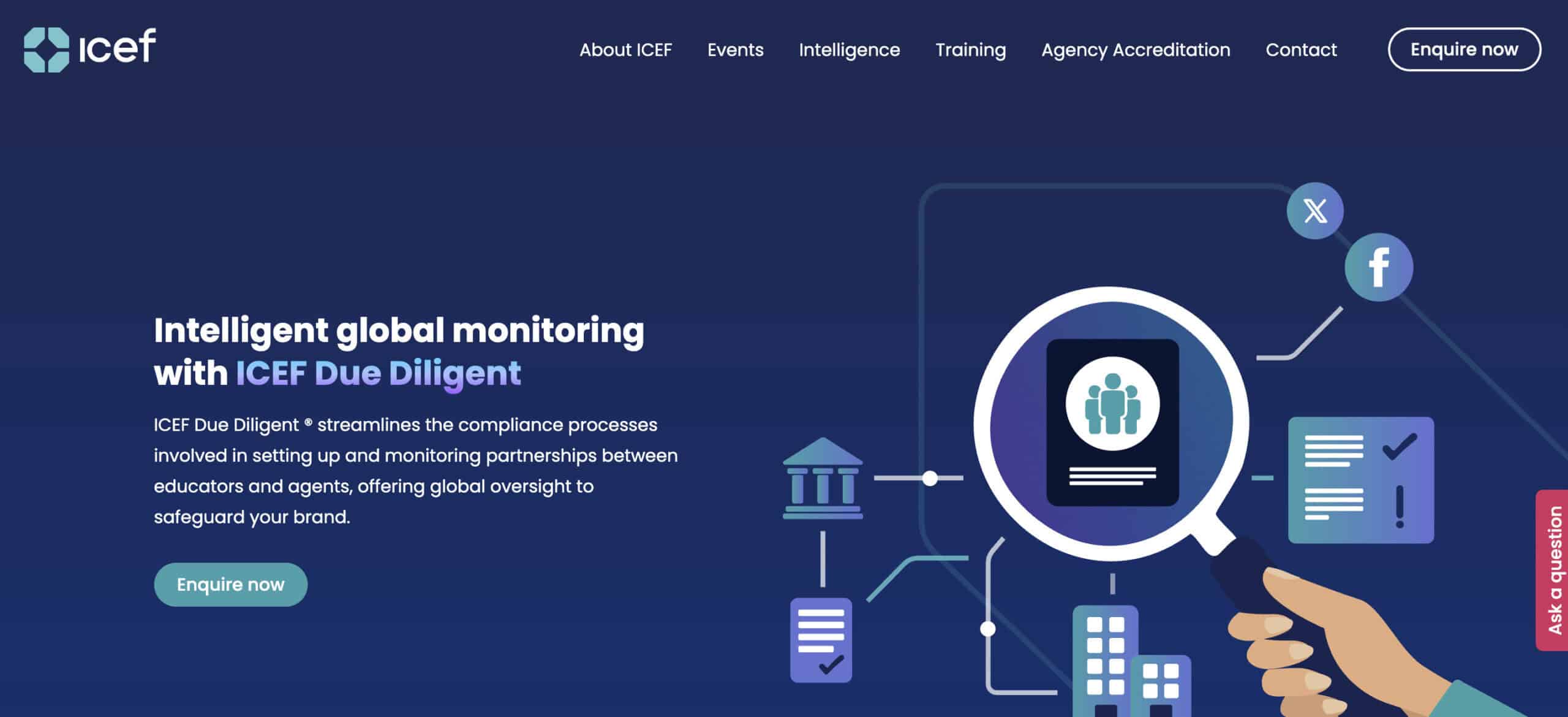
    ICEF has launched a new platform called Due Diligent, a system that it describes as “the first AI-powered tool designed to ensure ethical, transparent and compliant educator-agency partnerships”.

    It aims to improve the transparent monitoring of agent finances, representatives, social media and in-country marketing.

    The company already accredits over 2,300 agents and has trained more than 140,000 counsellors, enabling them to become certified through the ICEF Academy.

    The new platform promises to provide both educators and agents with real-time information about one another in a reciprocal way, including financial and regulatory checks as well as social media listening.

    Scaled by using the latest wave of artificial intelligence technology, the ICEF software constantly scans agent activity based on an institution’s own approved list, creating regular reports of social media messaging happening in each market to ensure it is on brand and compliant.

    Unapproved use of branding or incorrect information can also be flagged, allowing institutions better visibility of the long tail of subagent networks.

    Due Diligent has also been designed to search for information on the individuals who operate and own agencies, including financial checks and media coverage. The aim is to identify bad actors who may reappear again in another agency.

    Speaking to The PIE News, ICEF’s chief visionary officer, Tony Lee, said: “Most importantly, the new platform is looking at the individuals behind an agency. It’s about that transparency of knowing who those agencies are, so it’s not just a random company name in a random country – it’s knowing who’s behind that company as an individual.

    “We’ve also been able to use the next generation of social media listening software and crawling software so that we can hear and see what those individuals are saying in the public spaces,” continued Lee.

    Most importantly, the new platform is looking at the individuals behind an agency
    Tony Lee, ICEF

    The launch of ICEF Due Diligent is part of ICEF’s wider ‘Together for Transparency’ campaign, which is championing professional standards and greater trust between educators, recruitment agencies and students worldwide.

    “ICEF has been working in the agent space for 30 years,” continued Lee. “But we’re not judge or jury. We’re giving the framework for the entire sector to be effectively the ones that judge what is good or bad practice, we’re simply turning the lights on [to help make a considered decision].

    The platform was developed in consultation with over 400 industry stakeholders. One of the main frustrations expressed by the sector has been the burden of annually auditing large agent networks.

    It is hoped that the use of a continual AI-powered monitoring tool can relieve that burden and free up more time for strategic training, counselling and recruitment support.

    Markus Badde, CEO of ICEF, explained: “In today’s competitive and increasingly regulated environment, trust is everything. ICEF Due Diligent gives educators, agencies and stakeholders the confidence that their partners meet the highest professional and ethical standards, continuously.”

    Source link

  • UNC System Mandates Reports on DEI Compliance

    UNC System Mandates Reports on DEI Compliance

    The University of North Carolina System’s Board of Governors issued a memorandum requiring each of the system’s 17 campuses to develop a subcommittee to evaluate the campus’s compliance with the system’s anti-diversity, equity and inclusion policy, The Assembly reported.

    They have until Sept. 1 to show how they have complied with the policy, which cancelled previous DEI guidance and mandated neutrality from administrators on political and social issues. As a result of that policy, UNC campuses reported that they laid off dozens of staffers, moved 131 people to new positions, and redirected $16 million in DEI spending to student success and wellbeing programs.

    According to the memo, the reviews should include briefings with chancellors about employees whose jobs were changed as a result of the DEI ban.

    “These confidential reviews should compare an individual’s prior position to his or her new responsibilities, including how the employee’s performance in that role has changed, and what safeguards exist to ensure an employee’s previous responsibilities do not continue in the present role,” the memo states. “Confidential briefings from the chancellor on any disciplinary action taken against personnel should occur at this time as well.”

    The memo comes after four UNC employees were secretly filmed by a conservative nonprofit discussing circumventing DEI restrictions; three of those employees are no longer employed by their universities.

    Source link

  • Student protection through market exit is not a compliance exercise

    Student protection through market exit is not a compliance exercise

    As financial and regulatory pressures on higher education intensify, the once-hypothetical risk of a large-scale provider exiting the market is becoming increasingly likely.

    For government, regulators, providers, and students alike, the implications are far-reaching – and the sector needs to be better prepared.

    The risk is growing

    Following our previous reflections on this issue we received many messages of interest and support for doing some further work in this area. We also felt there was an opportunity to bring together the experiences of colleagues we have worked with on closures and mergers, and to capture the perspectives of receiving providers and learn from their experiences.

    SUMS Consulting reached out to us, offering to support a new project on a pro bono basis. Their expertise in supporting student services and change management, combined with the OIA’s experience of student complaints during provider exits, created a unique opportunity to look at the problem from both a practical and student-centred perspective. We also asked the Committee of University Chairs (CUC) to join the project’s steering group, ensuring governance perspectives were built into the work from the outset.

    The risks we highlighted last year have only intensified for students. At the OIA we have seen further complaints from students at smaller providers which have closed in recent months. In these scenarios we see staff working quickly to try to support students at both closing and receiving providers, but there is little legal scaffolding to protect students caught in these situations often leaving them with limited redress.

    Lessons from experience

    Whilst we recognise that there has been significant positive engagement, discussion and reports in this space, the SUMS and OIA report – Putting Students First – Managing the impact of higher education provider closure – focuses on mitigating the impact on students and specifically learning from the closures and cases the OIA has been involved in. If we don’t take these examples seriously, we risk missing a crucial opportunity to improve outcomes for students.

    Over the course of the project, there has been increasing discussion about these policy issues and a ‘playbook’ for market exit is frequently suggested. Whilst neither the SUMS nor the OIA has the expertise or role to produce something quite this detailed and comprehensive, SUMS have gathered insights from university leaders, students’ unions, experts, and those who have dealt directly with closures.

    Part one of our report provides the context for the study and collates findings on lessons and effective practice for the sector derived from all the research and information gathering for this study. SUMS also provide some conclusions on the gaps identified by the research and make a series of recommendations for Government, regulators and sector bodies and providers to consider to better support providers navigate exit and help mitigate the impact of future closures on students.

    Part two is a separately appended framework (in MS Excel format), which is a summary of the key lessons learnt from the study. The framework is not intended as a comprehensive guide for good institutional governance or achieving financial sustainability. Rather it is intended to provide a checklist of key actions that might be taken by providers to mitigate the risk of exit and, if exit is unavoidable, to help prepare for a managed exit.

    Several consistent themes emerged across our discussions – notably the practical disconnects between the current legal, regulatory, financial, and student protection processes. What’s clear is the value of early engagement – acting early and being transparent can reduce the impact on students – but we recognise this is difficult when reputational and commercial pressures are in play. Also it is apparent that receiving providers and students’ unions often play a vital role but aren’t always given the resources or support they need.

    We found that student protection is too often treated as a compliance task. If the sector is to avoid repeating past mistakes, this mindset must change.

    Moving the conversation forward

    This report is not the final word. We see it as a starting point — a resource that will grow over time, as more providers engage with it and share their own experiences. We hope that going forward the framework will continue to evolve – helping shape a more student-centred response. We also hope it will support other initiatives in this space, such as the forthcoming updates to the CUC Governance Code.

    Above all, we want to encourage providers, governors, and policymakers to engage in open and honest conversations about the risk of market exit — before it becomes an emergency. Used early, the framework can help institutions strengthen their preparedness, build resilience, and ultimately safeguard the student experience.

    What happens next?

    We encourage providers and others to review the framework and checklist with leadership and governance teams, integrate its guidance into risk and student protection planning, share feedback to help develop the next iteration of the work.

    We hope that this work will help enable honest and open conversations about exit, both within and between providers. We all need to understand that student protection isn’t just a compliance issue – it has a very direct impact on the experiences of students in the system, and we must all be ready.

    Ultimately, we need a more collaborative whole sector approach – because when a large-scale provider exits the market suddenly, the impact isn’t isolated – it becomes a sector-wide challenge. Ensuring students are protected must be a shared sector priority.

    Source link

  • U of Utah Urges Compliance After State Restricts Pride Flags

    U of Utah Urges Compliance After State Restricts Pride Flags

    A University of Utah lawyer last week urged faculty to comply with the state’s new prohibition on the “prominent“ display of pride flags and other flags on campus, The Salt Lake Tribune reported.

    Deputy general counsel Robert Payne urged faculty in a meeting not to “be a lightning rod to the Legislature” and said state lawmakers “have a lot of power over us,” the newspaper reported. Payne also suggested that if employees tried to get around the law by hanging pride posters instead of flags, legislators might “come back with something worse,” the Tribune reported.

    Utah’s Republican-controlled Legislature passed House Bill 77 last month, and Gov. Spencer J. Cox, a Republican, let it become law without signing or vetoing it. When it takes effect May 7, it will ban government entities, including public colleges and universities, from displaying flags on government property “in a prominent location.” Some flags are exempted, such as the U.S. flag and the prisoner of war/missing in action flags.

    Trevor Lee, a Republican Utah House member and HB 77’s chief sponsor, told Inside Higher Ed he didn’t file the legislation specifically to ban pride flags. But “that’s just been the biggest, biggest issue of any political flag,” he said. “I mean, it’s not even close.”

    Lee said the flags go beyond representing inclusivity. He said, “It’s a sex flag. It tells everyone what sexual ideology you believe in.”

    The University of Utah has released guidance online saying the law generally bans pride flags, Juneteenth flags and others from prominent locations. The guidance notes exemptions, including that students and employees can “wear or carry a flag as a personal expression of free speech,” and that employees can decorate their offices with flags “so long as they are not easily visible outside of their personal space (e.g., posted in an office window).”

    Payne said the university hasn’t yet decided how it will enforce the flag ban, according to the Tribune. The university’s guidance says, “Flags may also be used as decorations in connection with a brief cultural celebration hosted by the university within a university building,” but can’t be up for more than a week. It’s unclear whether pride will be considered a cultural celebration.

    Source link

  • Education Dept. Agrees to Push DEI Compliance Deadline

    Education Dept. Agrees to Push DEI Compliance Deadline

    State education agencies are no longer bound to certify their compliance with President Donald Trump’s executive orders and guidance memos banning diversity, equity and inclusion programs in order to continue receiving federal funds—at least for now.

    K-12 school districts were originally required to prove they had met the president’s standard by April 14. But now, as the result of an agreement reached Thursday in a lawsuit, the Department of Education cannot enforce that requirement or enact any penalties until April 24. The move to require school systems to certify their compliance was one of the department’s first actions since releasing the Feb. 14 Dear Colleague letter that declared all race-conscious student programming, resources and financial aid illegal.

    The National Education Association challenged that letter in a lawsuit and then moved for a temporary restraining order to block the certification requirement. (The department notified state educational agencies of the deadline April 3.)

    In addition to not enforcing the certification requirement, the Education Department also agreed not to take any enforcement action related to the Feb. 14 guidance until April 24, though that doesn’t cover any other investigations based on race discrimination.

    The plaintiffs, represented by the American Civil Liberties Union, still want to block the Dear Colleague letter entirely. But they see the agreement as a positive step.

    “This pause in enforcement provides immediate relief to schools across the country while the broader legal challenge continues,” the plaintiffs said in a news release.

    A judge will hold a hearing April 17 to consider the NEA’s motion for a preliminary injunction, which could block the guidance entirely.

    For more information on this case and others, check out Inside Higher Ed’s lawsuit tracker here.

    Source link

  • As compliance deadline looms, colleges must resist censorship — and the feds must provide more clarity

    As compliance deadline looms, colleges must resist censorship — and the feds must provide more clarity

    Last week, FIRE wrote about how colleges should interpret President Trump’s recent executive orders, Attorney General Pam Bondi’s anti-discrimination memo, and the Department of Education’s Office for Civil Rights newest “Dear Colleague” letter. 

    At the same time, we asked OCR to give colleges additional guidance so they have a better idea of what type of speech or conduct might run afoul of its “Dear Colleague” letter. OCR has not yet done so, and with the compliance deadline set for tomorrow, we fear institutions will over-correct and engage in campus censorship.

    In fact, we’ve already seen evidence of exactly that. 

    Grand View University in Iowa, for instance, reportedly cancelled its planned International Women’s Day activities, allegedly to comply with federal DEI directives. This, even though Bondi’s Feb. 6 memo exempts “educational, cultural, or historical observances — such as Black History Month, International Holocaust Remembrance Day, or similar events — that celebrate diversity, recognize historical contributions, and promote awareness without engaging in exclusion or discrimination.” 

    This type of overcompliance — in this case, cancelling activities or events that are expressly exempted from enforcement — unnecessarily degrades the extracurricular educational environment at higher education institutions and harms the student learning experience. 

    As we said last week: OCR is bound by the First Amendment and cannot order or compel colleges and universities to violate it. If there is a conflict between federal guidance and the First Amendment, the First Amendment prevails. Whether institutions are overcomplying out of fear of losing federal funding, or in an attempt to prove a point about the directive’s vague language, colleges and universities like Grand View must not preemptively shut down speech.

    OCR’s new Title VI letter: FIRE’s analysis and recommendations

    News

    The Department of Education should provide more clarity about its ‘Dear Colleague Letter’ to ensure protected speech isn’t censored on campus.


    Read More

    This isn’t the first time institutions have overread government directives to justify censorship. In 2021, for example, Idaho passed the “No Public Funds for Abortion Act.” In implementing the bill, the University of Idaho demanded that faculty not “promote or advocate in favor of abortion” or discuss “abortion or contraception” in classroom conversations unless they remained “neutral.” FIRE wrote to the university explaining that such a reading was flatly at odds with the First Amendment. In a thorough memorandum, Idaho Attorney General Raúl Labrador agreed, explaining that the “plain text of the Act does not prohibit public university employees from engaging in speech relating to academic teaching and scholarship that could be viewed as supporting abortion,” thus ending that censorship policy at the University of Idaho. 

    In that same vein, OCR cannot force schools to violate the First Amendment, a point we’ve hammered since the Obama-era OCR’s “Dear Colleague” letters forced institutions to adopt harassment policies that did exactly that. 

    OCR must be clear about the type of conduct that runs afoul of its new directives so that institutions are on notice about what’s permissible and what is prohibited. The office has yet to address vagueness in the “Dear Colleague” letter about “institutional programming” that might violate Title VI. That silence is creating a lot of confusion and preemptive censorship, especially when paired with President Trump’s Jan. 21 executive order declaring that government contractors — which includes many institutions of higher education — cannot “operate any programs promoting DEI that violate any applicable Federal anti-discrimination laws.”

    FIRE again urges institutions to hold the line on defending the free speech and academic freedom rights of their students and faculty. And we again ask OCR and the federal government to respect those same rights by immediately clarifying that their directives don’t require colleges and universities to violate those well-established rights. 

    Last week, a federal court enjoined two executive orders — including the Jan. 21 executive order — that prohibit, among other things, “promoting DEI” in violation of federal anti-discrimination law. The district court held the orders violate the First and Fifth Amendments because they discriminate on the basis of viewpoint and content, and are unconstitutionally vague. 

    While the government will likely appeal and we won’t know the final resolution for some time, the court’s analysis properly identified the orders’ ambiguity as a damning constitutional flaw. What, precisely, constitutes “promoting DEI” in ways that violate anti-discrimination laws? Can colleges host or sponsor speakers on DEI-related topics? Can institutions advertise DEI-related coursework or promote academic research? Restrictions on these activities would violate the First Amendment, but government attorneys were unable to clarify the meaning of the order when asked by the judge. Precision matters, especially when it comes to restrictions on expression. Vague pronouncements that sweep in protected debate, discussion, and programming raise constitutional and practical problems. 

    The best way forward for colleges is obvious, even if it might not be easy: Irrespective of the federal DEI directives, ditch speech-restrictive, orthodoxy-enforcing DEI bureaucracies and stand up for free expression and academic debate — in every political season. 

    As Len Gutkin, editor at The Chronicle of Higher Education, recently wrote: “Colleges should draw a sharp distinction between, on the one hand, DEI used in hiring, promotion, and training, and, on the other, curricular and disciplinary offerings.”  

    That’s the right balance. FIRE again urges institutions to hold the line on defending the free speech and academic freedom rights of their students and faculty. And we again ask OCR and the federal government to respect those same rights by immediately clarifying that their directives don’t require colleges and universities to violate those well-established rights. 

    Source link

  • A letter to NEH on compliance with Trump orders (opinion)

    A letter to NEH on compliance with Trump orders (opinion)

    On Feb. 11, the National Endowment for the Humanities announced on its website that it had modified its funding criteria for eligible humanities projects in compliance with three recent executive orders. According to the announcement, “NEH awards may not be used for the following purposes:

    • promotion of gender ideology;
    • promotion of discriminatory equity ideology;
    • support for diversity, equity, and inclusion (DEI) or diversity, equity, inclusion, and accessibility (DEIA) initiatives or activities; or
    • environmental justice initiatives or activities.”

    These prohibitions impose the terminology of Executive Orders 14151, 14168 and 14190 onto future applicants for NEH funding, whether individual scholars, museums, nonprofit organizations or colleges (including historically Black colleges and universities and tribal colleges). Published well within the stipulated 60-day window for government agency compliance with the order to terminate all “equity-related” initiatives, grants or contracts, these prohibitions represent a swift implementation of the Trump administration’s point-by-point mandate for “Ending Radical Indoctrination.”

    I can only begin to conjecture here about what the consequences of the NEH’s new criteria might be for the humanities, the domain of cultural and intellectual inquiry the NEH was created to foster. To cite the National Foundation on the Arts and Humanities Act of 1965, “While no government can call a great artist or scholar into existence, it is necessary and appropriate for the Federal Government to help create and sustain not only a climate encouraging freedom of thought, imagination, and inquiry but also the material conditions facilitating the release of this creative talent.”

    To uphold conditions defined by prohibition rather than freedom—and with prohibitions explicitly targeting the right to existence of queer and transgender people (“gender ideology”), the ability in any way to offset egregious structural inequalities in educational and cultural access (“DEI”), and even the very right to advocate on behalf of anyone’s rights (“discriminatory equity ideology”)—is to betray the very terms under which the NEH was created. In revising its Notice of Funding Opportunities, the NEH is in violation of its public mission.

    Presumably, as a government agency perpetually under threat of budget cuts, the NEH hastened to implement Trump’s executive orders in order to fend off wholesale elimination. The NEH is a federal agency and is thus directly implicated in the executive orders, provided those orders are constitutional. By complying with Trump’s ideology, the National Endowment may perhaps live to see another day, thereby preserving the careers of at least some of its approximately 185 employees and its ability—to do what?

    The NEH has not yet fully overhauled its website to reflect its compliance. Of its current listings of Great Projects Past and Present, perhaps “The Papers of George Washington,” “Journals of the Lewis and Clark Expedition,” and “The Real Buffalo Bill” might manage to squeeze through under the new stipulations, but would the Created Equal documentary film project be so lucky? Would a biography of union organizer César Chavez manage to qualify as a fundable project, or a documentary about “A Black Surgeon in the Age of Jim Crow”? How about the Transatlantic Slave Trade Database? The NEH has leveraged its own institutional survival on the forfeit of future such projects.

    The problem is a far deeper one, however. In what universe should it be too much to ask that a state-sponsored institution created to uphold the “material conditions” for freedom of thought, imagination and inquiry put up even the slightest resistance to the inhumane, reactionary and repressive edicts issued by the Trump regime? Even today, the NEH website champions its past support for projects that uphold justice in the face of oppression, that resist totalitarian erasure. Yet the NEH itself has mustered no such resistance. Instead, it has announced that any such projects are now ineligible for consideration.

    Of one thing I am certain: The National Endowment for the Humanities has forfeited its claim to the word “humanities.” The humanities do not designate a prohibitive sphere of capitulation to ruling forces. The humanities are not furthered by a governmental agency that serves, willingly or unwillingly, as an ideological extension of a political party. The humanities are a domain of inquiry, of questioning and investigation, not of unquestioning acquiescence.

    As a literature professor and an educator in the humanities for more than a quarter century, I have assured my students that the study of cultural, artistic and intellectual production is continuous with its practice. This not only means that humanistic inquiry involves creativity, creation and a commitment to thinking freely, but it also means that humanistic inquiry necessarily upholds the same responsibility to questions of ethics, value and meaning with which any other historical action must reckon. Humanists cannot, and do not, stand meekly aside while the “real” agents of historical change make big decisions.

    In posting a recent message to the frequently asked questions web form on the NEH website, I wrote that in light of the NEH’s silent capitulation to Trump’s executive orders, I was ashamed to call myself a humanist. I hereby recant that statement. I am not ashamed to call myself a humanist. It is the National Endowment for the Humanities that should be ashamed. Or, better yet, I call on the NEH and all its 185 employees, including and especially NEH chair Shelly C. Lowe, to recant their compliance with Executive Orders 14151, 14168 and 14190 and join other national and international agencies, organizations and individuals in resisting the inhumane and unconstitutional decrees of the Trump administration.

    Jonathan P. Eburne is a professor of comparative literature, English and French and Francophone studies at Pennsylvania State University and director of undergraduate studies in comparative literature.

    Source link

  • US Congress urged to crack down on student overstays

    US Congress urged to crack down on student overstays

    Over 7,000 of these student and exchange visitors that overstayed their visas came from India, house representatives heard in a committee hearing on immigration enforcement in the US on January 22.  

    “Thirty-two countries have student/exchange visitor overstay rates of higher than 20%,” Jessica Vaughan, director of policy studies at the anti-immigration think-tank, the Center for Immigration Studies, told the committee.  

    However, sector leaders have argued that Vaughan’s testimony contained “some serious and inaccurate generalisations” and relied on “faulty statistics for her claim about the student visa overstay rate,” according to NAFSA‘s director of immigration policy, Heather Stewart.  

    “International students are the most tracked non-immigrants in the US and a clear and comprehensive understanding of student visa misuse is needed if the field is to arrive at effective and appropriate solutions,” said Stewart.  

    After India, Vaughan highlighted China, Colombia and Brazil as each having more than 2,000 of their citizens overstay student/exchange visas in 2023, urging Congress to eliminate OPT and impose penalties for institutional sponsors, among a host of regulations.  

    “The F and M visa categories have [the] highest overstay rates of any of the broad categories of temporary admission,” Vaughan told committee members, with F visas used for academic study and M visas for vocational study.  

    According to recent DHS figures, the total overstay rate for student and exchange visitors in 2023 was 3.67% with a suspected in-country overstay rate of 2.86%, dropping slightly to 2.69% solely for F-1 students, with all metrics excluding Mexico and Canada.  

    Countries with highest student/exchange overstay rates by numbers (2023): 

    Country  Suspected in-country overstays  Total overstays  Total overstay rate 
    India   5,818 7,081 4.67%
    China 3,012 5,255 2.1%
    Colombia 2,792 3,223 8.29%
    Brazil 1,692 2,198 4.6%
    Source: US Homeland Security Entry/Exit Overstay Report FY 2023 

    While India, China, Colombia and Brazil recorded the largest numbers of student overstays in 2023, their overstay rate as a percentage of overall student populations in the US were relatively low.  

    It is perhaps unsurprising that India and China, whose combined student populations made up 54% of total international enrolments at US institutions in 2023/24, also saw the highest levels of visa overstays. 

    Country Total overstay rate
    Equatorial Guinea  70.18% 
    Chad   55.64%
    Eritrea  55.43% 
    Congo (Kinshasa)  50.06%
    Djibouti 43.75% 
    Burma 42.17% 
    Yemen  40.92% 
    Sierra Leone 35.83%
    Congo (Brazzaville)  35.14% 
    Togo  35.05% 
    Global (excl. Mexico + Canada) 3.67% 
    Source: US Homeland Security Entry/Exit Overstay Report FY 2023 

    Notably, the ‘in-country overstay rate’ refers to the percentage of individuals suspected to still be physically present in the US after their visa expired, while the ‘total overstay rate’ includes both those still in the country and those who may have eventually left after overstaying their visa, but were not recorded as departing. 

    Sector members have raised concerns about the “troubling” scale of the problem uncovered by the report, ranging from benign violations of legitimate students to “cases of wilful fraud”, said Eddie West and Anna Esaki-Smith, two leading US educators.  

    NAFSA, however, has disputed the figures as “unreliable”, claiming that the report “overstates” the issue and urged stakeholders to take caution when taking the figures out of context.  

    Indeed, DHS concedes that “infrastructural, operational and logistical challenges” in the exit environment make it difficult to identify students who do not depart via air or who transition from F-1 status to H-1B, legal permanent residency and other statuses.  

    What’s more, DHS data revealed a 42% decline in the suspected overstay rate for student and exchange visitors across a 15-month period ending in January 2024, indicating a lag time for the system to register students’ changing situations. 

    “Not only do visa issuance policies need to be adjusted and interior enforcement boosted, in addition Congress should amend the law in several important ways,” Vaughan told the hearing.  

    In a statement raising some concern about Vaughan’s testimony, she recommended that “the concept of dual intent should not apply to student visa applicants”. 

    Under current law, it does not.  

    While the Optional Practical Training (OPT) program has been widely proven to benefit American workers as well as international graduates, Vaughan blamed the initiative for spawning “an industry of diploma mills and fake schools”, calling for it to be eliminated or “much, much more closely regulated”.  

    Vaughan also recommended stricter regulations on H1-B specialty occupation visas, a move which Stewart warned would “immediately” make the US look less attractive to international students who “strongly consider” post-study employment opportunities when deciding where to study abroad.  

    During Donald Trump’s presidential campaign, he surprised some of the sector.

    The second-time US president spoke out in support of the H1-B visa during his presidential campaign amid a row about the work pathway among prominent Republicans.

    The US is the only one out of the ‘Big Four’ study destinations – US, UK, Australia and Canada – to publish data on international student overstay rates.

    Source link