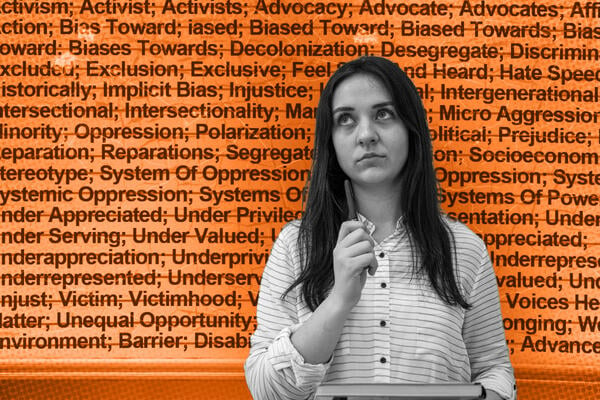
“Biases.” “Racism.” “Gender.” “Women.”
Those are just some of the terms colleges and universities are searching for in their databases to ensure compliance with federal DEI bans and similar directives from states and university systems.
Robin Goodman, distinguished research professor of English at Florida State University and president of the university’s chapter of United Faculty of Florida, said her institution is using a list of keywords to review webpages for DEI language in response to federal and state directives. While not all those terms were scrubbed, the list, which has circulated among faculty, disturbed her.
“From my point of view, those words are now dangerous words” that exacerbate a “culture of fear” on campus, she said.
She’s also mystified by which terms did and didn’t make it onto her university’s list, noting that the word “woman” is flagged, but not “man” or “sex.”
Campuses using keyword lists isn’t entirely new. Some state laws have pressured colleges to avoid using certain terms in the past, said Jon Fansmith, senior vice president of government relations and national engagement at the American Council on Education. But for most campuses, this is a “new space,” as some institutions scramble to comply with federal anti-DEI orders, like the Office for Civil Rights’ Dear Colleague letter, and try to mirror the ways grant-making federal agencies, like the National Science Foundation, have responded.
Colleges and universities are using the same tactics as many federal agencies parsing their grant projects and webpages to comply with federal anti-DEI directives. The National Science Foundation, which temporarily shut down grant reviews, searched for terms like “female” and “male-dominated” in its research grants. The Centers for Disease Control used a list of roughly 20 terms to guide choices about removing DEI-related language from its website. And the Defense Department reportedly flagged tens of thousands of images and web posts for removal because of alleged connections to DEI, including references to service members with the last name Gay and an image of the Enola Gay aircraft, which dropped the atomic bomb on Hiroshima during World War II.
Campus administrators taking this approach argue that, when tasked with reviewing massive numbers of webpages and programs, keywords make it easier to arrive at a smaller, more manageable pool to review. Faculty members, on the other hand, are baffled and outraged by the strategy. Some sympathize with campus leaders’ plight but argue it’s alarming to watch universities treat terms like “female” as red flags.
Fansmith doesn’t believe such lists are an ideal strategy.
Flagged word lists are “a very, very, very blunt tool” for “trying to understand academic content or the merits of research grants or projects,” he said.
‘Not a Perfect Approach’
University leaders recognize that devising keyword lists puts campuses on edge, but some argue it’s the most efficient way to respond to an onslaught of anti-DEI directives.
East Carolina University’s interim provost, Chris Buddo, explained at a recent Faculty Senate meeting that the Office of University Counsel crafted a list of terms over several months, initially used to review the university’s web presence to comply with the University of North Carolina system’s Equality Policy, which pared back DEI. (The North Carolina General Assembly also demanded an inventory of DEI trainings from the system in 2023, offering up a list of concepts and terms to guide the audit, including “accessibility,” “bias,” “racism” and “social justice.”)
Then, in February, a UNC system attorney issued a memo prohibiting campuses from mandating courses focused on DEI, referencing Trump’s January anti-DEI executive order. University officials again used a keywords list to search through the course catalog and ensure no general education or major requirements were focused on DEI.
Faculty at the meeting guffawed at some of the words flagged, including “cultural.”
“I know it’s been controversial, and I understand it is not a perfect approach,” Buddo told faculty. “But given the significant amount of content we are being asked to review, we started by using this blunt tool—and I recognize it is a blunt tool.”
He stressed that none of the words on the list are “inherently problematic.”
But “the list was developed as a way to cast the widest possible net, to make sure we could be aware of all the places that we might be viewed as being noncompliant,” he said.
Anne Ticknor, chair of the faculty and a professor in the College of Education at East Carolina University, said her institution has no choice but to comply with the system’s directives, though she tried to ensure that faculty had a say in any changes to course requirements.
“People were fearful that their academic freedom was being infringed upon, since faculty traditionally oversee curriculum, and that includes course titles, syllabus information, course descriptions, content—all of that is typically a faculty’s domain,” she said.
East Carolina officials told Inside Higher Ed in a statement that most courses flagged using the list were “false positives,” meaning that upon review, they weren’t required or didn’t relate to DEI.
Florida State University also emphasized in a statement to Inside Higher Ed that just because the university is using a list of key terms to review webpages and communications doesn’t mean those words or pages are necessarily being removed.
“For example, contrary to media reports, the words ‘woman’ and ‘women’ are easily found throughout the FSU website and have not been removed, nor are they being removed,” the statement read. “Florida State University, like all universities, routinely reviews its messaging to ensure information is up to date and compliant.”
Florida State president Richard McCullough recognized in a March 4 message to faculty and staff that they may have “feelings of uncertainty and concern.”
“While we are confident that our institution currently complies with the law, it is important that our messaging reflects new interpretations and priorities,” he told employees.
Some campus leaders said they crafted flagged-terms lists out of panic.
Officials at High Point University, a private institution in North Carolina, for example, told Inside Higher Ed in a statement that they created a keyword list in a moment of heightened worry last month after the U.S. Department of Education canceled three grants that supported graduate education programs, totaling $17.8 million. The Feb. 14 Dear Colleague letter, which gave institutions two weeks to rid themselves of race-conscious programming, exacerbated their concerns about losing federal funding for other programs.
According to The News & Observer, the university circulated a list of 49 terms, including “equality” and “gender,” and called for an audit of course descriptions and syllabi, student handbooks and webpages.
But officials quickly rescinded the move.
“Facing a 14-day deadline, we acted quickly based on our care and concern for students and faculty,” the statement from High Point read, “but clearly we overcorrected.”
Provost Daniel Erb sent an apology to academic leaders on March 2, saying he consulted with legal counsel and “there are no terms or words that you are required to change.”
“While many institutions were working towards removing certain terms and words from websites … our legal counsel has helped clarify that our priority should be on ensuring all our program qualifications and requirements do not discriminate on the basis of race, ethnicity, gender, religious beliefs, etc.,” Erb wrote. “Therefore, the concern about the language that is used is no longer a focus.”
ACE generally doesn’t recommend universities undertake such language reviews in response to the Office for Civil Rights’ anti-DEI directive, Fansmith said. He believes campuses’ usual processes for reviewing university communications and curricula should suffice.
“The administration has a view of what compliance with civil rights laws means,” which “I don’t think we necessarily believe the law itself supports,” he said.
The Ripple Effects
While harried administrators say the flagged terms are just a guidance tool, faculty members find the reviews burdensome and say they have a chilling effect in the classroom.
Margaret Bauer, professor of English, distinguished professor of arts and sciences and Rives Chair of Southern Literature at East Carolina University, said her department has a Multicultural and Transnational Literatures concentration. She hasn’t done a count, but she expects the word “cultural”—one of the words on the list—comes up in every course description in that concentration. She feels for her colleagues who’ve had to justify courses or explain why they’re false positives. (Bauer is also in the Faculty Senate but stressed that she’s speaking on her own behalf.)
“We’re already all overtaxed with so much bureaucracy,” she said. “Just to add something that’s so ridiculous—it’s really frustrating … We should have been grading or planning class, things that are productive. This was not productive.”
Bauer believes administrators are well intentioned and “want to protect us.”
But “I want them instead to push back … and say, ‘Curriculum is under faculty. And we don’t teach discrimination. We teach the history of it. We’re not doing anything wrong … These words are things our university believes in,’” she said.
Knowing the word list is out there makes concepts feel taboo in the classroom, she said.
“When I’m teaching Southern literature, I’m going to end up talking about the history of oppression, the history of discrimination … I can’t not talk about it,” she said, but she finds herself feeling “more self-conscious” about it. She worries faculty members without tenure might fear for their jobs if they “teach honestly.”
Goodman, of Florida State University, said she also can’t avoid the topics on her university’s flagged-term list.
“I’m a feminist theorist. I’ve written a lot of books, and they all have ‘feminism’ in the title,” she said. “So, I can’t backtrack it now. It’s all out there in the public.”
The flagged-words list—especially combined with recent Florida state laws allowing students to record professors in class and requiring professors to undergo post-tenure review—creates an environment where “faculty feel like they are being gagged in class, and they’re fearful,” she added.
Fansmith isn’t surprised faculty are worried.
Professors are used to “really complicated, detailed and multi-faceted levels of curriculum construction,” he said. “These are professionals who have spent their lives understanding those nuances, those details and why they matter,” so they’re concerned to see coursework in particular “reduced seemingly to a simplistic list of terms.”
He believes word lists are an acceptable, albeit not ideal, tool to use if they’re part of an internal review process “done with the care and attention that universities generally do with matters of curricular review and with respect for academic freedom.”
But “when it’s being mandated from the outside, by the federal government or a state and it’s getting into really perilous ideas of academic freedom and what can be taught, that’s when we start to really worry about what these lists mean and what they represent,” he said.