Tag: Conflict

  • conflict, peace and international education 

    conflict, peace and international education 

    It’s that time of year again. On streets and in shops across the UK this, someone will have been be selling poppies. And today, on Remembrance Sunday, at War Memorials from tiny villages to Whitehall, people will gather for a period of silence. A moment to reflect, to remember. 

    For me personally, there is a family connection. My paternal great-grandfather was killed in WWI, leaving four young children. His name is on the vast Tyne Cot memorial in Belgium, one of 35,000 of the missing who died in the Ypres Salient after August 16, 1917, and have no known grave.

    But I also think of another memorial, the one I gathered around for the years I worked at Sheffield University. This is the moving tribute to the students and staff who lost their lives in two World Wars. 

    This carved stone monument at the University’s core was once located in the original library, and it contains arguably the most sacred and painful book in its collection – a Book of Remembrance.

    Sheffield University had its own battalion in WWI and it was almost completely destroyed on the first day of the Battle of the Somme in 1916. Some 512 young men lost their lives in a single day. I was once given permission to lift off the glass cover and open the book. It was shocking, each page crammed full of so many hundreds of names. 

    For many of those students, hopefully joining up and travelling to France was the first time they had been overseas, just as it was for my great-grandfather. He left his mining village on the unluckiest of journeys – first to Gallipoli where he was gassed, and then to France where he died in the mud. 

    Today, students have a very different opportunity for travel, for connection. A century after my great-grandfather died, I have travelled the world in peacetime thanks to international education. I’ve been to Delhi and seen the vast war memorial at India Gate with its eternal flame and walls of other names – Hindu, Sikh, Muslim. I have friends from China whose relatives long ago would have dug the trenches as part of as part of the 140,000 strong Chinese Labour Corps for the British and French armies.

    Remembrance Day isn’t a British only tradition – a whole world was drawn into those terrible events. 

    What international students teach us now 

    And I have international students friends who don’t need a poppy to remind them to remember because they come from countries with current experience of conflict. 

    Who are they? A refugee scholar from Syria working on environmental sustainability. A Gaza scholar who rejects the language of resilience and uses her research to build deep understanding. A friend in Singapore who has family in Russia and Ukraine. And the Afghan scholars who have become not only friends but family, those who teach us all that the peace to sit with your loved ones and share a meal is never to be taken for granted. That for young girls and women to access education, university, careers and have choices is a right hard won that must be cherished. Each of them is also my teacher. 

    As the world changes, nationalism grows and spheres of influence are fortified by economic and literal weapons, those who understand one another are more important than ever

    And this is also why I believe in international education. Peace takes understanding. It takes work. As the world changes, nationalism grows and spheres of influence are fortified by economic and literal weapons, those who understand one another are more important than ever. 

    It is a tragedy that language courses close because, as John le Carré said, learning a language is an act of friendship. But international education in all its forms is also what my NISAU friends call a ‘living bridge’.

    Whether it happens through traditional programmes of overseas study, short courses, institutional partnerships, TNE or internationalisation at home, global education offers a precious opportunity to meet in peace. To gain a perspective not only on what others think and how they see the world, but about yourself. 

    Why it matters that #WeAreInternational 

    When years ago we founded a campaign called #WeAreInternational , it was a statement not about a structure of higher education but about who we are and want to be. It doesn’t mean abandoning your identity, it means opening it up to possibility. That is in itself an education. 

    John Donne famously wrote that no man is an island but that we are deeply connected to one another, all of us connected to the continent. And when others are harmed, we are all diminished. That the bell that tolls for any life is ringing for humanity too. 

    On Remembrance Sunday this year, as we are urged never to forget, there is also an implicit call to action – not to wage war but to build peace. How do we do that? Nobody is pretending it’s easy, but I think the education we are privileged to support has a very human part to play. 

    I think of the words of my Afghan scholar friend Naimat speaking at City St George’s University of London to students earlier this week. As the minute’s silence begins on today, I will think of my great-grandfather Robert, the lost students of Sheffield University, and the words of this international student who knows of what he speaks. 

    To achieve peace at all times, we must do three things:

    1. Acknowledge the past: we must study and accept the hard lessons, the disconnected dots, and the mistakes of history.
    2. Act in the present: we must stand up against injustice wherever it occurs, recognising that a violation of human rights in one corner of the world eventually casts a shadow over all of us.
    3. Prioritise the future: we must commit to sustained dialogue – not just talk, but a genuine exchange of ideas where all voices, especially the most marginalised, are heard and valued.

    Dialogue, he says, is the non-violent tool we possess to sustain peace. It is how we convert fear into understanding, and resentment into cooperation. And international education offers a precious and powerful opportunity for both. 

    Source link

  • A Student’s Guide to Success: Six Strategies to Reduce Team Conflict – Faculty Focus

    A Student’s Guide to Success: Six Strategies to Reduce Team Conflict – Faculty Focus

    Source link

  • New HEPI Policy Note: Universities’ role in global conflict

    New HEPI Policy Note: Universities’ role in global conflict

    Author:
    HEPI

    Published:

    With the UK Government moving to a posture of ‘war fighting readiness’ amid intensifying global conflict, a new HEPI Policy Note warns higher education remains an untapped asset in national preparedness.

    The Wartime University: The role of Higher Education in Civil Readiness by Gary Fisher argues UK universities must be recognised as central pillars of national security and resilience. The paper highlights how higher education institutions represent a ‘composite capability’ to enhance and sustain civil readiness, spanning defence, health, skills, logistics and democratic continuity, but warns this potential remains under-recognised and poorly integrated into emergency planning frameworks.

    You can read the press release and access the full report here.

    Source link

  • Virginia Democrats Accuse GMU Rector of Conflict of Interest

    Virginia Democrats Accuse GMU Rector of Conflict of Interest

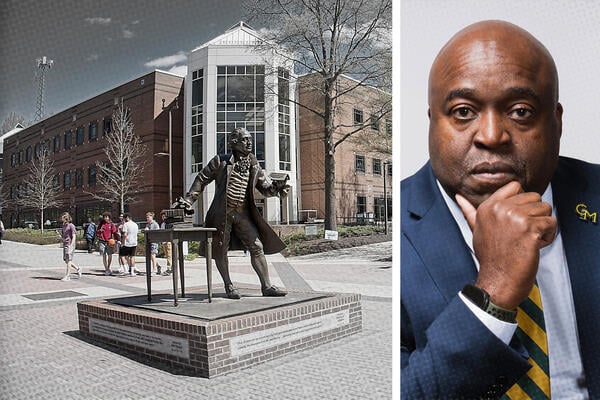
    Photo illustration by Justin Morrison/Inside Higher Ed | Robert Knopes/UCG/Universal Images Group/Getty Images | Maxine Wallace/The Washington Post/Getty Images

    Virginia Democrats want George Mason University board rector Charles Stimson to recuse himself from federal investigations into the university as well as discussions about the university president’s future, saying that his role at the Heritage Foundation, which recently released a report critical of GMU, presents a conflict of interest.

    The letter comes almost two weeks after a state Senate committee blocked 14 gubernatorial appointments to university boards, including six at GMU, which left the Board of Visitors without a quorum. The letter also follows the Heritage report that accused GMU of attempting to hide diversity, equity and inclusion programs. Stimson has had several jobs at Heritage, where he’s currently deputy director of the organization’s legal and judicial studies center.

    The Trump administration has accused GMU of engaging in discriminatory hiring practices and implementing “unlawful DEI policies” and has opened several investigations into the university.

    However, GMU president Gregory Washington has stood his ground, arguing that the federal government rushed the investigation and disputing its findings while rejecting calls to personally apologize. Now, as GMU’s Board of Visitors is stuck without a quorum while a legal challenge over the appointments plays out, state Democrats are seeking to neutralize Stimson in his role as rector.

    A Call for Recusal

    Senate Majority Leader Scott Surovell and other top Democrats in the Senate, L. Louise Lucas and Mamie E. Locke, specifically took issue with the Heritage report’s call to “withhold federal taxpayer funds from universities that violate the Civil Rights Act of 1964,” which the Education Department accused GMU of doing. State Democrats argued that Stimson’s employer is essentially seeking to harm the university.

    “This creates an untenable ethical conflict where your employer’s published position is diametrically opposed to your duties as Rector,” the lawmakers wrote to Stimson.

    (Stimson is one of multiple university board members appointed by Republican governor Glenn Youngkin with distinctly right-wing profiles, including some with ties to conservative think tanks, the Trump administration, GOP megadonors and former Republican politicians, Inside Higher Ed found earlier this year.)

    State Democrats also raised concerns over how he became rector.

    “The appearance of impropriety is compounded by the fact that your selection as Rector reportedly occurred only after direct intervention by Governor Youngkin, raising questions about whether your Heritage Foundation affiliation influenced that appointment,” the Democrats wrote.

    Given what they view as a conflict of interest, the three Democratic leaders called on Stimson to recuse himself “from all Board of Visitors deliberations, discussions, and votes” involving Washington’s employment status or performance evaluations, GMU responses to federal DEI investigations or compliance concerns, GMU funding strategies and university DEI policies.

    “If you cannot commit to this recusal, I believe the appropriate course would be your resignation as Rector to eliminate this conflict entirely,” Surovell and the other Democrats wrote to Stimson while calling on him to respond “outlining the specific steps you will take to address this conflict.”

    Neither GMU officials nor Stimson responded to requests for comment from Inside Higher Ed.

    Youngkin accused Democrats of trying to undermine university boards.

    “Virginia’s progressive left elected officials are trying to paralyze the governing boards of Virginia’s colleges and universities by using despicable bullying and intimidation tactics,” Youngkin wrote in a post on X.

    Faculty Support

    As Washington, GMU’s first Black president, has found himself in the Trump administration’s cross hairs and fighting back, board support has been a constant question. Rumors of Washington’s expected firing swirled in July, but the Board of Visitors kept him on the job.

    George Mason faculty have also rallied around the embattled president, with dozens of professors, students and others protesting outside the July meeting. GMU’s chapter of the American Association of University Professors applauded the senators’ letter on Tuesday.

    “We believe that Mr. Stimson has failed to fulfill his fiduciary duties and has repeatedly exceeded his proper authority as Rector of the Board of Visitors. His conflicting leadership role at the Heritage Foundation and his repeated attempts to overreach his authority threaten the foundation of Virginia’s largest public university, endangering its governance, stability, and future,” the GMU-AAUP Executive Committee wrote in an email to members.

    The local AAUP chapter struck a sharper tone than Virginia’s Senate leadership, alleging that Stimson has “usurped GMU President Gregory Washington’s authority to manage the university’s responses to federal investigations, contrary to the president’s delegated authority established in the [Board of Visitors’] Bylaws.”

    GMU-AAUP also echoed the call for Stimson to recuse himself from certain board duties.

    “If Rector Stimson cannot commit to this recusal, we join Senators Surovell, Lucas, and Locke in calling for his resignation as Rector to eliminate this conflict entirely,” the organization wrote. “The independence, integrity, and future of George Mason University depend on nothing less.”

    The group previously voted no confidence in the Board of Visitors in July.

    Source link

  • Higher education governance needs the conflict between academic and business imperatives to be successful

    Higher education governance needs the conflict between academic and business imperatives to be successful

    The sector’s financial challenges have shone a spotlight on governance effectiveness in higher education in England.

    When the incoming government tasked the Office for Students (OfS) with directing more of its energy towards financial sustainability in the summer of 2024, it was only a matter of months before director of regulation Philippa Pickford put forward the view that the sector needed “a conversation” about governance, specifically about how robustly boards had tested some of the financial projections they had been prepared to sign off.

    That signal of concern about governance has clearly manifested in the corridors of the Department for Education (DfE), if these words from the Secretary of State to the Commons Education Committee in May are anything to go by:

    The government is clear that there needs to be a focus on and improvement in providers’ governance. Planning and strategy development within higher education providers, including financial planning, should be supported by the highest standards of governance to ensure realistic planning, robust challenge and the development of sustainable business models.

    The sector has not been unresponsive to these cues – Advance HE in partnership with the wider sector is (taking the conversation metaphor literally) curating a “big conversation” about governance and the Committee of University Chairs (CUC) has pledged to review the higher education code of governance – which for a large number of institutions acts as a reference document for compliance with OfS’ conditions of registration on governance.

    The implicit underpinning premise from OfS and DfE is fairly stark: the government is disavowing any responsibility it might have to come up with a financial settlement that would shore up higher education finances while retaining the current delivery model; nor is it especially keen to have to deal with institutional bailouts arising from institutional inability to manage the changed funding landscape. The strong signal is that it is up to higher education institutions to work out how to survive in this environment – and if boards are not up to the task of finding the answers then it’s the boards that need reforming.

    Business acumen

    I read this communication as part of a discursive stand off between government and the sector in which the lines between the role of government and role of individual institutions in securing the future of higher education is contested. Within that context, the validity of the implied criticism – that boards are insufficiently businesslike and strategic – needs to be interrogated.

    There was a fascinating piece on The Critic last week by University of Buckingham academic Terence Kealey bemoaning the rise of the managerialist board. In Kealey’s analysis, when the balance of power in governance tilted towards the Senate – the governing body of academics – the institution thrived, as evidenced by strong performance in NSS and a financial surplus. But when the Council flexed its muscles, the university faltered, dropping in the league tables and spending more than it brought in.

    Kealey’s core argument – that academics are best placed to steward the core higher education mission of excellent teaching and research – picks up a longer standing critique of higher education governance that perceives organisational strategic objectives as articulated by institutional boards and executive teams as frequently in opposition to the academic endeavour, being far too concerned with financial efficiency, performance management, reputation/league tables, and capturing market share. Echoes of aspects of this critique appear in the recent Council for the Defence of British Universities’ proposed code of ethical university governance, which urges boards to adhere to high standards of transparent, principled, and public-spirited conduct.

    At the other end of the spectrum, the criticism of higher education governance – including sometimes from governors themselves – is that boards are insufficiently businesslike, fail to articulate long-term strategic objectives that will secure the institution’s sustainability, and have limited entrepreneurial spirit that would allow the institution to adapt to adverse headwinds. A more moderate version of this criticism argues that it is very difficult to convene the diverse skillset that could allow for effective board oversight of the wide range of activities that higher education institutions do.

    Thinking about activities like academic and knowledge exchange partnerships, the creation of new campuses or the erection of new buildings, or civic and international engagement, all of these have the the academic endeavour at their core but are mostly about deploying the knowledge and reputational assets of the institution to generate additional value – and they each carry complicated associated legal and regulatory compliance expectations and reputational risk. It’s not clear that developing those strategies and managing those risks and expectations coheres well with academic professional practice – though some academics will obviously have a keen interest and want to develop knowledge in these areas.

    The worst of both

    There has always been an expectation that higher education institutions need to be simultaneously academically excellent and sufficiently business savvy to make sure the institution remains financially stable. Both academic and institutional governance can fail – the latter often more spectacularly and with greater reputational impact – but the impact of academic governance failure is arguably greater overall both on the long term health of the institution and on the lives of the staff and students affected.

    So you could argue that it’s odd and/or problematic that the sector has witnessed the erosion of the power of senates and academic boards as part of a wider set of trends towards a more executive style of higher education leadership, the rise of metrics, league tables and more managerial approaches to institutional performance, the intensification of regulatory expectations, and the steady withdrawal of direct public funding from the sector. It’s telling that under the current regulatory regime in England institutional boards have had to master new expectations of oversight of academic quality, on the presumption that all institutional accountability should sit in one place, rather than being distributed – suggesting that quality is now seen as part of the wider business imperative rather than a counterweight to it.

    But simply pivoting the balance of power back to senates and the academic community doesn’t necessarily address the problem. It’s possible, I suppose, to imagine a relatively benign or at least predictable funding and regulatory environment in which some of the pressing strategic questions about institutional size and shape, partnerships, or external engagement are answered or moot, and in which knowledge stewardship, academic excellence, and (one would hope) student learning experience are the primary purpose of higher education governance.

    But even if that environment was plausible – I’m not sure it has ever existed – it doesn’t really address the more existential contemporary questions that governments and the public seem to be putting to higher education: how does the country see, and experience the value of all this knowledge stewardship and academic excellence? To realise that value and make it visible in more than an ad hoc way – to be institutionally accountable for the systematic manifestation of public value from academic knowledge – requires knowledge and professional practice beyond individual teaching and research excellence. And, more prosaically but equally importantly, buildings, infrastructure, and systems that create the environment for effective knowledge stewardship. Without a functioning institution there can be no knowledge stewardship.

    There’s a reason, in other words, even if you strip out all the neoliberal value propositions from higher education governance, why higher education institutions need a “business” arm and associated governance structures. And that’s before you confront the actual reality of the current situation where the funding and regulatory environment is neither benign nor predictable – and the need for effective external relationship-building and systematic collaboration is greater than it has been in decades.

    On the other hand, some of the business decisions that are made to secure financial sustainability or long term institutional success put the academic imperative at risk. Rapid growth in student numbers, redundancy programmes, departmental or services cuts or new strategic partnerships can compromise quality, as we have seen in a number of recent cases. There may be mitigations or the impact may be worth the reward, but there can be no meaningful strategic decision without being able to weigh up both.

    Yet where we have ended up, I fear, is in the worst of both worlds – institutional boards that are neither sufficiently academically robust to have a grip of academic excellence nor sufficiently strategic and entrepreneurial to ensure institutions are able to thrive in the current higher education landscape. This is no shade to the immense talent and knowledge of the individuals who take up roles as higher education governors – it is a structural critique.

    Creative tension

    Where I end up is with the question – if there is really an inbuilt tension between the academic and business imperatives of higher education institutions, what would it look like for that tension to be a productive one in higher education governance rather than a source of toxicity?

    I suspect – though I’ve not (yet) asked – many vice chancellors and their executive teams would argue that in their individual experience and team skillset they manifest both academic and business imperatives – that in fact, it is their job to reconcile these two aspects of institutional leadership in their daily practice, decisions, and communications.

    Yet if that reconciliation of two competing imperatives is the job of leadership, arguably it’s not going all that well. While this experience is by no means universal, it’s clear that at times both academic and professional staff can feel sidelined and disempowered in the tug of war for day to day resource – but also at a deeper level for a recognition of their purpose and contribution to the higher education endeavour. Each can feel subordinated to the other in the institutional hierarchy – yet while there are outliers on both sides I’d put money on the majority of individuals on both sides accepting and embracing the value and contribution of the other. Yet at the same time the real tensions and contradictions that manifest in the pursuit of the two parallel imperatives are deeply felt by staff yet not always acknowledged by leadership.

    What if the job of leadership and boards of governors was not to seek to reconcile academic and business imperatives, but to actively manage the conflicts that arise at times? Where strategic questions arise related to either opportunities or risks, boards need to understand the perspective of both “sides” before being able to judge whether the executive team’s decisions are appropriate. And for institutional staff (and students, to the extent they have a role in institutional governance) there needs to be confidence that the governors have the skills and understanding of the value and importance of both imperatives and the relationship between them – so that there is the trust that decisions have been made in the most effective and transparent way possible.

    There might even be a case for institutions to convene internal business strategy boards as part of the governance structure as a counterweight to academic boards – actively empowering both equally as sites of knowledge, expertise and influence – and potentially reducing the strategic burden on institutional boards through creating a more transparent and maybe even more democratic or at least representative forum for internal governance of strategic business development.

    It seems likely that the next academic year will see the higher education sector in England move on from “conversations” about governance into something more systematically developmental, whether that’s via the mechanism of the CUC’s review of the Higher Education Code of Governance, or a policy agenda from one of the sector bodies. This is one of those areas where the sector can help itself with government by taking a lead on reform.

    Yet there’s a risk that the financial pressures on the sector lead to too close a focus on the strategic business imperatives and not enough on the academic excellence imperative. Institutions need both to be successful, and boards and executive teams – as well as any reviewing organisation – need to give deep consideration to how those can – even if not always peacefully – coexist.

    Source link

  • Resources for Addressing Workplace Conflict

    Resources for Addressing Workplace Conflict

    by Christy Williams | March 5, 2025

    As your institution processes its response to recent executive orders and the reactions of employees and students across campus, increasing workplace tensions may make it more challenging for your HR team to maintain a positive and collaborative environment.

    These challenges are not novel for higher ed HR, but they can be used as a springboard to examine the approaches you’ve used in the past and reimagine how they should — or could — evolve now. So, how can we support each other in our collective need for respectful discourse and civil disagreement? Here are some valuable insights and resources to help you along the way.

    Develop Conflict-Savvy Leaders

    Conflict is an inevitable part of any workplace, and higher ed institutions are no exception. Erica Hines, chief human resources and personnel success officer at Community College of Aurora, recommends that rather than attempting to avoid conflict altogether, we recognize the importance of embracing conflict as an opportunity for growth. And creating a conflict-savvy culture like that begins at the top.

    It’s important for leaders not only to be prepared to address conflict, but also to model that behavior for everyone in your institution — administration, faculty, staff and students.

    As Hines details in her webinar, Developing Conflict-Savvy Leaders, when your institution’s leadership is prepared for conflict, a culture of trust can be built. When leaders are willing to face conflict head-on and focus on finding win-win solutions, fewer issues escalate.

    Train for Conflict Resolution

    It’s not enough, however, for only administration to be conflict-savvy and model civil conversations. Managers and employees should be provided with strategies for de-escalating workplace tensions.

    Tulane University’s conflict resolution program supports its employees with a variety of conflict resolution services, including consultations to learn about their program, coaching to help employees with specific challenges, mediation to help employees through a disagreement, and facilitated conversations led by a professionally trained specialist. Tulane’s HR team believes that “conflict can be a tool for positive change when employees have the resources to build upon their conflict competence.”

    Establish Clear Norms Around Communication and Feedback

    In the Developing Conflict-Savvy Leaders webinar, Erica Hines stresses that employees at all levels need to understand how to give and receive input in a constructive way. One norm she suggests is to use “I” or “my” when offering feedback. For example, “Here’s what I noticed…” or “Here’s what I felt when…” A norm you might establish for receiving feedback could focus on active listening, summarizing what you just heard, and then asking how you can reach a win-win solution. For example, “What would you prefer I do in that situation?” Or “What ideas do you have for managing this situation in the future?”

    When teams have a shared understanding of how to navigate difficult conversations, they can address issues proactively instead of letting them escalate. By integrating these practices into daily interactions, you can cultivate an environment where open dialogue and mutual respect thrive.

    Prioritize Professionalism and Civility

    Creating a culture of professionalism is the foundation of a kinder campus. As Jennifer Parker, assistant director of HR operations at the Colorado Community College System, highlights in her article, A Kinder Campus, professionalism is more than just following policies. Professionalism is how faculty, staff and administrators treat one another daily. Respect, integrity and ethical conduct should guide every interaction, ensuring that civility remains a cornerstone of your culture.

    Beyond professionalism, Parker emphasized the role of active listening and empathy in conflict resolution. When employees take the time to truly listen and seek to understand different perspectives, they’re not just resolving disputes — they’re “building bridges of trust.” Demonstrating empathy during difficult conversations helps diffuse tension and encourages constructive dialogue. When you prioritize professionalism, you create an environment where trust and collaboration flourish.

    From Conflict to Meaningful Conversations

    Addressing workplace conflict isn’t just about resolving disputes — it’s about creating an environment where open dialogue is encouraged, and employees feel heard and supported. Because of this, conflict resolution training shouldn’t be a one-time event, but an ongoing practice woven into workplace culture. While difficult conversations may never be easy, the more everyone practices, the more natural those conversations become. By setting clear expectations, proactively guiding discussions, and championing a culture of respect, you can help transform workplace tensions into opportunities for growth and collaboration.

    Related CUPA-HR Resources

    Developing Conflict-Savvy Leaders — This CUPA-HR webinar explores how HR can help leaders address conflict head-on, thus minimizing the need for HR intervention down the line.

    Ushering in the New Wave of Conflict Resolution: Tulane University’s Restorative Approach — This article details the launch of Tulane University’s conflict-resolution program.

    A Kinder Campus: Building an AI-Powered, Repeatable and Fun Civility Training Program — This magazine article outlines how the Colorado Community College System created a campaign to address incivility on their campuses.

    Civility in the Workplace Toolkit — This HR toolkit provides practical strategies for fostering respectful communications and managing workplace conflicts.

    Managing Difficult Conversations Toolkit — This HR toolkit provides basic strategies that can be widely used as starting points for many challenging conversations.

    Next Steps: A Practical Guide for Ensuring Access and Opportunity for All Employees — This CUPA-HR blog post offers considerations for ensuring that you are providing equal access and opportunity for all.

    Resilience and Psychological Safety: Navigating Uncertainty — This blog post explores how resilience and psychological safety can be particularly useful in times of change and uncertainty.


    Source link