
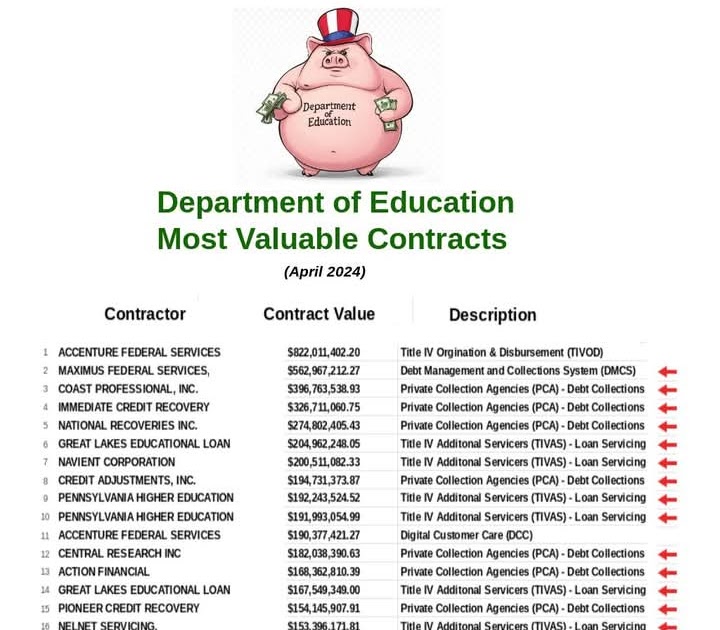
Thanks to Alan Collinge and Student Loan Justice for this information on government contractors for the US Department of Education’s Student Loan Portfolio.
Tag: Contractors
-
U.S. Appeals Court Overturns $15 Minimum Wage for Federal Contractors
by CUPA-HR | November 12, 2024
On November 5, the 9th U.S. Circuit Court of Appeals reversed a lower district court’s decision to dismiss a lawsuit challenging the Biden administration’s executive order and the Department of Labor (DOL)’s final rule to increase the minimum wage for federal contractors. The ruling orders the legal challenge to proceed, which could ultimately strike down the executive order and final rule.
In April 2021, the Biden administration published executive order 14026, which directed DOL to issue regulations to increase the minimum wage for federal contractors to $15 per hour beginning on January 30, 2022. Subsequently, in November 2021, DOL issued its final rule to implement the executive order, setting the minimum wage for federal contractors to $15 per hour on January 30, 2022, and requiring the secretary of Labor to annually review and determine the minimum wage amount beginning in January 2023.
The executive order and final rule were challenged by five states: Arizona, Idaho, Indiana, Nebraska and South Carolina. In their suit, the states claimed that the Biden administration violated the Federal Property and Administrative Services Act (FPASA) and exceeded its authority granted under the law by imposing a wage mandate through an executive order. They also argued that DOL violated the Administrative Procedure Act (APA), which governs how federal agencies proceed through the notice-and-comment rulemaking process, when implementing the final rule. The lawsuit was originally dismissed by a federal judge in the U.S. District Court of Arizona, leading the states to appeal to the 9th Circuit.
In the 9th Circuit’s ruling, two of the three judges on the panel sided with the states’ arguments, reversing the dismissal of the case from the lower district court. The majority opinion held that the minimum wage mandate exceeded the president’s authority under FPASA and that DOL’s final rule was subject to arbitrary-or-capricious review under the APA. As such, the circuit court sends the case back to the district court, where the federal judge will proceed with the case and issue a further ruling to uphold or strike down the executive order and final rule. For now, the order and final rule are still in place, but the future of both is uncertain. CUPA-HR will keep members apprised of any updates related to this lawsuit and further laws and regulations impacting federal contractors.
-
Federal Agencies Issue Proposed Rule on Pay Equity and Transparency for Federal Contractors – CUPA-HR
by CUPA-HR | February 14, 2024
On January 30, the Department of Defense, General Services Administration, and NASA issued a proposed rule to amend the Federal Acquisition Regulation (FAR) to create a salary history ban and require pay transparency during the hiring process for federal contractors and subcontractors. The proposed rule aligns with the Biden administration’s 2022 Executive Order, “Advancing Economy, Efficiency, and Effectiveness in Federal Contracting by Promoting Pay Equity and Transparency.”
According to the proposed rule, the FAR would be amended to implement a government-wide policy that would:
- prohibit contractors and subcontractors from seeking and considering job applicants’ previous compensation when making employment decisions about personnel working on or in connection with a government contract (“salary history ban”); and
- require these contractors and subcontractors to disclose on job announcements the compensation to be offered (“compensation disclosure” or “pay transparency”).
The proposed rule comes as many states and localities have recently implemented salary history bans and pay transparency laws. As the Notice of Proposed Rulemaking notes, 21 states, 22 localities, and Washington, D.C., have put bans into place that prohibit employers from asking job applicants for their salary, and 10 states have pay transparency laws in place, with several other states working toward implementing such laws.
The agencies have provided a 70-day comment period for the proposed rule, closing on April 1. Stakeholders are invited to submit comments on their support for or opposition to the provisions of the proposed rule. CUPA-HR will monitor for additional updates on this proposed rule and other policy initiatives at the federal level as they relate to pay transparency and salary history bans.
-
CUPA-HR Files Comment Extension Request to USDA Regarding New Blacklisting Regulation for Federal Contractors – CUPA-HR
by CUPA-HR | March 21, 2022
On February 17, the U.S. Department of Agriculture (USDA) issued a Notice of Proposed Rulemaking (NPRM) outlining plans to impose new HR-related conditions on USDA contracts. If finalized, the rule would require federal contractors on projects procured by the USDA to certify their compliance with dozens of federal and state labor laws and executive orders. The proposal mirrors similar “blacklisting” regulations pursued by the USDA during the Obama administration.
The USDA provided only 32 days for stakeholders to submit comments on the proposal. CUPA-HR, along with several other higher education associations, filed an extension request with the department asking for an additional 90 days to “evaluate the NPRM’s impact on [members’] research missions and collect the information needed in order to provide thoughtful and accurate input to the USDA.” CUPA-HR plans to file comments on the proposal as well.
The new proposed rulemaking amends the Agriculture Acquisition Regulation (AGAR) to require federal contractors on USDA supply and service projects that exceed the simplified acquisition threshold to certify that they and their subcontractors and suppliers are “in compliance with” 15 federal labor laws, their state equivalents and executive orders. This includes, but is not limited to:
- Fair Labor Standards Act;
- Occupational Safety and Health Act;
- National Labor Relations Act;
- Service Contract Act;
- Davis-Bacon Act;
- Title VII of the Civil Rights Act;
- Americans with Disabilities Act;
- Age Discrimination in Employment Act; and
- Family and Medical Leave Act.
Additionally, federal contractors submitting offers for a project would be required to disclose to the USDA previous violations and certify they and their subcontractors “are in compliance with” any required corrective actions for those violations. They would also be required to alert USDA to any future adjudications of non-compliance.
In 2011, the USDA tried to implement a similar policy via a Direct Final Rule and NPRM, but was forced to withdraw both due to stakeholder pushback. CUPA-HR filed comments with the Society for Human Resource Management calling the rules arbitrary and capricious. Our comments also criticized the rules for not adequately clarifying how contractors were expected to comply with the changes and for imposing severe penalties. Additionally, CUPA-HR joined comments filed by the American Council on Education and several other higher education associations that argued the USDA’s rules “impose[d] an unmanageable compliance burden and uncertain compliance risk for colleges and universities that conduct agricultural research under contracts with the [USDA].”
Additionally, the Obama administration issued an executive order in July 2014 implementing a similar government-wide policy. The Federal Acquisition Regulation (FAR) Council and the Department of Labor issued regulations and guidance, respectively, implementing the order, but they were blocked by a federal judge in October 2016 for violating the First Amendment and due process rights. Congress also passed a Congressional Review Act challenge to the executive order in 2017, permanently withdrawing the executive order and barring the FAR Council from issuing any substantially similar regulations.
Unlike past proposals, this time the USDA has stated that the certifications will be subject to the False Claims Act (FCA), which provides for substantially increased liability. The FCA provides for treble damages and penalties and allows for private citizens to file suits on behalf of the government (called “qui tam” suits). Qui tam litigants receive a portion of the government’s recovery. According to the Department of Justice (DOJ), the awards to qui tam litigants in FCA suits topped $238 million in 2021. The same DOJ statistics show qui tam suits were the majority of FCA claims, with the government filing 203 new suits under FCA in 2021 compared to 598 qui tam suits in the same year.
CUPA-HR will continue to monitor this issue closely.


