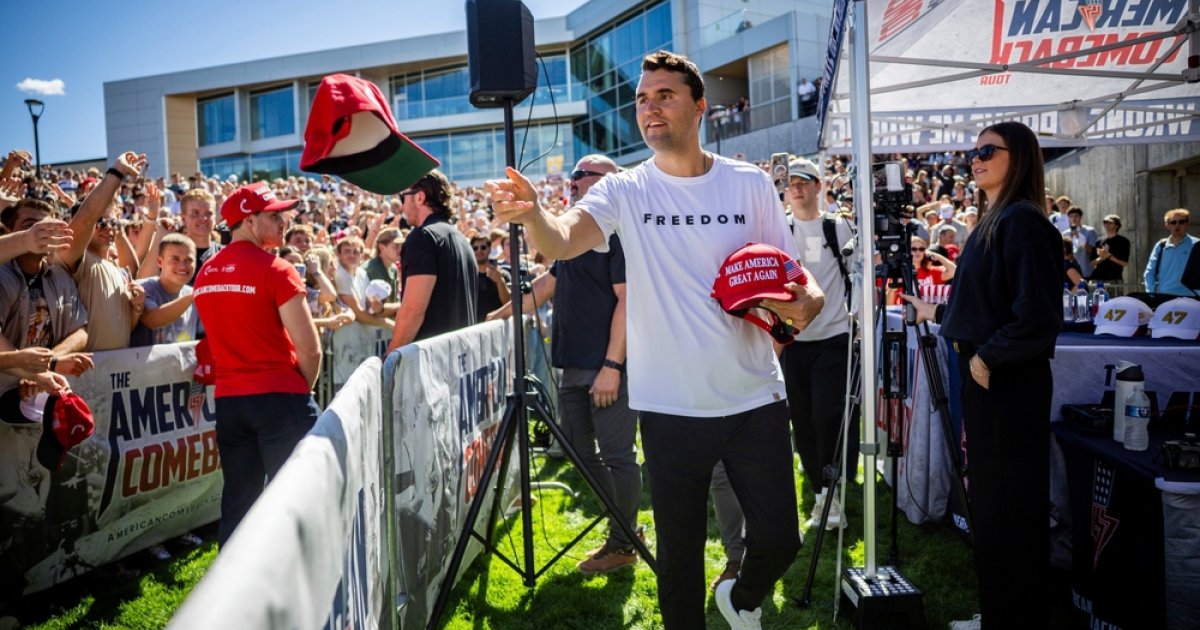
The recent controversies surrounding Charlie Kirk — and the extraordinary reaction that followed his campus appearances and commentary — offer a revealing window into the fragile state of free expression in contemporary America.
Two recent New York Times opinion pieces examining the backlash were right to highlight how quickly public discourse has hardened into a zero-sum contest in which speech itself becomes grounds for professional punishment, social ostracism, and institutional retaliation. But the deeper lesson is even more unsettling: Free speech is increasingly treated not as a constitutional principle, but as a conditional privilege — one that applies only when speech is politically comfortable.
This concern is not confined to the Kirk episode alone.
A mature liberal democracy does not protect speech because it is agreeable. It protects speech precisely because it is controversial.
In recent essays and commentary in the Times, Steven Pinker and Greg Lukianoff have voiced parallel anxieties about the narrowing of permissible speech in American life. Pinker, writing in response to the wave of cancellations following Kirk’s assassination, argued that the public reaction revealed something larger than partisan outrage: It exposed a culture increasingly governed by moral intimidation rather than democratic confidence. He warned that Americans have begun to treat disagreement itself as a form of complicity, a dynamic that pressures institutions to distance themselves from speakers not because of what they say, but because of how others might react.
In Pinker’s telling, this logic shrinks what he calls the “theater of ideas,” replacing open argument with reputational panic, association anxiety, and pre-emptive suppression. When leaders apologize not for their own actions but for the mere fact of conversation, he argued, they signal their inability to withstand the volatility of public outrage — a sign that our intellectual ecosystem is growing narrower, thinner, and more brittle.
Lukianoff’s column makes a complementary point from a different angle. Drawing on years of work at FIRE, he noted how quickly both institutions and individuals abandon their stated commitments to free expression the moment those commitments become uncomfortable. The Kirk episode, he wrote, was simply the latest example of a pattern he has watched unfold across campuses for more than a decade: a willingness to tolerate speech only when it fits within prevailing ideological or cultural fashions.
Lukianoff emphasized that the most troubling aspect is not the criticism of Kirk — criticism is central to free speech — but the eagerness to impose professional penalties, public shaming, or formal censure on anyone associated with him. The principle collapses the instant it is tested. Taken together, Pinker and Lukianoff reveal with unusual clarity that America is drifting toward a model of free expression that survives only when it flatters majority sentiment — a vision entirely at odds with the core purpose of the First Amendment.
In defense of fiery words
In the wake of political violence, calls to criminalize rhetoric are growing louder. But Brandenburg v. Ohio set the bar — and it’s a high one.
This is not an argument about whether one agrees with Kirk’s public statements. Many do not. Nor is it a defense of every remark, posture, or provocation associated with his political brand. That is beside the point. A mature liberal democracy does not protect speech because it is agreeable. It protects speech precisely because it is controversial — because democracy requires open contestation, not the selective silencing of whatever unsettles the cultural majority.
And yet, across universities, professional settings and online spaces, we have witnessed a familiar pattern repeat itself: organized efforts to deplatform, disrupt, shame, or punish those associated with political positions deemed unacceptable. Speakers are shouted down. Venues are pressured. Faculty and students who express dissenting views risk reputational harm or institutional discipline. Even civil engagement becomes suspect if it involves “the wrong people.”
This reflex is often defended as moral clarity. In reality, it is institutional cowardice.
There is a great irony here. The very individuals and institutions that loudly proclaim their commitment to diversity, inclusion, and pluralism often prove least capable of tolerating genuine intellectual diversity. They champion the language of openness even as they tighten the boundaries of permissible speech. What results is a shallow performance of tolerance that collapses the moment speech becomes genuinely uncomfortable.
Free speech is not a decorative ideal meant for ceremonial brochures or abstract jurisprudence seminars. It is a living civic discipline, and it demands that we cultivate tolerance even — especially — when it offends our sensibilities. That discipline has historically been one of the United States’ most distinguishing features: the belief that robust public debate, rather than enforced consensus, is the engine of democratic resilience.
But today’s culture increasingly treats emotional discomfort as a kind of injury, speech as a form of violence, and dissent as a moral failing. Within that framework, the logic of suppression becomes not only tempting but virtuous: If speech causes harm, then silencing it becomes an act of justice. Once adopted, that logic expands rapidly. Today it is Charlie Kirk. Tomorrow it will be someone else. The principle does not survive the politics.
The Times essays were right to note how the fear of association now extends far beyond extremist rhetoric to include basic engagement. Students who meet with controversial speakers, professors who host debates, and institutions that tolerate ideological diversity all find themselves scrutinized. The mere act of conversation becomes dangerous territory. That should alarm anyone who values the university as a space for intellectual exploration rather than ideological enforcement.
This is not merely a cultural concern. It is institutional. When administrators respond to pressure campaigns by canceling speakers, disciplining faculty, or issuing vague statements about “community harm,” they send a powerful message: Conformity is safer than inquiry. Over time, this breeds self-censorship. Students learn that advancement depends not on argumentation but on alignment. Faculty learn that silence is prudent. The public sphere narrows, not because debate has been resolved, but because people have learned to be afraid.
In the wake of Charlie Kirk’s assassination, colleges must not burden speaking events
After an assassin cut short a campus speech, colleges must keep in mind that passing security costs to speakers or canceling events under the guise of “safety” hands victory to the heckler’s veto — and invites more violence.
History tells us where this road leads. Societies that abandon free expression do not become kinder or more just. They become brittle. They lose the capacity for correction. Without dissent, errors calcify into doctrine. Without debate, divisions deepen underground until they erupt elsewhere; often violently.
A healthy society requires a different posture: one that refuses to reward political violence or celebrate rhetorical cruelty, but also refuses to treat speech as a crime. It is possible and necessary to maintain both moral standards and civic tolerance. We can condemn genuinely hateful language without constructing an environment where only preapproved opinions are allowed to exist.
This distinction matters. There is a difference between criticism and coercion, between moral disagreement and institutional suppression. The first is essential to democratic life. The second corrodes it.
The American tradition of free speech was never intended to be easy. It was built to withstand tension, disagreement, even anger. It requires a certain moral maturity — the ability to hear something one detests without immediately seeking to destroy the speaker. That maturity is thinning. And institutional leadership has not helped. Rather than modeling resilience and restraint, too many leaders respond to every controversy with ritualized apologies and performative distancing.
This, in turn, reinforces a culture in which power flows not through argument but through outrage. The loudest voices do not persuade; they intimidate. The most extreme reactions set the rules. The center retreats.
Defending free speech in this environment is not a partisan exercise; it is a civic one. Conservatives should care when progressive speech is suppressed. Progressives should care when conservative speech is silenced. And all citizens should recognize that the erosion of expressive freedom is rarely symmetrical or stable. It expands. It metastasizes. It eventually reaches those who once applauded it.
If free speech only survives during moments of convenience, it’s not really free.
Supporting the right to speak does not mean endorsing what is said. It means believing that a free society is strong enough to withstand unpopular ideas without resorting to coercion. It means valuing persuasion over prohibition. It means recognizing that democracy requires friction.
Charlie Kirk may be a lightning rod, but the underlying issue is larger than any one figure. The question is whether we still believe in a public square robust enough to sustain disagreement. Whether our institutions still trust citizens to confront ideas rather than suppress them. Whether discomfort is something to be navigated or eliminated.
If free speech only survives during moments of convenience, it’s not really free. It is permission masquerading as principle. And permission always has an expiration date.
What this moment demands is not perfect harmony but civic courage: the willingness to say that speech should be protected even when we dislike the speaker, that debate should remain open even when it unsettles us, and that the strength of a liberal society lies not in silencing dissent but in enduring it.
That endurance is not weakness. It is democracy.