The Re: University team here! I know you didn’t expect to hear from us this week, but we just passed the 100-day mark until the Re: University conference and the excitement is getting real. For those of you who don’t know, we are hosting the conference in the Marriott Ottawa on January 28th and 29th.
Our full agenda will be released soon but we have begun announcing our speakers and themes. Our two-day agenda is focused on exploration and action.
Day One looks outward and forward. Through provocative plenaries, global case spotlights, and rapid-fire exchanges, participants will examine how universities are adapting to shifting financial realities, emerging technologies, and new models of teaching and learning. The focus is on ideas: what’s possible, what’s working elsewhere, and what change might look like in practice.
Day Two turns those ideas into strategy. Sessions will focus on the “how” of transformation, think: governance, funding models, partnerships, and culture change. Participants will dig into what it takes to move from experimentation to execution and build institutions that are both resilient and ready for the future. While we may be biased, it is an incredible lineup so far.
So if you haven’t already, you should check out who is on the agenda so far here.
We also wanted to give you a heads up that we are 90% sold out of tickets so if you are planning to come, please make sure to get your ticket soon.
The university is the focal point of this conference, although we have others attending from the college sector, and we are so happy to say we have representatives from nearly 50 Canadian universities. If your institution isn’t on this list, we would love you to be part of the conversation:
Algoma University
Ambrose University
Brock University
Capilano University
Carleton University
Concordia University
Dalhousie University
Emily Carr University of Art and Design
Kwantlen Polytechnic university
Lakehead University
McMaster University
Memorial University of Newfoundland
Mount Allison University
Mount Royal University
Mount Saint Vincent University
Nipissing University
Northeastern University
Ontario College of Art & Design University
Ontario Tech University
Pacific Coast University for Workplace Health Sciences
Queen’s University
Saint Mary’s University
Simon Fraser University
St. Francis Xavier University
St. Jerome’s University
Thompson Rivers University
Toronto Metropolitan University
Trent University
Université de l’Ontario français
Université de Moncton
Université de Montréal
University College of the North
University of Alberta
University of British Columbia
University of Calgary
University of Guelph
University of Guelph-Humber
University of Manitoba
University of Northern British Columbia
University of Ottawa
University of Regina
University of Saskatchewan
University of Toronto
University of Victoria
University of Waterloo
Western University
Wilfrid Laurier University
York University
Yorkville University
We have been asked who should attend this conference and although it is open to anyone with an interest in the future of postsecondary education, we wanted to give you an idea of who will be joining these conversations.
40% of these attendees come from the President, Vice-President and Associate Vice-President portfolios, another 40% are Deans and Deputy Deans. The remaining 20% come from a wide range of roles such as CAOs, Special Advisors, Managers, Directors, Professors and many other important roles. We have attendees from institutions coast to coast with representatives also from colleges and polytechnics along with government, associations and various industry stakeholders. And not to forget our partners who we know are looking forward to meeting you all. Check them out here.
Whoever you are, if you are passionate about the future of the university in Canada then now is the time to get involved in the conversation.
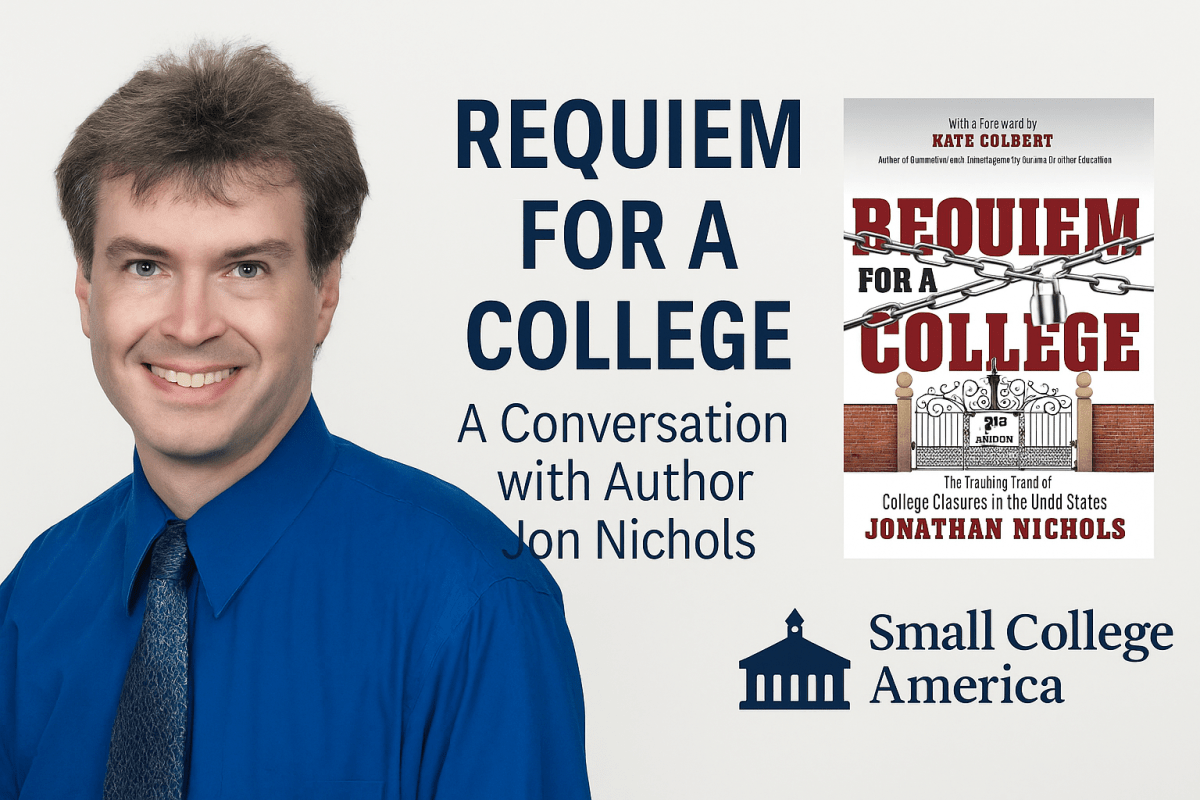
In the newest episode of Small College America, my co-host Kent Barnds and I speak with Jon Nichols, author of Requiem for a College: The Troubling Trend of College Closures in the United States. Nichols’ book offers a deeply personal and reflective look at the 2017 closure of Saint Joseph’s College, an institution intertwined with his family for three generations—his father, Dr. John Nichols, taught there for five decades, and his brother Michael continues to teach at Purdue University.
The Story of Saint Joseph’s College
Founded in 1889 by the Missionaries of the Precious Blood, Saint Joseph’s College in Rensselaer, Indiana, was a small Catholic liberal arts institution known for its close-knit community, rigorous Core Curriculum, and dedication to service. For more than a century, it served as both an educational and cultural anchor for Rensselaer and surrounding Jasper County, educating generations of teachers, business leaders, and clergy. At its peak in the 1970s, the college enrolled more than 1,500 students and earned national recognition for its innovative Core Program, which blended history, philosophy, and theology in an interdisciplinary approach to learning.
Despite its enduring mission and loyal alumni base, Saint Joseph’s faced mounting financial pressures and declining enrollment, leading to the suspension of operations in 2017. By that year, the college’s enrollment had declined to about 900 students, a sharp drop from its earlier decades of strength. The closure reverberated throughout the region, symbolizing a growing crisis among small, tuition-dependent private colleges across the United States.
About Jon Nichols
Jon Nichols is an author, educator, and observer of the changing higher education landscape. A graduate of Saint Joseph’s College and longtime member of its academic community, Nichols witnessed firsthand the personal and institutional struggles that informed Requiem for a College: The Troubling Trend of College Closures in the United States. His work combines narrative storytelling with research and reflection, capturing both the emotional and systemic dimensions of college closures. Today, Nichols teaches English at Waubonsee Community College in Illinois, where he continues to write and speak about the sustainability challenges facing small colleges and the communities they serve.
Nichols captures the profound emotional and social toll of a college closure—on faculty, students, alumni, and the surrounding town. His narrative reminds readers that when a college closes, it is not just an institution that disappears, but a community, a sense of purpose, and a shared legacy.
Our conversation explores a range of topics, including the warning signs that should have been taken more seriously—both at Saint Joseph’s and across higher education—and how his book captures not only institutional failure but also human loss: the erasure of identity, community, and legacy. Nichols also reflects on what sustainable models of higher education might look like in the years ahead and what long-term effects the closure has had on former students, faculty, and the Rensselaer community.
Small College America is a podcast series that shines a spotlight on the powerful impact of small colleges across the nation. Hosted by Dean Hoke and Kent Barnds, the podcast brings listeners inside the world of small colleges through candid conversations with higher education leaders, policy experts, and innovators. Each episode explores how these institutions are adapting, thriving, and continuing to deliver a personal, high-quality education.
Dr. Brielle Harbin helps educators prepare to practice civic courage. She supports faculty and leaders that it’s okay to feel discomfort. Learn why it’s necessary to practice ‘civic courage,’ a term she coined.
Discomfort and difference is a natural part of the learning process. Dr. Brielle Harbin found ‘civic courage’ better emphasizes the importance of embracing that discomfort instead of minimizing or avoiding it.
Yes, it feels safer to retreat from discomfort, feelings like:
Racing heartbeat
Your body tensing up
A feeling in your stomach
Rolling your eyes
A tinge of irritation
Dr. Brielle Harbin says, “You have to acknowledge the idea that it actually feels safer to retreat, but decide to not do it anyway.”
When people embrace the power of connection, when we share our ideas and engage in conversations, we can help more people. I’m delighted to share this conversation about civic courage with you. This is The Social Academic podcast with Jennifer van Alstyne. Thank you!
0:00 Dr. Brielle Harbin on Civic Courage for Educators 1:37 Dr. Harbin’s Path to Empowering Educators and Recognizing Burnout 6:04 Coining Civic Courage: Leaning into Discomfort for Growth 10:02 Building Community Through Substack (Notes From A Work Friend) 15:57 The Power of One: Amplifying Voices and Serving Others Online 26:32 Developing Civic Courage: A Journey of Worthiness and Unlearning 30:42 Embracing Authenticity and Engaging with Dr. Brielle Harbin
A full text version of this episode will be added here in the next 1-2 weeks.
Bio
Photo by Stacy Godfrey
Dr. Brielle Harbin is a political scientist, award-winning educator, and keynote strategist who helps colleges and faculty cultivate civic courage and sustainable academic systems. As the founder of Your Cooperative Colleague LLC, Brielle partners with higher education leaders to move their institutions from compliance and burnout toward belonging, creativity, and care. Her work centers nervous-system-aligned writing, ethical leadership, and faculty well-being as catalysts for innovation.
Through her flagship programs—Faculty Writing Rituals Unlocked, Steady Strides, and Steady in the Storm—she helps educators build restorative, purpose-driven writing practices that last beyond the semester.
A former tenured associate professor and public scholar, Brielle’s research and consulting focus on civic courage as a framework for leading change inside systems not built for everyone’s thriving. Her weekly newsletter, Notes From a Work Friend, offers practical and soulful reflections for faculty navigating the realities of academic life.
This guest blog was kindly authored by Dr Charlotte Ryland, Director of the Translation Exchange.
‘Languages are not just a skillset, they’re a mindset.’
I still remember where I was when a teacher friend made this comment, a few years ago, because it highlighted something I’d been worrying at for a long time. I felt that languages education for young learners undervalued the process of language learning itself, by underrating what it means to be a linguist. That value needed to be completely reframed: to move far beyond the notion that language learning gives you a set of useful communicative skills – the ‘utility argument’ – towards a more holistic and ambitious vision of the linguist’s mindset.
Fast forward to this summer, and a HEPI report by Megan Bowler highlighted a programme that I co-founded as doing just that: ‘[Think Like a Linguist offers] 12-13 year olds clear demonstrations of the value of a linguistic “mindset” and its real-world applications’.
That notion of the ‘real-world application’ is essential to how we think and talk about language learning and needs unpicking. I founded a languages outreach and advocacy centre (based at The Queen’s College, Oxford) because I was frustrated by existing languages outreach mechanisms run by universities. This frustration came in part from what I perceived as an over-emphasis on precisely those ‘real-world applications’: the outreach programmes I encountered tended to rely heavily on imagined futures – Keep learning your vocab and practising your grammar, then you’ll see! A life of travel, international business careers, slightly higher salaries awaits you! Yet this approach did not seem to be working for the year groups whose minds needed to be changed.
The cliff-edge for languages – in England and Wales – is now GCSE options, with over 50% of pupils opting out at the age of 13/14, i.e. at their first opportunity to do so. Languages presents university outreach with a special case, then: with a need to engage much younger learners than has traditionally been the case. Ideally, we start at upper primary and focus on lower secondary school learners, before pupils begin to think seriously about their GCSE options. My approach to working with this demographic has been to take a ‘show, not tell’ approach – to involve learners from age 8 in rich, creative, cultural activities that enable them to experience first-hand the pleasure and purpose of being a linguist.
That focus on showing is key to how we should treat the real-world applications, too. It is not enough to give pupils a learning experience based solely on communicative skills, while trying to tell them that this education will secure them a good job in our competitive, AI-soaked 21st-century economy. They don’t buy it, and the uptake statistics for formal language learning bear this out. Instead, we need to show those learners how relevant and in-demand the ‘linguistic mindset’ they develop will be, by integrating into the learning experience the broadest conception of what it means to be a linguist.
Higher Education institutions can do this. And they’ll do so much more effectively if they work together. They have access to a huge community of language graduates, who have between them generations of experience in the widest range of professions. With this community, the broadest conception of the linguistic mindset becomes tangible. In my experience, it falls into your lap the minute you ask one of these graduates about the impact of their languages education on their career path and life experience.
A standard response runs like this: they move quickly through the frontline benefits around communication in other languages – taking them as a given – and light instead on what Bowler refers to as ‘the irreplaceable advantages of the “linguistic mindset”’. For a lawyer, it includes the capacity to cope with frustration, to tolerate and work through uncertainty; for a consultant, it is being able to build trusted relationships and read between the lines. A civil servant might reference their ability to synthesise and analyse a large amount of information, seeking out potential biases and multiple perspectives. The list goes on and is underlined by the striking words of a 13-year-old participant in Think Like a Linguist: ‘I learnt that there is more to languages than speaking and listening. It’s also about thinking in your own way.’
If we have access to a form of education that stands to raise a generation of individuals able to think for themselves, and to do so on the global stage, then what are we waiting for?
The readiness of languages graduates to share these insights is one of the sector’s greatest assets. We need a national conversation about the value of languages for individuals and for society, fuelled by these stories and taking full account of the challenges currently being set us by AI. Duolingo have set us on an excellent path, with evidence in their user statistics and polling that the UK is a country of languages enthusiasts. As Duolingo’s UK Director Michael Lynas notes in his introduction to Bowler’s report, we need not be dogged by the negativity that often frames conversations about languages: instead, we must build on the tangible positives.
For this national conversation to make an impact, collaboration will be key. Shared learning from effective university outreach programmes to date can provide a basis for this conversation. And The Languages Gateway, a new cross-sector initiative dedicated to collating resources and supporting strategic collaboration, can host it. Further backing for this national conversation from higher education institutions and central government will support the Gateway in its work to raise the national profile of languages to where it belongs: delivering ‘irreplaceable’ value to 21st-century global Britain.
By Michael Grove, Professor of Mathematics and Mathematics Education and Deputy Pro-Vice-Chancellor (Education Policy and Academic Standards) at the University of Birmingham.
We are well beyond the tipping point. Students are using generative AI – at scale. According to HEPI’s Student Generative AI Survey 2025, 92% of undergraduates report using AI tools, and 88% say they’ve used them in assessments. Yet only a third say their institution has supported them to use these tools well. For many, the message appears to be: “you’re on your own”.
The sector’s focus has largely been on mitigating risk: rewriting assessment guidance, updating misconduct policies, and publishing tool-specific statements. These are necessary steps, but alone they’re not enough.
Students use generative AI not to cheat, but to learn. But this use is uneven. Some know how to prompt effectively, evaluate outputs, and integrate AI into their learning with confidence and control. Others don’t. Confidence, access, and prior exposure all vary, by discipline, gender, and background. If left unaddressed, these disparities risk becoming embedded. The answer is not restriction, but thoughtful design that helps all students develop the skills to use AI critically, ethically, and with growing independence.
If generative AI is already reshaping how students learn, we must design for that reality and start treating it as a literacy to be developed. This means moving beyond module-level inconsistency and toward programme-level curriculum thinking. Not everywhere, not all at once – but with intent, clarity, and care.
We need programme-level thinking, not piecemeal policy
Most universities now have institutional policies on AI use, and many have updated assessment regulations. But module-by-module variation remains the norm. Students report receiving mixed messages – encouraged to use AI in one context, forbidden in another, ignored in a third, and unsure in a fourth. This inconsistency leads to uncertainty and undermines both engagement and academic integrity.
A more sustainable approach requires programme-level design. This means mapping where and how generative AI is used across a degree, setting consistent expectations and providing scaffolded opportunities for students to understand how these tools work, including how to use them ethically and responsibly. One practical method is to adopt a ‘traffic light’ or five-level framework to indicate what kinds of AI use are acceptable for each assessment – for example, preparing, editing, or co-creating content. These frameworks need not be rigid, but they must be clear and transparent for all.
Such frameworks can provide consistency, but they are no silver bullet. In practice, students may interpret guidance differently or misjudge the boundaries between levels. A traffic-light system risks oversimplifying a complex space, particularly when ‘amber’ spans such a broad and subjective spectrum. Though helpful for transparency, they cannot reliably show whether guidance has been followed. Their value lies in prompting discussion and supporting reflective use.
Design matters more than detection
Rather than relying on unreliable detection tools or vague prohibitions, we must design assessments and learning experiences that either incorporate AI intentionally or make its misuse educationally irrelevant.
This doesn’t mean lowering standards. It means doubling down on what matters in a higher education learning experience: critical thinking, explanation, problem-solving, and the ability to apply knowledge in unfamiliar contexts. In my own discipline of mathematics, students might critique AI-generated proofs, identify errors, or reflect on how AI tools influenced their thinking. In other disciplines, students might compare AI outputs with academic sources, or use AI to explore ideas before developing their own arguments.
We must also protect space for unaided work. One model is to designate a proportion of each programme as ‘Assured’ – learning and assessment designed to demonstrate independent capability, through in-person, oral, or carefully structured formats. While some may raise concerns that this conflicts with the sector’s move toward more authentic, applied assessment, these approaches are not mutually exclusive. The challenge is to balance assured tasks with more flexible, creative, or AI-enabled formats. The rest of the curriculum can then be ‘Exploratory’, allowing students to explore AI more openly, and in doing so, broaden their skills and graduate attributes.
Curriculum design should reflect disciplinary values
Not all uses of AI are appropriate for all subjects. In mathematics, symbolic reasoning and proof can’t simply be outsourced. But that should not mean AI has no role. It can help students build glossaries, explore variants of standard problems, or compare different solution strategies. It can provoke discussion, encourage more interactive forms of learning, and surface misconceptions.
These are not abstract concerns; they are design-led questions. Every discipline must ask:
What kind of skills, thinking and communication do we value?
How might AI support, or undermine, those aims?
How can we help students understand the difference?
These reflections play out differently across subject areas. As recent contributions by Nick Hillman and Josh Freeman underline, generative AI is prompting us to reconsider not just how students learn, but what now actually counts as knowledge, memory, or understanding.
Without a design-led approach, AI use will default to convenience, putting the depth, rigour, and authenticity of the higher education learning experience at risk for all.
Students need to be partners in shaping this future. Many already have deep, practical experience with generative AI and can offer valuable insight into how these tools support, or disrupt, real learning. Involving students in curriculum design, guidance, and assessment policy will help ensure our responses are relevant, authentic, and grounded in the realities of how they now learn.
A call to action
The presence of generative AI in higher education is not a future scenario, it is the present reality. Students are already using these tools, for better and for worse. If we leave them to navigate this alone, we risk widening divides, losing trust, and missing the opportunity to improve how we teach, assess, and support student learning.
What’s needed now is a shift in narrative:
From panic to pedagogy
From detection to design
From institutional policy to consistent programme-level practice.
Generative AI won’t replace teaching. But it will reshape how students learn. It’s now time we help them do so with confidence and purpose, through thoughtful programme-level design.
The last book I recommended for digital learning teams to read to fuel conversations about AI and higher education was Co-Intelligence: Living and Working With AI by Ethan Mollick. It is short, taking only four hours and 39 minutes to read in audiobook format. (Is there any other way to read books?)
Yuval Noah Harari’s Nexus: A Brief History of Information Networks from the Stone Age to AI is an altogether different beast. Reading this book entails absorbing some significant opportunity costs at a portly 17 hours and 28 minutes of listening time.
Counterintuitively, at this moment in higher education, Nexus’s 17 hours and 28 minutes of required attention are more feature than bug. All of us working in digital learning and higher education would do well to trade time reading about the latest assault on our values and institutions and instead spend that time listening to Harari tell his AI story.
Despite the value of Nexus as a distraction from news, screens and any conversations about almost anything nowadays, real value can be derived from the book in our campus discussions about AI. Granted, a bit of handwaving may be necessary to connect Harari’s story with how we are going to infuse AI into our curriculum, course production and university administrative processes. As with most exercises in lateral thinking, the benefits come from the process, not the ends, and any attempt to connect the ideas in Nexus to campus AI policies and practices is sure to yield some interesting results.
What Harari sets out to do in Nexus is fit the emergence and future impact of AI within the broader historical story of the evolution of information networks. As with all prior information technology revolutions, AI (or at least generative AI) will decrease information creation and transmission costs.
In higher education, we already see the impact of AI-generated content, as AI-created assessments and AI-generated synthesis of course videos and readings appear across a wide range of online courses. Very quickly, we will start to see a transition from subject matter expert instructional videos to SME avatar media, generated from nothing more than a headshot and a script.
Harari’s worry about our AI future is that generative AI can create new information. Information does not equal knowledge, as platforms for dissemination can just as quickly (or more easily) spread disinformation as facts. What happens when generative AI generates and spreads so much disinformation that practical knowledge gets overwhelmed?
Unlike Mollick’s book Co-Intelligence, which is practical and positive, Nexus is abstract and a bit scary. It will be challenging to read Nexus with the goal of making connections with how we might handle the rise of generative AI on our campuses and within our industry without arriving at some level of pessimistic concern. After all, we are in the business of knowledge creation and dissemination, and generative AI promises to change (perhaps radically) how we go about both of these activities.
A second area of higher education AI concern that reading Nexus will do little to alleviate revolves around who creates the tools. The history of universities being dependent on the platforms of for-profit companies to accomplish our core mission-related teaching activities is not an encouraging precedent. The thought of higher education as a passenger in a corporate vehicle of AI tools and capabilities should invoke first worry and then action.
While Nexus’s lack of actionable steps for universities in the age of AI might frustrate many in our community looking for that road map, it may be that taking a 30,000-foot view is what is needed to best assess the landscape. What Nexus lacks in practical advice around AI for higher education, it excels in providing the overarching framework (information networks) and historical context in which to have different (and perhaps more ambitious) campus conversations on AI.
Every few years, the drumbeat of the skills agenda grows louder in higher education.
Those of us who teach media courses are reminded (again) that universities are held responsible for the screen sector’s talent pipeline. Policymakers and industry voices call for greater ‘relevance’ in our course content, and stronger ties between academia and the screen industries.
Yet, genuine collaboration has remained elusive, in part, because of layers of misunderstanding about both HE and the media industries. A better quality of conversation is now needed.
So, let’s start by clearing the ground and challenging several of the persistent myths that have undermined progress in this area. By myths, we simply mean common assumptions that are not always entirely false but collectively oversimplify and distort what is both possible and desirable for collaboration between these sectors.
Universities exist primarily to serve the needs of employers
Wrong. Universities serve a range of stakeholders and beneficiaries, but their priority is their students. Certainly, we put considerable energy and resources into improving our students’ chances of finding suitable work, but the model of employment has changed. Today’s graduate is unlikely to be heading for a stable, consistent, long-term occupation.
Work in the screen industries is based on contingent work arrangements and ever-evolving skillsets. If employability is to mean anything it is in the notion of career readiness – being prepared to manage an individual career over time. Of course, we want to ensure that industry can draw on a broad skills base for the graduate workforce, but we do so by prioritizing the immediate and long-term interests of our students, rather than the shifting “needs of the employer”.
The screen industries do not require a graduate workforce
Wrong. Despite there being no formal qualification requirement for many jobs in the screen industries, a degree matters a great deal. It is true that the graduate nature of media work is often downplayed within the industry, not least by the culture of “paying one’s dues” – the idea that whatever their qualifications, new entrants must prove themselves in the menial aspects of the job before they can progress.
But over 70 per cent of the workforce are graduates (and a higher proportion of new entrants). In the words of a recent report commissioned by the All-Party Parliamentary Group for Creative Diversity, “a degree will not guarantee an individual a job in the creative industries; but an individual is unlikely to get a creative industries job without a degree.”
Media work requires media graduates
Wrong. Media degrees are not a prerequisite for most screen industry roles. While certain degrees may offer added value for specific positions, the primary qualification sought is simply a degree.
Media employers appear to be more interested in what used to be called “graduateness” – a broader set of skills, attributes, and intellectual capabilities not limited to subject-specific knowledge. Graduates who work within the screen industries, therefore, are drawn from the full gamut of science, social science and humanities degree programmes.
The value of a media degree is determined by how well it prepares students for entry-level media jobs
Wrong. Given that graduates working in the screen industries are not drawn in any systematic way from media courses, it must follow that media courses are not necessarily any better placed to provide successful new entrants than are others. Conversely, skills developed on media courses make for graduates employable in a range or roles and sectors.
This is not to argue that these courses have no distinctive value for media industry employers. On the contrary, as employer-led entry-level training provision has been eroded, subject-specific knowledge, critical insight or practical media skills and experience can provide a valuable grounding for many media roles. Yet to fixate on ‘industry relevance’ is to miss the point that media work is now integral to all economic and cultural development and extends far beyond the screen industries.
Practice-based and “practical” courses exist primarily to produce “set-ready” graduates for specific industry roles
Wrong. This may be the pitch that many universities make to potential students and it may be the reason that students give when asked why they chose their degree programme. But both the complexity of student motivations and the critical purpose that practice plays within pedagogy are frequently misunderstood.
Many students who choose courses that foreground their practical components identify themselves as practical people who learn in a practical way. For many such students, these courses provide a path through HE that others do not. Thus, in opening the door of the university to a wider constituency, courses that contain practical elements ensure a richer diversity of talent for employers to draw from. Put simply, the value of university-based media practice is less as an end, than as a means.
Universities are a barrier to industry diversity
Wrong. The greatest challenges for those from minority groups are their lower employment prospects following graduation. The UK screen industries have historically been affected by a conspicuous lack of diversity. This has remained a problematic feature of the sector and is currently getting worse.
A more diverse industry is clearly an important goal towards which greater HEI-industry partnership and collaboration could profitably be focused, but this is unlikely to happen if the idea prevails that universities are the principal barrier.
Beyond the mythos
While collectively incoherent, these myths have tended to dominate initiatives for sector collaboration and partnership. Education and industry alike need to move beyond these unhelpful misconceptions to develop collaborative ventures based on authentic reciprocal relationships and a recognition that while employers bring industry insight and expertise, universities are leaders in education – a field in which industry is both a contributor and a beneficiary.
But for this to happen, there must be greater honesty and pragmatism about both the nature of work in the screen sector and the responsibility of universities to develop the broader career readiness of their students.
Peer-to-peer conversations can help students to make connections with each other and course content. In a course that requires out-of-class reading, that conversation is highly reliant on students doing their part and completing the assigned reading. However, in recent semesters, students engaging in focused reading in which they annotate text is dwindling. There has been a noticeable decline in students’ engagement with course materials, evidenced by reduced annotations and superficial reading habits (Deale & Hyun, 2021; Mizrachi & Salaz, 2022). It seems as if a quick scan of one of the assigned pages is the best effort. Without adequate reading, students will be reluctant, or unable, to participate in class discussions and conversations for lack of understanding and fear of not ‘measuring-up’ to peers (Severe, E., Stalnaker, J., Hubbard, A., Hafen, C. H., & Bailey, E. G., 2024). Subsequently, instructor facilitated classroom conversations intended to enhance understanding of course content may stagnate and falter. Naturally, to maximize student engagement with course content, students must have a degree of self-awareness and desire to do the work assigned to meet the goal of understanding, and mastering, course content.
The frame of content engagement can look different based on course, instructor and level of student. In this case, engagement is on the ‘micro’ level as it offers ideas on what can happen before, during, and after class (Handelsman, M. M., Briggs, W. L., Sullivan, N., & Towler, 2005). While engagement can be observed in many forms, this piece focuses on transactional engagement in which students interact with each other and with the instructor (Zepke & Leach, 2010). As instructors, we can provide the tools to help students engage with content and meaningfully participate in conversation to develop a more robust understanding of coursework.
Course Context
I teach a required, writing-intensive course for students in their junior year of their undergraduate studies. In addition to a heavy writing component, there is also a heavy reading component. While students enjoy the subject matter, they are not terribly thrilled by the amount of reading they are expected to complete. Generally, students start the semester strong, by keeping up with reading, sharing key points and participating in organic content-based conversations. By week four, they hit a wall. There is a notable drop off in the reading and conversations. In an ongoing effort to support students, I altered the clarified expectations and gave more support to students, both in class and beyond.
Choices
Students are busy with layers of competing obligations including classes, work, university organizations and athletics that may impact their time to prepare for class. They may also feel underprepared for reading focused non-fiction, informational texts that require more attention than a casual fiction novel. Being mindful of some students’ sensitivity to what they perceive as inadequate skills, the strategies listed below were shared in class. The whole group presentation and in-class practice encouraged students to try all the tools and self-determine which was most helpful for the time and abilities.
Before Class
Students were introduced to three strategies to use to capture the key points of the assigned reading. The activities provide multiple entry points that allow students to utilize the tool right away.
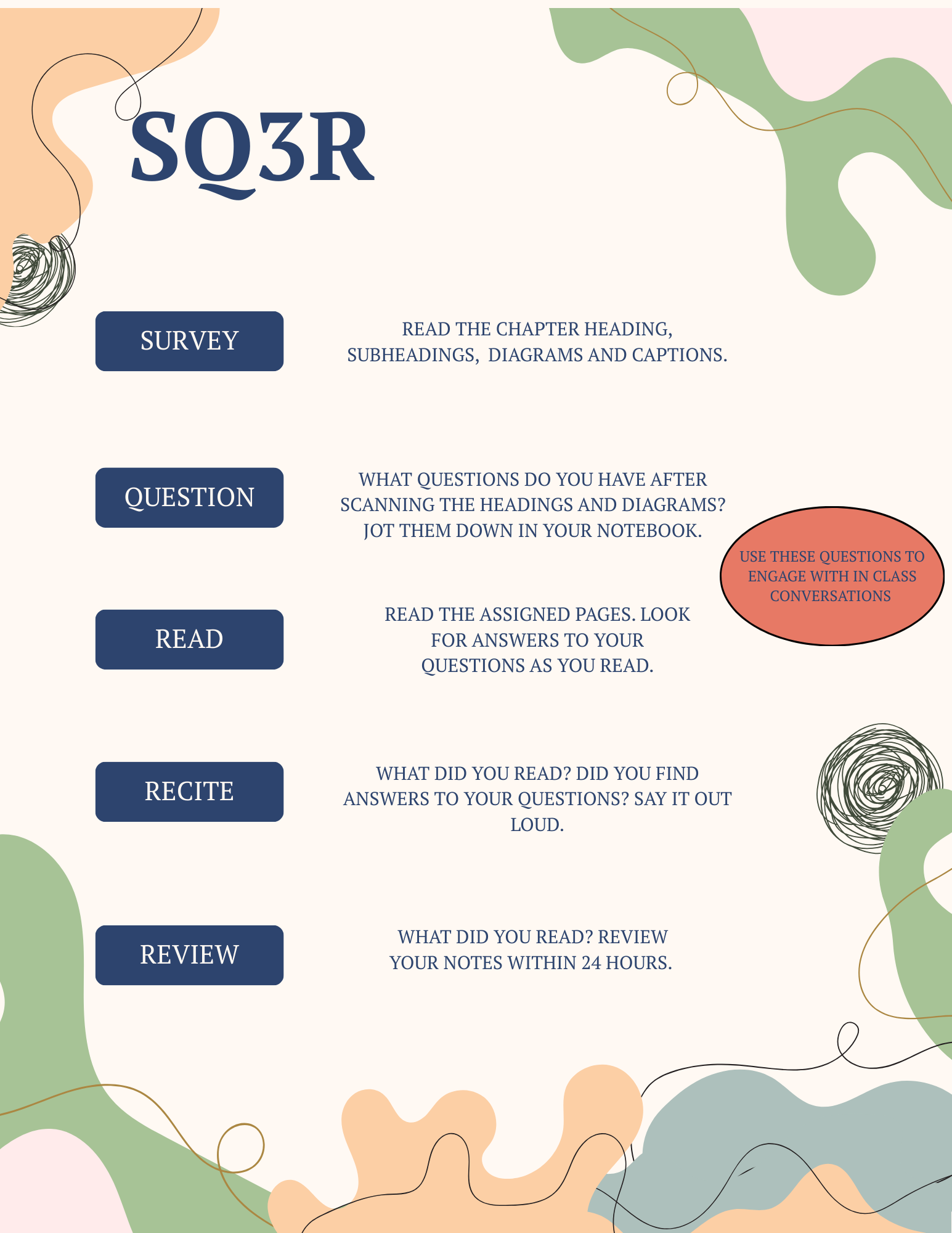
SQ3R. Although this is not a new strategy, I was surprised at how few students had experience working with it. Preparing to join classroom discussions requires intentional preparation. Some students may feel underprepared and think a simple scan of the assigned readings will enable them to join a conversation. While that may work on a superficial level, robust, and meaningful conversation requires proactive work. For students unsure of how to read for maximum understanding a review of the SQ3R strategy is helpful. After a class introduction to the strategy, all students are given a handout with the students so they can utilize as they see fit.
SQ3R
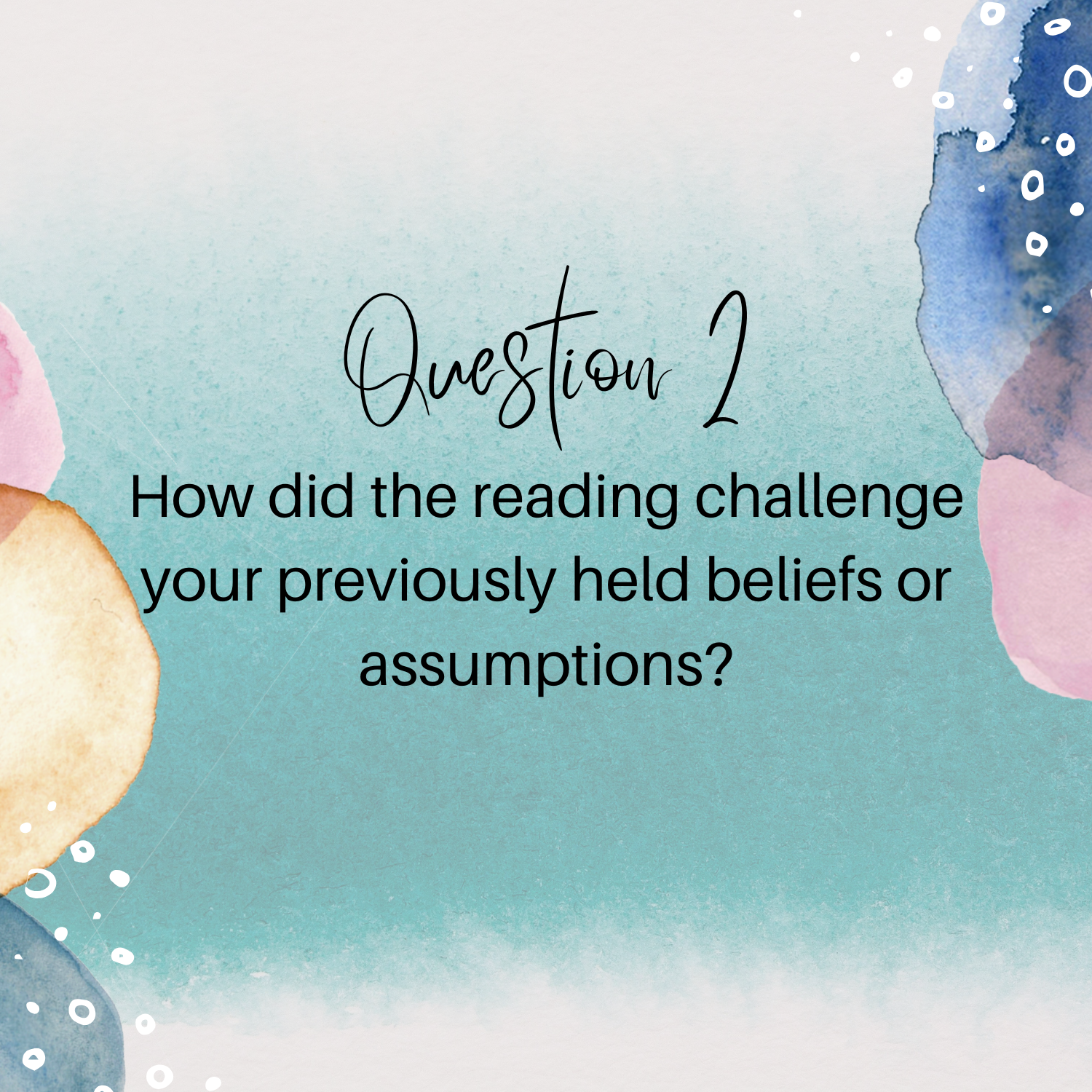
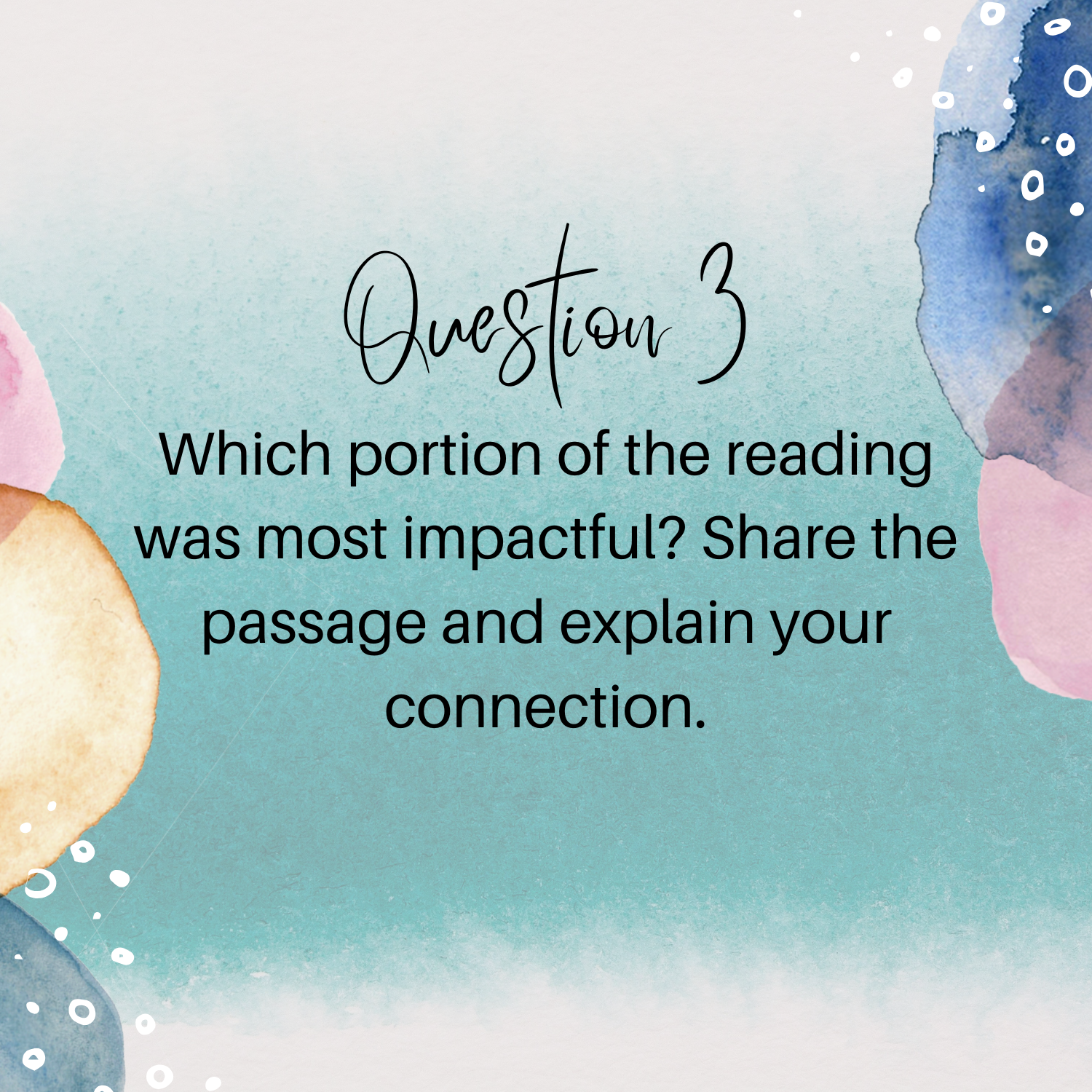
Launchpad. For some students, the formulaic nature of a guided strategy, like the SQ3R, may be too limiting. For the student that wants to prepare for in-class conversation, preparing and providing a few open-ended reading reflection questions (launchpad ideas) may be useful. The questions are intentional few in nature so students can focus on responding to one or two and reading to find solid text evidence to support responses.
Launchpad Example 1Launchpad Example 2
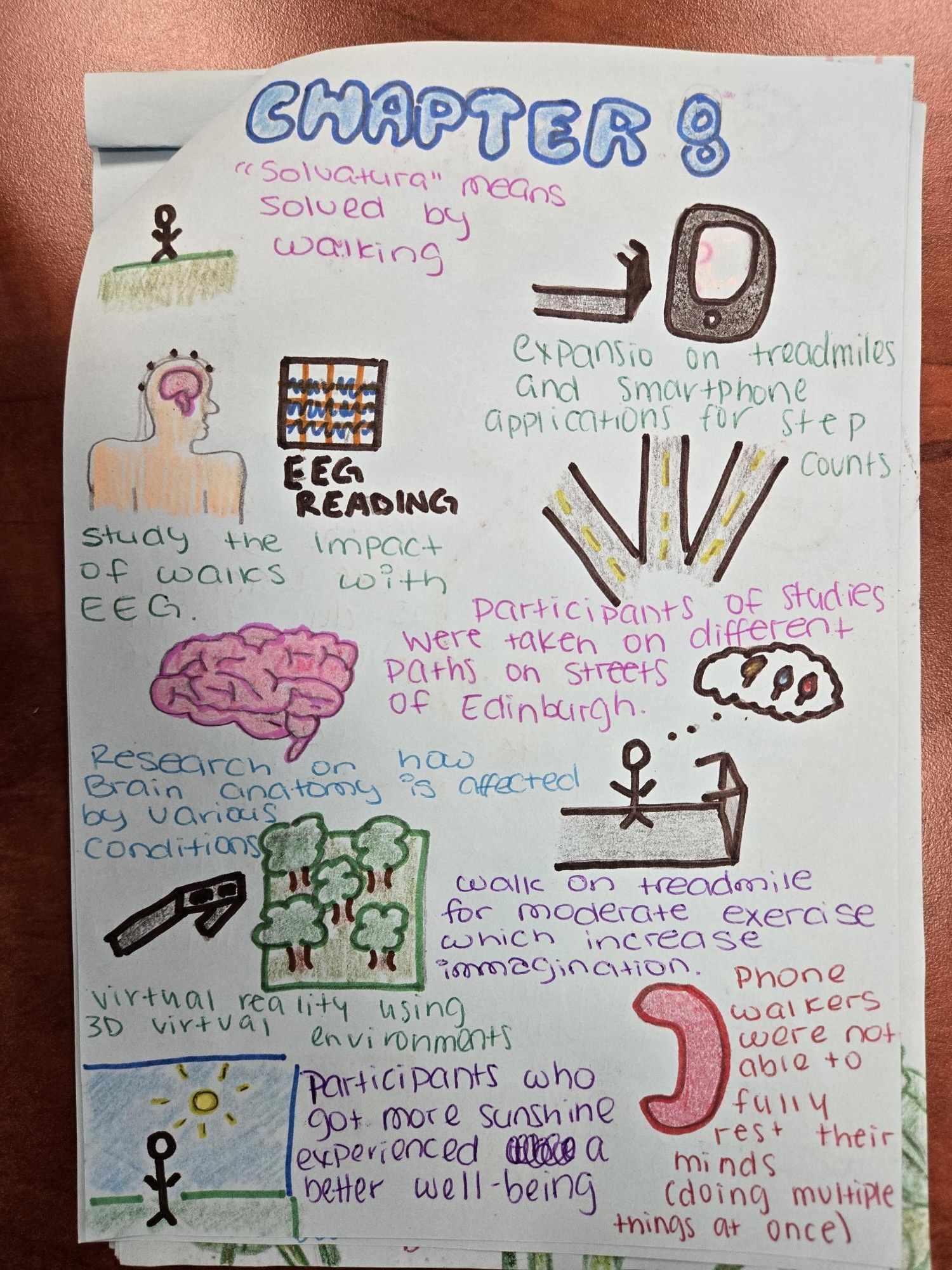
Sketchnoting. For students that best express their understanding visually, sketchnoting is a wonderful tool (Parks, 2022). Sketchnoting involves using images, words, and colors to make thinking visible on paper (or a device). When introduced in class as a worthwhile way to capture understating, students may be more likely to try the method rather than just trying to remember what they read.
Sketchnote
The First 10 Minutes of Class
Even with adequate preparation and readings, students get busy with other obligations between assigned coursework and class time. To help students feel prepared, the first 10 minutes (no more) of class is provided as a focused reflection.
Focused Reflection. During the 10-minute reflection, students may review their SQ3R notes, add to their reading reflections or sketchnotes. Students may also reread (or, for some, read) the assigned pages. For students that have done it all, they are tasked with doodle time. It’s not as unstructured as it seems.
Doodle Time. If a student is reluctant to participate in any of the focused reflections, they are given a doodle paper and three colored pencils. The expectation is to keep the pencils moving during the entire 10-minute period. Some students may start by drawing squiggles or lines, but they do transition into drawing sketches of things they’ve read. Once students believe there is no judgment on their artistic ability and that the focus time is really intended to help them think about the course content, they respond positively to the task. Some have even transitioned from doodling to sketchnoting because, as shared by one student, “it matches the way I think.”
By allowing this 10-minute period to capture thoughts, students have to ability to organize their thoughts and feel confident in their classroom conversation contributions. While it doesn’t level the field completely, and there are still students that do not read, those that do have shared they appreciate the time to refocus their attention on the coursework.
There are only two rules for focused reflection time. The rules are aimed at keeping the classroom distraction free.
No talking (to me or each other). The quiet period allows think-time for all students.
No devices. The device free period encourages students to independently think about the assigned readings without supporting- or competing- interests. Students are told candidly, I care about their input, not a generative AI summary of the reading.
Building a Safe Space for Conversations
Even with adequate preparation, sharing connections to coursework can be daunting. To support students in the process, a small to big approach is beneficial. First, students are assigned, by the instructor, into conversation corner groups. These groups are intentionally small to promote equitable opportunities to speak. With small classes, I create the groups and intentionally separate any groups of friends to provide opportunities for students to interact with others that may bring new perspectives to the conversation. For larger groups, a random group generator such as https://www.randomlists.com/team-generator can be used. After allowing small group conversation, the students are transitioned into whole group discussions in which they share understanding or respond to instructor posed questions as a group.
Getting the Conversation Going
Students may need help starting content-based conversations. Using a ‘fun’ tool engages students and allows all to have a chance to contribute.
Spinning Questions. Pickerwheel (https://pickerwheel.com) or Spin the Wheel (https://spinthewheel.io/#google_vignette) are sites that allow the instructor to enter questions into a spinning wheel. Students spin the wheel and respond to questions in small groups. Students can also create a discussion wheel in their instructor assigned small groups using the questions they created for their SQ3R notes.
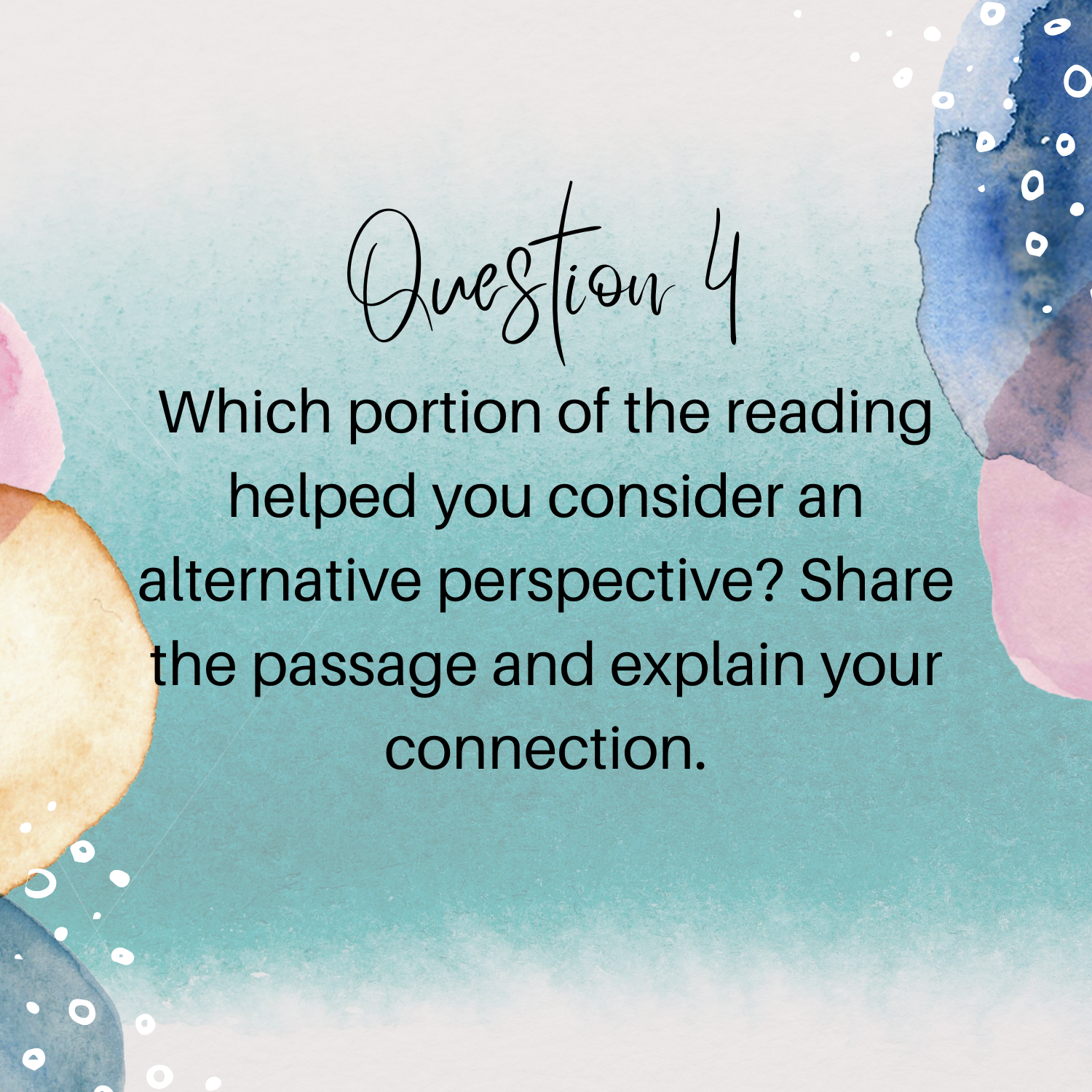
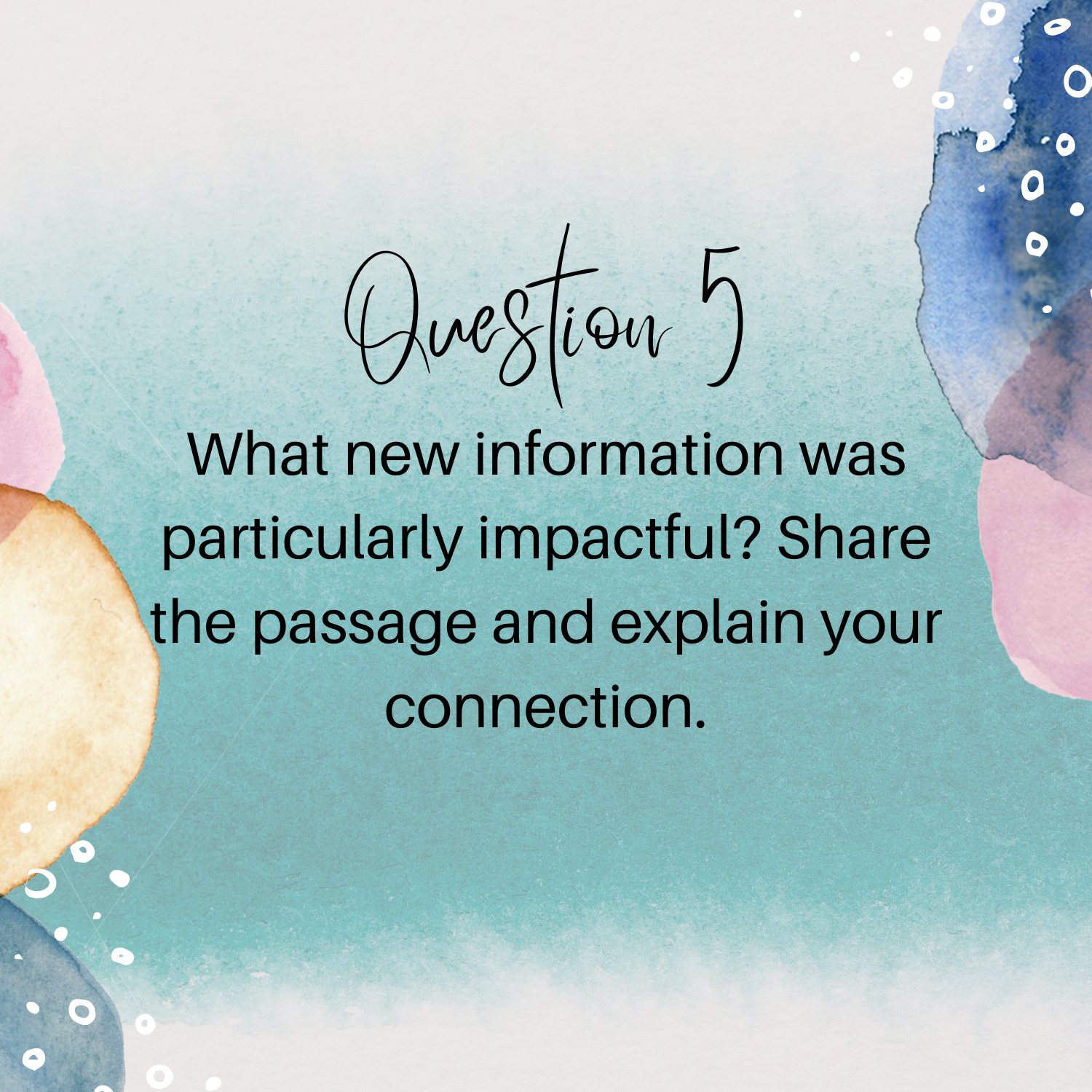
Conversation Cards. The use of Conversation Cards can help students engage in focused conversation about course content. Students can either draw random card or review all cards and choose the one that is most appealing to them.
Conversation Card Example 1Conversation Card Example 2Conversation Card Example 3Conversation Card Example 4Conversation Card Example 5
Ending Class
Ending class with an individual account of progress toward mastering course content helps students self-determine their next steps.
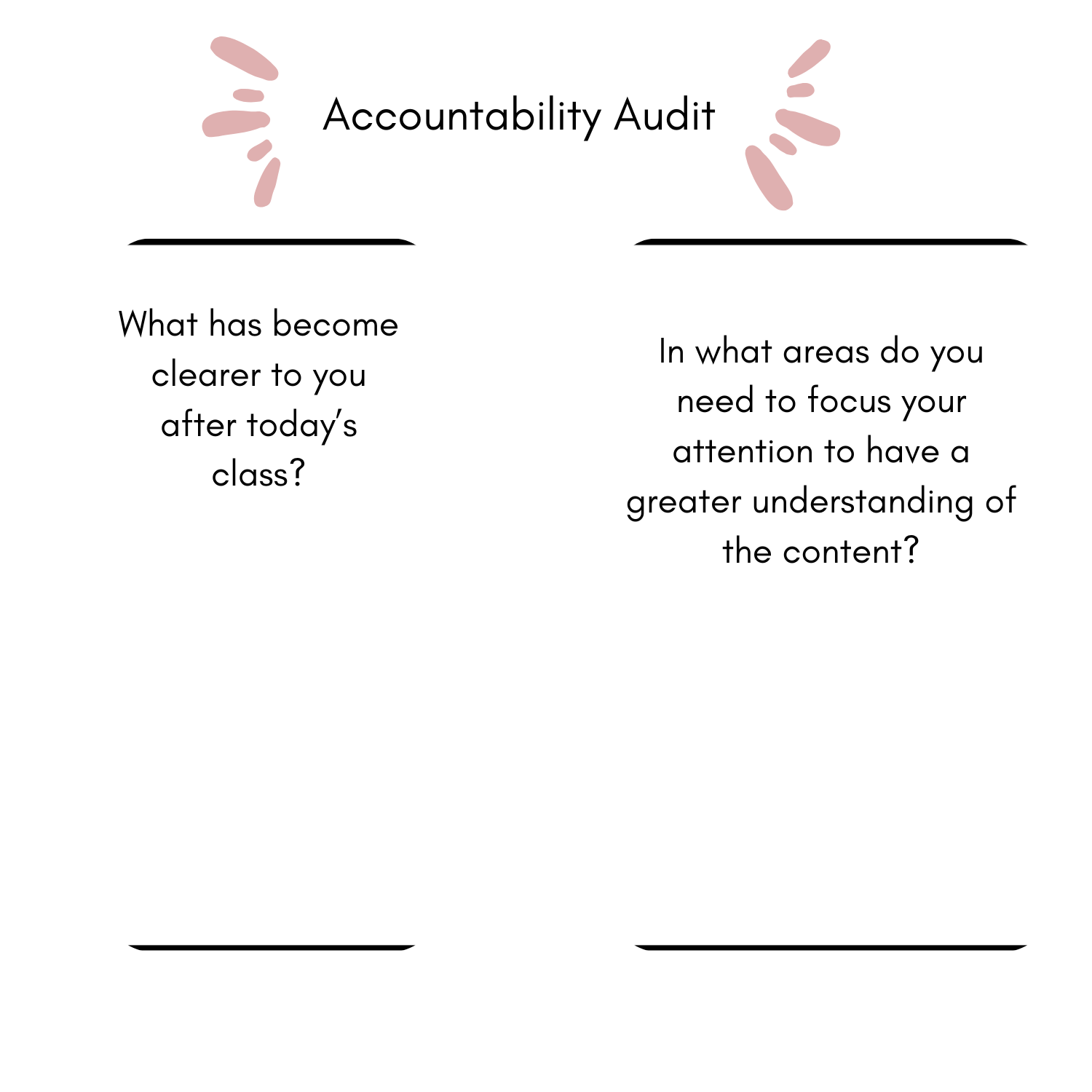
Accountability Audits. As a ticket out the door, students can complete an exit slip capturing their efforts for the day. Instructors may use the exit tickets as participation grades or as formative assessments to determine how students are understanding content. With larger courses, the instructor may elect to review a random sample of the work, telling students the work is about personal reflection and accountability. Exit slips may be handwritten or they may be done electronically.
Accountability Audit
One Last Word. Sometimes extra paper and written work just won’t work. An alternative is to ask individuals, or small groups of students, to suggest one word that sums up the main points of class. The main caveat is no word may be repeated. This one is fun, quick and pushes students to categorize their learning. Please consider a note of caution—this one can quickly turn into a small competition with individuals or groups trying to go first so “their” word is not shared by another group. Don’t worry—it’s all in good fun.
While engaging with content cannot be forced, finding tools that are interesting for students, focused enough for instructors to feel confident valuable class time is used productively and reinforces key points can make learning accessible to all.
Melissa Parks, PhD, is an associate professor of education at Stetson University in Deland, FL. Dr. Parks is an active member of the National Science Teaching Association (NSTA) and is currently a member of the NSTA Early Childhood- Elementary Science Teaching Committee. Her research interests include elementary pedagogies and environmental stewardship.
References
Deale, C. S., & Lee, S. H. (2021). To read or not to read? Exploring the reading habits of hospitality management students. Journal of Hospitality & Tourism Education, 34(1), 45–56. https://doi.org/10.1080/10963758.2020.1868317
Handelsman, M. M., Briggs, W. L., Sullivan, N., & Towler, A. (2005). A measure of college student course engagement. The Journal of Educational Research, 98(3), 184–192. https://doi.org/10.3200/JOER.98.3.184-192
Mizrachi, D., & Salaz, A. M. (2022). Reading format attitudes in the time of COVID. Journal of Academic Librarianship, 48(4), 102552. https://doi.org/10.1016/j.acalib.2022.102552
Parks, M. (2022). Drawing in college: Using sketchnoting to support student engagement. Faculty Focus. Magna Publications.
Severe, E., Stalnaker, J., Hubbard, A., Hafen, C. H., & Bailey, E. G. (2024). To participate or not to participate? A qualitative investigation of students’ complex motivations for verbal classroom participation. PloS one, 19(2), e0297771. https://doi.org/10.1371/journal.pone.0297771
Zepke, N., & Leach, L. (2010). Improving student engagement: Ten proposals for action. Active Learning in Higher Education, 11, 167-177. doi:10.1177/1469787410379680
There is a feeling among some policymakers that the UK research system lacks agility. But the key question is agility for who: for researchers, for research institutions, or for the government which funds the research?
By definition, research explores the unknown. These unknowns range from the unknown solutions to today’s challenges such as affordable healthcare and reversing climate change, to initiating the yet unknown technologies of tomorrow that will feed future economic growth.
Whose agility?
The UK government’s Plan for change: milestones for mission-led government repeatedly mentions the UK’s outstanding research base. It is also clear that government has high expectations of how our research system can demonstrate agility to pivot towards addressing major societal needs. But addressing any of these missions requires time, and hence a disciplined balance of agility and commitment to a long-term research agenda.
At a more operational level, for our national funders such as UKRI, legitimate concerns over the precarity of research careers, and the recognition that hard problems take time to solve, means that a large fraction of their annual budget is committed for three or more years into the future.
The extent of these multi-year commitments seemingly restricts the agility of the research system. However, looking more closely, embedded within these commitments are the commitments made to individual researchers to support them and their teams to pursue thematic programmes while empowering their own agility to rapidly pivot their research in response to new ideas of their own or the discoveries of others. It is precisely these longer-term funding commitments typified by support for research fellowships or the quality-related funding driven by REF that allows the UK’s researchers themselves to be agile.
It is widely accepted the UK’s research system is highly productive in basic curiosity-driven research. This productivity, we would argue, is a direct result of the researcher-led agility that our current funding system allows. However, we also recognise that government can and should identify areas of research in support of our industrial or other national needs – some on shorter time horizons.
The key is the balance between this academically-led and government directed agility – we can and do need to do both. Reaching this balance requires greater transparency from the funding agencies and an intellectually safe discussion between government and the research sector. We urge UKRI and DSIT to articulate this balance, around which we can all then work.
Speed and success
Related to these questions of agility are current problems in the funding system which if left unchecked will undermine our research productivity. The costs of research have far outstripped inflation and available research funding has not kept pace – for example, the fall in the number of doctoral training centres funded by EPSRC from 2014 to 2019 and to 2024.
These financial pressures have driven hyper competition in the sector. Success rates have plummeted, with many researchers’ experience being of ten per cent success rates or less – particularly in the schemes supporting academically-led, curiosity-driven research.
Perhaps even worse are the lengthening times taken to receive a funding decision; a decision on a three-year long application often takes more than one year to receive – hardly a route to agility of any kind.
Irrespective of these budget-constrained success rates, we urge our national funders to reduce significantly the time it takes to reach their decisions on whether to fund or not. Suggestions have been made to move to lottery funding, thereby reducing decision times and eliminating potential biases within an ultra-low success rate environment. But a lottery would not solve the issue of low success rates, and hence fails to provide the continuity of funding for people and the security of careers upon which their agility depends.
Beyond long decision times, low success rates drive many other unwanted behaviours: for example, conservatism in selection, or a tendency for the applicant to oversell.
The danger of system failure
The reality is that the public purse alone is insufficient to fund the research volume the UK requires. Hence a question for the research sector, funders and government alike is how we can maximise the gearing of taxpayers’ investments by securing industrial and philanthropic co-investment to drive economic growth and public benefit.
It should also be recognised that universities in the UK increasingly cross-subsidise the whole research system via non-publicly funded teaching, and that this aspect of the system is already highly geared. Leaving aside several successful schemes which already do this, such as EPSRC prosperity partnerships, we believe that a co-investment culture would also require system agility and prompt decisions.
We all feel that the research system lacks agility, but we each see this problem from our own perspectives. The government bemoans the forward commitment of our funders – but also needs to restrict the number of new initiatives to those that it has the resources to fund, perhaps refocussing an agreed fraction of the challenges each year. Funders think that they are empowering the agility of their researchers – but also need to realise that their lengthy decision times are harming productivity. Individual researchers should welcome the agility with which they are empowered – but must accept also the responsibility to never stop thinking as to how their expertise can be applied to benefit the economy and society.
These are the interconnected problems of agility, of balance between government priorities and curiosity-driven research, of success rates, of decision times. The system we have is in danger of failing us all – we need to talk.
The decision to enroll in college is significant, and students rely on institutional guidance to make informed choices. Financial information, particularly regarding tuition costs and financial aid, is often one of the first things they seek. Unfortunately, many higher education institutions struggle to initiate the conversation early in the enrollment funnel, which can lead to student frustration, decreased enrollment, and potentially higher student debt.
Engaging in financial aid discussions with prospective students early on in their enrollment journey is a crucial opportunity to alleviate concern and create a smoother experience. We’ve put together actionable strategies to help higher ed professionals initiate these conversations, better manage the student experience, and remove a significant barrier from their decision-making process. Explore strategies for how and when to have these conversations and highlight the key differences between traditional students and online adult learners, providing insights to increase enrollment and student success.
Gain additional insights into effectively managing financial aid discussions in our latest recorded webinar.
The Importance of Early Funnel Financial Advising
As consumers in today’s digital age, Modern Learners are accustomed to having information instantly accessible at the click of a button. Before committing to a program, students seek transparency about tuition costs and financial aid directly on the university’s website. According to EducationDynamics’ Online College Students Report, 90% of online college students begin their search on a college’s website, with 60% specifically looking for cost and financial information. However, only 36% report being able to easily find this critical information. The report also reveals that 58% of students prefer to learn about costs when they first visit a school’s website, while 26% expect this information after their initial inquiry. Only 10% are willing to wait until they hear back from the school post-application, and just 6% after acceptance. These findings identify a critical gap in the student experience.
Addressing this gap is vital for effectively guiding students through their enrollment journey. It’s also important to acknowledge that not all students have the same familiarity with navigating college financial processes. For example, the Online College Students Report found that 36% of online college students are first-generation college students, who may lack experience with navigating the college enrollment process, making conversations centered on financial aid even more critical.
Additionally, many online students have already incurred student loan debt from prior enrollment, which can impact their ability to finance their education through federal aid alone. This existing debt often influences their decision to re-enroll. Therefore, engaging in financial discussions and understanding the impact of various factors, such as debt and previous financial experiences, is essential.
Tailoring financial information and support to meet diverse needs is just one part of the broader conversation about enhancing financial literacy for prospective students. Financial literacy is an important component of their overall student journey, and by prioritizing this education and personalizing the approach, institutions can better support their students’ success while also improving enrollment outcomes.
Building a Comprehensive Financial Aid Conversation Strategy
When a prospective student inquiries and connects with an advisor, it presents an invaluable opportunity to provide a comprehensive review of tuition, costs, and all available financial options. At this stage, it’s important to ask questions that allow for individualized support, offering personalized answers tailored to each student’s specific financial situation. Remember, many students may already feel frustrated after struggling to find this information on the website. To address this, proactive financial conversations are key.
Despite the importance of financial clarity, many enrollment interviews with prospective students fail to delve deeply into financial options. Instead, students are often directed to only the FAFSA, which limits the students access to information on other options. Discussing other options, such as scholarships, grants, and payment plans, can help reduce the greater debt load and give students a clearer understanding of how financial decisions impact them each academic year.
Student Journey Mapping
Student journey mapping is a strategic process that helps institutions visualize and optimize the student experience from initial inquiry to enrollment. When integrated with financial advising, student journey mapping becomes a powerful tool for identifying gaps in existing financial aid conversations and ensuring students receive the support they need early in their enrollment process.
To start, assess your current student journey map by identifying all pre-enrollment touchpoints where financial advising is currently provided. Consider where financial discussions are taking place and how they are being conducted.
Ask questions such as:
Where is financial advising currently provided?
How is financial information currently provided?
What gaps exist in these conversations?
Once you have reviewed your existing student journey map, create a revised version that reflects a best-case scenario student journey. Consider the following:
Has the party responsible for financial advising changed or evolved?
Is the current system access still relevant?
Are there training or knowledge gaps that need to be addressed?
What specific questions should be asked during pre-enrollment advising to better address students’ financial needs?
By addressing these considerations, institutions can create a more seamless and supportive financial advising experience that meets the unique needs of prospective students.
Effective financial aid conversations are instrumental to student success, and well-trained enrollment teams can make a significant impact. With well-trained enrollment teams, institutions can provide clarity and support while fostering trust in the financial aid process. Here are four strategies for ensuring your team is prepared:
Sell the Vision: Communicate the importance of financial aid discussions in shaping the student experience, motivating your team to approach these conversations with empathy and purpose.
Solicit Feedback: Ask your enrollment team for input on their challenges and needs to ensure that training practices directly address their concerns.
Create or Outsource High-Quality Training Content: Develop or outsource engaging training content that covers financial aid topics. Consider leveraging professional support, such as our Financial Aid Advising services, to ensure your team is thoroughly supported.
Incorporate Relevant Resources or Data: Integrate current data and resources into your training materials, such as insights from the Online College Students Report to help your team understand the specific financial challenges students face and how to address them effectively.
By implementing these strategies, your team will be better equipped to guide students through complex financial decisions, ensuring they feel supported from the first conversation through to enrollment.
Beyond FAFSA
While the FAFSA is a starting point for financial aid, it’s important to explore a range of financial aid options to better address varying student needs.
Students may benefit from alternative financial aid options such as tuition reimbursement programs, employer-sponsored education benefits, scholarships, grants, and flexible payment plans. These resources can help reduce their reliance on loans and alleviate stress throughout their academic journeys.
Through presenting a range of financial aid options, institutions can empower students with greater access to financial support, increasing their chances of enrollment success while minimizing financial stress.
Monitoring and Adapting
To better understand the effectiveness of your advising strategies, consider tracking key performance indicators (KPIs) related to financial aid conversations. Monitoring these KPIs allows you to identify areas of improvement and make necessary adjustments to ensure students receive the best possible support.
Relevant KPIs to track include:
FAFSA Submission Time: Measure how quickly students are completing their FAFSA applications after engaging in financial aid conversations.
Packaging to Direct Cost: Track how effectively financial aid packages cover direct costs, such as tuition and fees.
Revised Award Letters/Packages: Monitor the frequency and outcomes of revised award letters or financial aid packages based on ongoing financial aid discussions.
Increased Payment Plans: Look for a rise in students adopting flexible payment plans due to better financial aid conversations.
Tuition Reimbursement: Track the usage of tuition reimbursement or employer-sponsored education benefits as alternative financial aid options.
Continuous monitoring and adjusting as needed are key to optimizing the financial advising process. By regularly reviewing KPIs and the quality of financial aid conversations, enrollment teams can ensure that their advising strategies remain effective and aligned to student goals.
Resources and Next Steps
Leverage Our Expertise
At EducationDynamics, we recognize that navigating the financial aid process can be a challenging part of the student journey. Our dedicated financial aid coaches provide your team with personalized support, helping to reduce the workload on your internal teams, allowing them to focus on core responsibilities. By partnering with us, you can streamline the financial aid process, increase efficiency, and improve enrollment outcomes.
Watch the Recorded Webinar
For a deeper dive into effective strategies for addressing financial aid conversations with prospective students, don’t miss our recorded webinar. This session offers valuable information on integrating financial guidance into the pre-enrollment experience and enhancing your financial aid conversations. Watch the recording now to access comprehensive approaches that can augment your institution’s financial advising process.