With the end of federal COVID-19 emergency funding and the inherent volatility of state income tax revenues, California school districts are in an era of financial uncertainty. Fortunately, Jurupa Unified School District is already several years into the process of finding ways to track and control expenses while still supporting teachers and staff so they can provide the best possible educational experience for our students. Here’s how we’re making staffing and payroll processes more efficient, starting with the perennially challenging extra duty.
Getting a handle on extra duty
In addition to our salaried staff, we have a number of part-time, hourly, and what we call “extra duty” assignments. Because a significant amount of our funding comes from grants, many of our assignments are temporary or one-time. We fill those positions with extra duty requests so we’re not committed to ongoing payroll obligations.
For many years, those extra duty requests and time cards were on paper, which meant the payroll department was performing redundant work to enter the information in the payroll system. The request forms we used were also on paper, making it very difficult to track the actual time being used back to the request, so we could be sure that the hours being used were within the limitations of the request. We needed a better control mechanism that would help school sites stay within budget, as well as a more formal budget mechanism to encumber the department and site budgets to cover the extra duty requests.
Budgeting can get very complicated because it’s cross-functional. It includes a position-control component, a payroll component, and a financial budgeting component. We needed a solution that could make all of those universes work together. The mission was either to find a system or build one. Our county office started a pilot program with our district to build a system, but ultimately decided against continuing with this effort due to the resources required to sustain such a system for 23 county districts.
Our district engaged in a competitive process and chose Helios Ed. Within six months, our team developed and launched a new system to address extra duty. Since then, we have saved more than $100,000 in staffing costs, time expenses, and budget overruns because of the stronger internal controls we now have in place.
A more efficient (and satisfied) payroll department
Eliminating redundant data entry and working with data instead of paper has allowed us to reduce staffing by two full-time equivalents–not through layoffs, but through attrition. And because they have a system that is handling data entry for them, our payroll department has more time to give quality to their work, and feel they are working at a level more aligned to their skills.
Finding efficiencies in your district
While Jurupa Unified has found efficiencies and savings in these specific areas, every school district is different. As many California district leaders like to say, we have 1,139 school districts –and just as many ways of doing things. With that in mind, there are some steps to the process of moving from paper to online systems (or using online systems more efficiently) that apply universally.
Sit down and identify your objectives. What are the critical components that you must have?
Make the decision to make or buy. When COVID first hit, Jurupa Unified created its own invoice-routing system through SharePoint. We’ve also built an excursion request process in PowerApps that handles travel, conferences, and field trips. As our county office found out, though, when you’re bringing a number of functionalities together, it can make more sense to work with a vendor you trust.
If you choose to buy software, be certain that it can do precisely what you need it to. If a vendor says they can develop a functionality along the way, ask to see the new feature before you buy.
Be certain the vendor will be responsive. When it comes to a function such as payroll, you’re dealing with people’s livelihoods, and you need to know that if there’s something wrong with the system, or if you need help, that help is just a phone call away.
Putting in a new payroll management system has made an enormous difference for our district, but it’s not the end of our cost-cutting process. We’re always looking at our different programs to see where we can cut back in ways that don’t impact the classroom. Ultimately, these changes are about ensuring that resources stay focused where they matter most. While budgets fluctuate and funding streams remain unpredictable, my team and I come to work every day because we believe in public education. I’m a product of public education myself, and I love waking up every day knowing that I can come back and support today’s students and teachers.
Jacqueline Benson, Jurupa Unified School District
Jacqueline Benson is the director of fiscal services at Jurupa Unified School District. She can be reached at [email protected].
Latest posts by eSchool Media Contributors (see all)
This audio is auto-generated. Please let us know if you have feedback.
Dive Brief:
A federal appeals court ruled on Monday that the National Institutes of Health cannot cap research overhead funding across the board, upholding an April lower court decision that spelled relief for beleaguered universities.
The 1st U.S. Circuit Court of Appeals unanimously concluded that NIH violated statutory law and the agency’s own regulatory procedures when it issued a policy capping reimbursement rates for indirect research costs at 15% for current and new grants.
The ruling is the latest blow to the Trump administration’s attempts to have multiple federal agencies cap indirect cost reimbursement rates at 15%. NIH on Tuesday declined to comment on the ruling or say if it planned to appeal.
Dive Insight:
When NIH issued the contested guidance in early February, it said it expected the move to save $4 billion — money that it planned to funnel toward financing direct research costs for institutions.
The move — widely panned in the academic community and elsewhere — broke with long-standing procedure of negotiating reimbursement rates with individual research institutions. For many large research universities, those rates top 50% and help pay for things like information technology, utilities, administrative support, and building and running laboratories.
These negotiations, built into NIH’s regulations, were also codified by Congress during the first Trump administration. Legislators passed an addition to an appropriations bill that advocates and judges have said specifically bars NIH from drawing up a universal reimbursement rate rather than negotiating individually with grantees.
NIH’s new policy drew multiple lawsuits, with high stakes looming while the legal battle played out. As one researcher at the University of Alabama at Birmingham put it, the cap would “cripple research infrastructure at hundreds of US institutions, and threatens to end our global superiority in scientific research.”
In court documents, scores of universities have described in detail how NIH’s 15% indirect cost cap would imperil their medical research operations and workforces, as well as the country’s ability as a whole to advance biomedical science — historically one of the U.S.’s major economic strengths. A February New York Times analysis found the policy could cost some of the top research universities over $100 million a year in funding.
As federal appellate Judge Kermit Lipez, a Clinton appointee, noted in this week’s ruling, NIH research has led to major medical breakthroughs and lowered death rates from conditions such as heart attacks and strokes.
“In short, the public-health benefits of NIH-funded research are enormous,” Lipez wrote.
In March, a district court judge ruled the new policy illegal and issued a preliminary injunction against it, followed by a permanent injunction in April. Despite the setbacks, the Trump administration has tried instituting identical caps at other agencies — namely, the U.S. departments of Energy and Defense, and the National Science Foundation. Federal judges so far have blocked those moves as well.
Several of those opposing NIH’s cap, which included a coalition of state attorneys general, lauded this week’s ruling.
“The Trump Administration wanted to eviscerate funding for medical research that helps develop new cures and treatments for diseases like cancer, diabetes, and Alzheimer’s,” California Attorney General Rob Bonta said in a statement Monday. “We’re starting the new year by building on our previous successes and securing yet another important victory against the Trump Administration.”
Lowering college costs, boosting accountability and reforming accreditation will likely be at the top of congressional Republicans’ to-do list for 2026. But as public approval ratings for President Trump continue to decline and midterm elections loom, higher education policy experts across the political spectrum say congressional conservatives could be running out of time.
The push for more affordable higher education has been gaining momentum for years, and while it was a common refrain at the committee level in 2025, complex and sweeping debates over tax dollars soaked up much of lawmakers’ attention.
First, the Republicans passed their signature piece of legislation, the One Big Beautiful Bill Act, which cut taxes for wealthy individuals, increased them for elite universities and overhauled the student loan system. Then, they turned their attention to disagreements on the federal budget—an impasse that led to the record 43-day government shutdown.
But in the few cases where members of the GOP did get to home in on college cost issues, whether via legislation or hearings, an underlying theme emerged—holding colleges accountable for their students’ return on investment.
Higher education experts have no doubt that concern will continue in 2026, but Congress won’t have the time or the oxygen needed to nail down real changes unless they figure out how to fund the government, which runs out of money again Jan. 31.
“The Republican majority is very conscious that it may be on the clock, and this would argue for trying to move rapidly and get things done,” said Rick Hess, a senior fellow and director of education policy studies at the American Enterprise Institute, a right-leaning think tank. “But with the narrow and fractious House majority, the way the budget is going to chew up time going into January and the pressure on the Senate to get judges confirmed, it’s just going to be a challenge for them to find much time to move further higher ed–related legislation.”
Legislative Actions
Republicans spent much of 2025 using their control of Congress and the White House to pass what many industry leaders have described as the largest overhaul to higher education policy in more than a decade—the One Big Beautiful Bill Act. And while policy experts were initially skeptical that this multi-issue package could pass given the complex, restrictive nature of a legislative process called reconciliation, the GOP found a way.
The final bill, signed into law July 4, served as a major win for the GOP, expanding federal aid for low-income students to include nontraditional short-term training programs, limiting loans for graduate students, consolidating the number of repayment plans and increasing taxes on wealthy colleges, among other provisions.
Conservative policy experts like Hess praised the overhaul as “a much-needed and positive set of changes.”
“There’s certainly more that can be done, but I think it moved us in a substantially better direction than we’ve been,” he added.
But aside from OBBBA, little legislation concerning colleges and universities advanced. Only one bill tracked by Inside Higher Ed, the Laken Riley Act, reached the president’s desk. That law gave state attorneys general increased power over visas that could affect some international students and scholars. Others, including the Protection of Women and Girls in Sports Act, a bill that forbids trans women from participating in women’s sports, and the DETERRENT Act, a bill designed to restrict foreign academic partnerships, made it out of the House in a matter of weeks but then got stuck in the Senate.
The story of 2025 in higher ed is a big, dramatic one, but it’s almost entirely one of executive branch activity.”
—Rick Hess, AEI
So when asked what congressional accomplishments stood out from 2025, progressive policy experts told Inside Higher Ed they didn’t see much. The things that did happen, they added, hurt students and institutions more than they helped.
“‘Accomplishments’ is not really the word I would use considering the challenges that higher education faced this year,” said Jared Bass, senior vice president of education at the Center for American Progress. “I don’t think that Congress actually met the moment for affordability or defending and preserving higher education.”
Instead, he said, legislators placed the burden of cost on the backs of students.
“The Republican argument is by cutting access to these loans they’ll actually drive down costs. But we’ll have to wait and see if that happens,” he explained. “But I would say it didn’t actually make college more affordable. It just made resources less available.”
Although the House Committee on Education and Workforce hosted a greater number of higher ed hearings, some of the more notable panels came from the Senate Health, Education, Labor and Pensions Committee.
“They actually wanted to put the ‘E’ back in HELP and focus on education issues,” said Emmanual Guillory, senior director of government relations at the American Council on Education, a leading higher ed lobbying group. “That wasn’t really the case under prior leadership. So that was good.”
Chairman Bill Cassidy, a Republican from Louisiana, right, and ranking member Sen. Bernie Sanders, Independent of Vermont, lead the Senate Health, Education, Labor and Pensions Committee.
Tom Williams/CQ–Roll Call Inc./Getty Images
Much of the shift in interest, Guillory added, was likely tied to new leadership. This was the first year that Sen. Bill Cassidy, a Louisiana Republican, held the gavel. In the last Congress, Cassidy had served as ranking member.
The House Committee on Education and Workforce also had new leadership, as Rep. Virginia Foxx of North Carolina handed the baton to Rep. Tim Walberg from Michigan. But it was the Senate’s tactics that led to more meaningful legislative progress in ACE’s view.
“Mr. Walberg may have pushed a slightly more aggressive agenda. The House definitely had more hearings in the higher ed space and tackled more hard-punching issues, but in the Senate they took a different approach,” Guillory said. “When it came to those difficult issues and conversations, the Senate chose to discuss those a bit more quietly and really work on solutions with stakeholder groups and ask, ‘How can we be influential with actual legislation?’”
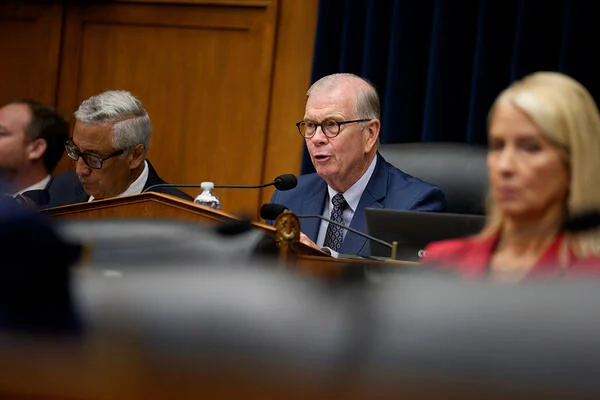
Chairman Tim Walberg took over the House Education and Workforce Committee in 2025.
Andrew Harnik/Getty Images
When asked for their reflections on the year, Cassidy and Walberg pointed to OBBBA, which they touted as a historic reform to drive down college costs and limit students from taking on insurmountable debt. But while Walberg then looked back to the ongoing antisemitism discussions and concerns about “hostile learning environments,” Cassidy touted his legislation aimed at helping students better understand the cost of college.
“College is one of the largest financial investments many Americans make, but there is little information to ensure students make the right decision,” he said. “That is why I introduced the College Transparency Act to empower families with better information so they can decide which schools and programs of study are best suited to fit their unique needs and desired outcomes.”
Democrats Fight Back
Meanwhile, Democrats in both chambers said they were forced to spend much of their time and attention maintaining the Department of Education, an agency they say is needed to do much of the work to fulfill Republicans’ priorities, be it addressing antisemitism and other civil rights issues or driving down college costs.
From his early days on the campaign trail in 2024, Trump has promised to dismantle the department, and starting in March of 2025, he began doing so—all without congressional approval.
Through it all, the Democrats repeatedly decried his “attack” on higher ed. They used statements, town halls and demonstrations outside the department to draw attention to decisions they said would be “detrimental” to “students, teachers and educators.”
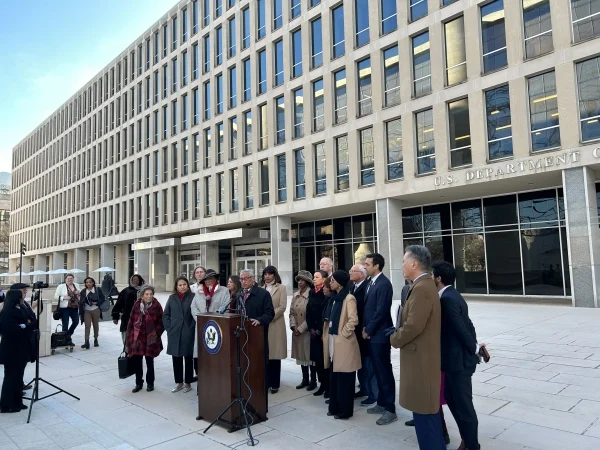
Lawmakers tried to access the Education Department in February but were denied entry.
Katherine Knott/Inside Higher Ed
Rep. Bobby Scott, a Virginia Democrat and ranking member of the House education committee, said he has spent much of his year in defense mode, pushing back against each of these actions.
“The administration has been dismantling the Department of Education, making access to education much less available,” he said. “And we’ve been trying to keep it together.”
But both Scott and Sen. Patty Murray, a Washington Democrat and former educator, acknowledged that as members of the minority, they can only do so much. A few Republicans have joined them in voicing concern about specific issues, but not enough, they say.
“We’ve had some successes—forcing some funding to be restored and rejecting, for example, President Trump’s push to slash Pell Grants by half in our draft funding bill for the coming year—but ultimately, we need a whole lot more bipartisan outrage and pushback from Republicans to truly start to undo the sweeping damage Trump has already caused,” Murray said.
And it wasn’t just Democrats who raised concerns.
“Congress has done very little to ask important questions, to ask the executive branch to justify some of the actions it is taking,” said Hess from AEI. “Hill Republicans are very much marching in lockstep to what the White House asks. The story of 2025 in higher ed is a big, dramatic one, but it’s almost entirely one of executive branch activity.”
What’s Ahead in 2026?
Now that congressional Republicans have completed a number of the tasks they set for themselves back in January 2025, most experts say two remaining items—college cost and accreditation reform—will be top priorities in 2026.
Most sources Inside Higher Ed spoke with anticipated that college cost reduction and transparency would be addressed first, largely because related bills made it out of a House committee in December and senators held a hearing on the topic. The bills, which would standardize financial aid offers and create a universal net price calculator, have already gained some significant bipartisan support.
Meanwhile, many remain skeptical of Republicans’ proposals for accreditation. Although no exact legislative language has been released, GOP lawmakers and Trump officials at the Department of Education have called for a major overhaul to not only ensure better student outcomes but also to deconstruct a what they see as a systemic liberal bias.
“I would hope to see a focus on accreditors taking an active role and not just sort of a check-the-box approach to quality assurance,” said Carolyn Fast, director of higher education policy at the Century Foundation, a left-leaning think tank. “What I’m concerned about is some of the efforts to reform accreditation don’t seem necessarily as concerned about making sure that the system is working in terms of their role as gatekeepers of federal funds … but more about political and cultural war issues.”
Bass from CAP said that he will be keeping a close eye on the midterm election campaign trail for a pulse on higher ed policy in general this year, as it gives the public a chance to speak up and direct change.
“I’m curious to see how conversations about affordability play out, not just for higher education or education over all, but just for the country,” he said. “There are going to be over 30 gubernatorial races next year, and the debate gets shaped over key issues like higher education, like college costs, like affordability. So it will be very interesting to see how both parties are going to show up.”
This audio is auto-generated. Please let us know if you have feedback.
Dive Brief:
College operating costs increased 3.6% in fiscal 2025, according to the latest Higher Education Price Index, which tracks the sector’s inflation.
“HEPI inflation rates are again elevated above what many consider the norm, set by expectations from prior decades,” according to a report from Commonfund Institute, which is responsible for the index. For the past five years, the HEPI rate has been above the prior decade’s annual average of 2.2%.
HEPI’s latest inflation rate continues a period of elevated cost increases for colleges and universities that began with the COVID-19 pandemic. The latest annual price increase of 3.6% is higher than the prior year’s rate of 3.4%. However, it’s much lower than the most recent peak of 5.2% in fiscal 2022.
Dive Insight:
HEPI found cost increases for colleges outpaced those tracked by the Consumer Price Index, which showed inflation for the general public rising 2.6% in fiscal year 2025. HEPI’s inflation rate has been higher than the CPI’s in nine out of the past 11 years.
The cost increases are putting immense pressure on many colleges. Some institutions that have closed in recent years have even cited inflation as one of the reasons they’re shutting down.
For others, the price hikes mean shrinking margins and the need for budget cuts. All three major credit rating agencies issued a gloomy 2026 outlook for either nonprofit colleges or the entire higher education sector, with each citing rising costs as a factor.
Out of eight cost categories that the HEPI tracks, administrative salaries grew the most in fiscal 2025, increasing by 4.8%.
Similarly, faculty salaries rose 4.3%, the highest rate recorded since HEPI began tracking inflation in the category in 1998. Inflation in faculty salaries has only reached 4% or higher two other times — a 4% increase in 2023 and a 4.1% increase in 2008. Faculty salaries have the most impact on the index.
Increases for the other categories were:
4.2% for utilities.
4.1% for service employees.
3.7% for miscellaneous services.
3.3% for clerical costs.
2.4% for fringe benefits.
Only supplies and materials saw deflation, with a 0.2% decline in costs.
Across institutions, two-year public colleges saw the highest overall cost increases at 4.6%. No other institution type had inflation above 4%. Part of this was due to inflation in faculty salaries at those institutions reaching 8.7% in fiscal 2025 — by far the highest out of any institution type.
Overall, public institutions had higher increases in faculty salaries than public colleges, 4.7% versus 3.6%. This breaks with the trend of private institutions more often seeing higher annual inflation in faculty costs, according to the Commonfund Institute report.
From New York to Jakarta, the scene is the same: Shelves overflowing with cheap, ultra-processed snacks and sugary drinks have become the new normal for millions of children. As a result, for the first time in history, more children are obese than underweight.
UNICEF’s new Feeding Profit report explains why: Across the globe, cheap and intensely marketed ultra-processed foods dominate what families are able to put on the table, while nutritious options remain out of reach.
Across the world, one in 20 children under five and one in five children and adolescents aged five to 19 are overweight. The number of overweight children and teens in 2000 almost doubled by 2022, with South Asia experiencing an increase of almost 500%. In East Asia, the Pacific, Latin America, the Caribbean, the Middle East and North Africa, the increase was at least 10%.
Ultra-processed foods and beverages, defined as industrially formulated, are composed primarily of chemically-modified substances extracted from foods, together with additives and preservatives to enhance taste, texture and appearance as well as shelf life.
These foods — which are often cheaper, nutrient poor and higher in sugar, unhealthy fats and salt — are now more prevalent than traditional, nutritious foods in children’s diets.
Today, children’s paths to healthy eating are shaped less by personal choice than by the food environments that surround them. Those are the places where and conditions under which people make decisions about what to eat. They connect a person’s daily life with the broader food system around them, and are shaped by physical, political, economic and cultural factors that help determine what foods are available, affordable, appealing and regularly eaten.
Such environments are steering children toward ultra-processed, calorie-dense options, even when healthier foods are available.
Around the world, countries are beginning to push back. In Mexico, where nearly four million children aged 4-10 are obese, the government took a bold step in March 2025. It banned the sale of ultra-processed foods and sugary drinks in schools.
The new rules go beyond restriction: Schools must offer fresh, regional foods such as fruits, vegetables and seeds, promote water as the default beverage, and establish health education programs. The policy also calls for regular health monitoring, mandatory fortification of wheat and corn flours, and more opportunities for physical activity, with penalties for schools that fail to comply.
Taking steps to slim down our diets
In September 2025, Malaysia’s Ministry of Education followed similar steps. It now prohibits 12 categories of ultra-processed foods and drinks in school canteens, from instant noodles and skewered snacks to frozen desserts and candy.
But even as countries rewrite their food policies, millions of families still face difficult choices at the market.
Shauna Downs, associate professor of food policy and public health nutrition at Rutgers University, has seen firsthand how hunger and obesity can coexist within the same communities in her research on informal settlements in Nairobi, Kenya.
“People are able to find nutrient-rich foods, like leafy greens, fruits, and vegetables, and animal-source foods, but they’re often expensive, and what they can get that’s cheaper is things like mandazi [fried dough], which provide energy, and they taste good, but they’re not getting the nutrients they need,” she said.
Families that want to buy the nutrient-rich foods are forced into heartbreaking choices, Downs said.
“So now they’re making a decision between ‘Am I gonna buy this food from the market, which my family needs, or am I gonna pay for my child to go to school?’” she said.
Looking at food environments
By spotlighting the food environment, consumers and researchers alike can move past the tired “eat less, move more” narrative to fight childhood obesity and ask a better question: Why wasn’t the healthy plate the obvious, easy and most affordable choice in the first place?
Long before ultra-processed foods flooded grocery shelves, they quietly took over another key part of children’s lives: school cafeterias. Back in 1981, the Reagan administration cut US$1.5 billion in U.S. school food funding, pushing public institutions to rely on convenience over nutrition.
Pamela Koch, associate professor of nutrition and education at Teachers College, Columbia University, said that one of the things cut was for funding for schools upgrade their kitchens.
“That was the same time as the food supply was becoming more and more [saturated] with highly-processed food, and a lot of food companies realized, ‘Wait, we could have a market selling to schools. Schools don’t have money to buy supplies’,” Koch said.
Companies began offering deals: Sign a long-term contract and receive a free convection oven to reheat ultra-processed foods. For schools facing budget cuts and limited staffing, the decision was simple. The cost of that convenience would echo for decades.
Let’s start with school meals.
The nonprofit Global Child Nutrition Foundation, highlights school meals as an essential lever for transforming food systems: Create demand for nutritious foods, improve the livelihoods of those working in the food system and promote climate-smart foods. However, the cost of scaling up national programs depends on the strength of supply chains, underlying food markets, logistics and procurement models.
Countries that depend on imported food, already challenged by infrastructure and expensive trading costs, will face additional challenges in delivering healthy school meals.
In much of the world, climate stress and weak infrastructure are making nutritious food both more difficult to grow and more expensive to purchase.
Small-scale farmers, sheep and cattle farmers, forest keepers and fishers — known collectively as smallholder farmers — grow much of the food in low-income countries. They face worsening yields due to climate change, land degradation and lack of access to the technology and resources that support sustainable food production.
At the same time perishable foods are becoming more expensive because the global supply chain — how food gets shipped from a farm in one country through distribution networks to store shelves in another country — is increasingly threatened by political tension, the lasting effects of the COVID-19 pandemic and climate change.
Durability over nutrition
Kate Schneider, assistant professor of sustainable food systems at Arizona State University, said that smallholder farmers grow food as their livelihood. “They’re not able to grow enough food, which is partly a story of climate change,” Schneider said. “Multiple generations now have been farming … year after year on the same land, but without external inputs –– fertilizers and modern, high-yielding seeds –– they are resulting in very low yields.”
Even when fresh fruits and vegetables are available, logistical barriers make it easier to sell ultra-processed foods. Fresh produce is heavy, vulnerable to spoilage and expensive to move, especially in countries with poor transport networks.
“When we’re thinking about fresh items, they’re perishable, and they need a cold chain,” Schneider said. “You’re paying, when you buy an apple, for the three that also rotted.”
Meanwhile, ultra-processed products like soda avoid this problem entirely: “It’s cheaper for them to have a ton of different bottling plants around countries than to distribute long distances,” Schneider said.
Connecting sustainability of diets and the environment
The EAT-Lancet Commission 2.0, a scientific body redefining healthy and sustainable diets, offers a different view: The ultra-processed foods fuelling obesity are also pushing food systems beyond climate and biodiversity limits.
The planetary health diet suggests a plant-rich diet that consists of whole grains, fruits, vegetables, nuts and beans, with only moderate or small amounts of fish, dairy and meat.
To build healthier and more just food systems, experts also recommend a whole list of other things: make nutritious diets more accessible and affordable; protect traditional diets; promote sustainable farming and ecosystems; reduce food waste.
And all of this should be done with the participation of diverse sectors of the society.
The responsibility of transforming food systems falls not only on governments but also on donors and financial partners, development and humanitarian organizations, academic institutions and civil society. The stakes are high, but so is the potential to change. With bold, coordinated action, the next generation of children can be nourished by healthy food, while building food systems that sustain both people and the planet.
Questions to consider:
1. How is obesity connected to the environment?
2. What are some governments doing to try to tackle the obesity crisis?
3. What changes could you make to your diet to make it healthier?
Join HEPI for a webinar on Thursday 11 December 2025 from 10am to 11am to discuss how universities can strengthen the student voice in governance to mark the launch of our upcoming report, Rethinking the Student Voice. Sign up now tohear our speakersexplore the key questions.
This blog was kindly authored by Dr Gary Jones, Dean of Student Success and Experience, Scholars School System, Dr Steve Briggs, Director of Learning, Teaching and Libraries, University of Bedfordshire, Professor Graeme Pedlingham, Deputy Pro-Vice Chancellor for Student Experience, University of Sussex, Dr David Grey, UKAT Chief Executive Officer and Professor Abigail Moriarty, Pro Vice-Chancellor Education & Students, University of Lincoln.
A recent analytic induction study (Grey & Bailey, 2020) defined personal academic tutoring in UK higher education as a “proactive, professional relationship between student and tutor sustained throughout the entire student journey.” This partnership involves “dialogue, metacognition, and a structured programme of activities” aimed at fostering student agency, self-efficacy, independent learning, and career and future goals.
Personal academic tutors play a crucial role by supporting students to “assimilate to the university environment”, facilitating learning and decision-making, reviewing progress, and providing essential information. They enhance both academic ability and emotional well-being through holistic support during one-to-one or group meetings at key academic moments. Personal academic tutors are described as “knowledgeable, approachable, helpful, patient, caring, reliable and non-judgmental” staff members who possess the skills to actively listen, instruct, and advise. They play a crucial role in supporting student success and outcomes.
HE size and shape is changing
The increasingly perilous position of economic sustainability in the UK higher education sector has meant that a growing number of institutions are instigating reviews of their ‘size and shape’. In turn, many providers face some tough decisions around what should be prioritised. We anticipate that multiple university senior leadership teams may review academic workload plan allocations during the 2025/26 academic year to ensure that academic staff time can be optimised. As such, consideration may be given to changing time allocations to prioritise teaching preparation and delivery, assessment, and research over personal academic tutoring. We argue that teaching and research should not be treated as more important than personal academic tutoring when allocating time. Nor should teaching and research time be reduced in favour of personal academic tutoring. Rather, we argue for equivalency and that time allocation for personal academic tutoring is an activity institutions should seek to protect, not cut.
The value of university education has become a sharper and often more critical question in media narratives, as well as for people considering studying in higher education. With the increasing cost of living and studying at university, the question of how universities can make the benefits to students as visible as possible is understandably at the forefront of many of our minds. We argue that personal academic tutoring is a critical part of achieving this through a strategic, purposeful, proactive, and student-centred approach that is informed by data rather than risking falling into a reactive approach.
The impact and benefit of personal academic tutoring
Personal academic tutoring plays a fundamental role in enhancing attainment and impacts the Office for Students’ metrics, which determine institutional success (such as the Teaching Excellence Framework, National Student Survey and Postgraduate Taught Experience Survey). Effective tutoring can be measured in many ways, but not least of these is the positive benefits for helping students to stay on course and be successful, directly supporting those key B3 continuation and completion rates. Effective personal academic tutoring is therefore a virtuous circle for improving student outcomes and experience, and can help give direct evidence of value to both current students and potential applicants.
Meaningful individualised relationships that encompass the entirety of a student’s learning journey are fostered through effective personal academic tutoring. Successful tutors nurture a sense of belonging and mattering, aid in navigating the complexities of the higher education study experience, cultivate vital analytical and transferable skills, and impact student career aspirations and employability. At its best, personal academic tutoring transcends traditional teaching methods by facilitating purposeful, structured interactions outside of learning, empowering student agency and promoting the holistic development of all students. As highlighted by NACADA, teaching beyond the curriculum and discipline can help to bring together and contextualise students’ educational experiences in terms of extending aspirations, abilities and lives beyond campus boundaries and timeframes.
Academic workload planning and personal academic tutoring
A recent UKAT senior leaders’ network group meeting provided a forum for discussions regarding allocating dedicated resources for personal academic tutoring in universities. Here, we explored the variation and inconsistencies across the sector regarding how universities operate their personal academic tutoring in terms of academic workload planning. Members reported that across institutions, resource allocation was often determined locally but was driven by central university policy. As the group engaged in thought-provoking dialogue, a critical question emerged: If we genuinely value the importance of learning beyond the traditional subject curriculum, why is personal academic tutoring often not prioritised to the same extent as other activities in the initial stages of academic workload allocation?
The case for a personal academic tutoring first mindset
Recognising there are institutional differences, possible common ways of addressing this challenge were discussed, considering the aforementioned financial constraints facing the HE sector. Abi presented to attendees a cup metaphor for academic workload planning based on her previous work. This suggests that, given the significance of personal academic tutoring on student outcomes, personal academic tutoring time should be the first thing built into an academic’s workload plan. She noted, however, that this is often not the case and time allocation for personal academic tutoring may be the last thing added into the workload ‘cup’ (behind teaching, assessment and research), in turn causing the cup to overflow and damaging the significance associated with personal academic tutoring. There was an overwhelming consensus that we should all adopt a personal academic tutoring first ethos in terms of academic workload planning. Accordingly, we encourage readers who will be undertaking academic workload plan reviews over the coming months to reflect on how they allocate personal academic tutoring time, particularly if personal academic tutoring has not historically been the first pour into the workload cup.
College affordability conversations tend to focus on tuition. But it’s the total cost of attendance (COA) that can catch many students off guard and derail their progress toward a degree. A new deep dive report from Inside Higher Ed—“Beyond Tuition: The Hidden Costs of College and Their Disproportionate Impact”—reveals how inaccurate COA disclosures and unexpected costs, from mandatory meal plans to technology fees to rising rents, can blindside students and threaten their success.
Join the Discussion
On Wednesday, Dec. 17, at 2 p.m. Eastern, Inside Higher Ed will host a live webcast discussion based on the report. Register for that here. Download “Beyond Tuition: The Hidden Costs of College and Their Disproportionate Impact” here.
Drawing on data from Inside Higher Ed’s Student Voice surveys and other research, plus interviews with dozens of experts, student advocates and students themselves, the report notes that just 27 percent of undergraduates fully understand their institution’s cost of attendance—and that, for some, even an unexpected $100 expense could threaten their enrollment. Hidden costs hit lower-income, first-generation, parenting, international and other student groups especially hard, the report also finds.
Examining efforts to improve COA accuracy and transparency, and zooming in on students and change-makers in California, New York and Texas, the report calls for colleges to provide more accurate COA data, expanded emergency aid and clearer communication to help students plan for the full cost of college, not just the tuition bill.
“The public doesn’t think about living costs, although you have to cover them when you go to school. They also think tuition is skyrocketing when it really hasn’t,” said Robert Kelchen, professor and department head of educational leadership and policy studies at the University of Tennessee at Knoxville. “To some extent we’re focused on the wrong problem.”
This independent editorial report is written by Melissa Ezarik, with support from the Gates Foundation. The findings and conclusions contained in the report are those of the author and do not necessarily reflect positions or policies of the Gates Foundation.
The average tuition and fees paid by students and their families after aid rose slightly for the 2025-26 academic year but remain well below historic peaks, according to the latest higher education pricing study from the College Board.
At public four-year colleges, net tuition and fees for first-time, full-time students increased just 1.3% to $2,300 from last year,when adjusted for inflation, according to the College Board’s estimates. That figure is down 48.3% from the peak in 2012-2013.
At private nonprofits, net tuition and fees for first-time, full-time students rose 3.7% annually to $16,910 in the 2025-26 year, when adjusted for inflation. By comparison, that’s down 14.6% from the peak for private colleges in 2006-07.
Dive Insight:
Despite widespread debate over the cost of college, in real terms those costs have largely decreased for students over the past two decades. Grants from both public and institutional sources can defray those costs and often significantly reduce college sticker prices.
In 2024-25, grant aid rose an inflation-adjusted 5.4% to $173.7 billion, according to the College Board. Much of that increase comes from a 19% spike in Pell Grant aid, which went to nearly 1 million more studentsduring the 2024-25 year. Enrollment in the program rebounded and eligibility expanded under the FAFSA Simplification Act.
Last year’s 7.3 million Pell recipients still fell well below the program’s height of 9.3 million in 2010-11. Total government spending on Pell, at $38.6 billion in 2024-25, was down about one-fourth from its peak in 2010-11 after inflation.
Institutional aid plays a significant role in reducing sticker prices as well, and increasingly so as colleges wrestle with enrollment pressures and competition. Grant aid from colleges made up 33% of the $205.2 billion in total student aid, which includes federal loans, for undergraduates in 2024-25. That’s compared to 23% a decade earlier, according to the College Board study.
That has reduced the burden for students. Average student debt for bachelor’s degree recipients in 2023-24 was $29,560,about $6,000 less than it was 10 years prior, according to the report.
While sticker prices have been rising, adjusting for inflation tempers the price growth. Before inflation, tuition and fees for residents rose 2.9% at four-year public colleges in 2025-26, while sticker prices rose 4% at private nonprofits. After factoring in inflation, those sticker price increases were 1% and 1.4%, respectively.
Still, the public often focuses on sticker price, and tuition discounting often muddies the college cost picture. Although tuition discounting often helps colleges recruit students, some experts say high sticker prices can scare off those not attuned to the complexities of college pricing and can distort the public conversation around cost.
The College Board also found that college enrollment has rebounded from a pandemic-era dip. Fall enrollment hit 18.9 million students in 2023, up from 18.5 million in 2022 and 18.6 million in 2021. However, that figure is down 9.6% from peak enrollment in 2011.
This blog was kindly authored by Jane Embley, Chief People Officer and Tom Lawson, Deputy Vice-Chancellor and Provost, both of Northumbria University.
It is welcome that the government’s recent white paper acknowledges the very real funding pressures on the university sector and outlines some measures to address them. It is rather disappointing, however, that one of the causes of that financial pressure recognised by both employers and trade unions – is somewhat sidestepped – namely the crisis in the post-92 institutions caused by the Teachers’ Pension Scheme (TPS). While the government has pledged to better understand the problem, this will presumably lead to a period of consultation before any new proposals come forward. The cost of TPS compounds the financial difficulty of many institutions, and the severity of the current situation means the moment for change is now.
The TPS cost crisis
At the beginning of 2025, we wrote a piece for this website that outlined the problem in general terms, and particularly, for Northumbria University. To briefly summarise, post-92 institutions are all required to enrol their staff who are engaged in teaching in TPS. The cost of TPS for employers (and employees) is rising, and having historically been similar to other pension schemes in the sector is now much more expensive than schemes such as the Universities Superannuation Scheme (USS) or the local Government Pension Scheme (LGPS). TPS employer contributions are now 28.68% whereas for USS they are 14.5%, and for Northumbria’s LGPS fund are 18.5%.
This means that for an academic salary of £57,500, in addition to NI costs, the employer pension cost is £8,300 per annum for USS, but for a TPS employee it is £16,500. Put simply, it is now considerably more expensive to employ a member of staff to do the same job in one part of the sector than another.
The figures are striking. For every 1,000 staff, an institution would face more than £8M per annum of additional costs if their colleagues were members of TPS rather than USS. For Northumbria, given the number of colleagues we have in TPS, the additional cost of this scheme compared to USS is more than £11M per annum. To put it another way, the fees of more than 800 Northumbria students are fully consumed by paying the additional cost of TPS, versus USS.
Why alternatives fall short
There are ways that universities can find alternatives to TPS – institutions can take steps to employ their academic staff via subsidiary companies and reduce pension costs by using defined contribution schemes. This has multiple disadvantages for individuals as well as institutions – not least because colleagues employed by that mechanism are not counted within the HESA return, for example, and as such are not eligible for participation in the Research Excellence Framework or for Research Council funding. As such, colleagues employed via such mechanisms cannot fully contribute across teaching and research and may find it difficult to progress their careers or move between institutions in the future.
At Northumbria, as a research-intensive institution, we did not consider the above to be a path we could take. As there are no clear proposals forthcoming from government we have had to seek recourse to a different solution.
Northumbria’s strategic response
As we predicted in our previous blog, individual institutions have no choice but to take control of the total cost of employment. Since then, at Northumbria, we have been thinking about how we might do just that. We have settled on an approach that follows a three-part solution, something which we believe offers flexibility and choice while managing the University’s pension costs down to an acceptable level in the medium to long term.
First, we are offering colleagues in TPS an attractive alternative – the main pension scheme in the sector, USS, following a recent agreement to change our membership terms. Over 200 colleagues at Northumbria are already members (having joined Northumbria with existing membership), and going forward, USS membership will be available to all our academic colleagues. Of course, we acknowledge that there are differences in the membership benefits of each scheme. USS is a hybrid scheme with defined benefits up to a threshold and then defined contributions beyond that. TPS is a career average defined benefit scheme. We will help our TPS members with this transition by providing personalised, independent financial information and guidance, as pensions are complex and any decision to move from TPS to USS will need careful consideration.
However, we do need to be confident that we can address the very high cost of TPS employer pension contributions, and have recently begun discussions within our university about moving to a total reward approach to remuneration.
Using the two pension schemes, we want to provide colleagues with the choice as to how much of their total reward they receive as income now and how much we pay in pension contributions.
For each grade point in our pay structure, we are aiming to establish a reward envelope, based on the total cost of salary plus employer pension contributions, reflecting USS rather than TPS rates. As such, a colleague remaining in TPS would have no reduction in their salary, although they will, initially, have a total reward package that exceeds the envelope for their grade point.
Our goal will be to increase the total reward envelope for each grade point each year by the value of the pay award determined via national collective pay bargaining. In this model, the cost of the total reward envelope will be the same, but colleagues will be able to choose how they construct their reward package based on their own personal preference or circumstances. Salaries for colleagues who are members of USS will increase in line with the rest of the sector. Those colleagues who choose to remain in TPS will not see an increase in their take-home pay, as this, plus the cost of their pension contributions, exceeds the envelope for their grade point. However, over time, when the value of the total reward envelope for colleagues in USS and TPS has equalised, the salaries for those choosing TPS will increase again.
Looking ahead: a fairer, sustainable future
We understand that many of our colleagues might find this change unpalatable; however, we feel the additional monthly cost of almost £1M cannot be justified. While to some this will be controversial, ultimately, our proposed approach will mean that over time (likely to be up to seven years) the reward envelope (or cost) for USS and TPS employees will have equalised and as such we will have eliminated the differential costs of employing these two groups of colleagues undertaking the same roles, and be on an equal footing with other universities.
We anticipate that by adopting this approach USS will, in time, become the normalised pension scheme for our academic staff, as it already is across the pre-92 universities. Along with competitive pay, colleagues will be members of an attractive sector-wide scheme, with lower personal contribution levels resulting in higher take-home pay. Of course, we will keep the whole approach under review as the employer pension contribution rates change over time, and we will be actively engaging with our colleagues over the coming months to seek their views on our proposal and to shape our future plans.
Finally, we are also encouraging our colleagues to consider carefully whether to opt out of TPS and join USS now. In order to gain traction and make earlier progress, we are offering existing salaried staff in TPS the choice to move early, with the University recognising this decision via a one-off payment, which shares the longer-term financial benefit of this with the University. Colleagues may receive the value of the savings made over the first year – typically between £5,800 and a maximum of £10,000 – as a taxable payment or via a payment into their pension, subject to a number of conditions in relation to their future employment.
As we have outlined, the time for change is now, and we cannot wait for the outcome of a consultation or for the government to decide how it will seek to address this obvious disparity in the sector. Ultimately, we believe that moving towards a total reward approach, as outlined above, is advantageous for both the University and for our colleagues. It provides choice – no one will be forced to leave TPS, and as such, colleagues can continue to choose to receive the benefits of that scheme by more of their total reward being paid in pension contributions than salary. Or colleagues can choose to access more of their total income now in their salary, while joining a hybrid pension scheme that is already in place across the sector and which delivers defined benefits, and defined contribution benefits for higher earners. We believe that this is a novel approach to what has been, for some time, an intractable problem in the sector.
School leaders are under constant pressure to stretch every dollar further, yet many districts are losing money in ways they may not even realize. The culprit? Outdated facilities processes that quietly chip away at resources, frustrate staff, and create ripple effects across learning environments. From scheduling mishaps to maintenance backlogs, these hidden costs can add up fast, and too often it’s students who pay the price.
The good news is that with a few strategic shifts, districts can effectively manage their facilities and redirect resources to where they are needed most. Here are four of the most common hidden costs–and how forward-thinking school districts are avoiding them.
How outdated facilities processes waste staff time in K–12 districts
It’s a familiar scene: a sticky note on a desk, a hallway conversation, and a string of emails trying to confirm who’s handling what. These outdated processes don’t just frustrate staff; they silently erode hours that could be spent on higher-value work. Facilities teams are already stretched thin, and every minute lost to chasing approvals or digging through piles of emails is time stolen from managing the day-to-day operations that keep schools running.
A centralized, intuitive facilities management software platform changes everything. Staff and community members can submit requests in one place, while automated, trackable systems ensure approvals move forward without constant follow-up. Events sync directly with Outlook or Google calendars, reducing conflicts before they happen. Work orders can be submitted, assigned, and tracked digitally, with mobile access that lets staff update tickets on the go. Real-time dashboards offer visibility into labor, inventory, and preventive maintenance, while asset history and performance data enable leaders to plan more effectively for the long term. Reports for leadership, audits, and compliance can be generated instantly, saving hours of manual tracking.
The result? Districts have seen a 50-75 percent reduction in scheduling workload, stronger cross-department collaboration, and more time for the work that truly moves schools forward.
Using preventive maintenance to avoid emergency repairs and extend asset life
When maintenance is handled reactively, small problems almost always snowball into costly crises. A leaking pipe left unchecked can become a flooded classroom and a ruined ceiling. A skipped HVAC inspection may lead to a midyear system failure, forcing schools to close or scramble for portable units.
These emergencies don’t just drain budgets; they disrupt instruction, create safety hazards, and erode trust with families. A more proactive approach changes the narrative. With preventive maintenance embedded into a facilities management software platform, districts can automate recurring schedules, ensure tasks are assigned to the right technicians, and attach critical resources, such as floor plans or safety notes, to each task. Schools can prioritize work orders, monitor labor hours and expenses, and generate reports on upcoming maintenance to plan ahead.
Restoring systems before they fail extends asset life and smooths operational continuity. This keeps classrooms open, budgets predictable, and leaders prepared, rather than reactive.
Maximizing ROI by streamlining school space rentals
Gymnasiums, fields, and auditoriums are among a district’s most valuable community resources, yet too often they sit idle simply because scheduling is complicated and chaotic. Paper forms, informal approvals, and scattered communication mean opportunities slip through the cracks.
When users can submit requests through a single, digital system, scheduling becomes transparent, trackable, and far easier to manage. A unified dashboard prevents conflicts, streamlines approvals, and reduces the back-and-forth that often slows the process.
The payoff isn’t just smoother operations; districts can see increased ROI through easier billing, clearer reporting, and more consistent use of unused spaces.
Why schools need facilities data to make smarter budget decisions
Without reliable facilities data, school leaders are forced to make critical budget and operational decisions in the dark. Which schools need additional staffing? Which classrooms, gyms, or labs are underused? Which capital projects should take priority, and which should wait? Operating on guesswork not only risks inefficient spending, but it also limits a district’s ability to demonstrate ROI or justify future investments.
A clear, centralized view of facilities usage and costs creates a strong foundation for strategic decision-making. This visibility can provide instant insights into patterns and trends. Districts can allocate resources more strategically, optimize staffing, and prioritize projects based on evidence rather than intuition. This level of insight also strengthens accountability, enabling schools to share transparent reports with boards, staff, and other key stakeholders, thereby building trust while ensuring that every dollar works harder.
Facilities may not always be the first thing that comes to mind when people think about student success, but the way schools manage their spaces, systems, and resources has a direct impact on learning. By moving away from outdated, manual processes and embracing smarter, data-driven facilities management, districts can unlock hidden savings, prevent costly breakdowns, and optimize the use of every asset.
Shane Foster, Follett Software
Shane Foster is the Chief Product & Technology Officer at Follett Software.
Latest posts by eSchool Media Contributors (see all)