Tag: County

  • Nevada Funding for Dolly Parton Book Program in Clark County Dries Up – The 74

    Nevada Funding for Dolly Parton Book Program in Clark County Dries Up – The 74


    Join our zero2eight Substack community for more discussion about the latest news in early care and education. Sign up now.

    Over the past two years, upwards of 18,000 young children in the Las Vegas metro area have received free monthly books in the mail as part of an early literacy program started by country icon Dolly Parton. But that ends this month.

    Storied Inc., the Clark County-based nonprofit partner for Parton’s Imagination Library, last week announced to parents and guardians that its October books would be the last until additional funding for the program is secured. The program, when funded, provides a free, age-appropriate monthly book to children 0 to 5 years old.

    According to Meredith Helmick, executive director of Storied, the nonprofit sought funding from the Nevada State Legislature earlier this year to keep the program going after an initial two-years of state grant funding ended, but they came up empty handed.

    Assembly Speaker Steve Yeager sponsored a bill to appropriate $3.9 million to the United Way of Northern Nevada and the Sierra, which currently runs the Imagination Library for Washoe County residents, to expand the program statewide. The bill was referred to the Assembly Committee on Ways & Means, where it languished until the end of the regular session without a hearing or even a mention, according to the legislature’s website.

    Helmick also hoped the nonprofit program might be able to secure funding through Senate Bill 460, Senate Majority Leader Nicole Cannizzaro’s omnibus education legislation.

    An early version of that bill appropriated $50 million for early childhood literacy readiness programs, but an amendment reduced that to $0 for the fiscal year beginning July 2025 and $12 million for the fiscal year beginning July 2026. Helmick says lawmakers chose to prioritize expansion of preschool seats, a Cannizzaro priority.

    SB460 was heavily negotiated and amended to include many of Gov. Joe Lombardo’s education priorities. Those priorities included setting aside $7 million in grant funding for charter school transportation.

    It appears those other priorities came at the expense of existing innovative programs that were working.

    Helmick says a survey of her families last year found 62% of them had fewer than 20 children’s books in their homes before enrolling their children in the program.

    “This program is such a low cost, high reward program,” she added.

    Helmick is hopeful the program can return to the Las Vegas area. She says Storied is having conversations with large companies and other nonprofits, reaching out to elected officials at all levels of government, and urging their supporters to do the same.

    “We’ve heard rumors of a special session,” she adds. “Can we rewrite SB460 to include the language that it took out? Are there other funds that we could add or tap into that we could fit under? Maybe that’s an avenue.”

    ‘It isn’t just about the books’

    Meredith Helmick and her husband, Kyle, were inspired to start Storied Inc. after attempting to sign up their daughter for Imagination Library only to learn the nationwide program didn’t serve their area.

    Dolly Parton launched Imagination Library in 1995 and the program has since given out more than 250 million free books to children in the United States and four other countries.

    Storied Inc. is one of several partners running the program in Nevada. According to Helmick, the other partners have managed to continue their programs, either in whole or by scaling down the number of kids served.

    The sheer size of Clark County’s population makes that a tougher task for Storied. According to the Imagination Library’s website, nearly 29,000 Nevada children are enrolled, the vast majority through Storied.

    Helmick says that before they even had a chance to market the program or figure out stable funding, an intrepid stranger found the sign up form and shared it on a social media group for parents in Las Vegas.

    “In 48 hours, we had 3,500 kids registered,” she recalls. “It was, like, ‘I guess we’re doing it now.’ But it all worked out beautifully.”

    From there, the program quickly grew just by word of mouth. It was funded from June 2023 to July 2025 by a grant from the state’s Early Childhood Innovative Literacy Program. Participation fluctuates each month as kids are signed up or age out at 5 years old, but Helmick says it stays in the range of 18,000 or 19,000 thousand children spanning most of Clark County.

    (Boulder City residents have a dedicated partner, Reading to Z, which currently serves fewer than 200 kids. Rural Clark County residents who live in Valley Electric Association’s service area can sign up for a program run by the energy cooperative’s charitable foundation.)

    Over the summer, with the funding drying up, Storied stopped accepting new kids into the program.

    “We didn’t want to disappoint families” by starting to send them books only to stop sending them a few months later, said Helmick. “One thing that sets (Imagination Library) apart is these books are sent directly to their home. I am a huge proponent of libraries. I’m there practically every week. But not everybody is able to do that. That is a barrier.”

    Additionally, the books arrive addressed to the child.

    “Getting it in the mail, the label with their name, it gives them ownership of the book,” says Helmick. “It makes a huge difference. I didn’t realize it until I heard it from families.”

    On the inside of each book cover is a note from Imagination Library with tips for parents on conversations they can have with their child about the book, or questions they can ask to boost critical thinking and early reading skills.

    “It isn’t just about the books and the words and the stories you’re reading with your kids,” said Helmick. “It’s sitting together side by side. It’s having conversations with them.”

    Nevada Current is part of States Newsroom, a nonprofit news network supported by grants and a coalition of donors as a 501c(3) public charity. Nevada Current maintains editorial independence. Contact Editor Hugh Jackson for questions: [email protected].


    Did you use this article in your work?

    We’d love to hear how The 74’s reporting is helping educators, researchers, and policymakers. Tell us how

    Source link

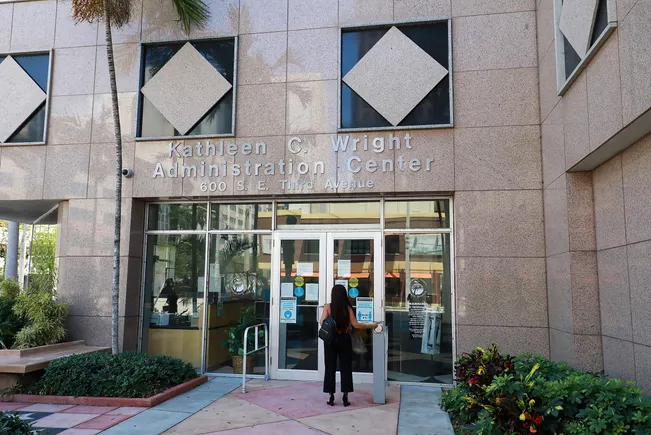
  • Broward County Public Schools faces enrollment drops, possible closures

    Broward County Public Schools faces enrollment drops, possible closures

    This audio is auto-generated. Please let us know if you have feedback.

    Dive Brief:

    • Broward County Public Schools announced plans to “address” 34 of its 239 schools for possible closures or consolidations during a Tuesday board meeting. 
    • The pending plans come at a time when the large Florida district is reporting an enrollment decrease of 10,360 students, a count taken 10 days into the 2025-26 school year compared to the year prior. The district’s total enrollment, excluding charter schools, was 188,002 on Aug. 22.
    • The district also reported in July that 58 of its schools were below 70% capacity, including 39 elementary schools, 16 middle schools and 3 high schools.

    Dive Insight:

    As the sixth largest school district in the U.S., BCPS is not immune to a national trend of districts facing enrollment drops amid declining birthrates and growing school choice options.

    In a May survey of current and former BCPS parents conducted by Hanover Research, the data found that about half of respondents — 53% — said they enrolled their children in a nontraditional schooling option because they wanted higher quality instruction. A third of families also cited smaller class sizes and another third indicated the availability of more programs. The district surveyed 8,983 parents who either had a child enrolled, formerly enrolled, or partially enrolled in a BCPS school.

    The top two reasons parents said they unenrolled their children from BCPS was because they were dissatisfied with the district’s education quality (26%) and they were concerned about school safety (24%).  

    Among those who previously had a child enrolled or partially enrolled at BCPS, 20% said improved teacher quality through professional development would have made them more likely to stay. Some 18% also separately said better support for students with disabilities, improvements on handling school bullying, or strengthened safety and security measures would have encouraged them to keep their child in the district.

    To retain families, the district is being advised based on the parent survey results to:

    • Track school climate and culture outcomes for improvements.
    • Offer more college and career readiness support.
    • Provide more support to teachers to improve the district’s education quality.
    • Tackle school safety issues and work to reduce bullying and harassment.

    An August analysis by Bellwether, an education nonprofit, warns that more school closures and consolidation could be on the horizon in the coming months and years due to declining enrollment — ultimately leading to strained school budgets. Bellwether estimated that the total loss in revenue from declining enrollment at the nation’s largest 100 districts could total up to $5.2 billion based on 2023-24 school enrollment. 

    Other large school districts recently weighing a number of school closures and consolidations as a result of declining enrollment include Atlanta Public Schools, Austin Independent School District in Texas and St. Louis Public Schools.

    Source link

  • At Hudson County Community College, Inclusion Drives Recruitment and Retention – CUPA-HR

    At Hudson County Community College, Inclusion Drives Recruitment and Retention – CUPA-HR

    by Julie Burrell | February 27, 2024

    The motto at Hudson County Community College is “Hudson is Home,” a saying created by their students that reflects HCCC’s commitment to community across their three New Jersey campuses. Located in one of the densest and most ethnically diverse counties in the country, HCCC uses inclusive strategies to boost employee recruitment and retention.

    HCCC’s focus on promoting a culture of care and belonging positions them well to contend with voluntary turnover, which remains on the rise nationally as higher ed employees report feeling overworked and undervalued. HCCC’s inclusion and belonging initiatives, including their new peer-to-peer recognition program, address the top three predictors that employees will seek work elsewhere: recognition for contributions, being valued at work, and having a sense of belonging.

    In their recent CUPA-HR webinar, HCCC’s Anna Krupitskiy, vice president for human resources, and Stephanie Sergeant, assistant director of human resources, explained how they use inclusive strategies to engage their approximately 1,000 employees, including:

    Prioritizing a Culture of Care

    Addressing the needs of parents is one way HCCC creates a culture of care through inclusion. In the past, parents who were employees or students were confronted with unclear and inconsistent guidelines. But the institution’s new parent-friendly children on campus policy makes it clear that children are welcome on HCCC’s three campuses. With the new policy, Krupitskiy says, “we wanted to make sure that there’s a strong message that we do allow children on campus.” HR has also collaborated with campus partners on their Take Your Child to Work Day program, where children of employees engage in a range of campus activities, like participating in science projects or watching a nursing demonstration, before ending the day with an ice cream social.

    Using Checkpoints During Recruitment to Ensure Inclusive Hiring

    HCCC has created checkpoints to ensure there are meaningful milestones to reflect on inclusion during the recruitment and selection process. The first checkpoint is the composition of the hiring committee itself. Krupitskiy and Sergeant stress that screening committees should be representative of HCCC, not just in terms of demographics, but also such characteristics as how long a person has been employed at HCCC, what role or level of position they hold, what union affiliation they have, etc. They’ve also invited students to participate in searches when appropriate.

    Job descriptions are another area they’ve scrutinized, asking if certain minimum qualifications inherently limit a pool of applicants. Might a minimum qualification, like years of experience, be listed as a preferred qualification instead?

    Implementing a Peer-to-Peer Recognition Program  

    Recognizing employee contributions is a critical retention tool. Only 59% of higher ed employees say they receive regular verbal recognition for doing good work, according to CUPA-HR data. To address recognition, HCCC holds a years-of-service event, with awards for five to 40-plus years of service for both part-time and full-time employees. Their new Hudson is Home employee recognition program allows colleagues to nominate each other for awards ranging from Collaboration and Team Achievement to a Part-Time Spotlight award. Employees receive an email notification when they’ve been nominated, which has driven up participation overall.

    To learn more about the programs and initiatives at HCCC — including working to close pay equity gaps and establishing professional development funds — view the recording of Retention Strategies for an Inclusive and Engaged Workforce. For data on higher ed retention challenges and recommendations, see The CUPA-HR 2023 Higher Education Employee Retention Survey.


    Source link