Tag: crime

  • GMercyU Unveils Crime Scene House for Student Investigations

    GMercyU Unveils Crime Scene House for Student Investigations

    Inside an unoccupied house, a student gingerly pushes open a creaky door and takes a wary step into a dark room—only to find the walls completely splattered with blood.

    It sounds like the cliché climax in a horror movie, but for students in the criminal justice program at Gwynedd Mercy University, it’s a regular class assignment.

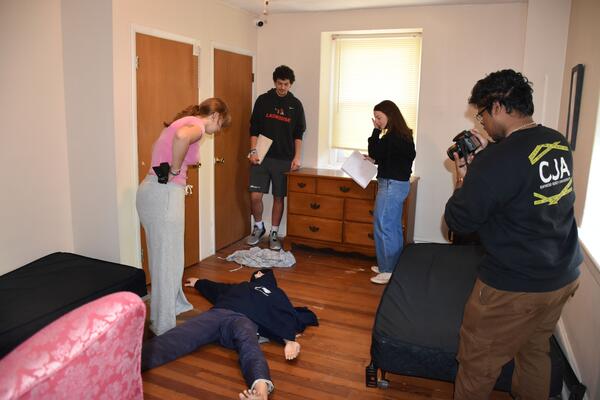
    This fall, Gwynedd Mercy unveiled a new Crime Scene House, a three-story home that features various staged rooms for experiential learning in forensic science. Students now have a space for simulated criminal investigations, with each room configured to resemble a different crime scene they might encounter, including the blood spatter room.

    Gwynedd Mercy is one of a dozen-plus colleges across the country that turn houses into mock crime scenes; West Virginia University claims the title for largest hands-on training complex in the U.S., boasting four crime scene houses, a vehicle processing garage, a ballistics test center and designated grounds for excavation.

    The not-so-haunted houses are designed to give students a safe, supervised space to immerse themselves in a crime scene. Plus, it’s a great enrollment draw for students who get a thrill out of murder mysteries.

    “We’re very excited about the opportunity to have students come into our program and learn the how-to, so then they walk out of here and they say, ‘This is what I want to do,’” said Patrick McGrain, associate professor of criminal justice and the program director at Gwynedd Mercy. “It really is for the benefit of creating a more professional law enforcement community.”

    From convent to crime scene: McGrain and university leaders aspired to open a crime scene house on campus for years. In July, the dream became a reality when the Catholic university’s administrators identified an older building that used to house the Sisters of Mercy. The building was in disarray, and when McGrain was offered the opportunity to revamp it for students, he jumped at the chance.

    The Crime Scene House holds a variety of staged rooms to practice different investigations including a kitchen, a bathroom, two bedrooms and an office. In addition, the house features spaces for other simulated experiences, including an interrogation room, an evidence area to analyze fingerprints and a model “flophouse,” or a low-rent motel room used for drugs. And of course, the blood spatter room.

    “We’re going to teach students how to analyze blood splatter, the analysis of the trajectory,” McGrain said.

    Every element of the house is available for students to manipulate and investigate, even the flooring.

    “We have carpet laid down that they cut out pieces, use luminol and then take it over to the lab, well, what is it that we have?” McGrain explained. “Is it feces, it is urine, is it semen, is it blood? What is it that we’re looking at and what do you think happened in this room?”

    Faculty can track students’ progress solving the investigations through cameras mounted in each of the rooms.

    While the home at times may resemble an escape room, with CCTV cameras and a mystery to solve, “the only person locked in is the one who’s been kidnapped, and that’s been planned, and it’s a dummy,” McGrain said.

    The university allocated a small budget for furniture, but a significant number of items came directly from campus community members, who donated household items or clothing.

    “I even had two students who found a couch on the side of the road, grabbed it, put it in their trunk and brought it in,” McGrain said. “It is now the couch that sits in the living room.”

    Because the house is designed to be ransacked and torn up by “criminals,” the university also keeps backup furniture and wall decor.

    “If we want to break something, if we need to tear something, we do,” McGrain said. “The hands-on learning knows no limits.”

    Experiential learning: Other academic programs, including nursing, psychology and social work, have simulation labs integrated into the curriculum to allow students to practice their skills. In the same way, the house gives criminal justice students a chance to gain career skills.

    Before the Crime Scene House was established, Gwynedd Mercy faculty would set up a classroom to resemble the crime scene.

    “It’s not nearly as detailed,” McGrain said. “You don’t have the furniture. You don’t have the fake drugs or guns.”

    The facility has also served as a resource for law enforcement to train new detectives on how to use tech tools, such as digital photography and indoor drones.

    Jerome Mathew, a junior criminal justice student, said having the Crime Scene House is a game-changer—especially for getting incoming students amped about studying criminal justice.

    “They were really thrilled about seeing all the different fake drugs, money, different rooms, the cameras and how monitored everything was,” Mathew said.

    Gwynedd Mercy has plans to grow the criminal science major and launch a forensic science minor. The Crime Scene House will be an integral piece of that, McGrain said. “We’re expecting to see a spike in applications and a spike in admissions.”

    Source link

  • Missouri President Wants Local Officials to Address Crime

    Missouri President Wants Local Officials to Address Crime

    University of Missouri president Mun Choi is pressing local officials about crime rates near the Columbia campus after a student from neighboring Stephens College died Sunday following a downtown shooting, KCUR and the Columbia Missourian reported. 

    The president’s demand to address the city’s “rampant crime rate” has gathered some support, but critics say that his characterization of the local climate is overexaggerated, pointing to data from the local police department.

    The shooting, which also resulted in serious injuries to two others, took place early Saturday morning on the college town’s main street. One individual, not from the city, got into a verbal dispute and then opened fire toward the people he was confronting. The three individuals he hit, however, were bystanders.    

    In a letter sent the same day as the shooting, Choi called on city and county leaders to bolster the police presence and prosecute crimes to the fullest extent of the law. He also urged them to take down encampments of unhoused individuals, pass a loitering notice and repeal policies that “attract criminals to the region.”  

    But when asked during a press conference Monday what policies and practices he believes “attract criminals,” the MU president said he had none to cite. Neither the shooter in the Saturday incident nor any of the victims have been identified as unhoused, according to local reporting.

    “That is why I am asking [local leaders] to evaluate the processes that we have and the practices,” he explained. “Are we giving the impression to potential criminals that this is a region that doesn’t take crime enforcement as well as the punishment that comes with it seriously?”

    Choi later added that students and local business owners have been raising safety concerns about the city’s unhoused population. According to university data, the number of arrests and trespassing violations issued to the unhoused has “gone up dramatically” since 2019, he said.

    That is different, however, from what some local police department data shows.

    In a Facebook post Monday, the city’s mayor, Barbara Buffaloe, said there have been 58 gunshot incidents since the beginning of the year. That’s down from 105 in the first nine months of 2024.

    Columbia Police Department chief Jill Schlude did note in a separate letter, however, that since 2019 more crimes have been concentrated downtown, occurring between midnight and 3 a.m. 

    “The connection between late-night social activity and violence is clear, and that is where we continue to focus our efforts,” Schlude said.

    Regardless of any disputes over the data, multiple government officials—including Gov. Mike Kehoe, several members of the Columbia City Council and Mayor Buffaloe—have voiced support for Choi’s general call to improve safety. Buffaloe has also committed to forming a task force on the matter, and the CPD has outlined plans to increase the police presence downtown. 

    “Statistics cannot be used solely as a reason for us to move away from what needs to be done in the city of Columbia,” Choi said.

    Source link

  • Speech is not a crime — even if it complicates ICE’s job

    Speech is not a crime — even if it complicates ICE’s job

    While I was driving down I-95 yesterday, a notification popped up on Google Maps: “Police ahead.” I eased my foot off the gas. Sure enough, a minute later I passed a cruiser parked in the median, radar aimed at oncoming traffic. I paid it forward by tapping “Still there” on Maps.

    Did I commit a crime? Did Google?

    No. Google simply provided a tool for sharing publicly observable information. I used it, just like millions of drivers do every day. That’s speech, and the First Amendment protects it. 

    None of that changes if you swap out highway patrol for Immigration and Customs Enforcement (ICE). But the Trump administration sees it differently.

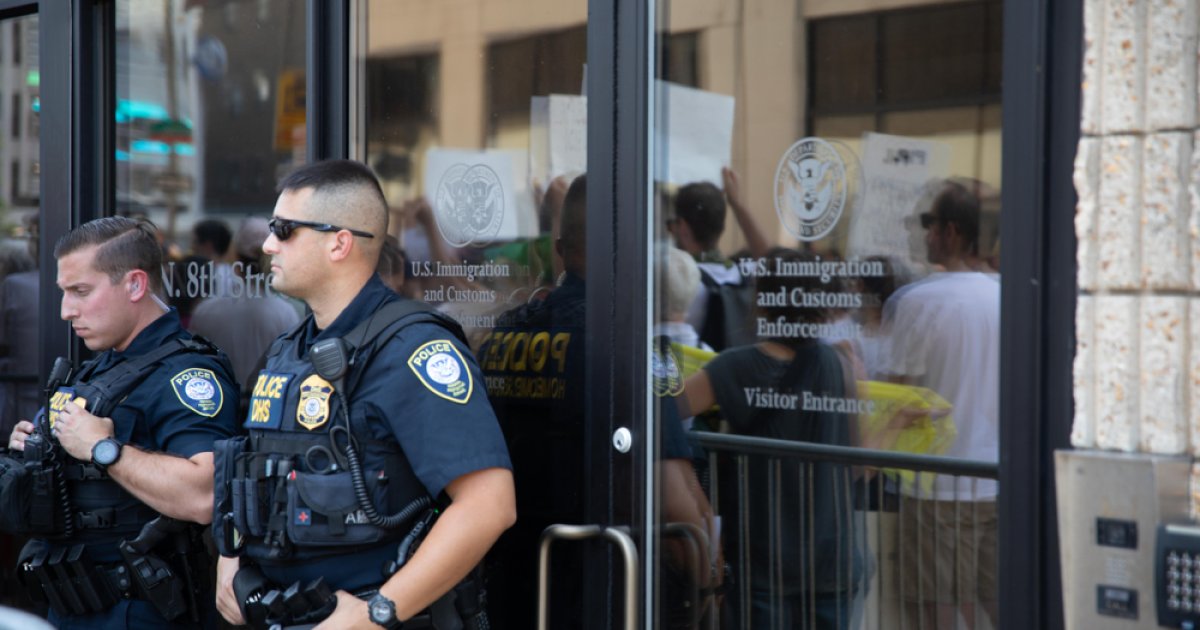
    A new iPhone app called ICEBlock lets users report sightings of ICE activity and receive alerts about the agency’s presence within a 5-mile radius. The app’s website says:

    ICE has faced criticism for alleged civil rights abuses and failures to adhere to constitutional principles and due process, making it crucial for communities to stay informed about its operations. 

    The app also warns users not to use it “for the purposes of inciting violence or interfering with law enforcement.”

    After CNN reported on ICEBlock Monday, Trump administration officials claimed the app put ICE agents in danger and threatened to prosecute not only the app’s developer, but also … CNN. Border czar Tom Homan called on the Department of Justice to investigate whether the network had “crossed that line of impeding federal law enforcement officers.” 

    The next day, Secretary of Homeland Security Kristi Noem said her agency was “working with the Department of Justice” to see if they could prosecute CNN for its coverage of the app. President Trump went further, adding CNN “may be prosecuted also for having given false reports on the attack in Iran.” He made similar threats to sue The New York Times over its coverage.

    At the risk of stating the obvious, CNN’s routine reporting on ICEBlock is constitutionally protected. Even if the app itself were illegal, which it’s not, the press still has a right to report on it as a matter of public interest.

    Consider the extensive reporting on the notorious “open-air drug market” in Philadelphia’s Kensington neighborhood. That journalism isn’t illegal just because it might tip off someone about where to get fentanyl.

    By the administration’s logic, not just CNN, but anyone who speaks publicly about ICEBlock has committed a crime. Right-leaning outlets have covered the app, too. Prosecuting them for raising public awareness of the app would be just as unconstitutional. Ironically, the administration’s censorial threats are almost certainly doing more to amplify the app than CNN’s initial report did. The president’s team should look up the Streisand effect.

    This episode is just the latest example of the administration trying to stretch the meaning of “obstruction” to cover nearly any speech that might complicate immigration enforcement. Back in February, Homan asked the Department of Justice to investigate Congresswoman Alexandria Ocasio-Cortez for “impeding our law enforcement efforts” by releasing a webinar and flyer that reminded people of their constitutional rights when interacting with ICE. 

    Informing the public that they don’t have to consent to warrantless searches might make ICE’s job more difficult, but that doesn’t strip the speech of constitutional protection. It’s as absurd as claiming a police officer interferes with the district attorney’s job by telling a suspect he has the right to remain silent. 

    As FIRE explained at the time, the First Amendment protects a significant amount of expression, including “providing information about the presence of law enforcement officers.”

    Of course, there are narrow and carefully defined exceptions to the First Amendment. True threats aren’t protected. Nor is incitement. But speech qualifies as incitement only if the speaker intends to provoke immediate unlawful action and their speech is likely to provoke it. That’s a very high bar. Simply noting the presence of law enforcement in a particular location or talking about an app that facilitates that speech doesn’t come close. 

    It’s possible to imagine scenarios where speech might cross that line. If a hostile crowd gathered near ICE agents and someone with a megaphone called on them to attack, that would likely qualify as incitement. But that’s not what we’re dealing with here. 

    There are also circumstances in which helping someone evade law enforcement is a crime. You can’t lawfully harbor a fugitive or physically interfere with officers performing their duties. And the Supreme Court has held the First Amendment does not protect speech “used as an integral part of conduct in violation of a valid criminal statute.” Consider a lookout who warns accomplices during a robbery that police are approaching. That person is intentionally working with specific individuals to carry out a specific unlawful act. The speech isn’t general or political. It’s instrumental to the commission of the crime and is not protected.

    What is protected under the First Amendment is sharing publicly observable information about what government agents are doing in public — or providing the means to do so with a tool like ICEBlock — especially when that speech is tied to political activism. A federal appeals court recently upheld that principle in a case involving a man standing on a sidewalk with a sign that read “Cops Ahead.” The court found his sign, an analog version of the police alerts on Google Maps and Waze, was protected by the First Amendment. 

    It’s absolutely critical to maintain precise, narrow standards that prevent the government from expanding its power to regulate speech and suppress dissent. When officials blur the line between obstructing justice and merely speaking about public law enforcement activity, they put core First Amendment freedoms at risk.

    But let’s step back and remember the administration is not only claiming ICEBlock is illegal, but also suggesting that reporting on it is a criminal offense. Just as baseless is the president’s threat to prosecute and/or sue CNN and The New York Times over their coverage of the bombing of Iran. After the U.S. military struck Iran’s nuclear sites, both outlets reported on a preliminary assessment from the Defense Intelligence Agency (DIA) that contradicted Trump’s claim that the sites were “completely and totally obliterated.” 

    Reporting the government’s own findings about a major military action is not a crime — it’s protected by the First Amendment as well as vital to an informed citizenry. Again, this isn’t a close call.

    In New York Times v. United States, the Supreme Court rejected the government’s attempt to block the press from publishing the Pentagon Papers — a classified history of U.S. involvement in Vietnam — despite the government’s claims that it would harm national security. 

    Trump’s issue with CNN and The New York Times isn’t even about national security. He’s upset that the DIA report undercut his narrative. But if he thinks the report is wrong, his problem is with his own intelligence agency, not the outlets who accurately reported on its assessment. (Notably, both CNN and The New York Times made clear the report was preliminary, the analysis ongoing, and that the administration disputed its conclusions.)

    FIRE has gotten flak over the past few months for focusing so much on President Trump. Believe me, we wish we didn’t have to. 

    But when the most powerful official in the country repeatedly shows contempt for the First Amendment, it’s our job as a free speech organization to call that out. Presidents wield enormous power to stifle dissent. Their rhetoric and actions influence how other government officials interpret the bounds of the First Amendment, and they shape public attitudes about the enduring value of free expression.  

    This isn’t about partisanship. We unequivocally opposed the Biden administration’s efforts to suppress speech and consistently push back against censorship from the left, too. And much of our work doesn’t relate to partisan flashpoints that dominate the news. Every day, we’re defending ordinary Americans facing censorship from state legislaturesuniversitiescity councilsschool boards, and other government actors.

    As FIRE’s Executive Vice President Nico Perrino said yesterday, “The biggest threat to free speech is political power,” and at this moment, the right side of the aisle controls both political branches of the federal government. 

    That balance will shift, as it always does. But FIRE’s mission of holding those in power to the First Amendment will not.

    Source link