Tag: Crisis

  • Leadership Matters During Crisis – EducationDynamics

    Leadership Matters During Crisis – EducationDynamics

    Over the past few weeks, we have heard from some accomplished communications and marketing professionals that these campus positions are being eliminated or entangled in budget battles. Those of us who have had the opportunity to work in this field for decades know that, especially during “challenging” times, this type of short-term thinking will have negative, long-term consequences. 

    Consider the state of affairs and public perception of higher education. If ever there was a time for colleges and universities to amplify and demonstrate an institution’s value, including reaching new audiences and those already in the fold, it is now. 

    For college and university presidents and chancellors, leadership includes watching the horizon and longer-term planning, even as the ground shifts more frequently today. There is no time to coast or risk needing to recover lost reputational ground. Yet that risk is absolute without a steady, if not bold, approach to the work of campus communications and marketing professionals focused on defining, elevating and protecting an institution’s reputation and thereby helping to drive revenue. Supporting student enrollment, engagement and retention is a given for these dedicated staff members. Add the internal communications (remember COVID messaging and how people’s lives were at stake?), issues management, crisis communications and fundraising-related needs to the new kid on the block for many: strengthening your institution’s advocacy-related communications. This work is all core to institutional competitiveness and resilience.

    Now that we have convinced you, here are suggestions for building on your team’s successes:

    • Keep your communications and marketing team resourced and motivated. Support professional development opportunities, such as conferences, webinars hosted by national higher education organizations, including the American Council on Education, inviting speakers to “Zoom in” or tapping existing on-campus expertise. This doesn’t need to be costly, and such investments pay off.
    • Agree to participate in local, regional and national visibility opportunities. Your words will matter, especially as president or chancellor, and can set a campus-wide tone. Coaching and editing counsel are readily available to you in advance of these opportunities.
    • Include campus communicators and marketers early and often in strategic decision-making. They see around corners and will be mindful of risk and reward. The best in this field will speak truth to power and steer effectively.
    • Encourage your team to connect with those whose communications and marketing efforts you’ve admired from afar. The higher ed communications and marketing professionals community, including groups such as PRSA’s Counselors to Higher Education and CASE, is generous and thoughtful, open to learning from each other’s successes and missteps.
    • Show up for your team. A few minutes of in-person appreciation go a long way for those not often recognized for the impact of their work.

    It boils down to this: How will anyone know just how impressive your students, faculty and staff are, the impact on your community and your institution’s groundbreaking research, if your institution does not have the structure and the best people to show and tell these stories in earned, owned and shared media channels? How do we expect to have the buy-in and build greater awareness and understanding of the value of higher education? Consider who you want to tell your institution’s stories and how, namely from an informed and experienced perspective, as you also consider the alternative during a tighter budget cycle. Finally, please know that we stand ready to partner with you and your team to help you make your mark.

    Source link

  • Solving our literacy crisis starts in the lecture hall

    Solving our literacy crisis starts in the lecture hall

    Key points:

    The recent NAEP scores have confirmed a sobering truth: Our schools remain in the grips of a literacy crisis. Across the country, too many children are struggling to read, and too many teachers are struggling to help them. But why? And how do we fix it?

    There are decades of research involving thousands of students and educators to support a structured literacy approach to teaching literacy. Teacher preparation programs and school districts across the nation have been slow to fully embrace this research base, known as the science of reading. Since 2017, consistent media attention focused on the literacy crisis has created a groundswell of support for learning about the science of reading. Despite this groundswell, too many educators are still entering classrooms without the skills and knowledge they need to teach reading.

    While there is steady progress in teacher preparation programs to move toward the science of reading-aligned practices, the National Council on Teacher Quality’s latest report on the status of teacher preparation programs for teaching reading (2023) still shows that only 28 percent of programs adequately address all five components of reading instruction. Furthermore, according to the report, up to 40 percent of programs still teach multiple practices that run counter to reading research and ultimately impede student learning, such as running records, guided reading, leveled texts, the three cueing systems, etc. This data shows that there is still much work to be done to support the education of the teacher educators responsible for training pre-service teachers.

    The disconnect between theory and practice

    When it comes to literacy instruction, this problem is especially glaring. Teachers spend years learning about teaching methods, reading theories, and child development. They’re often trained in methods that emphasize comprehension and context-based guessing. However, these methods aren’t enough to help students develop the core skills they need to become proficient readers. Phonics–teaching students how to decode words–is a critical part of reading instruction, but it’s often left out of traditional teacher prep programs.

    One primary reason this disconnect happens is that many teacher prep programs still rely on outdated methods. These approaches prioritize reading comprehension strategies that focus on meaning and context, but they don’t teach the foundational skills, like phonics, essential for developing fluent readers.

    Another reason is that teacher prep programs often lag when it comes to incorporating new research on reading. While the science of reading–a body of evidence built from decades of research and studies involving thousands of students and educators about how humans learn to read and the instructional practices that support learning to read–has been gaining deserved traction, it’s not always reflected in the teacher preparation programs many educators go through. As a result, teachers enter classrooms without the knowledge, skills, and up-to-date methods they need to teach reading effectively.

    A way forward: Structured literacy and continuous professional development

    For real progress, education systems must prioritize structured literacy, a research-backed approach to teaching reading that includes explicit, systematic instruction in phonics, decoding, fluency, and comprehension. This method is effective because it provides a clear, step-by-step process that teachers can follow consistently, ensuring that every single student gets the support they need to succeed.

    But simply teaching teachers about structured literacy is not enough. They also need the tools to implement these methods in their classrooms. The goal should be to create training programs that offer both the theoretical knowledge and the hands-on experience teachers need to make a lasting difference. Teachers should graduate from their prep programs not just with a degree but with a practical, actionable plan for teaching reading.

    And just as important, we can’t forget that teacher development doesn’t end once a teacher leaves their prep program. Just like doctors, teachers need to continue learning and growing throughout their careers. Ongoing professional development is critical to helping teachers stay current with the latest research and best practices in literacy instruction. Whether through in-person workshops, online courses, or coaching, teachers should have consistent, high-quality opportunities to grow and sharpen their skills.

    What do teacher educators need?

    In 2020, the American Federation of Teachers published an update to its seminal publication, Teaching Reading is Rocket Science. First published in 2000, this updated edition is a collaboration between the AFT and the Center on Development and Learning. Although some progress has been made over the past 20 years in teaching reading effectively, there are still too many students who have not become proficient readers.

    This report outlines in very specific ways what pre-service and in-service teachers need to know to teach reading effectively across four broad categories:

    1. Knowing the basics of reading psychology and development
    2. Understanding language structure for word recognition and language comprehension
    3. Applying best practices (based on validated research) in all components of reading
    4. Using validated, reliable, efficient assessments to inform classroom teaching

    There should be a fifth category that is directly related to each of the four areas listed above: the knowledge of how to address the specific oral language needs of multilingual learners and speakers of language varieties. Structured, spoken language practice is at the heart of addressing these needs.

    Moving forward: Reimagining teacher training

    Ultimately, fixing the literacy crisis means changing the way we think about teacher preparation and ongoing professional development. We need to create programs that not only teach the theory of reading instruction but also provide teachers with the practical skills they need to apply that knowledge effectively in the classroom. It’s not enough to just teach teachers about phonics and reading theory; they need to know how to teach it, too.

    Literacy instruction must be at the heart of every teacher’s training–whether they teach kindergarten or high school–and ongoing professional development should ensure that teachers have the support they need to continuously improve.

    It’s a big task, but with the right tools, knowledge, and support, we can bridge the gap between theory and practice and finally begin to solve a literacy crisis that has stubbornly endured for far too long.

    Latest posts by eSchool Media Contributors (see all)

    Source link

  • Colorado reversal on misgendering ban is a crisis averted but a danger revealed

    Colorado reversal on misgendering ban is a crisis averted but a danger revealed

    Colorado just dodged a constitutional bullet. Not a legislative win so much as a near-miss.

    The Kelly Loving Act, named after a trans person killed in the Club Q mass shooting in Colorado Springs in 2022, started out as a sweeping and constitutionally suspect bill aimed at protecting transgender individuals from discrimination, but trampling the First Amendment in the process.

    The bill would have classified misgendering and deadnaming in certain contexts as unlawful under the Colorado Anti-Discrimination Act. Its most controversial provision said that if a parent doesn’t use their child’s preferred pronouns, that must be considered “coercive control” in any custody dispute. This would have negatively impacted a parent’s case for custody of their child, regardless of any other context.

    The original bill would have also required parents, journalists, business owners, and educators to use people’s chosen names and pronouns in every piece of public-facing content, from news articles to school newsletters.

    But the Constitution protects the right to call others by any name or pronoun under the sun, even if it causes hurt or offense. Forcing people to use particular language, even with the intention of inclusivity, is compelled speech, and the First Amendment generally forbids it.

    The test of a free society is not how well it protects popular speech, but how well it protects speech that others find uncomfortable or even offensive.

    This important principle also protects the rights of people in states whose government officials would seek to require that people be deadnamed and misgendered, or prohibit other expression in support of trans or queer causes. The First Amendment blocks that kind of speech restriction as well.

    Of course, any speech, including declining to use a child’s preferred pronouns, can be part of a broader pattern of abuse that would be appropriate to consider in decisions about the custody of children. The problem was that the bill automatically counted this speech as a legal mark against parents, regardless of any further context. This served to effectively force all parents to adopt the state’s preferred speech, lest they one day face a custody battle and risk losing their children because of it.

    Another concern was that the Kelly Loving Act included “pre-publication requests” for publishers to use preferred names and pronouns, signaling that the law may be used against journalists simply for quoting a legal name in a criminal proceeding or publishing information already in the public domain that contradicts someone’s preferences or identity. This raised serious concerns that the law could chill legitimate journalistic expression and infringe on press freedoms protected by the First Amendment.

    Thankfully, its sponsors stripped all three provisions — misgendering, deadnaming, custody — out before the state senate approved the bill this week.

    Colorado’s lawmakers did the right thing by cutting these provisions. But we should still reflect on what happened because while the final bill is harmless, the impulse behind it is not.

    There are those in America who believe the state should address speech they oppose by compelling citizens to use approved words, or forbidding them from using disapproved words. This goes beyond political correctness to coercive control, to use a familiar term.

    The right is no stranger to this kind of behavior either. Florida’s Stop WOKE Act, which aims to control what can or cannot be said about race and gender in classrooms and workplaces under the guise of anti-discrimination law, is no better. After FIRE filed a lawsuit challenging the law, a federal court halted enforcement of key parts of it.

    If you think it’s dangerous for Florida’s legislators to have the power to police speech in public school classrooms, then you should find it equally outrageous for Colorado legislators to try to mandate what pronouns parents can use with their own children in their own homes or journalists can use when reporting stories.

    When a state starts dictating which words are acceptable in public discourse and private discussion, it jumps headlong into the culture wars, telling everyone to fall in line or face the consequences.

    Sadly, this is nothing new. Milton, Locke, and Voltaire all warned against the dangers of governments trying to manage thought. In Areopagitica, Milton argued for the liberty to know and argue freely “above all liberties.” In our wisdom, we Americans took note and enshrined this liberty in our First Amendment, understanding it is the one that protects the rest.

    In A Letter Concerning Toleration, Locke eloquently wrote “the care of souls is not committed to the civil magistrate, any more than to other men.” In other words, the state has no business telling you what to think or say any more than your fellow citizens.

    That is not how a free society operates, and that is why in West Virginia v. Barnette, the Supreme Court famously struck down a rule requiring students to salute the flag. In the words of Justice Robert H. Jackson, “If there is any fixed star in our constitutional constellation, it is that no official, high or petty, can prescribe what shall be orthodox in politics, nationalism, religion, or other matters of opinion.”

    Thankfully, we live in a country where the government doesn’t get to tell you what you have to say or what you must believe. The test of a free society is not how well it protects popular speech, but how well it protects speech that others find uncomfortable or even offensive.

    The revisions to this bill should be counted as a victory for the good people of Colorado. But we should also be concerned this was such a close shave in the first place because it indicates a dangerous impulse lurking in our culture. If people want to lead on inclusion, they must do so by persuasion, not coercion.

    Source link

  • The Silent Crisis: Bullying Among Nurse Educators in Higher Education – Faculty Focus

    The Silent Crisis: Bullying Among Nurse Educators in Higher Education – Faculty Focus

    Source link

  • Another year, another teacher supply crisis…

    Another year, another teacher supply crisis…

    Today on the HEPI blog, John Cater revisits a quarter-century of teacher education policy to consider how we can solve the teacher supply crisis – read on below.

    And Amira Asantewa and Reuel Blair explore how growing social capital – not just academic engagement – is key to tackling the widening Black-white degree awarding gap in UK universities in a powerful reflection on identity, belonging and community. Read that piece here.

    • Dr. John Cater was Vice-Chancellor of Edge Hill University from 1993-2025 and member of the Board of the Teacher Training Agency and its successor body from 1999-2006.  He also chaired the Joint UUK/GuildHE Teacher Education Advisory Group (2013-2019) and is the author of HEPI Policy Paper 95, Whither Teacher Education and Training (2017).

    Twenty-five years ago, the attraction of teaching was on the wane, and universities’ enthusiasm for training teachers was sinking fast. The Evening Standard’s billboards screamed, ‘Schools in Crisis’ as the capital’s schools closed on Fridays or brought pupils in for just half-days because of a shortage of teachers.  

    Fast forward to 2025, and the recent National Foundation for Educational Research (NFER) publication, Teacher Labour Market in England 2025, has reached the newsstands, prompting the same headlines: ‘Schools in Crisis’.

    But two and a half decades ago, it was turned around.  A serious attempt to tackle teacher workloads (WAMG, the Workload Allocation Model Group) was put in place, with ‘guaranteed’ non-contact preparation time and a rapid increase in the number and responsibilities of teacher support workers ((Higher Level) Teaching Assistants).  And one of the most effective marketing campaigns, No-One Forgets a Good Teacher, was launched.

    These are more sceptical, more cynical times, and the challenges of teaching are well understood, but there are strategies which could ameliorate the current crisis.

    1. A Better Product. Teaching is a ‘present in person’ profession.  No class of thirty adolescents is going to be controlled, still less educated, by an unattended whiteboard.  But, particularly in secondary education, rolling up a teacher’s preparation time into a single day, even fortnightly, which could be worked from home, would make the profession more attractive to many.  And most school staffrooms need to move into the twenty-first century if they are to match working conditions in the wider world.
    2. Better Marketing.  Teaching is a vocation, and the opportunity to change lives and create life chances still resonates with many.  A focus on case studies (Tony Blair and Eric Anderson being amongst the best-remembered from the above campaign), moving from the abstract to the relatable, have proved effective in the past. 
    3. A Partnership Approach.  Too often, the relationship between the state and its agents and training providers has been driven by a contractual ‘purchaser/ provider’ model, characterised by mutual distrust.  Similarly, school and college participation in the renewal of the profession, for example, by offering placements and link tutors, has been discretionary and often wrapped in a cash nexus.  Some universities are also unnerved by the risk to brand and reputation inherent in the inspectorial process, particularly when teacher training consists of a very small proportion of their portfolio (a concern which can also relate to apprenticeship provision).  If scrutiny is accepted by all to be risk-based and proportionate, resource is released to focus on both areas of concern and the sharing of best practice.
    4. Supporting Teaching as well as Training.  Incentivising training has its merits, and the NFER Report does indicate a weak correlation between bursaries and the take-up of training places, but training is not teaching.  If you have to offer £27,000 to persuade someone to train, are you sending an implicit message about the desirability of the profession you may enter?  And, whilst starting salaries (now at least £30,000 per annum outside London) have improved, the financial incentives for taking increased responsibility are widely regarded as insufficiently attractive to keep teachers in the profession.
    5. Re-visit Repayments.  The lowering of the student loan repayment threshold to £25,000 in 2023 and the extension of the loan term penalises those in the lower-middle salary range – teachers, nurses, social workers – whilst those on higher salaries benefit from lower interest payments.  Simply in the interest of fairness, it needs re-visiting.
    6. Fee forgiveness. Teacher retention is an even bigger issue than teacher recruitment, with over a third of all entrants leaving the profession within five years.  London Economics and the Nuffield Foundation, amongst others, have repeatedly highlighted the limited cost of writing off outstanding student loans for those who provide a decade or more of service, a cost which would be eliminated fully when reduced recruitment and training costs and anticipated improvements in service quality are taken into account.  
    7. Key worker accommodation.  The demise of public sector housing and the lack of available and affordable rental accommodation has severely restricted teacher mobility and teacher supply, with particular challenges in high-cost locations (such as the Home Counties).  Part of the current Government’s drive to construct 1.5m new homes should place key worker housing close to the top of the priority list.

    In the aftermath of the Chancellor’s Spring Statement, the issue of productivity looms large.  A highly educated and committed workforce is integral to the future of the UK economy, and a ready supply of well-qualified, passionate teaching professionals is the building block on which that economy can thrive.

    Source link

  • Why Not Flexible Transfer for All, Not Just in Crisis?

    Why Not Flexible Transfer for All, Not Just in Crisis?

    Meet Estevan, featured by Texas A&M University–Corpus Christi as a Transfer Student Success Story. Estevan benefited from a high degree of personalized support—including advising on course selection and financial aid planning—that helped him identify a clear path to transfer in his major of choice. Such personalized support helped Estevan thrive and make the dean’s list after transferring.

    Estevan’s story is one of the many inspiring success stories about transfer students we hear every day, even when the odds seem stacked against them. For example, we know that 80 percent of community college students nationwide intend to complete a bachelor’s degree, yet only 31 percent transfer to a four-year institution within six years of entry. When they succeed in transferring, transfer students often outperform their peers who start and stay at the same institution. And yet, we do not make transfer easy. For one, learners face a confusing set of ever-changing rules that varies across institutions, making it difficult to know which courses are transferable and applicable to their intended program of study.

    Added to that, we know life is unpredictable and even a learner’s best-laid plans can be derailed by one lost job, one sick family member or one unexpected change in financial aid. When the unpredictable happens, can institutions better flex to meet learners where they are?

    The signs point to yes—if you look at the examples of incredible institutional flexibility in response to the recent rise in institutional closures and mergers. As reported by Inside Higher Ed, nearly 100 institutions closed in the last academic year alone due to declining enrollments and financial pressures. When institutions close, accreditors and their member institutions step up to support students through a process called teach-out. Teach-out policies, while they differ by accreditor, are generally designed to help other institutions flexibly accept and apply students’ coursework to a degree or credential in order to help affected students complete their studies in a timely fashion. In such arrangements, the expressed goal is to apply the rules in ways that help bring students in and flex those rules that would effectively leave students out.

    Teach-out policies are exactly the type of thoughtful guidance that should be in place to support students. But as we’ve described, institutional closure is not the only reason students transfer, and it is not the only crisis students face. So this leads us to ask, if institutions can be flexible when faced with one type of student transfer, can they be similarly flexible in other transfer scenarios as well?

    We are excited to share that we had the opportunity to ask that question of the members of the Middle States Commission on Higher Education (for which one of the authors, Heather Perfetti, serves as president). In fall of 2024, MSCHE, WASC Senior College and University Commission, and the Southern Association of Colleges and Schools Commission on Colleges partnered with the Beyond Transfer Policy Advisory Board and Sova to design and field the Survey on Transfer and Learning Mobility to their institutional members. The survey sought to determine members’ perspectives on student transfer and learning mobility and to discern the role of accreditors in these processes through the institutional lens.

    In one of the most striking survey results, half of MSCHE’s responding institutions said they believe that institutions should apply similar flexibility for students who transfer and/or have previous learning as they do for students in teach-out situations (138 institutions responded to the survey, with a 30 percent response rate). Members of the PAB shared this finding at MSCHE’s Annual Meeting in December 2024, and a MSCHE member voiced the following powerful reflection: “We flex that way all the time for our own self-interest when we want to close one of our own programs.”

    We share these findings not to throw open the doors on academic rigor and quality, but rather to ask the field to pause and reflect on why credit transfer policies are stringent, knowing the barriers they may pose for students. We recognize the claims that strict credit transfer policies protect student preparation and program cohesion. If that’s true, what data are used to prove that students are not well prepared if they don’t take courses in a linear sequence? What evidence is used to understand and control for program cohesion? And if it’s not true, what are the real reasons, and can we discuss them openly so that we can better serve students? We can’t identify real solutions if we’re not honest about the actual problems.

    From MSCHE’s perspective, this survey finding feels like a call to pause, reflect and inspire us into action. MSCHE is proud of its existing transfer policies, which are crafted to support students and the mobility of their learning. But MSCHE is also willing to revisit its policies and accreditation activities through the lens of how principles related to teach-out during crises, like closures, can inform transfer more generally.

    Through the Council of Regional Accrediting Commissions, in collaboration with WSCUC and SACSCOC, we’ll talk to our peer accreditation agencies as well about key questions for accreditors and how accreditors can and should:

    • Engage governing boards and member institutions about the importance of transfer and learning mobility;
    • Leverage self-study as a moment for institutions to review and revise policies that are barriers to transfer;
    • Celebrate with institutions the ways they are supporting stronger transfer policies and the awarding of credit;
    • Remind constituents that accreditors want to see and support institutional innovation to better serve students;
    • Promote what accreditation policies actually require, and bust myths around statements such as “the accreditor won’t let me do that” (because, quite frankly, those statements are rarely true);
    • Elevate how the accreditor complaint and third-party comment process can be used by students to bring institutional transfer policies, procedures and decisions to accreditor attention; and
    • Quite simply: Be student centered, all the time.

    We hope this post gives you food for thought. Through our partnership and aligned efforts such as the Learning Evaluation and Recognition for the Next Generation Commission (led by Sova and the American Association of Collegiate Registrars and Admissions Officers and on which MSCHE, WSCUC and SACSCOC all sit), we will be looking to support the field with additional thinking about strong principles for student-centered credit evaluation and transfer. In the meantime, we’ll leave you with this question: How do you flex for students?

    Source link

  • Does Texas Have a Teacher Retention Crisis? – The 74

    Does Texas Have a Teacher Retention Crisis? – The 74


    Get stories like this delivered straight to your inbox. Sign up for The 74 Newsletter

    Texas teachers may be increasingly fed up with their job, but they’re still staying in school.

    State data shows Texas public school educators continue to return to the classroom at somewhat similar rates as years past, despite multiple surveys showing the large majority of them have contemplated quitting the profession.

    While teacher turnover has slightly increased over the past decade, state data show there hasn’t been a large exodus of experienced teachers. In fact, the average years of experience for Texas public school teachers hasn’t notably changed since 2014-15, nor has the share of first-year teachers hired by districts.

    The numbers run counter to years of warnings that Texas teachers are primed to bolt en masse out of frustration with the job. At the same time, Texas does still face widespread issues with morale, as well as big challenges in finding certified teachers and filling several types of positions, including special education educators and bilingual teachers.

    Steady hands in schools

    While much has changed in Texas classrooms over the decade, students continue to be educated by mostly veteran teachers. The average tenure for Texas teachers has held steady during that stretch, ranging from 10.9 to 11.2 years of experience.

    The state did see a slight dip in the share of first-year teachers — who, on average, have less positive impact on student achievement than other educators — during the late 2010s, then a slight uptick over the past few years. Still, novice teachers account for fewer than 1-in-10 Texas educators.

    A small rise in turnover

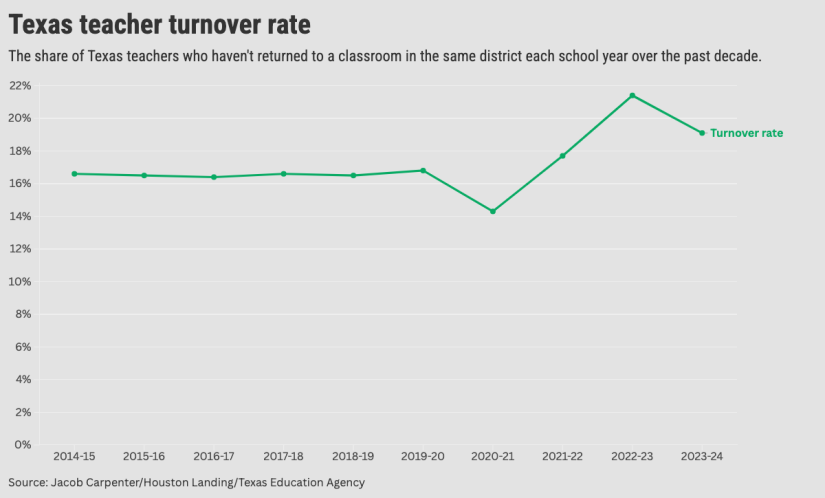
    Teacher turnover, a measure of how many educators don’t return to teach in the same district each year, has ticked higher since the pandemic. While it once hovered near 16 percent, it’s reached roughly 20 percent over the past two years.

    Ultimately, a 4 percentage point difference equates to about 15,000 more teachers who aren’t returning to a classroom in their district. However, state data shows teachers of all experience levels are leaving at similar rates.

    Still stressed

    Teachers might be sticking with their jobs, but that doesn’t mean they’re happy about it.

    A 2024 poll of 1,100 Texas teachers by the Charles Butt Foundation, an Austin-based education advocacy nonprofit, found nearly four-fifths of educators surveyed had seriously considered quitting the profession in the past year. Pay, quality of campus leadership and a sense of feeling valued ranked among the biggest factors in whether teachers had considered quitting.

    Separate polls by two of the largest Texas educator unions — the Texas American Federation of Teachers and Texas State Teachers Association — also showed about two-thirds of teachers had considered leaving the profession.

    Texas education leaders also are worried about the state’s ability to retain teachers and hire tough-to-fill positions. A state panel convened by the Texas Education Agency examined the issues and made numerous recommendations in 2023, though few of its proposals have been put into action.

    As teachers leave Texas schools, district leaders are increasingly filling those positions with uncertified teachers, who generally leave the profession sooner than certified teachers.

    This article first appeared on Houston Landing and is republished here under a Creative Commons Attribution-NoDerivatives 4.0 International License.


    Get stories like these delivered straight to your inbox. Sign up for The 74 Newsletter

    Source link

  • What next for int’l education after South Korea’s political crisis?

    What next for int’l education after South Korea’s political crisis?

    On April 4, 2025, South Korea’s Constitutional Court upheld the impeachment of President Yoon Suk Yeol, marking a historic conclusion to 122 days of political turmoil triggered by his failed declaration of martial law on December 3, 2024.

    However, the damage sustained during the transitionary period proved irreversible. Massive public protests, legal battles, sharply divided public opinion, and a temporary presidential suspension culminated in Yoon’s permanent removal from office.

    This article examines how the political crisis has disrupted international higher education in South Korea, focusing on five key areas: reputational damage, impact on students from Asia and the Global South, rising xenophobia, heightened student anxiety, and the sidelining of education policy.

    A blow to Korea’s brand

    Before the political crisis of late 2024, Korea had successfully positioned itself as one of Asia’s most attractive destinations for international students, combining strong government support, cultural appeal through the Korea’s soft power, and a reputation for safety and modernity.

    The country’s international student population had surged to over 200,000 by mid-2024, driven by initiatives like the Study Korea 300K strategy and bolstered by perceptions of national stability.

    However, Yoon’s abrupt declaration of martial law and the ensuing constitutional crisis shattered this image. International media coverage of soldiers surrounding parliament and global expressions of concern drew unsettling comparisons to authoritarian eras, eroding the confidence that had fuelled South Korea’s internationalisation drive. While little direct harm came to students, the perception of fragility alone risks deterring future enrolments.

    Disruptions for the global south

    The political crisis affected international students from Asia and the Global South, who make up the vast majority of the country’s foreign enrolment.

    With countries like China, Vietnam, Mongolia, and Uzbekistan sending thousands annually, students were drawn by proximity, affordability, and opportunity – but instead found themselves facing uncertainty, confusion, and fear.

    The brief but shocking declaration of martial law raised urgent concerns about campus safety, academic continuity, and visa stability, prompting embassies and international offices to issue advisories and support measures.

    Although campuses largely remained operational, the prolonged instability created bureaucratic delays, disrupted programs, and heightened anxiety, especially for students from politically sensitive backgrounds. The overall experience tested students’ faith in Korea as a stable destination.

    Polarisation and the rise of xenophobia

    The political crisis intensified domestic polarisation and spilled over into rising xenophobia, particularly targeting Chinese nationals. Fueled by conspiracy theories and nationalist rhetoric, Yoon’s supporters alleged foreign interference in South Korean politics, echoing fringe narratives prevalent among far-right media.

    These claims, amplified by partisan outlets and street rallies, created an atmosphere of suspicion and scapegoating against a narrowly profiled demographic. While many South Koreans rejected these xenophobic narratives, the episode revealed how quickly foreign students can become collateral damage in domestic political conflicts.

    Heightened anxiety and mental health concerns

    Over the past four months, international students in South Korea have faced heightened anxiety as political turmoil compounded the usual challenges of studying abroad. The situation introduced fears ranging from immediate safety during protests to long-term worries about academic continuity, visa stability, and career prospects.

    International students in South Korea have faced heightened anxiety as political turmoil compounded the usual challenges of studying abroad

    Many students, especially those unfamiliar with Korea’s political system or fluent only in limited Korean language, struggled to interpret rapidly unfolding events, and some even began contingency planning in case of campus closures or evacuation.

    Mental health stressors were exacerbated by long-distance concerns from worried families, unfamiliar political polarisation, and rising xenophobia.

    Higher education policy and discourse sidelined

    Most importantly, national discourse on higher education was effectively sidelined as government attention and public debate fixated on the impeachment process.

    While some initiatives, like the IEQAS certification and the Glocal Project, quietly moved forward, they received minimal coverage or engagement. The leadership vacuum and political paralysis delayed or derailed potential reforms, only resulting in many schools’ collective move to raise tuition fees after a 16-year freeze.

    Within universities, students and faculty who might normally advocate for education policy were drawn into the political fray, and civil discourse on educational development disappeared from the national agenda.

    International education standpoint

    From an international education perspective, the crisis tarnishes South Korea’s branding as a rising study destination.

    The martial law incident and subsequent impeachment chaos created precisely the kind of uncertainty that can give students and parents pause. For example, Hong Kong experienced a notable challenge in international student interest after the protest upheavals of 2019/20, as safety and political issues became a concern.

    No expert in this field would overlook the fact that one of the most powerful drivers of human migration is the political and social compatibility between home and host countries. This helps explain why Korea and Japan have become two of the most attractive destinations for international students in Asia.

    Looking ahead: time for rebuilding

    With the Constitutional Court having issued its ruling, the path to restoring its global reputation hinges on reaffirming its commitment to inclusion, transparency, and predictability. The crisis has illuminated how deeply political instability can affect international education and serves as a cautionary example for emerging study destinations: preserving democratic norms and open societies is essential to sustaining trust and long-term progress in the global arena.

    Rebuilding Korea’s global education brand will require more than a return to stability; it will necessitate deliberate reassurances of democratic resilience, institutional integrity, and a sustained commitment to providing a safe, welcoming environment for international students.

    On the bright side, the decision, grounded in constitutional procedure, stands as a testament to the resilience and maturity of Korea’s democratic institutions

    On the bright side, the decision, grounded in constitutional procedure, stands as a testament to the resilience and maturity of Korea’s democratic institutions. Despite the turbulence, the peaceful and lawful resolution of the crisis reaffirms the country’s enduring commitment to the rule of law, institutional checks and balances, and civic accountability.

    For international observers and students alike, this outcome offers a renewed sense of confidence that Korea’s democratic foundations remain robust. As such, it opens the door for a more transparent and inclusive national recovery, one where education, international engagement, and democratic integrity can move forward together.

    All in all, on the heels of the impeachment, restoring confidence in the national system and reviving the momentum of internationalisation and higher education reform must become a central national priority.

    Source link

  • How Being a Mother and Academic Helped Me Fix Higher Education’s Transfer Crisis

    How Being a Mother and Academic Helped Me Fix Higher Education’s Transfer Crisis

    Dr. Alicia M. AlveroWhen my daughter transferred to Queens College in Spring 2019, I could not have been more excited. As associate provost at the college, I’ll admit I was biased but even two decades of experience in higher education couldn’t fully prepare me for her struggle to transfer credits. 

    Queens College is one of The City University of New York’s 25 colleges. My daughter transferred from another school within the system yet despite mastering course material, she was told to take what was basically the same course all over again. 

    Fortunately, I understood the appeals process and was able to point her in the right direction. As a result, she obtained credit for the course, which counted toward her major. At the same time, reality struck: A student should not need to have an associate provost as a parent to transfer college credits. Frankly, they shouldn’t even need to appeal credits within the same system. 

    Nationally, the transfer system has been set up to let students fail for decades. On average, students lose a fifth of their credits when transferring to a four-year college, according to the U.S. Government Accountability Office. This leads to wasted tuition dollars and makes it more challenging to earn a bachelor’s degree. A 2023 report by the Community College Research Center found that only 16% of community college students earned a bachelor’s program within six years and just 10% of low-income students did

    As the largest public urban university system in the nation, CUNY had a real opportunity to make a change. In 2023, CUNY’s Board of Trustees charged the University’s leadership – including myself – to fix the transfer system. 

    CUNY has long been dedicated to eliminating the obstacles that result when a student transfers. In fact, the expectation that CUNY should provide a seamless ability to transfer between its constituent colleges dates to its formation as a centralized system in the 1960s. 

    Enshrined in New York state education law is the mandate for CUNY to “maintain its close articulation between senior and community college units.” Each year, up to 15,000 CUNY students – like my daughter – transfer between campuses, most commonly from a community college to a four-year college. 

    The purpose of an integrated university system is to offer an array of options for students which transfer seamlessly across all colleges. And over the years there have been efforts to achieve that at CUNY.  

    In 2013, the University implemented the Pathways initiative which established the seamless transfer of general education courses across its undergraduate colleges.  There are also many individual articulation agreements between colleges. But such agreements, between a singular CUNY community college’s program and a corresponding bachelor’s level program at another college, could only go so far in addressing a systemic problem and sometimes result in credits transferring as blanket elective, which does not help a student make progress in their major. Truly universal transferability would require faculty buy-in and better digital tools. 

    And so, one of the first things I knew I needed to do was engage our University Faculty Senate, both out of respect for their role in our decision-making process as part of shared governance and to leverage their expertise. This would come to be one of the most important steps in making this effort successful. 

    As we engaged faculty in discussions about transfer, we shifted the focus from simply identifying equivalent courses to defining the essential competencies students must master in the first half of their major. Faculty across institutions readily reached consensus on the core knowledge and skills students needed to succeed in the second half of their program.

    This competency-based approach then led to productive conversations about how specific courses developed these critical skills. Initially, the goal was to group courses into equivalent “blocks,” ensuring students could transfer seamlessly. In some cases, this process led faculty to align their individual courses more closely; others maintained course groupings but ensured consistency across institutions. Both approaches resulted in universal transfer pathways, guaranteeing students full credit toward their major at any receiving college. 

    At the same time, faculty helped us navigate practical roadblocks. For instance, we recognized that a universal approach could not always apply to programs leading to licensing exams— such as the CPA exam— where external accrediting bodies impose strict curricular requirements. While this nuance was clear to accounting faculty, it underscored for others the importance of discipline-specific constraints in shaping transfer policy. 

    Ultimately, this collaborative process ensured that transfer credit advances students’ progress toward degree completion rather than being lost as elective credit. Through collaboration, more than 300 courses, or blocks of courses, are now universally equivalent to each other across all colleges. 

    Starting in fall 2025, for over 75% of students transferring anywhere within the system, they will carry over most credits in their major. The University tackled the six most common transfer majors first – accounting, computer science, biology, math, psychology and sociology – ensuring credits transfer retroactively. We will work to align 100% of majors next. 

    The new system creates consistency on what students across CUNY campuses need to learn in the first half of their major and is expected to save students an average of $1,220 in wasted credits. 

    The CUNY Transfer Initiative extends beyond curricular alignment; it also involves evaluating the tools, policies, and practices that affect transfer student success. By reviewing policies, we identified gaps where new policies were needed and determined where existing policies required adjustments to better achieve their intended outcomes. We enhanced the CUNY Transfer Explorer (T-Rex), a tool that shows students how their credits transfer across the system, by adding leaderboards with key transfer metrics for each college and a feature that estimates how much of a degree would be completed at any CUNY school. 

    On January 21, the University automated a critical process in its student information system, known as CUNYfirst, ensuring admitted transfer students can immediately see how their credits apply at their new college. Previously, this was a manual, campus-specific process that required student advocacy and often caused delays. On its first day, the automation benefited 18,850 students, reducing stress and supporting informed academic decisions. 

    Fixing the transfer crisis will take continued effort. 

    To make sure that this system does not break again, we will be working with faculty to  adjust how we develop the curriculum for new courses. This means we will now proactively consider how a potential new course will transfer across the CUNY system before it even exists. As the initiative grows, we will have 100% of credits in the first half of a major count towards a degree when students transfer from one of CUNY’s associate programs to the same major in a CUNY bachelor’s degree program.

    The conversation is also continuing across the country. In 2023, the United States Department of Education hosted a summit of 200 higher education leaders on improving the transfer process. Then-U.S. Secretary of Education Dr. Miguel Cardona acknowledged that the current state of the college transfer system is broken, saying that it, “stacks the deck against community college students who aspire to earn four-year degrees.” 

    As part of my research when starting this effort, I reached out to my colleagues from colleges across the country to see what I could learn about what may work in improving outcomes for our transfer students. The collective response? “If you find a solution, please let us know.” 

    Everyone sees that the current state of our higher education system does a great disservice to students who transfer, presenting logistical and financial challenges that derail students who are otherwise dedicated to enhancing their education. While there is still work to be done, I am proud to say that we’ve truly begun to dismantle those barriers in an effort that I hope other public institutions of higher education will take inspiration from. 

    Dr. Alicia M. Alvero is the interim executive vice chancellor and university provost at The City University of New York. A professor of organizational behavior management for nearly two decades at CUNY’s Queens College, she also served as the college’s associate provost for academic and faculty affairs.   

    Source link

  • HEDx Podcast: ‘Never waste a crisis’: CIO of Arizona State University – Episode 159

    HEDx Podcast: ‘Never waste a crisis’: CIO of Arizona State University – Episode 159

    Arizona State University (ASU) chief information officer Lev Gonick and Dave Rosowsky, senior advisor to the president of ASU, both believe universities can thrive in the age of AI by actively shaping how the technology is integrated into higher education.

    In this podcast, they share how ASU fosters innovation through bold leadership, a culture of rapid experimentation, and partnerships with over 300 tech companies.

    Get a sneak peek into the lessons they’ll be sharing at HEDx’s April conference in Melbourne, which will offer insights into how universities can “do the work to change the model” and embrace the transformative potential of AI.

    Read more:

    Do you have an idea for a story?
    Email [email protected]

    Source link