In telling the story across different platforms, the important thing is to think about who you tell the story to. Imagine talking to them in person. You wouldn’t drone on with facts and data, you would get to what your story is really about.
The great thing is that in publishing across platforms through different types of media, you don’t need fancy equipment or fancy sound or video editing techniques.
Instead, the people who know how to do all that often go out of their way to make things look more raw, because raw looks more authentic and authentic is what many media consumers value.
You can even use an AI program to help you create images, but make sure you tell your audience that you did that. In telling true stories you don’t want to mislead or misinform.
“To me the essential ingredient is that two persons or two teams from different countries collaborate, right?” Ricci said. “So who’s doing the podcast itself makes it really a cross-border operation.”
A podcast becomes cross-border, he said, when you bring different perspectives from different countries together in one story. There are two ways to make that story compelling to both the audiences and to Europe as a whole.
The first way, he said, is to have a strong story that articulates across borders and is relevant for two countries. It can be a very specific story that relates to feelings and notions interesting to anyone. The second way is to start from a general topic and then find a story within that topic.
“I’d really love that all podcasts speak to every audience we aim to target,” Ricci said. “I think it’s the biggest challenge to make sure that every podcast finds its audience in every national context.”
At WePod, the team divided the production process into stages.
First there was a pre-editorial stage where they brainstormed ideas. Then came a pre-production phase, where within the topic they reflected more concretely about the characters of each podcast.
“How do the different episodes talk to each other?” Ricci said.
Provide room for perspectives.
That was followed by the production phase. That involved going on the ground, setting up interviews and working on scripts and language transcriptions.
Finally, in the post-production phase everything textual became a finished podcast, ready to be promoted and distributed.
Caminero said that every podcast WePod did was produced in at least two languages, the first in the native language of the podcast producer and in English for a cross-border audience. “Obviously, this creates specific challenges because not all versions can be identical,” Caminero said. “You need to make room for adaptations.”
Ricci said that it was important in a big production like WePod, with people from different nationalities, to give people room to express themselves. “I think it takes time just to sit around the table, understand each other,” Ricci said.
This becomes important when you have deadlines and deliverables. “You’re pretty much kind of freaking out to meet everything, every deliverable you have to meet, every deadline,” Ricci said. If you try to impose a top down approach, it won’t work.
“So, I think it just takes a lot of talking before action,” Ricci said.
Questions to consider:
1. What does it mean to be cross-border?
2. How can a story that is interesting in one country have resonance in another?
3. Can you think of a topic important to your region that would also be important to people elsewhere?
The globalised education landscape continues to grow. According to ICEF Monitor, the volume of students studying abroad is expected to reach more than 9 million by the year 2030. And for education sectors around the world, international students are a major financial pillar. For example, in the 2021/22 academic year, non-EU students generated almost £9bn in tuition for UK universities.
Pursuing academic goals abroad is an exciting prospect for students. However, the financial intricacies of international tuition payments can quickly turn to stress in the face of unpredictable currency fluctuations, communication hurdles, and complex administrative procedures. Meanwhile, for education institutions there is a fine art to balancing the need for secure and compliant cross-border transactions, with demand from students, their families, and agents for a seamless, user-friendly payments experience.
The risks behind international tuition payments
Handling cross border payments can be a tightrope walk for education institutions. When it comes to Gen Z and Gen Alpha, there’s an expectation that any sort of payment will be digital first, and seamless. However, there are several inherent risks to cross border transactions that finance teams can’t ignore.
Topping the list would be payments fraud and scams. From phishing to fake agents, students are susceptible to schemes that lead to misdirected funds and enrolment issues – a threat that continues to escalate in the age of AI deepfakes.
Currency volatility can surprise students and institutions alike. In the time between a student calculating their fees, and initiating a payment, the whims of the market can increase costs. For the institution, this can equate to payments arriving short, especially if intermediaries have deducted fees along the way.
The challenge of managing international anti-money laundering (AML) and know your customer (KYC) regulations is another consideration. Plus, manual process for reconciliation and other administrative tasks can lead to errors, delays and financial discrepancies. The headaches for students and finance teams are real.
Digital natives want seamless experiences
Today’s international students expect cross-border payments to mirror modern eCommerce platforms. They want to make a payment online, from any device in a their method of choice, from bank transfers to e-wallets.
Fast processing and real-time tracking are critical. For many international students, tuition fees are a major investment, and they want to see their funds are on track to reach their destination on time.
Handling cross border payments can be a tightrope walk for education institutions
Most of all, international payments should look and feel like local transactions. Payment platforms should accommodate diverse backgrounds for clear communication and support multiple currencies so students and their families know exactly how much their payment will cost. Even better if they get real-time rates.
Failure to meet these demands can have real repercussions. Students are an institution’s greatest ambassador, and any negative experience can tarnish reputation and influence enrolment decisions.
Find balance with the right payment provider
Harmony between risk management and user convenience is increasingly critical for education institutions, and the best place to start is by partnering with a payment provider you can trust. Experienced international payments specialists offer robust fraud detection and compliance support, instilling confidence in students and institutions alike.
Platforms that offer clear, up-front information about fees, exchange rates, and payments processes goes a long way towards building trust with students and their families. Combine this with advanced technology that delivers real-time tracking, and integration with financial systems for automated reconciliation, and your institution is well positioned to succeed in the digital age.
To discover how Convera can help you offer a seamless payment experience for your international students, and reduce administrative burden for your teams, please get in touch here.
About the author: Joanne McChrystal, originally from Ireland, is an alumna of Sheffield Hallam University, UK and the University of Economics in Vienna, Austria. With nearly three decades in financial services and a deep expertise in international payments, she has lived and worked across four European countries. Now, as the global head of education at Convera, Joanne drives forward initiatives that support educational institutions and their partners globally. She is fervently committed to facilitating seamless student journeys through innovative technology and robust partnerships.
To tackle the major challenges facing society, cross-disciplinary research may be necessary. However, conducting this type of research requires researchers to overcome functional silos. Various factors, such as differing incentives, cultures, terminologies, and jargon, can lead to opportunistic or counterproductive behavior. So, how can cross-disciplinary research be conducted effectively to advance knowledge and understanding? To answer this question, we will first explore the processes of theorizing. Next, we will discuss ways to break down cross-disciplinary barriers. Finally, we will offer practical guidelines for successfully conducting cross-disciplinary research.
First, we argue that the theorising process developed by Brodie and Peters (2020) provides guidelines for undertaking cross-disciplinary research by integrating general theoretic perspectives and contextual research to develop midrange theory. Midrange theory bridges the theoretical domain of knowledge and the applied domain of knowledge (Figure 1). The paradigmatic perspective provides the outer ring for the recursive theorizing process between general theory, midrange theory, and applied research.
Figure 1: Domains of knowledge and levels of theory
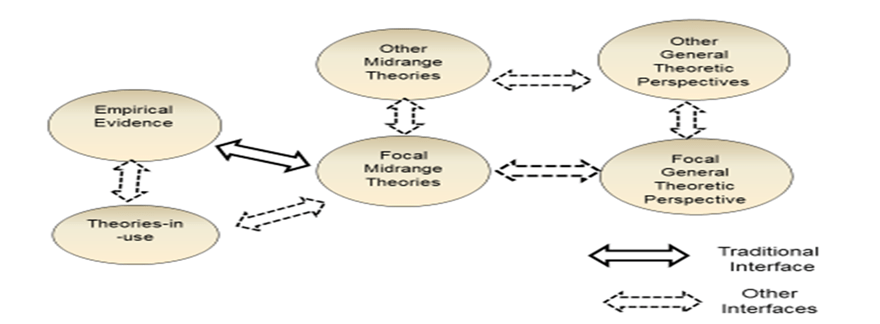
By employing the aforementioned theorising process, senior management can demonstrate to researchers that there are various ways to develop and apply midrange theory. The primary general theoretical perspective can connect directly with midrange theory, but alternative general theoretical perspectives can also offer routes that lead to other midrange theories. These alternative pathways can eventually converge on a focal midrange theory that can be utilised in research (as shown in Figure 2).
Figure 2. Interfaces for theorizing
Second, we propose ways to break down barriers to cross-disciplinary research. Senior management should recognize that research teams do not necessarily have to consist of cross-disciplinary researchers. Instead, teams should be composed of experts from their own disciplines who possess enough familiarity with the research problem and a basic understanding of each other’s fields to enable effective communication. A team of mono-disciplinary experts with a strong mix of skills and effective communication abilities is more advantageous than a team of cross-disciplinary researchers who lack sufficient experience or expertise.
Senior management should also recognise that research is typically mono-disciplinary. For instance, a cross-disciplinary grant application might struggle because the reviewers are often mono-disciplinary experts who may not grasp the cross-disciplinary elements or recognize the value of collaborative research. Therefore, senior management should encourage their researchers to take on riskier, but potentially rewarding, collaborations with peers from vastly different disciplines.
Senior management’s efforts to support and reward cross-disciplinary research can sometimes be misguided, as cross-disciplinary work should not be pursued as an end in itself. Imposing a vaguely defined cross-disciplinary agenda on researchers can lead to wasted efforts or, at best, projects that are difficult to fund or publish. A more effective approach would be for senior management to encourage researchers to start with the research problem, determine which problem class it falls into, and assess whether the problem is significant or complex enough to justify cross-disciplinary work, especially when questions arise that require expertise from multiple fields. Most importantly, and often overlooked, senior management should avoid the temptation to reward cross-disciplinary research solely for its own sake. It is far more advantageous to create an environment where researchers excel in their own disciplines while being rewarded for occasionally taking on larger cross-disciplinary challenges.
Third, the following practical guidelines can help break down barriers and create an environment that encourages cross-disciplinary research. For instance, researchers should be encouraged to present their work outside their own discipline, as this can enhance visibility, generate fresh insights, and open up opportunities for future collaboration. Senior management could promote participation in initiatives that address major societal challenges and incentivise researchers to engage with practitioners and the broader community. They should also prompt researchers to consider how their theoretical knowledge could be applied to real-world problems faced by policymakers, practitioners, and consumers.
Senior management could encourage research groups to formulate clear and well-defined research questions that accurately identify the specific problem class and knowledge gap. This approach will help determine whether expertise from multiple scientific disciplines is necessary. Refining a knowledge gap into a focused research problem can attract potential collaborators and offer context and direction for the collaborative research.
When two or more scientific disciplines are involved, it may be unclear who should provide guidance. Senior management could form a leadership team that can bring in additional members to offer expertise as needed.