

Tag: cultures

  • The Critical Role of University Leaders in Shaping Safer Cultures and Meeting OfS Condition E6 on Harassment and Sexual Misconduct

    The Critical Role of University Leaders in Shaping Safer Cultures and Meeting OfS Condition E6 on Harassment and Sexual Misconduct

    Harassment and sexual misconduct have no place on our university campuses, nor in wider society. Yet, both continue to be pervasive. The Office for National Statistics reports that 1 in 10 people aged 16 years and over experienced at least one form of harassment in the previous 12 months, while the Crime Survey for England and Wales reveals that “an estimated 7.9 million (16.6%) adults aged 16 years and over had experienced sexual assault since the age of 16 years”. The adverse sequelae for victims/survivors are well documented. 

    The Office for Students (OfS), noting the absence of national-level data at higher education institutions (HEIs),  piloted the design and delivery of a national sexual misconduct prevalence survey in 2023 (full survey due to be reported in September 2025). The study, involving 12 volunteering institutions, found 20% of participating students experienced sexual harassment and 9% experienced sexual assault/violence. The 4% response rate requires cautious interpretation of the findings; however, they are in line with other studies.

    Over the last decade, universities have taken these matters more seriously, appreciating both the impact on victims/survivors and on their institution’s culture and reputation. In 2016, Universities UK and Pinsent Mason published guidance (updated in 2022) for HEIs on managing student misconduct, including sexual misconduct and that which may constitute a crime.  As of 1 August 2025, the OfS has sought to strengthen universities’ actions through introducing condition E6 to ensure institutions enact robust, responsive policies to address harassment and sexual misconduct, as well as promote a proactive, preventative culture.  Our experience, however, suggests that universities’ preparedness is varied, and the deadline is not far away.

    Culture Starts at the Top

    Organisational culture is shaped significantly by those at the top. At its heart is ‘the way things are done around here’: the established, normative patterns of behaviour and interaction that have come to be. Senior leaders have the power to challenge and change entrenched patterns of behaviour or to reinforce them. Thus, compliance with Condition E6 is just a starting point; herein lies an opportunity for university leaders to lean deeper into transforming institutional culture to the benefit of all.

    Understandably, times of significant financial challenge may cause executive teams to quail at more demand on limited resource. This can precipitate a light-touch, bare minimum and additive approach; that is, devolving almost exclusive responsibility to a university directorate to work out how to do even more with less.  Yet, the manifold benefits of inclusive cultures are well established, including improved performance and productivity and lower rates of harassment and sexual violence. Leadership attention to and engagement in building a positive culture will see wider improvements follow. Moreover, hard though it is to write this, we know from our own work in the sector that some leaders or teams are not modelling the ‘right’ behaviour.

    Ultimately, the imperative to transform culture is in the best interests of the institution although it should also manifest a desire for social justice. Consequently, university governors need to understand and have oversight of the imperative; though narrowly defined as regulatory, it should be strategically defined as the route to creating a happier, healthier and more productive community likely to generate the outputs and outcomes the governing authority seek for a successful and sustainable institution.

    Creating Safer Cultures

    We use the term ‘safer culture’ to refer to a holistic organisational environment that is intolerant of harassment, discrimination, and mistreatment in any form. Underpinning the sustainable development of a safer culture are eight key pillars:

    1. Leadership Commitment, Governance and Accountability
      Senior leaders and university governors need to visibly and actively promote an inclusive and respectful culture, holding themselves – and others – accountable.  Strategic allocation of resources and institutional infrastructure needs to support cultural change, and governance mechanisms must enable assurance against objectives.  A whole-institution approach is required to avoid commitments becoming initiative-based, siloed, inconsistent, or symbolic: the responsibility should be shared and collective.
    2. Clear Policies, Procedures and Systems
      Institutions need to develop accessible policies that define inappropriate behaviour, including harassment and sexual misconduct, and outline clear consequences for non-adherence. Associated procedures and systems should support effective prevention and response measures.
    3. Training and Development
      A tiered training approach should be adopted to embed shared understanding, develop capability and confidence, raise awareness, and foster appropriate levels of accountability across the organisation: among students and staff, including the executive team and governing body. Specialist skills training for those in frontline and support roles is essential.
    4. Reporting Processes
      Simple, reliable, confidential, and trusted reporting mechanisms are required. These must protect against retaliation, the need to repeat disclosure information unnecessarily, and provide swift access to appropriate support through a minimum of touchpoints.
    5. Provision of Support
      A trauma-informed, empathetic environment is crucial to ensure individuals feel safe and supported, whether they are disclosing misconduct or have been accused of such. User-focused support systems and wellbeing services need to be in place for all members of the university’s community.
    6. Investigation and Resolution
      Fair, timely, and impartial processes are required which uphold the rights of all parties and enforce meaningful consequences when misconduct is confirmed. Those involved must be appropriately trained and supported to ensure just outcomes for all.
    7. Risk Management
      Risk should be proactively identified and appropriately managed. Individuals throughout the organisation need to understand their responsibility in relation to risk, both individual and institutional.
    8. Investigation and Resolution
      Creating a safer culture requires regular evaluation through policy review, data analysis and reporting, including staff and student feedback. This is essential to address emerging issues, enhance interventions in line with changing policy and practice, and achieve cultural maturity.

    A Leadership Imperative

    The imminent introduction of condition E6 offers university leaders an opportunity to bring renewed and purposeful focus to developing an institutional culture that is safe, respectful and high achieving – the very foundation of academic excellence, creativity and innovation. At a time when equity, diversity and inclusion are under threat worldwide, including in the UK, the imperative has never been greater.
    Source link

  • Building inclusive research cultures– How can we rise above EDI cynicism?

    Building inclusive research cultures– How can we rise above EDI cynicism?

    • Dr Elizabeth Morrow is Research Consultant, Senior Research Fellow Royal College of Surgeons in Ireland, & Public Contributor to the Shared Commitment to Public Involvement on behalf of National Institute for Health and Care Research.
    • Professor Tushna Vandrevala is Professor of Health Psychology, Kingston University.
    • Professor Fiona Ross CBE is Professor Emerita Health and Social Care Kingston University, Deputy Chair Westminster University Court of Governors & Trustee Great Ormond Street Hospital Charity.

    Commitment and Motivation for Inclusive Research

    The commitment to inclusivity in UK research cultures and practices will endure despite political shifts abroad and continue to thrive. Rooted in ethical and moral imperatives, inclusivity is fundamentally the right approach. Moreover, extensive evidence from sources such as The Lancet, UNESCO and WHO highlights the far-reaching benefits of inclusive research practices across sectors like healthcare and global development. These findings demonstrate that inclusivity not only enhances research quality but also fosters more equitable outcomes.

    We define ‘inclusive research’ as the intentional engagement of diverse voices, communities, perspectives, and experiences throughout the research process. This encompasses not only who conducts the research but also how it is governed, funded, and integrated into broader systems, such as policy and practice.

    Beyond higher education, corporate leaders have increasingly embraced inclusivity. Research by McKinsey & Company shows that companies in the top quartile for gender diversity are 25% more likely to outperform their peers in profitability, while those leading in ethnic diversity are 36% more likely to do so. This clear link between inclusivity, innovation, and financial success reinforces the value of diverse teams in driving competitive advantage. Similarly, Egon Zehnder’s Global Board Diversity Tracker highlights how diverse leadership enhances corporate governance and decision-making, leading to superior financial performance and fostering innovation.

    Inclusion in research is a global priority as research systems worldwide have taken a ‘participative turn’ to address uncertainty and seek solutions to complex challenges such as Sustainable Development Goals. From climate change to the ethical and societal implications of Artificial Intelligence (AI), inclusive research is a track that ensures that diverse perspectives shape solutions that are effective, fair and socially responsible.

    Take the example of AI and gender bias – evidence shows that women are frequently not included in technology research and are underrepresented in data sets. This creates algorithms that are biased and can have negative consequences of sensitivity, authenticity, or uptake of AI-enabled interventions by women. Similar biases in AI have been found for other groups who are often overlooked because of their age, gender, sexuality, disability, or ethnicity, for example.

    Accelerating Inclusion in UK Research

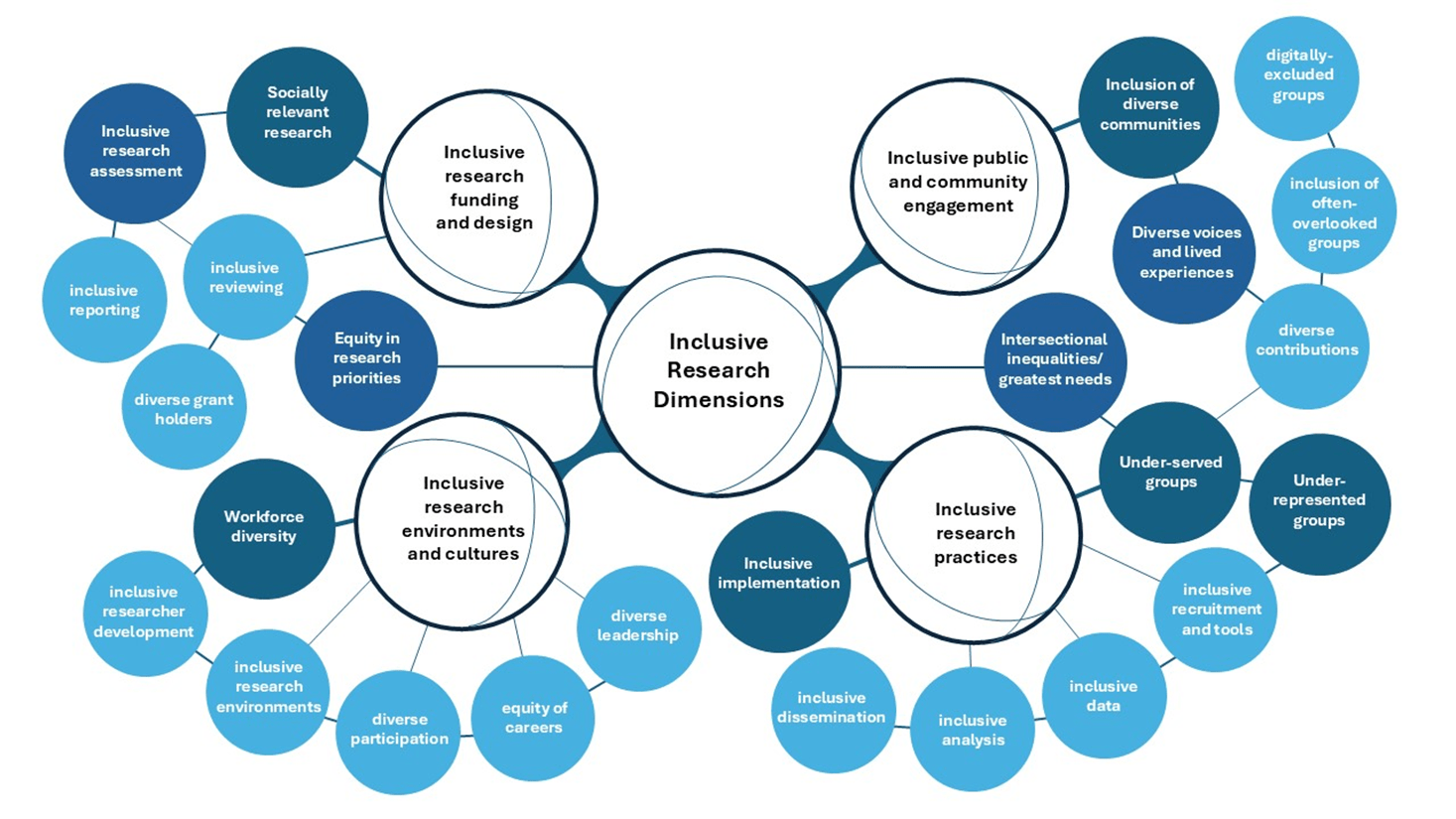
    A recent horizon scan of concepts related to the UK research inclusion landscape indicates domains in which inclusive research is being developed and implemented, illustrated by Figure 1.

    Inclusion is being accelerated by the Research Excellence Framework (REF) 2029, with a stronger focus on assessing People, Culture, and Environment (PCE). REF 2029 emphasises the integration of EDI considerations across research institutions, with a focus on creating equitable and supportive cultures for researchers, participants and communities. The indicators and measures of inclusion that will be developed and used are important because they can encourage diversity of perspectives, knowledge, skills and worldviews into research processes and institutions, thereby increasing relevance and improved outcomes. All units of assessment and panels involved in the REF process will have guidance from the People and Diversity Advisory Panel and the Research Diversity Advisory Panel. This means that inclusion will develop in both the culture of research institutions and the practices that shape research assessment.

    The National Institute for Health Research, which is the largest funder of health and social care research, has pioneered inclusion for over 30 years and prioritises inclusion in its operating principles (see NIHR Research Inclusion Strategy 2022-2027). NIHR’s new requirements for Research Inclusion (RI) will be a powerful lever to address inequalities in health and care. NIHR now requires all its domestic commissioned research to address RI at the proposal stage, actively involve appropriate publics, learn from them and use this learning to inform impact strategies and practices.

    Given the learning across various domains, we ask: How can the broader UK system share knowledge and learn from the setbacks and successes in inclusion, rather than continually reinventing the wheel? By creating space in the system between research funders and institutions to share best practices, such as the Research Culture Enablers Network, we can accelerate progress and contribute to scaling up inclusive research across professional groups and disciplines. There are numerous examples of inclusive innovation, engaged research, and inclusive impact across disciplines and fields that could be shared to accelerate inclusion.

    Developing Shared Language and Inclusive Approaches

    Approaches to building inclusive cultures in research often come with passion and commitment from opinion leaders and change agents. As often happens when levering change, a technical language evolves that can become complex and, therefore, inaccessible to others. For example, acronyms like RI can apply to research inclusion, research integrity and responsible innovation. Furthermore, community-driven research, public and community engagement, and Patient and Public Involvement (PPI) have become synonymous with inclusive research, and such participation is an important driver of inclusion.

    The language and practices associated with inclusive research vary by discipline to reflect different contexts and goals. This can confuse rather than clarify and form barriers that possibly get in the way of trust and more effective inclusion strategies and practices. We ask: How can we establish shared understanding, methods of participation, accountability pathways and mechanisms that will promote inclusion in the different and dynamic contexts of UK research?

    With over 20 years of experience in the fields of inclusion and equity, like other researchers, we have found that interdisciplinary collaboration, participatory methods, co-production, and co-design offer valuable insights by listening to and engaging with publics and communities on their own terms and territory. An inclusive approach has deepened our understanding and provided new perspectives on framing, methodological development, and the critical interpretation of research.

    Final reflection

    Key questions to overcome EDI cynicism are: How can we deepen our understanding and integration of intersectionality, inclusive methods, open research, cultural competency, power dynamics, and equity considerations throughout research processes, institutions, and systems? There is always more to learn and this can be facilitated by inclusive research cultures.

    Figure 1. Inclusive Research Dimensions

    Source link