Tag: CUPAHR

  • Trends in Higher Ed Employee Learning and Development – CUPA-HR

    Trends in Higher Ed Employee Learning and Development – CUPA-HR

    by CUPA-HR | February 1, 2023

    Employee learning and development (L&D) offerings at higher ed institutions have changed significantly over the last three years. To find out what other institutions are doing in this area, Krista Vaught, assistant director of employee learning and engagement at Vanderbilt University, conducted a survey in the summer of 2022. Survey responses from L&D professionals at 115 institutions reveal the following trends in program delivery, attendance, topics and outcomes.

    Program Delivery

    Since 2020, synchronous online sessions have been offered by most (89) institutions, followed by self-paced modules (85). Some institutions indicated that at certain points, employees were limited to online learning and self-paced only, as they did not host live workshops.

    Prior to the pandemic, synchronous, in-person workshops were the primary delivery method at most institutions. Now, synchronous online is the primary method at 35 percent of institutions surveyed, asynchronous online at 30 percent of institutions, synchronous in-person at 18 percent of institutions and hybrid at 17 percent of institutions.

    Attendance

    Attendance and participation have fluctuated. In the early 2020 shift to remote work, there was a sense that employees had newfound time to pursue L&D, at least initially. From March 2020 to December 2021, 31 percent of institutions surveyed saw increased participation, while 27 percent said it was mixed or hard to tell. Eighteen percent said it increased then decreased, and 17 percent said it decreased.

    What did institutions see in 2022? Results were mixed again. Twenty five percent said attendance and participation were about the same as prior to 2022, 23 percent said it decreased, 21 percent said it increased and 27 percent said it was mixed or hard to tell.

    What’s causing the fluctuations and challenges in attendance and participation?

    • Time and availability
    • Burnout
    • Increased workload as employees transition back to more on-campus work or take on additional responsibilities because of turnover, leaving less time to pursue learning
    • Unsupportive supervisors who see learning as taking away time from work rather than part of work
    • Employee preference for different delivery methods (in-person versus virtual)
    • Learning opportunities are not always prioritized, resulting in last-minute no-shows

    Topics

    According to respondents, the most popular workshop topics fall under management and leadership, and wellness and communication.

    Assessing Outcomes

    Follow-up surveys are the most popular tool for assessing outcomes of workshops, followed by attendance and participation numbers.

    Prioritizing Learning and Development 

    In the ongoing competition for talent, L&D can be a game changer, both in attracting new talent and retaining the talent you already have. By investing in and prioritizing programs to support managers, develop leaders and promote better communication, institutions can create a workplace that’s hard to leave.

    Interested in more data and insights HR pros can use when brainstorming L&D initiatives, making a case for those initiatives, and designing them and assessing them? Head over to the full article, Higher Education Learning and Development Trends in 2022 – Where We Are now and Where We’re Headed (members-only) in the winter issue of Higher Ed HR Magazine.

    To learn how one institution launched a multi-faceted retention initiative, including manager and leadership development opportunities, watch the recording of the recent CUPA-HR webinar Solving the Retention Puzzle.

    Related Resources:

    CUPA-HR Learning Framework and Resources

    Management and Supervisor Training Toolkit (CUPA-HR Knowledge Center)

    Creating Your Individual Development Plan (E-Learning Course)

    Understanding Higher Education (E-Learning Course)


    Source link

  • USCIS Proposes Fee Rule With Significant Increases for Employers – CUPA-HR

    USCIS Proposes Fee Rule With Significant Increases for Employers – CUPA-HR

    by CUPA-HR | January 19, 2023

    On January 4, 2023, U.S. Citizenship and Immigration Services (USCIS) issued a proposed rule to adjust certain immigration and naturalization benefit request fees, which would result in significantly higher fees for employment-based petitioners. USCIS last adjusted fees in 2016, but the most recent fee review conducted by the agency determined that the 2016 fees are insufficient to cover the agency’s operating costs. Unlike other government agencies that receive the majority of their funding through congressional appropriations, USCIS receives approximately 96 percent of its funding from filing fees. USCIS claims that the increased fees will “allow USCIS to more fully recover its operating costs, reestablish and maintain timely case processing, and prevent the accumulation of future case backlogs.”

    While the proposal is nearly 500 pages long and has significant implications for both employment-based and family-based filings, this blog post focuses on the most significant implications for higher ed employers. Of significance for higher ed employers is a new proposal to fund the Asylum Program with employer petitions fees. Specifically, USCIS “proposes a new Asylum Program Fee of $600 be paid by any employers who file either a Form I-129, Petition for a Non-immigrant Worker, or Form I-140, Immigrant Petition for Alien Worker.”

    In addition to the new Asylum Program Fee, USCIS is proposing to increase almost all employment-based and employment-based “adjacent” filing fees. A full fee schedule can be found in Table 1 of the preamble to the proposal and includes the following highlights:

    • Fees for I-129 Petitions for H-1B workers rose 70 percent, from $460 to $780;
    • Fees for I-129 Petitions for L-1 workers rose 201 percent, from $460 to $1,385;
    • Fees for I-129 Petitions for O-1 workers rose 129 percent, from $460 to $1,055;
    • I-765 Employment Authorization (EAD) application fees were structured in a way to encourage online applications by providing a discount for online filings. Online applications will be priced at $555, regardless of whether the individual needs their biometrics, whereas paper-based filings will be $650.
    • Changes made to the I-539 fees for applications to extend/change non-immigrant status were similarly structured to the I-765 changes. Online applications will be priced at $525, whereas paper-based applications are rising to $620.
    • I-485 Adjustment of Status applications uniformly rose to $1,540. For those interested in applying for adjustment of status and a travel document (I-131), those fees will be $2,170 for electronic applications and $2,190 for paper-based applications. Lastly, for those looking to concurrently file for a status adjustment, a travel document and an EAD (I-765), that will cost $2,820.

    In addition to the aforementioned changes, USCIS is also proposing to revise the premium processing timeframe interpretation from calendar days to business days. Currently, premium processing allows petitioners to receive an adjudicative action on their case within 15 calendar days. Changing the interpretation to business days would add nearly a week to the existing adjudication time.

    As mentioned earlier, the fee proposal is nearly 500 pages long and as such includes numerous changes not covered in this blog post. CUPA-HR will continue to evaluate the proposal, which is open for public feedback through March 6, 2023, and plans to join with other higher education associations to submit comments identifying the proposals impact to the higher education community.


    Source link

  • HR and the Courts – January 2023 – CUPA-HR

    HR and the Courts – January 2023 – CUPA-HR

    by CUPA-HR | January 18, 2023

    Each month, CUPA-HR General Counsel Ira Shepard provides an overview of several labor and employment law cases and regulatory actions with implications for the higher ed workplace. Here’s the latest from Ira.

    Divided Court of Appeals Rules That Separating Bathrooms By Biological Sex Does Not Violate the Constitution or Title IX — Transgender Student’s Discrimination Claim Denied

    The full 11th U.S. Circuit Court of Appeals (covering Florida, Alabama and Georgia) recently held in a sharply divided 7 to 4 decision that separating school bathrooms by biological sex is constitutional and does not violate Title IX. The majority decision is subject to multiple dissents (Adams v. School Board of St. Johns County, Florida (11th Cir. No. 18-13592, 12/30/22)). The case involved a St. Johns County, Florida, school board, which restricted bathroom use by biological sex, not allowing students who identified with a sex different from their biological sex to use the bathroom of their choice.   

    The majority decision rejected the transgender plaintiff’s reliance on the Supreme Court decision in Bostock v. Clayton County, which held that under federal job discrimination law, sex discrimination includes bias based on gender identity or sexual orientation. The majority decision pointed out that a school setting “is not the workplace,” and Bostock expressly decided not to tackle the issue of sex-segregated locker rooms or bathrooms. The majority concluded that the U.S. has a long history of separating sexes when it comes to the use of public bathrooms, and such sex-based classifications have never necessarily violated the Equal Protection Clause. It is likely that other circuits may decide this issue differently, setting up an ultimate decision on this issue by the Supreme Court.  

    NLRB Expands Damage Remedies Against Employers Who Commit Unfair Labor Practices

    The National Labor Relations Board (NLRB), in a decision applicable to all private colleges and universities in America, recently ruled that it will award damages in addition to back pay and reinstatement to employees who are subject to unfair labor practices (Thryv Inc. (N.L.R.B. Case No. 20-CA-250250, 12/13/22)). The case was brought by the NLRB against Thryv Inc., a software and marketing company, which the NLRB alleged violated the National Labor Relations Act (NLRA) by laying off employees without first bargaining with the union.  

    The NLRB ruled 3 to 2 (with two Republican member dissenters) that its “make-whole” remedies for employees affected by unfair labor practices will include damages that are the “direct and foreseeable pecuniary harm” resulting from an employer’s unfair labor practice, in addition to back pay and reinstatement. For example, this would include out of pocket costs for medical payments that would have been covered by an employer’s health insurance had the employee continued to be employed but for the unlawful termination. 

    Firefighter Loses First Amendment Religious Objection to Being Photographed for ID and Accountability Card

    A Christian firefighter from Bourne, Massachusetts, lost his First Amendment religious claim against his fire department after he was disciplined (suspended for 24 hours and ineligible for pay increases for at least six months) for refusing to be photographed for his ID card and accountability tag that would be attached to his firefighting gear and used at fire scenes (Swartz v. Sylvester (2022 BL 416412, 1st Cir., No. 2101568, 11/21/22)). The firefighter claimed that his religious beliefs precluded him from engaging in acts of self-promotion and that the photos might be used for promotional purposes. 

    The fire chief’s directive came after he became aware that some firefighters had worn ties and others wore t-shirts for their ID and authentication tag photos. The fire chief issued a directive that all firefighters would sit for their photos wearing their dress uniform for consistency. The photos would also be used in a display at the firehouse, be submitted to the media when a firefighter died in the line of duty and might be submitted to the media following a firefighter’s promotion.  

    In rejecting the plaintiff’s claim, the court concluded that the directive was applied uniformly, without exception, was facially neutral and was rationally related to the legitimate government purpose of publicizing the fire department and promoting the integrity of governmental institutions. 

    NLRB General Counsel Concludes That the NCAA Violated the NLRA By Failing to Treat Student-Athlete Basketball and Football Players as Employees

    The NLRB general counsel has concluded that the NCAA is violating the NLRA by failing to treat student-athlete basketball and football players as employees. The decision could eventually lead to the ability of these student-athletes to form labor unions. Absent settlement of the case, the NLRB Los Angeles Regional Office will issue a complaint against the NCAA and likely the Pac-12 Conference and the University of Southern California for failure to treat these student-athletes as employees. The case was brought to the NLRB by the National College Players Association, an advocacy group seeking to organize student-athletes. The final decision as to whether student-athletes are employees rests with the full NLRB, which will eventually address this matter. 

    New York Temporarily Abandons Statute of Limitations on State Law Sex Harassment Claims

    New York state has temporally done away with the statute of limitations on sex abuse claims, giving adult victims of sex abuse one year to file a claim against employers and offenders seeking financial compensation. The Adult Survivors Act, which became effective November 24, 2022, gives victims of alleged sex abuse a one year period to file a claim in New York no matter when the alleged abuse occurred. The new statute is intended to fill the gap left by 2019 legislation, which expanded New York’s statute of limitations on sex abuse cases from one year to 20 years, but did not do so retroactively.  

    Jury Awards Former Softball Coach $800,000 in Damages for Emotional Pain and Mental Anguish in Sex Discrimination Case

    A federal court jury has awarded a former university baseball coach $800,000 in damages for alleged emotional pain and mental anguish in a sex discrimination case in which the former coach alleged she was paid less than male comparators and was suspended from her position because of her sex. She had been suspended from her position following parental complaints about her coaching style. She alleged that a male coach who was the subject of similar parental complaints was treated less severely. The court dismissed her complaint with regard to salary discrimination, but allowed her discriminatory suspension allegations to proceed to a jury trial. The $800,000 jury award is subject to the university’s Motion for Judgment, not on the verdict likely to be filed after a final award is formalized by the federal district court judge (Hall v. Alabama State University (M.D. Ala. No. 16-cv-00593, 12/19/22)).  

    The jury trial proceeded for two days, and the jury concluded that the plaintiff’s gender was a motivating factor in the decision to suspend her.   

    Boston College Trustees Sued in Class-Action Lawsuit Claiming ERISA Violations in Allegedly Allowing “Above Market” Administrative Fees to Be Paid to Investment Adviser Without Competitive Bidding

    A federal district court judge recently denied the motion for summary judgement filed by defendants and allowed a class-action lawsuit to proceed against the trustees at Boston College who were sued for allegedly allowing “above market” record-keeping fees and “excessive” investment-management fees, which plaintiff’s claimed were not properly monitored or assessed through a competitive bidding process. In ruling the motion a “close call,” the judge allowed the lawsuit to proceed to discovery into the institution’s and trustees’ conduct (Sellers v. Trustees of Boston College (2022 BL 461759, D. Mass. No. 1:22-cv-10912, 12/27/22)).

    The plaintiffs also challenged the alleged inadequate performance of certain plan investments. The retirement plans in question cover approximately 3,000 employees and contain over $1.1 billion in assets. In allowing the case to proceed, the judge concluded that the plaintiffs are alleging more than poor performance during a limited time. The plaintiffs are alleging that the institution and trustees were not aware of the historical imprudence of certain investments or recent published court decisions regarding questionable fees and investments in this area.  


    Source link

  • New Research Finds Higher Ed Institutions Are at Risk of Losing Supervisors to Other Employers – CUPA-HR

    New Research Finds Higher Ed Institutions Are at Risk of Losing Supervisors to Other Employers – CUPA-HR

    by CUPA-HR | January 11, 2023

    As previous research from CUPA-HR has shown, America’s colleges and universities are in the midst of a talent crisis, as many employees are considering other employment opportunities due to a number of factors. As a follow-up to the initial findings of CUPA-HR’s 2022 Higher Education Employee Retention Survey, CUPA-HR has released new findings focused specifically on those in supervisory roles, and the data show that many supervisors are overwhelmed, under-resourced, and struggling to fill positions and maintain morale.

    The newly published report, The CUPA-HR 2022 Higher Education Employee Retention Survey: Focus on Supervisors, explores supervisors’ likelihood of looking for new employment, their current challenges and working environments, and which job aspects specific to supervisors are associated with their retention. The report analyzes data from the 3,815 higher ed administrators, professionals and non-exempt staff, most (57 percent) of whom were supervisors, who responded to CUPA-HR’s 2022 Higher Education Employee Retention Survey.

    Findings

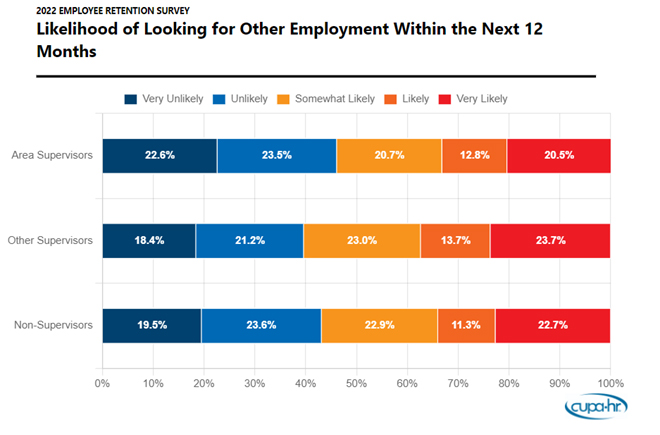
    Higher ed supervisors are looking for other employment opportunities, and less than half would seek new opportunities at their current institution. Nearly two in five (36 percent) supervisors indicate they are likely to look for other employment in the next 12 months, and only 40 percent say they would seek job opportunities at their current institution. The most common cited reason for seeking other employment is pay.

    Most higher ed supervisors work long hours and have absorbed more duties since the onset of the COVID-19 pandemic. Data show that supervisors are more likely than non-supervisors to work additional hours. Fewer than half (47 percent) of non-supervisors work more hours than what is considered full-time. However, 89 percent of area supervisors and 76 percent of other supervisors work more hours per week than what is considered full-time at their institution. Additionally, supervisors are more likely than non-supervisors to agree that they have absorbed additional responsibilities of other staff who have left the institution since the onset of COVID-19. Supervisors are also more likely than non-supervisors to report that they experienced an increase in job expectations since the start of the pandemic.
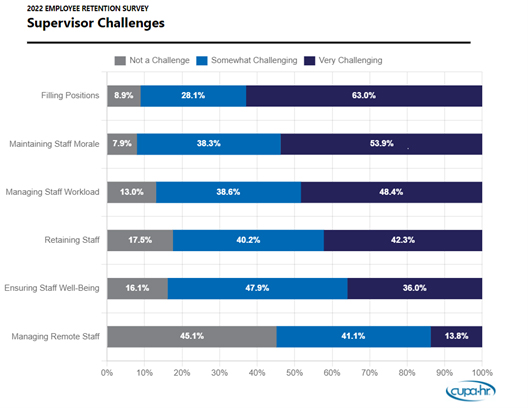
    Filling positions and maintaining morale are supervisors’ top challenges. As shown in the figure below, almost two-thirds (63 percent) of supervisors indicated they find filling positions very challenging and over half (54 percent) found maintaining staff morale very challenging.

    Higher ed supervisors report a lack of adequate training and support. Only three in five supervisors agree that they have resources and support in their supervisory role. Less than half (46 percent) agree that they have been provided with adequate management training for their supervisory role. However, when supervisors have more resources and support in their supervisory roles, more power to advocate for their staff, more power to allow flexible schedules, and more power to allow their staff to work remotely, they are less likely to seek other employment.

    Implications of Supervisor Turnover and How to Combat It

    Turnover in any role can impact an institution due to loss of talent, institutional knowledge and team or interdepartmental rapport. However, turnover in a supervisor role has more far-reaching implications. Supervisor turnover also impacts direct reports, who must adjust to a new supervisor and may need to adapt to new team priorities and vision. Loss of supervisors also equates to a loss of leaders who are key to succession plans.

    In light of what the data show, there are several actions higher ed institutions can take to keep their supervisors:

    • Provide supervisors with resources and support in their capacity as supervisors, particularly around filling empty positions and managing staff morale.
    • Ensure supervisors have the ability, knowledge and resources to advocate for their staff.
    • Give supervisors more autonomy to determine their staff’s working arrangements, as the data show that supervisors who have more power to allow their staff to work remotely and have flexible schedules are less likely to seek other employment.
    • Commit to reducing supervisor workload.
    • If possible, raise salaries for supervisors (but not at the expense of non-supervisors).

    For a deeper look into the data, read the full report.

    Note: In the findings, “area supervisors” refer to those supervisors who are the top-most leaders in their department, units or areas (self-identified in the survey; 26 percent of respondents). “Other supervisors” are those who self-identified as having at least one direct report but were not the top-most leader in their department (31 percent of respondents). “Non-supervisors” are those employees who have no direct reports (43 percent of respondents).

    CUPA-HR Research

    CUPA-HR is the recognized authority on compensation surveys for higher education, with its workforce surveys designed by higher ed HR professionals for higher ed HR professionals and other campus leaders. CUPA-HR has been collecting data on the higher ed workforce for more than 50 years, and we maintain one of the largest workforce databases in existence. CUPA-HR also publishes numerous research publications and interactive graphics highlighting trends and issues around higher ed workforce planning, pay equity, representation of women and racial/ethnic minorities and more. Learn more about CUPA-HR research.


    Source link

  • Retirement Plan Changes and Workplace Protections for Pregnant Workers Included in Fiscal Year 2023 Omnibus Bill – CUPA-HR

    Retirement Plan Changes and Workplace Protections for Pregnant Workers Included in Fiscal Year 2023 Omnibus Bill – CUPA-HR

    by CUPA-HR | January 10, 2023

    On December 29, 2022, President Biden signed the $1.7 trillion Consolidated Appropriations Act of 2023 (omnibus bill) to fund the federal government through fiscal year 2023 (FY 2023). Given the “must-pass” nature of the bill, the omnibus bill also served as a vehicle for policy unrelated to government funding that was unlikely to pass as a standalone bill in Congress. Below outlines some of the highlights that will impact higher education generally and human resources specifically.

    SECURE 2.0

    Notably, the new law includes changes to the access and use of individual retirement funds. Provisions from a package of retirement-related bills, referred to as SECURE 2.0, were ultimately included in the final omnibus package. Specifically, the new law included the following provisions, in addition to others not listed here:

    • Automatic 401(k) and 403(b) plan enrollment: The new law requires employers to automatically enroll employees into newly created 401(k) and 403(b) retirement plans at a rate between 3 to 10 percent of eligible wages. Employees will then have the option to opt out of the enrollment. Employers with 10 or fewer employees and companies in business for less than three years are excluded from this requirement.
    • Expanded eligibility for part-time employees: The law requires employers to provide the option to participate in employer retirement plans for part-time employees who work between 500 and 999 hours for at least two consecutive years (lowered from three consecutive years previously required).
    • Emergency expenses and savings accounts: Employees would be allowed to withdraw up to $1,000 from retirement accounts for qualified emergency expenses without facing early withdrawal penalties if the worker is under 59.5 years old. Additionally, the law allows employers to offer employees an emergency savings account through payroll deductions for amounts up to $2,500.
    • Matching employer contributions for student loan payments: Employers will be allowed to make contributions to their company retirement plan on behalf of employees who are paying student loans and are not contributing to a retirement account as a result.
    • Roth treatment of employer contributions: The new law grants employers the option to amend their retirement plans and allow employees to choose their employer’s matching and non-elective contributions to be made as Roth contributions.
    • Multiple Employer and Pooled Employer Plans for 403(b) plans: The new law allows employers to participate in Multiple Employer Plans (MEPs) and Pooled Employer Plans (PEPs) for 403(b) plans.

    The final law also included several changes to individual activity with respect to their retirement plans, including an increase to the “catch-up” contribution limits of up to $10,000 for older retirement savers and an increase to the age an individual is required to begin taking minimum distributions from their retirement accounts, which is now effective at age 73 and effective at age 75 effective in 2033.

    Workplace Protections for Pregnant Workers

    Additionally, Congress was able to agree on the inclusion of the Pregnant Workers Fairness Act (PWFA) and the Providing Urgent Maternal Protections (PUMP) for Nursing Mothers in the omnibus bill.

    Pregnant Workers Fairness Act

    Passed by the House in May 2021, the PWFA specifically declares that it is an unlawful employment practice for employers with 15 or more employees to do any of the following:

    • fail to make reasonable accommodations to known limitations of such employees unless the accommodation would impose an undue hardship on an entity’s business operation;
    • require a qualified employee affected by such condition to accept an accommodation other than any reasonable accommodation arrived at through an interactive process;
    • deny employment opportunities based on the need of the entity to make such reasonable accommodations to a qualified employee;
    • require such employees to take paid or unpaid leave if another reasonable accommodation can be provided; or
    • take adverse action in terms, conditions or privileges of employment against a qualified employee requesting or using such reasonable accommodations.

    Though the bill enjoyed bipartisan support in both the House and Senate, Republicans opposed bringing the bill to a Senate vote without the inclusion of a religious exemption for employers. Such exemptions were provided in the omnibus bill’s version of the PWFA, ultimately helping lead to its passage.

    PUMP for Nursing Mothers Act

    The PUMP for Nursing Mothers Act passed the House of Representatives in October 2021 with bipartisan support. The bill aims to amend the Fair Labor Standards Act (FLSA) to expand access to breastfeeding accommodations in the workplace for lactating employees and builds upon existing protections in the 2010 Breaktime for Nursing Mothers Act by broadening breastfeeding accommodations and workplace protections. In the new law, the PUMP for Nursing Mothers Act is expanded to include salaried employees exempt from overtime pay requirements under the FLSA as well as other categories of employees currently exempt from such protections, such as teachers, nurses and farmworkers. It also clarifies that break time provided under this bill is considered compensable hours worked so long as the worker is not completely relieved of duty during such breaks, and it ensures remedies for nursing mothers for employer violations of the bill.

    Similar to the PWFA, the PUMP for Nursing Mothers Act did not reach a Senate floor vote, leaving the omnibus bills as one of the last options for passage before the 117th Congress’s term expired.

    Immigration Provisions

    Due to the situation at the southern border, the new law excluded any major immigration overhauls, such as the Equal Access to Green cards for Legal Employment (EAGLE) Act, which would have addressed the immigration visa backlog and made changes to the H-1B visa program. Additionally, protections for the Deferred Action for Childhood Arrivals (DACA) program and Dreamers that have been threatened by recent court decisions were not included in the final bill enacted into law.

    Despite the exclusion of important reforms, the new law reauthorized several expiring immigration programs that are already utilized by institutions of higher education, including additional funds for the E-Verify program.

    Higher Education Funding

    Several provisions were included in the omnibus package that will increase funding for a variety of higher education programs. Notably, the bill includes a $500 increase to the maximum Pell Grant a recipient can receive, raising the total to $7,395 for the 2023-24 award year. Additionally, the bill included funding increases for Federal Work-Study grants, Title III and V programs, Postsecondary Student Success Grants, and the TRIO and GEAR UP programs.

    CUPA-HR will continue to analyze the provisions included in the FY 2023 funding bill and will keep members apprised of any additional noteworthy provisions included in the law.


    Source link

  • Fall 2022 Regulatory Agenda Targets Release Dates for DOL’s Overtime Proposal and Final Title IX Rule – CUPA-HR

    Fall 2022 Regulatory Agenda Targets Release Dates for DOL’s Overtime Proposal and Final Title IX Rule – CUPA-HR

    by CUPA-HR | January 10, 2023

    On January 4, 2023, the Biden administration released the anticipated Fall 2022 Unified Agenda of Regulatory and Deregulatory Actions (Regulatory Agenda), providing the public with a detailed glimpse into the regulatory and deregulatory activities under development across approximately 67 federal departments, agencies and commissions. Agendas are generally released in the fall and spring and set target dates for each agency and sub-agency’s regulatory actions for the coming year.

    After completing a thorough review of the items included in the Regulatory Agenda, CUPA-HR put together the following list of significant proposed actions for members.

    Department of Labor

    Wage and Hour Division — Defining and Delimiting the Exemptions for Executive, Administrative, Professional, Outside Sales and Computer Employees

    According to the Regulatory Agenda, the Department of Labor (DOL)’s Wage and Hour Division (WHD) is now planning to release a Notice of Proposed Rulemaking (NPRM) to address changes to the Fair Labor Standards Act (FLSA)’s overtime pay requirements in May 2023. The WHD first announced their intention to move forward with the NPRM in the Fall 2021 Regulatory Agenda, stating its goal “to update the salary level requirement of the section 13(a)(1) exemption [under the FLSA].”

    As a refresher, changes to overtime pay requirements have been implemented through regulations under both the Obama and Trump administrations. In May 2016, the Obama administration’s DOL issued a final rule increasing the salary threshold from $23,660 to $47,476 per year and imposed automatic updates to the threshold every three years. However, court challenges prevented the rule from taking effect and it was permanently enjoined in September 2017. After the Trump administration started the rulemaking process anew, the DOL issued a new final rule in September 2019 raising the minimum salary level required for exemption from $23,660 annually to $35,568 annually. This final rule went into effect January 1, 2020 and remains in effect today.

    Since the regulation’s reintroduction in the Fall 2021 Regulatory Agenda, CUPA-HR has participated in several DOL listening sessions and has sent letters to the DOL expressing concerns with the timing of the rulemaking. Specifically, our concerns highlight the ongoing challenges of the COVID-19 pandemic and the continued reliance on hybrid and remote work, a historically tight labor market in the U.S. and the effects of inflation on the workforce.

    Wage and Hour Division — Employee or Independent Contractor Classification Under the Fair Labor Standards Act

    In May 2023, the WHD anticipates issuing a final rule to amend the current method for determining independent contractor status for workers.

    On October 13, 2022, the DOL published an NPRM to rescind the current method for determining independent contractor status under the FLSA. The current test finalized by the Trump administration in 2021 has two core factors of control and investment with three additional factors (integration, skill and permanency) that are relevant only if those core factors are in disagreement. The Biden rule proposes a return to a “totality-of-the-circumstances analysis” of multiple factors in an economic reality test, including the following six factors, which are equally weighted with no core provisions:

    • the extent to which the work is integral to the employer’s business;
    • the worker’s opportunity for profit or loss depending on managerial skill;
    • the investments made by the worker and the employer;
    • the worker’s use of skill and initiative;
    • the permanency of the work relationship; and
    • the degree of control exercised or retained by the employer control.

    Employment and Training Administration — Strengthening Wage Protections for the Temporary and Permanent Employment of Certain Aliens in the United States 

    In September 2023, the DOL’s Employment and Training Administration (ETA) plans to issue an NPRM to establish “a new wage methodology for setting prevailing wage levels for H-1B/H-1B1/E-3 and PERM programs consistent with the requirements of the Immigration and Nationality Act.” The proposal will likely amend the Trump administration’s final rule that was scheduled to take effect on November 14, 2022, but was subsequently vacated by a federal court in June 2021. The new proposal will take into consideration the feedback it received in response to a Request for Information (RFI) on data and methods for determining prevailing wage levels “to ensure fair wages and strengthen protections for foreign and U.S. workers.”

    CUPA-HR filed comments in opposition to the Trump administration’s regulations on the issue and in response to the Biden administration’s RFI.

    National Labor Relations Board

    Joint Employer

    In August 2023, the National Labor Relations Board (NLRB) plans to release its anticipated final rule to amend “the standard for determining whether two employers, as defined under the National Labor Relations Act (NLRA), are a joint employer under the NLRA.”

    On September 7, 2022, the NLRB issued an NPRM on the joint employer standard. The NPRM establishes joint employer status of two or more employers if they “share or co-determine those matters governing employees’ essential terms and conditions of employment,” such as wages, benefits and other compensation, work and scheduling, hiring and discharge, discipline, workplace health and safety, supervision and assignment and work rules. According to the NLRB’s press release, the Board “proposes to consider both direct evidence of control and evidence of reserved and/or indirect control over these essential terms and conditions of employment when analyzing joint-employer status.”

    Department of Education

    Office for Civil Rights — Nondiscrimination on the Basis of Sex in Education Programs or Activities Receiving Federal Financial Assistance 

    In May 2023, the Department of Education’s Office for Civil Rights (OCR) plans to release its highly anticipated Title IX final rule. The rulemaking would finalize the June 2022 NPRM to rollback and replace the Trump administration’s 2020 regulations, specifically with respect to its grievance procedures, while simultaneously expanding protections against sex-based discrimination to cover sexual orientation, gender identity and pregnancy or related conditions.

    CUPA-HR filed comments in September 2022 in response to the NPRM. In our comments, we tried to bring attention to the possible impact the proposed regulations could have on how higher education institutions address employment discrimination. The Department of Education received over 200,000 comments in response to the NPRM, which they must review prior to issuing a final rule to implement their changes.

    In addition to the Title IX rulemaking, the OCR also announced its intention to issue an NPRM to address Title IX protections as it relates to athletics programs at educational institutions. The Department of Education announced its intention to pursue a separate rulemaking to address transgender students participation in athletic programs at institutions of higher education and such protections afforded to them under Title IX after the topic was frequently discussed in the media and in Congress in 2022. According to the Regulatory Agenda, the NPRM was set to be released in December 2022, but it has not yet been released.

    Department of Homeland Security

    U.S. Immigration and Customs Enforcement — Optional Alternative to the Physical Examination Associated With Employment Eligibility Verification (Form I-9) 

    According to the Regulatory Agenda, the Department of Homeland Security (DHS) plans to issue a final rule in May 2023 that would finalize the agency’s proposed rule aiming to “revise employment eligibility verification regulations to allow the Secretary to authorize alternative document examination procedures in certain circumstances or with respect to certain employers.”

    On August 18, 2022, the DHS published its NPRM on optional alternative examination practices for employers when reviewing an individual’s identity and employment authorization documents required by the Form I-9, Employment Eligibility Verification. If finalized, the proposed rulemaking would create a framework under which the Secretary of Homeland Security could allow alternative options for verifying those documents, such as reviewing the documents via video, fax, or email rather than directly allowing employers and agents to use such alternative examination options. According to the NPRM, the Secretary would be authorized to implement the alternative examination options in a pilot program if they determine such procedures would offer an equivalent level of security, as a temporary measure to address a public health emergency declared by the Secretary of Health and Human Services, or a national emergency declared by the President.

    CUPA-HR filed comments in response to the DHS NPRM in October 2022. The comments were supportive of the Department moving forward with the NPRM, but cautioned against requiring secondary, in-person review of I-9 documents after virtual inspection and once an employee is in-person on a regular and consistent basis; issuing training for document detection and/or anti-discrimination training that may be offered at a high cost without proper vetting, and requiring institutions to be enrolled in E-Verify to participate in the alternative options.

    U.S. Citizenship and Immigration Services — Modernizing H-1B Requirements and Oversight and Providing Flexibility in the F-1 Program

    In October 2023, the DHS’s United States Citizenship and Immigration Services (USCIS) plans to release an NPRM to “amend its regulations governing H-1B specialty occupation workers and F-1 students who are the beneficiaries of timely filed H-1B cap-subject petitions.” The NPRM will specifically propose to “revise the regulations relating to ‘employer-employee relationship’ and provide flexibility for start-up entrepreneurs; implement new requirements and guidelines for site visits including in connection with petitions filed by H-1B dependent employers whose basic business information cannot be validated through commercially available data; provide flexibility on the employment start date listed on the petition (in limited circumstances); address ‘cap-gap’ issues; bolster the H-1B registration process to reduce the possibility of misuse and fraud in the H-1B registration system, and clarify the requirement that an amended or new petition be filed where there are material changes, including by streamlining notification requirements relating to certain worksite changes, among other provisions.”

    Department of Agriculture

    Agriculture Acquisition Regulation: Internal Policy and Procedural Updates and Technical Changes

    In May 2023, the Department of Agriculture (USDA) plans to re-propose an NPRM that was previously issued in February 2022 and included controversial provisions that would require federal contractors on projects procured by the agency to certify their compliance with dozens of federal and state labor laws and executive orders.

    In the February NPRM, the USDA provided only 32 days for stakeholder comment submissions on the proposal. CUPA-HR filed an extension request with the department asking for an additional 90 days to “evaluate the NPRM’s impact on [members’] research missions and collect the information needed in order to provide thoughtful and accurate input to the USDA,” as well as official comments that were pulled from 2012 comments CUPA-HR submitted with the Society for Human Resource Management (SHRM).

    While it is unclear whether the May NPRM will include the blacklisting language again, the abstract of the re-proposal states that “the new proposed rule would be responsive to the comments received on our February 2022 proposal.”


    Source link

  • In Case You Missed Them – Inspiring Reads of 2022 and Can’t-Miss CUPA-HR Resources – CUPA-HR

    In Case You Missed Them – Inspiring Reads of 2022 and Can’t-Miss CUPA-HR Resources – CUPA-HR

    by CUPA-HR | January 4, 2023

    Throughout the year, the Higher Ed Workplace Blog and Higher Ed HR Magazine feature HR innovations and success stories from the CUPA-HR community. In case you missed them, we’ve listed several great blog posts and articles of 2022 that will leave you feeling inspired and ready to take action at your institution.

    The Higher Ed Workplace Blog

    Higher Ed HR Magazine

    • While there’s a time and place to maintain a more serious demeanor, there’s a case to be made for incorporating humor into the workplace — especially for HR professionals who are often viewed as the enforcers of an organization. Read how HR can use the powerful tool of humor to its advantage: Dear HR, It’s OK to Laugh — Incorporating Humor Into the HR Workplace
    • Kansas State University’s Human Capital Services (HCS) knew their remote work policy was in need of a major overhaul. When COVID-19 entered the scene, HCS had to overcome multiple obstacles and a major time crunch to build a comprehensive remote work program and strategy for faculty and staff. Learn how they did it in their article A Consultative Approach: Kansas State University’s Framework for HR Success
    • Did you know that 47 percent of chief academic officers (CAOs) have been in their position three years or less? While there is limited data regarding why CAOs consider staying or leaving their positions, CUPA-HR CEO Andy Brantley conducted interviews with 13 CAOs to gain a deeper understanding of what motivates them to stay or leave. Read the full article Chief Academic Officer Transition: Opportunity, Chaos or Something In Between?
    • Many institutions collect data from their employees on engagement, climate and satisfaction, but don’t always take specific steps to improve those factors. Learn best practices for developing an engagement, satisfaction, or climate survey that will produce actionable results: Employee Engagement/Satisfaction/Climate Assessment: Producing Actionable Results

    Don’t Miss These CUPA-HR Resources!

    Okay, so you’re feeling inspired after reading these HR success stories, but now you’re wondering how you can get to work at your institution. These CUPA-HR resources can help you take that next step!

    • Understanding Higher Education is an e-learning series designed to help all employees be more effective in their roles by developing a deeper understanding of institutional structure and culture. Take Course 1 now.
    • Knowledge Center toolkits are designed with higher ed in mind. Toolkits are added and updated often, so stop by often to see what’s new.
    • From new research publications to annual workforce data, the Research Center is the central hub for all things CUPA-HR research.


    Source link

  • NLRB Region Files Complaint Against the NCAA, Pac-12 and the University of Southern California – CUPA-HR

    NLRB Region Files Complaint Against the NCAA, Pac-12 and the University of Southern California – CUPA-HR

    by CUPA-HR | December 21, 2022

    On December 15, the National Labor Relations Board (NLRB)’s Region 31 announced it will pursue a complaint against the National Collegiate Athletic Association (NCAA), the Pac-12 Conference and the University of Southern California (USC) for violating the National Labor Relations Act (NLRA) by misclassifying student-athletes as non-employees, unless the matter is settled. On February 8, the National College Players Association filed an unfair labor practice (ULP) charge with the region alleging that USC; the University of California, Los Angeles; the Pac-12 Conference; and the NCAA are “joint employers” who violated the NLRA by “repeatedly misclassifying employees as ‘student-athlete’ non-employees.”

    Region 31 is part of the NLRB’s Office of General Counsel, which is responsible for receiving charges from employees, unions or employers that allege violations of the NLRA. The region decides whether to issue a complaint on charges it receives. If the region does not issue a complaint, the matter is generally closed. If the region decides to file a complaint, however, the case is litigated before an administrative law judge.

    Region 31’s complaint is the latest development regarding the employment status of student-athletes. The National College Players Association’s February 8 charge followed NLRB General Counsel Jennifer Abruzzo’s memorandum issued last September in which she argues that student-athletes are employees under the NLRA and are therefore afforded all statutory protections as prescribed under the law.

    The region’s decision in response to the February ULP charge means the NCAA, Pac-12 Conference and USC can either settle or litigate the case. A final ruling could take years to come to fruition, however, as both parties in the case could appeal the decisions made by the administrative law judge to the five-member NLRB. The NLRB’s decision can be appealed to federal appellate courts  and from there all the way up to the Supreme Court.

    The news of the region’s complaint follows the announcement earlier in the day that Massachusetts Governor Charlie Baker would be the NCAA’s next president in March after his last term in office expires in January. Baker, a Republican, is known for his work to build bipartisan consensus on policy in Massachusetts, which the NCAA may recognize as a strength as they continue to engage Congress on other issues related to student-athlete compensation. It is unclear what, if any, impact this will have on the ULP charges.

    CUPA-HR will continue to keep members apprised of this case and others involving student-athlete employment classification that may emerge in the future.


    Source link

  • HR and the Courts – December 2022 – CUPA-HR

    HR and the Courts – December 2022 – CUPA-HR

    by CUPA-HR | December 13, 2022

    Each month, CUPA-HR General Counsel Ira Shepard provides an overview of several labor and employment law cases and regulatory actions with implications for the higher ed workplace. Here’s the latest from Ira.

    University Wins Dismissal of “Deliberate Indifference” to Sex Harassment Claims on Statute of Limitations Grounds 

    A federal district court dismissed 12 counts of alleged indifference to sex harassment brought by six Jane Does, five of whom are current or former students and one of whom is a current professor. The case involves allegations against a male graduate student in French language studies who was arrested for rape of a student at another college in 2018. It is alleged that the university did not act on sex harassment allegations of inappropriate touching and “raunchy” texts following the incident at the other college.

    The graduate student allegedly raped Doe #1 in September 2020, and the university suspended him in November 2020 following an investigation for sexual harassment, endangerment and disorderly conduct. The graduate student fled the country for France in December 2020 and has not returned. The graduate student was indicted for rape stemming from the 2018 alleged assault in December 2021.

    The federal district court judge dismissed all the allegations on statute of limitations grounds (Doe #1 et al v. Board of Supervisors of Louisiana State University and Agriculture and Mechanical College et al ( M.D. La. No. 21-cv-00564, 11/3/22)). Louisiana has the shortest statute of limitations in the country at one year and the judge concluded that the majority of the claims were time barred, granting plaintiffs the ability to amend two of the 12 claims and refile them.

    Athletic Director Applicant Loses Reverse Discrimination Claim on the Basis of Interview Performance

    A white athletic director applicant who claimed superior qualifications for a senior athletic director position failed to show that the stated reason for his rejection (poor interview performance) in favor of a minority applicant was pretextual. The plaintiff was a long-time athletic director in the South Bend Indiana School district at the time he applied for a broader and more senior athletic director position. The judge ruled that while the plaintiff may have been more qualified “on paper alone” by a comparison of resumes with the minority applicant who was chosen for the job, the employer showed that a comparison of resumes was not the sole criteria for job selection (Groves v. South Bend Community School Corporation (2022 BL 347215, 7th Cir. No. 21-03336, 10/1922)).

    The judge went on to recognize that the minority applicant performed much better during his interview and convinced the interviewer that he would be much better able to mend the strained relationship the school district had with the State Athletic Association. The judge further observed that during the interview, the plaintiff stressed his experience in firing coaches and this was not helpful in the mind of the interviewer with regard to the State Athletic Association. The judge concluded that the facts supported the conclusion that interview performance was not a pretext to commit race discrimination. The judge’s conclusion was affirmed by the 7th U.S. Circuit Court of Appeals (covering Wisconsin, Illinois and Indiana).

    State of Florida Appeals Federal Judge’s Decision Blocking the Florida Law Restricting Employer Anti-Bias Training

    The state of Florida has appealed to the U.S. Court of Appeals for the 11th Circuit, asking the appellate court to reverse a federal judge’s decision that barred enforcement of the controversial law’s provisions, which prohibited employers in the state of Florida from promoting various sex- and race-based anti-bias concepts as part of employee training.

    The federal district trial judge issued a preliminary injunction barring enforcement of much of the law based on a conclusion that it violated employers’ First Amendment free speech rights under the U.S. Constitution. The state of Florida argued in its appeal that the statute does not restrict employer free speech, rather it blocks employer conduct “conscripting employees against their will into the audience as a condition of their employment,” (Honeyfund.com Inc et al v. DeSantis et al (Case No. 13135, 11th Cir.)).

    The federal trial judge had concluded that Florida state lawmakers wrote a law that attempts to squelch viewpoints on race and sex bias that they do not like. CUPA-HR will follow this litigation as it develops.

    Department of Labor Proposes Self-Correction Program for Retirement Plans With Late Participant Contributions and Loan Repayments

    The Department of Labor is proposing a new self-correction component under its Voluntary Fiduciary Correction Program (VFCP) to allow plan administrators to self-correct certain plan violations without the need to file a formal application and no action request. Under the proposed rule, the plan would report the correction through an online portal. The VFCP allows plans to self-correct certain Employee Retirement Income Security Act violations and avoid civil penalties by identifying and correcting certain plan design and implementation errors. Under the proposal, plans with late participant contributions or loan repayments could use this alternative to self-correct these violations.

    Under the proposed rule, the self-correction must be made within 180 days of the withholding or receipt of funds and the lost earnings must not exceed $1,000. Publication of the proposed rule is expected to be made in late November/early December, and comments must be submitted within 60 days of publication of the proposed rule.

    Terminated Softball Coach Sues for First Amendment Speech and Religious Discrimination Allegedly Related to Her Offer to Adopt a Student’s Baby

    A former assistant softball coach has filed a lawsuit in federal court alleging that her former university discriminated against her in the exercise of her free speech rights and religious beliefs when she was discharged after she offered to adopt a student’s baby and refused to reveal the identity of the student (Wiggins v. Idaho State University et al (D. Idaho No. 22-cv-00474, complaint filed 11/17/22)).

    The complaint alleges that the university violated the former coach’s First Amendment speech and exercise of religion rights by “coercing” the coach to convince the birth mother to disclose the pregnancy and birth to her parents and to withdraw her offer to adopt the baby. The complaint alleges that the university discharged the coach after she refused to disclose the name of the birth mother to the athletic director and dean of students so they could contact the birth mother‘s parents. The plaintiff alleges that her offer to adopt the baby was an “exercise of” her Christian faith. The plaintiff also alleges that the loss of employment forced her to sell her home and move her family to Texas.


    Source link

  • CUPA-HR Sends Letter to Congress Asking for DACA Protections – CUPA-HR

    CUPA-HR Sends Letter to Congress Asking for DACA Protections – CUPA-HR

    by CUPA-HR | November 22, 2022

    On November 17, CUPA-HR joined the American Council on Education (ACE) and over 60 other higher education associations in sending a letter to House of Representatives and Senate leadership urging Congress to pass permanent protections for the Deferred Action for Childhood Arrivals (DACA) program after recent court decisions have left the status of the program in limbo.

    On October 5, the U.S. Court of Appeals for the Fifth Circuit unanimously upheld a 2021 ruling by the lower Court in the Southern District of Texas that enjoined the DACA program and vacated the 2012 Department of Homeland Security (DHS) memorandum that originally established the program. The Fifth Circuit agreed with the lower court’s finding that the promulgation and enforcement of the DACA memorandum violated the Administrative Procedure Act but noted that the Biden administration had finalized a new DACA regulation in August, leading the Appeals Court to send the case back to the Texas District Court to consider the legality of the August rulemaking. On October 14, however, the Texas District Court ruled against the final rule, arguing that the existing injunction blocking the 2012 memorandum also covered the new final rule.

    As a result of these rulings, the DHS is blocked from accepting new applications for the DACA program, but the agency is permitted to continue renewing existing protections to current DACA beneficiaries. DHS Secretary Alejandro Mayorkas issued a statement in response to the Texas Court’s decision saying “It is clearer than ever that only the passage of legislation will give full protection and a well-deserved path to citizenship for DACA recipients. I urge Congress to swiftly pass legislation to provide permanent protection to the hundreds of thousands of Dreamers who call the United States home.”

    ACE’s letter states the urgency with which Congress needs to act to ensure protections are granted to DACA recipients. The letter specifically asks Congress to pass legislation to provide DACA protections to current and future beneficiaries before the 117th Congress ends January 3, 2023.

    CUPA-HR will keep members apprised of any updates on the status of the DACA program.


    Source link