Tag: CUPAHR

  • 4 Considerations for Using Salary Data to Inform Compensation Decisions – CUPA-HR

    4 Considerations for Using Salary Data to Inform Compensation Decisions – CUPA-HR

    by Missy Kline | November 15, 2022

    Editor’s note: This blog post, originally published in April 2019, has been updated with additional resources and related content.

    Salary benchmarking is not one-size-fits-all — especially when you’re looking at groups as varied as administrators, professionals, staff and faculty on a college or university campus that is unique in its combination of Carnegie class, affiliation, regional location and mission. The question, then, is how to tailor your benchmarking efforts to take these variables into account and choose data that is appropriate to your unique needs.

    Here are four considerations to help you make the best use of salary data for compensation budget planning for your faculty and staff:

    1) Which institutions should your institution’s salaries be benchmarked against? Making the right comparisons — using position-specific data and carefully selected peers — can make all the difference when planning salaries that will make your institution competitive in the labor market. When you use CUPA-HR’s DataOnDemand, you can narrow down peer institutions by one or several institution-level criteria such as affiliation (public, private indephttp://cupahr.org/surveys/dataondemand/endent or private religious), Carnegie classification, enrollment size, geographic region, total expenses or other characteristics. Remember, balance is key: a larger comparison group gets you more robust data for comparison, but you must also make sure you are comparing to the right types of institutions that make sense for your goals.

    2) Not all faculty are the same. Tenure track faculty, non-tenure track teaching faculty, non-tenure track research faculty and adjunct faculty may each require unique compensation strategies, as do faculty members from different disciplines and ranks. Will the same salary increase help retain both tenured and non-tenured faculty? Does collective bargaining impact salary targets for some, but not all, of these faculty sub-groups? Are there unique, fast-growing, or in-demand departments/disciplines that require a separate strategy?

    3) Keep in mind that administrator salaries are broadly competitive. Like faculty, many administrative positions in higher ed are competitive at a national level. Often, institutions seek administrators with experience at other institutions of a similar size or mission, and with this experience and mobility comes an expectation of a competitive salary. As higher ed moves toward a “business model” where innovative leadership strategies are displacing more traditional shared governance models, finding administrators with the appropriate skills and expertise is becoming increasingly competitive, not only within higher education but sometimes against the broader executive employment market.

    4) Employment competition varies for staff and professionals. Many non-exempt staff are hired from within local labor markets, and therefore other institutions or companies in your state or local Metropolitan Statistical Area might be a better salary comparison than a nationwide set of peer institutions. Exempt or professional staff, however, may be more limited to competition from the higher ed sector, perhaps on a state or regional level. In addition, changes brought about by the pandemic (e.g., remote work opportunities, a desire to relocate) have made many professional positions more globally competitive. Are your institution’s salaries for these employees appropriately scoped for the market in which you need to compete?


    Additional Articles and Resources

    How One College Is Using Salary Data to Ensure Pay Equity and Market-Par Compensation

    Compensation Programs/Plans, Executive Compensation in Higher EdEqual Pay Act (CUPA-HR Toolkits)

    Working in a Fish Bowl: How One Community College System Navigated a Compensation Study in a Transparent Environment (Higher Ed HR Magazine)


    Source link

  • HR and the Courts – November 2022 – CUPA-HR

    HR and the Courts – November 2022 – CUPA-HR

    by CUPA-HR | November 8, 2022

    Each month, CUPA-HR General Counsel Ira Shepard provides an overview of several labor and employment law cases and regulatory actions with implications for the higher ed workplace. Here’s the latest from Ira.

    EEOC Disavows Publicly-Expressed Views of Former General Counsel Regarding Abortion Travel Issues 

    The Equal Employment Opportunity Commission (EEOC) took the rare step of publicly disavowing the views expressed by its former general counsel who was appointed during the Trump administration and replaced during the Biden administration. The EEOC stated on October 31, 2022 that its former general counsel expressed her personal views, not that of the agency, when she warned that employers providing travel assistance to employees seeking an abortion but not for other procedures might be sued by the EEOC. Nonetheless, this is a developing area of the law and counsel should be consulted on these issues.

    Supreme Court Hears Oral Argument Over Continuation of Affirmative Action In College Admissions

    The Supreme Court heard oral argument over the continuation of Affirmative Action in college admissions on October 31, 2022 in Students for Fair Admissions (SFFA) v. Harvard and Students for Fair Admissions (SSFA) v. University of North Carolina (UNC). The first major Supreme Court decision involving Affirmative Action in college admissions occurred in 1978 in University of California v. Bakke. In Bakke, a divided Supreme Court approved the University of California’s Affirmative Action plan with four justices ruling in favor of the plan and four justices ruling that the Affirmative Action plan violated the constitution. The remaining solo opinion of Justice Lewis Powell coupled with the four votes in favor of Affirmative Action became the precedent. Justice Powell concluded that a race-conscious admissions program could theoretically satisfy constitutional strict scrutiny by being narrowly tailored to promote a diverse student body.

    In 2003, a majority of the Supreme Court endorsed Justice Powell’s solo opinion in Grutter v. Bollinger when Justice Sandra Day O’Connor added in the majority opinion that the Court expects that such policies will no longer be necessary in 25 years.

    The Supreme Court set aside two hours to hear oral argument in two lawsuits brought by the SFFA, an anti-Affirmative Action group, against Harvard University and the University of North Carolina. The SFFA wants the Supreme Court to overturn Justice Powell’s solo opinion in the Bakke case and end consideration of race in college admissions. The group argues among other things that current Affirmative Actions policies routinely discriminate against Asian Americans who do not receive racial preferences. Both colleges deny that Affirmative Action policies discriminate against Asian Americans.

    To complicate matters further, both cases were coupled for oral argument, but were uncoupled and heard separately because Justice Ketanji Brown Jackson recused herself for the Harvard case because of past work on Harvard’s Board of Overseers.

    Supreme Court Considers Long-Standing Preemption of State Laws Barring Employer State-Based Claims of Destruction of Property During Labor Disputes

    The Supreme Court will also reconsider this term its 60-year-old decision in San Diego Building Trades v. Garmon (commonly referred to as the Garmon Preemption Doctrine), in a case in which an employer is seeking to sue a teamsters local union alleging common law state claims of intentional destruction of property during a labor dispute and commencement of a strike (Glacier Northwest Inc. v. International Brotherhood of Teamsters, Local 174 (US No. 21-1449)). The Supreme Court ruled in the Garmon case that the federal National Labor Relations Act (NLRA) preempts and therefore prohibits all state court lawsuits against unions, concluding that an employer’s sole remedy is subject to the provisions of the NLRA, and that sole remedy for relief is up to the National Labor Relations Board (NLRB).

    In the case at hand, the Washington State Supreme Court dismissed an employer’s common law lawsuit against Teamster Local Union No. 174 for intentional destruction of property holding that under Garmon preemption the employer’s sole remedy is before the NLRB, which does not grant property damages to employers so harmed. The employer in the case alleged that its teamster union drivers returned the employers ready mix concrete trucks fully loaded with concrete to the yard prior to leaving on strike with the concrete in the trucks ready to harden and therefore destroyed the trucks. The teamsters claimed that they left the trucks running so that they could be unloaded safely.

    Some commentators conclude that if the Supreme Court alters Garmon broadly and allows such lawsuits to proceed, it could trigger a new and effective employer weapon in holding union’s liable for economic consequences of strikes and other actions taken during labor disputes. Those commentators also point out that if the Supreme Court broadly limits preemption, it could lead to conservative-leaning states to enact legislation restricting union conduct during strikes.

    California Joins Growing List of States Expanding Paid Leave Benefits

    California’s recent enactment of paid leave protections requiring employers to provide employees with paid leave to care for individuals who are not legal relatives joins the growing list of states regulating this area of employee benefits. So far, 11 states and the District of Columbia have enacted paid leave programs. Five of those states (Colorado, Connecticut, New Jersey, Oregon and Washington) allow employees to use those benefits to take care of non-relatives designated as “akin to family.”

    Nationwide, this is leading to a unique patchwork of requirements depending on where the employee is employed. Research should be conducted in your local jurisdiction to guide your institution on the breadth and application of possible city and/or state requirements. In addition, remote work in another state may also alter which state’s laws applies.

    U.S. Court of Appeals to Address Whether Sovereign Immunity Exempts State University From Federal Whistleblower Wrongful Discharge Claims

    The U.S. Court of Appeals for the 4th Circuit (covering Maryland, Virginia, West Virginia, North Carolina and South Carolina) will address whether Maryland state sovereign immunity applies to Morgan State University and Maryland State University in a case involving federal whistleblower wrongful discharge claims by the university’s former director of broadcast operations (Williams v. Morgan State University (4th Cir., Case no 21-01918, 10/13/22)).

    The plaintiff complained that the university mishandled a debate between Baltimore mayoral candidates and that she was ultimately discharged because she claimed that the mishandling may have violated the Federal Hatch Act and Federal Communications Commission regulations. The federal trial court dismissed the plaintiff’s federal claims, holding that while Maryland had waived sovereign immunity with respect to state tort claims, it did not do so regarding federal claims. The Court of Appeals has taken the unusual position of asking the Maryland State Court of Appeals whether the state has waived sovereign immunity with regard to federal tort claims.

    The plaintiff also added a federal whistleblower claim that the university’s dean and other professors were intentionally inflating expense numbers to federal and state agencies to “pad the university’s funding.”

    NLRB Returns to In-Person Manual Union Elections to Replace Mail-In Ballots Mandated During COVID-19 Pandemic

    In-person voting at employer premises in NLRB-supervised union elections is returning as the primary method of voting as the NLRB modifies the rules that it enacted during the onset of the COVID-19 pandemic, which lead to a great increase in mail-in voting. Nearly 75 percent of the 3,185 NLRB-supervised elections, which were conducted since the start of 2020 during the pandemic, were conducted by mail according to Bloomberg BNA. Unions prevailed in 76 percent of the mail-in elections as opposed to prevailing in 68 percent of the in-person elections. Employers generally prefer in-person manual elections because of the NLRB rules, which ensure secrecy, avoid electioneering around voting areas and arguably prevent voter fraud coercion.

    Employer groups argue that there is greater turn out during in-person manual voting. Unions claim that employers have an unfair advantage at in-person, manual voting because the election takes place on the employer’s “home turf.”


    Source link

  • Three Take-Home Messages From the 2022 Annual Conference – CUPA-HR

    Three Take-Home Messages From the 2022 Annual Conference – CUPA-HR

    by CUPA-HR | November 2, 2022

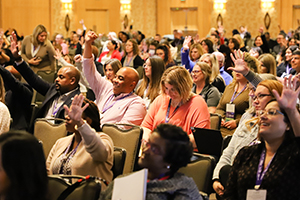
    Thank you to all who attended the CUPA-HR Annual Conference and Expo in person and virtually last week! It was wonderful to welcome new (300+ first-timers!) and familiar faces and to learn about successful projects and initiatives from higher ed peers at institutions across the country. 

    For those who weren’t able to attend, here’s some food for thought from our three outstanding keynote speakers:

    • Stand-Out Leadership — Opening keynote Sara Ross applied her passion for brain science to a key element of stand-out leadership: accountability. Ross explained that employees would rather have leaders who hold themselves accountable for their actions than perfect leaders. One way HR professionals can be stand-out leaders and hold themselves accountable is by using Ross’s SLOW strategy when responding to critical situations on campus. The SLOW strategy helps us respond in a way that is reflective of the positive impact we want to make in our roles as HR leaders.
      • S – Stop. Intercept your emotional reaction. Our brains are designed to process emotions first and logic second. By pausing and checking in with your emotions before responding to a situation, you prevent adding more fuel to the fire.
      •  L – Language. Check your body language. No really, look in the mirror! Pay attention to how you are presenting yourself. People are honed in on your body language, so you must make sure your body language is aligned with your message.
      • O – Oxygenate. Consciously slow your breathing to push back on your fight-or-flight instincts. Research shows that slowing down for as little as two minutes and deepening your breath can decrease the amount of cortisol in your system by up to 20 percent, which is essential when responding to an already stressful situation.
      • W – Wonder. Step outside your perspective and challenge yourself by thinking from someone else’s perspective. This simple practice helps reset our sensitivity and tap into empathy.
    • How to Citizen — Sunday’s keynote speaker, Baratunde Thurston, spoke about how racial injustices during the summer of 2020 motivated him to launch his podcast, “How To Citizen With Baratunde.” He challenged the audience to think about the word “citizen” as a verb rather than a noun. “Citizen” as a noun can carry divisive and exclusive undertones, but as a verb, it gives us something to do to improve our society. According to Thurston, there are four principles that serve as the foundation of how to “citizen.” The four principles are showing up and participating; investing in relationships with yourself and others; understanding power and what we give our power to; and to do all of these things to benefit our collective selves, not just our individual selves. What specific ways can you begin to “citizen” at your institution?
    • Reinvent HR — The take-home message from David Ulrich’s energizing talk about reinventing HR is that HR is not about HR, but about creating value for stakeholders inside and outside the organization (students, family, employers, community, alumni) so that our institutions and communities can succeed. Here are five ways HR can lead in this area: 1) Empower the next generation by making sure people feel better about themselves following their interaction with a leader, 2) Shape the future by establishing a compelling vision/mission, 3) Engage today’s talent by living the Es (empathy, emotion, energy, experience), 4) Make things happen by delivering on promises and creating a positive work environment, and 5) Invest in yourself so you can invest in others.

    Don’t Forget! Conference attendees can watch the sessions they missed or re-watch their favorites on demand. Recordings of our keynotes and livestreamed concurrent sessions are available for viewing in the desktop conference platform and the app.

    Be sure to save the dates for our Spring Conference, April 23-25 in Boston, and our 2023 Annual Conference, taking place October 1-3 in New Orleans! Registration details coming soon.


    Source link

  • Labor and Employment Policy Updates — October 2022 – CUPA-HR

    Labor and Employment Policy Updates — October 2022 – CUPA-HR

    by CUPA-HR | October 22, 2022

    As the 2022 midterm election nears, Congress has turned its focus to campaigning and essentially halted legislative action until after the election. Despite the lack of activity from Congress, federal agencies have continued to push forward with anticipated regulatory actions in the labor and employment policy area. This blog post details some of the regulatory activity CUPA-HR is currently monitoring, as well as a stalled nomination for a top position at the Department of Labor (DOL).

    NLRB Joint Employer Rule

    On September 7, the National Labor Relations Board (NLRB) issued a notice of proposed rulemaking (NPRM) on the joint employer standard. Generally speaking, the NPRM proposes to expand joint employer status to entities with indirect or reserved control over essential terms and conditions of employment.

    The NPRM establishes joint employer status of two or more employers if they “share or co-determine those matters governing employees’ essential terms and conditions of employment,” such as wages, benefits and other compensation, work and scheduling, hiring and discharge, discipline, workplace health and safety, supervision, assignment and work rules. According to the NLRB’s press release, the Board “proposes to consider both direct evidence of control and evidence of reserved and/or indirect control over these essential terms and conditions of employment when analyzing joint-employer status.”

    Comments in response to the proposal were originally due November 7, but after stakeholders requested an extension to the filing deadline the Board extended the comment period to December 7.

    Independent Contractor Rule

    On October 13, the DOL published an NPRM to rescind the current method for determining independent contractor status under the Fair Labor Standards Act. The current test finalized by the Trump administration in 2021 has two core factors of control and investment with three additional factors (integration, skill and permanency) that are relevant only if those core factors are in disagreement. The Biden rule proposes a return to a “totality-of-the-circumstances analysis” of multiple factors in an economic reality test, including the following six factors, which are equally weighted with no core provisions:

    • The extent to which the work is integral to the employer’s business;
    • The worker’s opportunity for profit or loss depending on managerial skill;
    • The investments made by the worker and the employer;
    • The worker’s use of skill and initiative;
    • The permanency of the work relationship; and
    • The degree of control exercised or retained by the employer control.

    Comments in response to the NPRM are due November 28.

    Jessica Looman Nomination

    On September 13, the Senate Health, Education, Labor and Pensions (HELP) Committee held a hearing on the nomination of Jessica Looman to serve as Administrator of the DOL’s Wage and Hour Division (WHD). Looman was officially nominated for the position in July 2022, months after Biden’s previous nominee David Weil failed to receive 50 votes to clear the Senate floor and become the WHD Administrator.

    Looman has not yet had a committee vote to move her nomination to a full Senate floor vote. It is unclear when a Senate HELP vote will take place, but is likely to come after the election in November. Regardless of the timing on a vote, Looman continues to carry out the WHD’s rulemaking agenda in her current role as the Principal Deputy Administrator.

    CUPA-HR will keep members apprised of any updates relating to the rulemakings and nomination discussed above.


    Source link

  • Kansas State University’s Braggin’ Wagon Offers a Unique Way to Recognize Campus Employees – CUPA-HR

    Kansas State University’s Braggin’ Wagon Offers a Unique Way to Recognize Campus Employees – CUPA-HR

    by CUPA-HR | October 19, 2022

    Think about a time you were recognized by a colleague for a job well done. Whether it was a grand gesture or a small act of recognition, chances are the personal shoutout put some pep in your step. Positive recognition in any form is a sure mood booster and helps move campus well-being in the right direction.

    In a recent CUPA-HR webinar, Refuel, Invest and Inspire Campus Well-Being, presenters from Kansas State University (K-State) shared a unique way of recognizing teams and departments on campus: the Braggin’ Wagon.

    The Braggin’ Wagon was developed by K-State’s Staley School of Leadership, which has a strong partnership with HR. The decorative travelling wagon is filled with treats, candy, small toys and other fun items for the receiving team to enjoy. Once the wagon is delivered to a department, it is up to that department to restock the wagon and deliver it to another department in order to keep the recognition going.

    This simple yet powerful way of recognizing campus employees serves a double purpose — it adds an element of fun to the work day for the team being recognized (who doesn’t love getting a surprise treat in the middle of a work day?), and it also gives the team passing on the wagon an opportunity to get out of the office for some exercise and take a mental break in the work day.

    When K-State resumed in-person work, it was important to put the emphasis on our employees and the solid work they were doing to make a difference. The Braggin’ Wagon was a way for departments to recognize other university partners who contributed to their work in a positive way,” says Shanna Legleiter, associate vice president of human capital services at K-State.

    With the Braggin’ Wagon as inspiration, what are some other creative ways HR can shine a spotlight on employees who work hard to keep campus operations running smoothly? Are there campus partnerships that can be formed to bring ideas for recognition to life? Don’t be afraid to think outside of the box when it comes to recognition opportunities!


    Source link

  • DHS Extends I-9 Flexibility Guidance Through July 2023 – CUPA-HR

    DHS Extends I-9 Flexibility Guidance Through July 2023 – CUPA-HR

    by CUPA-HR | October 12, 2022

    On October 11, the Department of Homeland Security (DHS) announced a further extension of the flexibilities on Form I-9 compliance requirements that have been in place since the onset of the COVID-19 pandemic. The guidance was set to expire October 31, but has now been extended through July 31, 2023.

    The guidance will continue to allow for remote inspection of Form I-9 documents in situations where employees work exclusively in a remote setting due to COVID-19-related precautions. For employees who physically report to work at a company location on any regular, consistent or predictable basis, employers are required to use standard I-9 procedures.

    On August 18, the DHS published a Notice of Proposed Rulemaking which would create a framework under which the Secretary would be authorized to extend the flexibilities on a more permanent basis. Given the length of time the rulemaking process takes, CUPA-HR is grateful for the DHS’s extension of the Form I-9 flexibilities.


    Source link

  • HR and the Courts – October 2022 – CUPA-HR

    HR and the Courts – October 2022 – CUPA-HR

    by CUPA-HR | October 4, 2022

    Each month, CUPA-HR General Counsel Ira Shepard provides an overview of several labor and employment law cases and regulatory actions with implications for the higher ed workplace. Here’s the latest from Ira.

    University’s Internal Investigation of Pay Equity Claims Protected By Attorney-Client Privilege — EEOC Fails In Attempt to Require Disclosure of Documents 

    A federal district court judge recently rejected the Equal Employment Opportunity Commission (EEOC)’s demand that a university turn over 54 documents related to an internal investigation the university conducted by inside and outside counsel concerning pay equity claims made by an athletic department employee who claimed she was paid approximately $37,000 less annually than a similarly situated male employee. The court rejected the EEOC’s argument that the investigation was conducted by the institution’s EEO office and did not involve seeking legal advice (Equal Employment Opportunity Commission v. George Washington University (2022 BL 308648, D.D.C., No. 1:17-cv-01978. 9/1/22)). The court ruled that the investigation and all related documents are protected by the attorney-client privilege.

    The court concluded that the university did not waive privilege by asserting good faith compliance with federal law as a defense to the EEOC’s claim for punitive damages. The court added that the university does not intend to use the documents in question in proving the good faith defense.

    Failure to Renew a Coach’s Discretionary Contract May Be an Actionable Adverse Employment Action Subject to a Title IX Retaliatory Termination Claim

    The Ninth Circuit Court of Appeals (covering California, Oregon, Washington, Arizona, Montana, Idaho, Nevada, Alaska and Hawaii) recently ruled that failure to renew a golf coach’s contract may be an adverse employment action subject to a Title IX retaliation claim (Macintyre v. Carroll College (9th Cir., No. 21- 35642, 9/8/22)). The plaintiff was hired as an assistant golf coach in 2006, promoted to head golf coach in 2007 and appointed associate athletic director in 2013. His contract was subject to renewal at the discretion of the college.

    The plaintiff became aware of what he thought was an improper disparity in the amount the college spent on men’s versus women’s athletic programs. He concluded that the college was out of compliance with applicable Title IX mandates. He alleges that after raising these issues with the interim athletic director and the Title IX coordinator he received negative performance reviews for the first time. He filed a grievance alleging discrimination. In settling the matter, he was given a two-year contract to be head golf coach. At the end of the two-year period his contract was not renewed. His current action alleges that the non-renewal was in retaliation for his raising Title IX concerns.

    The court, in ruling that the case should go forward, concluded that this non-renewal might be an adverse employment action and might deter employees from reporting discrimination.

    California Appeals Court Rules That Remote Work Due to COVID-19 Can Broaden Where Employees May Sue for Job Bias

    A California appellate court recently ruled that the COVID-19 pandemic and technological advances have changed the way people work. The court went on to hold that the venue provisions of the California Fair Employment and Housing Act were meant to remove barriers for suing for job discrimination. Therefore, the “modern reality” of work means that an employee who was fired while on pregnancy leave at her home in Los Angeles County can sue there rather than in Orange County where the employer was located (Malloy v. Superior Court of Los Angeles County ( 2022 BL 330038 Cal. St. App 2nd Dist, 9/19/22)).

    The court concluded that allowing remote workers to sue where they worked or would have worked effectuates the purposes of the Act. The case involved a demand by the plaintiff’s employer that she return to the physical office after her pregnancy leave had ended. After the plaintiff was fired for not coming back to work, the plaintiff sued under the California statute for pregnancy and sex discrimination and sex harassment, interference with her family and medical leave rights, and retaliation for trying to exercise her family and medical leave rights. The plaintiff also included a claim for wrongful termination in violation of public policy.

    California Moves Toward Requiring Employers to Prove Impairment Before Terminating an Employee for Cannabis Use

    In another California development which may spread to other states, the governor signed a new law which goes into effect on January 1, 2024 that prohibits employers from discriminating against employees who use cannabis during off-duty hours. Commentators conclude that this gives California employers 15 months to develop an accurate test on whether an employee is impaired at the job after smoking marijuana or consuming cannabis-infused snacks before firing them or otherwise disciplining an employee for marijuana use. The dilemma is that scientists conclude that there is currently no accurate test that determines impairment form using marijuana or cannabis products.

    Cosmetology Students and School Both Win Partial Summary Judgement on Claims That Students Should Be Paid For Work Completed as Part of School-Supervised Job Training

    A federal court in Michigan ruled in favor on summary judgement on some of the claims brought by cosmetology students that they should be paid for work performed as part of their course obligations to engage in supervised on-the-job training. The cosmetology school also won partial summary judgement regarding some of the tasks for which the student made wage claims (Eberline v. Douglas J. Holdings, Inc. (2022 BL 332583, E.D. Mich. Partial Summary Judgement 9/22/22)).

    The court divided the student tasks for which pay was claimed into three categories, namely client services, janitorial tasks and retail sales. The court held that there was no genuine dispute of facts on who was the primary beneficiary of client services tasks, ruling that the students were the primary beneficiary in this area, therefore granting partial summary judgement to the school. Similarly, the court ruled that there was no genuine dispute of facts on who was the primary beneficiary of janitorial tasks, ruling that the school was the primary beneficiary, therefore granting partial summary judgement to the students. Finally, the court ruled that there is a genuine dispute of facts on who is the primary beneficiary of retail sales tasks, thus ruling that this area must be given to a jury to decide.


    Source link

  • Build Psychological Safety and Fun Into the Workplace to Reduce Overwork and Burnout – CUPA-HR

    Build Psychological Safety and Fun Into the Workplace to Reduce Overwork and Burnout – CUPA-HR

    by CUPA-HR | September 28, 2022

    In the wake of the Great Resignation and talent recruitment challenges, heavy workloads have led to stress and burnout for some employees. One way higher ed HR pros can help identify sources of stress and mitigate burnout is by considering employees’ work environments. Are invisible pressures placed on employees, causing team members to downplay or hide their concerns about heavy workloads, or can employees be honest about their concerns and feel comfortable bringing their whole selves to work each day? How would employees describe the atmosphere where they work? Are levity and humor weaved into the workday, or is the lack of levity contributing to feelings of being overwhelmed?

    In the recent CUPA-HR virtual workshop, How to Manage Unmanageable Workloads, presenter Jennifer Moss explained how building psychological safety and bringing the fun back to work can reduce the impact of overwork and burnout. So what is psychological safety, and how can HR integrate it and the elements of fun and play into the workplace?

    Increase Psychological Safety

    “Psychological safety is the ability to reveal one’s true self and opinions without fear that doing so will lead to negative repercussions in terms of reputation, career, status or relationships with others,” explains Why Psychological Safety Matters Now More Than Ever, an article in the Spring 2021 issue of Higher Ed HR Magazine. Teams with high psychological safety see more open conversations between team members and managers about their work. They feel comfortable sharing honestly because they know they won’t be punished simply for doing so.

    Read the article to learn how HR pros can elevate psychological safety in the workplace by attending to systems and structures, supporting employees to forge connections, and fostering a learning orientation.

    Bring Back the Fun

    Although HR has much serious work to do, leaders can look for opportunities to incorporate fun, where appropriate. The application of fun and play has been shown to reduce stress and feelings of burnout while also improving creativity and productivity in working environments. Having fun at work has shown to have a positive impact on employee morale, engagement and camaraderie, all of which collectively have an influence on an organization’s culture. Here are some ideas to bring back the fun and stimulate play in the workplace.

    Encourage Humor

    Similar to incorporating more fun into the workplace, there are also plenty of benefits to weaving humor into the workplace. This element of work is sometimes considered non-essential but has many emotional and physical benefits that make us happier and healthier at work. Humor builds trust in relationships; a culture where it’s okay to admit failure; and happier, healthier employees. Learn how to conduct a humor audit to analyze where your workplace humor went right and ways to use it more effectively.

    Related resources:

    Health and Well-Being Toolkit (CUPA-HR members-only toolkit)

    How to Bring the Fun at Work (Higher Ed Workplace Blog)


    Source link

  • Three Elements of a Successful Onboarding Program – CUPA-HR

    Three Elements of a Successful Onboarding Program – CUPA-HR

    by CUPA-HR | September 14, 2022

    Onboarding programs consisting of a brief history lesson about the institution and instructions for how to get a parking pass aren’t likely to inspire new hires. Here are three elements of onboarding programs that go beyond the basics to create a deeper understanding of campus culture and a sense of belonging.

    Orient New Hires to Higher Education

    Learning industry-specific skills and knowledge is essential for employees to thrive in their workplaces. Higher education is no different. New hires must quickly get up to speed on how their departments function within the context of their institution and its mission. This can be overwhelming for anyone, especially someone new to higher education.

    To address this learning curve, CUPA-HR created Understanding Higher Ed Course 1 — An Overview of Higher Education for All Employees. The course is designed to help all higher ed employees understand different types of institutions, terminology, cultural hallmarks of the higher ed work environment, the basics of higher ed funding, and key soft skills that support success in the workplace.

    Create a Sense of Belonging

    A crucial aspect of the workplace that can’t be captured in a new-hire orientation video is the sense of belonging employees experience. And if staff members work remotely, opportunities to connect with coworkers and build community may be even more difficult to achieve.

    To overcome these challenges, the University of Florida’s Academic and Professional Assembly (APA), led by several HR employees, reconsidered their approach to onboarding. Through their Warm Welcome experience they helped create a campus culture that fosters a sense of belonging for new staff. The APA helps spark campus connections by hosting welcome events and small groups where new hires can interact with high-level leaders. During these events, leaders share personal stories and insights about leadership, diversity and inclusion and the value that staff bring in the pursuit of the university’s many goals. This storytelling approach draws out leaders’ personalities, camaraderie, sense of humor and transparency, and allows staff to see the “human” aspect of a large institution. Read more about UF’s Warm Welcome experience to learn how to design a warm welcome experience for your staff.

    Partner With Other Departments

    Onboarding shouldn’t fall solely on HR’s shoulders. Support from many areas of the institution is critical for a successful onboarding program. Additionally, shared responsibility for onboarding can positively affect organizational culture, departmental buy-in and employee retention. Presenters from the University of Colorado Boulder shared their strategic partner model in a 2019 CUPA-HR on-demand webinar “Onboarding: A Strategic Partner Model for Bringing About Cultural Change.” Watch the webinar recording to learn more about UC Boulder’s model to increase employee engagement, retention and productivity while keeping the focus on institutional goals.

    There are many reasons employees are drawn to work at an institution, and a successful onboarding program shows them why they should stay.


    Source link

  • CUPA-HR Submits Comments in Response to Title IX NPRM – CUPA-HR

    CUPA-HR Submits Comments in Response to Title IX NPRM – CUPA-HR

    by CUPA-HR | September 13, 2022

    On September 12, CUPA-HR submitted comments in response to the Department of Education (DOE)’s Notice of Proposed Rulemaking (NPRM) to amend Title IX. The NPRM seeks to rollback and replace the Trump administration’s 2020 Title IX rule, specifically with respect to its grievance procedures, and establish expanded protections against sex-based discrimination to cover sexual orientation, gender identity and pregnancy or related conditions.

    CUPA-HR filed comments to bring attention to the possible impact the proposed regulations could have on how higher education institutions address employment discrimination. In our comments, we highlight the two sets of grievance procedures promulgated by the proposal: procedures used for cases involving employee-on-employee sex-based harassment (section 106.45) and procedures used for sex-based harassment involving an employee and student, regardless of whether the employee involved is the complainant or respondent (section 106.46). Our comments argue that such procedures in cases where the employee is a respondent may be unnecessarily prescriptive and will interfere with existing obligations, policies and procedures already utilized by institutions that are required to handle such incidents of sex-based employment discrimination under Title VII of the Civil Rights Act of 1964 (Title VII) and state and local employment laws.

    In light of our concerns, our comments ask the DOE to exempt any sex-based harassment of employee respondents against a student complainant from the section 106.46 requirements, and to exempt all sex-based harassment claims where an employee is the respondent, regardless of whether the complainant is a student or an employee, from the section 106.45 requirements. These comments directly align with the concerns and requests written in the American Council on Education’s comments, which CUPA-HR also signed on to.

    Finally, our comments suggest that the DOE consult with other federal agencies with jurisdiction over discrimination law, including the Equal Employment Opportunity Commission to rationalize the requirements instituted by the Title IX regulations and Title VII, and to issue joint guidance on how to minimize potential conflicts between the obligations to claimants under Title VII and respondents under Title IX.

    The DOE received over 200,000 comments in response to the NPRM, which they must now review prior to issuing a final rule to implement their changes. It is therefore unclear when we can expect the final rule and effective date of the new regulations. CUPA-HR will keep members apprised of any updates on the Title IX regulations.


    Source link