Tag: CUPAHR

  • August Recess Roundup: Congressional and Regulatory Updates – CUPA-HR

    August Recess Roundup: Congressional and Regulatory Updates – CUPA-HR

    by CUPA-HR | August 22, 2022

    When August arrives, Congress leaves D.C. and heads to their home districts for the annual August recess period. To keep CUPA-HR members apprised of recent and future actions on the Hill and in federal agencies, here are highlights of the latest actions by Congress, nominations they’ll have to consider when they return, and regulations that may be issued throughout the month.

    Legislative Updates

    On August 16, President Biden signed the Inflation Reduction Act into law following its passage, along partisan lines, in both the U.S. Senate and House of Representatives. The Inflation Reduction Act, which is a slimmed down version of the reconciliation bill Democrats have been pushing for, focuses on policies to mitigate the impacts of climate change, reduce healthcare costs and increase tax revenue to reduce the federal budget deficit. This reconciliation bill was narrowed down from the “Build Back Better” agenda, a step necessary to gain support from Senators Joe Manchin (D-WV) and Kyrsten Sinema (D-AZ) to get the bill over the 50-vote threshold. Notably, the final package did not include “Build Back Better” provisions like paid leave, universal community college and childcare.

    Additionally, on August 9, President Biden signed the CHIPS and Science Act, which provided new funding to boost U.S. investments in research and manufacturing of semiconductors. With respect to the research investments, the bill includes a five-year, $81 billion authorization of the National Science Foundation to go toward research funding. Additionally, the bill provides new funding to historically black colleges and universities and other minority-serving institutions, and for STEM programs at colleges and universities.

    Nominations Awaiting Confirmation

    On July 27, President Biden announced Jessica Looman as the new nominee for the Department of Labor (DOL)’s Wage and Hour Division Administrator. Looman has been serving as acting administrator for the agency since June 2021. Her nomination replaces Biden’s previously withdrawn nomination of David Weil, who failed to garner enough support in the Senate to be confirmed. Looman’s nomination will have to go through the Senate Health, Education, Labor and Pensions (HELP) Committee prior to going to the Senate floor for a full vote. Timing on both votes are uncertain at this point.

    Additionally, Kalpana Kotagal’s nomination for the Equal Employment Opportunity Commission (EEOC) continues to be held up in the Senate. In May, the Senate HELP Committee deadlocked on a vote to move her nomination to the full Senate, which means the full Senate will have to vote to advance her nomination out of committee — a logistical hurdle in a 50-50 Senate with sparse time on their legislative calendar. The result of this hold up means the EEOC will continue to operate with a Republican majority as federal statute allows Republican Commissioner Janet Dhillon, whose term expired in July, to remain an active member of the EEOC while her successor’s nomination is pending. If and when nominee Kotagal is confirmed, she will replace Commissioner Dhillon and tip control of the EEOC to a 3-2 Democratic majority. Her confirmation vote is also uncertain at this point.

    Regulatory Updates

    Though not guaranteed, there may be several proposals and final regulations that may be released by the Department of Education, the DOL and other relevant agencies throughout the month. Some of these include the expected proposed rule on Form I-9 remote verification flexibilities from the Department of Homeland Security, which has already had its review completed by the White House; a proposed rule on independent contractor classification, which was sent to the White House for review in July; and a final rule on the Deferred Action for Childhood Arrivals program, which has a target release date set for August.

    In addition to these proposed and final rules CUPA-HR is waiting to be released, the Department of Education is still undergoing its notice-and-comment period for the Title IX proposed rule that was released in June. CUPA-HR is assessing the proposal and will put together comments in response to the proposed rule. Comments are due September 12.

    CUPA-HR will keep members apprised of legislative and regulatory actions as August recess continues and we move into the fall.


    Source link

  • Event Planning, Institutional Research, Museum, and Tutor Positions See Significant Growth in the Wake of the Pandemic – CUPA-HR

    Event Planning, Institutional Research, Museum, and Tutor Positions See Significant Growth in the Wake of the Pandemic – CUPA-HR

    by CUPA-HR | August 10, 2022

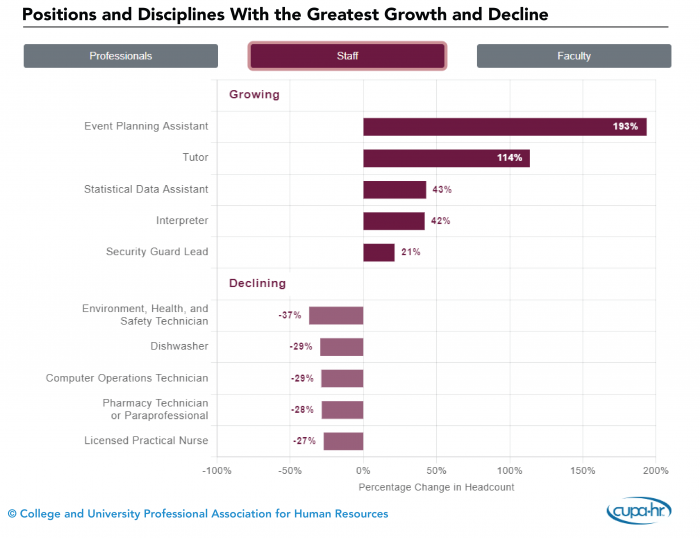
    According to data recently released by CUPA-HR, the higher ed workforce positions that saw the greatest growth from 2020-21 to 2021-22 were event planning assistant (up 193%), institutional research analyst (up 161%), head of campus museum (up 120%) and tutor (up 114%). These increases reflect an increase in the number of people hired to fill existing or newly created positions since 2020-21.

    The positions that saw the greatest decline in number of employees were environment, health and safety technician (down 37%), head of campus learning resources center (down 36%), online instruction operations manager (down 32%) and dishwasher (down 29%). These decreases reflect a decrease in the number of people in these positions since 2020-21, either because the institution has reduced the number of available positions or because those positions have unfilled vacancies.

    A new interactive graphic from CUPA-HR shows the Positions and Disciplines With the Highest Growth and Decline for higher ed professionals, staff and tenure-track faculty.

    The Ongoing Impact of COVID-19

    In many cases, the growth and decline in these positions over the past year reflect the impact of the COVID-19 recession that began in the spring of 2020. Like so many employers, institutions have experienced the effects of the Great Resignation and the subsequent challenges of talent recruitment amid the growing availability of remote and flexible work options.

    Other factors may also be at work. The return to in-person events, the growing demand for data to inform institutional decision-making, and the continued interest in honoring the cultural histories of institutions may have increased demand for the positions that saw the greatest increases. Also, as the high school graduates most impacted by the pandemic’s disruption of classroom learning make their way to college, more tutors may be needed to help them bridge anticipated gaps.

    Smaller Shifts in Faculty

    Overall, tenure-track faculty saw much smaller increases and declines in the years analyzed. Disciplines with the highest growth were Library Science (up 8.4%), Liberal Arts and Sciences (up 7.0%), and Area, Ethnic, Cultural, Gender and Group Studies (up 2.3%). Disciplines with the greatest declines were Communications Technologies (down 22%), Agriculture (down 9%) and Engineering Technologies and Technicians (down 6.4%).

    More About the Results

    The data for these results came from CUPA-HR’s annual Professionals in Higher Education Survey, Staff in Higher Education Survey and Faculty in Higher Education Survey. Analyses included more than 600 institutions that participated in each survey in both years of the comparison. For additional details, see the interactive graphic in the Research Center. These data and more are available through CUPA-HR’s DataOnDemand subscription service.


    Source link

  • HR and the Courts – August 2022 – CUPA-HR

    HR and the Courts – August 2022 – CUPA-HR

    by CUPA-HR | August 9, 2022

    Each month, CUPA-HR General Counsel Ira Shepard provides an overview of several labor and employment law cases and regulatory actions with implications for the higher ed workplace. Here’s the latest from Ira.

    EEOC Reaches Settlement Banning Employer Collection of Family COVID-19 Testing Results — GINA Implications 

    In a case involving a dermatology medical practice in Florida, the EEOC reached a settlement of the charge it brought against the employer medical. The case alleged that the employer violated the Genetic Information Nondiscrimination Act of 2008 (GINA) when it collected family COVID-19 testing results of its employees. Title II of GINA bans employers from collecting an employee’s genetic testing results and a worker’s family medical history.

    However, the EEOC also issued guidance stating that an employer can still ask its employees if they had contact with anyone who has been diagnosed with COVID-19 or who has had symptoms of COVID-19. Nonetheless GINA prohibits employers from inquiring directly and specifically as to the COVID-19 status of an employee’s family members.

    The EEOC also recently issued guidance on July 12, 2022, that, going forward, before requiring employees to submit to COVID-19 testing, employers should consider whether current pandemic circumstances and individual workplace circumstances justify viral screening of employees. Essentially the EEOC’s position is that before going forward with workplace COVID-19 screening, the employer must demonstrate a “business necessity” based on general pandemic circumstances and individual workplace circumstances.

    Federal Court Holds That Discharge Proximity to an Employee’s Filing for Extended FMLA Leave Warrants a Jury Trial Over Retaliatory Discharge Claims 

    A federal district judge recently ruled that a plaintiff’s claim that her discharge shortly after seeking an extension in FMLA leave to deal with mental health problems was retaliatory  warrants a jury trial over FMLA retaliatory discharge allegations and dismissed the employer’s motion for summary judgement. The plaintiff was a human resources manager who allegedly suffered from depression and anxiety. The employer argued that it was entitled to summary judgement because the plaintiff was discharged before the employer made a decision on the FMLA extension request. The judge concluded that gaps and inconsistencies in the employer’s explanation of the reasons for discharge warrant a finding of fact by a jury as to the timing and reason for discharge (Moryn v. G4S Secure Solutions USA, Inc. (2022 BL 222775 Dist Minn. No. 0:21-cv-00123, 6/28/22)).

    The plaintiff had requested and received a three-month leave of absence based on the recommendation of her physician for mental health reasons. When the three-month leave concluded, the employee requested an additional month followed by a part-time work schedule that progressively added more days to the job.

    Separately the judge dismissed the allegations under Minnesota state discrimination law related to disability discrimination and the allegations that the employer failed to accommodate the plaintiff.

    Court of Appeals Rules That a State Agency’s Banning of “Black Lives Matter” Adornments to Employee Uniforms Violates the First Amendment

    The U. S. Court of Appeals for the 3rd Circuit (covering Pennsylvania, New Jersey and Delaware) affirmed the decision of a federal trial court, which ruled that a Pennsylvania local transit authority violated the First Amendment guarantee of free speech by prohibiting Black Lives Matter adornments on employees’ uniforms as part of its policy prohibiting political and social adornments on employee uniforms.

    The court of appeals also ruled that the Allegheny County Port Authority’s policy revision, which allowed employees to wear only certain masks to make it easier for the authority to enforce its ban on Black Lives Matter messaging, violated the First Amendment. The case challenging the transit authority’s policies was brought by the employees’ union in Amalgamated Transit Union Local 85 v. Port Authority of Allegheny County (3rd Cir. No. 21-1256, 6/29/22 ).

    U.S. Supreme Court Rules in Favor of Football Coach’s After-Game Prayer, Concluding His Discharge Violates the First Amendment Free Speech and Religion Provisions 

    In a long-awaited and controversial decision, the U.S. Supreme Court ruled against a school district firing of a football coach who refused to abandon his long-practiced ritual of kneeling in prayer at the 50-yard line at the conclusion of each football game. In doing so, the Supreme Court overruled the decision of the 9th U.S. Circuit Court of Appeals ruling in favor of the school district. The football coach argued that he had agreed to the school district’s demands that he stop leading prayers with his players, but wanted to continue taking a knee in prayer alone after each game.

    Justice Neil Gorsuch concluded that the case was about “three quiet prayers,” and because no student joined in those prayers, the coach was acting as a private citizen, not a school employee or coach. The justice concluded that the coach was not acting within the scope of his activities as a coach and therefore his actions were protected by the First Amendment. The Supreme Court decision was a divided one, 6 to 3 (Kennedy v. Bremerton School District ( US 21-418, 6/27/22 )).

    NLRB Reports That Private-Sector Union-Organizing Petitions Have Risen 58% and Unfair Labor-Practice Charges Filed by Employees Have Risen 16% in Fiscal Year 2022

    The National Labor Relations Board (NLRB) reported a sharp increase in private-sector union-organizing petitions filed during the first three quarters of fiscal 2022 (October 1-June 30), concluding that union-organizing petitions rose by 58%. The increase in union-organizing petitions has been across the board in the private sector and not limited to high-profile organizing nationwide at Starbucks and Amazon. U.S. workers filed 1,892 organizing petitions in the first three quarters of fiscal 2022 as compared to 1,197 petitions in the first three quarters of fiscal 2021.

    The data also show that U.S. workers filed 16% more unfair labor-practice charges against employers during the first three quarters of fiscal 2022. Unfair labor-practice charges at the end of June had increased from 11,451 in fiscal 2021 to 13,105 in fiscal 2022.


    Source link

  • The Wildfire Program Welcomes a New Cohort for 2022-23 – CUPA-HR

    The Wildfire Program Welcomes a New Cohort for 2022-23 – CUPA-HR

    by CUPA-HR | August 3, 2022

    For the higher ed HR community to thrive there must be a pipeline of early-career professionals waiting in the wings, and one way CUPA-HR equips early-career pros to grow in their role and take steps toward their career goals is through the Wildfire program.

    The program, sponsored in part by HigherEdJobs, is a 12-month immersive experience that connects a small, select group of early-career higher ed HR professionals with some of the top leaders in the profession, giving them a variety of learning opportunities.

    Rob Keel, a member of the 2019-20 Wildfire cohort and past president of the CUPA-HR Tennessee Chapter, had this to say about the program: “Wildfire helped open my eyes to the possibilities within higher education HR. The network I gained through my involvement with Wildfire has provided so much support as I navigate my career. If you want to develop relationships that have the power to transform, Wildfire has the power to do just that.”

    As a new year gets underway, we want to congratulate and welcome the Wildfire program participants for 2022-23:

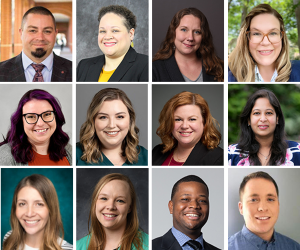
    • TJ Bowie, Equal Opportunity and HR Compliance Manager, Elon University
    • Joy Brownridge, Training and Development Specialist, University of Illinois System
    • Amanda Burshtynsky, Employee Payroll and Insurance Clerk, Genesee Community College
    • Kelleebeth Cantu, HR and Employment Coordinator, Trinity University
    • Audrey Ettesvold, Human Resource Specialist, Idaho State Board of Education
    • Alexis Hanscel, Benefits Manager, Denison University
    • Kathleen Hermacinski, Human Resource Coordinator, Eureka College
    • Anshuma Jain, HR Administrator, Hudson County Community College
    • Jessica Ludwick, Human Resources Consultant, University of North Carolina Wilmington
    • Tracey Pritchard, HR Coordinator, University of Iowa
    • Trevon Smith, HR Generalist, Drake University
    • Christopher Williams, HR Partner, University of Maine System Office

    Interested in joining our 2023-24 cohort? Learn more about the Wildfire program.


    Source link

  • Federal Judge Blocks Department of Education’s Title IX Guidance – CUPA-HR

    Federal Judge Blocks Department of Education’s Title IX Guidance – CUPA-HR

    by CUPA-HR | July 27, 2022

    On July 15, a federal judge from the U.S. District Court of the Eastern District of Tennessee issued a preliminary injunction blocking enforcement of the Department of Education’s Title IX guidance that prohibits discrimination on the basis of gender identity and sexual orientation. Specifically, the ruling blocks enforcement of a June 2021 Notice of Interpretation issued by the department’s Office for Civil Rights (OCR) in light of the Supreme Court’s 2020 decision in Bostock v. Clayton County and President Biden’s Executive Order, “Guaranteeing an Educational Environment Free from Discrimination on the Basis of Sex, Including Sexual Orientation and Gender Identity.”

    Twenty Republican-controlled states, led by their attorneys general, were listed as plaintiffs on the case, arguing that the department’s guidance should not be enforced by the agency as it did not go through the notice-and-comment rulemaking process and is not codified law. They claimed that the department’s enforcement of the guidance also puts states at risk of losing significant federal funding if they do not comply with the guidance. The Eastern District of Tennessee judge ruled in favor of the plaintiffs, issuing the preliminary injunction while stating that the guidance interferes with states’ abilities to enforce their own laws that prohibit transgender students from participating on sports teams or using restrooms that align with their gender identity.

    As it currently stands, the injunction applies only to the 20 states listed as plaintiffs in the case, potentially impacting the policies of colleges and universities in those states. Notably, the injunction does not impact the recently issued Title IX proposed regulations that are currently undergoing a 60-day notice-and-comment period. If the Title IX regulations are codified into law, however, they may face similar legal challenges.

    CUPA-HR will continue to monitor this issue and keep members apprised of any developments related to Title IX.


    Source link

  • More Than Half of College and University Employees Say They Are Likely to Look for Other Employment in the Near Future – CUPA-HR

    More Than Half of College and University Employees Say They Are Likely to Look for Other Employment in the Near Future – CUPA-HR

    by CUPA-HR | July 21, 2022

    New research from CUPA-HR shows that higher education institutions are in the midst of a talent crisis, as many staff, professionals and administrators are considering other employment opportunities due to dissatisfaction with their pay, their opportunities for advancement, their institutions’ remote and flex work policies, and more.

    The newly published research report, The CUPA-HR 2022 Higher Education Employee Retention Survey: Initial Results, provides an overview of what proportion of the higher ed workforce is at risk for leaving, why they’re considering leaving employment, and with which policies, work arrangements and benefits employees are satisfied or dissatisfied. The report includes several recommendations for addressing these issues.

    Data from 3,815 higher ed employees across 949 institutions and representing 15 departments/functional areas were analyzed for this report.

    Findings

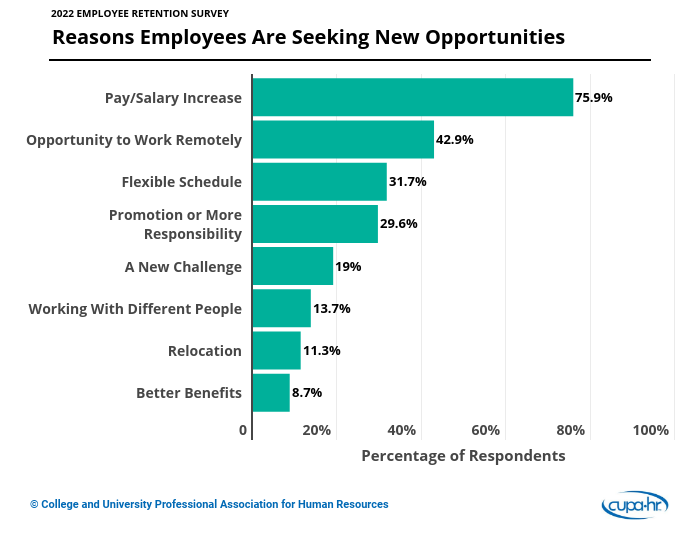
    Higher ed employees are looking for other jobs, mostly because they desire a pay increase. More than half (57%) of the higher ed workforce is at least somewhat likely to look for other employment opportunities in the next 12 months. The most common reason for seeking other employment (provided by three-fourths of those likely to look for another job) is an increase in pay. Other reasons are that they desire more remote work opportunities, a more flexible schedule, and a promotion or more responsibility.

    Higher ed institutions are not providing the remote work opportunities that employees want. Nearly three-fourths (71%) of employees report that most of their duties can be performed remotely, and 69% would prefer to have at least at least a partially remote work arrangement, yet 63% are working mostly or completely on-site.

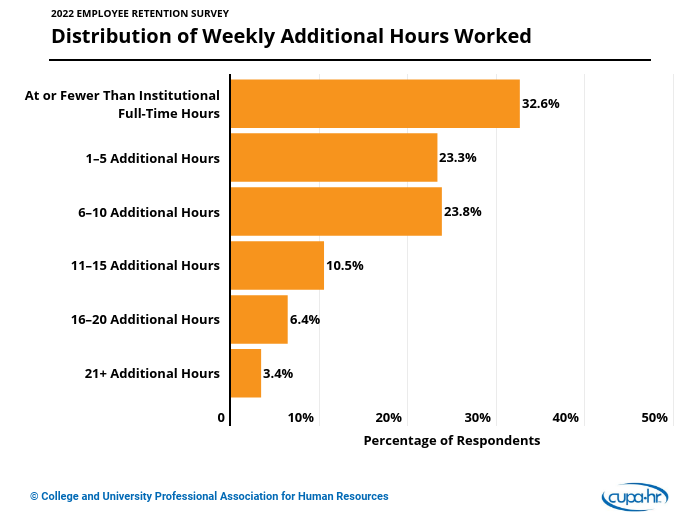
    Higher ed employees are working longer and harder than ever. Two-thirds (67%) of full-time staff typically work more hours each week than what is considered full-time. Nearly two-thirds (63%) have taken on additional responsibilities of other staff who have recently left, and nearly three-fourths (73%) have taken on additional responsibilities as a direct result of the pandemic.

    Higher ed employees have clear areas of satisfaction and dissatisfaction. Areas of satisfaction include benefits, relationship with supervisor, job duties, and feeling a sense of belonging. Areas of dissatisfaction include investment in career development, opportunities for advancement, fair pay, remote work policies and parental leave.

    Read the full report.


    Source link

  • Association Leaders Gathered to Learn, Laugh and Launch a New Year at the 2022 ALP! – CUPA-HR

    Association Leaders Gathered to Learn, Laugh and Launch a New Year at the 2022 ALP! – CUPA-HR

    by CUPA-HR | July 20, 2022

    CUPA-HR’s Association Leadership Program (ALP) has taken place every July for more than two decades, bringing together chapter, region, and national board members; association staff; key corporate partners; and other invited guests. After two years of meeting only virtually, these leaders were finally able to meet again in person last week.

    “We’re Still Standing!”

    The HR challenges of the past two years have included leading emergency COVID-19 response, exploring a new frontier of flexible work, and addressing unprecedented talent recruitment and retention challenges. Through it all, higher ed HR professionals have been on the front lines, adapting and transforming the workplace with resourcefulness, leadership and strategic insights.

    To celebrate that strength and resilience, CUPA-HR president and CEO, Andy Brantley, and national board chair, Jay Stephens, kicked off the two-day meeting with Elton John’s “I’m Still Standing” playing in the background and issued an irresistible photo challenge for attendees. (Be sure to check out the photos posted to Twitter with the hashtag #cupahr22.)

    Building Knowledge and Connection

    The ALP’s highly interactive program included:

    • tips for managing chapters and developing a leadership pipeline
    • updates on CUPA-HR’s work on Title IX and other public policy imperatives
    • a practical overview of CUPA-HR’s DEI Maturity Index and new Research Center
    • a discussion of winning strategies for higher ed’s post-pandemic war for talent
    • a presentation on cultivating trauma-informed practice in higher education leadership

    Beyond the programming, however, what attendees valued most about the event was the opportunity to validate their campus experiences in conversations with peers, rekindle the motivation behind their work, and take away great ideas for transforming their HR teams and their institutions in ways big and small.

    Interested in Taking Your Professional Development Further?

    CUPA-HR’s volunteer leaders have committed to advancing the profession and the mission of CUPA-HR. They understand the complexities of higher ed HR, and they want to enhance the knowledge and skills they need to lead their institutions into the future.

    Are you ready to take that next step in developing your leadership skills, shaping the profession, and gaining one-of-a-kind access to successful practices and HR professionals from across the country? Then CUPA-HR leadership — in a chapter, at the region level, or even on the national board of directors — might be right for you. Learn more about how you can get involved.


    Source link

  • The Emerging CUPA-HR Leaders Program Welcomes a New Cohort for 2022-23 – CUPA-HR

    The Emerging CUPA-HR Leaders Program Welcomes a New Cohort for 2022-23 – CUPA-HR

    by CUPA-HR | July 19, 2022

    The goal of CUPA-HR’s Emerging CUPA-HR Leaders program is to identify potential volunteer leaders who have shown exemplary leadership and initiative within higher ed HR and exhibit the desire to play an active role in advancing the profession. Invited participants have the unique opportunity to engage in problem-solving work groups and develop deep networks with peers while gaining an inside look at CUPA-HR’s operations and structure.

    Throughout the program, participants are encouraged to serve the association in a leadership capacity, lending a fresh and informed perspective. Many participants have gone on to hold positions on chapter boards, region boards and CUPA-HR’s national board of directors.

    The 2021-22 Cohort Curated Best Practices for CUPA-HR Chapters

    Before our previous cohort of leaders embark on the next step in their professional journeys, we want to acknowledge a special project they developed over the past several months. Each year, CUPA-HR recognizes outstanding work by chapters across the country, especially in the areas of event planning and programming, engagement, chapter management and leader development. The 2021-22 Emerging CUPA-HR Leaders wanted to collect those best practices in a format that was easy to share with future chapter leaders. As a result, CUPA-HR’s Chapter Toolkit now includes recorded interviews with some of CUPA-HR’s most experienced chapter leaders passing along lessons learned and secrets to chapter success.

    Many thanks to our 2021-22 Emerging CUPA-HR Leaders for their time and efforts:

    • Meg Arnold, Director of Organizational Development at Belmont University
    • Nicole Englitsch, Organizational Development Specialist at The University of Texas Rio Grande Valley
    • Jamee Harrington, Chief HR officer at Rogue Community College
    • Shannon Raum, Assistant Director of HR at Notre Dame of Maryland University
    • Taylor Zeilinger, HR Manager at the University of Wisconsin-Madison

    The 2022-23 Cohort Will Explore New Ways to Grow the Profession

    “We are excited to welcome this year’s Emerging CUPA-HR Leaders cohort,” says CUPA-HR President and Chief Executive Officer Andy Brantley. “These individuals are outstanding higher education human resources leaders who will help us lead the association into the future.”

    Congratulations to the 2022-23 Emerging CUPA-HR Leaders:

    • Laura Good, Assistant Director of Human Resources and Benefit Systems Manager, University of Mount Union
    • Leslie Hardin, Vice President Human Resources, Johnson County Community College
    • Beth Muha, Assistant Vice President of Human Resources, American University
    • Allyson Mullin, Executive Director of Human Resources, Alvernia University
    • Krista Vaught, Assistant Director, Employee Learning and Engagement, Vanderbilt University
    • Angela Wurtsmith, Executive Director of Human Resources, Colorado Mountain College

    Interested in joining our 2023-24 cohort? Learn more about the Emerging CUPA-HR Leaders program.


    Source link

  • HR and the Courts – July 2022 – CUPA-HR

    HR and the Courts – July 2022 – CUPA-HR

    by CUPA-HR | July 6, 2022

    Each month, CUPA-HR General Counsel Ira Shepard provides an overview of several labor and employment law cases and regulatory actions with implications for the higher ed workplace. Here’s the latest from Ira.

    Long Awaited Title IX Regulations Issued

    On Thursday, June 23 the Biden administration’s Department of Education issued its long anticipated new Title IX proposed regulations. The proposed regulations consist of a 700-page document published in the Federal Register and open for public comment for 60 days. The significant highlights of the proposed regulation include the expanding of the definition of sex harassment to include as prospective claimants those who allege discrimination or harassment based on sexual orientation, gender identity, pregnancy and any situation that creates a “hostile environment.”

    The proposed regulations throw out the Trump administration’s definition of sex harassment, which required the alleged sex harassment be “so severe and pervasive as to be objectively offensive,” and return to the pre-Trump era’s “severe and pervasive” standard, which is consider by most commentators to be a lower bar for future alleged sex harassment victims.

    The proposed regulations also expand jurisdiction over alleged sex harassment to include off-campus and out of the country matters, including study abroad situations. Finally, the proposed regulations also eliminate the requirement that investigations include cross examination of victims and in-person hearings. We will follow developments as these regulations ultimately wind their way to finalization. Learn more.

    Court of Appeals Rules That a Professor Has an Independent Right to Sue a University Under Title IX for an Alleged Gender-Biased Sex Harassment Allegation Which Led to His Denial of Tenure 

    The U.S. Court of Appeals for the 2nd Circuit (covering New York, Vermont and Connecticut) ruled that a professor has an “implied right” of action for alleged gender bias under Title IX concerning the conduct of a Title IX investigation into charges of sex harassment brought by a student. The 2nd Circuit joined a number of other circuit courts in holding that Title IX grant professors have a right to sue under similar alleged circumstances (Vengalatorre v. Cornell University (2nd Cir. No. 15-14, 6/2/22)).

    The professor alleged that the university’s procedures for investigating the allegations were “fundamentally flawed,” as the student’s allegations were time-barred under the university’s Title IX procedures. The university continued its investigation under the university’s “Romance Policy,” which took the investigation out of the hands of the Title IX coordinator and Title IX investigators. The investigation continued under the jurisdiction of a faculty committee, which the plaintiff alleged would not take action against allegedly false accusations because of “Twitter blow back.” The professor alleges that he was denied tenure as a result of a gender-biased investigation. The court ruled that the professor can proceed to trial over his allegations under Title IX.

    Transgender Sheriff’s Deputy Wins Title VII Lawsuit Over Denial of Coverage for Sex-Change Surgery but Loses ADA Claim Based on Gender Dysphoria

    A federal district judge in Georgia ruled in favor of  a sheriff’s deputy that she was improperly denied coverage for sex change and related genital surgery under the county’s health plan. The judge ruled that pursuant to the Supreme Court’s 2020 decision in the Bostock case that gender identity discrimination is prohibited by Title VII of the Civil Rights Act of 1964. The judge ruled that the exclusion for “sex change surgery” contained in the county’s insurance policy is facially discriminatory to transgender plan participants (Lang v. Houston County (2022 BL 191359  M.D. Ga. No. 5:19-cv-00392, 6/2/22)).

    The judge observed that it is undisputed that mastectomies are covered when they are medically necessary for cancer treatment but not when they are medically necessary for a sex change procedure. Similarly hormone replacement therapy is covered when medically necessary to treat menopause but not when medically necessary for a sex change. The judge concluded that this exclusion applies only to transgender participants and therefore violates Title VII.

    However, the judge dismissed plaintiff’s claims under the ADA. The Judge ruled that the ADA exclusion of “gender identity disorders” from coverage under the statute applies to plaintiff’s medical condition of “gender dysphoria.”

    University Subject to Gender-Based Discrimination Claim by Professor/Applicant for Position Never Filled

    The Court of  Appeals for the 6th Circuit recently over turned a trial court’s dismissal of a Title IX gender discrimination lawsuit filed by the top-ranked applicant for a position that was not filled. The plaintiff, a male, alleged gender discrimination against him by way of a plot to leave the leave the position he was ranked number one for unfilled, and then create two new, separate positions that were filled by female applicants. The trial court dismissed the case as “unripe” as the original position was never filled. The appeals court reversed, holding that an employer can commit hiring bias a number of ways, including cancelling a job opening in favor of creating a new position in which to hire employees of a different gender (Charlton-Perkins v. University of Cincinnati (2022 BL 292328, 6th Cir. No. 21-13840, 6/3/22)).

    The appeals court concluded that the alleged failure to hire the male plaintiff professor, despite the fact he was the number one applicant, is enough by itself to describe an adverse employment action and state an actionable discrimination claim for relief.

    North Carolina State Plan Covering Teacher and State Employees Ordered to Pay Employees’ Transgender Care

    The North Carolina Medical Plan for Teachers and State Employees’ exclusion of gender-confirmation coverage discriminates against transgender employees and their dependents on the basis of sex and transgender status in violation of the Constitution’s equal protection clause and Title VII, concludes the U.S. District Court for the Middle District of North Carolina (Kadel V. Falwell (M.D.N.C., No. 19-cv-272, 6/10/22)). The court observed that the plan distinguishes between medically necessary drugs that conform to the patients biological sex and medically necessary drugs that do not. A similar case is pending with the Arizona State Plan, which we recently reported on.


    Source link

  • DOL Targets October 2022 for Release of a New Overtime Proposal – CUPA-HR

    DOL Targets October 2022 for Release of a New Overtime Proposal – CUPA-HR

    by CUPA-HR | June 29, 2022

    On June 21, the Biden administration released the anticipated Spring 2022 Unified Agenda of Regulatory and Deregulatory Actions (Regulatory Agenda), providing the public with a detailed glimpse into the regulatory and deregulatory activities under development across approximately 67 federal departments, agencies and commissions. Agendas are generally released in the fall and spring and set target dates for each agency and sub-agency’s regulatory actions for the coming year.

    Based on a thorough review of the Regulatory Agenda, CUPA-HR would like to highlight the following proposed actions for members, including an updated target date for the release of a new overtime proposal.

    Department of Labor

    Wage and Hour Division – Defining and Delimiting the Exemptions for Executive, Administrative, Professional, Outside Sales and Computer Employees

    According to the Regulatory Agenda, the Department of Labor (DOL)’s Wage and Hour Division (WHD) is now planning to release a Notice of Proposed Rulemaking (NPRM) to address changes to the Fair Labor Standards Act (FLSA)’s overtime pay requirements in October 2022. In the Fall 2021 Regulatory Agenda, WHD announced their intention to move forward with the NPRM with the goal “to update the salary level requirement of the section 13(a)(1) exemption [under the FLSA].”

    Changes to overtime pay requirements have been implemented through regulations under both the Obama and Trump administrations. In May 2016, the Obama administration’s DOL issued a final rule increasing the salary threshold from $23,660 to $47,476 per year and imposed automatic updates to the threshold every three years. However, court challenges prevented the rule from taking effect and it was permanently enjoined in September 2017. After the Trump administration started the rulemaking process anew, in September 2019, DOL issued a new final rule raising the minimum salary level required for exemption from $23,660 annually to $35,568 annually. This final rule went into effect January 1, 2020, and it remains in effect today.

    From April through June 2022, DOL held several listening sessions for interested stakeholders to discuss any support or concerns they may have with the anticipated rulemaking. CUPA-HR participated in all of the calls, expressing our concerns with the timing of the rulemaking as it relates to the ongoing challenges of the COVID-19 pandemic, a historically tight labor market, and increasing inflation.

    Employment and Training Administration – Strengthening Wage Protections for the Temporary and Permanent Employment of Certain Aliens in the United States

    In October 2022, DOL’s Employment and Training Administration (ETA) plans to issue an NPRM to establish “a new wage methodology for setting prevailing wage levels for H-1B/H-1B1/E-3 and PERM programs consistent with the requirements of the Immigration and Nationality Act.” The proposal will likely amend the Trump administration’s final rule that was scheduled to take effect on November 14, 2022, but was subsequently vacated by a federal court in June 2021. The new proposal, which is included in the Department’s Statement of Regulatory Priorities, will take into consideration the feedback it received in response to a Request for Information (RFI) on data and methods for determining prevailing wage levels “to ensure fair wages and strengthen protections for foreign and U.S. workers.”

    CUPA-HR filed comments in opposition to the Trump administration’s regulations on the issue and in response to the Biden administration’s RFI.

    National Labor Relations Board

    Joint Employer

    In July 2022, the National Labor Relations Board (NLRB) is planning to release an NPRM to potentially amend the standard determining when two employers may be considered joint employers under the National Labor Relations Act. The new standard will revise the 2020 Trump Administration’s final rule, which reversed the Obama-era NLRB decision in the 2015 Browning-Ferris Industries case and established that an entity can only be a joint employer if it actually exercises control over the essential terms and conditions of another employer’s employees. While details of the Democratic-majority NLRB’s NPRM on joint employer status are unknown, we would expect them to revise the current standard to reflect the Obama-era decision.

    Department of Homeland Security

    USCIS – Modernizing H-1B Requirements and Oversight and Providing Flexibility in the F-1 Program

    In May 2023, the Department of Homeland Security (DHS)’s United States Citizenship and Immigration Services (USCIS) plans to release an NPRM to “amend its regulations governing H-1B specialty occupation workers and F-1 students who are the beneficiaries of timely filed H-1B cap-subject petitions.” The NPRM will specifically propose to “revise the regulations relating to ‘employer-employee relationship’ and provide flexibility for start-up entrepreneurs; implement new requirements and guidelines for site visits including in connection with petitions filed by H-1B dependent employers whose basic business information cannot be validated through commercially available data; provide flexibility on the employment start date listed on the petition (in limited circumstances); address ‘cap-gap’ issues; bolster the H-1B registration process to reduce the possibility of misuse and fraud in the H-1B registration system; and clarify the requirement that an amended or new petition be filed where there are material changes, including by streamlining notification requirements relating to certain worksite changes, among other provisions.”

    ICE – Optional Alternative to the Physical Examination Associated With Employment Eligibility Verification (Form I-9)

    According to the Regulatory Agenda, DHS plans to issue an NPRM in July 2022 to “revise employment eligibility verification regulations to allow the Secretary to authorize alternative document examination procedures in certain circumstances or with respect to certain employers.”

    DHS has provided temporary flexibility in the Form I-9 verification process since the beginning of the COVID-19 pandemic. Specifically, the flexibility guidance allows for remote inspection of Form I-9 documents in situations where employees work exclusively in a remote setting due to COVID-19-related precautions. While that guidance is only temporary, DHS issued a Request for Public Input (RPI) on October 26, 2021, to determine whether those flexibilities should be kept in place permanently. It is possible that DHS will use that feedback to develop and implement this NPRM.

    CUPA-HR has engaged with DHS on the Form I-9 flexibilities through the pandemic. Most recently, DHS announced an additional extension of the Form I-9 flexibility guidance through October 31, 2022. CUPA-HR sent a letter to USCIS Director Ur M. Jaddou asking for this additional extension. Additionally, CUPA-HR submitted comments in response to the RPI based on a recent survey detailing members’ experiences with the Form I-9 verification process flexibilities.

    On June 7, ICE sent its proposal to the Office of Information and Regulatory Affairs (OIRA). OIRA is the White House office responsible for reviewing regulations and proposed regulations before they are publicly released and generally takes 30-90 days for this review, indicating ICE is on target to issue their proposal in July.

    Department of Agriculture

    Agriculture Acquisition Regulation: Internal Policy and Procedural Updates and Technical Changes

    In December 2022, the Department of Agriculture (USDA) plans to re-propose an NPRM that was previously issued in February 2022 and included controversial provisions that would require federal contractors on projects procured by the agency to certify their compliance with dozens of federal and state labor laws and executive orders.

    In the February NPRM, USDA provided only 32 days for stakeholder comment submissions on the proposal. CUPA-HR filed an extension request with the department asking for an additional 90 days to “evaluate the NPRM’s impact on [members’] research missions and collect the information needed in order to provide thoughtful and accurate input to the USDA,” as well as official comments that were pulled from 2012 comments CUPA-HR submitted with the Society for Human Resource Management (SHRM).

    While it is unclear whether the December NPRM will include the blacklisting language again, the abstract of the re-proposal states that “the new proposed rule would be responsive to the comments received on our February 2022 proposal.”


    Source link