Tag: CUPAHR

  • CUPA-HR Submits Letter to DOL Requesting Stakeholder Meetings Prior to Anticipated Overtime Proposed Rule – CUPA-HR

    CUPA-HR Submits Letter to DOL Requesting Stakeholder Meetings Prior to Anticipated Overtime Proposed Rule – CUPA-HR

    by CUPA-HR | February 8, 2022

    On February 8, CUPA-HR and 14 higher education organizations sent a letter to the Department of Labor (DOL) Wage and Hour Division (WHD)’s Acting Administrator Jessica Looman requesting that the agency engage in stakeholder meetings with the higher education community during the initial stages of the rulemaking process for the anticipated overtime rule.

    In December 2021, the DOL announced in its Fall Regulatory Agenda that it plans to issue a Notice of Proposed Rulemaking (NPRM) this April to update the salary level to qualify for the executive, administrative and professional employee exemptions (collectively known as “white collar” or “EAP” exemptions) to the Fair Labor Standard Act’s overtime pay requirements. In 2015, the Obama administration’s DOL proposed an increase to the threshold of over 100 percent from $23,660 to $50,440 per year. After the comment period ended, the DOL issued a final rule in 2016 that would have increased the level to $47,476. The rule was stayed and then overturned by a federal court in 2017; however the Trump administration DOL reevaluated the rule in light of the litigation and issued a new rule in 2019 that increased the salary threshold starting January 1, 2020, to $35,568 per year.

    While the DOL has not publicly stated the salary threshold increase it is considering for the April NPRM, members of Congress and advocates have recommended that the Biden administration DOL increase the threshold by over 100 percent to at least to $82,732 by 2026.

    Given the likelihood that the DOL is feeling significant pressure from certain stakeholders to pursue a robust increase, CUPA-HR drafted the letter highlighting higher education’s significant involvement with DOL’s prior rulemakings in 2016 and 2019 and the particular concerns institutions harbored with the 100 percent increase to the salary threshold in 2016. It further explains that due to the pandemic-related workforce changes across colleges and universities, the DOL must hold stakeholder meetings with our community before issuing the anticipated overtime NPRM — as was done in 2004, 2014 to 2015, and 2019.

    CUPA-HR will keep members apprised of any actions taken by the DOL as it moves forward with the overtime rule.


    Source link

  • White House Announces Actions to Attract STEM Talent – CUPA-HR

    White House Announces Actions to Attract STEM Talent – CUPA-HR

    by CUPA-HR | February 7, 2022

    On January 21, President Biden announced several agency programs at the Department of State (DOS) and Department of Homeland Security (DHS) to help international STEM students and researchers access certain non-immigrant visas to allow them to study and work in the United States. The programs aim to admit and retain more international scholars to help advance STEM competitiveness in the U.S.

    Department of State

    The first announced program was DOS’s Early Career STEM Research Initiative. The initiative will facilitate engagement between J-1 visa recipients coming to the U.S. to participate in STEM research with host organizations, including businesses. Additionally, the department also announced new guidance to allow J-1 visa recipients in STEM fields to obtain up to 36 months of optional practical training. According to the announcement, the guidance will be applicable for exchange students in the 2021-2022 and 2022-2023 academic years, so long as the students meet certain academic training requirements.

    Department of Homeland Security

    Of significance, the president’s announcement also included a decision by DHS to add 22 new fields of study in the STEM Optional Practical Training (OPT) program through the Student and Exchange Visitor Program (SEVP). The program permits F-1 students earning bachelors, masters and doctorate degrees in certain STEM fields to remain in the United States for up to 36 months to complete OPT after earning their degrees. DHS issued a notice in the Federal Register announcing the specific fields of study added to the designated list of STEM fields.

    Additionally, the United States Customs and Immigration Services (USCIS) issued guidance “to clarify how USCIS evaluates evidence to determine eligibility for O-1A non-immigrants of extraordinary ability, with a focus on persons in science, technology, engineering or mathematics (STEM) fields, as well as how USCIS determines whether an O-1 beneficiary’s prospective work is within the beneficiary’s area of extraordinary ability or achievement.”

    CUPA-HR will keep members apprised of any further updates to these programs and any additional policies and guidance documents impacting student visas as released by President Biden and Congress.


    Source link

  • 4 Ways HR Pros Can Support DEI During Black History Month and Beyond – CUPA-HR

    4 Ways HR Pros Can Support DEI During Black History Month and Beyond – CUPA-HR

    by CUPA-HR | February 2, 2022

    “Black History Month is an opportunity to understand the stories of Black Americans as something more than a history of racism and strife. It’s a time to recognize their undeniable impact on our country and culture.” – BestColleges.com

    Since 1976, U.S. presidents have officially designated February as Black History Month. This month-long celebration of the historic contributions of the Black community is the legacy of historian and scholar Carter G. Woodson, who worked tirelessly to reform the way Black history is taught in schools.

    Today, higher ed institutions recognize and honor Black History Month in myriad ways, but the work required to create and sustain equality, an inclusive workplace culture and a sense of belonging on our campuses is ongoing.

    The CUPA-HR resources listed below provide insights and tools to help individuals and institutions build on their understanding of the issues and take action to bring about change. The current 21-Day Equity Habit Building Challenge, in particular, offers a one-of-a-kind opportunity to learn from institutions that are making meaningful strides in this work.

    • Participate in a 21-Day Challenge. The concept of the 21-day challenge was introduced several years ago by diversity expert Eddie Moore, Jr. to create greater understanding of the intersections of race, power, privilege, supremacy, oppression and equity. There are several challenges to choose from:
    • Watch the on-demand webinar, Measurements That Matter: Using HR Data to Advance DEI Goals. In this webinar, presenters from the USC Race and Equity Center shared their insights and strategies for increasing diversity in campus workforces. You’ll learn what types of data to collect, how to use that data to get a better sense of your institution’s workforce diversity gaps and how to provide equitable responses to any issues uncovered.
    • Add DEI resources to your toolbelt. Explore the Diversity, Equity and Inclusion Toolkit (CUPA-HR members-only resource). Here you’ll find resources, trainings, policies, forms and templates, and much more to help support your institution’s DEI efforts.
    • Watch the recording of the virtual town hall, Partners in Justice, We Will Not Be Silent! This discussion features voices from our higher ed HR community and explores what it means to move beyond existing DEI initiatives to create real systemic and cultural change at our colleges and universities.

    Throughout the month, take time to dive into one or more of these resources (individually or with a group) and explore new ways to take action now and throughout the year.


    Source link

  • Tips to Help HR Retain and Engage Talent – CUPA-HR

    Tips to Help HR Retain and Engage Talent – CUPA-HR

    by Jill Thompson | January 26, 2022

    In a recent members-only article from the winter issue of Higher Ed HR Magazine, Britni Elder, associate vice president for human resources and risk management at the University of Central Arkansas, shared tips and resources higher ed HR practitioners can tap into to get ahead of the resignation curve and not only hold onto employees, but keep them engaged and moving up within the institution.

    • Address employee discontentment at the manager level — Managers with poor people skills can lead to unhappy employees, and ultimately, more turnover within the institution. HR must ensure managers are equipped to manage their teams well and to help each team member reach their potential. This is a great opportunity for HR to partner with upper-level management to teach new managers the skills that will help them be the best leaders for their teams, not just managers.
    • Educate employees about total compensation — Oftentimes, employees leave for a bigger paycheck only to find that the base pay is better, but the benefits at the new job don’t compete with those of their previous job. When HR informs employees about total compensation (the tangible and intangible benefits offered by the employer), it enriches the employee decision-making process. They have the tools to really see when better pay is better pay, not just better base pay.
    • Prioritize well-being check-ins — Sometimes, employees are unhappy, and one way they think they can fix it is to change jobs. Unfortunately, the urge to change jobs may be only a deflection of deeper issues. HR can help in this area by keeping mental health resources and access to counseling opportunities in front of employees. Encourage managers to make time for intentional check-ins with direct reports.
    • Build a path for employees to reach their full potential — Focusing on what’s next for employees can open their eyes to the opportunities right in front of them rather than searching for something else outside the institution. HR should initiate conversations and ask employees about their career goals and construct a path to help them get there. Sometimes all it takes is a conversation to get things moving.

    Read the full members-only article: Four Areas HR Can Address to Boost Engagement and Retention.

    Resources for employee engagement and retention: 

    Employee Engagement Toolkit

    Stay Interviews Toolkit

    Compensation Programs/Plans Toolkit


    Source link

  • New Research Shows Women in the Leadership Pipeline in Higher Education Have Better Representation and Pay in Institutions With Female Presidents and Provosts – CUPA-HR

    New Research Shows Women in the Leadership Pipeline in Higher Education Have Better Representation and Pay in Institutions With Female Presidents and Provosts – CUPA-HR

    by CUPA-HR | January 24, 2022

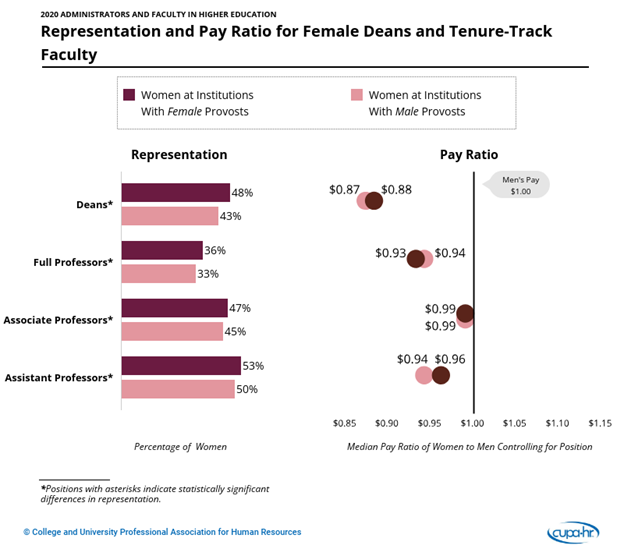
    New research by CUPA-HR has found that U.S. colleges and universities with women presidents or provosts have higher representation of women in administrative, dean and faculty positions than institutions led by men. The study also found that colleges and universities with women presidents have higher pay for women in administrative positions than institutions led by men. These positions tend to be pipelines for the senior-most executive positions in higher ed, which underscores the significance of the findings.

    Women Administrators Pay and Representation in Institutions With Female Presidents

    Findings show that institutions with female presidents have a higher percentage of women in all administrative categories — senior institutional officers, institutional administrators and heads of divisions. Although female administrators are generally paid less than male administrators in the same positions regardless of the sex of the president, female senior institutional officers, institutional administrators, and heads of divisions are paid more equitably at institutions with a female president than at institutions with a male president.

    Female Deans and Faculty Pay and Representation in Institutions With Female Provosts

    Institutions with female provosts have a significantly higher representation of women in dean positions and in all faculty ranks. Provost sex does not have a strong or consistent impact on pay equity for deans and faculty; however, it is worth noting that better representation at higher faculty ranks and in dean positions has an impact on pay, as these positions make higher salaries.

    The representation of women drops with successive faculty ranks (from assistant to associate to full professor). These promotions represent the few times in a faculty member’s career when appreciable salary increases are granted. If women are not being promoted, they are not receiving these pay raises. In addition, those in dean positions are generally promoted from senior faculty ranks. Therefore, if women are not adequately represented in senior faculty, they will not have the same likelihood as men of being considered for a higher-paying dean position.

    To sum up the findings, higher ed institutions with female executives have better representation of women throughout their institutions in positions that: a) are paid higher salaries and b) serve as key points in the executive leadership pipeline. Jackie Bichsel, CUPA-HR’s director of research and co-author of the new report, noted that, “In an era where institutions are adapting to shifting workforce expectations, adjusting to continuous decreases in budgets, contemplating changes in enrollment, addressing challenges of recruitment and retention, and rethinking their mission, more openness to change and less tolerance of risk may be just what is needed to navigate this new landscape. Providing more (and more equitable) opportunities for women to advance within higher education seems an obvious path forward in this navigation.”

    Read the full report, Women in the Leadership Pipeline in Higher Education Have Better Representation and Pay in Institutions With Female Presidents and Provosts.


    Source link

  • Supreme Court Blocks OSHA Vaccine and Testing ETS and Upholds CMS Healthcare Worker Vaccine Mandate – CUPA-HR

    Supreme Court Blocks OSHA Vaccine and Testing ETS and Upholds CMS Healthcare Worker Vaccine Mandate – CUPA-HR

    by CUPA-HR | January 14, 2022

    On January 13, the U.S. Supreme Court blocked enforcement of the Occupational Safety and Health Administration (OSHA)’s Emergency Temporary Standard (ETS) that would mandate vaccines or testing requirements for employers with 100 or more employees, but reinstated enforcement of the Centers for Medicare and Medicaid Services (CMS)’s mandate that would require COVID-19 vaccinations for healthcare workers working at facilities that participate in Medicare and Medicaid.

    In December, the U.S. Court of Appeals for the 6th Circuit vacated the 5th Circuit Court’s nationwide emergency motion to stay the OSHA ETS, paving the way for OSHA to continue enforcement of the ETS vaccine and testing requirements. The decision led several business groups and Republican-led states to file emergency applications with the Supreme Court seeking to reinstate the stay. The Supreme Court heard oral arguments on the OSHA mandate on January 7, leading to the court’s decision to block the vaccine and testing mandate.

    Additionally, the Supreme Court heard oral arguments on the CMS healthcare worker mandate on January 7. They ultimately ruled in favor of allowing the CMS healthcare worker vaccine mandate to take effect while the mandate is being litigated in several U.S. district courts and circuit courts. The CMS mandate was previously stayed in 25 states after four lawsuits were filed against CMS in district courts in Missouri, Louisiana, Florida and Texas.

    Though not heard or ruled on by the Supreme Court, the federal contractor vaccine mandate, which requires all federal contractors to mandate COVID-19 vaccinations for their employees, remains stayed by the U.S. District Court for the Southern District of Georgia, which issued a nationwide preliminary injunction against the mandate on December 7. The Biden administration has appealed the decision to the 11th Circuit Court, which has since upheld the lower court’s injunction but has not yet ruled on the legal merits of the mandate. Litigation continues for this rule in the 11th Circuit Court.

    The Supreme Court’s decisions bring the rules back to the lower courts to continue litigation on their merits; however, the recent decisions do signal how the Supreme Court would likely rule on the merits of the cases if they are once again appealed to the higher court.

    CUPA-HR will continue to keep members apprised of any legal updates as they relate to the fate of the OSHA ETS, the CMS healthcare vaccine mandate, and the federal contractor vaccine mandate.


    Source link

  • HR and the Courts – CUPA-HR

    HR and the Courts – CUPA-HR

    by CUPA-HR | January 12, 2022

    Each month, CUPA-HR General Counsel Ira Shepard provides an overview of several labor and employment law cases and regulatory actions with implications for the higher ed workplace. Here’s the latest from Ira.

    NCAA Loses Appeal For Expedited Ruling Denying Student-Athletes’ Minimum Wage FLSA Claims — Claims Move to Federal Court Trial 

    The National Collegiate Athletic Association (NCAA) was denied a request or fast track consideration of its appeal of an adverse trial court order to proceed to trial over student-athlete claims that they are covered by the Fair Labor Standards Act minimum wage and overtime rules as they are employees. The trial court judge ruled that the question of whether the student-athletes are employees is a mixed question of law and fact, which should go to trial. The judge concluded that the NCAA can appeal an adverse trial decision after trial.

    The NCAA countered that similar suits in the U.S. Appeals Seventh and Ninth Circuits have been dismissed. The NCAA argued that appeals courts in the Seventh Circuit (covering Illinois, Indiana and Wisconsin) and in the Ninth Circuit (covering California, Oregon, Washington, Nevada, Arizona, Idaho and Montana) both held that the NCAA is not the employer of student-athletes. In rejecting the NCAA’s interlocutory appeal, the Third Circuit (covering Pennsylvania, New Jersey and Delaware) ruled that the NCAA failed to meet its burden in showing exceptional circumstances justifying departing from the normal policy of delaying appellate consideration until a final judgement is issued.

    EEOC Issues “Guidance” That COVID-19, Under Certain Circumstances, May Be a Disability Covered and Protected By the ADA From Discrimination

    The Equal Employment Opportunity Commission (EEOC) issued “guidance” in mid-December stating that, in certain circumstances, COVID-19 may be a disability covered by the Americans With Disabilities Act (ADA), making it illegal for employers to discriminate against employees with COVID-19. The EEOC chair pointed out that employees with disabilities resulting from COVID-19 may be eligible for a reasonable accommodation. Depending on each employee’s individual circumstances, an employee recovering from COVID-19 may meet the ADA’s definition of a disability as a mental or physical impairment that substantially limits a major life activity, or an employer’s perception that the individual has a disability.

    Someone who has COVID-19 and experiences multi-day headaches, dizziness and brain fog attributable to COVID-19 is an example of an impairment covered by the ADA. However, the EEOC pointed out that not every person with COVID-19 will qualify as disabled. For example, if someone has COVID-19 and is asymptomatic or has mild symptoms similar to the flu that lasts only a few weeks, with no other consequences, that person would not qualify as disabled. The EEOC suggests an individual assessment of each employee with COVID-19 might be necessary to determine whether it is a disability.

    State and Local Ordinances Regulate the Use of Artificial Intelligence/Automated Job Applicant Screening Tools In Screening Job Applicants

    New York City (NYC) just established one of the broadest new laws concerning the use of artificial intelligence tools to screen job applicants by NYC employers. The effective date is unclear and local counsel should be consulted on the new regulations in NYC. Under the NYC law, such artificial intelligence tools will be banned in NYC unless they are subject to a “bias audit” conducted a year before the use of the tool. Illinois passed a law similar to the NYC law. Maryland passed a law banning the use of facial recognition in the employment application process without the applicant’s consent. The attorney general in the District of Columbia is also proposing a related proposal addressing “algorithmic discrimination.” The EEOC recently indicated that it would study the use of artificial intelligence job screening tools to see if they contribute to bias in employment decisions.

    Denial of Healthcare Coverage For Transgender Surgery Is Subject to Discovery Squabbles As Arizona Appeals Trial Court Order to Turn Over Attorney Opinions Concluded Its Actions Were Legal

    The state of Arizona recently appealed a federal trial court’s decision that it turn over “attorney opinions” and that its actions excluding transgender surgery from health plan coverage were legal, to the Ninth Circuit Court of Appeals. The Ninth Circuit covers California, Oregon, Washington, Arizona, Nevada, Idaho and Montana. The health plan’s exclusions are subject to a lawsuit alleging that the denial of benefits violates the applicable sex discrimination statutes.

    The state claimed that its actions excluding such benefits form coverage were legal and relied on “attorney opinions” to that effect. The plaintiff in the case asked that the opinions be turned over as part of the litigation, and the state of Arizona refused, claiming the documents were subject to attorney/client privilege The federal trial court judge agreed with the plaintiff, holding that Arizona waived privilege by implication, concluding that privilege cannot be used as both a sword and a shield.

    U.S. Department of Labor and NLRB Sign a Memorandum of Understanding, Agreeing to Cooperate In Enforcement Proceedings

    The Biden administration’s Department of Labor and National Labor Relations Board (NLRB) have come to an agreement on a memorandum of understanding (MOU) to collaborate on enforcement investigations and share information on potential violations of the law. The enforcement agreement will target independent contractor misclassification matters and retaliation claims brought by workers. On the DOL side, this agreement involves the DOL’s Wage and Hour Division, which enforces the minimum wage and overtime provisions of the Fair Labor Standards Act.

    The MOU partners two agencies with similar goals. It appears to follow through on last year’s tri-agency discussion between the DOL, NLRB and the EEOC when the agencies sought to discuss cooperation on retaliation claims brought by employees.


    Source link

  • Biden Administration Releases Fall 2021 Regulatory Agenda – CUPA-HR

    Biden Administration Releases Fall 2021 Regulatory Agenda – CUPA-HR

    by CUPA-HR | January 10, 2022

    On December 10, the Biden administration issued the Fall 2021 Unified Agenda of Regulatory and Deregulatory Actions (Regulatory Agenda), providing the public with insights on what various federal agencies expect to work on in terms of regulatory activity in the near- and long-term.

    In an effort to keep members apprised of upcoming noteworthy regulatory actions, CUPA-HR has read through the Regulatory Agenda and has flagged the following proposed activity:

    Department of Labor

    Wage and Hour Division — Defining and Delimiting the Exemptions for Executive, Administrative, Professional, Outside Sales and Computer Employees

    In April 2022, the Department of Labor (DOL)’s Wage and Hour Division plans to issue a Notice of Proposed Rulemaking (NPRM) addressing overtime pay requirements for certain “white-collar” employees, including executive, administrative, and professional employees, currently exempt from the requirements under the Fair Labor Standards Act (FLSA). According to the Regulatory Agenda, one of the goals of the NPRM would be “to update the salary level requirement of the section 13(a)(1) exemption [under the FLSA].”

    Changes to overtime pay requirements have been implemented through regulations under both the Obama and Trump administrations. In May 2016, the Obama administration’s DOL issued a final rule increasing the salary threshold from $23,660 to $47,476 per year and imposed automatic updates to the threshold every three years. However, court challenges prevented the rule from taking effect and it was permanently enjoined in September 2017. After the Trump administration started the rulemaking process anew, in September 2019, DOL issued a new final rule raising the minimum salary level required for exemption from $23,660 annually to $35,568 annually. This final rule went into effect January 1, 2020, and it remains in effect today.

    DOL’s Statement of Regulatory Priorities, a component of the fall Regulatory Agenda that presents additional information about the most significant regulatory activities planned for the coming year, states that this proposed update will “ensure that middle class jobs pay middle class wages, extending important overtime pay protections to millions of workers and raising their pay.”  Given this statement, it is likely that we will see the Biden administration’s DOL attempt to increase the salary level in the NPRM to something closer to the Obama administration’s proposed level, if not higher.

    Employment and Training Administration — Strengthening Wage Protections for the Temporary and Permanent Employment of Certain Aliens in the United States

    In March 2022, DOL’s Employment and Training Administration (ETA) plans to issue a NPRM to establish “a new wage methodology for setting prevailing wage levels for H-1B/H-1B1/E-3 and PERM programs consistent with the requirements of the Immigration and Nationality Act.” The proposal will likely amend the Trump administration’s final rule that was scheduled to take effect on November 14, 2022, but was subsequently vacated by a federal court in June 2021. The new proposal, which is included in the Department’s Statement of Regulatory Priorities will take into consideration the feedback it received in response to a Request for Information (RFI) on data and methods for determining prevailing wage levels “to ensure fair wages and strengthen protections for foreign and U.S. workers”.

    CUPA-HR filed comments in opposition to the Trump administration’s regulations on the issue and in response to the Biden administration’s RFI.

    Occupational Safety and Health Administration — Improve Tracking of Workplace Injuries and Illnesses

    According to the Regulatory Agenda, the Biden administration’s Occupational Safety and Health Administration (OSHA) plans to release a NPRM to restore provisions of the May 2016 “Improve Tracking of Workplace Injuries and Illnesses” final rule. The Regulatory Agenda set December 2021 as the target date for release, but as of early January, the regulation is still pending review at the Office of Information and Regulatory Affairs.

    The proposal seeks “to amend [OSHA’s] recordkeeping regulation to restore the requirement to electronically submit to OSHA information from the OSHA Form 300 (Log of Work-Related Injuries and Illnesses) and OSHA Form 301 (Injury and Illness Incident Report) for establishments that meet certain size and industry criteria.” In the Regulatory Agenda, OSHA notes that the current regulations only require electronic submissions from the OSHA Form 300A (Summary of Work-Related Injuries and Illnesses), as the Trump administration’s 2019 final rule rescinded the requirements to electronically submit the OSHA Form 300 and OSHA Form 301.

    National Labor Relations Board

    Joint Employer

    In February 2022, the National Labor Relations Board (NLRB) is planning to release a NPRM to potentially amend the standard determining when two employers may be considered joint employers under the National Labor Relations Act. The new standard will revise the 2020 Trump Administration’s final rule, which reversed the Obama-era NLRB decision in the 2015 Browning-Ferris Industries case and established that an entity can only be a joint employer if it actually exercises control over the essential terms and conditions of another employer’s employees. While details of the Democratic-majority NLRB’s NPRM on joint employer status are up in the air, we would expect them to revise the current standard to look something more like the Obama-era decision.

    Department of Education

    Office for Civil Rights — Nondiscrimination on the Basis of Sex in Education Programs or Activities Receiving Federal Financial Assistance

    In April 2022, the Department of Education is planning to release a NPRM to amend the “regulations implementing Title IX (…) consistent with the priorities of the Biden-Harris administration,” such as the priorities set forth in Executive Order (EO) 13988, “Preventing and Combating Discrimination on the Basis of Gender Identity and Sexual Orientation” and EO 14021, “Guaranteeing an Educational Environment Free from Discrimination on the Basis of Sex, Including Sexual Orientation and Gender Identity.” This NPRM will revise the amendments the Trump administration made through the 2020 Title IX final rule.

    The Department of Education highlighted this new rulemaking in their Statement of Regulatory Priorities. The addition of the rulemaking to the priorities document and the accelerated expected release date of April 2022 from May 2022 as stated in the Spring 2021 Regulatory Agenda indicate that the agency is likely considering this as one of the top regulatory priorities above other proposed actions.

    Department of Homeland Security

    USCIS — Modernizing H-1B Requirements and Oversight and Providing Flexibility in the F-1 Program

    According to the Regulatory Agenda, the Department of Homeland Security (DHS)’s United States Citizenship and Immigration Services (USCIS) plans to release a NPRM in May 2022 to “amend its regulations governing H-1B specialty occupation workers and F-1 students who are the beneficiaries of timely filed H-1B cap-subject petitions.” The NPRM will specifically propose to “revise the regulations relating to ‘employer-employee relationship’ and provide flexibility for start-up entrepreneurs; implement new requirements and guidelines for site visits including in connection with petitions filed by H-1B dependent employers whose basic business information cannot be validated through commercially available data; provide flexibility on the employment start date listed on the petition (in limited circumstances); address “cap-gap” issues; bolster the H-1B registration process to reduce the possibility of misuse and fraud in the H-1B registration system; and clarify the requirement that an amended or new petition be filed where there are material changes, including by streamlining notification requirements relating to certain worksite changes, among other provisions.”

    ICE — Optional Alternative to the Physical Examination Associated With Employment Eligibility Verification (Form I-9)

    According to the Regulatory Agenda, DHS is planning to issue a NPRM in June 2022 to “revise employment eligibility verification regulations to allow the Secretary to authorize alternative document examination procedures in certain circumstances or with respect to certain employers.”

    Since the outset of the COVID-19 pandemic, DHS has provided temporary flexibility in the Form I-9 verification process to allow for remote inspection of Form I-9 documents in situations where employees work exclusively in a remote setting due to COVID-19-related precautions. While that guidance is only temporary, DHS issued a Request for Public Input (RPI) on October 26, 2021 to determine whether those flexibilities should be kept in place permanently. It is possible that DHS will use that feedback to develop and implement this NPRM.

    CUPA-HR has engaged with DHS on the Form I-9 flexibilities through the pandemic. In December, CUPA-HR sent a letter to DHS requesting the Form I-9 flexibilities be extended past December 31, 2021. DHS announced soon after that the flexibilities would be extended until April 30, 2022. Additionally, CUPA-HR submitted comments in response to the RPI based on a recent survey detailing members’ experiences with the Form I-9 verification process flexibilities.

    CUPA-HR will keep members apprised of these proposed regulations and others as they are introduced in the coming year.


    Source link

  • Read and Listen to Inspiring CUPA-HR Content From 2021 – CUPA-HR

    Read and Listen to Inspiring CUPA-HR Content From 2021 – CUPA-HR

    by CUPA-HR | January 5, 2022

    Throughout 2021, HR practitioners have proven their resilience time and again by positively impacting higher education not only in response to the ever-evolving pandemic, but also in building more flexible, diverse and inclusive workplaces. CUPA-HR captured many of these higher ed success stories, as well as leadership advice, helpful resources and workforce data trends in the following articles, podcasts and blog posts.

    As you read and listen to the inspiring work your HR colleagues are doing at colleges and universities around the country, we encourage you to jot down ideas to take into the year ahead: 

    Retention and Engagement 

    Develop to Retain: Tools and Resources for Higher Ed Professional Development (The Higher Ed Workplace Blog)

    Maintaining Culture and Connection for Remote Employees (The Higher Ed Workplace Blog)

    Stay tuned for an article in the upcoming winter issue of Higher Ed HR Magazine: “Four Areas HR Can Address Now to Boost Retention and Engagement.”

    Future of Work 

    New Report Highlights Changes to the Professional Workforce in the Wake of the Pandemic (The Higher Ed Workplace Blog)

    New Report Highlights Changes to Faculty Workforce in the Wake of the Pandemic (The Higher Ed Workplace Blog)

    Navigating Compliance With a Multi-State Workforce (The Higher Ed Workplace Blog)

    Determining Remote Work Eligibility and Talking to Leadership About Flexible Work (CUPA-HR Soundbite)

    Diversity, Equity, and Inclusion 

    5 CHROs Use CUPA-HR’s DEI Maturity Index to Energize Their DEI Efforts (The Higher Ed Workplace Blog)

    A Mission for Greater Faculty Diversity — Oakland University’s Diversity Advocate Program (Higher Ed HR Magazine)

    Can HR Investigators Be Anti-Racist? — Action Steps to Overcome Racial Bias When Conducting Workplace Investigations (Higher Ed HR Magazine)

    Juneteenth — How Will Your Institution Observe the Day? (The Higher Ed Workplace Blog)

    Supporting the LGBTQ+ Community in Higher Ed — 3 Learning Resources for HR (The Higher Ed Workplace Blog)

    Three Ways HR Can Promote Cultural Appreciation Over Appropriation (The Higher Ed Workplace Blog)

    Boost Your Pay Equity Know-How By Tapping Into These Resources (The Higher Ed Workplace Blog)

    Mental Health

    Mental Health Month Focus: Resources (The Higher Ed Workplace Blog)

    Strategies to Become More Resilient in Work and Life (The Higher Ed Workplace Blog)

    HR Care Package — Resources for Self-Care (The Higher Ed Workplace Blog)

    HR Leadership 

    CUPA-HR Conversations: Higher Ed HR Turns 75 (CUPA-HR Podcast)

    Why Psychological Safety Matters Now More Than Ever (Higher Ed HR Magazine)

    Opening Doors for Strategic Partnerships With Academic Leadership (Higher Ed HR Magazine)


    Source link

  • EEOC Adds Technical Assistance Guidance to Clarify When COVID-19 Is Considered a Disability Under the ADA – CUPA-HR

    EEOC Adds Technical Assistance Guidance to Clarify When COVID-19 Is Considered a Disability Under the ADA – CUPA-HR

    by CUPA-HR | December 22, 2021

    On December 14, the Equal Employment Opportunity Commission (EEOC) released additional COVID-19 technical assistance to clarify certain circumstances under which employers and employees may consider COVID-19 a disability under the Americans with Disabilities Act (ADA) and the Rehabilitation Act. The guidance, which is presented in a Q&A format, focuses broadly on the definition of disability under the ADA and Rehabilitation Act and provides examples detailing how an individual diagnosed with COVID-19 or post-COVID-19 conditions could be considered to have a disability under these laws.

    According to an EEOC press release, the technical assistance adds the following key guidance:

    • An applicant’s or employee’s COVID-19 may cause impairments that can be considered disabilities under the ADA, regardless of whether the initial case of COVID-19 itself constituted an actual disability.
    • An applicant or employee with mild COVID-19 symptoms that resolve in a few weeks with no other consequences will not have a disability as defined under the ADA that would make them eligible to receive a reasonable accommodation.
    • Applicants or employees with disabilities under the ADA are entitled to a reasonable accommodation when their disability requires it, and the accommodation is not an undue hardship for the employer. They are not automatically entitled to reasonable accommodations under the ADA. Employers can choose to do more than the ADA requires.
    • Employers risk violating the ADA if they prevent employees from returning to work once the employee is no longer infectious and is medically able to return to work without posing a threat to infect others.

    The EEOC also clarifies that this technical guidance differs from July guidance from the Department of Justice (DOJ) and the Department of Health and Human Services (HHS), which addresses “Long COVID” as a Disability under Sections 504 and 1557 of the ADA. According to the press release, the DOJ and HHS guidance only focuses on long COVID, while the EEOC’s new technical assistance focuses more broadly on COVID-19 in the context of Title I of the ADA and Section 501 of the Rehabilitation Act, which covers employment.

    CUPA-HR will continue to keep members apprised of any COVID-19 guidance as it relates to disability and discrimination under EEO law.


    Source link