My first year or two after graduating from college, I kept wanting there to be some instruction book that would teach you how to do all the lessons you somehow had missed in life thus far that it seemed like people should know. Today, young people would refer to this body of knowledge and skills as “adulting,” I think. I’m still wishing I had the magical powers that I witness only on the internet of those people who are able to meal plan effectively and sustainably (as in do it week in and week out). I’ll do it like once and then be so exhausted by the process that I won’t try again until like three years later.
It still amuses me how this yet-to-be-discovered curriculum evades me. When you think you have something figured out, change emerges, and you’re right back in a liminal space. Jarche writes:
The Cynefin framework can help us connect work and learning, especially for emergent and novel practices, for which we do not have good or best practices known in advance.
Speaking of instructions: Will I ever live to see the day when I don’t need to look up the pronunciation of Cynefin each time I run across it, yet again? I’ve been in the field of learning my whole life, though started getting paid for it at the age of 14 and a half, when I first started working and was quickly asked to train other people how to scoop ice cream, decorate cakes, clean the store, and so on at the local Baskin Robbins. It wasn’t that complicated. Sweeping the floors looked the same day-to-day, Even when someone requested a new cake design, it was essentially tracing on plastic wrap and didn’t require new ways of thinking.
Instead of step-by-step actions, many of the challenges I navigate today at work are complex. I was once selected to be the scholar in residence for the University of Michigan Dearborn specifically because I wasn’t an “expert” (nor did I claim to be one). The role was to explore artificial intelligence in higher education. The team who hired me said it was specifically my curiosity that was what made them think I would be an effective person to help them explore the various perspectives people hold without acting as if there was some easy way to step-by-step figure out exactly what needed to happen.
Jarche writes:
In a crisis it is important to act but even more important to learn as we take action.
This “as we are going” learning is only possible with intentionality. It’s otherwise all to easy to succumb to the tyranny of the urgent and neglect the humility required to continuously learn from what is emerging. We are invited to think of an example of each of the following, which I will attempt to do:
formal community – at my work, we have our Academic Leadership Council (ALC)
informal community – a group of friends have a text chat, where we share each others joys and sorrows, as well as recommend podcasts, articles, tv shows, books, and so on with each other
open knowledge network – I’m thinking about communities that arise from clever (intentional) hashtag use, such as ones related to the disability movement, or Black lives matter, etc.
formal knowledge hub – so many universities have resources to share with faculty related to teaching + learning, like the University of Virginia Teaching Hub
I’ve been curious about curiosity for a long while now. That foundation made it that much more rewarding for me to see it as the current topic for Harold Jarche’s PKMastery workshop. There’s a vulnerability that comes from allowing ourselves to be curious. Yet what that yearning allows for is unparalleled and well worth the costs.
Lifelong Learning
When we are curious, our learning never ends. Getting to work at a university, being invited to speak at many other institutions for higher learning, and having kids who are both in middle school, affords me a never-ending buffet of learning. Sometimes, it can get overwhelming and I need to resort to bookmarking things that seem interesting, but that I may not have time to look to deeply at in the moment. Tagging those bookmarks allow me to uncover resources in the future, when they will be most relevant to something I’m curious about then.
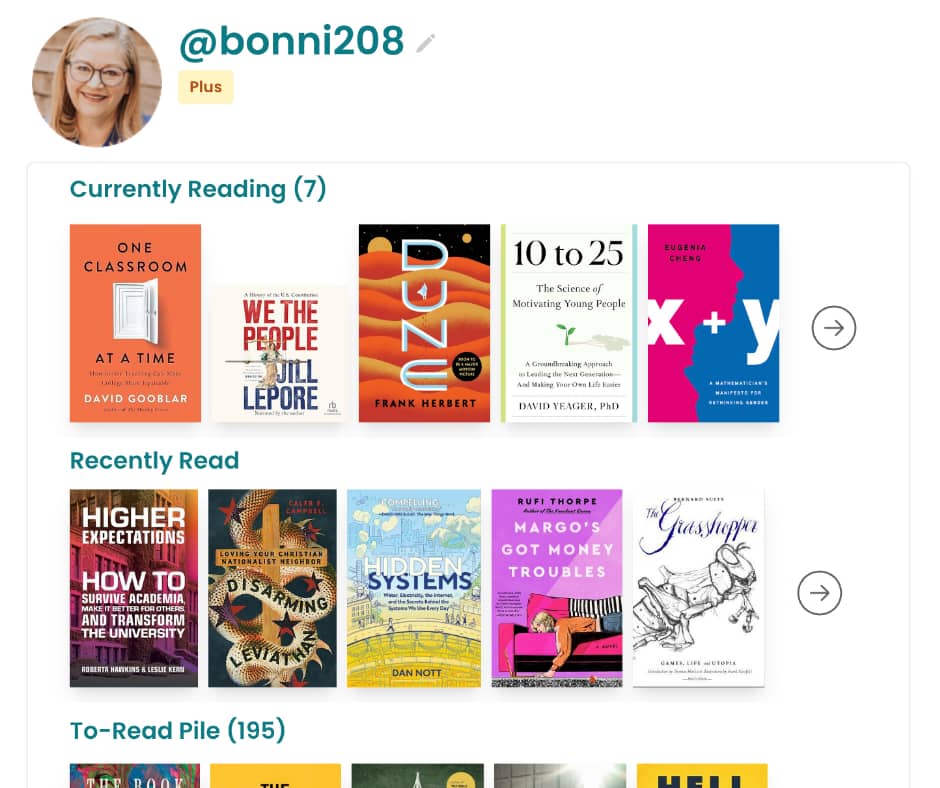
I like tracking my reading in a service called StoryGraph. Setting a minimum goal for books read in a year helps overcome my natural tendency toward my attention going to RSS headline and short-form reading. Most years, I’m struggling to reach the goal, come December. However, my focus on listening to more audio books has allowed me to already have surpassed my 2025 goal.
Healthy Human Relationships
When we focus on being curious about what others thing and having empathy for them, the possibility for having healthy human relationships emerges. It’s easy to focus on “winning” as the sole pursuit of our interactions with others. However, when our focus is on being right, instead of initially on curiosity, we limit the potential for solutions that are geared toward the common good. Covey writes:
Next to physical survival, the greatest need of a human being is psychological survival—to be understood, to be affirmed, to be validated, to be appreciated. When you listen with empathy to another person, you give that person psychological air. And after that vital need is met, you can then focus on influencing or problem solving.
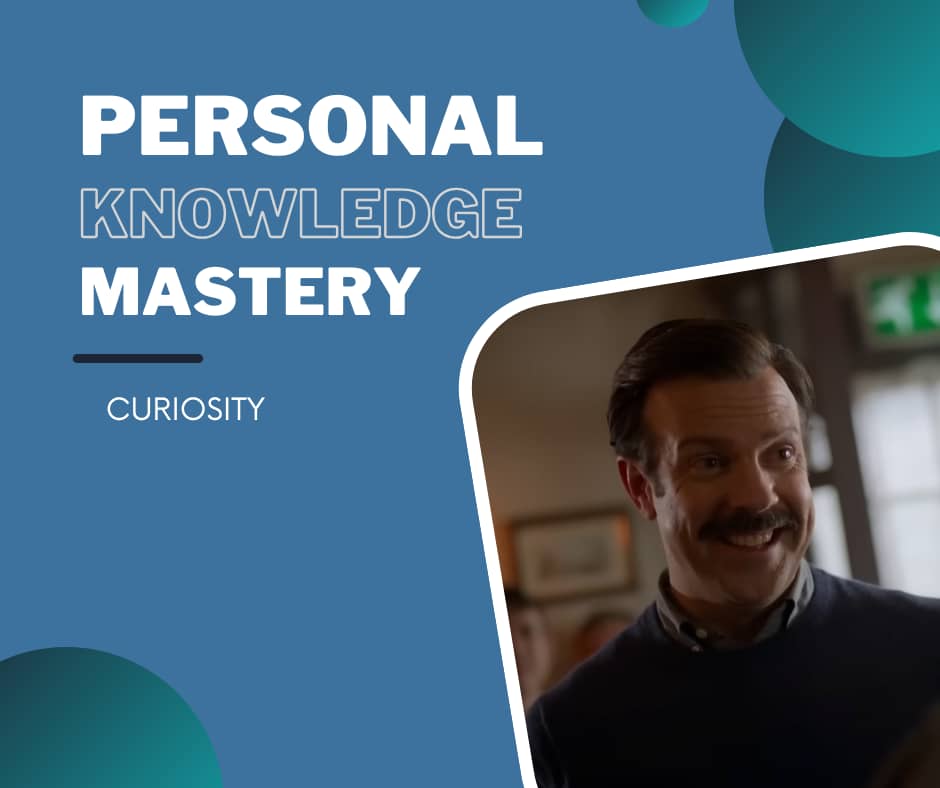
I smiled, as soon as I saw that Jarche had included this beloved clip from Ted Lasso in his writing about curiosity. At this point in the show, Rupert, is “winning” at humiliating his ex-wife (the blonde woman whose expression you can see throughout many of the camera angles during the clip). She doesn’t want to see Ted Lasso also be humiliated by Rupert and is concerned that is exactly what’s about to happen.
However, curiosity wins the day, as does kindness. Lasso says at one point:
Don’t mistake my kindness for weakness.
Curiosity is a powerful aim and one that is infectious. When we resolve to continually fuel our openness and getting better, together, we unleash a powerful problem-solving potential.
Cultivating Curiosity
Jarche writes about curiosity and resolve. He describes the need for a “constant dance between bigger groups of ideas and smaller groups of people working together,” and how necessary both cooperation and collaboration are to effective problem solving and creativity.
In this week’s reading, Jarche reminds us of how needed a human set of skills are today:
The skills required to live in a world dominated by complex and non-routine work requires — creativity, imagination, empathy, and curiosity.
He also stresses the unbounded potential for creativity that we posses, when we focus on curiosity:
While the industrial economy was based on finite resources, a creative economy is not. There is no limit to human creativity. We have to make a new social contract — not based on jobs — but rather enabling a learner’s mindset for life.
Until next time… And until then: Let’s all stay curious.
I’ve just embarked on Harold Jarche’s Personal Knowledge Mastery (PKM) Workshop (October–November 2025). The first invitation Jarche gives is to examine our networks. We begin with a naming exercise: the top four people who come to mind in response to prompts like:
Who do you most frequently communicate with to get work done?
Who do you approach for career or work advice?
Who are the main people you socialize with informally?
Who do you contact when facing complex work problems?
After listing names, we reflect on their demographics, roles, ages, and how much diversity (or lack thereof) we see in our knowledge network. Jarche encourages us to spot gaps and opportunities for expanding who we include.
Because the prompt focuses on recent months, I observed that some of the questions hit harder than others, given what I’ve been up to, lately. For example, I haven’t been actively job-searching for a long while, so the aspect of the career advice question focused on who I reach out to when considering whether to accept a job or leave my organization felt a bit hypothetical. But answering using a longer time span than solely these last few months nudged me to think about past seasons in which those questions were more pressing.
Serendipitous Invitations and Saying Yes
One outcome of doing the naming exercise is that it reminded me of an invitation to co-facilitate a book study with two other friends. The topic was not related to my formal role at work. The three of us had joked throughout the month-long study about whether we chose the worst possible evening for it. I teach a multi-hour block on Monday afternoons and my fellow facilitators also had all sorts of things going on in their professional and personal contexts. And yet, we were ultimately all glad to have said yes to the commitment.
It ended up being challenging, yet hopeful: people with shared values, diverse perspectives, different paradigms, and a desire to consider our role in the work to live out what we believe. It made me appreciate intentionally saying no to lesser priorities so that I can say yes to what matters most.
After browsing and reflecting on some of the supporting materials that Jarche includes about network mapping, I realized that this experience may be emblematic of “The Strength of Weak Ties,” an idea brought forth by Mark S. Granovetter back in 1973. Granovetter defines the strength of a tie as a composite of time spent, emotional intensity, intimacy (mutual confiding), and reciprocal services. He shows that as tie strength increases, so does overlap in one’s social circle (i.e. your strong ties tend to know each other). Weak ties, being more distant, often serve as bridges between clusters in a network. He reveals about the strength of ties:
Most intuitive notions of the “strength” of an interpersonal tie should be satisfied by the following definition: the strength of a tie is a (probably linear) combination of the amount of time, the emotional intensity, the intimacy (mutual confiding), and the reciprocal services which characterize the tie.
Granovetter also shares the understandable emphasis on strong ties, yet also cautions us about what is lacking in our personal and societal development, were we to focus exclusively on strong ties. He writes:
Treating only the strength of ties ignores, for instance, all the important issues involving their content. What is the relation between strength and degree of specialization of ties, or between strength and hierarchical structure?
The article is pretty dense reading and I am only skimming the surface here, no doubt not quite getting the richness of what he shares.
The Teaching in Higher Ed Network
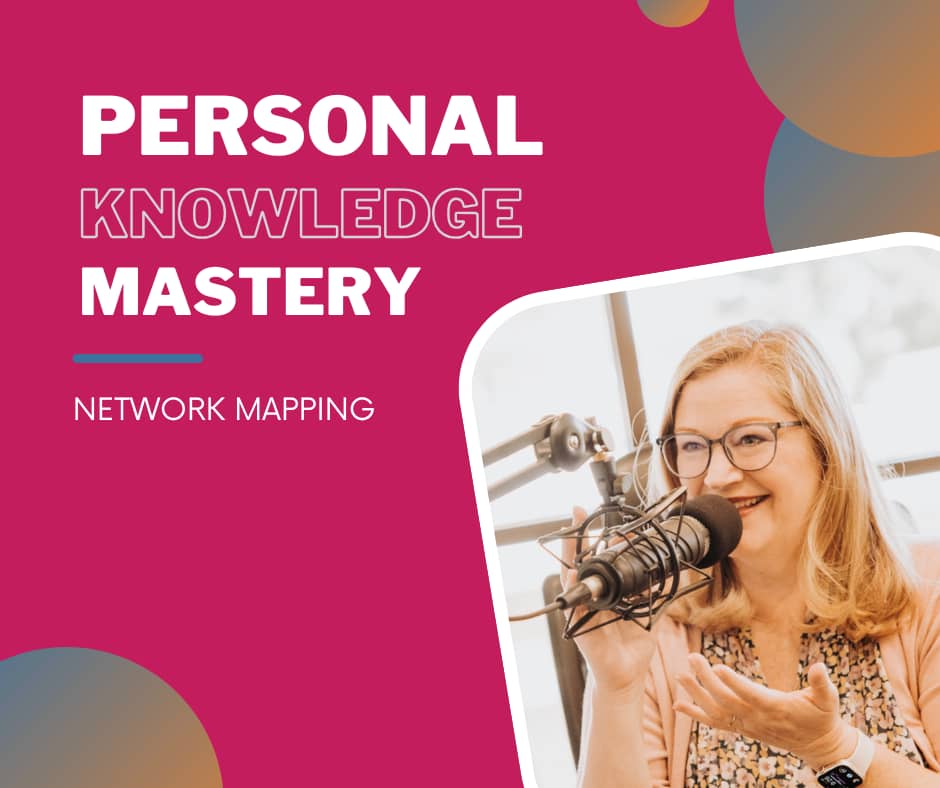
I’ve long been grateful for my Teaching in Higher Ed podcast and the network is has helped me to cultivate since June of 2014. Over the 11+ years, it’s connected me with people across disciplines and invited discussions about assessment, AI, pedagogy, digital literacy, and more..
By the way: Harold Jarche has been a guest on Teaching in Higher Ed (Episode 213). It was an honor to speak with him, after having followed his work for such a long time. In that episode, he says, “You can’t turn data into information until you have the knowledge to understand the data.” That line struck me again as I think about how PKM is about sense-making, not just accumulation of information.
My Most Frequently-Mentioned Name
As I reviewed my responses, the name that surfaced most often was Dave (my husband). That shouldn’t surprise me: we met while earning our master’s degrees, later pursued doctoral work together, and share many disciplinary interests. He is also someone who regularly challenges my thinking while supporting me. His name appeared in questions about deep matters, who I talk to when launching something new, someone I informally socialize with, a person I want to talk to about complex problems, and finally to get career advice from.
Informal Socializing: Breaking the Rule
One of the prompts asked: Who do you socialize with informally?
I confess: I broke the rule of listing specific names. First off, I really don’t socialize informally very often, at all. Most time I spend with others is somehow geared toward an aim of some kind. My informal socializing is mostly with my immediate family (Dave and our two, curious children).
I also reflected on the recent optional activity I did with the students enrolled in my personal leadership and productivity class, while answering the questions posed by Jarche for this activity. They have an assignment to plan their 85th birthday party, which is based off of a prompt offered by Stephen Covey in the 7 Habits of Highly Effective People. After students reflect, they can optionally sign up for a time to join me on campus or online for a time to celebrate and reflect together on what they learned.
That, plus I bring cupcakes and play Stevie Wonder’s Happy Birthday song (which thus far, 100% have agreed is the best of the birthday songs).
Reflections & Next Moves
A few reflections and intentions as I begin Jarche’s PKM workshop this week:
New seasons evolve my network ties. My closer-knit network in recent months reflect my focus during that time. In a different season, I would have listed different people.
Mix strong and weak ties. I already see how much value my core, close relationships (like Dave) bring. But I also am thankful for the times when my podcast allows me to reach outward, diversify, and surface my weaker ties that bring novelty and new perspectives.
Nurture the giving habit. As Rob Cross (in his work on networks) says, effective networks often grow when people give first and who go beyond the superficial.
I have enjoyed this opportunity to reflect on my networks and look forward to continuing to explore some of the resources that Harold includes. I’m also ready to get to learn more about the others participating in the PKM workshop these next couple of months. If I know anything about PKM and about Harold, it is what will become “us” as a cohort that will make the biggest difference in our learning.
Plus that whole thing about getting out of something what you put into it…