Tag: cuts

  • Federally run tribal colleges reel from staff cuts

    Federally run tribal colleges reel from staff cuts

    Native American education advocacy groups are calling on the Trump administration to spare Haskell Indian Nations University and Southwestern Indian Polytechnic Institute from employee cuts, after the Office of Personnel Management ordered federal agencies to lay off most probationary employees.

    The two tribal colleges are the only ones operated by the Bureau of Indian Education rather than tribal nations, making them vulnerable to the administration’s federal workforce reductions.

    At Haskell Indian Nations University, about 40 people have already lost their jobs across campus departments, out of about 160 employees, according to a Monday letter from the Haskell Board of Regents to the U.S. Department of the Interior. The board urged in the letter that the university be exempt from the staff cuts. The Lawrence Times reported that the institution has had to postpone or cancel some campus events. Meanwhile, roughly 20 employees were laid off at Southwestern Indian Polytechnic Institute, out of a staff of about 100, according to Indian Country News.

    Pearl Yellowman, the former vice president of operations at Southwestern Indian Polytechnic Institute, who was recently laid off, told the Native American news outlet that one department has only a single employee left.

    “Our students are going to say, ‘Where’s my instructor?’ ‘What happened to my class?’ ‘What’s going on?’ ‘Is my future of being a student OK here?’ ‘Where’s my tutor?’ ‘What happened to this person?’ ‘Are my scholarships in jeopardy?’ ‘Is my financial aid in jeopardy?’” Yellowman told Indian Country News.

    Ahniwake Rose, president and CEO of the American Indian Higher Education Consortium, said in a news release that “there are legitimate concerns that workforce reduction at these institutions will eliminate vital services and much-needed educational programs the students need to complete their degree programs.”

    Jason Dropik, executive director of the National Indian Education Association, emphasized in the release that the Bureau of Indian Education has a “federal trust obligation to educate Native youth.”

    “Significant workforce reductions will negatively impact students and have long-term educational consequences for our Tribal Nations,” he said.

    For Haskell, this isn’t the first time the university’s status as a federally run tribal college has been a source of tension. Kansas lawmakers have recently debated about whether Haskell should be under the auspices of the Bureau of Indian Education at all.

    U.S. senator Jerry Moran and Representative Tracey Mann of Kansas announced plans late last year to propose legislation to remove federal control of Haskell, arguing the institution would be better run by a new university Board of Regents. The plan, backed by the then-president of the Haskell board, came after a tense congressional hearing regarding student and employee complaints about the university, which were revealed in a report by the bureau.

    After the recent staff cuts, Dalton Henry, president of the Haskell Board of Regents, recognized these policymakers and the Bureau of Indian Education for “working to reduce the impact of these changes.”

    “We are grateful for their attention to this issue,” Henry said in a news release.

    Source link

  • Podcast: Wales cuts, mental health, regulation

    Podcast: Wales cuts, mental health, regulation

    This week on the podcast the Welsh government has announced £18.5m in additional capital funding for universities – but questions remain over reserves, job cuts, competition law and student protection.

    Meanwhile, new research reveals student mental health difficulties have tripled in the past seven years, and Universities UK warns that OfS’ new strategy risks expanding regulatory burden rather than focusing on priorities.

    With Andy Westwood, Professor of Public Policy at the University of Manchester, Emma Maslin, Senior Policy and Research Officer at AMOSSHE, Livia Scott, Partnerships Coordinator at Wonkhe and presented by Jim Dickinson, Associate Editor at Wonkhe.

    Read more

    The government’s in a pickle over fees and funding

    As the cuts rain down in Wales, whatever happened to learner protection?

    Partnership and promises are not incompatible

    Student mental health difficulties are on the rise, and so are inequalities

    Source link

  • Higher ed unions rally against Trump’s cuts, layoffs

    Higher ed unions rally against Trump’s cuts, layoffs

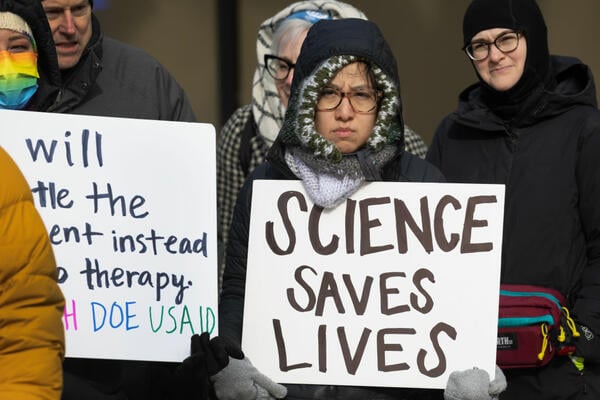
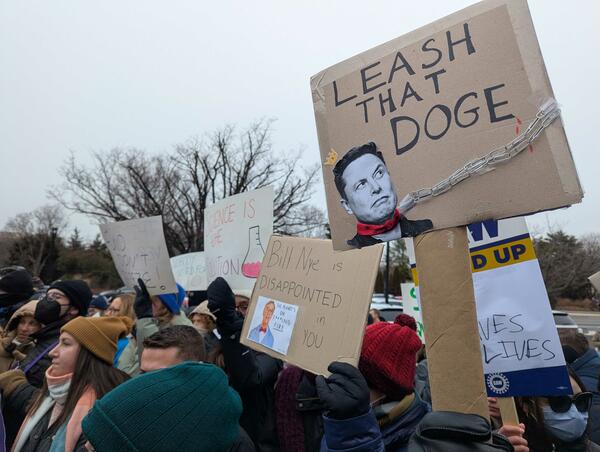
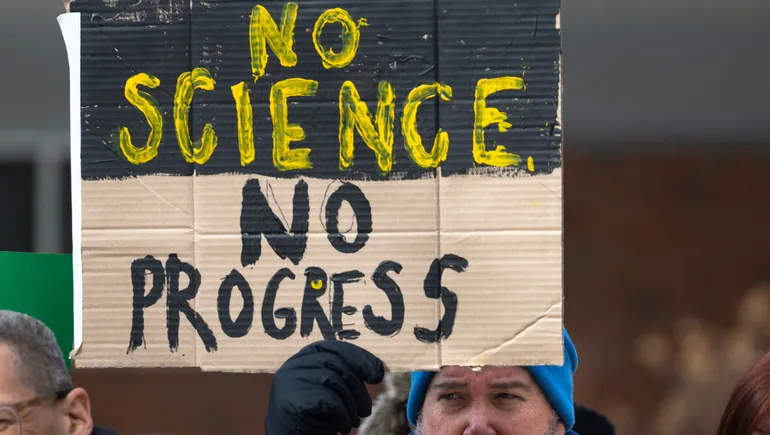
    At more than a dozen events across the country Wednesday, workers and faculty at colleges and universities gathered to speak out against what they see as an attack on federal research funding, lifesaving medical research and education. 

    In Washington, D.C., hundreds rallied in the front of the Department of Health and Human Services, while in Philadelphia, hundreds gathered at the office of Senator Dave McCormick, a Pennsylvania Republican. Other protests were planned at colleges in Seattle and St. Louis, among others. 

    The rallies were part of a national day of action organized by a coalition of unions representing higher ed workers, students and their allies. The coalition includes the American Association of University Professors, the American Federation of Teachers, Higher Ed Labor United and United Auto Workers, among others.

    Hundreds in Philly braved the freezing temps to rally for our healthcare, research, and jobs! ❄️💪Workers & students from CCP, Drexel, UPenn, Rutgers, Temple, Jefferson, Arcadia, Rowan, Moore—alongside elected leaders & union presidents—made it clear: We won’t back down. #LaborForHigherEd

    [image or embed]

    — Higher Education Labor United (HELU) (@higheredlabor.bsky.social) February 19, 2025 at 2:33 PM

    In recent weeks, the Trump administration has proposed capping reimbursements for indirect research costs, laid off hundreds of federal employees and cracked down on diversity, equity and inclusion. Most recently, the Education Department gave colleges and K-12 schools until Feb. 28 to end all race-conscious student programming, resources and financial aid. Higher education advocates have called that directive “dystopian” and “very much outside of the law.”

    Colleges and universities sued to block the rate cut for indirect costs, warning it would mean billions in financial losses and an end to some research. Some colleges have already frozen hiring in response, even though the cut is temporarily on hold.

    “If politics decides what I can and cannot study, I’m afraid I will fail the very people who need this research and inspire me to do it,” said Lindsay Guare, a doctoral student at the University of Pennsylvania, in a news release about the Philadelphia event. “In an ideal world, I would be fighting to expand support for my science instead of fighting to keep it afloat … The work done in Philadelphia’s institutions doesn’t just lead the world in innovation—it saves lives.”

    Source link

  • This week in 5 numbers: Court temporarily blocks NIH funding cuts

    This week in 5 numbers: Court temporarily blocks NIH funding cuts

    The number of states that sued to block the National Institutes of Health from implementing cuts to funding for indirect research costs. Earlier this week, U.S. District Court Judge Angel Kelley issued restraining orders against the cuts in the attorneys general-led case, along with a similar one filed by the Association of American Medical Colleges and other groups.

    Source link

  • Why the NIH cuts are so wrong (opinion)

    Why the NIH cuts are so wrong (opinion)

    Indirect cost recovery (ICR) seems like a boring, technical budget subject. In reality, it is a major source of the long-running budget crises at public research universities. Misinformation about ICR has also confused everyone about the university’s public benefits.

    These paired problems—concealed budget shortfalls and misinformation—didn’t cause the ICR cuts being implemented by the NIH acting director, one Matthew J. Memoli, M.D. But they are the basis of Memoli’s rationale.

    Trump’s people will sustain these cuts unless academics can create an honest counternarrative that inspires wider opposition. I’ll sketch a counternarrative below.

    The sudden policy change is that the NIH is to cap indirect cost recovery at 15 percent of the direct costs of a grant, regardless of the existing negotiated rate. Multiple lawsuits have been filed challenging the legality of the change, and courts have temporarily blocked it from going into effect.

    Memoli’s notice of the cap, issued Friday, has a narrative that is wrong but internally coherent and plausible.

    It starts with three claims about the $9 billion of the overall $35 billion research funding budget that goes to indirect costs:

    • Indirect cost allocations are in zero-sum competition with direct costs, therefore reducing the total amount of research.
    • Indirect costs are “difficult for NIH to oversee” because they aren’t entirely entailed by a specific grant.
    • “Private foundations” cap overhead charges at 10 to 15 percent of direct costs and all but a handful of universities accept those grants.

    Memoli offers a solution: Define a “market rate” for indirect costs as that allowed by private foundations (Gates, Chan Zuckerberg, some others). The implication is the foundations’ rate captures real indirect costs rather than inflated or wishful costs that universities skim to pad out bloated administrations. On this analytical basis, currently wasted indirect costs will be reallocated to useful direct costs, thus increasing rather than decreasing scientific research.

    There’s a false logic here that needs to be confronted.

    The strategy so far to resist these cuts seems to focus on outcomes rather than on the actual claims or the underlying budgetary reality of STEM research in the United States. Scientific groups have called the ICR rate cap an attack on U.S. scientific leadership and on public benefits to U.S. taxpayers (childhood cancer treatments that will save lives, etc.). This is all important to talk about. And yet these claims don’t refute the NIH logic. Nor do they get at the hidden budget reality of academic science.

    On the logic: Indirect costs aren’t in competition with direct costs because direct and indirect costs pay for different categories of research ingredients.

    Direct costs apply to the individual grant: costs for chemicals, graduate student labor, equipment, etc., that are only consumed by that particular grant.

    Indirect costs, also called facilities and administrative (F&A) costs, support infrastructure used by everybody in a department, discipline, division, school or university. Infrastructure is the library that spends tens of thousands of dollars a year to subscribe to just one important journal that is consulted by hundreds or thousands of members of that campus community annually. Infrastructure is the accounting staff that writes budgets for dozens and dozens of grant applications across departments or schools. Infrastructure is the building, new or old, that houses multiple laboratories: If it’s new, the campus is still paying it off; if it’s old, the campus is spending lots of money keeping it running. These things are the tip of the iceberg of the indirect costs of contemporary STEM research.

    In response to the NIH’s social media announcement of its indirect costs rate cut, Bertha Madras had a good starter list of what indirects involve.

    Screenshot via Christopher Newfield

    And there are also people who track all these materials, reorder them, run the daily accounting, etc.—honestly, people who aren’t directly involved in STEM research have a very hard time grasping its size and complexity, and therefore its cost.

    As part of refuting the claim that NIH can just not pay for all this and therefore pay for more research, the black box of research needs to be opened up, Bertha Madras–style, and properly narrated as a collaborative (and exciting) activity.

    This matter of human activity gets us to the second NIH-Memoli claim, which involves toting up the processes, structures, systems and people that make up research infrastructure and adding up their costs. The alleged problem is that it is “difficult to oversee.”

    Very true, but difficult things can and often must be done, and that is what happens with indirect costs. Every university compiles indirect costs as a condition of receiving research grants. Specialized staff (more indirect costs!) use a large amount of accounting data to sum up these costs, and they use expensive information technology to do this to the correct standard. University staff then negotiate with federal agencies for a rate that addresses their particular university’s actual indirect costs. These rates are set for a time, then renegotiated at regular intervals to reflect changing costs or infrastructural needs.

    The fact that this process is “difficult” doesn’t mean that there’s anything wrong with it. This claim shouldn’t stand—unless and until NIH convincingly identifies specific flaws.

    As stated, the NIH-Memoli claim that decreasing funding for overhead cuts will increase science is easily falsifiable. (And we can say this while still advocating for reducing overhead costs, including ever-rising compliance costs imposed by federal research agencies. But we would do this by reducing the mandated costs, not the cap.)

    The third statement—that private foundations allow only 10 to 15 percent rates of indirect cost recovery—doesn’t mean anything in itself. Perhaps Gates et al. have the definitive analysis of true indirect costs that they have yet to share with humanity. Perhaps Gates et al. believe that the federal taxpayer should fund the university infrastructure that they are entitled to use at a massive discount. Perhaps Gates et al. use their wealth and prestige to leverage a better deal for themselves at the expense of the university just because they can. Which of these interpretations is correct? NIH-Memoli assume the first but don’t actually show that the private foundation rate is the true rate. (In reality, the second explanation is the best.)

    This kind of critique is worth doing, and it can be expanded. The NIH view reflects right-wing public-choice economics that treat teachers, scientists et al. as simple gain maximizers producing private, not public goods. This means that their negotiations with federal agencies will reflect their self-interest, while in contrast the “market rate” is objectively valid. We do need to address these false premises and bad conclusions again and again, whenever they arise.

    However, this critique is only half the story. The other half is the budget reality of large losses on sponsored research, all incurred as a public service to knowledge and society.

    Take that NIH image above. It makes no logical sense to put the endowments of three very untypical universities next to their ICR rates: They aren’t connected. It makes political narrative sense, however: The narrative is that fat-cat universities are making a profit on research at regular taxpayers’ expense, and getting even fatter.

    The only way to deal with this very effective, very entrenched Republican story is to come clean on the losses that universities incur. The reality is that existing rates of indirect cost recovery do not cover actual indirect costs, but require subsidy from the university that performs the research. ICR is not icing on the budget cake that universities can do without. ICR buys only a portion of the indirect costs cake, and the rest is purchased by each university’s own institutional funds.

    For example, here are the top 16 university recipients of federal research funds. One of the largest in terms of NIH funding (through the Department of Health and Human Services) is the University of California, San Francisco, winning $795.6 million in grants in fiscal year 2023. (The National Science Foundation’s Higher Education Research and Development (HERD) Survey tables for fiscal year 2023 are here.)

    table visualization

    UCSF’s negotiated indirect cost recovery rate is 64 percent. This means that it has shown HHS and other agencies detailed evidence that it has real indirect costs in something like this amount (more on “something like” in a minute). It means that HHS et al. have accepted UCSF’s evidence of their real indirect costs as valid.

    If the total of UCSF’s HHS $795.6 million is received with a 64 percent ICR rate, this means that every $1.64 of grant funds has $0.64 in indirect funds and one dollar in direct. The math estimates that UCSF receives about $310 million of its HHS funds in the form of ICR.

    Now, the new NIH directive cuts UCSF from 64 percent to 15 percent. That’s a reduction of about 77 percent. Reduce $310 million by that proportion and you have UCSF losing about $238 million in one fell swoop. There’s no mechanism in the directive for shifting that into the direct costs of UCSF grants, so let’s assume a full loss of $238 million.

    In Memoli’s narrative, this $238 million is the Reaganite’s “waste, fraud and abuse.” The remaining approximately $71 million is legitimate overhead as measured (wrongly) by what Gates et al. have managed to force universities to accept in exchange for the funding of their researchers’ direct costs.

    But the actual situation is even worse than this. It’s not that UCSF now will lose $238 million on their NIH research. In reality, even at (allegedly fat-cat) 64 percent ICR rates, they were already losing tons of money. Here’s another table from the HERD survey.

    table visualization

    There’s UCSF in the No. 2 national position, a major research powerhouse. It spends more than $2 billion a year on research. However, moving across the columns from left to right, you see federal government, state and local government, and then this category, “Institution Funds.” As with most of these big research universities, this is a huge number. UCSF reports to the NSF that it spends more than $500 million a year of its own internal funds on research.

    The reason? Extramurally sponsored research, almost all in science and engineering, loses massive amounts of money even at current recovery rates, day after day, year in, year out. This is not because anyone is doing anything wrong. It is because the infrastructure of contemporary science is very expensive.

    Here’s where we need to build a full counternarrative to the existing one. The existing one, shared by university administrators and Trumpers alike, posits the fiction that universities break even on research. UCSF states, “The University requires full F&A cost recovery.” This is actually a regulative ideal that has never been achieved.

    The reality is this:

    UCSF spends half a billion dollars of its own funding to support its $2 billion total in research. That money comes from the state, from tuition, from clinical revenues and some—less than you’d think—from private donors and corporate sponsors. If NIH’s cuts go through, UCSF’s internal losses on research—the money it has to make up—suddenly jump from an already-high $505 million to $743 million in the current year. This is a complete disaster for the UCSF budget. It will massively hit research, students, the campuses’ state employees, everything.

    The current strategy of chronicling the damage from cuts is good. But it isn’t enough. I’m pleased to see the Association of American Universities, a group of high-end research universities, stating plainly that “colleges and universities pay for 25 percent of total academic R&D expenditures from their own funds. This university contribution amounted to $27.7 billion in FY23, including $6.8 billion in unreimbursed F&A costs.” All university administrations need to shift to this kind of candor.

    Unless the new NIH cuts are put in the context of continuous and severe losses on university research, the public, politicians, journalists, et al. cannot possibly understand the severity of the new crisis. And it will get lost in the blizzard of a thousand Trump-created crises, one of which is affecting pretty much every single person in the country.

    Finally, our full counternarrative needs a third element: showing that systemic fiscal losses on research are in fact good, marvelous, a true public service. A loss on a public good is not a bad and embarrassing fact. Research is supposed to lose money: The university loses money on science so that society gets long-term gains from it. Science has a negative return on investment for the university that conducts it so that there is a massively positive ROI for society, of both the monetary and nonmonetary kind. Add up the education, the discoveries, the health, social, political and cultural benefits: The university courts its own endless fiscal precarity so that society benefits.

    We should also remind everyone that the only people who make money on science are in business. And even there, ROI can take years or decades. Commercial R&D, with a focus on product development and sales, also runs losses. Think of “AI”: Microsoft alone is spending $80 billion on it in 2025, on top of $50 billion in 2024, with no obviously strong revenues yet in sight. This is a huge amount of risky investment—it compares to $60 billion for federal 2023 R&D expenditures on all topics in all disciplines. I’m an AI skeptic but appreciate Microsoft’s reminder that new knowledge means taking losses and plenty of them.

    These up-front losses generate much greater future value of nonmonetary as well as monetary kinds. Look at the University of Pennsylvania, the University of Wisconsin at Madison, Harvard University, et al. in Table 22 above. The sector spent nearly $28 billion of its own money generously subsidizing sponsors’ research, including by subsidizing the federal government itself.

    There’s much more to say about the long-term social compact behind this—how the actual “private sector” gets 100 percent ICR or significantly more, how state cuts factor into this, how student tuition now subsidizes more of STEM research than is fair, how research losses have been a denied driver of tuition increases. There’s more to say about the long-term decline of public universities as research centers that, when properly funded, allow knowledge creation to be distributed widely in the society.

    But my point here is that opening the books on large everyday research losses, especially biomedical research losses of the kind NIH creates, is the only way that journalists, politicians and the wider public will see through the Trumpian lie about these ICR “efficiencies.” It’s also the only way to move toward the full cost recovery that universities deserve and that research needs.

    Source link

  • The latest roundup of DEI cuts across the country

    The latest roundup of DEI cuts across the country

    This audio is auto-generated. Please let us know if you have feedback.

    The conservative-led fight against diversity, equity and inclusion efforts has been supercharged thanks to a powerful ally — the newly sworn-in President Donald Trump.

    In recent years, many state legislatures have enacted anti-DEI laws, and even more have proposed these measures. But these attempts happened under the Biden administration, which supported diversity initiatives at colleges and sought to strengthen them at the federal level.

    Trump has aimed to unravel that work.

    He signed multiple executive orders attacking diversity efforts in the first couple days of his second term, including one declaring that college DEI policies and programs could amount to violations of federal civil rights laws. It also prompted federal agencies to identify organizations, including colleges with endowments over $1 billion, for potential civil compliance investigations

    Another executive order directed agencies to end all DEI programs and positions “under whatever name they appear.” It further sought to terminate federal “equity-related” grants and contracts, endangering massive swaths of college research funding.

    Trump’s orders have incited confusion among higher education leaders and sparked legal challenges. However, colleges in states across the political spectrum are cutting DEI programs in response. 

    Below, Higher Ed Dive is rounding up the ever-growing list of colleges nixing DEI programs, pulling DEI language from institutional communications, and cancelling events aimed at supporting students from minority groups.

    Arizona State University

    On Jan. 27, the U.S. Office of Budget and Management released a memo calling for a massive freeze on federal funding to ensure government programs complied with Trump’s executive orders, including one targeting DEI. The news prompted Arizona State University to instruct its researchers to stop working on DEI-related activities on their federally funded projects and avoid using unspent funds allocated for DEI work.

    Even after OMB rescinded the memo — and White House officials released conflicting messages on where the freeze stood — Arizona State told researchers to hold off.

    “All Executive Orders remain in effect and will continue to be enforced,” the guidance said.

    Arizona State has since placed that announcement — and its entire webpage dedicated to research operations news — behind a university login. The university did not immediately respond to a request for comment Tuesday.

    Boston University

    Boston University announced Jan. 30 that its Center for Antiracist Research would shutter on June 30. CAR’s 12 staff members will be employed through that time and “are receiving resources and support to assist with their transitions,” the university said. 

    The private nonprofit attributed the closure to the departure of Ibram X. Kendi, a prominent antiracist scholar and the center’s founder.

    Kendi, who left to lead the Howard University Institute for Advanced Study in Washington, D.C., acknowledged the challenge of opening the center during the pandemic and the “intense backlash over critical race theory” it faced. CAR opened in 2020, shortly after the murder of George Floyd and the resulting demonstrations against police violence.

    “I feel honored to have been able to do this work with you over the last five years,” Kendi said in a statement. “I am departing for an opportunity I could not pass up, but what connected us at CAR remains, especially during this precarious time.”

    CAR prompted concern in 2023 when it laid off more than half its staff — a total of 19 employees — citing a need to restructure. Boston University launched an investigation into CAR’s use of grant funds, though its final audit found “no issues” with how the center managed its money. 

    California Polytechnic State University

    California Polytechnic State University will eliminate its Office of University Diversity and Inclusion as an independent department and move it under the personnel division, the Mustang News, its student newspaper, reported in late January. 

    A spokesperson for the public minority-serving institution told Mustang News that the decision was “not in response to any outside influences.”

    As of Tuesday, the university’s statement affirming diversity is still viewable online.

    Source link

  • Campus closures, mergers, cuts, and crises at the start of 2025 (Bryan Alexander)

    Campus closures, mergers, cuts, and crises at the start of 2025 (Bryan Alexander)

    Today, while Trump continues to flood the zone, I want to establish a
    sense of what the higher education baseline was before he cut loose. 
    As the new administration goes even more energetically after academia
    I’d like to share some data about our sector’s standing.

    Last year I tracked cuts and crises afflicting dozens of campuses.  I
    posted roughly every months, noting program cuts, institutional
    mergers, and campus closures, as well as financial crises likely to
    cause same: March 1March 20March 28, April, MayJuneJulySeptember, November. Today I’ll continue that line for the reasons I’ve previously given:
    to document key stories in higher education; to witness human suffering;
    to point to possible directions for academia to take.  In addition, I
    want to help paint a picture of the world Trump is starting to attack.

    Some caveats: I’m doing this in haste, between the political chaos
    and a stack of professional deadlines, which means the following will be
    more telegraphic than usual.  I may well have missed some stories, so
    please let me know in comments.

    Closing colleges and universities

    Philadelphia’s University of the Arts closed in 2024. Now different
    actors are angling for its physical remains.  Temple University purchased an iconic building, Quadro Bay bought another, and while more bids appear.

    Mergers

    Gannon University (Catholic, Pennsylvania) and Ursuline College (Catholic, Ohio) agreed to merge by this December.  The idea is to synthesize complementary academic offers and provide institutional stability, it seems.

    Seattle University (Jesuit, Washington state) and the Cornish College of the Arts (private, Washington) also agreed to merge.  As with the Lake Erie schools, one motivation is to expand curricular offerings:

    Emily Parkhust, Cornish’s interim president, said the deal opens new doors for the tiny school’s nearly 500 students.

    “This strategic combination will allow our students opportunities
    that we simply weren’t able to offer and provide at a small arts
    college,” she said. “Such as the opportunity to take business classes,
    computer courses, pursue master’s degree programs, engage in college
    sports — and even swim in a pool.”

    Financial problems also played a role: “Cornish declared it was undergoing a financial emergency in 2020, and this year, Seattle University paused hiring as it faces a $7.5 million deficit.”

    The Universidad Andres Bello (Universidad Andrés Bello; private, Chile) purchased Post University (for-profit, Connecticut).

    Campuses cutting programs and jobs

    In this series I’ve largely focused on the United States for the
    usual reasons: the sheer size and complexity of the sector; limited
    time. But in my other writing I’ve noted the epochal crisis hitting
    Canadian higher education, as the nation’s decision to cut international
    enrollment has struck institutional finances.   Tony Bates offers a good backgrounder.  Alex Usher’s team set up an excellent website tracking the resulting retrenchment.

    British higher education is also suffering, partly for the reasons
    that nation’s economy is hurting: negative effects of Brexit, energy
    problems stemming from the Ukraine war, and political fecklessness. For
    one example I find the University of Hull (public research) which is combining 17 schools into 11 and ending its chemistry program, all for financial reasons. Cardiff University (Prifysgol Caerdydd; public research) cut 400 full time jobs, also for financial reasons:

    Vice-Chancellor Professor
    Wendy Larner defended the decision to cut jobs, saying the university
    would have become “untenable” without drastic reforms.

    The job role cuts are only a
    proposal, she said, but insisted the university needed to “take
    difficult decisions” due to the declining international student
    applications and increasing cost pressures.

    Prof Larner said the
    university is not alone in its financial struggles, with most UK
    universities grappling with the “broken” funding system.

    Back in the United States, Sonoma State University (public university, part of California State University system) announced a massive series of cuts.

    “approximately 46 university faculty – both tenured and
    adjunct – will receive notice that their contracts will not be renewed
    for 2025-26. Additional lecturers will receive notice that no work will
    be available in fall 2025… Four management positions and 12 staff
    positions also will be eliminated.”

    The university will shut down a group of departments: “Art History,
    Economics; Geology; Philosophy; Theater and Dance; and Women and Gender
    Studies.”

    (These are the kind of cuts I’ve referred to as “queen sacrifices,”
    desperate moves to cut a school’s way to survival.  The term comes from
    chess, where a player can give up their most powerful piece, the queen.
    In my analogy tenured faculty represent that level of relative power.)

    There will be some consolidation (“The college also plans to merge
    the Ethnic Studies departments (American Multicultural Studies, Chicano
    and Latino Studies, and Native American Studies) into one department
    with one major”) along with ending a raft of programs:

    Administrative Services Credential in ELSE; Art
    History BA; Art Studio BFA; Dance BA; Earth and Environmental Sciences
    BA; Economics BA; Education Leadership MA; English MA; French BA;
    Geology BS; German Minor; Global Studies BA; History MA;
    Interdisciplinary Studies BA; Interdisciplinary Studies MA; Philosophy
    BA; Physical Science BA; Physics BA; Physics BS; Public Administration
    MPA; Spanish MA; Theatre Arts BA; Women and Gender Studies BA.

    Additionally, and unusually, SSU is also ending student athletics:
    “The University will be removing NCAA Division II athletics entirely,
    involving some 11 teams in total.”

    What lies behind these cuts?  My readers will not be surprised to learn that enrollment decline plays a role, but might be shocked by the decline’s size: “SSU has experienced a 38% decrease in enrollment.”

    More cuts: St. Norbert College (Catholic, liberal arts, Wisconsin) is planning to cut faculty and its theology department. (I posted about an earlier round of cuts there  in 2024.)  Columbia College Chicago (private, arts) will terminate faculty and academic programs.  Portland State University (Oregon) ended contracts for a group of non-tenure-track faculty.

    The University of New Orleans (public research) will cut $2.2 million of administration and staff.

    The University of Connecticut (public, land grant) is working on closing roughly two dozen academic programs.  According to one account, they include:

    master’s degrees in international studies, medieval
    studies, survey research and educational technology; graduate
    certificates in adult learning, literacy supports, digital media and
    design, dementia care, life story practice, addiction science and survey
    research; a sixth-year certificate in educational technology, and a
    doctoral degree in medieval studies.

    It’s not clear if those terminations will lead to faculty and staff reductions.

    Budget crises, programs cut, not laying off people yet

    There are also stories of campuses facing financial pressures which
    haven’t resulted in cuts, mergers, or closures so far, but could lead to
    those. Saint Augustine’s University (historically black, South Carolina) is struggling to get approval for a campus leasing deal, while moving classes online “to take care of deferred maintenance issues.”  SAU has been facing controversies and financial challenges for nearly a generation.

    The president of another HBCU, Tennessee State University, stated that they would run out of money by this spring.  That Higher Ed Dive article notes:

    TSU’s financial troubles are steep and immediate. An FAQ page on
    the university’s website acknowledges that the financial condition has
    reached crisis levels stemming from missed enrollment targets and
    operating deficits. This fall, the university posted a projected deficit of $46 million by the end of the fiscal year.

    The Middle States Commission on Higher Education agreed to hear an accreditation appeal from Keystone College (private, Pennsylvania), while that campus struggles:

    Keystone college front page 2025 Feb

    From the top of Keystone’s web page right now.

    The board of William Jewell University (private liberal arts, Missouri) declared financial exigency
    This gives them emergency powers to act. As the official statement put
    it, the move “enables reallocation of resources, restructuring of
    academic programs and scholarships and significant reductions in force.”

    Brown University (private research university, Rhode Island) is grappling
    with a $46 million deficit “that would grow to more than $90 million,”
    according to provost Francis J. Doyle III and Executive Vice President
    for Finance and Administration Sarah Latham.  No cuts are in the offing,
    although restraining growth is the order of the day. In addition,
    there’s a plan to increase one sort of program for revenue:

    the university will work to “continue to grow master’s
    [program] revenue, ultimately doubling the number of residential
    master’s students and increasing online learners to 2,000 in five
    years.”

    KQED reports
    that other California State University campuses are facing financial
    stresses, notably Cal State East Bay and San Francisco State
    University.  The entire CSU system and the University of California
    system each face massive cuts from the state’s governor.

    Reflections

    Nearly all of this is occurring before the second Trump
    administration began its work. Clearly parts of the American
    post-secondary ecosystem are suffering financially and in terms of
    enrollment.

    It’s important to bear in mind that each school’s trajectory is
    distinct from the others in key ways. Each has its history, its
    conditions, its competing strategies, resources, micropolitics, and so
    on. Each one deserves more exploration than I have time for in this
    post.

    At the same time I think we can make the case that broader national
    trends are also at work. Operating costs rise for a clutch of reasons
    (consumer inflation, American health care’s shambles, deferred
    maintenance being a popular practice, some high compensation practices,
    etc) and push hard on some budgets. Enrollment continues to be a
    challenge (I will return to this topic in a future post). The Trump
    administration does not seem likely to ameliorate those concerns.

    Note, too, that many of the institutions I’ve touched on here are not
    first tier campuses. The existence of some may be news to some readers.
    As a result, they tend not to get much media attention nor to attract
    resources.   It is important, though, to point them out if we want to
    think beyond academia’s deep hierarchical structures.

    Last note: this post has focused on statistics and bureaucracy, but
    these are all stories about real human beings.  The lives of students,
    faculty, staff and those in surrounding communities are all impacted. 
    Don’t lose sight of that fact or of these people.

    (Seattle University photo by Michael & Sherry Martin; thanks to Karen B on Bluesky, Karen Bellnier otherwise, Mo Pelzel, Peter Shea, and Siva Vaidhyanathan for links; thanks to IHE for doing a solid job of covering these stories)

    Source link

  • Big state systems were among those announcing cuts in January

    Big state systems were among those announcing cuts in January

    A new year is underway, but many colleges are still reeling from the fiscal challenges of 2024.

    With yawning budget gaps and bleak financial projections at some campuses, administrators are cutting jobs, academic programs and athletics options to plug holes and stabilize their finances.

    Here’s a look at cuts announced in January.

    Sonoma State University

    Facing a budget deficit estimated at nearly $24 million, the California State University campus is enacting deep cuts that will include dismissing dozens of faculty members, eliminating multiple programs and dropping athletics, according to an announcement from interim president Emily F. Cutrer.

    “The University has had a budget deficit for several years. It is attributable to a variety of factors—cost of personnel, annual price increases for supplies and utilities, inflation—but the main reason is enrollment,” Cutrer wrote in an announcement last month.

    She added that Sonoma State’s enrollment has dropped by 38 percent since 2015.

    On the personnel side, 46 faculty members, including tenured as well as adjunct professors, will not have their contracts renewed for the next academic year. An unspecified number of lecturers will also receive notices that “no work will be available in fall 2025,” Cutrer wrote. Four management and 12 staff positions are also being eliminated as part of Sonoma State’s cost-cutting measures.

    In addition, more than 20 programs have been identified for closure and others will be combined. University officials are also looking to close a half dozen academic departments.

    All 11 SSU athletic programs, which compete at the NCAA Division II level, will be eliminated. However, SSU coaches have announced plans to file a lawsuit in an effort to save their sports.

    California State University, Dominguez Hills

    Anticipated budget cuts also drove layoffs at this CSU campus in Southern California, which let go 32 employees last month, many probationary or temporary workers, LAist reported.

    “While these layoffs will be disruptive to our operations, the vast majority of our staff will remain employed at CSUDH continuing to provide the high level of support to our community that we are known for,” President Thomas Parham wrote in an email.

    Other institutions across California are also likely to introduce cost-cutting measures in the coming months due to anticipated decreases in state appropriations that will limit funding. The 23 institutions in the CSU system are bracing for state budget cuts of nearly $400 million.

    University of New Orleans

    After consolidating five colleges into two in December, the University of New Orleans laid off 30 employees last month as it chips away at a $10 million budget deficit, NOLA.com reported.

    Additionally, the university announced furloughs for full-time, nontenured employees last month, which local media outlets reported will affect nearly 300 workers.

    “While these actions are necessary, we are deeply sensitive to the hardship they undoubtedly will cause. We remain fully committed to supporting those who are affected through this transition,” President Kathy Johnson said in a January announcement. “Our focus remains on protecting UNO’s academic mission and its vital role in the New Orleans region. We are pursuing long-term strategies to increase enrollment, secure new funding, and enhance operational efficiency to avoid similar measures in the future.”

    St. Francis College

    The financially struggling institution in New York laid off 17 employees last month, The City reported. It follows other moves administrators have made in recent years—including previous layoffs, the sale of the Brooklyn campus and the elimination of athletic programs—to help fix St. Francis’s financial woes.

    Despite the institution’s recent struggles and multiple years of operating losses, President Tim Cecere offered the news outlet an optimistic outlook, noting that cost-cutting measures have put the college on a path toward sustainability.

    “The college hasn’t been this strong in years,” Cecere said. “We have zero debt, which not a lot of colleges can say. Every dollar that comes in is optimized for the benefit of the students.”

    St. Norbert College

    Jobs and programs are on the chopping block as the small Catholic institution in Wisconsin navigates financial issues, The Green Bay Press Gazette reported.

    At least 13 majors will be cut, including chemistry, computer science, history and physics.

    An unspecified number of faculty members are also expected to be laid off, the newspaper reported, as the college aims to shave $7 million in expenses ahead of the next fiscal year.

    Cleveland State University

    Efforts to cut spending prompted Cleveland State University to drop three athletic programs—wrestling, women’s softball and women’s golf—Ideastream Public Media reported.

    Cleveland State will also move its esports team from athletics to the College of Engineering.

    The move comes as the university whittles down a budget deficit that reportedly stands at $10 million. Last summer 50-plus faculty members took buyouts as part of cost-reduction efforts.

    Indiana University

    More than two dozen jobs were eliminated from the state flagship’s athletics department last month—part of a cost-reduction effort in response to the House v. NCAA settlement, which will require IU and other institutions to begin sharing revenue with athletes starting in the 2025–26 academic year, The Indianapolis Star reported.

    Of the 25 positions eliminated, 12 were reportedly vacant.

    Western Illinois University

    Furloughs for administrative employees who are not in a bargaining unit are expected as the regional public institution seeks to cut expenditures, Tri States Public Radio reported.

    WIU is reportedly dealing with a $14 million deficit for fiscal year 2025.

    The furlough program will run from the beginning of February through July 31 and is tiered by annual salary. Administrators making more than $150,000 will be required to take three unpaid days off each month, while those earning between $100,000 and $149,000 will be asked to take off two unpaid days each month and those making $99,999 to $75,000 will have to take off one unpaid day per month.

    Catholic University of America

    With the Catholic research university in Washington, D.C., facing a $30 million structural deficit, administrators are considering merging departments and potentially closing the Benjamin T. Rome School of Music, Drama, and Art, Catholic News Agency reported.

    Officials did not specify publicly whether job cuts would be included as part of the overall changes, which are expected to go before CUA’s Board of Trustees for approval in March.

    University System of Maryland

    Amid state budget cuts, Maryland’s public university system will likely be forced to lay off employees.

    Anticipating a funding cut of $111 million across the 11-campus system, officials may eliminate as many as 400 jobs through layoffs as well as closing vacant positions, The Baltimore Banner reported, which they estimate will save $45 million. Though a timeline for cuts was not announced, system chancellor Jay Perman said some jobs will be student facing, including advising, counseling and mental health services. Perman also noted that some faculty positions across the system will likely go unfilled.

    Source link

  • Podcast: Cuts, applications, campus climate

    Podcast: Cuts, applications, campus climate

    This week on the podcast as news of further redundancies sweeps the sector, we ask how bad things can get before the government will act or the public notice.

    Plus UCAS end of cycle applications data has arrived, there’s a new report on the campus encampments, and there’s data futures news to get across.

    With Alex Stanley, Vice President for Higher Education at the National Union of Students, Eve Alcock, Director of Public Affairs at the Quality Assurance Agency, James Coe, Associate Editor at Wonkhe, David Kernohan, Deputy Editor at Wonkhe and presented by Mark Leach, Editor-in-Chief at Wonkhe.

    Read more

    An early look at 2023–24 financial returns shows providers working hard to balance the books.

    Lessons for leaders from the campus encampments.

    UCAS End of Cycle provider data, 2024.

    Data futures, reviewed.

    Source link

  • ‘Sobering news’: Sonoma State University makes broad cuts to tackle $24M deficit

    ‘Sobering news’: Sonoma State University makes broad cuts to tackle $24M deficit

    This audio is auto-generated. Please let us know if you have feedback.

    Dive Brief:

    • Sonoma State University is moving to cut staff, faculty, programs, departments and its athletics programs as it faces a larger-than-expected deficit of nearly $24 million.
    • Interim President Emily Cutrer described the depth of the university’s budget hole as “sobering news.” To manage it, the university is cutting four management positions and 12 staff positions, and it will not renew contracts of 46 tenured and adjunct faculty members for the 2025-26 academic year. 
    • It also plans to axe about two dozen undergraduate and graduate programs. Additionally, it will eliminate its departments of art history, economics, geology, philosophy, theater and dance, and women and gender studies, while consolidating other programs and schools.

    Dive Insight:

    In announcing the cuts at Sonoma State, Cutrer outlined several forces behind the university’s growing budget gap. She cited, in part, inflation — in personnel costs, as well as supplies and utilities. Recent cost escalations led the university to the “unfortunate realization” that its yearslong deficit was even larger than expected, the president said. 

    But the public institution’s chief challenge is enrollment, Cutrer said, noting a 38% decline since its peak in 2015. (Fall headcount stood at just under 6,000 in 2023, per federal data.) Those decreases hit the university’s revenue in tuition and fees as well as in enrollment-based funding from the California State University system. 

    To cope, Sonoma over the past two years has offered buyouts, made “strategic” job cuts and frozen hiring, among other operational moves, Cutrer said. 

    “Unfortunately, the actions taken so far, difficult though they have been, are not enough,” she added. “Further steps must be taken to fully close the budget gap and ensure Sonoma State’s financial capacity to best serve its current and future students and adapt to a changing higher education landscape.” 

    Those steps entail broad-based cuts. On the chopping block is a wide range of programs, including bachelor’s programs in art, economics, physics, philosophy and many others. Some master’s programs are also slated to be cut, among them Spanish, English and public administration. 

    Meanwhile, other programs will be consolidated. For example, Sonoma’s departments of American multicultural studies, Chicano and Latino studies, and Native American studies are set to merge into an ethnic studies department with a single major under it. 

    Also making headlines is Sonoma’s decision to end its Division II NCAA athletics programs after the current academic year, which was made after a “thorough review of the university’s financial necessities and long-term sustainability,” the institution said. Sonoma plans to honor the scholarships of current student athletes and to support those who decide to transfer to another school, such as by helping them obtain their transcripts.

    Expected savings from the cuts include:

    • $8 million in reduced instructional costs. 
    • $3.8 million from reorganization.
    • $3.7 million from cutting athletics. 
    • $3.3 million from hiring freeze.  
    • $1.3 million from university-wide budget reductions.

    Cutrer said the round of cuts likely represent the “large majority” Sonoma will have to make this year, but she warned more could be necessary as it discusses shared services with Cal State.

    Sonoma is by no means the only public institution in California making cuts. The Cal State and University of California systems are both scrambling to manage potential reductions in state funding amounting to hundreds of millions of dollars after Gov. Gavin Newsom unveiled his latest budget proposal for the 2025-26 fiscal year. 

    After the proposal’s release earlier this month, Cal State — facing a state funding reduction of $375 million — said that a “shortfall of this magnitude will negatively impact academic programming, student services, course offerings and the CSU workforce.”

    Source link