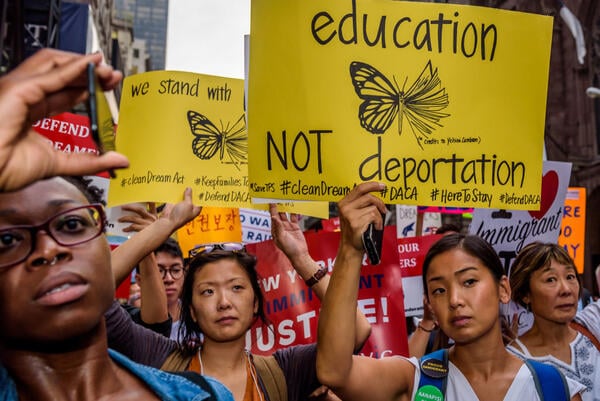
Tricia McLaughlin, assistant press secretary at the Department of Homeland Security, recently told the undocumented immigrants brought to the U.S. as children known as Dreamers, who have for years participated in the Deferred Action for Childhood Arrivals program, to self-deport.
She insisted that the Obama-era program, which protects these individuals from deportation and gives them work authorization, “does not confer any form of legal status in this country.”
“We encourage every person here illegally to take advantage of this offer and reserve the chance to come back to the U.S. the right, legal way,” McLaughlin said in a statement to NPR.
Her comments contradict those made by President-elect Donald Trump in a December interview with Meet the Press. He said then that he’d willingly work with Democrats on a plan to keep Dreamers in the country.
“They were brought into this country many years ago,” he told Meet the Press. “Some of them are no longer young people, and in many cases they’ve become successful. They have great jobs … We’re going to have to do something with them.”
This conflicting rhetoric is emblematic of the tenuous position Dreamers, including thousands of college students, have occupied for years, uncertain whether past protections and legal promises will hold. Today, most of the country’s roughly 400,800 undocumented students don’t have DACA status. But the Presidents’ Alliance on Higher Education and Immigration estimates about 119,000 are eligible for the program based on 2022 data.
DACA has suffered—and survived—attacks before, including from Trump during his first term, but immigrant advocates say this administration is launching precision strikes against Dreamers; instead of moving to end the DACA program wholesale, they’re casting doubt on the program’s legal power, and, one by one, targeting other benefits historically extended to Dreamers.
Gaby Pacheco, president and CEO of TheDream.US, a scholarship provider for undocumented students, said the federal government is “chipping away” at protections and public benefits for this population.
The administration is “coming at it from different angles in different ways and creating a lot of chaos,” Pacheco said. “A lot of people are confused and are trying to figure out what’s next and how to protect themselves,” including students and higher ed leaders.
A ‘Methodical, Surgical’ Attack
Legal challenges to DACA go back more than a decade. The U.S. Supreme Court prevented the program from expanding in 2016. Then, during Trump’s first term, he ordered the end of DACA under pressure from Republican lawmakers. When the Supreme Court ruled against his plans to immediately end the program, Trump tried to curb DACA in 2020 by rejecting new applications and limiting the renewal period.
Earlier this year, a three-judge panel for the U.S. Court of Appeals for the Fifth Circuit unanimously affirmed a 2023 district court order that deemed DACA unlawful, but the judges also issued a stay, leaving the status quo unchanged for now. No new DACA applications have been processed since the judge who made that order, U.S. District Judge Andrew S. Hanen, first ruled against the program in 2021. Hanen issued a new order in late July asking for additional written arguments from the parties in the case.
Pacheco said that now the government is doing a “very methodical, surgical” unwinding of Dreamers’ rights.
For example, the administration revoked DACA recipients’ eligibility for Affordable Care Act health insurance. Some Dreamers with DACA status, including students, have been detained by law enforcement.
Meanwhile, the U.S. Department of Justice sued four states for allowing local undocumented students, with and without DACA, to pay in-state tuition, successfully ending these policies in Texas and Oklahoma with support from state lawmakers. The Department of Education is also investigating five universities—the University of Louisville, the University of Nebraska, the University of Miami, the University of Michigan and Western Michigan University—alleging scholarships they provide for undocumented and DACA students violate civil rights law.
“There has been an escalating series of attacks and targeting of undocumented students, including those with DACA, and the institutions seeking to enroll and support them under this administration,” said Miriam Feldblum, president and CEO of the Presidents’ Alliance. “Over all, for students with and without DACA, this has become an increasingly anxious time” as well as for “campuses who are being targeted.”
A DACA recipient, who gained DACA status in 2014 and graduated with a bachelor’s degree in 2022, said the slew of new policies is “really affecting” day-to-day life for undocumented immigrants, including those in the program.
The recipient, who asked to remain anonymous, said the DACA program offered some sense of safety, but that protection now feels “very thin,” like a “Band-Aid on a wound.”
“I can’t imagine what it must feel like to be, especially a younger student or somebody who is currently in college,” they said. “You’re probably in the middle of your academic career and your state has now rescinded in-state tuition … How do you finish your education? What are you supposed to do?”
‘Just the Beginning’
Diego Sánchez, director of policy and strategy at the Presidents’ Alliance, said in a recent webinar that he worries the administration’s coordinated attack on DACA, and Dreamers over all, could signal a larger-scale war on the policy. He believes it’s a “very real concern right now” that the Trump administration could try to end DACA through the formal rule-making process—posting a proposed rule for public feedback, then issuing a regulation to phase out the program.
“We haven’t seen a formal announcement, but the rhetoric coming out of DHS, along with the uptick in enforcement, the detention of Dreamers all over the country, some who’ve had DACA, some who have never benefited from DACA, suggests that this may be under serious consideration,” he said.
Pacheco also fears life for Dreamers in college is going to get worse. She noted that the One Big Beautiful Bill Act poured about $170 billion into immigration enforcement. And while ICE doesn’t have access to the Free Application for Federal Student Aid database, a data-sharing agreement between the Internal Revenue Service and the Department of Homeland Security has students and their advocates worried about immigrant students’ data. Meanwhile, the federal government has plenty of data on DACA recipients, who have been dutifully filing their renewals every two years.
“I always try to be very careful how I say this to our students and to folks when I’m speaking, but this is really just the beginning,” she said.
Higher Ed as ‘Lines of Defense’
Immigrant advocates say colleges and universities have a vital role to play in making DACA and undocumented students safer.
Pacheco believes higher ed institutions over all are “one of the biggest lines of defense for students.” College officials can have plans in place for potential ICE visits and insist that law enforcement show warrants if they come looking for undocumented students, she said, and the fact of being a student, if they’re detained, can elicit public sympathy. And campuses have networks of alumni who can “rally around” them.
“One of the safest places where they can be is in a classroom, in an institution of higher learning,” Pacheco said.
Feldblum said higher ed institutions can also support Dreamers by not complying pre-emptively with the Trump administration’s legal challenges to benefits. For example, scholarships based on immigration status are “permissible,” she said, provided they don’t discriminate based on race, ethnicity, national origin or shared ancestry.
“The key here is to be clear that these programs, this status, is lawful,” Feldblum said. “And while the federal government may be attempting to threaten different regulations or programs … states and colleges and universities need to make sure they are not pre-emptively changing policy or regulation when the law does not require them to do so.”
Pacheco said she empathizes with higher ed leaders who are nervous to put their federal funds at risk by showing public support for their undocumented students. But she believes, at some point, higher ed is going to need to push back.
“When is it going to be enough?” she said. “And when are we going to draw a line and fight back and stand up for academic freedom and stand up for what these institutions have pledged, which is to educate everyone and to ensure that everyone has access to an equitable education?”