South Dakota is the fourth state in the country to commit to President Donald Trump’s federal education tax credit program, Republican Gov. Larry Rhoden announced Friday in Sioux Falls.
Under the program, South Dakotans who owe federal income taxes can either send up to $1,700 to the federal government, or they can donate that $1,700 to a government-recognized scholarship granting organization to public, private or homeschool entities in the state. The program starts in 2027.
Nebraska’s Republican Gov. Jim Pillen announced the state’s commitment in September. Republican governors for North Carolina and Tennessee announced their commitment this summer. Oregon, New Mexico and Wisconsin officials said they do not intend to opt into the program. Some critics nationally have questioned whether there will be proper guardrails, accountability and “quality control” in place.
Rhoden called the imminent program a “winning situation” for South Dakota taxpayers.
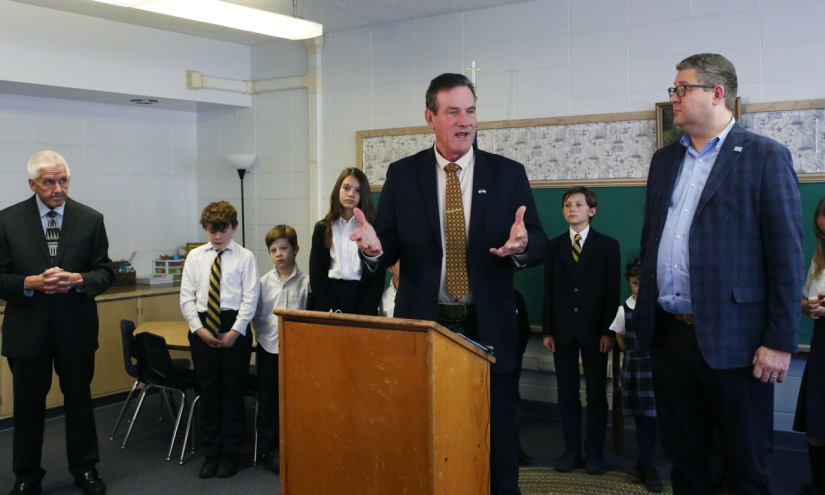
“I’d just as soon give those dollars to a private school than Uncle Sam,” Rhoden said at the announcement, standing in front of a row of students attending the St. Joseph Academy. “I think they know how to spend it a little wiser than the federal government.”
Rhoden added that the federal tax credit will “pair well” with South Dakota’s existing tax credit program, which allows insurance companies to donate up to a total of $5 million to a private school scholarship program for students whose families have low incomes.
South Dakota Gov. Larry Rhoden (left) and First Lady Sandy Rhoden (right) speak to St. Joseph Academy students in Sioux Falls on Nov. 11, 2025. (Photo by Makenzie Huber/South Dakota Searchlight)
Sara Hofflander, founder of St. Joseph Academy, said the school is “grateful” for the potential extra funding, though she plans to “approach everything cautiously.”
“Running an independent school obviously requires a heavy commitment from families,” Hoffman said, adding that the extra funding would “lift some of that burden, so we can focus more on the needs of our students.”
Historically, “school choice” efforts in the state have met resistance from the public school industry.
Advocates vehemently fought former Gov. Kristi Noem’s effort to introduce Education Savings Accounts, which would have provided public funding for private education and homeschool options during the last legislative session, calling the failed effort an attack on public education. Those same advocates referred to the state’s education tax credit program as “backdoor school voucher program.”
But Rob Monson, executive director for the School Administrators of South Dakota, said the program will benefit public and private education. South Dakotans can direct their tax credit dollars to organizations representing public schools in the state. The funding could be spent on not only tuition and fees for private schools, but tutoring, special needs services for students with disabilities, transportation (such as busing), afterschool care and computers.
“That’s a huge win for taxpayers of South Dakota, but also every form of education across the state,” Monson said.
South Dakota Education Secretary Joe Graves said the program will support education innovations and a “robust competitive system.”
Graves told lawmakers on Thursday, while presenting lackluster test scores to a committee, that “innovation” would be key to improving student outcomes, especially for Native American students and children living in “education deserts.”
“We’re not doing well enough, and we need to do better,” Graves said at Friday’s announcement.
If more students attend private or alternative schooling options, that would mean less state funding for public schools because of decreased student enrollment. Monson told South Dakota Searchlight that state revenues could be impacted by participation in the tax credit program, since it would remove federal tax dollars used to support other programs or go toward states. The federal government would still be obligated to fund some federal education programs, Monson added.
The scholarship funds would be available to families whose household incomes do not exceed 300% of their area’s median gross income. The U.S. Department of Treasury is expected to issue proposed rules detailing the program’s operation.
Graves said he assumes there will be reporting “at some level” of how the funds are spent.
South Dakota Searchlight is part of States Newsroom, a nonprofit news network supported by grants and a coalition of donors as a 501c(3) public charity. South Dakota Searchlight maintains editorial independence. Contact Editor Seth Tupper for questions: [email protected].
Did you use this article in your work?
We’d love to hear how The 74’s reporting is helping educators, researchers, and policymakers. Tell us how
This audio is auto-generated. Please let us know if you have feedback.
Dive Brief:
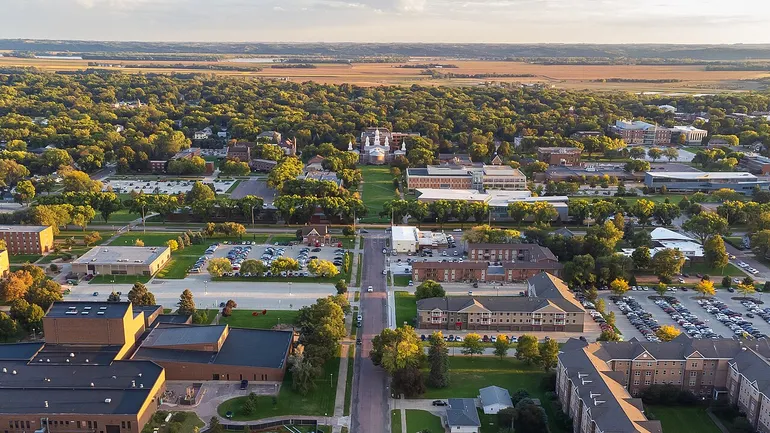
A federal judge has ordered leaders at the University of South Dakota to temporarily reinstate Phillip Michael Hook,a tenured art professor it sought to fire over a social media post critical of Charlie Kirk.
On Sept. 12, the university notified Hook he would be placed on administrative leave and that it intended to terminate his contract over a private Facebook post he shared criticizing Kirk the day of the conservative firebrand’s killing.
Hook is suing university leaders, alleging they unconstitutionally retaliated against him over his political speech.The professor’s case has a “fair chance of prevailing,” U.S. District Judge Karen Schreier said Wednesday in granting the temporary restraining order.
Dive Insight:
Hook is just one of an increasing number of college employees who have been reprimanded or fired over their speech about Kirk following his killing on Sept. 10. And a growing number of the educators affected are taking their cases to court. Schreier’s ruling this week represented one of the first court actions in such a lawsuit.
The federal judge said Hook must prove he made his comments as a citizen on “a public matter of concern” and that the University of South Dakota’s actions came as a result of that speech.
Hours after Kirk was killed, Hook said on his private Facebook account that he had no “thoughts or prayers” for Kirk.
In 2012, Kirk founded Turning Point USA, a conservative advocacy group geared toward young people, and became a prominent figure on college campusesin the process. Many of his political beliefs — such as opposition to race-conscious college admissions and gun control — fell in line with those of the conservative movement more broadly.
But his comments on some issues regularly prompted significant outcry and backlash, such as when he called Supreme Court Justice Ketanji Brown Jackson a “diversity hire” and said “prowling Blacks go around for fun to go target White people.” He also espoused the great replacement theory, which labels immigration policies as part of a plot to undermine the power and influence of White people.
“I’m sorry for his family that he was a hate spreading Nazi and got killed. I’m sure they deserved better,” Hook said in his Facebook post. “But geez, where was all this concern when the politicians in Minnesota were shot? And the school shootings? And Capitol Police?”
A few hours later, Hook deleted the post and shared “a public apology to those who were offended” by it on the same account. He published both posts while he was off work, according to court documents.
However, Hook’s original comments gained significant attention after conservative politicians shared a screenshot of them online.
Jon Hansen,the Republican speaker for South Dakota’s House and a 2026 candidate for governor, on Sept. 12 called Hook’s speech disgusting and “unbecoming of someone who works for and represents our University.”
“Yesterday, after seeing the post, I immediately reached out to USD President Sheila Gestring and called on the professor to be fired. I understand that the professor is likely to be terminated from his position,” Hansen said on social media.
A few hours later, South Dakota Gov. Larry Rhoden said Hook’s post made him “shaking mad” and that the South Dakota Board of Regents intended to fire the professor, a decision he applauded.
The same day, Hook received a letter from Bruce Kelley, the university’s fine arts dean, notifying him of the university’s “intent to terminate” his employment.
The letter alleged that Hook had violated two university policies, according to court documents.
One bans “neglect of duty, misconduct, incompetence, abuse of power or other actions” that diminish trust in faculty or prevent them from doing their job. The other requires that faculty “at all times be accurate, show respect for the opinions of others and make every effort to indicate when they are not speaking for the institution.”
University of South Dakota officials said this week that, over the two days between Hook’s post and Kelley’s letter, the university and the South Dakota Board of Regents received hundreds of messages criticizing Hook’s comments and calling for his removal.They confirmed that one such call came from Hansen.
However, the federal judge who ordered Hook’s temporary reinstatement said the officials failed to show that the reaction to the professor’s private comments disrupted his lessons or the university’s operations.
The Sept. 12 letter “identifies Hook’s social media post as the single piece of evidence it used to support its decision to terminate Hook’s position,” Schreier wrote.
Kelley had placed Hook on administrative leave until Sept. 29, when a personal conference was to be held to “discuss this matter and intended disciplinary action.”
Hook sued Kelley and Gestring, along with board president Tim Rave, on Tuesday seeking to have their decision ruled unconstitutional.
Schreier’s order will remain in effect until Oct. 8, when the court is scheduled to hear arguments over a more permanent preliminary injunction. The temporary restraining order allows for the Sept. 29 meeting to still occur, should the defendants choose.
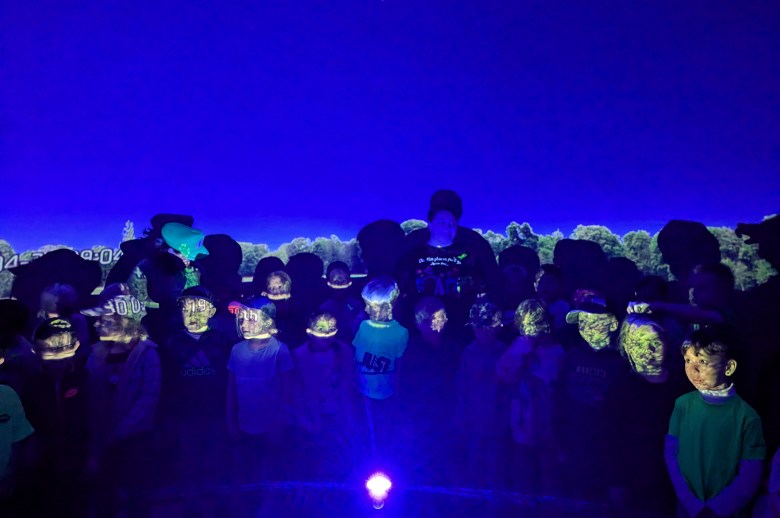
The kindergartners of South Dakota’s Hamlin County are, in fact, in space. To be specific, they are on planet Earth, near the geographic center of North America, sitting crisscross applesauce inside an 11-foot-high inflatable planetarium set up in their school gym.
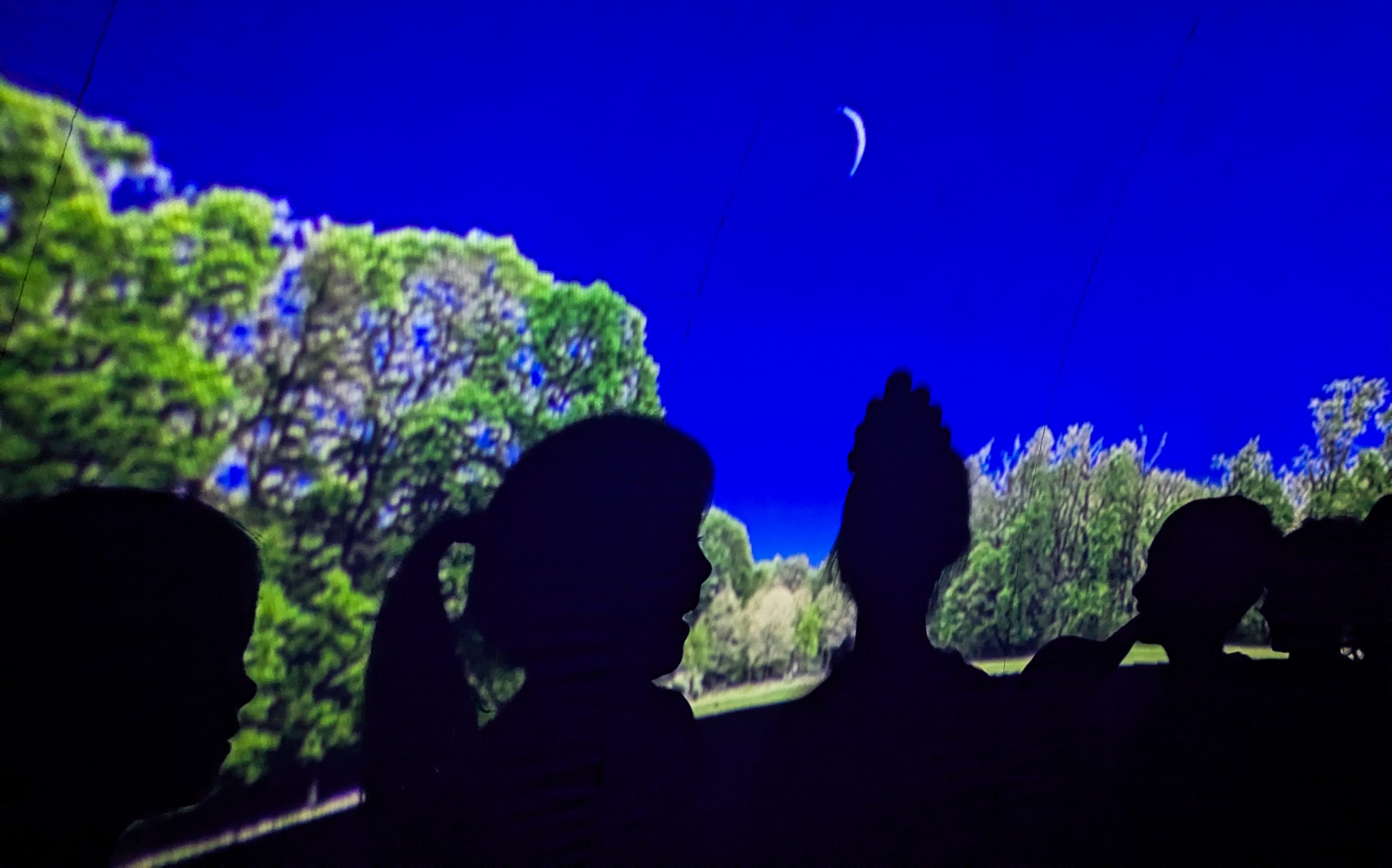
The darkness is velvety. Childish whispers skitter around the dome like mice. The kids are returning from a short mission to Jupiter, piloted by Kristine Heinen, a young museum educator with a ponytail who knows how to make her voice BIG AND EXCITED and then inviting and quiet to hold little ones’ attention.
“Now we’re over China!” Heinen says.
“My friend went to China!” a girl calls out.
“The other side is nighttime and this side’s bright,” expounds a boy with a crew cut. “The sun shines here so it can’t shine over there.“
The school is in eastern South Dakota, 34 miles northeast of the settlement where Laura Ingalls Wilder grew up and attended a one-room schoolhouse. The sprawling Hamlin Education Center is a modern-day analogue, serving an entire district in one building, with just under 900 students, pre-K through 12. Notable graduates include U.S. Homeland Security Secretary Kristi Noem, the former governor of South Dakota.
The center is roughly equidistant from four tiny towns, surrounded by open fields where cornstalks shine in the sun; 95 percent of students arrive by bus, from up to 20 miles away. Over a third of them qualify for free or reduced-price lunch, said Dustin Blaha, the elementary school’s principal.
Hamlin Elementary students line up for their turn visiting a traveling planetarium sponsored by the South Dakota Discovery Center. Credit: Anya Kamenetz for The Hechinger Report
During the planetarium’s daylong visit to the small community of Hayti, S.D., an educator from the South Dakota Discovery Center wowed 500 elementary school students with a presentation about the planets and stars. Credit: Anya Kamenetz for The Hechinger Report
Many Hamlin Elementary haven’t had a chance to visit the South Dakota Discovery Center in Pierre three hours away, so the museum brings traveling exhibits like a portable planetarium to them. Credit: Anya Kamenetz for The Hechinger Report
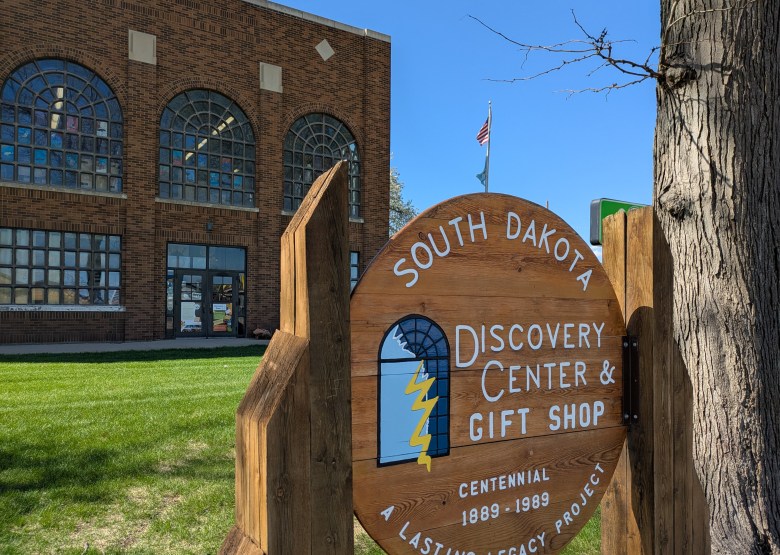
Blaha said that most of these children have never been to the South Dakota Discovery Center, a hands-on science museum three hours west in the state capital. But thanks to a federal agency called the Institute of Museum and Library Services, a part of the museum can come to them.
The IMLS was established in 1996, combining previously separate programs. The small agency became the largest source of federal funding for museums and libraries, last year awarding $266.7 million in program grants, research and policy development across all 50 states. IMLS awarded the South Dakota Discovery Center about $45,000 in 2023 to upgrade this traveling planetarium.
But students around the state may be waiting a long time for the next upgrade.
Related: Young children have unique needs and providing the right care can be a challenge. Our free early childhood education newsletter tracks the issues.
President Donald Trump signed an executive order in mid-March calling for the agency to be “eliminated to the maximum extent consistent with applicable law.” Mass firings followed.
On May 1, the U.S. District Court in Washington, D.C., issued a temporary restraining order to block the agency’s dismantling, followed on May 6 by a second federal judge finding the dismantling of this and two other agencies unconstitutional. On May 20, the American Library Association reported that employees are returning to work and some grants have been restored.
But the administration is continuing its legal battle to all but shutter the IMLS. The latest post on the agency’s Instagram account is captioned, “The era of using your taxpayer dollars to fund DEI grants is OVER,” holding up for criticism grants that were aimed at addressing systemic racism in museums, equitable library practices, and diverse staff development. The IMLS and the Department of Government Efficiency did not respond to requests for comment.
A veteran of the agency who asked to remain anonymous because of fear of reprisal said they first saw DOGE staffers meeting with leadership on March 28. “On the 31st, we were put on administrative leave. We had about two hours to turn in your key cards, your ID, get everything off your laptop you’re ever going to need. We were locked out of our computer systems by 3:30 and told to get out of the building.” A skeleton crew was hastily rehired the next day.
The ex-staffer points out that the Institute of Museum and Library Services spends, or spent, just 7 percent of its budget on its 70 staff, passing the rest along as grants. “We are not a bloated agency.” They have two kids at home, one with special needs and are married to another federal employee whose job is also at risk; but they are almost as worried about their grantees as themselves.
“After 20 years, I didn’t even get to put an out-of-office response up. Is someone emailing me right now and getting nothing, because all of a sudden their grant just ended? I hate that,” the former IMLS employee said.
Almost all grants awarded required a one-to-one cost share out of the local institution’s budget, the staffer said. Plus, typically the grantees pay for activities first and then apply to get reimbursed. “We’re leaving these often small rural museums and libraries on the hook.”
Anne Lewis, executive director of the South Dakota Discovery Center, said that organizations like hers would be “wobbly” without federal funding and would have to scale back on ambitious programs like the planetarium upgrade.
“The new system has much better interaction and control,” said Heinen, the museum educator. An earlier version had a static point of view, but upgraded visual effects means that “now we have spaceship mode,” she said. “We can travel to destinations including planets, and go in a full 360-degree mode around galaxies.”
With a flick of the touchscreen menu, she can also display the constellations of a dozen different cultures including Lakota, a significant benefit especially when she visits tribal schools.
The South Dakota Discovery Center, based in Pierre, has used federal support from the Institute for Museum and Library Services to pay for a traveling planetarium exhibit. Credit: Anya Kamenetz for The Hechinger Report
It’s a lean operation: Heinen drove solo nearly 200 miles from Pierre to Watertown the evening before and spent the night at an Econo Lodge. From there, it was another 20-some miles to Hayti, where she arrived at 7:30 in the morning, set up the dome herself, and ran 30-minute programs all day.
The whole elementary school, about 500 kids in total, saw the planetarium, with each show customized to the children’s interest and grade level; and she also conducted a parent engagement program in the afternoon. Heinen said she never tires of being a “Santa Claus” for science. ”As soon as they see me, they know something fun is going to happen.”
During this visit, the fan favorites were Jupiter, Mars and the sun. “It was cool when we went to Mars,” said Nash Christensen, 6. “And the volcano on that one moon, and the big hurricane on Jupiter. I think Jupiter is a dangerous place to live.”
Grant recipients of the Institute of Museum and Library Services say the support from the federal government has been critical to running their programs. For example, the Boston Children’s Museum, the second-oldest children’s museum in the country, has used federal grant money to improve school readiness. One of the outcomes was a new exhibit in the museum, “Countdown to Kindergarten,” that mimics a kindergarten classroom, complete with a school bus you can sit in out front.
“It’s helpful not only for the kids, but some of our caregivers who came from other countries and may not have gone to a school like this,” said Melissa Higgins, the museum’s vice president of programs and exhibits.
At the Madison Children’s Museum in Wisconsin, federal funds paid for a multistate partnership that provides climate education for young children and their families. In Fort Lauderdale, Florida, a grant covered five “STEMobiles,” which offer hands-on science activities for children ages 3-5 in low-income parts of Broward County. The Philadelphia School District won a two-year planning grant to try to improve its pipeline of school librarians; they were down to only a handful for a district of 200,000 students.
But the greatest impact may come in rural, often deep-red areas.
“Rural communities have particularly unique challenges,” said Lewis at the South Dakota Discovery Center. “There’s 800,000 people in the state, and they’re dispersed. We don’t have a concentration of funders and donors who can help support these enrichment activities.”
She said the teachers she serves are “passionate, committed and, like every other place in the world, underfunded.” If not for institutions like hers, students would probably go without this kind of hands-on science experience, she said.
Blaha, the elementary school principal, concurred. “The planetarium brings excitement and expertise that we don’t typically have in a community like this,” he said.
For now, the excitement is coming to an end. The class has “landed” on a green lawn, under a deep blue sky. Heinen announces “It’s time to leave.” She’s met with a chorus of, “Noo!”
“You guys, we were in here for a full 30 minutes.”
“It felt like 10!”
“It felt like a second!”
Tonight, many of them will be able to look up at the dark sky over the prairie and show their parents Jupiter, Ursa Major and Mars.
Contact the editor of this story, Christina Samuels, at 212-678-3635 via Signal at cas.37 or [email protected].
The Hechinger Report provides in-depth, fact-based, unbiased reporting on education that is free to all readers. But that doesn’t mean it’s free to produce. Our work keeps educators and the public informed about pressing issues at schools and on campuses throughout the country. We tell the whole story, even when the details are inconvenient. Help us keep doing that.