Tag: Data

  • More Gender Breakouts of Admission Data

    More Gender Breakouts of Admission Data

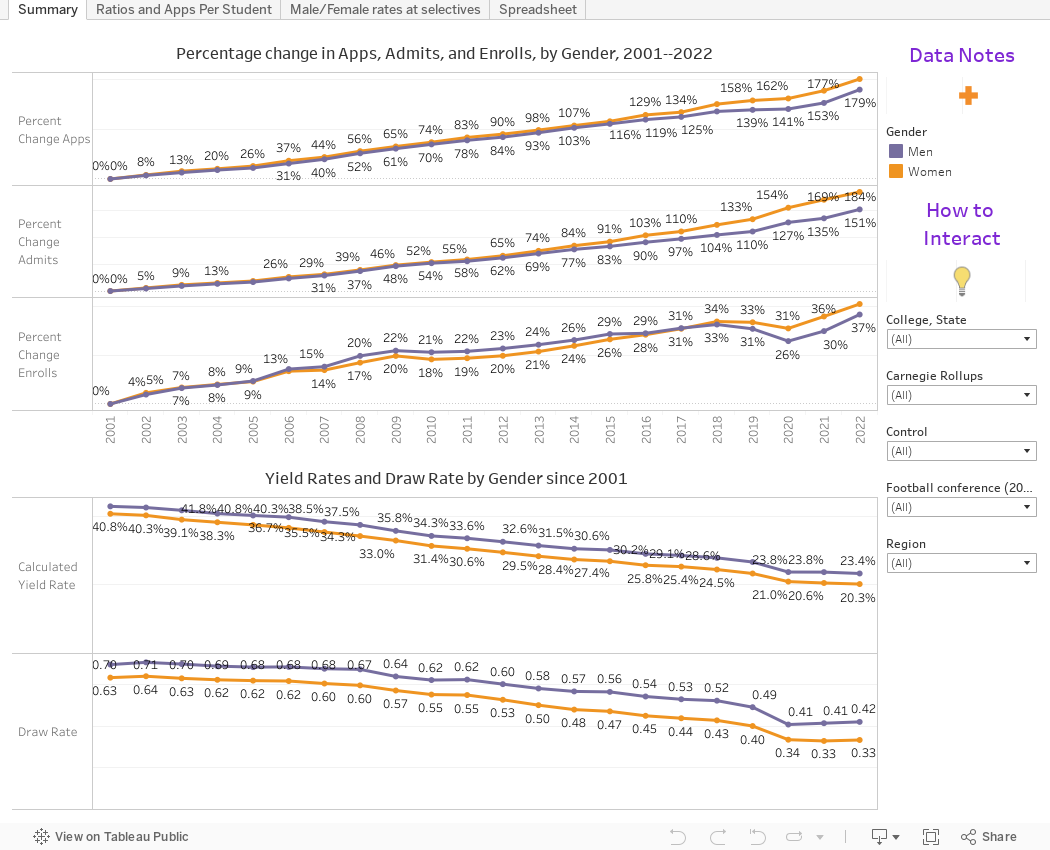
    I’ve written a lot about yield rates over time, and I’ve also written about differences in admission patterns among male and female applicants here and here; I’ve decided to take a fresh look at both based on some continuing discussions I’ve heard recently. 

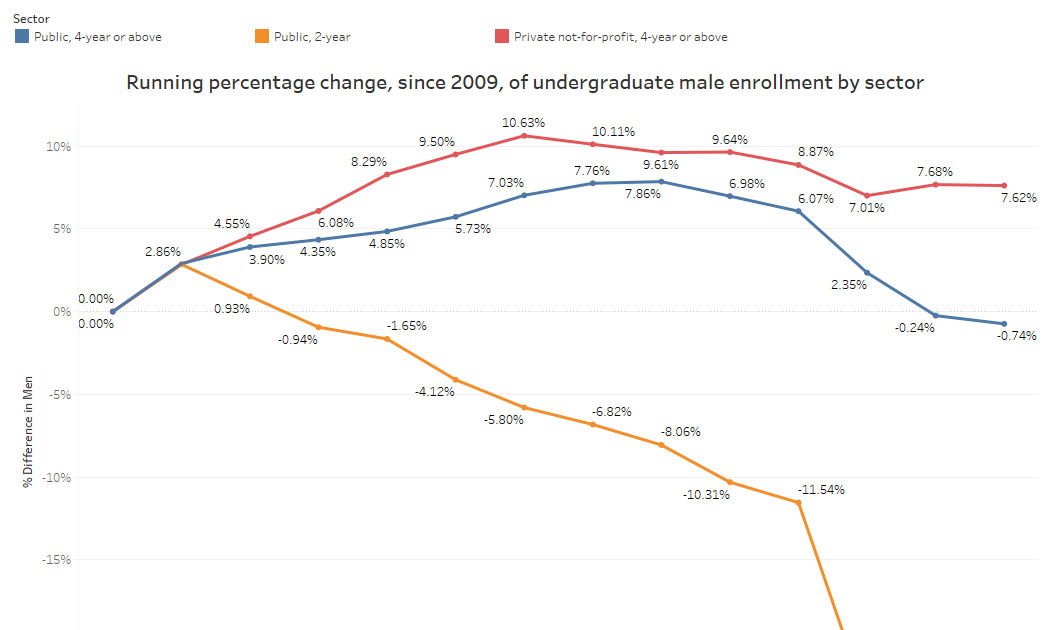
    You have, of course, heard about the crisis of male enrollment in American colleges, which, if you look at the data, is really a crisis of enrollment at Community Colleges.  Far be it from me to insist on data, however.

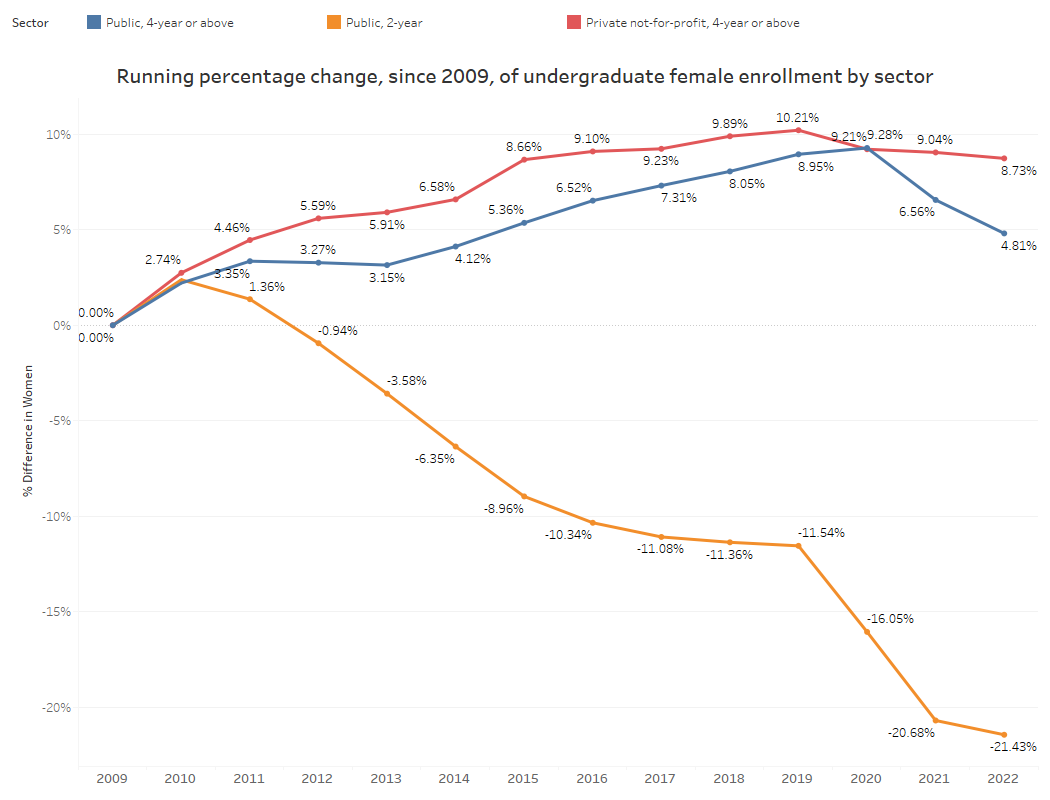
    Here is the same data for women, just to point out that there are differences.  Whether we should celebrate increasing attainment among young women or decry the inability of young men to keep up is your choice. 

    Regardless, here is a detailed breakout of these patterns as they show up in admissions over time.  There are four views here: A summary on tab one (using the tabs across the top); ratios of women to men at all stages of the process and estimated applications per student; gender-specific admission rates at the highly rejectives over time; and, for anyone who wants to download the data using the little icon at the bottom, a spreadsheet format.  Note: IPEDS just started collecting application data on non-binary students, so it will be a while before any trend analysis is possible.  For 2022, I only included students who self-identified as male or female.)

    Rather than explain the interactivity, I’ve put two buttons on the first view: Hover over the Orange Plus Sign to read some caveats about the data; and hover over the lightbulb for information about how to interact.

    As always, I’d love to hear what you see.

    Source link

  • Medical College Admission Data, 2023

    Medical College Admission Data, 2023

    This is a reboot of a visualization I did in 2018, which I found fascinating, but which didn’t get much traffic at the time, and thus, I’ve not refreshed it.  But I still find it compelling and instructive.

    Each year, the Association of American Medical Colleges publishes a lot of data about admission to medical colleges in the US. But frankly, it’s a mess, and takes a lot of effort to clean up and visualize: Each link is a separate spreadsheet, and each spreadsheet has spacer rows and merged cells and lots of stuff that needs to be scrubbed (carefully) before analyzing and visualizing.  So, if you use this work in a professional capacity, I’d appreciate your support for my time, software and hosting costs at this link. As a reminder, I don’t accept contributions from high school counselors, students, or parents who are using the site.  (And if you know anyone at AAMC, tell them raw data would be much appreciated).

    There are seven views here, some of which combine several data sets.  Use the tabs across the top to access the views.

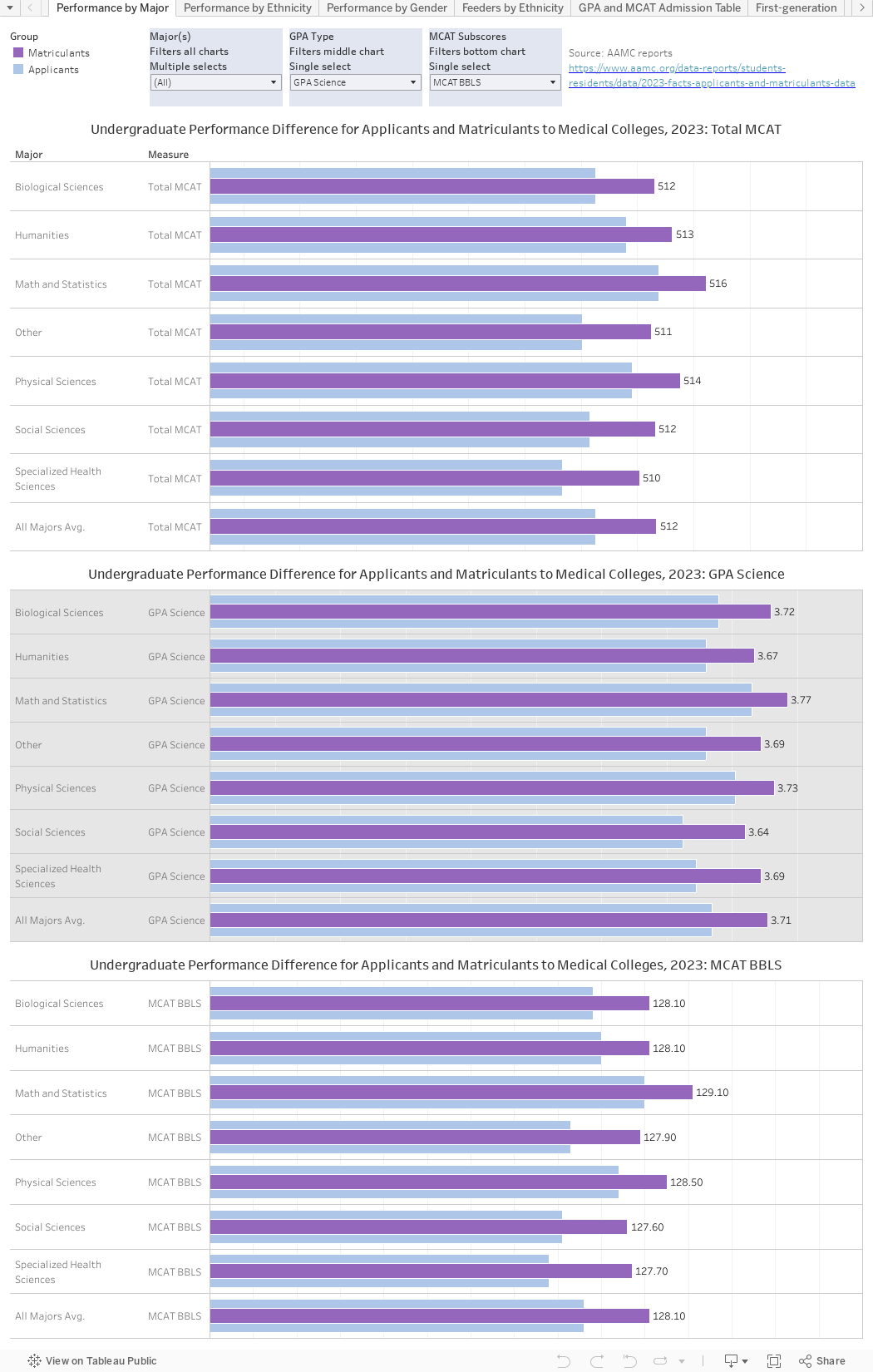
    The first three tabs show similar data, broken out three ways: By undergraduate major, by ethnicity, and by gender for applicants and matriculants. Don’t be afraid to use the filters to get what you want; you won’t break anything, and there is a reset button at the bottom.

    The top chart on these three views shows Total MCAT scores for applicants (blue) and matriculants (purple).  The middle chart shows your choice of GPA, using the filter at the top: Science, Non-Science, and Overall.  And the bottom chart shows sub-scores on the MCAT, again, based on the filter you choose.  Hover over a bar for details. 

    Total MCAT scores range from 472 to 578 with 500 being the mid-score, and each of the four sections–Biological and Biochemical Foundations of Living Systems; Chemical and Physical Foundations of Biological Systems; Psychological, Social, and Biological Foundations of Behavior; and Critical Analysis and Reasoning Skills–is scored from a low of 118 to a high of 132, with a midpoint of 125. Read about them here, whence I shamelessly stole this information.

    The fourth tab shows which undergraduate institutions sent applications to US Medical Schools in what quantity, based on student ethnicity.  Note that the data are not complete, but rather a compilation of five different reports, for colleges sending applications from at least 100 White students, 50 Asian students, 15 African-American students, 10 Hispanic students, or five Native American/Alaska Native students.  A college can be on one list but not another: For instance, the University of Oklahoma is #1 for Native students, but not on the list of institutions sending at least 50 Asian students.

    When you hover over the bars, you can see that institution in larger context, like this:

    The fifth tab gets into the nitty-gritty, and show the distribution of applicants and admits by GPA and MCAT ranges (top two charts), as well as the admission rate (bottom), showing the success of being admitted to at least one medical college.

    The sixth and seventh tabs are simple summaries by first-generation status, and gender over time.

    There is an awful lot of data here, and again, if you have any sway with the AAMC, tell them I’d sign my life away to get raw data in one big file.  As always, let me know what you see here.

    Source link

  • Data Show Women and People of Color Aren’t Advancing to Higher Faculty Ranks at the Same Rate as White Men – CUPA-HR

    Data Show Women and People of Color Aren’t Advancing to Higher Faculty Ranks at the Same Rate as White Men – CUPA-HR

    by CUPA-HR | May 2, 2024

    New research from CUPA-HR on the state of the faculty workforce in higher education shows that despite some growth in representation among tenure-track women and faculty of color in new hires, advancement to higher faculty ranks remains a barrier. What’s more, these promotion gaps are found in every faculty discipline.

    CUPA-HR’s research team analyzed data from the Faculty in Higher Education Survey, a comprehensive data source that collects salary and demographic data by tenure status, rank, and faculty discipline, to evaluate representation and pay equity for women and faculty of color from 2016-17 to 2022-23.

    In addition to the finding that women and faculty of color are not being promoted to senior faculty ranks at the same rate as White men, the data also show that women, Black, and Hispanic or Latina/o faculty are better represented in non-tenure-track than in tenure-track positions, and that pay gaps in non-tenure-track positions persist for these groups. Combined with the fact that these groups are less likely to be promoted to higher ranks in tenure-track positions, the result is that a substantial segment of faculty, primarily women and people of color, are employed in positions that pay lower salaries throughout their careers.

    Other Findings

    Tenure-track faculty positions are on the decline. There has been a decline in tenure-track positions and a corresponding increase in non-tenure-track positions over the past seven years. In 2016-17, tenure-track roles accounted for 73% of faculty, but by 2022-23, this proportion fell to 66%, with a marked increase in non-tenure-track positions over the last two years. Additionally, the percentage of new tenure-track assistant professor hires dropped in recent years, indicating a trend toward more new non-tenure-track hires.

    The representation of women and people of color in tenure-track faculty positions is increasing, yet challenges remain. There was a notable increase in the representation of tenure-track (TT) women and faculty of color from 2016-17 to 2022-23. In 2022-23, more than one-fourth (26%) of TT faculty were people of color. This marks a 28% increase over the span of seven years, compared to 2016-17, when faculty of color constituted closer to one-fifth (21%) of all TT faculty. However, the growth in racial/ethnic representation still lags when compared to the demographic composition of U.S. doctoral degree holders. Further, despite strides toward pay equity for tenure-track faculty of color, White women in tenure-track positions still face persistent pay gaps in 2022-23.

    Explore the interactive graphics and read the full report, Representation and Pay Equity in Higher Education Faculty: A Review and Call to Action.


    Source link

  • CUPA-HR’s Equal Pay Day Data for Higher Education: Women in Higher Ed Are Paid Just 82 Cents on the Dollar, Most Women of Color Are Paid Even Less – CUPA-HR

    CUPA-HR’s Equal Pay Day Data for Higher Education: Women in Higher Ed Are Paid Just 82 Cents on the Dollar, Most Women of Color Are Paid Even Less – CUPA-HR

    by Julie Burrell | March 12, 2024

    Since 1996, the National Committee on Pay Equity has acknowledged Equal Pay Day to bring awareness to the gap between men’s and women’s wages. This year, Equal Pay Day is March 12 — symbolizing how far into the year women must work to be paid what men were paid in the previous year.

    To help higher ed leaders understand, communicate and address gender pay equity in higher education, CUPA-HR has analyzed its annual workforce data to establish Higher Education Equal Pay Days for 2024. Tailored to the higher ed workforce, these dates observe the gender pay gap by marking how long into 2024 women in higher ed must work to make what White men earned the previous year.

    Higher Education Equal Pay Day fell on March 5, 2024, for women overall, which means that women employees in higher education worked for more than two months into this year to gain parity with their White male colleagues. Women in the higher ed workforce make on average just 82 cents for every dollar a White male employed in higher ed makes.

    Highlighting some positive momentum during this Women’s History Month, some groups of women are closer to gaining pay equity. Asian American women in higher ed worked two weeks into this year to achieve parity on January 14 — not ideal, but by no means insignificant. In fact, during the academic year 2022-23, Asian American women administrators in particular saw better pay equity than most other groups, according to CUPA-HR’s analysis.

    But the gender pay gap remains for most women, and particularly for women of color. Here’s the breakdown of the gender pay gap in the higher ed workforce, and the Higher Education Equal Pay Day for each group.* These dates remind us of the work we have ahead.

    • March 5 — Women in Higher Education Equal Pay Day. On average, women employees in higher education are paid 82 cents on the dollar.
    • January 14 — Asian Women in Higher Education Equal Pay Day. Asian women in higher ed are paid 96 cents on the dollar.
    • March 1 — White Women in Higher Education Equal Pay Day. White women in higher ed are paid 83 cents on the dollar.
    • March 12 — Native Hawaiian/Pacific Islander Women in Higher Education Equal Pay Day. Native of Hawaii or Pacific Islander women in higher ed are paid 80 cents on the dollar.
    • March 28 — Black Women in Higher Education Equal Pay Day. Black women in higher ed are paid 76 cents on the dollar.
    • April 12 — Hispanic/Latina Women in Higher Education Equal Pay Day. Hispanic/Latina women in higher ed are paid 72 cents on the dollar.
    • April 22 — Native American/Alaska Native Women in Higher Education Equal Pay Day. Native American/Alaska Native women are paid just 69 cents on the dollar.

    CUPA-HR research shows that pay disparities exist across employment sectors in higher ed — administrators, faculty, professionals and staff — even as the representation of women and people of color has steadily increased. But with voluntary turnover rising, not addressing pay disparities could be costly.

    CUPA-HR Resources for Higher Education Equal Pay Days

    As we observe Women’s History Month and Higher Education Equal Pay Days for women, we’re reminded that the fight for equal pay is far from over. But data-driven analysis with the assistance of CUPA-HR research can empower your fight for a more equitable future.

    See our interactive graphics that track gender and racial composition, as well as pay, of administrative, faculty, professional, and staff roles, collected from CUPA-HR’s signature surveys:


    *Data Source: 2023-24 CUPA-HR Administrators, Faculty, Professionals, and Staff in Higher Education Surveys. Drawn from 633,020 men and women for whom race/ethnicity was known.


    Source link

  • NLRB Higher Education Union Election Data for 2023 – CUPA-HR

    NLRB Higher Education Union Election Data for 2023 – CUPA-HR

    by CUPA-HR | March 5, 2024

    During calendar year 2023, union organizing continued to rise at institutions of higher education. Data from the National Labor Relations Board on union organizing show that 31.2% of all private-sector workers who successfully unionized in 2023 were employed by institutions of higher education. Public institutions also saw considerable union activity, though this is not reflected in NLRB data.*

    To provide an update regarding collective bargaining at private colleges and universities across the country, CUPA-HR’s government relations team has compiled the following NLRB data** from 2023 and early 2024 to summarize organizing activity.

    Organizing Efforts at Private Institutions in 2023

    • There were 132,303 workers in bargaining units that held elections in 2023. Of this total, 32,477 workers were from institutions of higher education.
    • There were 92,574 workers in total who joined certified bargaining units in the U.S. in 2023. Of this total, 28,859 workers were from institutions of higher education.

    Private Institution Union Drive Data in 2023

    • There were 55 union elections held at private institutions of higher education last year.
    • Of the 55 held, 48 union elections resulted in worker unionization. Again, this totaled 28,859 workers from private institutions of higher education.***
      • 20 elections included non-faculty, non-student workers with various positions.
      • 14 elections included graduate students with various positions (including two RA elections).
      • 13 elections included undergraduate students with various positions (including five RA elections).
      • Two elections included faculty.
      • Two elections included non-tenured faculty specifically.
      • Two elections included adjunct faculty.
      • Two elections included postdoctoral workers.
    • Three elections did not result in unionization. Four elections have been held at institutions, but they have not yet been closed. It is unclear why they are pending.

    Private Institution Election Data since January 1, 2024

    • So far this year, there have been eight union elections at institutions of higher education. Seven of the elections resulted in worker unionization, and one is still open for unknown reasons.
      • In the seven decided elections, 2,477 workers are included in the bargaining units.
      • In the one open case, 290 workers could be unionized.
    • Since January 1, 2024, there are seven pending petitions for unionization at institutions of higher education. In the seven pending petitions, 3,674 workers could be unionized depending on the result of the elections.

    CUPA-HR will continue to monitor this NLRB data and keep members apprised of future higher education union organizing trends.


    *The NLRB is a federal agency and only has jurisdiction over private employers, which includes private higher education institutions. Public institutions handle collective bargaining activity with their state and local labor relations agencies. CUPA-HR regularly tracks activity from the NLRB and is providing an overview of union activity at private institutions, but members at public institutions are encouraged to share union activity with the CUPA-HR government relations team as it occurs.

    **To compile the data, CUPA-HR searched for “Election Results” and “R Case Reports” that included the search terms “university,” “college,” and “school” during the calendar year 2023 and from January 1, 2024 to March 4, 2024.

    ***The grouped data below do not add up to 48 total elections because some units included multiple groups (i.e. undergraduate and graduate students, tenured and non-tenured faculty, etc.).


    Source link

  • Newly Updated CUPA-HR Data Shed Light on Trends in Representation and Pay Equity in the Higher Ed Workforce – CUPA-HR

    Newly Updated CUPA-HR Data Shed Light on Trends in Representation and Pay Equity in the Higher Ed Workforce – CUPA-HR

    by Julie Burrell | January 22, 2024

    Progress in both representation and equitable pay for women and people of color remained sluggish in most roles on college and university campuses in academic year 2022-23, according to the newest data. Through several interactive graphics representing years of research, CUPA-HR highlights the progress that has been made and the disparities that persist. The data track gender and racial composition as well as pay of administrative, faculty, professional, and staff roles, collected from CUPA-HR’s signature surveys.

    While the representation of women and people of color across all roles has steadily increased, inequity remains, especially when it comes to compensation for women and people of color. However, there were some notable areas of progress when it comes to compensation. Asian women and men of color (except for Native American/Alaskan Native men) in administrative roles saw better pay equity than most other groups.

    Administrators

    The share of racial and ethnic minorities in administrative roles continued to grow over the past decade, but gaps in both representation and pay remained steady. This is especially true for women of color, who represented less than 11% of these roles and, for the most part, received lower salaries than White men.

    In 2022-23, people of color made up 18.7% of administrators, up from 12.9% in 2011-12. Although the proportion of people of color in higher ed administrator positions grew steadily over the last decade, these increases have not kept pace with the rate at which minorities are obtaining graduate degrees.

    No improvement was shown in pay disparities for most women administrators. All female administrators except for Asian women received lower salaries than White men. Conversely, men of color, except for Native American/Alaskan Native men, were paid salaries greater than those of White men.

    The Administrators in Higher Education Survey collects data on administrator positions that manage a higher ed institution or a division within it.

    See the Administrators Composition and Pay Equity by Gender and Race/Ethnicity interactive graphics, as well as data broken out by CEO, provost and chief HR officer.

    Faculty

    There are two notable findings regarding faculty composition. First, more women faculty were represented in non-tenure-track roles than in tenure-track roles in 2022-23. Second, with each increase in rank, the proportions of women faculty and faculty of color decreased for both tenure-track and non-tenure-track faculty. Taken together, this means that women were over-represented in the lowest-paying and lowest-ranking positions.

    Pay gaps within rank persist, particularly for women faculty at the professor level, regardless of tenure status. These gaps are most notable for female professors of color in non-tenure-track positions. Pay gaps for assistant and associate professors have narrowed over time, particularly for tenure-track faculty.

    The factor that most impacts faculty pay is promotion to a higher rank, which is often the only time faculty receive significant increases in salary. When there is bias in promoting women and faculty of color to successive ranks, as our data continued to show, this results in career earnings gaps that far exceed what is often detected in pay equity studies within rank for a given year.

    The Faculty in Higher Education Survey collects data on tenure-track faculty positions and non-tenure-track teaching faculty positions.

    See the Faculty Composition and Pay Equity by Gender and Race/Ethnicity interactive graphics.

    Professionals

    In academic year 2022-23, women of all races and ethnicities were paid less than their male counterparts in professional roles, while women’s representation increased from 58% to 61% across all professional positions since 2016-17. The growth is due to slight increases in the representation of women of color, from 13.1% in 2016-17 to 15.7% in 2022-23.

    Representation by gender and race/ethnicity varied widely by position. Human resources had the greatest share of women professionals, with 82% being women, including 28% women of color. Information technology had the lowest percentage of professional women (27%), and librarians and development/fundraising professionals had the lowest representation of professionals of color (14%).

    While pay was more equitable for most groups (apart from Hispanic/Latina women and men of two or more races), pay disparities persisted. Women of all races and ethnicities were paid less than their male counterparts. In addition, Hispanic/Latino men, Native Hawaiian men, and men of two or more races were paid less than White men.

    The Professionals in Higher Education Survey collects data on positions in specific functional areas in higher ed institutions, such as academic or student services, that usually require a baccalaureate degree.

    See the Professionals Composition and Pay Equity by Gender and Race/Ethnicity interactive graphics.

    Staff

    Staff roles continued to have a higher representation of people of color than any other higher ed employee group last year. Staff also continued to be the lowest-paying positions in higher ed, with women particularly hard hit by pay disparities.

    In 2022-23, women of color represented about 19% of all higher ed staff, and men of color represent about 13% of all higher ed staff — a modest increase since 2016-17. Skilled craft employees were the least racially diverse, a finding that has persisted across the past six years. Notably, skilled craft staff are among the highest-paid staff positions.

    Since 2016-17, women were paid consistently and considerably less than White men. Pay equity for American Indian/Alaska Native women, Asian women, and Native Hawaiian/Other Pacific Islander women was better in 2022-23 than in 2016-17. Pay equity was the same or worse in 2022-23 than in 2016-17 for Black women, Hispanic/Latina women, women of two or more races, and White women. Men of color fared considerably better than women of color when it came to pay equity.

    The Staff in Higher Education Survey collects data on positions that are generally non-exempt and do not require a college degree.

    See the Staff Composition and Pay Equity by Gender and Race/Ethnicity interactive graphics.

    CUPA-HR Research

    CUPA-HR is the recognized authority on compensation surveys for higher education, with its workforce surveys designed by higher ed HR professionals for higher ed HR professionals and other campus leaders.


    Source link

  • CUPA-HR Data Highlights Trends in Representation and Pay Equity in the Higher Education Workforce, and the News Is Mixed – CUPA-HR

    CUPA-HR Data Highlights Trends in Representation and Pay Equity in the Higher Education Workforce, and the News Is Mixed – CUPA-HR

    by CUPA-HR | March 1, 2023

    When it comes to representation and pay equity for women and people of color in the higher education workforce, colleges and universities have frequently struggled to make meaningful progress. Through several new interactive graphics representing years of research, CUPA-HR shines a light on the progress that has been made and the disparities that persist. These graphics represent data from CUPA-HR’s four signature higher ed workforce surveys — Administrators, Faculty, Professionals, and Staff — through 2022.

    Administrators

    While the proportion of people of color in higher ed administrator positions has grown steadily over the last 10 years, these increases have not kept pace with the rate at which minorities are obtaining graduate degrees. In 2022, people of color made up 18.2 percent of administrators, up from 12.9 percent in 2012.

    The data also show that pay gaps for women administrators of all races/ethnicities are consistent across the past 10 years and notably wide. Pay inequity is particularly egregious for women administrators of color (with the exception of Asian women). Men of color, on the other hand, have been paid salaries equitable to or greater than those of White men in recent years.

    The Administrators in Higher Education Survey collects data on administrator positions that manage a higher ed institution or a division within it.

    See the Administrators Composition and Pay Equity by Gender and Race/Ethnicity interactive graphics, as well as data broken out by CEO, provost and chief HR officer.

    Faculty

    There are two notable findings in faculty composition. First, more women are represented in non-tenure-track than in tenure-track faculty. Second, for each tenure status and with each increase in rank, the proportions of women and faculty of color decrease. This means that women are over-represented in the lowest-paying and lowest-ranking positions. This remains the case despite the fact that the proportion of women and faculty of color have increased slightly at each rank over the past five years.

    Pay gaps for women faculty, regardless of tenure status or rank, continue to persist, particularly at the rank of professor. These gaps are most notable for women of color. Pay gaps at other ranks have narrowed over time, particularly for tenure-track faculty. Importantly, the factor that most impacts faculty pay is promotion to a higher rank. Often, the only significant increases in salary happen with these promotions. These data show that the only group that has greater representation with each increase in rank is that of White male faculty, and this pattern has persisted over time.

    The Faculty in Higher Education Survey collects data on tenure-track faculty positions and non-tenure-track teaching faculty positions.

    See the Faculty Composition and Pay Equity by Gender and Race/Ethnicity interactive graphics.

    Professionals

    Women’s representation has increased across all professionals’ positions since 2017, and in 2022, women represented more than 60 percent of higher ed professionals. This change is due to slight increases in representation of women of color since 2017. In 2022, representation of people of color was 24 percent overall, with the highest percentage among human resources professionals (34 percent) and diversity and equal opportunity professionals (33 percent).

    In 2022, women were consistently paid less than White men, a pattern that has worsened since 2017. However, men of color were paid more equitably in 2022 compared to previous years.

    The Professionals in Higher Education Survey collects data on positions in specific functional areas in higher ed institutions, such as academic or student services, that usually require a baccalaureate degree.

    See the Professionals Composition and Pay Equity by Gender and Race/Ethnicity interactive graphics.

    Staff

    Staff employees have a higher representation of people of color than any other higher ed employee group. This is notable in that these are the lowest-paying positions in higher ed. In 2022, women of color represented about 19 percent of all higher ed staff, and men of color represented about 13 percent of all higher ed staff. These numbers have increased since 2017, though modestly. Skilled craft employees were the least racially diverse group, as 80 percent were White men, a finding that has persisted across the past six years. Notably, skilled craft staff are among the highest-paid staff positions.

    Since 2017, women in staff positions have been paid consistently and considerably less than White men in staff positions, a pattern that has worsened over time, particularly for women in office and clerical positions. Men of color were paid more equitably in 2022 when compared to 2017.

    The Staff in Higher Education Survey collects data on positions that are generally non-exempt and do not require a college degree.

    See the Staff Composition and Pay Equity by Gender and Race/Ethnicity interactive graphics.

    CUPA-HR Research

    CUPA-HR is the recognized authority on compensation surveys for higher education, with its workforce surveys designed by higher ed HR professionals for higher ed HR professionals and other campus leaders. CUPA-HR has been collecting data on the higher ed workforce for more than 50 years, and we maintain one of the largest workforce databases in existence. CUPA-HR also publishes numerous research publications and interactive graphics highlighting trends and issues around higher ed workforce planning, pay equity, representation of women and racial/ethnic minorities and more. Learn more about CUPA-HR research.


    Source link

  • 4 Considerations for Using Salary Data to Inform Compensation Decisions – CUPA-HR

    4 Considerations for Using Salary Data to Inform Compensation Decisions – CUPA-HR

    by Missy Kline | November 15, 2022

    Editor’s note: This blog post, originally published in April 2019, has been updated with additional resources and related content.

    Salary benchmarking is not one-size-fits-all — especially when you’re looking at groups as varied as administrators, professionals, staff and faculty on a college or university campus that is unique in its combination of Carnegie class, affiliation, regional location and mission. The question, then, is how to tailor your benchmarking efforts to take these variables into account and choose data that is appropriate to your unique needs.

    Here are four considerations to help you make the best use of salary data for compensation budget planning for your faculty and staff:

    1) Which institutions should your institution’s salaries be benchmarked against? Making the right comparisons — using position-specific data and carefully selected peers — can make all the difference when planning salaries that will make your institution competitive in the labor market. When you use CUPA-HR’s DataOnDemand, you can narrow down peer institutions by one or several institution-level criteria such as affiliation (public, private indephttp://cupahr.org/surveys/dataondemand/endent or private religious), Carnegie classification, enrollment size, geographic region, total expenses or other characteristics. Remember, balance is key: a larger comparison group gets you more robust data for comparison, but you must also make sure you are comparing to the right types of institutions that make sense for your goals.

    2) Not all faculty are the same. Tenure track faculty, non-tenure track teaching faculty, non-tenure track research faculty and adjunct faculty may each require unique compensation strategies, as do faculty members from different disciplines and ranks. Will the same salary increase help retain both tenured and non-tenured faculty? Does collective bargaining impact salary targets for some, but not all, of these faculty sub-groups? Are there unique, fast-growing, or in-demand departments/disciplines that require a separate strategy?

    3) Keep in mind that administrator salaries are broadly competitive. Like faculty, many administrative positions in higher ed are competitive at a national level. Often, institutions seek administrators with experience at other institutions of a similar size or mission, and with this experience and mobility comes an expectation of a competitive salary. As higher ed moves toward a “business model” where innovative leadership strategies are displacing more traditional shared governance models, finding administrators with the appropriate skills and expertise is becoming increasingly competitive, not only within higher education but sometimes against the broader executive employment market.

    4) Employment competition varies for staff and professionals. Many non-exempt staff are hired from within local labor markets, and therefore other institutions or companies in your state or local Metropolitan Statistical Area might be a better salary comparison than a nationwide set of peer institutions. Exempt or professional staff, however, may be more limited to competition from the higher ed sector, perhaps on a state or regional level. In addition, changes brought about by the pandemic (e.g., remote work opportunities, a desire to relocate) have made many professional positions more globally competitive. Are your institution’s salaries for these employees appropriately scoped for the market in which you need to compete?


    Additional Articles and Resources

    How One College Is Using Salary Data to Ensure Pay Equity and Market-Par Compensation

    Compensation Programs/Plans, Executive Compensation in Higher EdEqual Pay Act (CUPA-HR Toolkits)

    Working in a Fish Bowl: How One Community College System Navigated a Compensation Study in a Transparent Environment (Higher Ed HR Magazine)


    Source link

  • 2022 Data: Changes in Higher Ed Pay and Workforce Size – CUPA-HR

    2022 Data: Changes in Higher Ed Pay and Workforce Size – CUPA-HR

    by CUPA-HR | April 27, 2022

    CUPA-HR has released its data on overall higher ed pay increases, as well as changes in workforce size for 2021-22.

    Higher Ed Pay Increases Have Not Kept Pace With Inflation

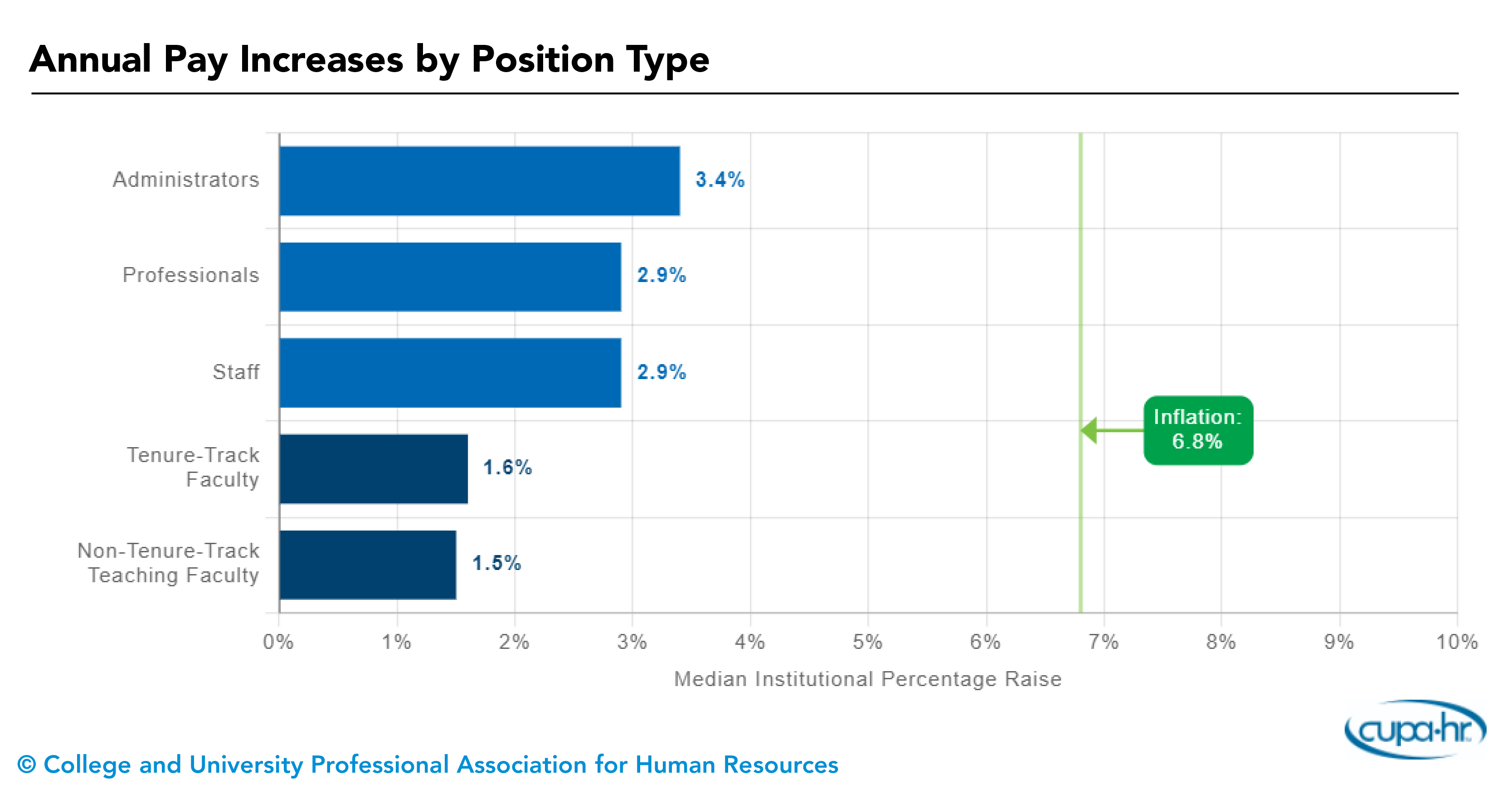
    The soaring inflation rate has far outpaced pay increases for the higher education workforce. According to findings from CUPA-HR’s annual workforce surveys for 2021-22, overall median salaries for administrators increased by 3.4%. Professionals and non-exempt staff saw increases of 2.9%, and salaries for tenure-track and non-tenure-track faculty increased by 1.6% and 1.5%, respectively. The inflation rate for 2021 was 6.8% and continues to climb.

    This is not the first year that pay increases have not kept up with inflation. Pay increases for administrators, professionals and staff last met or exceeded inflation in 2019-20.  Non-tenure-track faculty salary increases last met or exceeded inflation in 2016-17, and tenure-track faculty salary increases have not kept pace with inflation in any of the past six years.

    Explore pay-increase trends on CUPA-HR’s website.

    Overall Workforce Size Has Declined in the Wake of the Pandemic

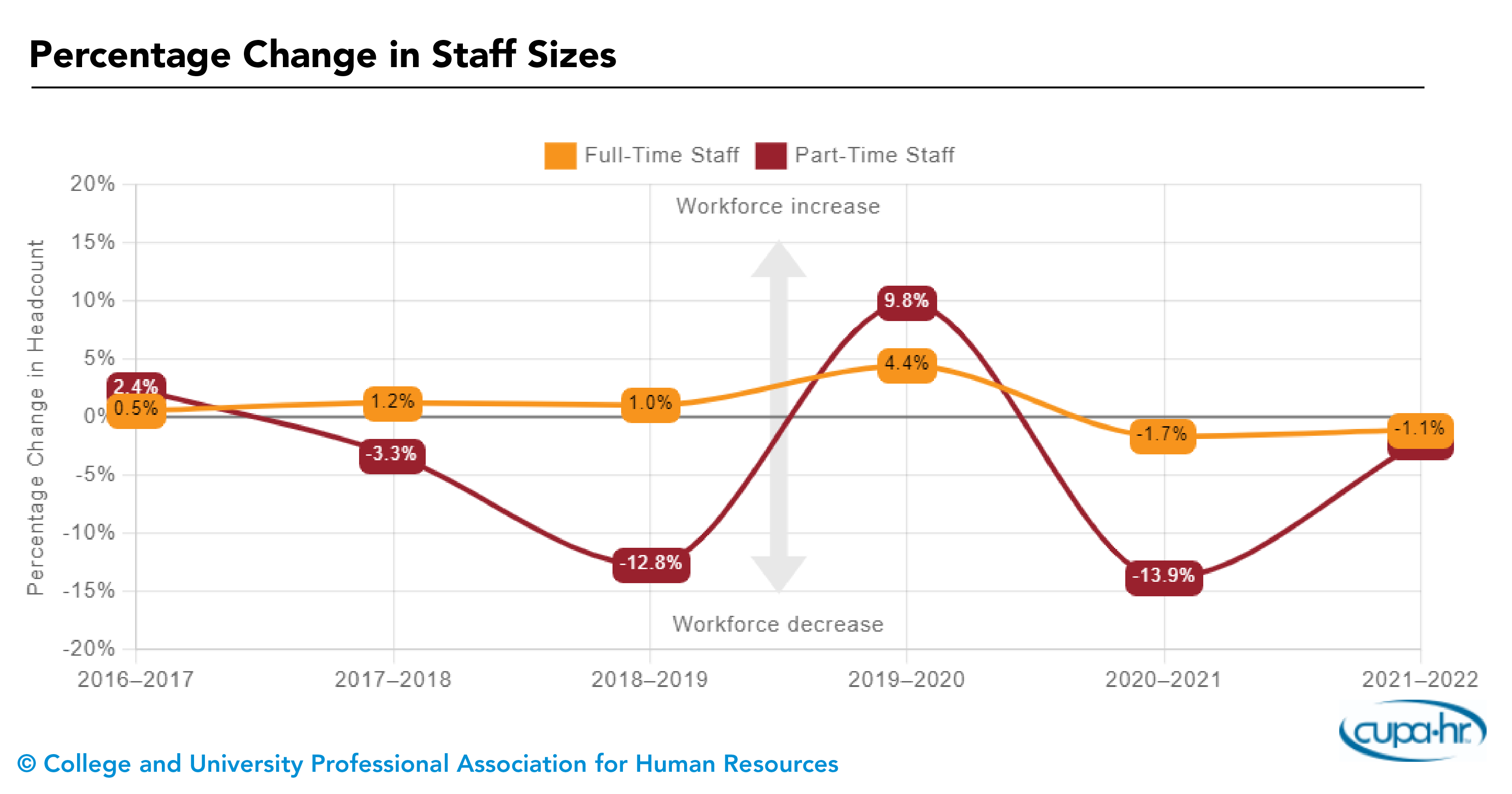
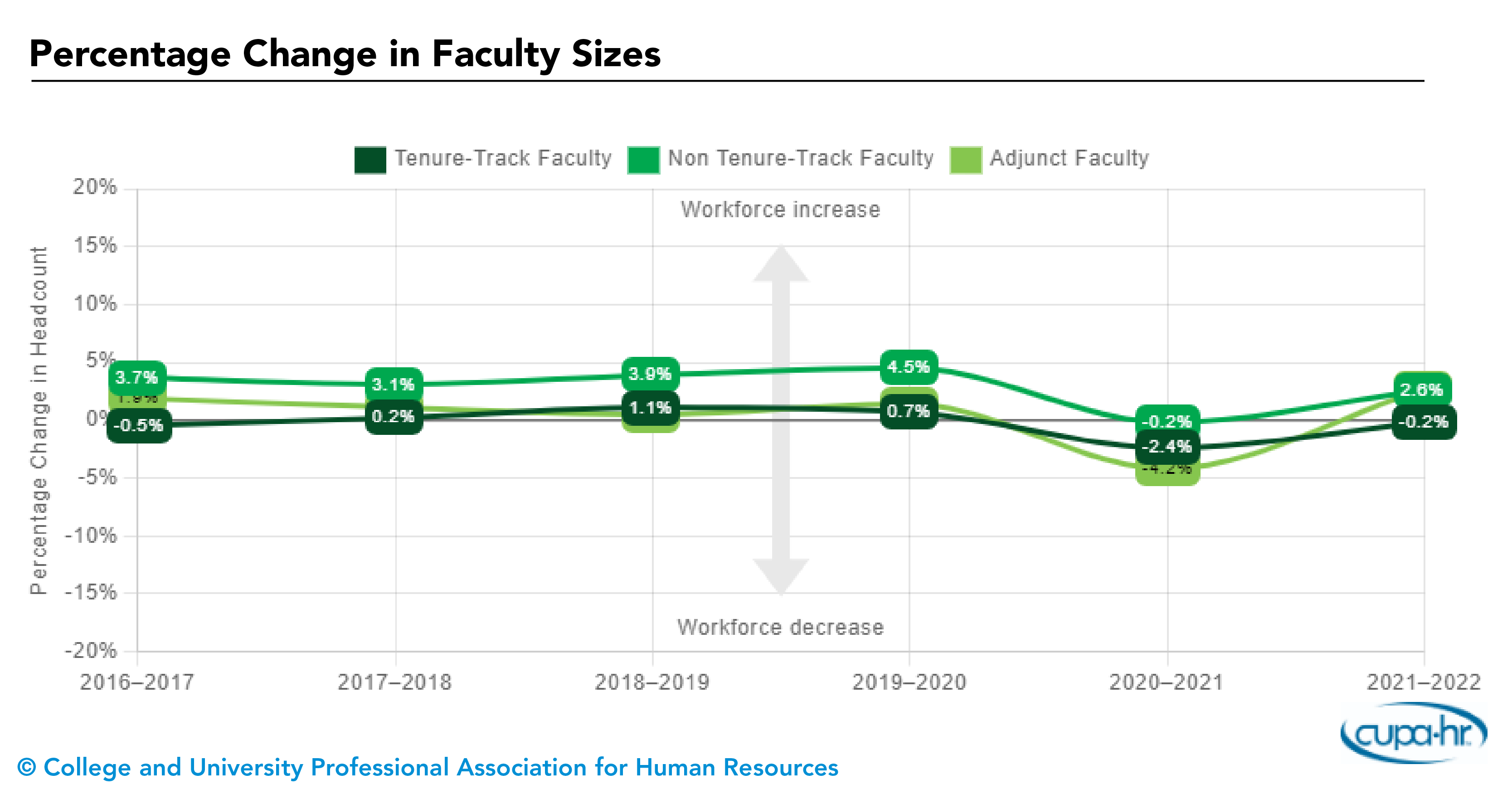
    Historically, the overall size of the higher education workforce has increased from year to year. However, colleges and universities are experiencing the same employee recruitment and retention challenges that most U.S. employers have struggled with in the past few years. In both 2020-21 and 2021-22, the size of full-time staff, part-time staff, and tenure-track faculty declined from the prior year.

    Two areas of the workforce that saw growth this year were those of non-tenure-track faculty and adjuncts. Although the number of non-tenure-track faculty and adjuncts declined between 2019-20 and 2020-21, those numbers have rebounded in 2021-22.

    Explore the trends in workforce size changes on CUPA-HR’s website.

    In-Depth Data and Custom Reports

    Higher ed institutions can use CUPA-HR’s DataOnDemand (DOD) subscription service to run comprehensive data tables and analyses.


    Source link