Having failed to complete deals to sell the troubled giant for-profit University of Phoenix to major state universities in Arkansas and Idaho — after people in those states got cold feet — the school’s owner, private equity behemoth Apollo Global Management, just before the holiday weekend announced an initial public offering for the school.
Phoenix’s parent company had been publicly traded until AGM and two other firms took the company private in 2017. Now they have gone back to Wall Street to re-sell the school to investors.
But should investors want to buy this operation? The presence of the heavily-advertised University of Phoenix in the college market has been bad for U.S. students, taxpayers, and the economy, because it has led many students to enroll in a school that often deceives people, and often leaves students with heavy debts and without the careers they sought — when they could be using taxpayer support and their own money to enroll in better value programs.
Moral and macro-economic concerns aside, it’s not even clear that buying Phoenix will be good for investor bottom lines.
The University of Phoenix, which has received tens of billions from federal taxpayers for student grants and loans — at times more than $2 billion in a single year — has faced numerous law enforcement investigations and actions for its deceptive recruiting of veterans, military service members, and other students across the country.
Most notably, in 2019, Phoenix reached a record $191 million settlement with the Federal Trade Commission, which claimed the school had lured students with false claims about partnerships with major employers. Phoenix ran ads falsely indicating that the school had deals with companies including AT&T, Yahoo!, Microsoft, Twitter, and the American Red Cross to create job opportunities for its students and tailor school programs for such jobs, when that was not the case. The deceptive claim went to the heart of prospective students’ motivations for enrolling. Andrew Smith, then the Director of the FTC’s Bureau of Consumer Protection, said at the time of the agreement, “Students making important decisions about their education need the facts, not fantasy job opportunities that do not exist.”
And last year California’s attorney general reached a settlement with Phoenix to resolve allegations that the school’s aggressive recruitment tactics directed at military students violated consumer protection laws.
The now almost entirely online school did a two-year dance with the University of Idaho that drew immense criticism from lawmakers, executive branch officials, newspaper editorial boards, and others in that state before the deal was finally called off in June.
Bloomberg reported earlier this year that an IPO might value the University of Phoenix operation, which had $810 million in revenue for 2023-24 (81 percent of that from federal taxpayer dollars), at $1.5 billion to $1.7 billion. And the new Trump administration has signaled in multiple ways that it is reducing protections for students against predatory college abuses, a development that may make investors more willing to buy a piece of a school like Phoenix.
But new federal legislation requires schools to provide some financial value for students. Also, state attorneys general, who have curbed and even slayed a number of for-profit giants over a decade, are watching; the media understands this issue, as it did not in the last wild west era fifteen years ago; and more potential students are wary after a generation of abuses.
So it may end up being much tougher to thrive in the predatory college business than some might think.
On the eve of the 4th of July holiday, when they probably hoped no one was paying attention, the Trump Department of Education issued an Interpretive Rule that will make it easier for for-profit colleges to evade regulations aimed at protecting students, and especially student veterans and military service members, from low-quality schools.
The Department’s 90-10 rule, created by Congress, requires for-profit colleges to obtain at least ten percent of their revenue from sources other than taxpayer-funded federal student grants and loans, or else — if they flunk two years in a row — lose eligibility for federal aid. The purpose is to remove from federal aid those schools of such poor quality that few students, employers, or scholarship programs would put their own money into them.
For decades, low quality schools have been able to avoid accountability through a giant loophole: only Department of Education funding counted on the federal side of the 90-10 ledger, while other government funding, including GI Bill money from the VA, and tuition assistance for active duty troops and their families from the Pentagon, counted as non-federal. That situation was particularly bad because it motivated low-quality predatory schools, worried about their 90-10 ratios, to aggressively target U.S. veterans and service members for recruitment.
After years of efforts by veterans organizations and other advocates to close the loophole, Congress in 2021 passed, on a bipartisan basis, and President Biden signed, legislation that appropriately put all federal education aid, including VA and Defense Department money, on the federal side of the ledger.
The Department was required by the new law to issue regulations specifying in detail how this realignment would work, and the Department under the Biden administration did so in 2022, after engaging in a legally-mandated negotiated rulemaking that brought together representatives of relevant stakeholders. In an unusual development, that rulemaking actually achieved consensus among the groups at the table, from veterans organizations to the for-profit schools themselves, on what the final revised 90-10 rule should be.
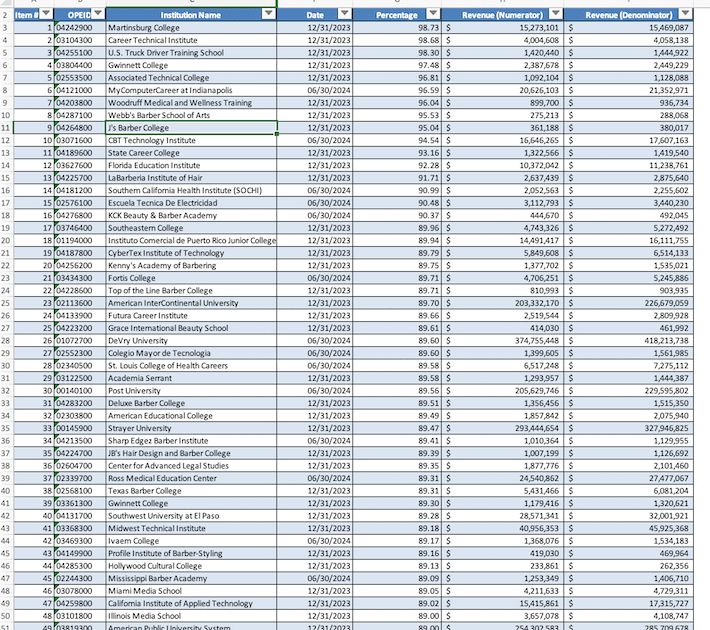
The new rule took effect in 2023, and when the Department released the latest 90-10 calculations, for the 2023-24 academic year, sixteen for-profit colleges had flunked, compared with just five the previous year. These were mostly smaller schools, led by West Virginia’s Martinsburg College, which got 98.73 percent of its revenue from federal taxpayer dollars, and Washington DC’s Career Technical Institute, which reported 98.68 percent. Another 36 schools, including major institutions such as DeVry University, Strayer University, and American Public University, came perilously close to the line, at 89 percent or higher.
The education department last week altered the calculation by effectively restoring an old loophole that allowed for-profit colleges to use revenue from programs that are ineligible for federal aid to count on the non-federal side. That loophole was expressly addressed, via a compromise agreement, after Department officials discussed the details with representatives of for-profit colleges, during the 2022 negotiated rulemaking meetings.
All the flunking or near-flunking schools can now get a new, potentially more favorable, calculation of their 90-10 ratio under the Trump administration’s re-interpretation of the rule.
In the lawless fashion of the Trump regime, the Department has now undermined a provision of its own regulation without going through the required negotiated rulemaking process. (The Department’s notice last week included a labored argument about why its action was lawful.)
As it has done multiple times over its first six months, the Trump Department of Education, under Secretary Linda McMahon, has again taken a step that allows poor-quality predatory for-profit colleges to rip off students and taxpayers.
Since February 2007, International Higher Education Consulting Blog has provided timely news and informational pieces, predominately from a U.S. perspective, that are of interest to both the international education and public diplomacy communities. From time to time, International Higher Education Consulting Blog will post thought provoking pieces to challenge readers and to encourage comment and professional dialogue.
“Look, I get it. It doesn’t matter who he is at a private dinner with a comedian. It matters who he is on the world stage. I’m just taking it as a positive that this person exists.” – Bill Maher, recounting his dinner with President Trump, HBO
“I knew I couldn’t change his views, but we need to talk to the other side — even if it has invaded and annexed other countries and committed unspeakable crimes against humanity.” – Larry David, “My Dinner with Adolf,” The New York Times
By and large, I have long appreciated Bill Maher’s “Real Time” comic stings. Just the sort of thing that social comedy should do. In 2002, we shared a stage as recipients of a Hugh Hefner First Amendment Award. It was an honor, even though I found him rather full of himself.
That said, after watching my fill of Rachel Maddow and others, I take escapist pleasure in watching Bill slay any variety of righteous types with his comic axe. That is, until I watched the April 11 episode of “Real Time,” the one where he joked about his dinner at the White House with President Trump.
While Maher did note Trump’s attacks on him, and his counter-attacks on Trump, he did so in a way that made Trump seem like little more than a nice guy with different views. Maher normalized the man who time and again has attacked First Amendment values with authoritarian abandon — the very values Maher champions.
Ah, Bill’s dinner with Donald was so delightfully memorable: Donald was “gracious and measured.” And catch this: he’s no “crazy person,” said Maher, though he “plays a crazy person on TV.” Moreover, he’s “much more self-aware than he lets on.” He’s “just not as fucked up as I thought [he] was.”
Oh, the private Donald was so tolerant, so engaging, so rational, and so open to hearing the other side. Ya just got to get to know the guy, break bread with him, warts and all. Hell (and that’s the word), in person he is actually “measured,” even if he presents a real threat to constitutional democracy and a clear and present danger to almost every value of First Amendment law.
The folks at “Fox And Friends” loved the Maher/Trump “Kumbaya” moment, though they did not buy Maher’s private/public distinction regarding Trump’s personality. Hardly. For them, what Maher portrayed was the real Trump: “What Bill Maher saw was what the American public as a whole has come to see. . . He’s not pretending to be something he isn’t. And that’s what stood out.”
All of it made me want to puke!
“You know,” I said to my wife Susan, “I wonder what he’d say if he met Hitler and found him to be ‘gracious.’”
Cut to Tuesday morning: It’s early, and Susan says, “You gotta read this Larry David piece in the Times. It’s titled ‘My Dinner With Adolf.’ It tracks what Maher said about Trump while mocking Maher every inch of the way.”
Ok, match on!
Just as sometimes one must “fight fire with fire,” so too sometimes one must fight “comedy with comedy.” Enter Larry David. Here’s how his satiric response to Maher’s dinner with Trump opens:
Imagine my surprise when in the spring of 1939 a letter arrived at my house inviting me to dinner at the Old Chancellery with the world’s most reviled man, Adolf Hitler. I had been a vocal critic of his on the radio from the beginning, pretty much predicting everything he was going to do on the road to dictatorship. No one I knew encouraged me to go. “He’s Hitler. He’s a monster.” But eventually I concluded that hate gets us nowhere. I knew I couldn’t change his views, but we need to talk to the other side — even if it has invaded and annexed other countries and committed unspeakable crimes against humanity.
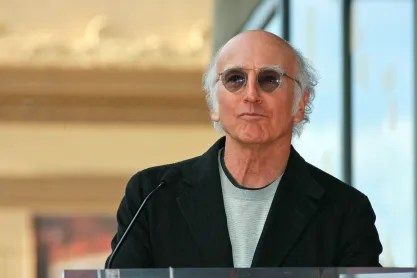
Larry David at the induction ceremony for Mary Steenburgen into the Hollywood Walk of Fame (Shutterstock.com)
And here’s how David ends his deliciously jeering counter to Maher:
Two hours later, the dinner was over, and the Führer escorted me to the door. “I am so glad to have met you. I hope I’m no longer the monster you thought I was.” “I must say, mein Führer, I’m so thankful I came. Although we disagree on many issues, it doesn’t mean that we have to hate each other.” And with that, I gave him a Nazi salute and walked out into the night.
Note to Bill: You gotta curb your enthusiasm for your “gracious” and “measured” friend. Tyranny isn’t funny, it’s evil!
Hold on! Maher got worse when Banon arrived:
Awful as his naïve Trump dinner fiasco was, I was nonetheless eager to hear Maher’s interview with Steve Bannon thereafter. When he wasn’t joking around, the good news was that Bill asked tough questions. The bad news was that, save for an opening exchange about Trump’s third-term aspirations, Maher really didn’t press Bannon every time he responded with an evasive answer. He just let it sit there and moved on to another tough question followed by more evasive answers . . . followed by “bro bonding.”
Really Bill! What the fuck happened to your strong sting, bro? You were more like a soft butterfly.
Remember:
‘60 Minutes’ producer quits over journalistic independence
Bill Owens
CBS News entered a new period of turmoil on Tuesday after the executive producer of “60 Minutes,” Bill Owens, said that he would resign from the long-running Sunday news program, citing encroachments on his journalistic independence.
In an extraordinary declaration, Mr. Owens — only the third person to run the program in its 57-year history — told his staff in a memo that “over the past months, it has become clear that I would not be allowed to run the show as I have always run it, to make independent decisions based on what was right for ‘60 Minutes,’ right for the audience.”
“So, having defended this show — and what we stand for — from every angle, over time with everything I could, I am stepping aside so the show can move forward,” he wrote in the memo, which was obtained by The New York Times.
‘60 Minutes’ has faced mounting pressure in recent months from both President Trump, who sued CBS for $10 billion and has accused the program of “unlawful and illegal behavior,” and its own corporate ownership at Paramount, the parent company of CBS News.
Paramount’s controlling shareholder, Shari Redstone, is eager to secure the Trump administration’s approval for a multibillion-dollar sale of her company to Skydance, a company run by the son of the tech billionaire Larry Ellison.”
Comments offered to FAN by Floyd Abrams and Ira Glasser
“It is deeply troubling that Bill Owens, whose leadership of ‘60 Minutes’ as its executive producer has been repeatedly honored through the years, has been obliged to resign because of pressure from the Trump Administration and ABC’s new corporate owner. It is a blow to independent journalism and a great loss to the American public.” — Floyd Abrams
“Unless the Supreme Court radically changes First Amendment law, Trump’s suit has no legal merit. If Paramount isn’t interested in defending CBS’ right to criticize public officials, it ought to sell CBS to someone who is, and stick to the entertainment business. What Edward R. Murrow and Walter Cronkite constructed, Shari Redstone [executive chairwoman of Paramount Global] is tearing down.” — Ira Glasser
Related
Coming Next Wednesday
Zick’s Resources Compilation of Executive Actions Affecting First Amendment Rights
Coming as soon as next Wednesday, Professor Stephen Solomon and his colleagues over at First Amendment Watch will launch Professor Timothy Zick’s invaluable Resources pages, replete with a comprehensive, topical, and hyperlinked set of references to virtually all of the Trump executive orders and related actions affecting free expression. This user-friendly and topic-specific resources page provides the most detailed and yet across-the-board account of what has happened within the last 100 days of this Administration in matters concerning the First Amendment.
Jury rules against Palin in defamation against The New York Times
The New York Times did not libel former Alaska Gov. Sarah Palin in a 2017 editorial that contained an error she claimed had damaged her reputation, a jury concluded Tuesday. Former Alaska Gov. Sarah Palin campaigned for the state’s U.S. House seat in 2022 with the support of President Trump. She did not win.
The jury deliberated a little over two hours before reaching its verdict. A judge and a different jury had reached the same conclusion about Palin’s defamation claims in 2022, but her lawsuit was revived by an appeals court.
Palin was subdued as she left the courthouse and made her way to a waiting car, telling reporters: “I get to go home to a beautiful family of five kids and grandkids and a beautiful property and get on with life. And that’s nice.”
FIRE fires back in Trump pollster fraud suit
“This lawsuit is, as the Bard put it, a tale ‘full of sound and fury, signifying nothing.’”
This case is built entirely on a tissue of shopworn campaign rhetoric and fever-dream conspiracy theories, yet even accepting Plaintiffs’ wild factual assertions as true, the Complaint lacks any plausible legal theory on which to grant relief. The allegations of “fraudulent news” are an affront to basic First Amendment law, and Plaintiffs continue to butcher elementary concepts like duty, reliance, causation, and damages under Iowa law. The Court should dismiss the Amended Complaint.
Arguments
Plaintiffs’ Claim That Election Polls and the News Coverage They Generate Can Be Labelled “Fraud” Unprotected by the First Amendment is Utterly Baseless.
There is No General First Amendment Exception for False Speech.
Election Polling is Not Commercial Speech and is Fully Protected Election News Coverage.
No Case Law Supports Plaintiffs’ Theory of Liability.
Plaintiffs’ Claims are Facially Deficient Under Iowa Law
Plaintiffs Fail to Plead a Cognizable ICFA Claim.
Plaintiffs Fail to Plead a Fraudulent Misrepresentation Claim.
Plaintiffs Fail to Plead a Negligent Misrepresentation Claim.
Piercing the Corporate Veil.
Conclusion
This lawsuit is, as the Bard put it, a tale “full of sound and fury, signifying nothing.” William Shakespeare, Macbeth, Act 5, Scene 5. Once you get past the groundless assertions, campaign-style hyperbole, and overheated conspiracy theories, there is nothing left. No legal basis whatsoever supports the claims, and Plaintiffs’ opposition to the motions to dismiss reveals both shocking unfamiliarity with basic concepts of First Amendment law and a disregard of the pleading requirements for fraud or misrepresentation under Iowa law. As one court summed it up in another of President Trump’s attacks on free speech: “This case should never have been brought. Its inadequacy as a legal claim was evident from the start. No reasonable lawyer would have filed it. Intended for a political purpose, none of the counts of the amended complaint stated a cognizable legal claim.” Trump v. Clinton, 653 F.Supp.3d at 1207. The Court should dismiss this case with prejudice.
Attorneys for Defendants J. Ann Selzer, and Selzer & Company: Robert Corn-Revere, Conor T. Fitzpatrick, Greg H. Greubel, and Matthew A. McGuire
School district ordered to pay attorney fees to censored parent
Bret Nolan (Federalist Society)
A federal judge has ordered that the Sheridan County (WY) School District must pay attorneys’ fees following a lawsuit with Harry Pollak, a parent censored during a 2022 school board meeting
Following a lengthy legal dispute, the United States District Court for the District of Wyoming has awarded attorneys’ fees totaling $156,000 to the litigation team representing Harry Pollak of Sheridan County. Mr. Pollak was represented by Institute for Free Speech Senior Attorney Brett Nolan and local counsel Seth Johnson.
Mr. Pollak initially filed suit against the Sheridan County School District in March 2022 after he was cut off from speaking from speaking critically about the superintendent at a school board meeting. The board cited a policy against discussing “personnel matters” as the reason for censoring him, and it called the police to escort him out of the building.
Last fall, the district court ruled in favor of Mr. Pollak, declaring that the school board violated his First Amendment rights and awarded him nominal damages of $17.91 (a symbolic amount referring to the year the First Amendment was ratified). The court also permanently enjoined the board from enforcing its policy to prevent speakers like Mr. Pollak who want to criticize school staff by name.
[ . . . ]
To read the full fees order, Pollak v. Wilson, et al., click here.
Mchangama and Marami on deportation and dissent
The Trump administration is invoking a clause of the Immigration and Nationality Act of 1952 that allows the Secretary of State broad discretion to deport anyone he believes “would have potentially serious adverse foreign policy consequences for the United States.” As such, a recently released memo detailing the government’s case against the most prominent of the activists, Mahmoud Khalil, refrains from charging him with any crime. On Friday, a Louisiana immigration judge upheld the Government’s decision to deport Khalil. Constitutional scholars debate whether and to what extent the First Amendment protects noncitizens in such cases, and the Supreme Court may eventually weigh in.
But the question is not only constitutional — it is foundational. Is deporting foreigners for expressing disfavored views compatible with a robust commitment to a culture of free speech?
As it turns out, history has a lot to tell us about states that exclude foreigners with controversial opinions and those that welcome non-native dissenters.
[ . . . ]
From Zenger to Hitchens, from Abrams to Arendt, it has often been immigrants who tested the boundaries of the First Amendment — and in doing so, helped define its meaning. To now deport people for unpopular opinions is not merely a constitutional gray zone. It is a betrayal of the very idea that truth and progress emerge from argument, not conformity.
Silencing foreign voices won’t make America safer. It will make it smaller and less resilient. A confident, free nation doesn’t banish speech — it engages it.
The odd couple: Franks and Corn-Revere in dialogue (and debate) at Brooklyn Law School event
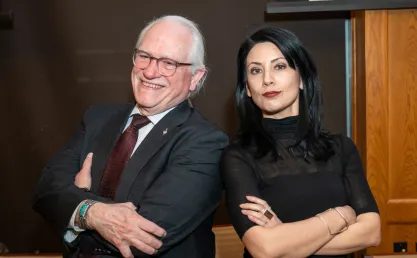
FIRE Chief Counsel Robert Corn-Revere (left) and Professor Mary Anne Franks
Dr. Mary Anne Franks — Eugene L. and Barbara A. Bernard Professor in Intellectual Property, Technology, and Civil Rights Law, George Washington Law School; President and Legislative & Tech Policy Director, Cyber Civil Rights Initiative
Robert Corn-Revere — Chief Counsel, Foundation for Individual Rights and Expression (FIRE)
Moderators
William Araiza, Stanley A. August Professor of Law, Brooklyn Law School
2024-2025 SCOTUS term: Free expression and related cases
Cases decided
Villarreal v. Alaniz(Petition granted. Judgment vacated and case remanded for further consideration in light of Gonzalez v. Trevino, 602 U. S. ___ (2024) (per curiam))
Murphy v. Schmitt (“The petition for a writ of certiorari is granted. The judgment is vacated, and the case is remanded to the United States Court of Appeals for the Eighth Circuit for further consideration in light of Gonzalez v. Trevino, 602 U. S. ___ (2024) (per curiam).”)
TikTok Inc. and ByteDance Ltd v. Garland (9-0: The challenged provisions of the Protecting Americans from Foreign Adversary Controlled Applications Act do not violate petitioners’ First Amendment rights.)
Review granted
Pending petitions
Petitions denied
Emergency Applications
Yost v. Ohio Attorney General (Kavanaugh, J., “IT IS ORDERED that the March 14, 2025 order of the United States District Court for the Southern District of Ohio, case No. 2:24-cv-1401, is hereby stayed pending further order of the undersigned or of the Court. It is further ordered that a response to the application be filed on or before Wednesday, April 16, 2025, by 5 p.m. (EDT).”)
Free speech related
Mahmoud v. Taylor (Free exercise case — Issue: Whether public schools burden parents’ religious exercise when they compel elementary school children to participate in instruction on gender and sexuality against their parents’ religious convictions and without notice or opportunity to opt out.)
Thompson v. United States (Decided: 3-21-25/ 9-0 w special concurrences by Alito and Jackson) (Interpretation of 18 U. S. C. §1014 re “false statements”)
This article is part of First Amendment News, an editorially independent publication edited by Ronald K. L. Collins and hosted by FIRE as part of our mission to educate the public about First Amendment issues. The opinions expressed are those of the article’s author(s) and may not reflect the opinions of FIRE or Mr. Collins.
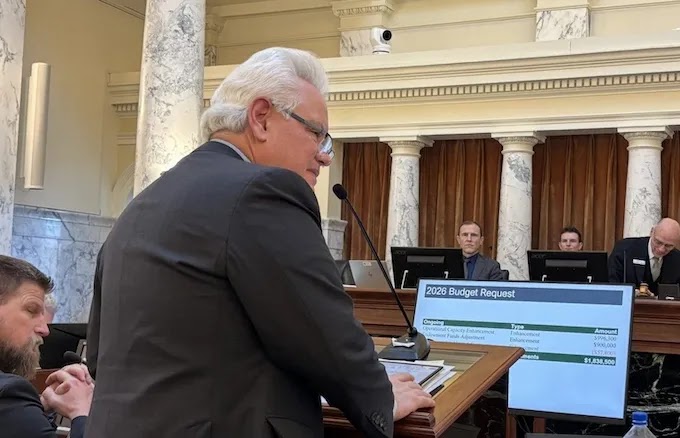
In testimony Monday before a joint committee of the Idaho
legislature, University of Idaho president C. Scott Green seemed a
little less committed to the deal he has relentlessly touted for more
than a year and a half — for his school to buy, for $685 million, the
huge for-profit University of Phoenix from private equity giant Apollo
Global Management.
According to Idaho Education News, Green said the next move was Apollo’s. “We’re waiting to hear what they would like to do,” Green said.
The Green school deal has assumed that operation of Phoenix would
bring millions in new revenue to fund his university. But it ignores
that running a for-profit college, one that has repeatedly gotten in trouble with law enforcement,
would be a tremendous challenge: If Green pushed to end Phoenix’s
predatory practices and improve student outcomes, it probably would
start losing money, because predatory practices, coupled with high
prices and low spending on education, have made up the school’s secret
sauce. But if Green allowed the deceptive conduct to persist, the school
could face more legal peril. And, whatever route he took, Green’s
school might end up assuming massive liability for student loan debt the
government has cancelled based on past abuses at Phoenix.
At its peak, Phoenix was the largest for-profit college in the
country and got upwards of $2 billion a year in federal student aid,
while boasting dismal graduation rates and high levels of loan defaults.
Last summer, the University of Idaho and Apollo agreed to a one-year extension of their purchase deal. That arrangement expires June 10. Meanwhile Apollo has the right to talk with other potential buyers.
Apollo already has sent Idaho $5 million to cover the school’s
high-priced legal and consulting fees in connection with the deal, and
it has agreed to pay up to $20 million to Idaho if the deal falls
through.
Green told the legislature that $20 million would cover his school’s
costs with perhaps $2 to $3 to spare. “I think we’re well-protected,” he
boasted.
Kind of. Green, whose background is in corporate management and
finance, could potentially walk away without losing money for the
school. But he has tied up state university, executive, legislative, and
judicial resources for many hundreds of hours jousting over an effort
that would keep alive a predatory school that has buried thousands of
graduates in debt they can’t afford to repay, while wasting billions in
federal taxpayer dollars, when that time could have been focused on the
real challenges of state higher education.
If Idaho can’t work out a deal, Apollo may run out of options to dump
the school, and this taxpayer-funded multi-billion dollar disgrace may
at last be put down.
[Editor’s note: This article originally appeared on Republic Report.]
Since February 2007, International Higher Education Consulting Blog has provided timely news and informational pieces, predominately from a U.S. perspective, that are of interest to both the international education and public diplomacy communities. From time to time, International Higher Education Consulting Blog will post thought provoking pieces to challenge readers and to encourage comment and professional dialogue.
Since February 2007, International Higher Education Consulting Blog has provided timely news and informational pieces, predominately from a U.S. perspective, that are of interest to both the international education and public diplomacy communities. From time to time, International Higher Education Consulting Blog will post thought provoking pieces to challenge readers and to encourage comment and professional dialogue.
The Spring 2021 Gateway Leadership Institute will appeal to those international education professionals and related higher education experts who are interested in developing new knowledge and skills needed to shape the next generation of international higher education. Through a combination of webinars, workshops, and coaching, the Institute engages participants in an exploration of new directions in educational technology. Working in small teams, participants will be assigned to a specific EdTech company and will work on a realistic challenge over the course of the Institute. The Institute facilitators are Drs. Rosa Almoguera and George F. Kacenga.
Participation is now only US$125. Apply by Saturday, February 20th. Learn more and apply here.
Note: I’m an affiliate of the Gateway International Group but receive no compensation for this post. For the first Gateway Leadership Institute I served as a volunteer mentor. I’m posting to support this Gateway International Group endeavor.