Tag: day

  • Return to Learn Day 2024 – by Sharon Connor – ALL @ Liverpool Blog

    Return to Learn Day 2024 – by Sharon Connor – ALL @ Liverpool Blog

    Storm Lillian might have been causing chaos across the North West, but nothing could dampen the spirits of everyone involved in this year’s Return to Learn Day. For the second year running, the team at Go Higher invited potential mature learners to experience a full day of talks and tours on campus.

    The day was (high) kicked off on a musical note, with Dr Freya Jarman (below left) leading listeners through the history of the multiple meanings of singing high notes in Western music. Covering everything from Tiny Tim to Barbara Streisand, our visitors quickly warmed to the topic and were keen to share their own insights and experiences. We hardly had time to pause for breath, before Heather Johnston from Sydney Jones Library delivered an informative talk on KnowHow, the University of Liverpool’s skills support service. Go Higher and KnowHow work closely together all year round; we know that many mature students may not have written anything vaguely academic for many years, and may never have used a referencing system – the Study Skills team at Go Higher are there to support your learning throughout the whole course, and KnowHow provide the university wide support for both undergraduate and postgraduate students.

    Lunch provided an enjoyable opportunity for guests to chat informally with not only professional services and teaching staff, but also current and former Go Higher students. Peer support plays a major role in the success of Go Higher, not only within a year group, but more widely as a mentoring system for students to continue that contact even after they have started their undergraduate studies.

    The University of Liverpool is the only university in England with an Irish Studies Department, and Dr Sean Haughey outlined the degree course content, as well as reminding us of just how many Go Higher students decide to study with this close and supportive department. Sean also gave us a taste of the sort of lecture students might expect, asking just how divided society is now in Northern Ireland. Combining contemporary cultural references such as Derry Girls, with recent government polls on schooling opportunities, Sean suggested that social attitudes towards mixed communities are far more positive than are often put forward by politicians and the press.

    Thankfully rain had stopped by mid afternoon, and although it was still too wet to take the campus tour, attendees were welcomed for a guided tour at the iconic Victoria Gallery and Museum in Ashton Street. https://vgm.liverpool.ac.uk/  Our on campus bookstore, Blackwells, kindly offered attendees a discount for any purchases made on the day.
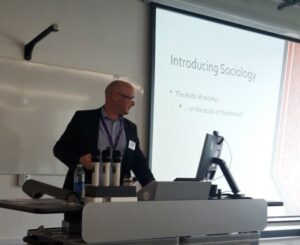
    The afternoon was completed by a lecture from Go Higher’s sociology lecturer, Dr David Ellis (left), who discussed his research in a talk titled ‘Towards a Sociology of Debt: Cultural Change in Britain and Beyond’. David explored the deregulation of banking by the Conservative Party in the 1980s, and the impact that it is still having today. A major point of discussion was what constituted ‘credit’ and how it differed from ‘debt’. There were so many comments and questions following this that we reached the end of the day before we knew it.

    Just in time for visitors to leave, the sun came out – but we hope to see many of them return as students in September.

    White Rabbit image by John Tenniel, from the Project Gutenberg edition of Alice In Wonderland (public domain).

     

    Source link

  • CUPA-HR’s Equal Pay Day Data for Higher Education: Women in Higher Ed Are Paid Just 82 Cents on the Dollar, Most Women of Color Are Paid Even Less – CUPA-HR

    CUPA-HR’s Equal Pay Day Data for Higher Education: Women in Higher Ed Are Paid Just 82 Cents on the Dollar, Most Women of Color Are Paid Even Less – CUPA-HR

    by Julie Burrell | March 12, 2024

    Since 1996, the National Committee on Pay Equity has acknowledged Equal Pay Day to bring awareness to the gap between men’s and women’s wages. This year, Equal Pay Day is March 12 — symbolizing how far into the year women must work to be paid what men were paid in the previous year.

    To help higher ed leaders understand, communicate and address gender pay equity in higher education, CUPA-HR has analyzed its annual workforce data to establish Higher Education Equal Pay Days for 2024. Tailored to the higher ed workforce, these dates observe the gender pay gap by marking how long into 2024 women in higher ed must work to make what White men earned the previous year.

    Higher Education Equal Pay Day fell on March 5, 2024, for women overall, which means that women employees in higher education worked for more than two months into this year to gain parity with their White male colleagues. Women in the higher ed workforce make on average just 82 cents for every dollar a White male employed in higher ed makes.

    Highlighting some positive momentum during this Women’s History Month, some groups of women are closer to gaining pay equity. Asian American women in higher ed worked two weeks into this year to achieve parity on January 14 — not ideal, but by no means insignificant. In fact, during the academic year 2022-23, Asian American women administrators in particular saw better pay equity than most other groups, according to CUPA-HR’s analysis.

    But the gender pay gap remains for most women, and particularly for women of color. Here’s the breakdown of the gender pay gap in the higher ed workforce, and the Higher Education Equal Pay Day for each group.* These dates remind us of the work we have ahead.

    • March 5 — Women in Higher Education Equal Pay Day. On average, women employees in higher education are paid 82 cents on the dollar.
    • January 14 — Asian Women in Higher Education Equal Pay Day. Asian women in higher ed are paid 96 cents on the dollar.
    • March 1 — White Women in Higher Education Equal Pay Day. White women in higher ed are paid 83 cents on the dollar.
    • March 12 — Native Hawaiian/Pacific Islander Women in Higher Education Equal Pay Day. Native of Hawaii or Pacific Islander women in higher ed are paid 80 cents on the dollar.
    • March 28 — Black Women in Higher Education Equal Pay Day. Black women in higher ed are paid 76 cents on the dollar.
    • April 12 — Hispanic/Latina Women in Higher Education Equal Pay Day. Hispanic/Latina women in higher ed are paid 72 cents on the dollar.
    • April 22 — Native American/Alaska Native Women in Higher Education Equal Pay Day. Native American/Alaska Native women are paid just 69 cents on the dollar.

    CUPA-HR research shows that pay disparities exist across employment sectors in higher ed — administrators, faculty, professionals and staff — even as the representation of women and people of color has steadily increased. But with voluntary turnover rising, not addressing pay disparities could be costly.

    CUPA-HR Resources for Higher Education Equal Pay Days

    As we observe Women’s History Month and Higher Education Equal Pay Days for women, we’re reminded that the fight for equal pay is far from over. But data-driven analysis with the assistance of CUPA-HR research can empower your fight for a more equitable future.

    See our interactive graphics that track gender and racial composition, as well as pay, of administrative, faculty, professional, and staff roles, collected from CUPA-HR’s signature surveys:


    *Data Source: 2023-24 CUPA-HR Administrators, Faculty, Professionals, and Staff in Higher Education Surveys. Drawn from 633,020 men and women for whom race/ethnicity was known.


    Source link

  • Three Virtual Offerings to Spark Joy and Encourage Self-Care This Valentine’s Day – CUPA-HR

    Three Virtual Offerings to Spark Joy and Encourage Self-Care This Valentine’s Day – CUPA-HR

    by Julie Burrell | February 13, 2024

    Even though it’s not mentioned in the job description, stress management is no doubt a daily part of your life in higher ed HR. Prioritizing well-being is also at the forefront of strategies to retain and recruit talent. CUPA-HR has found that 56% of higher ed employees are at least somewhat likely to look for a new position in the coming year, and the strongest predictors of retention are factors related to job satisfaction and well-being.

    You know that attentiveness to mental and physical health helps you and your team thrive, but it may be difficult to find the time and budget to make wellness a daily practice. This Valentine’s Day is an opportunity to treat yourself and your team to the gift of well-being by scheduling time to participate in Well-Being in Higher Education, a week-long virtual event. From February 26 to March 1, CUPA-HR will join with 20+ higher ed associations to help you deepen your knowledge of well-being on your campus and offer moments of connection across the higher ed community.

    CUPA-HR-sponsored sessions include:

    • An Integrated Approach to Fostering Workplace Well-Being
    • Managing Anxiety and Stress in the Workplace
    • Staff Well-Being: Its Role in Creating a Healthy Campus

    You may also want to check out these related CUPA-HR resources:

    Is saying “yes” your love language? Do you struggle to say no even when you don’t have the bandwidth? Learn how to say no with confidence in one of our most popular webinars of 2023, Managing Stress and Self-Care: “No” Is a Complete Sentence, which offers practical tools for minimizing stress and leads participants in creating a self-care plan.

    Help stave off burnout by practicing the skill of resilience. While it may seem like some people are naturally more resilient than others, resilience is a learned skill you can develop and practice in your work and personal life. Learn how in this webinar and accompanying Higher Ed HR Magazine article.


    Source link

  • Setting Up New Leaders for Success From Day One – Strategies for HR – CUPA-HR

    Setting Up New Leaders for Success From Day One – Strategies for HR – CUPA-HR

    by CUPA-HR | March 29, 2023

    Consider this scenario: An institution hires a new leader who has previously worked in higher ed. Assuming the individual has already acquired the knowledge and skills necessary to get the job done, HR guides them through a brief onboarding and launches them into their new role. Six months later, HR checks in with the leader to see how things are going and discovers a dissatisfied leader and a team in turmoil. What went wrong?

    According to Sara Reed, vice president of people and talent at Western Governors University, HR sometimes falsely assumes that new leaders with higher ed experience know how to get the job done. Consequently, expectations may not be clearly articulated, which can create rough patches for the leader to navigate on their own. In the recent CUPA-HR webinar Building Leader Confidence in Transition: We Can’t Do It Alone, Reed explained that to help create a smooth transition for new leaders and ensure success from day one, HR can consider implementing these strategies in the pre-hire and onboarding phases:

    • Pre-hire: Provide accurate and clear position descriptions. HR should be very clear about what the institution is looking for in the role. Is the institution looking for a different leader than in the past, or a leader who meets the status quo? What context is there surrounding the job description that the candidate should be aware of? For example, will the new leader be leading a team that is in transition or turmoil? If so, what resources and contacts can help the new leader in a situation like this?
    • Pre-hire: Be clear about the mission of the institution. What mission does this new leader need to advance and further? Do job candidates see the values and beliefs of the institution displayed on the website? Who is included in the interview process? Can a broad number of people be included in the hiring process to send the message that the position is of high importance?
    • Pre-hire: Have the individual meet the team they’ll be leading. Create an opportunity during the interview process for the potential new leader to meet the team they’ll be leading. Allowing job candidates and future team members to have conversations beforehand could reveal potential areas of conflict between the two parties.
    • Onboarding: Pair the new leader with a skills mentor and a cultural mentor. While a new leader’s knowledge, abilities and experiences in previous positions can be beneficial in helping them succeed in their new role, they still must learn the cultural and political landscape. In the webinar, Reed shared her personal testament to having a “nuts and bolts” mentor and a cultural mentor when she first began working in higher ed. While a “nuts and bolts” mentor explains institutional policies and how to use systems, a cultural mentor can help clue in a new leader to the cultural and political landscape and serve as a “safe space” to ask questions and get insights. As Reed suggested in the webinar, a cultural mentor is someone you can approach after a meeting and ask, “What just happened?”

    Interested in more pre-hire and onboarding strategies and tactics to help new leaders in transition? Watch the webinar recording: Building Leader Confidence in Transition: We Can’t Do It Alone.


    Source link

  • Celebrate International Day of People With Disabilities on December 3 – CUPA-HR

    Celebrate International Day of People With Disabilities on December 3 – CUPA-HR

    by CUPA-HR | November 30, 2021

    In 1992, as part of its focus on promoting the well-being of people with disabilities, the United Nations called for an international day of celebration for people with disabilities. Held on December 3 each year, International Day of People With Disabilities is a day to recognize and learn from the experiences of those with disabilities and for organizations to show support and take action to create more diverse and inclusive communities.

    In recognition of the day, we’re sharing some inspiring articles and blog posts highlighting the work of HR pros to create more inclusive campuses and workplaces.

    Additional resources: 

    CUPA-HR ADA Toolkit
    Creating Inclusive Communities Project


    Source link