Tag: deadline

  • Students, schools race to save clean energy projects in face of Trump deadline

    Students, schools race to save clean energy projects in face of Trump deadline

    Tanish Doshi was in high school when he pushed the Tucson Unified School District to take on an ambitious plan to reduce its climate footprint. In Oct. 2024, the availability of federal tax credits encouraged the district to adopt the $900 million plan, which involves goals of achieving net-zero emissions and zero waste by 2040, along with adding a climate curriculum to schools.

    Now, access to those funds is disappearing, leaving Tucson and other school systems across the country scrambling to find ways to cover the costs of clean energy projects.

    The Arizona school district, which did not want to impose an economic burden on its low-income population by increasing bonds or taxes, had expected to rely in part on federal dollars provided by the Biden-era Inflation Reduction Act, Doshi said. 

    But under HR1, or the “one big, beautiful bill,” passed on July 4, Tucson schools will not be able to receive all of the expected federal funding in time for their upcoming clean energy projects. The law discontinues many clean energy tax credits, including those used by schools for solar power and electric vehicles, created under the IRA. When schools and other tax-exempt organizations receive these credits, they come in the form of a direct cash reimbursement.

    At the same time, Tucson and thousands of districts across the country that were planning to develop solar and wind power projects are now forced to decide between accelerating them to try to meet HR1’s fast-approaching “commence construction” deadline of June 2026, finding other sources of funding or hitting pause on their plans. Tina Cook, energy project manager for Tucson schools, said the district might have to scale back some of its projects unless it could find local sources of funding. 

    “Phasing out the tax credits for wind and solar energy is going to make a huge, huge difference,” said Doshi, 18, now a first-year college student. “It ends a lot of investments in poor and minority communities. You really get rid of any notion of environmental justice that the IRA had advanced.”

    Emma Weber leads a chant at a Colorado state capitol rally in support of “The Green New Deal for Colorado Schools.” Credit: Courtesy of Emma Weber

    The tax credits in the IRA, the largest legislative investment in climate projects in U.S. history, had marked a major opportunity for schools and colleges to reduce their impact on the environment. Educational institutions are significant contributors to climate change: K-12 school infrastructure, for example, releases at least 41 million metric tons of emissions per year, according to a paper from the Annenberg Institute at Brown University. The K-12 school system’s buses — some 480,000 — and meals also produce significant emissions and waste. Clean energy projects supported by the IRA were helping schools not only to limit their climate toll but also to save money on energy costs over the long term and improve student health, advocates said.

    As a result, many students, consultants and sustainability leaders said, they have no plans to abandon clean energy projects. They said they want to keep working to cut emissions, even though that may be more difficult now.

    Related: Become a lifelong learner. Subscribe to our free weekly newsletter featuring the most important stories in education. 

    Sara Ross, cofounder of UndauntedK12, which helps school districts green their operations, divided HR1’s fallout on schools into three categories: the good, the bad and the ugly. 

    On the bright side, she said, schools can still get up to 50 percent off for installing ground source heat pumps — those credits will continue — to more efficiently heat and cool schools. The network of pipes in a ground source pump cycles heat from the shallow earth into buildings.

    In the “bad” category, any electric vehicle acquired after Sept. 30 of this year will not be eligible for tax credits — drastically accelerating the IRA’s phase-out timeline by seven years. That applies to electric school buses as well as other district-owned vehicles. Electric vehicle charging stations must be installed by June 30, 2026 at an eligible location to claim a tax credit.*

    EPA’s Clean School Bus Program still exists for two more years and covers two-thirds of the funding for all electric school buses districts acquire in that time. The remaining one-third, however, was to be covered by federal and state tax credits. 

    The expiration of the federal tax credits could cost a district up to $40,000 more per vehicle, estimated Sue Gander, director of the Electric School Bus Initiative run by the nonprofit World Resources Institute. 

    Related: So much for saving the planet. Climate jobs, and many others, evaporate for 2025 grads

    Solar projects will see the most “ugly” effects of HR1, Ross said. 

    Los Angeles Unified School District is planning to build 21 solar projects on roofs, carports and other structures, plus 13 electric vehicle charging sites, as part of an effort to reduce energy costs and achieve 100 percent renewable energy by 2040. The district anticipated receiving around $25 million in federal tax credits to help pay for the $90 million contract, said Christos Chrysiliou, chief eco-sustainability officer for the district. With the tight deadlines imposed by HR1, the district can no longer count on receiving that money. 

    “It’s disappointing,” Chrysiliou said. “It’s nice to be able to have that funding in place to meet the goals and objectives that we have.”
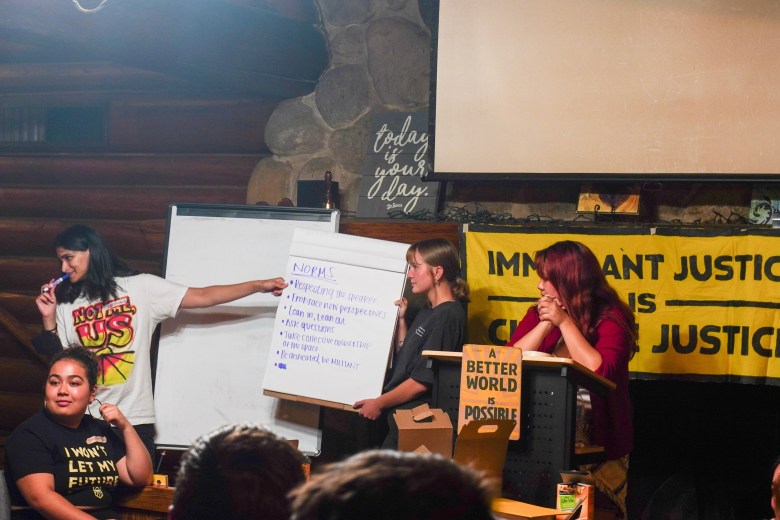
    Emma Weber, at left, trains student leaders at Sunrise Movement’s “summer intensive” in Illinois this year. Credit: Courtesy of Emma Weber

    LAUSD is looking at a small portion of a $9 billion bond measure passed last year, as well as utility rebates, third-party financing and grants from the California Energy Commission, to help make up for some of the gaps in funding.

    Many California State University campuses are in a similar position as they work to install solar to meet the system’s goal of carbon neutrality by 2045, said Lindsey Rowell, CSU’s chief energy, sustainability and transportation officer. 

    Tariffs on solar panel materials from overseas and the early sunsetting of tax credits mean that “the cost of these projects are becoming prohibitive for campuses,” Rowell said. 

    Sweeps of undocumented immigrants in California may also lead to labor shortages that could slow the pace of construction, Rowell added. “Limiting the labor force in any way is only going to result in an increased cost, so those changes are frightening as well,” she said. 

    New Treasury Department guidance, issued Aug. 15, made it much harder for projects to meet  the threshold needed to qualify for the tax credits. Renewable energy projects previously qualified for credits once a developer spent 5 percent of a project’s cost. But the guidelines have been tightened — now, larger projects must pass a “physical work test,” meaning “significant physical labor has begun on a site,” before they can qualify for credits. With the construction commencement deadline looming next June, these will likely leave many projects ineligible for credits.

    “The rules are new, complex [and] not widely understood,” Ross said. “We’re really concerned about schools’ ability to continue to do solar projects and be able to effectively navigate these new rules.” 

    Schools without “fancy legal teams” may struggle to understand how the new tax credit changes in HR1 will affect their finances and future projects, she added.

    Some universities were just starting to understand how the IRA tax credits could help them fund projects. Lily Strehlow, campus sustainability coordinator at the University of Wisconsin, Eau-Claire, said the planning cycle for clean energy projects at the school can take ten years. The university is in the process of adding solar to the roof of a large science building, and depending on the date of completion, the project “might or might not” qualify for the credits, she said. 

    “At this point, everybody’s holding their breath,” said Rick Brown, founder of California-based TerraVerde Energy, a clean energy consultant to schools and agencies. 

    Brown said that none of his company’s projects are in a position where they’re not going to get done, but the company may end up seeing fewer new projects due to a higher cost of equipment. 

    Tim Carter, president of Second Nature, which supports climate work in education, added that colleges and universities are in a broader period of uncertainty, due to larger attacks from the Trump administration, and are not likely to make additional investments at this time: “We’re definitely in a wait and see.”

    Related: A government website teachers rely on is in peril 

    For youth activists, the fallout from HR1 is “disheartening,” Doshi said. 

    Emma and Molly Weber, climate activists since eighth grade, said they are frustrated. The Colorado-based twins, who will start college this fall, helped secure the first “Green New Deal for Schools” resolution in the nation in the Boulder Valley School District. Its goals include working toward a goal of Zero Net Energy by 2050, making school buildings greener, creating pathways to green jobs and expanding climate change education. 

    Emma, far left, and Molly Weber, far right, work with climate leaders from the Boulder Valley School District’s Sunrise Movement to prepare for Colorado’s legislative session. Credit: Courtesy of Emma Weber

    “It feels very demoralizing to see something you’ve been working so hard at get slashed back, especially since I’ve spoken to so many students from all over the country about these clean energy tax credits, being like, ‘These are the things that are available to you, and this is how you can help convince your school board to work on this,’” Emma Weber said.

    The Webers started thinking about other creative ways to pay for the clean energy transition and have settled on advocating for state-level legislation in the form of a climate superfund, where major polluters in a community would be responsible for contributing dollars to sustainability initiatives. 

    Consultants and sustainability coordinators said that they don’t see the demand for renewable energy going away. “Solar is the cheapest form of energy. It makes sense to put it on every rooftop that we can. And that’s true with or without tax credits,” Strehlow said. 

    *Correction: This version of the story includes updated information on the timeline for the expiration of tax credits for electric vehicle charging stations.

    Contact editor Caroline Preston at 212-870-8965, via Signal at CarolineP.83 or on email at [email protected]

    This story about tax credits was produced by The Hechinger Report, a nonprofit, independent news organization focused on inequality and innovation in education. Sign up for the Hechinger newsletter.

    The Hechinger Report provides in-depth, fact-based, unbiased reporting on education that is free to all readers. But that doesn’t mean it’s free to produce. Our work keeps educators and the public informed about pressing issues at schools and on campuses throughout the country. We tell the whole story, even when the details are inconvenient. Help us keep doing that.

    Join us today.

    Source link

  • UCAS applications and offer making by June deadline, 2025

    UCAS applications and offer making by June deadline, 2025

    The UCAS 30 June application deadline is the last point an applicant can apply outside of clearing.

    Though most applications (particularly from UK 18 year olds) happen by the January deadline, the June figures allow for a complete analysis of application behaviour in the UCAS main scheme.

    The number of 18 year old UK applicants has reached a record high of 328,390 (up 2.2 per cent on last year) – with the total number of applicants at 665,070 (up 1.3 per cent on last year).

    Application rates

    As always it is salutary to compare the often-pushed narrative that young people are being tempted away from expensive/poor-value/woke (delete as per your personal preference) higher education with the actuality that numbers are rising. You could even be tempted to imagine what the application rates might be like in a sector with a realistic student maintenance offer.

    I mention application rates because this is what declinist commentators will seize on. For UK domiciled 18 year old applicants, the application rate is 41.20 – down from 41.80 per cent last year. This fall is visible across most measures of deprivation: in England, for example, every IMD quintile but quintile 5 (the least disadvantaged) sees a falling application rate.

    [Full screen]

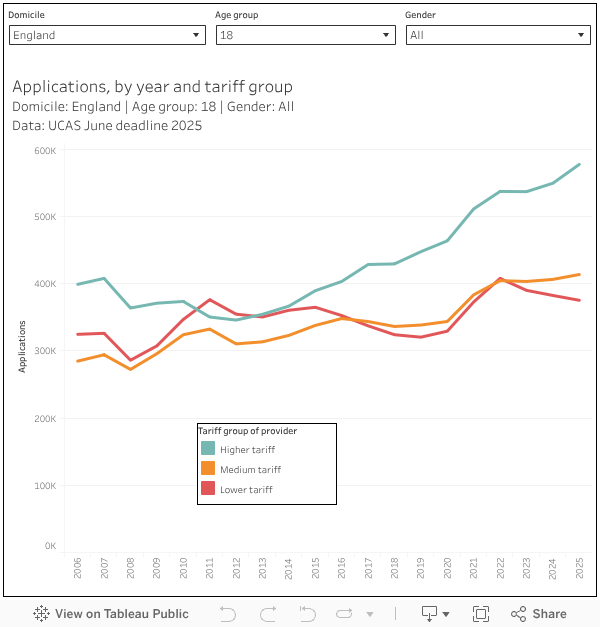
    In part, this could be a function of another year where the dominance of higher tariff providers in driving applications has increased: higher tariff providers disproportionately inspire applications from (and recruit) better off young people.

    This chart shows the number of applications to each of three tariff groups. For UK 18 year olds the default is fast becoming an application to a high tariff provider. We don’t (unfortunately) get application numbers by deprivation and tariff group.

    [Full screen]

    These number of placed students is likely to rise too: UCAS and Ofqual have suggested that there are 28,000 places available in Clearing this year.

    Offer rates

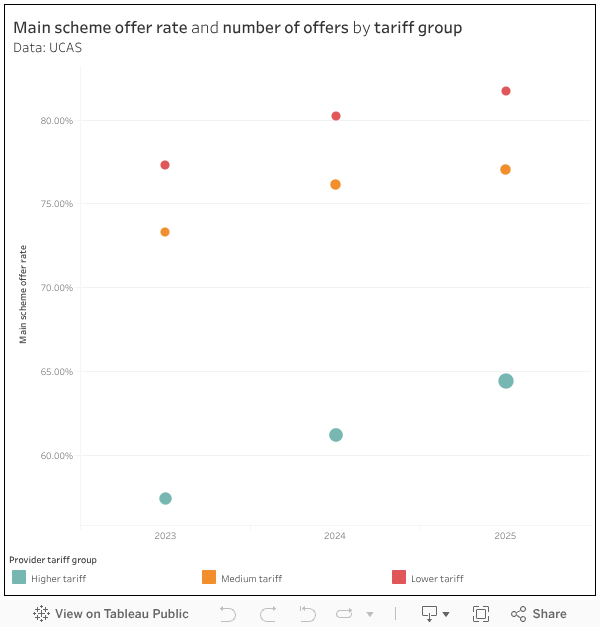
    One innovation in this year’s release is information on offer rates – the proportion of applications that result in an offer being made. We get three years of data, which demonstrate that offer rates are rising across the sector – and that (as you may expect) high tariff providers are less likely to make offers than lower tariff providers. The growth among high tariff providers is driven both by rising application numbers and a rising offer rate.

    [Full screen]

    For believers of the other recruitment myth (that universities load up on international students and are less keen to take even very able home students) we get a timely corrective. It turns out that 98.5 per cent of UK 18 year old applicants have an offer, compared with 89.7 per cent of international students.

    [Full screen]

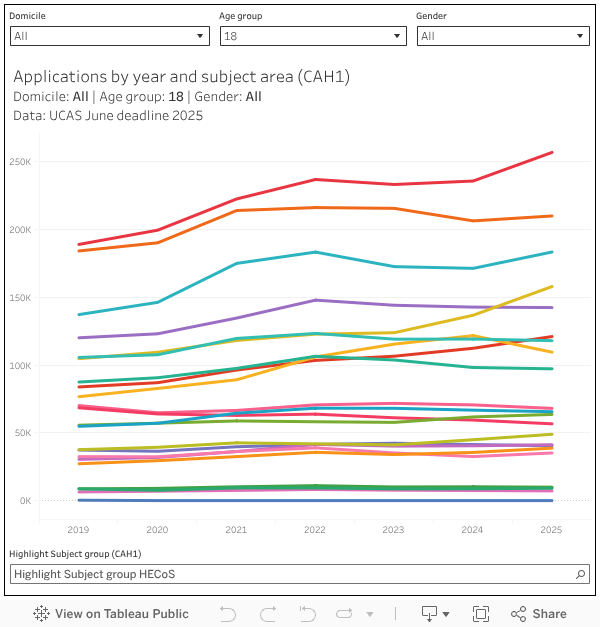
    Subjects

    Finally, it’s always fascinating to look at applications by subject area – a plot by CAH1 groups shows a sharp rise in the popularity of business, subjects allied to medicine, engineering, and law: with an intriguing drop in applications to computing subjects. There may be a generative AI effect on computing applications – the rise of “vibe coding” and other uses of agents in software development may mean that the attraction of learning to programme computers properly may be waning.

    That’s the best explanation I have – and it is curious that law (a domain where predictions of AI tools eating entry level roles are ten a penny) doesn’t appear to be experiencing a similar phenomenon.

    [Full screen]

    Source link

  • Education Dept. Agrees to Push DEI Compliance Deadline

    Education Dept. Agrees to Push DEI Compliance Deadline

    State education agencies are no longer bound to certify their compliance with President Donald Trump’s executive orders and guidance memos banning diversity, equity and inclusion programs in order to continue receiving federal funds—at least for now.

    K-12 school districts were originally required to prove they had met the president’s standard by April 14. But now, as the result of an agreement reached Thursday in a lawsuit, the Department of Education cannot enforce that requirement or enact any penalties until April 24. The move to require school systems to certify their compliance was one of the department’s first actions since releasing the Feb. 14 Dear Colleague letter that declared all race-conscious student programming, resources and financial aid illegal.

    The National Education Association challenged that letter in a lawsuit and then moved for a temporary restraining order to block the certification requirement. (The department notified state educational agencies of the deadline April 3.)

    In addition to not enforcing the certification requirement, the Education Department also agreed not to take any enforcement action related to the Feb. 14 guidance until April 24, though that doesn’t cover any other investigations based on race discrimination.

    The plaintiffs, represented by the American Civil Liberties Union, still want to block the Dear Colleague letter entirely. But they see the agreement as a positive step.

    “This pause in enforcement provides immediate relief to schools across the country while the broader legal challenge continues,” the plaintiffs said in a news release.

    A judge will hold a hearing April 17 to consider the NEA’s motion for a preliminary injunction, which could block the guidance entirely.

    For more information on this case and others, check out Inside Higher Ed’s lawsuit tracker here.

    Source link

  • As compliance deadline looms, colleges must resist censorship — and the feds must provide more clarity

    As compliance deadline looms, colleges must resist censorship — and the feds must provide more clarity

    Last week, FIRE wrote about how colleges should interpret President Trump’s recent executive orders, Attorney General Pam Bondi’s anti-discrimination memo, and the Department of Education’s Office for Civil Rights newest “Dear Colleague” letter. 

    At the same time, we asked OCR to give colleges additional guidance so they have a better idea of what type of speech or conduct might run afoul of its “Dear Colleague” letter. OCR has not yet done so, and with the compliance deadline set for tomorrow, we fear institutions will over-correct and engage in campus censorship.

    In fact, we’ve already seen evidence of exactly that. 

    Grand View University in Iowa, for instance, reportedly cancelled its planned International Women’s Day activities, allegedly to comply with federal DEI directives. This, even though Bondi’s Feb. 6 memo exempts “educational, cultural, or historical observances — such as Black History Month, International Holocaust Remembrance Day, or similar events — that celebrate diversity, recognize historical contributions, and promote awareness without engaging in exclusion or discrimination.” 

    This type of overcompliance — in this case, cancelling activities or events that are expressly exempted from enforcement — unnecessarily degrades the extracurricular educational environment at higher education institutions and harms the student learning experience. 

    As we said last week: OCR is bound by the First Amendment and cannot order or compel colleges and universities to violate it. If there is a conflict between federal guidance and the First Amendment, the First Amendment prevails. Whether institutions are overcomplying out of fear of losing federal funding, or in an attempt to prove a point about the directive’s vague language, colleges and universities like Grand View must not preemptively shut down speech.

    OCR’s new Title VI letter: FIRE’s analysis and recommendations

    News

    The Department of Education should provide more clarity about its ‘Dear Colleague Letter’ to ensure protected speech isn’t censored on campus.


    Read More

    This isn’t the first time institutions have overread government directives to justify censorship. In 2021, for example, Idaho passed the “No Public Funds for Abortion Act.” In implementing the bill, the University of Idaho demanded that faculty not “promote or advocate in favor of abortion” or discuss “abortion or contraception” in classroom conversations unless they remained “neutral.” FIRE wrote to the university explaining that such a reading was flatly at odds with the First Amendment. In a thorough memorandum, Idaho Attorney General Raúl Labrador agreed, explaining that the “plain text of the Act does not prohibit public university employees from engaging in speech relating to academic teaching and scholarship that could be viewed as supporting abortion,” thus ending that censorship policy at the University of Idaho. 

    In that same vein, OCR cannot force schools to violate the First Amendment, a point we’ve hammered since the Obama-era OCR’s “Dear Colleague” letters forced institutions to adopt harassment policies that did exactly that. 

    OCR must be clear about the type of conduct that runs afoul of its new directives so that institutions are on notice about what’s permissible and what is prohibited. The office has yet to address vagueness in the “Dear Colleague” letter about “institutional programming” that might violate Title VI. That silence is creating a lot of confusion and preemptive censorship, especially when paired with President Trump’s Jan. 21 executive order declaring that government contractors — which includes many institutions of higher education — cannot “operate any programs promoting DEI that violate any applicable Federal anti-discrimination laws.”

    FIRE again urges institutions to hold the line on defending the free speech and academic freedom rights of their students and faculty. And we again ask OCR and the federal government to respect those same rights by immediately clarifying that their directives don’t require colleges and universities to violate those well-established rights. 

    Last week, a federal court enjoined two executive orders — including the Jan. 21 executive order — that prohibit, among other things, “promoting DEI” in violation of federal anti-discrimination law. The district court held the orders violate the First and Fifth Amendments because they discriminate on the basis of viewpoint and content, and are unconstitutionally vague. 

    While the government will likely appeal and we won’t know the final resolution for some time, the court’s analysis properly identified the orders’ ambiguity as a damning constitutional flaw. What, precisely, constitutes “promoting DEI” in ways that violate anti-discrimination laws? Can colleges host or sponsor speakers on DEI-related topics? Can institutions advertise DEI-related coursework or promote academic research? Restrictions on these activities would violate the First Amendment, but government attorneys were unable to clarify the meaning of the order when asked by the judge. Precision matters, especially when it comes to restrictions on expression. Vague pronouncements that sweep in protected debate, discussion, and programming raise constitutional and practical problems. 

    The best way forward for colleges is obvious, even if it might not be easy: Irrespective of the federal DEI directives, ditch speech-restrictive, orthodoxy-enforcing DEI bureaucracies and stand up for free expression and academic debate — in every political season. 

    As Len Gutkin, editor at The Chronicle of Higher Education, recently wrote: “Colleges should draw a sharp distinction between, on the one hand, DEI used in hiring, promotion, and training, and, on the other, curricular and disciplinary offerings.”  

    That’s the right balance. FIRE again urges institutions to hold the line on defending the free speech and academic freedom rights of their students and faculty. And we again ask OCR and the federal government to respect those same rights by immediately clarifying that their directives don’t require colleges and universities to violate those well-established rights. 

    Source link

  • Colleges scramble to meet federal anti-DEI deadline

    Colleges scramble to meet federal anti-DEI deadline

    The clock is running out on colleges as they mull how to respond to a sweeping federal order to end all race-based policies and programs.

    In the face of an imminent Friday night deadline, college leaders are scrambling to determine how to navigate the Feb. 14 Dear Colleague letter issued by the Education Department’s Office for Civil Rights, which declares all race-based educational programs and policies discriminatory and illegal. When they sent the letter on Valentine’s Day, department officials gave institutions two weeks to comply or face investigations and, possibly, the loss of federal funding.

    For many colleges, the challenge is figuring out how to avoid drawing unwanted government attention without abandoning key services for underrepresented students and staff.

    Institutions aren’t going to lose federal funding overnight. The investigative process is notoriously lengthy, and the Education Department has never revoked a college’s federal funding over civil rights concerns. The OCR may also be rendered impotent, at least temporarily, if a judge decides to halt enforcement while considering a lawsuit filed Tuesday challenging the letter.

    But college leaders are anxious about the threat of federal funding cuts, which would be catastrophic for the majority of postsecondary institutions. Ray Li, who previously worked as an attorney at the Office for Civil Rights, said he expects the office to launch investigations shortly and that many colleges will buckle under the pressure, shedding practices that fostered campus diversity and belonging.

    For now, colleges seem to be taking a slow and cautious approach, removing language about race and DEI buzzwords from the names of programs and launching internal policy reviews.

    University of Nebraska president Jeffrey P. Gold said system campuses are in the midst of a comprehensive review of programs and policies, but no changes have been made yet. The Nebraska Board of Regents discussed possible tweaks to its bylaws at a recent board meeting, like removing references to “cultural diversity” and revising language on equal opportunity in employment, but no final decisions were made.

    Gold said that as the review process continues, he doesn’t expect to “turn up anything that looks or feels like discrimination,” as the letter describes.

    But it’s possible “we will turn up some things that require some language changes or possibly some changes in titles, changes in offices … that could be misinterpreted by the Department of Education just because of [the] use of specific terminology.”

    He added that Nebraska banned affirmative action in 2008 and the state’s second attempt at an anti-DEI bill is pending in the Legislature, so “we have been changing websites [and] titles for years—that’s why I believe that there’s nothing substantive that we really have to change at this time.”

    The University of Montana undertook a similar compliance review that tasked senior administrators with assessing whether their departments had any policies or practices at odds with the Dear Colleague letter.

    “We made the decision to be as thorough as possible,” said Dave Kuntz, the university’s director of strategic communications. The review, however, led to “very minimal changes and really no changes at a programmatic or operational level.”

    University leaders over all concluded that the institution was already in compliance, though some programs, like the Women’s Leadership Initiative, chose to tweak their webpages to clarify that they don’t bar anyone who wants to participate.

    A spokesperson for the Education Department did not respond to multiple questions from Inside Higher Ed in time for publication.

    A Thorough Scrubbing

    Many institutions are responding by scrubbing their websites of words like “diversity” and “inclusion.” The University of Cincinnati, Carnegie Mellon University, the University of Pittsburgh, the University of Alaska system and many more all did so after the Dear Colleague letter; some colleges had already begun revising their digital presence in response to Trump’s executive order on DEI in January.

    The University of Colorado removed all references to a former DEI office and replaced them with a website for a new “Office of Collaboration.” The University of Pennsylvania scrubbed the websites for all 16 undergraduate and graduate schools of DEI keywords and removed references to diversity and affirmative action from its nondiscrimination policies.

    Shaun Harper, a professor of education, business and public policy at the University of Southern California, said he’s been disappointed that higher ed leaders are heavily revising their institutions’ online presences in the hopes that it will appease the OCR—a project he believes will prove futile. In the Dear Colleague letter, acting assistant secretary for civil rights Craig Trainor specifically warned against using “proxies for race” and promised to investigate race-neutral programs that “discriminate in less direct, but equally insidious, ways.”

    “Scrubbing websites, launching reviews—these are the easy things to do while colleges are in ‘wait and see’ mode, to find out if that will take the target off their backs,” said Harper, an Inside Higher Ed contributor who authored a blog post last week recommending ways colleges can fight back against the Dear Colleague letter. “I think it’s both weak and reckless.”

    Some institutions have gone one step further. Colorado State University issued a statement in which leaders simultaneously maintained that its policies are already race-neutral and promised to do more to comply with the new federal directives.

    “The new administration’s interpretation of law marks a change,” the statement reads. “Given the university’s reliance on federal funding, it is necessary to take additional steps.”

    And one day before the deadline, Ohio State University president Ted Carter announced the institution would shutter two DEI offices and eliminate more than a dozen staff positions, some of the most dramatic measures a college has taken during the new Trump administration.

    In a particularly telling move, OSU’s Office of Institutional Equity will be renamed the Office of Civil Rights Compliance to “more accurately reflect its work,” according to an email sent to students Thursday.

    ‘We’ve Seen This Film Before’

    For a glimpse of how anti-DEI compliance battles might play out between institutions and policymakers, consider the red states that have passed laws mandating similar cuts to race-conscious programs.

    In Texas and Florida, public colleges reacted to impending or newly signed anti-DEI laws by changing the names of university offices and campus resources, moving personnel to student support services, and removing DEI mentions from university materials and websites. But in both cases, lawmakers came down hard to ensure the institutions took more strident action, leading to significant layoffs, spending cuts and policy changes.

    “We’ve seen the prequel to this film before in Texas,” Harper said. “When that Senate bill was looming, many institutions thought they were very smartly getting ahead of it by just renaming things. That proved to be a failed strategy, and I very comfortably predict that some version of that will also happen nationally.”

    In some states, the “review and revamp” strategy for avoiding DEI crackdowns appeared to work for a while. The University of Arkansas eliminated its DEI office in June 2023 in part to pre-empt a bill that state lawmakers were considering to force spending cuts. And last year, the University of North Carolina system Board of Trustees passed an anti-DEI resolution just as legislation was gaining steam to mandate enforcement from the state; that legislation was never brought to a full vote.

    But circumstances have changed as the Trump administration launches direct attacks on DEI. Arkansas governor Sarah Huckabee Sanders signed a law earlier this month that will “prohibit affirmative action and preferential treatment in state-supported institutions,” including public colleges like the University of Arkansas. Even in Texas, where public universities underwent broad layoffs and spending cuts in response to state legislation, lawmakers have threatened to cut $400 million in higher ed funding unless colleges do more to comply.

    “If they don’t kick DEI out of their schools, they’re going to get a lot less,” Texas lieutenant governor Dan Patrick said at a policy forum last week.

    What Happens Next?

    Legal experts say it’s unclear what will happen after the OCR’s deadline passes. The Dear Colleague letter promised more detailed guidance, but none has materialized.

    “We’re kind of all in agreement that [the letter] is really confusing and overbroad, and the timeline is really outrageous,” said Andrea Stagg, director of consulting services at Grand River Solutions, a company that works with colleges on legal compliance issues. She noted that many underresourced colleges don’t have in-house legal teams to assess their risk by the deadline.

    “What actually happens after tomorrow? How fast will it be?” she said Thursday. “I don’t know.”

    Typically, the Office for Civil Rights opens investigations based on complaints from students, families or legal advocates, but it can also launch its own direct investigations. Most cases end with a voluntary resolution, in which the institution agrees to make certain changes. But unresolved cases can be referred to the U.S. Department of Justice for litigation.

    Li believes the OCR will likely receive complaints from anti-DEI groups as well as open some direct investigations into higher ed institutions with race-based scholarships, affinity group graduation ceremonies or other practices called out by the letter, starting next week. (He pointed out that the current OCR has already launched some direct investigations into universities related to Title IX.)

    But that doesn’t mean the day after the Dear Colleague deadline “schools are just going to lose all their federal funding”—assuming normal procedures are followed, he said. Such investigations can take months, even years.

    An investigation reaching the point of litigation is also “an incredibly rare step that, under most administrations, pretty much never happens,” Li said. And the Department of Education taking away federal funding over an OCR investigation would be completely unprecedented.

    “But, also, rare things are happening right now,” Li conceded.

    Stagg said it’s hard to tell to what extent normal processes will be followed, or how much the Department of Government Efficiency’s reductions to the federal workforce could affect investigations.

    “There is a real question as to who will do these investigations” and how the OCR will choose institutions to focus on, she said. “Is there going to be an AI tool to search [college] websites for certain terms, the way we saw with the flagging of grants? It could be that the president has a bad interaction at a meeting with a leader and then they are targeted for investigation.”

    An Education Department spokesperson did not respond to questions about planned investigations, agency capacity and enforcement mechanisms in time for publication.

    It’s also unclear how much resistance colleges will put up. Li believes there’s a strong case to be made that some of the practices targeted in the Dear Colleague letter are perfectly legal. Higher ed institutions under investigation could refuse to make changes and go head to head with the Department of Justice. But they’d be signing up for an onerous, likely expensive process that puts their funding in jeopardy.

    “The question is, is anyone willing to litigate it?” Li said.

    Even if the Dear Colleague letter is rescinded, Li said the Office for Civil Rights has clearly signaled its plans for the next four years, and he believes higher ed institutions will continue working to rid themselves of anything that could attract scrutiny.

    “I think there’s going to be an overcorrection,” he said. “It is going to lead to some perfectly legal programs that support fostering racially inclusive communities on campus being taken away.”

    Source link

  • Another reprieve for gainful employment, financial value transparency reporting deadline

    Another reprieve for gainful employment, financial value transparency reporting deadline

    This audio is auto-generated. Please let us know if you have feedback.

    Dive Brief:

    • The U.S. Department of Education is extending the reporting deadline for the gainful employment and financial value transparency regulations to Sept. 30, according to an agency announcement last week. 
    • The seven-month extension aims to give college officials more time to submit the required information and to allow institutions that have already sent in their data to make corrections. 
    • The Education Department has pushed back the reporting deadline several times amid concerns that colleges didn’t have enough time or guidance to provide the data required under the new regulations. This extension, the first one under the Trump administration, will be the last, the announcement said.

    Dive Insight:

    The Education Department originally asked colleges to submit the gainful employment and financial value transparency data by July 2024, but higher education institutions requested more time given last year’s bumpy rollout of the revamped Free Application for Federal Student Aid. 

    The Biden administration released final gainful employment and financial value transparency regulations in 2023. 

    Under the gainful employment rules, career education programs must prove that their graduates earn enough money to pay off their student loans and that at least half of them make more than workers in their state who only have high school diplomas. Programs that fail those tests risk losing their access to Title IV federal financial aid. 

    Although the financial value transparency regulations don’t threaten federal financial aid, they create new reporting requirements for all colleges. Under the rule, the Education Department will post data collected from institutions about their programs — such as costs and debt burdens — on a consumer-facing website to help students make informed decisions about their college attendance. 

    The Biden administration extended the deadline for reporting requirements three times. Despite the delays, Education Department officials said late last year that they still expected to produce data in the spring to help students select their colleges. 

    With its latest announcement, the Trump administration’s Education Department is delaying that timeline also. 

    “The Department does not plan to produce any FVT/GE metrics prior to the new deadline and will take no enforcement or other punitive actions against institutions who have been unable to complete reporting to date,” it said. 

    It’s so far unclear how the Trump administration will handle the gainful employment regulations. In President Donald Trump’s first term, then-Education Secretary Betsy DeVos rescinded the Obama-era version of the rules, saying they unfairly targeted the for-profit college sector. 

    The Education Department is facing at least one lawsuit over the Biden administration’s version of the gainful employment rule. However, a federal judge earlier this month paused legal proceedings for 90 days after the new administration sought more time “to become familiar with and evaluate their position regarding the issues in the case,” according to court documents.

    The National Association of Student Financial Aid Administrators — one of the organizations that pushed for a delay — applauded the move to extend the regulatory reporting deadline.

    The change “is a sensible and welcome decision that will give financial aid offices much needed breathing room while they navigate unresolved issues in submitting their data and make necessary corrections to ensure the data they submit is accurate,” NASFAA Interim President and CEO Beth Maglione said in a statement last week.

    Source link