Last year, FIRE launched the Free Speech Dispatch, a regular series covering new and continuing censorship trends and challenges around the world. Our goal is to help readers better understand the global context of free expression. Want to make sure you don’t miss an update? Sign up for our newsletter.
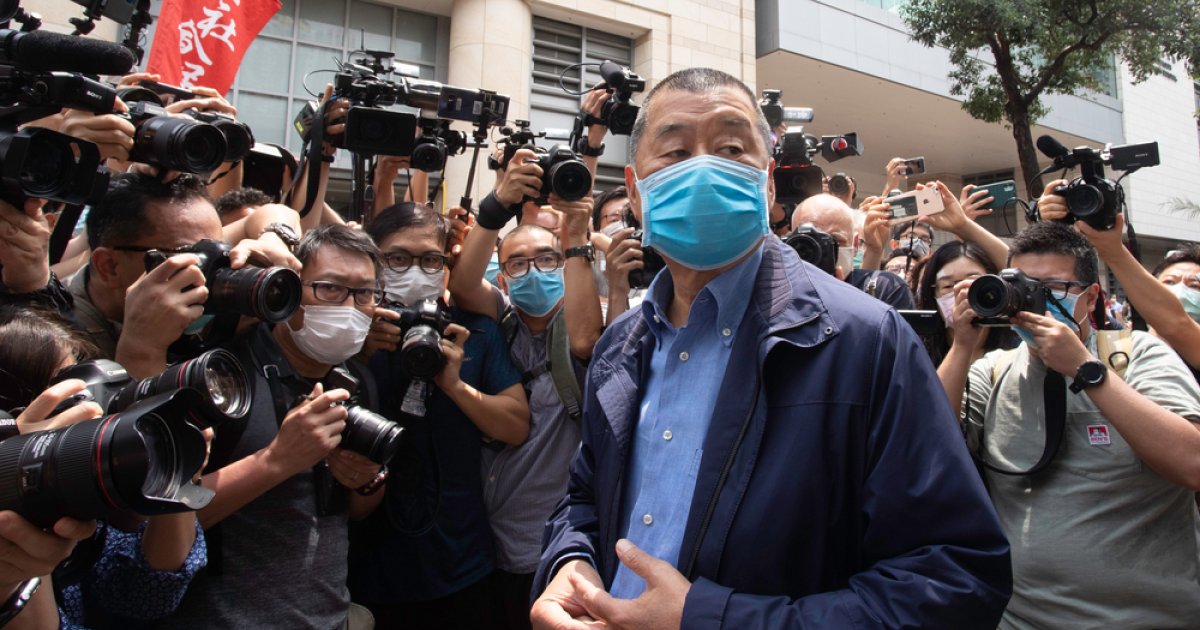
For challenging the CCP, Jimmy Lai may spend the rest of his life behind bars
The result press freedom and human rights advocates feared has arrived: 78-year-old media tycoon, Chinese Communist Party critic, and Apple Daily founder Jimmy Lai was found guilty in Hong Kong this week. After five years in detention, much of it in solitary confinement, a West Kowloon Magistrates’ Court found him guilty of sedition and collusion with foreign forces on Monday morning.
He will be sentenced at a later date. Lai, who has suffered deteriorating health amidst his detainment, may very well die in prison.
Authorities launch censorship campaign after Hong Kong’s tragic Wang Fuk Court fire
It’s a page straight out of the authoritarian playbook: Censorship after a crisis to protect the interests of the state from the fallout. Unfortunately, authorities in Hong Kong are not straying away from this strategy. In the aftermath of a deadly residential fire that took at least 159 lives, some of those who have spoken out about the tragedy are now themselves at risk. Hong Kong officials warned they would punish those who “exploit” the tragedy and threatened foreign media against “spreading false information, distorting and smearing the government’s disaster relief and aftermath work” or “provoking social division and opposition.”
Miles Kwan, a university student, started a petition calling for “four big demands” including more regulation, investigation, and assistance to displaced residents after the fire. His position caught the attention of authorities, but not in the way he’d hoped — Kwan was quickly arrested on sedition charges. Other arrests followed, including of a solicitor who intended to speak at a pre-emptively canceled press conference about the fire and a former district councillor. Hong Kong Baptist University suspended the campus student union and “blocked from sight by tall barriers” a union notice board featuring messages about the fire. Separately, authorities also charged a man with sedition for encouraging others on social media not to vote in the latest “patriots only” election.
Proposed Trump admin policy could make self-censorship a condition of entry for tourists
Last week, the U.S. Customs and Border Protection announced its intention to impose a new policy on tourists from dozens of countries that do not require visas for short visits to the country. Under the proposal, tourists will have to provide five years of social media history in their Electronic System for Travel Authorizations applications, just so they can visit Yellowstone or Disney. Tourists will no doubt worry that their travel plans could be disrupted over years-old tweets and social media commentary.
“Requiring temporary visitors here for a vacation or business to surrender five years of their social media to the U.S. will send the message that the American commitment to free speech is pretense, not practice. This is not the behavior of a country confident in its freedoms,” FIRE warned in response. Keep an eye out for a forthcoming formal comment from FIRE on the matter.
China’s censorship targets underground pastors — and the global internet
After dozens of arrests, 18 leaders of the underground Zion Church were charged with “illegally using information networks,” which can result in up to three years in prison. The church is not sanctioned by the government.
Meanwhile, Chinese tech conglomerate Tencent is reportedly abusing trademark claims to pressure U.S. based cloud hosting service Vultr to halt operations of FreeWeChat, a censorship watchdog tool run by GreatFire.org. FreeWeChat monitors censorship on WeChat, Tencent’s immensely popular social app. After months of back and forth over Tencent’s allegations, Vultr issued “a formal 30-day notification of termination of services.” FreeWeChat has moved to another hosting provider, but expects the new one to face similar threats.
Prosecutors seek to reverse important UK free speech victory
In October’s Free Speech Dispatch, I celebrated the overturning of Hamit Coskun’s conviction for burning a Quran outside the Turkish consulate in London. But that victory, a rare one in the UK these days, may be short-lived.
Late last month, the Crown Prosecution Service appealed the Southwark Crown Court’s ruling in favor of Coskun, where Justice Joel Nathan Bennathan said that free expression “must include the right to express views that offend, shock or disturb.” The CPS asserts that Quran burning itself is not a criminal act but Coskun “demonstrated hostility towards a religious or racial group, which is a crime.”
In Quran burning conviction, UK judge uses violence against defendant as evidence of his guilt
UK judge cites violence against Quran-burning protester as proof of his guilt, Brazil sentences comedian to over eight years for telling jokes, and France targets porn.
“Our case remains that Hamit Coskun’s words, choice of location and burning of the (Quran) amounted to disorderly behaviour,” CPS said in a statement. “We have appealed the decision, and the judge has agreed to state a case for the High Court to consider.” The CPS may be claiming this doesn’t amount to a restriction on blasphemous expression, but the UK’s National Secular Society rightly worries that “CPS seems determined to establish a blasphemy law by the back door.”
Meanwhile, former Premier League player Joey Barton was found guilty of 6 out of 12 counts of sending grossly offensive electronic communications with intent to cause distress or anxiety, earning a suspended prison sentence over a series of social media posts. In them, Barton attacked commentators Eni Aluko and Lucy Ward, calling them “the Fred and Rose West of football commentary,” a comparison to a notorious serial killer couple, and photoshopped their faces onto the Wests in a photo.. In another post he said Aluko was “only there to tick boxes” and because of DEI and affirmative action. Barton also called another broadcaster a “bike nonce” and implied he had been on Jeffrey Epstein’s island.
Trump minimizes Jamal Khashoggi murder, transnational prosecutions, and other press freedom news
- Last month, President Trump welcomed Saudi Crown Prince Mohammed bin Salman to the Oval Office — and berated an ABC journalist in the room who asked about MBS’s role in the gruesome murder of Washington Post columnist Jamal Khashoggi. “You don’t have to embarrass our guest by asking a question like that,” Trump said to the journalist, and called Khashoggi “extremely controversial.” Trump also said of Khashoggi, “Whether you like him or didn’t like him, things happen, but he [gesturing toward Mohammed] knew nothing about it and we can leave it at that.” U.S. intelligence previously confirmed MBS’s involvement in ordering the killing.
- After Trump’s repeated threats to sue the BBC in U.S. courts for its edits to his Jan. 6, 2021 speech, FCC Chair Brendan Carr announced an investigation targeting the BBC. In a letter to NPR and PBS, which sometimes broadcast BBC material, Carr said he sought “to determine whether any FCC regulations have been implicated by the BBC’s misleading and deceptive conduct.” And this week, Trump did indeed file his suit against the BBC in Florida, seeking $10 billion in damages — yet another frivolous lawsuit filed by the president.
Carr’s threats to ABC are jawboning any way you slice it
ABC suspended Jimmy Kimmel hours after FCC Chair Brendan Carr suggested they could face consequences for remarks Kimmel made in the aftermath of Charlie Kirk’s murder.
- Vietnamese police are targeting a journalist over his reporting — and he doesn’t even live in Vietnam. Authorities have issued an order to prosecute and arrest Berlin-based Le Trung Khoa for “making, storing, spreading information, materials, items for the purpose of opposing the state.”
- Malaysian authorities are also pursuing a transnational prosecution, with the assistance of Thai courts. Australian academic and Thai resident Murray Hunter will go on trial this month in Thailand on criminal defamation charges over Substack posts about Malaysia’s internet regulator. He could face a fine or up to two years imprisonment.
- American right-wing journalist Andy Ngo is suing the UK’s Guardian News and Media for libel over its description of Ngo as an “‘alt-right’ agitator” in a Mumford and Sons album review.
- Bianet editor Tuğçe Yılmaz is facing charges of “insulting the Turkish nation, the state of the Republic of Turkey, and its institutions and organs” for her reporting on Armenian youth today and their relationship to the Armenian genocide.
- Turkish police arrested a man, and the YouTuber who interviewed and broadcast him, over a poem the man read that prosecutors claim insulted President Recep Tayyip Erdoğan and “incit[ed] hatred among the public.”
- British musical duo Bob Vylan are suing Irish public broadcaster RTÉ for defamation, alleging that RTÉ defamed the duo in a report calling the band’s “death, death to the IDF” chant at this summer’s Glastonbury music festival “anti-Semitic.”
American writer in Germany receives another visit from police
Berlin-based American writer CJ Hopkins, whose prosecution FIRE covered last year, is in trouble with authorities again. Hopkins says Berlin police arrived at his home on the morning of Nov. 26 and proceeded to interrogate him and his wife and seize his computer. He is apparently facing new charges over the “publication and distribution” of his book The Rise of the New Normal Reich: Consent Factory Essays, Vol. III (2020-2021). The cover art of the book, which showed a swastika and medical mask, was the root of Hopkins’ previous legal trouble. He had posted the image to social media to compare European COVID policies to Nazism and was charged with “disseminating propaganda.”
So to Speak Podcast Transcript: CJ Hopkins compared modern Germany to Nazi Germany. Now he’s standing trial.
J Hopkins is an American playwright, novelist, and political satirist. He moved to Germany in 2004.
Tech censorship news from Australia, India, Russia, and more
- Reddit is challenging Australia’s age restrictions on social media, citing the country’s free expression protections, and the application of that ban to the message forum. Australia’s government is digging in, though. Health Minister Mark Butler, who promised to “fight this action every step of the way,” said, “It is action we saw time and time again by Big Tobacco against tobacco control and we are seeing it now by some social media or big tech giants.”
- The under-16 social media bans are spreading. Following Australia’s lead, the Malaysian government is planning for a system of age verification to limit social media access to people 16 and older. Denmark and Norway are pursuing similar plans.
- Due to privacy and security concerns, Apple said it would not comply with an order from the Indian government to require its phones to automatically come with Sanchar Saathi, a cybersecurity app the government says addresses phone theft. The pushback was successful — the government shortly after announced it was rolling back its mandate to phone manufacturers.
- Claiming to combat “content that can negatively impact the spiritual and moral development of children,” particularly LGBT content, Russian media regulator Roskomnadzor cut off access to the popular online game platform Roblox.
- Italian YouTube channel Parabellum, which has covered Russia’s invasion of Ukraine, also says it’s received warnings from Roskomnadzor, particularly over its map of operations within Ukraine. Parabellum analyst Mirko Campochiari shared that he received an order from a Russian court to “remove information prohibited in the Russian Federation, to block traffic from Russia to the map, and to notify the Russian authority of the censorship carried out.”
Award-winning director Jafar Panahi sentenced in absentia
Iranian director Jafar Panahi was sentenced in absentia to a year in prison by a Tehran court for “propaganda activities against the system.” Panahi is also subject to a two year travel ban. Panahi filmed It Was Just an Accident, which recently received the Palme d’Or at Cannes, “clandestinely in Iran following a seven-month stint in prison.”