Tag: degree

  • llinois Community College Bachelor’s Degree Bill Stalls Amid Equity Concerns

    llinois Community College Bachelor’s Degree Bill Stalls Amid Equity Concerns

    Illinois Governor JB PritzkerA legislative initiative backed by Illinois Governor JB Pritzker that would allow community colleges to offer four-year bachelor’s degrees in high-demand fields has temporarily stalled in the state’s General Assembly, with lawmakers raising concerns about potential impacts on minority-serving institutions.

    The bill, which was one of Gov. Pritzker’s top legislative priorities announced in his February State of the State address, failed to advance from the House Higher Education Committee before Friday’s deadline for most non-spending bills.

    Rep. Katie Stuart, who chairs the committee, declined to call House Bill 3717 for a vote, though she indicated the legislation may still have a path forward this session.

    “I don’t think around here anything’s really ever dead, and I think there’s a path forward,” Stuart told reporters following last Wednesday’s committee hearing.

    Stuart, whose district includes Southern Illinois University Edwardsville, expressed specific concerns about how the proposed expansion might affect institutions that primarily serve minority students, such as Northeastern Illinois University and Chicago State University.

    “If we’re not careful about what programs are allowed, that it could collapse the existing programs in those institutions, collapse their student base, and just make them not able to be operational,” Stuart explained. “And then we wouldn’t have a four-year institution serving those communities.”

    This sentiment reflects growing concerns in higher education about maintaining equitable access while expanding educational options, particularly when considering the vital role that historically minority-serving institutions play in providing educational pathways for underrepresented populations.

    The governor’s proposal, introduced as House Bill 3717 by Rep. Tracy Katz Muhl, aims to make bachelor’s degrees more affordable and accessible, particularly in rural areas where four-year universities may not have a significant presence.

    “With lower tuition rates and a greater presence across the state — especially in rural areas — community colleges provide the flexibility and affordability students need,” Pritzker said when introducing the initiative. “This is a consumer-driven, student-centered proposal that will help fill the needs of regional employers in high-need sectors and create a pathway to stable, quality jobs for more Illinoisans.”

    The bill would allow community colleges to offer bachelor’s degrees in select fields, provided the college’s board of trustees demonstrates the program would address an “unmet workforce need” in their service area and that the institution possesses adequate resources and expertise to sustain the program.

    Following last week’s committee hearing, a coalition of presidents from several public and private universities in Illinois, including Chicago State and Northeastern Illinois University, released a statement acknowledging their concerns while expressing willingness to find a compromise.

    The university leaders noted they were concerned about “duplicating efforts and increasing costs at a time of limited resources,” but added they are “encouraged by negotiations and remain committed to working collaboratively to build a higher education ecosystem that serves all of our students and employers.”

    Despite missing the committee deadline, both Rep. Stuart and the governor’s office expressed optimism about reaching a compromise that addresses the concerns of all stakeholders.

    .

    Source link

  • Ithaka’s New Transfer Explorer Maps Transfer Courses to Degree Requirements

    Ithaka’s New Transfer Explorer Maps Transfer Courses to Degree Requirements

    Over two-thirds of adult Americans who have attempted to transfer academic credit report having at least one negative experience, according to a recently released survey from Public Agenda. Student mobility is increasing, as is student access to college-level learning from multiple sources. But as evidenced by the Public Agenda survey and slow progress toward improving outcomes for transfer students, higher education institutions are still struggling to improve the transfer experience.

    Part of this continued struggle is the siloed and opaque nature of information about how prior learning will be accepted and applied toward a credential upon transfer to a new institution. With 1.2 million students transferring between institutions in 2024—a 4.4 percent increase from 2023—it is more critical than ever to overcome the barriers students face moving academic credit to and between institutions to earn a degree.

    To help address these complex and longstanding challenges, our teams at not-for-profit Ithaka have launched a new, public, national credit mobility website, Transfer Explorer. Currently in its beta release, Transfer Explorer will expand in 2025 to contain data from a growing number of institutions across four states, thanks to collaborations with the Connecticut State Colleges and Universities system, the City University of New York, the South Carolina Commission on Higher Education, and the Washington Student Achievement Council.

    To break down transfer data silos, Transfer Explorer member schools establish an automated data feed of evaluated course equivalencies, course catalog information and program requirements directly from their institutions’ student information and degree audit systems. This enables Transfer Explorer to create exploration tools with the most accurate and up-to-date information and allows institutions to easily maintain accurate information on the website simply by maintaining data within their existing systems. Data integration from member college source systems is powered by CampusAPI Requisite and Equivalency services from the nonprofit DXtera Institute.

    Students can use Transfer Explorer beta to:

    • Create a personal wallet of courses they have taken or plan to take at one or more schools
    • Explore how courses in that wallet transfer and apply to degree requirements at Transfer Explorer member schools
    • Create multiple explorations and research different schools and degrees
    • Save and share explorations by creating a personal, unique, and editable hyperlink
    • Discover information about Transfer Explorer member schools

    Three schools in South Carolina are the first to be featured as destination schools on Transfer Explorer: Aiken Technical College, Coastal Carolina University and Lander University. These represent three different source systems (Colleague, Banner and DegreeWorks), but their data are normalized for a consistent exploration experience in Transfer Explorer.

    Lander University was the first institution to launch Transfer Explorer in February 2025.

    “At Lander University, we have made major changes over the past five years to make our institution more transfer friendly: We have streamlined our general education curriculum, modified the maximum number of credit hours we will accept and added staff to enhance the transfer student onboarding experience,” said Lloyd Willis, dean of the College of Graduate and Online Studies.

    “We view Transfer Explorer as the next step of this evolution. We love the tool’s user interface, the level of data it contains and the functionalities it contains that empower students to engage in course articulation and transfer conversations with their academic advisers.”

    Community and technical colleges play a critical role in student mobility both as preparers of students for transfer and careers, as well as receivers of transfer students from all sectors of higher education. Aiken Technical College is planning to use Transfer Explorer in its recruitment and admission activities for new students, as well as to support students planning to transfer to a university.

    “Aiken Technical College is excited to be a part of the Transfer Explorer project. The website is very user-friendly for students and advisors and will go a long way in avoiding lost college credits for students upon transfer,” said Chad Crumbaker, vice president of academic affairs and workforce innovation at Aiken Technical College.

    Crumbaker is also eager to see how Transfer Explorer can help Aiken improve transfer processes and rules: “It also will help us identify additional opportunities to analyze course equivalencies to ensure that students get credit towards their programs for the courses they have already taken and to confirm that our transfer agreements are in practice in our transfer process.”

    Transfer Explorer will continue to expand and grow in 2025 and beyond. Upcoming additions to the site include enabling users to add credit for prior learning experiences (e.g., exams, military training) to their explorations, improving the interoperability of school data by allowing comparisons across destinations and enhancing the user experience in collaboration with member schools and systems.

    Transfer Explorer is inspired by and builds upon the groundbreaking CUNY Transfer Explorer (T-Rex) created by the City University of New York and Ithaka S+R in 2020, which has helped hundreds of thousands of people explore, discover and use the over 1.6 million credit transfer rules for the CUNY system’s 20 undergraduate colleges.

    Transfer Explorer and the broader Articulation of Credit Transfer Project have been generously funded by Ascendium Education Group, the Gates Foundation, the Carroll and Milton Petrie Foundation, ECMC Foundation, the Heckscher Foundation for Children, and the Ichigo Foundation.

    Chris Buonocore is product manager for Transfer Explorer at Ithaka and founding member of the CUNY Transfer Explorer platform.

    Alex Humphreys is vice president for innovation at Ithaka, where he leads a team that scouts and develops the future of research and education through projects, partnerships and investments.

    Martin Kurzweil is vice president for educational transformation at Ithaka S+R and principal investigator of the ACT project.

    Emily Tichenor is a senior program manager at Ithaka S+R leading initiatives and research focused on credit mobility, including Transfer Explorer.

    Source link

  • Accelerated Business Degree Reduces Student Debt

    Accelerated Business Degree Reduces Student Debt

    As more students and parents consider the value of higher education and the cost of a four-year degree, interest has grown in three-year degree opportunities that allow students to complete their education in less time for a lower tuition rate.

    Westminster College in Pennsylvania launched a new Degree in Three program in the School of Business this year, allowing learners to graduate with 125 credits and shave a year off their time in undergraduate education. Additionally, the program pairs with the college’s master of business administration, so learners can complete two degrees in four years if they so choose.

    The background: There were a few catalysts for creating a formal three-year degree program, explains Robert Badowski, Westminster’s school of business chair. First, more students were coming in with credits from high school from AP or dual-enrollment programs, making their degree progress quicker. Second, more students and parents had noted the high cost of education and concerns about student debt.

    A May 2024 Student Voice survey by Inside Higher Ed and Generation Lab found seven in 10 respondents say higher education institutions in general charge too much for an undergraduate education.

    Westminster isn’t the only college facing pressure to get students to graduation sooner: Interest in formalized three-year degree programs has grown in recent years, and more institutions are looking to get in the game, even medical schools.

    At Westminster, the college had helped students shape their own schedules to graduate in three years rather than four, but a curriculum review and restructuring of elective courses has helped make this accessible to all students.

    What’s different: Westminster students can take up to 19 credit hours per semester and be considered full-time, but the business program offered primarily four-credit courses, making it difficult for students to max out their credit load.

    “You could take four classes, but if you took the fifth class, you were paying extra money, and most students don’t want to take on that burden, even if it was cutting off a year,” Badowski explains.

    Many three-year degree programs reduce the total number of credits students have to complete, but Westminster accelerated business students still complete at least 125 credits. To do so, faculty members reimagined their four-credit elective courses to be worth either one or two credits instead.

    Now, instead of engaging in a deep dive into an elective topic, students receive greater breadth in a variety of areas and are able to hit that 19-credit threshold exactly.

    “We had a meeting [with faculty members] as far as which courses made sense to do this with, and we found out in the process that a lot of [content] was stretched out purposefully just to be stretched out,” Badowski says. The process of removing content or packing it into seven or eight weeks, therefore, made more sense in many cases.

    The restructuring of elective courses is something that will benefit all business students, not just those participating in the accelerated degree program, giving them greater flexibility in scheduling.

    BOGO deal: In addition to removing costs associated with attending college, the Degree in Three program allows students to pair their undergraduate and graduate degrees in a four-year timeline.

    “We have a pretty neat deal that if students want to take one of their M.B.A. classes the last semester of their senior year, they can,” Badowski says. “We don’t charge for the M.B.A. course, so that gets them kind of jettisoned into the program.”

    The offering is particularly attractive to student athletes at the college, many of whom want to use all four years of eligibility.

    The price of an M.B.A. at Westminster is also around $10,000, so students spend less for a three-plus-one M.B.A. degree than four years in their undergraduate program, Badowski says.

    What’s next: Administrators are working on creating awareness of the offering among prospective students and particularly parents, who “are going to look at this and hopefully go, ‘I can help my kids save a year of tuition, maybe get them out of college a year faster,’” Badowski says.

    The college doesn’t have specific goals for enrollment, but Badowski would like to see 20 in the first year and consistent growth after that. “I’m hoping that people find it useful for them, [because] they’re still getting the same amount of credits. They’re taking the same classes as everybody else, it’s just faster.”

    Get more content like this directly to your inbox. Subscribe here.

    Source link

  • PGWP eligibility expanded for college degree students

    PGWP eligibility expanded for college degree students

    Canada’s college sector has welcomed a recent policy change from the IRCC stating that graduates of college degree programs will now join university students in being exempted from PGWP field of study requirements announced in October 2024.  

    At the time, the IRCC updated the eligibility criteria for students applying for a post-graduation work permit, allowing only college graduates from certain fields of study to apply for a PGWP, thus putting the college sector at a severe disadvantage.  

    The most recent revision has been hailed as a rare piece of good news for Canadian colleges, which stakeholders warned were at risk of being “decimated” by the IRCC’s eligibility criteria.  

    Conestoga College senior vice-president Gary Hallam said the decision was an “important step forward” for the sector, acknowledging “the excellence of our academic programming and the essential role colleges play in ensuring graduates have the skills and knowledge needed for success in today’s workforce”.

    “We are particularly pleased our international students will now benefit from the breadth of our programming,” added Hallam, highlighting Conestoga’s 25 degree programs offering a blend of theory and hands-on practical learning.

    The change applies to students who applied for a study permit after November 1, 2024, to pursue a college bachelor’s, master’s or doctoral degree program.  

    Coupled with other restrictions, the field of study requirements were already having a dramatic impact on Canadian institutions, with new international college enrolments seeing a 60% decline in 2024, triggering a stream of course closures and layoffs felt hardest in Ontario.  

    The IRCC’s decision… acknowledges the essential role colleges play in ensuring graduates have the skills and knowledge needed for success in today’s workforce

    Gary Hallam, Conestoga College

    The English and French language requirements announced last year remain in place for all PGWP applicants, and non-degree students will still have to meet the field of study requirements intended to foster greater alignment between education and labour-market needs.  

    Earlier this year, the IRCC added education as an eligible field of study reflecting labour market shortages across the regions in areas such as early childhood education, teaching assistance and childcare provision.  

    Despite some confusion regarding the wording of the IRCC’s guidance, the Canadian Bureau for International Education (CBIE) confirmed the change, and that the department was working to update its website.  

    Since January 2024, the IRCC has stepped up scrutiny of international student recruitment at Canadian institutions, capping international student numbers with the aim of reducing temporary residents from 6.5% of Canada’s total population to 5% by the end of 2026.

    Source link

  • Report finds racial disparities in STEMM degree persistence

    Report finds racial disparities in STEMM degree persistence

    A new report from the Common App found major racial disparities in persistence rates for students who enter college pursuing degrees in science, technology, engineering, mathematics or medicine.

    Just over half of all college applicants express interest in a STEMM field before entering college—except for Asian American students, 72 percent of whom are interested in STEMM. But while more than half of white and Asian students pursuing STEMM obtain a degree in their chosen field within six years, only one-third of first-generation and Latino students who pursue STEMM, and 28 percent of Black or African American students, persist to earn a degree.

    The disparities go beyond race. While 54 percent of continuing-generation STEMM students earn a degree in their chosen field, only 34 percent of first-gen students do so. And 51 percent of STEMM-interested students from above the median household income earn a degree in their field, compared to 38 percent of students from below median income levels.

    “Our research finds many more talented STEMM aspirants from underrepresented backgrounds applying for college than completing it,” the report concludes.

    The study also found that more female STEMM students switch their degree paths (18 percent) than male students (14 percent), though they complete STEMM degrees at similar rates.

    Source link

  • Hiding in plain sight? A simple statistical effect may largely explain the ethnicity degree awarding gap

    Hiding in plain sight? A simple statistical effect may largely explain the ethnicity degree awarding gap

    • By Sean Brophy (@seanbrofee), Senior Lecturer at the Centre for Decent Work and Productivity, Manchester Metropolitan University.

    A persistent challenge in UK higher education is the ethnicity degree awarding gap – the difference between White and ethnic minority students receiving top degrees (firsts or 2:1s). The Office for Students (OfS) aims to entirely eliminate this gap by 2030/31, but what if most of this gap reflects success in widening participation rather than systemic barriers?

    Between 2005/6 and 2021/22, university participation grew 21% faster for Asian students and 17% faster for Black students compared to White students. This remarkable success in widening access might paradoxically explain one of the UK’s most persistent higher education challenges.

    Figure 1 presents ethnicity gaps over time compared to a White baseline (the grey line constant at zero). The data for 2021/22 shows significant gaps: 21 percentage points for Black students, 9 for Asian students, and 4 for Mixed ethnicity students compared to their White peers. Traditional explanations focus on structural barriers, cultural differences, and potential discrimination, and much of the awarding gap remains unexplained after adjusting for prior attainment and background characteristics. However, a simpler explanation might be hiding in plain sight: the gap may also reflect a statistical effect created by varying participation rates across ethnic groups.

    Ethnicity Degree Awarding Gap (2014/15 – 2021/22)

    Figure 1. Source: HESA

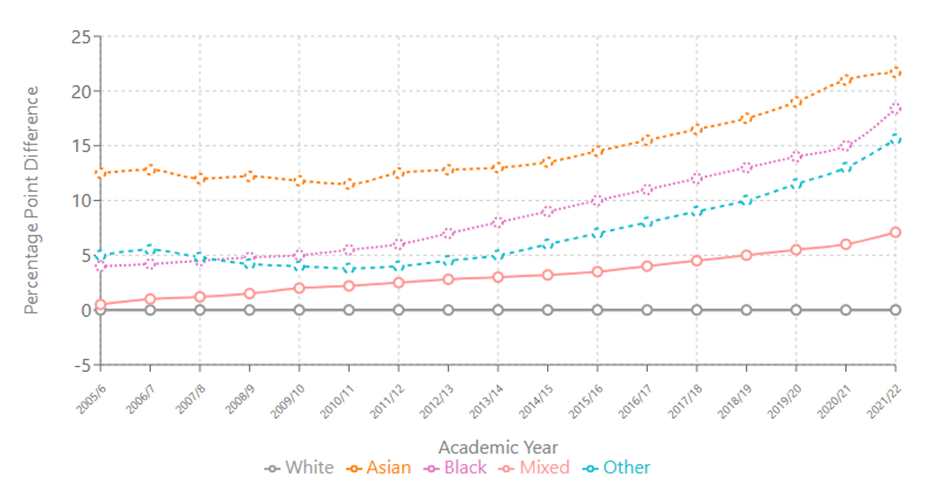
    Here is the key insight: ethnic minority groups now participate in higher education at remarkably higher rates than White students, which likely then drives some of the observed ethnicity awarding gaps. Figure 2 presents the over-representation of ethnic groups in UK higher education relative to the White reference group (again, the constant grey line). The participation gap has grown substantially – Asian students were 22 percentage points more likely to attend university than White students in 2021/22, with Black students 18 points higher.

    Over-representation of ethnic groups in HE compared to White baseline (2005/6-2021/22)

    Figure 2. Source: UCAS End Of Cycle Report 2022

    This difference in participation rates creates an important statistical effect, what economists call ‘compositional effects’. When a much larger proportion of any group enters university, that group may naturally include a broader range of academic ability. Think of it like this: if mainly the top third of White students attend university, but nearly half of ethnic minority students do, we would expect to see differences in degree outcomes – even with completely fair teaching and assessment.

    This principle can be illustrated using stylized ability-participation curves for representative ethnic groups in Figure 3. These curves show the theoretical distribution of academic ability for Asian, Black, and White groups, with the red shaded area representing the proportion of students from each group accepted into higher education in 2021/22. It would be surprising if there was no degree awarding gap under these conditions!

    Stylized ability-participation curves by ethnic group

    This hypothesis suggests the degree awarding gap might largely reflect the success of widening participation policies. Compositional effects like these are difficult to control for in studies, and it is noteworthy that, to date, no studies on the ethnicity awarding gap have adequately controlled for these effects (including one of my recent studies).

    While this theory may offer a compelling statistical explanation, future research pursuing this line of inquiry needs to go beyond simply controlling for prior achievement. We need to examine both how individual attainment evolves from early education to university, using richer measures than previous studies, and how the expansion of university participation has changed the composition of student ability over time. This analysis must also account for differences within broad ethnic categories (British Indian students, for example, show different patterns from other Asian groups) and consider how university and subject choices vary across groups.

    My argument is not that compositional effects explain everything — rather, understanding their magnitude is crucial for correctly attributing how much of the gap is driven by traditional explanations, such as prior attainment, background characteristics, structural barriers, or discrimination. Only with this fuller picture can we properly target resources and interventions where they’re most needed.

    If this hypothesis is proven correct, however, it underscores why the current policy focus on entirely eliminating gaps through teaching quality or support services, while well-intentioned, may be misguided. If gaps are the statistically inevitable result of differing participation patterns among ethnic groups, then institutional interventions cannot entirely eliminate them. This doesn’t mean universities shouldn’t strive to support all students effectively – but it does require us to fundamentally rethink how we measure and address educational disparities.

    Rather than treating all gaps as problems to be eliminated, we should:

    1. Fund research which better accounts for these compositional effects.
    2. Develop benchmarks that account for participation rates when measuring degree outcomes.
    3. Contextualize the success of widening participation with acknowledging awarding gaps as an inevitable statistical consequence.
    4. Focus resources on early academic support for students from all backgrounds who might need additional help, particularly in early childhood.
    5. Explore barriers in other post-16 or post-18 pathways that may be contributing to the over-representation of some groups in higher education.

    Source link

  • The barriers that must be removed for degree apprenticeships to meet NHS workforce targets

    The barriers that must be removed for degree apprenticeships to meet NHS workforce targets

    The recent notion that level 7 apprenticeships will be ineligible for support from the apprenticeship levy has caused consternation amongst training providers, especially in healthcare.

    Training providers and employers are urgently seeking clarity on the government’s position – the current “announcement without action” leaves stakeholders unclear about next steps and further risks the reputation and role of apprenticeships in skills development.

    The development of advanced roles in health or shortened routes to registerable qualifications significantly relies on level 7 apprenticeships. The NHS Long Term Workforce Plan is full of examples of how advanced and new roles are needed now and in the future.

    Once again, decisions are being made by the Department for Education without consulting or collaborating with the Department of Health and Social Care, which means that questions are left unanswered. It is not the first time that training providers and University Alliance have called for joined up thinking and, unfortunately, it certainly won’t be the last.

    Expansion of opportunity

    Health apprenticeships at the University of Derby started small with level 5 provision about ten years ago (subsequently expanding to levels 6 and 7) – we could not have foreseen the enormous expansion of opportunity both in health and other industries that would follow.

    I am proud to say that “I was there” when the nurse degree apprenticeship standard was approved in 2017 – the culmination of two years’ collaboration between the Nursing and Midwifery Council, government, Skills for Health, employers and training providers.

    There were challenges, but we made it, and it opened the door to transformation in how healthcare professionals are educated.

    A bumpy road

    But the journey remains bumpy, and apprenticeships seem to be experiencing a particular period of turbulence. New research conducted by the University of Derby on behalf of University Alliance demonstrates the need for change in how the levy is utilised, the importance of partnership working, and the support that those involved with apprenticeship delivery need in order to secure successful outcomes.

    While the NHS Long Term Workforce Plan of 2023 is itself being refreshed, we can be confident that apprenticeships will continue to have a significant part to play in workforce development. However, our new research has shown how and where employers and training providers need support to make this happen.

    Employers told us how expensive they find it to support apprenticeships, with apprentice salaries, backfill and organisational infrastructure contributing to the financial burden. We know that apprentices need significant support through their learning journey, taking time and investment from employers.

    To make apprenticeships truly successful, the support required is over and above that normally expected in healthcare programmes, yet apprenticeships are specifically excluded from the NHS Healthcare Education and Training tariff. This feels like a double whammy – no support from the tariff and no flexibility in how the levy could be utilised differently, meaning that the responsibility remains with the employer to resource.

    Equally, training providers reported the additional activities and responsibilities associated with the delivery of apprenticeships. The University of Derby has recently successfully completed its inspection by Ofsted. The week of the inspection required input from teams across the University, but the enduring responsibilities of compliance and record keeping make this a continuous activity for a skilled and specialist team.

    The Education and Skills Funding Agency then came hot on the tails of Ofsted – while this is not unexpected, it has again required teams from across the University working long hours to be audit ready. These inspections have served as a reminder of the regulatory burden placed on training providers, especially in healthcare.

    A matter of commitment

    Today marks the start of National Apprenticeship Week. At the University of Derby, we are hosting a week of activities and events, encouraging aspirant apprentices and a range of employers to come and find out more about what apprenticeships can do for them. It is heartening to hear that the number of young people coming to the campus this year has more than doubled since last year’s event.

    Finally, the word is beginning to spread about apprenticeships, and we find school leavers are increasingly well informed about their post-16 and post-18 options.

    The week’s events will be ably supported by our employer partners and apprentices, truly reflecting the partnerships that have developed over the years. These partnerships take a significant amount of investment on all sides – anyone in the vocational education and training world will know that strong partnerships take time and effort to build and maintain. But even the briefest of conversations with apprentices will tell you that it is all worth it. Their confidence, passion and knowledge (their skills and behaviours too) shine through. In a city like Derby, the awareness of the positive difference you are making not only to the apprentice, but also to their family and friends, is never far from your thoughts.

    It is difficult to know how the advent of Skills England will impact the pace and scale of reform, but the present inertia may set the country back – and it certainly will if a blanket approach to level 7 apprenticeship funding is adopted, and lack of join-up between DfE and DHSC remains the status quo.

    National Apprenticeship Week 2025 has the potential to be a force for good – and should be the week that all stakeholders commit to making a difference.

    Source link

  • Degree Apprenticeships in England: What Can We Learn from the Experiences of Apprentices, Employers, and Education and Training Providers?

    Degree Apprenticeships in England: What Can We Learn from the Experiences of Apprentices, Employers, and Education and Training Providers?

    By Josh Patel, Researcher at the Edge Foundation.

    Degree Apprenticeships (DAs) were launched in 2015, as a novel work-based learning route to obtaining a degree. On their introduction, then Prime Minister David Cameron said they would ‘give people a great head start, combining a full degree with real practical skills gained from work and the financial security of a regular pay packet’. Since then, they have taken the higher education sector by storm. Their growth has been the key factor in the expansion of higher apprenticeships from 43,800 starts in 2015/16 to 273,700 in 2023/24, a rise from 4.8% to 35% of all apprenticeships. They have stimulated innovative models of delivery and new and productive relationships between employers and providers. Former Skills Minister Robert Halfon remarked that ‘Degree Apprenticeships’ were his ‘two favourite words in the English language’.

    DAs have, however, recently come under scrutiny. Concerns persist that the growth of DAs and their high cost – reported in the media as growing from 2% of the apprenticeship budget in 2017/18 to 21% in 2021 – might crowd out opportunities for young entrants to the workforce, as DAs are primarily taken by existing employees. The suitability of DAs as instruments to improve upward social mobility has been contested. Meanwhile, the government is drawing up plans to increase the flexibility of the Apprenticeship Levy through which Degree Apprenticeships can currently be funded, asking employers ‘to rebalance their funding for apprenticeships… to invest in younger workers’.

    Our report, ‘Degree Apprenticeships in England: What Can We Learn from the Experiences of Apprentices, Employers, and Education and Training Providers?’, written in collaboration with colleagues from the Universities of Bath, Huddersfield, and Oxford, was published on Tuesday and is a timely intervention into these discussions. Here, we present the evidence for some our policy recommendations, gathered from nearly 100 interviews with stakeholders including large employers and SMEs, providers, degree apprentices, and policymakers.

    Engaging employers

    The government needs to consider a more systematic approach that serves to rationalise the way that employers are supported to offer a wide range of work-based opportunities. As Edge has identified in other programmes, such as T Levels or plans to provide universal work experience through the government’s Youth Guarantee, DAs are restricted by the number of employers willing to engage. We repeatedly heard evidence of the difficulties ‘resource-poor’ employers had in engaging with the design of apprenticeship standards and participating fully in collaboration with providers. As one SME told us contributing to the design and development of a DA ‘doesn’t give me any benefit now, and I’m impatient’.

    The government needs to develop a coherent strategy for DAs with a particular focus on support for SMEs, including improved awareness of levy transfer schemes. Involvement in DAs is often based on being ‘in the know’ and contacts with providers and local authorities. In our ‘Learning from the past’ stream of work, we reviewed Education Business Partnerships, as an example of intermediary organisations, noting both their strengths and shortcomings, which could inform effective initiatives for supporting employers.

    Reducing complexity

    With the creation of Skills England, the government should take the opportunity to review and simplify the process of design, delivery and quality assurance for DAs, and ensure regulatory elements work together. DAs currently draw in a large number of bodies including the OfS, IfATE, regulatory bodies, professional bodies and Ofsted. Providers told us that this had created a complex landscape of ‘many masters’ where lines of accountability are blurred and innovation is stifled. Providers described ‘overregulation’ as limiting ‘our ability to go off-piste’, and while the process could be constructive, providers were unconvinced of its added value. ‘Does that add to the quality?’ one provider asked. ‘I don’t think it necessarily does’.

    Skills England’s remit includes shaping technical education to respond to skills needs, and its incorporation of IfATE has already begun. As a first exercise, it could review the regulatory requirements to remove any duplication and contradictions and then consult with the sector to devise a simpler, clearer mechanism for providers to report.

    Increasing flexibility

    These difficulties meant that, while we found examples of excellent integration of academic learning and the workplace, concerns persisted as to the vocational relevance and obsolescence of learning, particularly in fast-moving sectors such as IT and mental health provision. One employer involved in delivery said they told their apprentices: ‘we have to teach you this so you get through your apprenticeship, but actually in practice that is not the way it’s done any longer’.

    In other countries, such as the Netherlands, a proportion (up to 20-25%) of an apprenticeship standard is kept flexible to be agreed between the employer and provider so that it can take better account of the current and changing situation in that particular industry, location and employer – such flexibility could be piloted in the UK.

    …without compromise

    The government’s commitment to adapting the levy into a ‘Growth and Skills Levy’, offers opportunities to improve DA delivery. Diversification was not a major consideration for the majority of employers when recruiting, though we certainly did hear evidence from those with a strong sense of their social corporate responsibility. As one SME put it:

    there are too many people in the IT industry that are like me. So we’re talking middle-aged white guys. […] Now, DAs allow people who don’t necessarily, wouldn’t consider getting into this industry from a variety of backgrounds, creeds, colours…

    We recommended in our Flex Without Compromise report that the government should take a measured approach to levy reform to minimise the risk that a broadening of scope diminishes the opportunities available particularly for younger people and newer entrants to the labour market. It should consider modelling the impact of differentiating levy funding available for DAs by either or both age and staff status, and diversification of the workforce. This could be a powerful mechanism to encourage employers to focus DA opportunities on younger people and on new recruits but would need to be considered carefully to allow for continued expansion of DAs.

    These initiatives might help address existing challenges and enhance the efficacy of Degree Apprenticeships in fostering equitable access and meeting the needs of learners and employers.

    To find out more about Edge and to read the report in full, visit www.edge.co.uk

    Source link

  • Liaison Unveils New Intelligent Names Degree Intent Scores, Enhancing Predictive Power and Reach 

    Liaison Unveils New Intelligent Names Degree Intent Scores, Enhancing Predictive Power and Reach 

    Liaison, a leader in education technology and data-driven solutions, is excited to announce the release of its 2025 Intelligent Names Degree Intent Scores. These advanced scores represent a transformative leap in identifying adult learners nationwide with the highest potential for pursuing a degree. 

    The 2025 Degree Intent Scores are powered by cutting-edge data science, advanced modeling techniques, and insights from a national survey conducted in late 2024. Combined with responses from Liaison’s extensive consumer database of over 260 million Americans, this enhanced model offers unparalleled precision and reach into the adult learners market. 

    Recent testing using a national dataset of graduate program applicants showed a 20% improvement in predicting applicant activity within the highest intent band when comparing the new intent scores to the original. Similarly, an analysis of a national dataset of bachelor’s degree seekers found that Liaison’s Bachelor’s Degree Intent model accurately identified 91% of degree seekers under the age of 25 in the top two quintiles. These findings underscore the model’s remarkable accuracy, effectiveness, and value for higher education institutions. 

    “The 2025 Degree Intent Scores mark a major milestone in our mission to connect educational institutions with adult learners who are ready to take the next step in their academic journeys,” said Dr. Mark Voortman, Chief Data Scientist at Liaison. “By leveraging large-scale data and state-of-the-art modeling techniques, we’ve significantly enhanced our ability to help institutions identify adult learners most likely to pursue degree opportunities in the near future.” 

    The updated scoring model empowers colleges, universities, and other education providers with deeper, data-driven insights to refine recruitment strategies, enhance student engagement, and achieve enrollment goals more effectively. 

    Learn more about Intelligent Names here.

    Source link

  • Degree apprenticeship delivery needs strengthening to realise their potential

    Degree apprenticeship delivery needs strengthening to realise their potential

    Degree apprenticeships have, ten years from their introduction, stimulated innovative models of delivery and nurtured productive relationships between employers and education and training providers.

    Their rapid growth has, however, invited questions as to whether they are the right instrument for introducing young people to the workforce, or whether Apprenticeship Levy funding would be better spent elsewhere. To consider and evaluate degree apprenticeships, the Edge Foundation in collaboration with colleagues from the Universities of Bath, Huddersfield and Oxford, conducted nearly 100 interviews with large employers, SMEs, education and training providers, degree apprentices and policymakers.

    Our research confirmed degree apprenticeships represent a unique confluence of theoretical higher education and practical skills and promote both academic achievement and workplace competency. Our primary finding was, however, that there is considerable heterogeneity in delivery of these programmes. This flexibility is degree apprenticeships’ greatest asset; it simultaneously, however, increases their complexity.

    Aligning employer needs

    Our research found numerous examples of pragmatic, trusting partnerships between education and training providers and employers. As one education and training provider told us:

    I was able to bring my employer partners with me to the university […] So it’s been great to sit down and […] say “what is it that is missing?” […] And them saying “can you do this? Can you do that?” […] so I can truly say, from the heart, this is for the first time, we are truly, truly, employer-driven.

    However, it remains challenging to engage the full spectrum of employers. Employers engage in these initiatives primarily out of a concern for workforce development, striving to support employees’ professional growth while addressing existing or upcoming skills shortages. However, despite their significance in the UK economy, engagement with SMEs remains challenging.

    Trailblazers, for example, that design apprenticeship standards, have struggled to engage and represent the needs of SMEs. Resource-poor businesses like SMEs often struggle to realise an immediate return on investment for their input. The process is resource intensive, and even with employer and input from regulatory bodies and sector-specific organisations, there is tension in whether professional body requirements can keep pace with modern workplace practices.

    Diversity in delivery structures

    The delivery of degree apprenticeships varies widely even within the same sector, with different patterns of block study, virtual or face-to-face sessions, workplace experiences, placement rotations, and assessments. We heard from apprentices whose learning environment was entirely virtual, featuring asynchronous methods such as recorded lectures and digital resources, to fully in-person models with collaborative project work.

    Concerns about coordinating theoretical elements with workplace roles remain a high priority, with regular communication between employers and tutoring staff viewed as essential. Nonetheless, there is some evidence of excellent integration of learning with workplace practice and, as one education and training provider told us:

    we have huge amounts of anecdotal discussions from employers about the very real, not just skills and talent impact, but the business benefits that students are bringing.

    Positively, degree apprentices experienced learning outcomes and developed skills that surpassed typical undergraduate levels, and many apprentices and employers recognised they had significant advantages in employment for their present and future careers.

    Support systems for apprentices

    Employer mentors’ relationships with apprentices are varied, with providers offering different types of mentorship, from personal tutors to skills coaches. The coordination of tripartite reviews – involving apprentices, employers, and education and training providers – acts as a critical connection among all stakeholders. Apprentices also frequently reported they had formed important and supportive relationships with other apprentices, particularly those who were attached to large employers, where structured support networks were often in place – another area of divergence between the apprentices’ experiences of large and smaller employers. Nevertheless, despite apprentices with SMEs being less likely to have access to similar collegial groups of apprentices at similar career levels, they often praised their employers and team members for offering a supportive and nurturing environment for their development.

    Repeatedly throughout our evidence, stakeholders of all types stressed the importance of effective communication as key for helping learners to see the connections between their work and their academic study. But this could be highly resource intensive, and we found ETPs were not confident in the sustainability of their provision. Education and training providers report that much of their activity around degree apprenticeships is compliance-driven, often overwhelmed by complex auditing and reporting processes that intersect with internal monitoring mechanisms, requiring considerable additional resources, administrative structures and staff. These multiple bodies can sometimes measure quality in incompatible ways. These burdens were significant enough that some education and training providers questioned the feasibility of continuing to offer degree apprenticeships.

    The long-standing challenge of work-related learning, that features throughout vocational programmes, is ensuring the on- and off-the-job training work seamlessly together. Degree apprenticeships certainly exhibit instances of good practice here. But our research also highlighted the great deal of variability in delivery of degree apprenticeships. The linchpin of the quality of learning on a degree apprenticeship programme is directly related to the quality of collaboration between employers, education and training providers, and apprentices.

    Employers and education and training providers in particular should work together to share and implement best practice and ensure that the content of the taught elements and the apprentice’s learning on the job connect and relate to each other as regularly and deeply as possible. Likewise, allowing increased flexibility in the apprenticeship standards, as we have seen in places such as the Netherlands, would allow degree apprenticeships to keep better pace with the rapidly changing economy and workplace practices.

    Finally, we have learned that despite degree apprenticeships offering brilliant opportunities for people to both begin and develop their careers, their success rests on enough opportunities being available in the first place. This requires reducing barriers that hinder the engagement of education and training providers, employers and apprentices. Notably we have found the administrative burdens in relation to accountability on the part of education and training providers, and the management of DAs, as well as the ability to transfer levy funds, on the part of employers, are all persistent barriers to wider engagement.

    With degree apprenticeships coming under scrutiny following the government’s announcement to broaden the Apprenticeship Levy into a Growth and Skills Levy, articulating their strengths and identifying where challenges lie is key to securing their sustainability and ongoing success.

    You can read the full research findings from Degree apprenticeships in England here or sign up to attend the online launch event 10.00-11.30am UK time on Tuesday 28 January.


    Source link