Earlier this week, we announced a new partnership between the University of Michigan and Google to provide free access to Google Career Certificates and Google’s AI training courses for more than 66,000 students across U-M’s Ann Arbor, Dearborn and Flint campuses. These high-demand, job-ready programs are now available through the university’s platform for online and hybrid learning, Michigan Online. The courses and certificates help students to develop in-demand skills in areas like cybersecurity, data analytics, digital marketing, UX design, project management and foundational AI.
We’re both proud graduates of the University of Michigan. Our undergraduate experiences in Ann Arbor were transformational, shaping how we think, who we are and the lives we’ve led. There are countless ways to take advantage of an extraordinary place like U-M. But with the benefit of hindsight, one lesson stands out: Learning how to learn may be the most valuable thing you can take with you.
That has always been true. But it’s becoming more essential in a world where technological change is accelerating and the life span of a “job-ready” skill is shrinking.
A False Choice We Can’t Afford to Make
Today’s learners are navigating a noisy debate: Is a degree still worth it? Should they invest in college—or seek out a set of marketable skills through short-term training?
Too often, this is framed as an either-or choice. But our new partnership underscores the power of both-and.
A college degree is a powerful foundation. And when paired with flexible, high-impact programs like Google Career Certificates, AI Essentials and Prompting Essentials, students are positioned to thrive in a dynamic global workforce. This is not about diluting the value of higher education. It’s about enhancing it—by equipping students with the durable intellectual tools of a university education and the technical fluency to succeed in real-world roles.
The stakes are high. Nearly 70 percent of recent college graduates report needing more training on emerging technologies, while a majority of employers expect job candidates to have foundational knowledge of generative AI. As noted in a New York Times opinion piece by Aneesh Raman, chief economic opportunity officer at LinkedIn, the rise of AI and automation is reshaping the skills required for many jobs, making it imperative for educational institutions to adapt their curricula accordingly. This underscores the importance of integrating practical, technology-focused training into traditional degree programs to ensure graduates are prepared for the modern workforce. The world of work is changing rapidly. Higher education can and must evolve with it.
Rethinking What It Means to Prepare Students for the Future
This partnership is part of a larger effort at the University of Michigan to reimagine what it means to support lifelong learning and life-changing education. Through Michigan Online, U-M students already have access to more than 280 open online courses and series created by faculty in partnership with the Center for Academic Innovation, as well as thousands of additional offerings from universities around the world. These new certificates and AI courses deepen that commitment, creating new on-ramps to opportunity for every student, regardless of background or campus.
Through Google’s flexible online programs, we’ve seen how high-quality, employer-validated training can make a meaningful difference. More than one million learners globally have completed Google Career Certificates, and over 70 percent report a positive career outcome—such as a new job, raise or promotion—within six months of completion. Google’s employer consortium, including more than 150 companies like AT&T, Deloitte, Ford, Lowe’s, Rocket Companies, Siemens, Southwest, T-Mobile, Verizon, Wells Fargo and Google itself, actively recruits from this pool of talent. Google partners with over 800 educational institutions in all 50 states, including universities, community colleges and high schools, to help people begin promising careers in the Google Career Certificate fields.This new partnership extends these opportunities to U-M students to further support career readiness.
By offering accessible, skill-based programs like the Google Career Certificates, we aim to provide additional scaffolding for student success and career readiness, alleviating some of the pressures associated with traditional academic routes and recognizing diverse forms of achievement.
An Invitation to Higher Ed and Higher Ed Ecosystem Leaders
We believe this partnership is a model for how industry and education can come together to create scalable, inclusive and future-forward solutions.
But it’s just one step.
As we reflect on this moment, we invite fellow leaders in higher education, industry and government to ask,
How can your institution better integrate career-relevant skills into the student journey without sacrificing the broader mission of a liberal arts education?
What partnerships or platforms might allow your students to benefit from both a degree and credentials with market value?
In an era defined by AI, how will your institution ensure students are not just informed users of new tools, but thoughtful, responsible and empowered innovators?
How can your institution or organization expand equitable access to high-value learning opportunities that lead to social and economic mobility?
What role should public-private partnerships play in shaping the future of education, work and innovation, and how can we design them for long-term impact?
The path forward isn’t a binary choice. It’s a commitment to both excellence and access, both degrees and skills, both tradition and transformation.
We’re honored to take this step together. And we look forward to learning alongside our students and our peers as we navigate what’s next. In a rapidly shifting higher education environment, we see reason for optimism: opportunities to reimagine student success, forge lasting strategic partnerships and strengthen the bridge between higher education and the future of work.
James DeVaney is special adviser to the president, associate vice provost for academic innovation and the founding executive director of the Center for Academic Innovation at the University of Michigan.
MUSCATINE, Iowa — The suspect moved menacingly toward her, but Elexiana Oliva stood her ground, gun drawn and in a half crouch as she calmly tried to talk him down.
The confrontation wasn’t real, and neither was the gun. But the lesson was deadly serious.
Oliva is a criminal justice major at Muscatine Community College in this largely agricultural community along the Mississippi River. She was in a simulation lab, with that scenario projected on a screen as classmates watched, spellbound.
Just 18, Oliva is determined to become a police detective, a plan that includes earning a bachelor’s degree after she finishes her associate degree here. But she’ll have to go somewhere else to do it — likely, in her case, to a university in Texas.
“It’s not our fault that we grew up in a place where there’s not a lot of big colleges and big universities,” Oliva said.
Related: Interested in innovations in higher education? Subscribe to our free biweekly higher education newsletter.
Iowa has joined a growing number of states that are considering letting community colleges like this one offer bachelor’s degrees, or where community colleges have already started adding them, as a way of filling these so-called rural higher education deserts and training workers in rural places for jobs in fields where there are growing shortages.
“It would be a big game-changer, especially for those who have a low income or a medium income and want to go and further our education,” Oliva said.
Downtown Muscatine, Iowa. About an hour from the nearest public university, Muscatine could benefit from a proposal to let community colleges offer bachelor’s degrees. Credit: Mike Rundle for The Hechinger Report
Abouthalf of states allow community colleges to offer bachelor’s degrees. In Iowa, which is among the half that don’t, lawmakers have commissioned a study to determine whether it should add bachelor’s degrees in some programs at the state’s 15 community colleges. An interim report is due in May.
A similar proposal in Illinois is backed by that state’s governor, JB Pritzker, who has said the move would make it easier and more affordable for residents to get degrees — “particularly working adults in rural communities.” Three-quarters of community college students in Illinois said they would pursue bachelor’s degrees if they could do it on the same campus, according to a survey released by Pritzker’s office.
And in Texas, Temple College will open a center in June where students at the two-year public institution will be able to earn bachelor’s degrees through partner Texas A&M University-Central Texas, including in engineering technology with a concentration in semiconductors.
“When you can offer university classes on community college campuses, that makes a world of difference” to rural students, said Christy Ponce, the president of Temple.
What’s been blocking many of these students from continuing their educations, Ponce said, “is the sheer distance. There’s not a public university option within an hour or more away. And affordability and transportation barriers are huge issues.”
Fewer than 25 percent of rural Americans hold bachelor’s degrees or higher, according to the National Center for Education Statistics, compared to the national average of 33 percent. And the gap is getting wider, the U.S. Department of Agriculture finds in its most recent analysis of this.
Significantly fewer students in rural places than in urban areas believe that they can get degrees, a Gallup survey for the Walton Family Foundation found, citing the lack of nearby four-year universities as a principal reason.
In those states that already allow community colleges to offer bachelor’s degrees, they’re often limited to certain high-demand fields, such as teaching and nursing. Even as this idea has spread, America’s 960 public community colleges collectively confer only about 1 percent of bachelor’s degrees each year, the American Association of Community Colleges reports.
In many places, what’s stopping them from giving out more is opposition from four-year universities and colleges, many of which are increasingly hard up for students as the number of 18-year-olds begins to fall — a phenomenon enrollment managers have dubbed the demographic cliff.
That Illinois proposal, for example, is stalled in committee after several public and private university presidents issued a statement opposing it. Negotiations are continuing.
While community colleges in California have been allowed since 2021 to offer bachelor’s degrees, several have been blocked from adding four-year programs that the California State University System contends it already offers. An independent mediator has been brought in to resolve the impasse.
And while the two-year, public College of Western Idaho will launch a bachelor’s degree in business administration in the fall, it’s doing so only over the objections of Boise State University, which said it “could hurt effective and efficient postsecondary education in Idaho, cannibalizing limited resources available to postsecondary education and duplicating degree offerings.”
Community colleges also need more students; their enrollment declined by 39 percent from 2010 to 2021, and they face that same impending demographic cliff. Those that add bachelor’s degrees increase their full-time enrollment from 11 percent to 16 percent, research conducted at the University of Michigan has found.
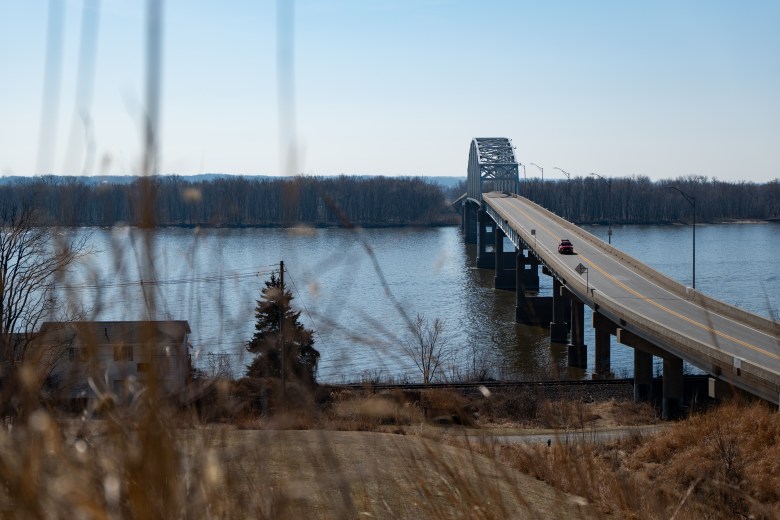
The Norbert F. Beckey Bridge, seen from the Mark Twain Overlook in Muscatine, Iowa, which links Muscatine with Rock Island County, Illinois, across the Mississippi River. Credit: Mike Rundle for The Hechinger Report
The principal impetus for the largely bipartisan push to offer bachelor’s degrees at community colleges, however, is to train more workers for those fields in which there are shortages.
“What I think is misunderstood is that, in general, these are not like the baccalaureates that conventional four-year institutions offer,” said Davis Jenkins, a senior research scholar at the Community College Research Center at Teachers College, Columbia University. (The Hechinger Report, which produced this story, is an independent unit of Teachers College.)
Bachelor’s degrees at community colleges, said Jenkins, “meet an economic need for bachelor’s degree graduates that isn’t being met by other institutions.”
That includes by helping rural workers move up in their jobs without leaving home. “It’s all about serving our workforce needs,” said Iowa state Rep. Taylor Collins, Republican chair of Iowa’s House Committee on Higher Education, who requested the study into whether bachelor’s degrees should be offered at community colleges in that state. “It’s a way to upskill our workforce.”
In his own district, south of Muscatine, “we’re kind of on an island where we only have the community college” — especially since the closing of nearby private Iowa Wesleyan University in 2023. “There are a lot of students who are place-bound. There are a lot of students who want to live locally” and not move away to get a bachelor’s degree.
That’s a focus of the ongoing study, said Emily Shields, executive director of Community Colleges for Iowa, which is conducting it. “Sometimes people have ties, responsibilities, jobs, family things, where moving to where there is a degree available isn’t an option for them,” Shields said.
Sure, she said, rural students can take courses online. But “you’re not getting the student services, you’re not getting activities, you’re not getting the other sort of enrichment support and belonging that a lot of our students, I think, are looking for.”
Many also say they’re looking for the kind of individual attention they get in their hometown and at a community college such as the one in Muscatine, which has an enrollment of 1,800.
Shiloh Morter stayed in his hometown of Muscatine, Iowa, to go to community college. Among the advantages, he says: “The sunsets here are pretty nice. I can tell you, there’s not a whole lot of other places that have clouds like we do.” Credit: Mike Rundle for The Hechinger Report
Shiloh Morter bikes to campus on all but the very coldest days. He plans to become an engineer, but “figured I would save the money and go to community college and try and branch out and develop better habits” first, said Morter, who is 20.
In the automotive technology garage off the main corridor of the small school, cars were lined up neatly with their hoods popped. Nursing students worked on anatomically correct crash test dummy-style “patients.”
Twenty-year-old Mykenah Pothoff enrolled at the college when it debuted a registered nursing program, saving herself money on tuition and a nearly hourlong drive, each way, to the University of Iowa. She also was worried about “just, like, finding my way around” the university, which has more than 30,000 students.
Jake Siefers is majoring in psychology at an Iowa community college. If he could stay and get his bachelor’s degree in the same place, “it would be huge,” he says. “There’s a lot of untapped human potential” in rural places that could benefit from more access to higher education. Credit: Mike Rundle for The Hechinger Report
Jake Siefers, 32, is a psychology major planning to go on to get bachelor’s and master’s degrees. Siefers said he hopes to help other people who, like him, are recovering from alcoholism, and for whom he said there are too few services in Iowa. So he came home to Muscatine to start working toward an associate degree at the community college.
“I could afford it, and it was close and I actually know a lot of people that work here,” said Siefers. “It’s great coming in here and being, like, ‘Hey, I went to high school with you, and you work in the office.’ I mean, that’s everyone in Iowa, right?”
If he could stay and get his bachelor’s degree in Muscatine, “it would be huge,” he said. “There’s a lot of untapped human potential” in rural places that could benefit from the kind of access to a higher education that is now more limited, said Siefers.
Letting students like them finish bachelor’s degrees near where they live “would make it easier for everybody,” said Jaylea Perez, 19, another psychology major who also plans to earn one.
Jaylea Perez is enrolled in community college in Iowa but eventually hopes to earn a bachelor’s degree in psychology. Adding bachelor’s degrees at community colleges “would make it easier for everybody,” she says. Credit: Mike Rundle for The Hechinger Report
Simply having bachelor’s degrees available would make rural students aspire to them who otherwise might not, said Naomi DeWinter, president of Muscatine Community College.
“Everything opens up to them,” said DeWinter, in a coffee shop across the highway from the Walmart.
She sees the most potential among people already working, such as paraprofessionals in schools who want to become teachers; a state job board lists nearly 1,000 vacancies in Iowa for teachers.
DeWinter recalled a graduate so exemplary that he was featured in a promotional video, who after earning his associate degree started substitute-teaching while commuting in his free time to the University of Iowa to get his bachelor’s degree — one course at a time.
“He said, ‘That’s how I’m juggling my work, my family and the affordability,’ ” she said. “His whole career is going to be over before he’s a [full-time] teacher. I feel as though we failed him.”
Like the substitute teacher, students said they want to stay in Muscatine, despite those limits. They like the peace and quiet compared to cities — hardly anyone ever honks, they noted — and the sense of community evident among the friends who run into each other at the Hy-Vee.
“We don’t have the best view of the Milky Way, but we for sure definitely don’t have a bad one,” said Shiloh Morter, ticking down a list of advantages to living on the sweeping plain carpeted with cultivated fields and dotted with barns and silos. “And, yeah, the sunsets here are pretty nice. I can tell you, there’s not a whole lot of other places that have clouds like we do.”
The Hechinger Report provides in-depth, fact-based, unbiased reporting on education that is free to all readers. But that doesn't mean it's free to produce. Our work keeps educators and the public informed about pressing issues at schools and on campuses throughout the country. We tell the whole story, even when the details are inconvenient. Help us keep doing that.
We interviewed students currently studying creative arts subjects at a Russell Group university to hear more about their experiences of social class inclusivity. Speaking to ten undergraduate and eight postgraduate students studying a range of creative fields including music, drama and film, we found that working-class students find it difficult to attend class, are disadvantaged in terms of accessing the cultural resources needed to succeed on their course, and feel excluded from social life on campus.
Economic disadvantage presents a considerable barrier to students completing arts subjects at university. To be inclusive, university staff may have to adjust teaching and learning. We would like to make the case for those working in higher education to consider what classed assumptions are made about students in our institutions and accordingly reassess our expectations of those studying the creative arts.
Many of the disadvantages or challenges that working-class students face are connected to wider structural inequalities that are deeply entrenched in our society. At the same time, there are still meaningful interventions that staff can make to support working-class students. We suggest four ways in which university staff can make their practice more inclusive to working-class students.
Discuss working-class stories as present and live
Universities are middle-class spaces. In creative arts subjects, students often make work referring to their class identity. This can be at odds in institutions where middle-class experience is the “norm”.
Class diversity must be present within teaching. More working-class mentorship and role models would help students to feel like they belonged at university – including visiting working-class creatives. Our participants also advocated for contemporary working-class experience in the curriculum, in academic texts, and in the artworks discussed.
Staff must maintain a supportive and safe space when discussing issues pertaining to social class. Staff should also recognise that not everyone wants to talk about their background or experience. Additionally, staff must be aware of social class-based stereotyping that might exist in other students’ creative work, and be prepared to intervene when necessary if (often unintended) prejudices around work, class, accent, or lifestyle emerge.
Adapt teaching to the multiple demands on working-class students’ time
More and more students are undertaking part-time work alongside their studies. It is difficult to devise our curricula for only those students who can commit all their time to studying, when significant numbers are balancing their studies with multiple part-time, temporary and precarious jobs, or with care responsibilities.
Working-class and carer students may be commuting considerable distances to engage with their studies. This is creating a two-tier system of engagement, and many of the students we interviewed felt that teaching and learning on their courses was not flexible enough to support their participation. The same issues are present when students try to engage in extracurricular and cultural activities.
Working-class students asked for more online resources and access to course materials immediately at the start of modules, alongside concerns over early starts and late finishes and travel costs. They wanted permission to speak to staff about part-time work without feeling like they were “doing something wrong” or not taking their studies seriously. The normalisation of working alongside studying is something that staff may have to accept and work with, rather than try to push against.
Early intervention is important
The early stages of the student’s degree are a key time when social class difference and disadvantage is felt, with high levels of anxiety around finance and budgeting in comparison to more affluent peers.
Working-class students asked for the university to provide information to support their transition into economic independence. Examples include advice on budgeting, lists of free resources, inexpensive alternatives and free access to cultural resources.
Peer support plays a huge role in the transition to higher education. Working-class peer support groups and mentorship are as significant interventions to help.
Adjust assumptions and reassess expectations
University staff can make a difference to the experience of working-class students through simple adjustments of the assumptions we make.
Interviewees believed staff made assumptions about what creative arts students should know, or the kind of experiences they should have had prior to university. These assumptions corresponded with a more middle-class experience, for example knowledge of university life, or access to (and the ability to afford) cultural resources or engagement with extra-curricular activities. Participants were particularly frustrated by assumptions from staff that students could afford to pay for learning resources not available in the library.
Extra work is also needed to ensure that working-class or other marginalised students feel comfortable and entitled to ask for help from staff.
Because many students now must work alongside studying, students may have less time to complete their work outside of class. Stronger steers on the amount of time to complete activities and prioritisation of reading, and the removal of blame for those struggling to balance time constraints of working whilst studying can all be effective.
Working-class creatives
Class inclusivity means students feel like they belong on their course, alongside having the financial security to take the time and space to study.
This is particularly important in the creative arts because the more time and space students have to engage with their course or with extracurricular activities like arts societies, the more working-class stories will be represented in the creative work they make. Creative arts subjects must better support working-class students to engage fully with their studies – and not to be disadvantaged by financial pressure, lack of resource, or through feeling like they don’t belong on their course.
And analysis suggests campuses are already seeing an influx of applicants from the U.S. itself. Figures from the University and College Admissions Service, UCAS, show that 6,680 U.S. students applied to U.K. courses for 2025–26 by the main deadline at the end of January.
This was a 12 percent increase on the year before and the most since comparable records began in 2006. It surpasses the previous record of 6,670 set in 2021–22 and is more than double the demand in 2017.
Maddalaine Ansell, director of education at the British Council, said she was “delighted” by the 20-year high.
“It’s a testament to the quality of U.K. universities that so many people want to study here. Three-year degrees, lower tuition costs and poststudy work opportunities all increase the attractiveness of the U.K. offer,” she said.
“As well as adding to the vibrancy of their courses, we hope that these students will also take a lasting affection for the U.K. forward into their future careers and stay connected with us for years to come.”
Almost two-thirds (63 percent) of the applicants from the U.S. were 18 years old, and 61 percent were women.
The UCAS data covers undergraduate applicants, but separate figures show an uptick in demand at all levels—even before Trump’s second term began.
Recent Home Office statistics reveal that 15,274 U.S. main applicants were issued sponsored study visas in 2024.
Recent research by the British Council found that more international students would choose the U.K. over the U.S. as a result of Trump’s return to the White House.
Universities UK said the increase in demand to study in the U.K. is positive, following a turbulent period for international student recruitment.
“But it is too early to say whether this is the start of a longer-term trend,” added a spokesperson.
“What is important now is for universities and government to continue to work together to promote the U.K. as a welcoming destination, and to preserve our competitive offer to international students.”
Title: Accounting for Additional Credentials in Postsecondary Earnings Data
Authors: Jason Delisle, Jason Cohn, and Bryan Cook
Source: The Urban Institute
As policymakers across both parties consider how to evaluate postsecondary outcomes and earnings data, the authors of a new brief from the Urban Institute pose a major question: How should students who earn multiple credentials be included in data collection for the college that awarded their first degree?
For example, should the earnings of a master’s degree recipient be included in the data for the institution where they earned their bachelor’s degree? Additionally, students who finish an associate degree at a community college are likely to earn higher wages when they complete a bachelor’s degree at another institution. Thus, multiple perspectives need to be considered to help both policymakers and institutions understand, interpret, and treat additional degrees earned.
Additional key findings include:
Earnings Data and Accountability Policies
Many legislative proposals would expand the use of earnings data to provide further accountability and federal aid restrictions. For example, the House Republicans’ College Cost Reduction Act, proposed in 2024, would put institutions at risk of losing funding if they have low student loan repayment rates. The brief’s authors state that the bill does not indicate if students who earn additional credentials should be included in the cohort of students where they completed their first credential.
The recently implemented gainful employment rule from the Biden administration is explicit in its inclusion of those who earn additional credentials. Under the rule, students who earn an additional degree are included in both calculations for their recent degree and the program that awarded their first credential.
How Much Do Additional Credential Affect Earnings Data?
Determining how much additional credentials affect wages and earnings for different programs is difficult. The first earnings measurement—the first year after students leave school—is usually too early to include additional income information from a second credential.
Although the entire data picture is lacking, a contrast between first- and fifth-year earnings suggests that the number of students earning additional degrees may be very high for some programs. As an example, students who earn associate degrees in liberal arts and general studies often have some of their quickest increases in earnings during these first five years. A potential explanation is because students are then completing a bachelor’s degree program at a four-year institution.
Policy Implications: How Should Earnings Data Approach Subsequent Credentials?
In general, it seems that many policymakers have not focused on this complicated question of students who earn additional degrees. However, policy and data professionals may benefit from excluding students who earn additional credentials to more closely measure programs’ return on investment. This can be especially helpful when examining the costs of bachelor’s programs and their subsequent earnings benchmarks, by excluding additional earnings premiums generated from master’s programs.
Additionally, excluding students who earn additional credentials may be particularly valuable to students in making consumer and financial aid decisions if the payoff from a degree is extremely different depending on whether students pursue an additional credential.
However, some programs are intended to prepare students for an additional degree, and excluding data for students who earn another degree would mean excluding most graduates and paint a misleading picture.
To read the full report from the Urban Institute, click here.
—Austin Freeman
If you have any questions or comments about this blog post, please contact us.
By Professor Amanda J. Broderick, Vice-Chancellor & President at the University of East London.
It wasn’t so long ago that universities across the UK were rallying to preserve the graduate visa route, a vital lifeline for international students and higher education. When the Migration Advisory Committee (MAC) concluded there was no significant abuse of the pathway and recognised its immense value, the sector exhaled a collective sigh of relief. Data from the Office for National Statistics (ONS) underscored this conclusion: 80% of international students leave the UK within five years of arrival.
But amidst this hard-fought victory, a critical oversight emerged. In our defence of the graduate visa, we inadvertently highlighted the transient nature of international students in the UK, risking the perception of them as only economic contributors rather than showcasing the profound, enduring responsibilities we owe to them as alumni – and their broad value. The reality is, universities have a far greater role to play in empowering international graduates to thrive – not just within the UK, but globally.
A Broader Vision for Graduate Support
International students arrive with diverse ambitions. Some envision building careers in the UK, while others plan to apply their skills back home. Regardless, the implicit promise of higher education remains the same: their degree must unlock opportunities and enable them to succeed, whether they are in Hyderabad, Atlanta, Cairo or Athens. But how effectively are we fulfilling this promise?
We are getting better as a sector at having frank conversations about support for international students while at university – HEPI and Uoffer Global’s recent report on integration challenges facing Chinese students by Pippa Ebel is a good example of this. But as these students graduate, their needs evolve.
Economic growth is the mantra of the UK government, but this will remain a distant dream if we do not focus on global skills as part of the solution. Business and industry are competing internationally for talent and innovation, and as such, global employability and enterprise are an integral part of the education agenda.
To truly fulfil our responsibilities, universities must look beyond the campus experience and address the evolving, global needs of their international alumni. This involves building a bridge between academic learning and the economic, cultural, and professional landscapes of not only the UK but our alumni’s home countries too.
UEL’s Global Employability Model
At the University of East London (UEL), this principle is central to our mission. My recent visit to India for the UEL 2024 India Summit offers a case study in how universities can redefine global graduate support. With over 8,000 Indian students in 2024, UEL’s commitment to fostering long-term success is clear. The Summit – spanning Chennai, Hyderabad, and Vadodara – brought together leaders from academia, government, and industry to explore partnerships that align a UEL education with India’s economic and societal needs.
A key outcome of the Summit was the launch of the UEL India Industry Advisory Board. This pioneering collaboration between alumni, industry leaders, and academic experts provides strategic direction on UEL’s curriculum development and enterprise initiatives aligned to India’s workforce demands, while also offering alumni robust post-graduation support. Another important engagement took place at T-Works Innovation Centre in Hyderabad, where we worked with international stakeholders on the practical steps UEL can take to bridge the gap between academia and industry. The result: stronger industry ties, better-prepared graduates, and increased support for retaining high-value talent, reducing brain drain and supporting local innovation.
These efforts are not isolated. UEL has long been engaged in projects that foster international employability, including partnerships with Tamil Nadu’s government, where we hosted a hackathon and work placement initiative for computer science and engineering students. This initiative resulted in work placements for alumni based in Chennai, opening up career pathways in sectors such as robotics and AI.
UEL’s forward-thinking approach also extends beyond such events – our international employability offer begins during a student’s degree, with Careers in India mentoring panels and an employer webinar series, opportunities for students to connect with industry professionals and gain insights into fields such as business, HR product design, and digital marketing in India. This support does not finish after graduation; our offer to global alumni includes post-graduation employability boosters, lifelong access to career support portals with free resources, and business incubation and acceleration.
Perhaps most importantly, we also offer a programme of peer-to-peer mentoring, facilitated by our India alumni chapter and bolstered by our Industry Advisory Board, creating a supportive network that fosters continuous learning and career advancement. Unlike many universities, where alumni engagement is viewed primarily through a philanthropic lens, at UEL it is integral to our mission of creating real-world impact. By empowering our international alumni to ‘pay it forward’, we generate a virtuous cycle of mentorship, opportunity, and success. Through our alumni’s success, we amplify the value of a UK degree, not just for the individual, but for their home countries and the global economy too.
Rethinking Metrics of Success
Alongside universities’ own work to ensure they support global graduate employability, we must also look to the role of other stakeholders in this endeavour. As policymakers and universities work together to shape the future of higher education, we must advocate for more nuanced metrics to capture the true global success of our graduates. The Graduate Outcomes Survey (GOS), while valuable, is insufficient to capture the global impact of UK higher education. Refined metrics that capture the contributions of international students to both the UK and their home countries could better highlight the profound influence of UK higher education on a global scale. This data is critical not only for refining university strategies but also for safeguarding the UK’s reputation as a global leader in higher education.
David Willetts’ recent report with the Resolution Foundation also raises issues with the GOS, pointing out that ‘many graduates are on a long and not necessarily straightforward route to a career,’ and that ‘assessing where they are at 15 months is premature’. This is surely even more pertinent for many of our international graduates, whose circumstances may not be accurately captured by a one-size-fits-all survey. Our support for these students must be based on their specific contexts as much as possible – including how we measure success.
Above all, the responsibility to support international graduates does not end at graduation. The world is changing, and the future workforce demands new skills and global collaboration. By supporting international graduates throughout their careers, we help them not only succeed but also lead the way in shaping the jobs the world needs tomorrow. In partnership with business, government, and stakeholders beyond, we can ensure that our international graduates are equipped to thrive in a rapidly evolving global economy – both for their own success and for the benefit of communities worldwide.
At UEL, we are committed to this vision. By nurturing a cycle of mentorship and opportunity, we aim to empower our alumni to transform their communities and industries. Their success is our success – and a testament to the enduring value of UK HE. It’s time for the sector to embrace its role as a global enabler, ensuring that every graduate not only thrives but becomes a beacon of the UK’s educational excellence around the world.
An ed-tech consultant writes that a recent article about online completion rates “shows a disturbing disregard for the complexities of education outcomes.”
By Ian Blenkharn, Director of Education and Student Services at the University of Bath.
Like most institutions across the sector, the University of Bath is carefully considering the potential opportunities, implications and challenges posed by the new Lifelong Learning Entitlement (LLE).
Bath is somewhat unusual in having both a high proportion of integrated master’s courses and a high proportion of students studying programmes with a placement year (nearly two-thirds of Bath students undertake a placement during their time with us). This means we have a large number of students studying five-year, integrated masters programmes with a year on placement.
This raises important questions for us, as it will for others across the sector. The information so far published about the LLE seems to suggest that we will be able to charge students for the full, five-year integrated-masters-with-placement programme, which has a total of 600 credits under the CATS credit accumulation framework. However, it isn’t yet clear whether students, who are automatically entitled to a ‘digital wallet’ to cover up to 480 credits of higher education study, will be able to pay for the entirety of their programme without access to private funding.
For those programmes offered at Bath, the shortfall would be the cost of the placement year – either 15% or 20% of the maximum regulated fee. Perhaps not a deal-breaker for those with access to the Bank of Mum and Dad. However, it could deter some students for whom the chance to work for a year in industry provides unparalleled opportunities to build social capital, experience and confidence to compete in the graduate jobs market. We know that such opportunities are transformative for our students. The prospect of this becoming the preserve of students who can privately fund their tuition risks not only the viability of the programmes we offer but also the social mobility benefits they afford students from widening participation backgrounds.
The decision by the Labour government to defer the implementation of the LLE to January 2027 means there is some time to clarify the situation for both universities and students. However, we will have students applying in September 2025 for deferred entry in 2027, so the time to clarify the situation is shorter than it first appears.
It is imperative that everyone has clarity on this issue (and many others associated with the LLE) before we enter the 2025/2026 recruitment cycle. This is so universities can appropriately advise students on how much their course will cost and whether their Lifelong Learning Entitlement will be sufficient to cover those costs. At the moment, far too many unanswered questions are swirling around the LLE, as evidenced by the 400+ sector participants who logged on to the Higher Education Strategic Planners Association (HESPA)-organised seminar on the LLE with representatives from the Student Loans Company. The sector, and most importantly the students who will be pioneers of the new LLE system, need these questions answered as soon as possible.
The 2023 NCES completion data points to some interesting – and impactful – student trends that continue to paint a picture of a fundamentally changing set of priorities for the Modern Learner. Specifically, more students are moving towards degrees that have firm career outcomes, either in furthering their current career or starting a new endeavor.
Institutions need to pay attention to these trends in order to prepare themselves for a radically different higher education market in the next 5-7 years. This includes prioritizing programs that align with the market’s appetite, as well as re-investing in the value proposition of programs that are currently declining in popularity.
Other Highlights
Associate degree completions saw marked decline, which is notable considering the growth of Undergraduate Certificate completions. Students seem to be preferring certificates that can lead to employment opportunities.
STEM programs continue to either grow or remain stable, depending on the level of the degree. This was most notable at the Graduate level. As more jobs continue to require advanced degrees, this trend is set to only grow in importance.
Liberal Arts programs across all levels experienced significant YoY reductions in completions. Schools that are defined by their Liberal Arts programs will need to assess ways in which they continue to project relevance as the market shifts.
Undergraduate Health Profession programs also saw a decline, which goes against the commonly held belief that the labor market and these programs are continuing to grow. This is something that should definitely be monitored and evaluated, to ensure that institutions do not over-invest in a sector that may be slowing.
2023 NCES Completions Data and the Changing Priorities of the Modern Learner
The 2023 National Center for Education Statistics (NCES) completions data offers a rich and complex tapestry of insights into the trajectory that the Modern Learner is taking their education. As enrollment managers and marketers, it is our imperative to move beyond surface-level observations and delve into the intricate patterns and implications woven within these numbers. This data serves not merely as a historical record but as a powerful compass, guiding us towards a deeper understanding of the Modern Learner’s market demands, and the strategic decisions that will chart the course for institutions in the years to come.
This year’s data unveils a series of significant shifts in student choices, reflecting both the evolving needs of the labor market and the lingering reverberations of the COVID-19 pandemic. We observe a notable decline in associate degree completions, particularly in general studies and humanities, while undergraduate certificates continue their upward trajectory. At the bachelor’s level, STEM fields remain stable, while other areas, especially those associated with traditional liberal arts programs, face headwinds. Graduate programs, particularly in STEM disciplines, are experiencing a surge in completions, and both undergraduate and graduate certificates continue to gain popularity.
In this analysis, we will dive deep into the data, exploring the specific programs experiencing growth or decline, examining the multifaceted factors driving these trends, and discussing the profound implications for higher ed. We will delve into the remarkable growth in graduate programs and certificates, highlighting the increasing demand for advanced credentials in the labor market. We will also confront the undergraduate decline, exploring the potential impact of the COVID-19 pandemic and the looming 2025 enrollment cliff, with a particular focus on the challenges facing private non-profit liberal arts schools. By understanding these multifaceted trends and their interconnectedness, we can proactively adapt our strategies, ensuring that our institutions not only remain relevant and competitive but also thrive amidst a landscape in flux.
Associate Degree: Trade Focused
The 5% decline in associate degree completions is notable both in what programs dropped and which programs are continuing to see growth. The most significant drop emanates from Liberal Arts and Sciences, General Studies, and Humanities, programs that have historically served as a bridge to further education or a broad foundation for diverse career paths. 61% of the YoY decline were in this category. The decline in these areas, coupled with the simultaneous rise in undergraduate certificates, suggests a growing preference among students for more focused, career-oriented pathways that offer a faster and more tangible return on investment.
This shift in student preferences is not surprising in the context of a rapidly changing labor market that increasingly values specialized skills and knowledge. Students are seeking educational pathways that provide them with a clear and direct route to employment and career advancement. In this environment, the perceived value of broad-based, general education programs may be diminishing.
However, amidst this overall decline, we observe encouraging signs of growth in fields directly aligned with high-demand skills. Programs such as Construction Trades, Mechanic and Repair Technologies/Technicians, and Computer and Information Sciences and Support Services have all witnessed increases in completions. This trend underscores the enduring value of associate degrees that equip students with tangible, marketable skills, enabling them to seamlessly transition into the workforce and meet the demands of employers seeking skilled talent.
Bachelor’s Degree: Value Proposition Challenges
At the bachelor’s level, we encounter a mixed bag of stability and change. While STEM fields remain a stronghold, with only a negligible 0.07% dip, other areas, particularly those associated with traditional liberal arts programs, are facing challenges. The most pronounced decline occurs in Health Professions, a field traditionally associated with strong job prospects and stable growth. This decline, juxtaposed with the increase in master’s level completions in Health Professions, suggests a potential shift towards requiring advanced degrees for certain healthcare roles. This mirrors a broader trend of “graduate degree bloat” in the labor market, where employers increasingly demand advanced credentials for positions that previously required only a bachelor’s degree.
The COVID-19 pandemic has undoubtedly exacerbated the challenges facing undergraduate programs. The disruption to traditional learning models, coupled with economic uncertainty and concerns about the value of a college degree, has led many students to reconsider their educational plans. The looming 2025 enrollment cliff, which predicts a significant drop in the number of high school graduates, further compounds these challenges, creating a perfect storm for undergraduate enrollment.
Private non-profit liberal arts schools are particularly vulnerable in this environment. The growth areas in the undergraduate space are mainly concentrated in STEM programs, leaving liberal arts institutions grappling with declining enrollments and a need to reimagine their value proposition. Adapting to this changing landscape will require innovative approaches to curriculum design, student support, and career services. Tuition driven, liberal arts institutions must demonstrate the relevance and value of their programs in today’s world, not only highlighting the critical thinking, communication, and problem-solving skills that their graduates possess (which has always been their particular promise), but also their undergraduate’s career opportunities.
Graduate Studies: Career Growth and Specialization
Graduate programs, especially those in STEM disciplines, are experiencing a period of remarkable growth. The 51% and 25% surges in Computer and Information Science and Support Services and Engineering master’s completions, respectively, echo the trends at the bachelor’s level and underscore the premium placed on advanced technical expertise. The overall 30% rise in STEM master’s completions further solidifies this trend, reflecting the insatiable demand for skilled professionals in these fields.
This surge in graduate completions aligns with the broader trend of graduate degree bloat (others might more favorably describe it as “expansion”) in the labor market. As certain industries and professions increasingly require advanced degrees for career advancement, we can anticipate continued growth in graduate programs, particularly in fields that offer a clear pathway to high-demand, well-paying jobs. This presents a significant opportunity for institutions to expand their graduate offerings and cater to the growing population of working professionals seeking to upskill and advance their careers.
Graduate certificates are also experiencing growth, with a 2% increase in completions. The growth in fields like Computer and Information Technology, Psychology, and Engineering/Engineering-related Technologies/Technicians demonstrates the appeal of these focused credentials for professionals seeking to enhance their skill sets or transition into new careers. The flexibility and shorter duration of graduate certificates make them an attractive option for busy professionals who may not have the time or resources to pursue a full master’s degree – especially if the certificates are tied to a degree later.
The flourishing graduate landscape presents a wealth of opportunities for institutions. Expanding graduate program offerings, enhancing online and hybrid learning options, and strategically marketing to working professionals are all essential strategies for capitalizing on this growth. The increasing popularity of graduate certificates also underscores the need for institutions to develop a diverse portfolio of graduate programs that cater to the varied needs and preferences of learners.
Navigating the Data’s Implications for Engaging with the Modern Learner
The 2023 NCES completions data provides a roadmap for navigating the complexities of the higher education landscape. The trends we’ve observed highlight the growing preference for career-focused programs, specialized credentials, and flexible learning options. They also underscore the challenges facing undergraduate programs, particularly in the liberal arts, in the wake of the COVID-19 pandemic and the approaching enrollment cliff.
To thrive in this environment, institutions must be proactive, agile, and data-driven. The Modern Learner is looking for clear career outcomes – not just in program availability but in the flexibility that comes with balancing work with furthering education. They want to know exactly what they can expect from their investment of time and money to the program. Schools must also reimagine their programs, enhance student support services, and strategically market offerings to meet the evolving needs of learners and the demands of the labor market. They need to embrace innovation and explore new models of education that provide students with the skills and knowledge they need to succeed in the 21st century.
For associate degree programs, this may involve a greater emphasis on career-focused pathways, stackable credentials, and partnerships with employers. Bachelor’s degree programs, especially in the liberal arts, may need to re-articulate their value proposition, highlighting the transferable skills and lifelong learning benefits that their graduates acquire. Graduate programs should continue to expand and innovate, offering a mix of traditional degrees and flexible certificates to meet the diverse needs of working professionals.
Above all else, if this data is speaking to troubling realities on campus, the most important takeaway should be: trying the same strategies that are producing tepid results in regards to enrollment growth will not be the solution going forward. If you are seeing challenging enrollment numbers for any level of program, think about how your institution can more readily adapt to these changing trends, whether that be introducing multiple starts per term, reworking tuition costs, or making better strategic use of marketing and enrollment processes for priority programs.
Is Your Institution Ready for the Modern Learner?
We help schools all the time who have been trying to fit a square peg into a round hole, and often the solution is for an outside perspective to create a vision for the future. The time to act is right now, there is a quickly closing time frame for ensuring a flourishing future for your institution. In fact for many schools, it is already too late. The Modern Learner is moving at a swift pace, and if universities do not keep up, they will quickly be left behind.