
Tag: Delayed

  • Federal Aid Conference Delayed, University Employees Lament

    Federal Aid Conference Delayed, University Employees Lament

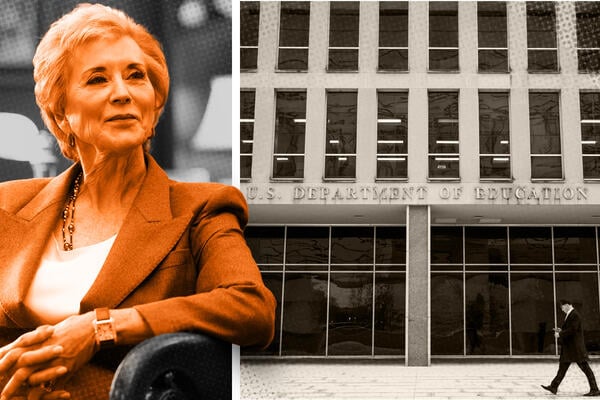
    Photo illustration by Justin Morrison/Inside Higher Ed | Caiaimage/Chris Ryan/iStock/Getty Images

    Each year during the first week of December, the Department of Education has historically hosted the Federal Student Aid Training Conference to provide university administrators with updated education on regulations and technical systems. That hasn’t happened this year.

    Now, many financial aid experts are expressing their frustrations on social media, attributing the lapse to the Trump administration’s major reductions in force and calling it a shortsighted mistake.

    “There is no conference. That’s what happens when you fire many of the staff who organized and conducted the training,” Byron Scott, a retired FSA staff member, wrote on LinkedIn. “Perhaps in ‘returning’ this Department of Education function to the states—where [it] never was—the Department forgot to tell the states about this new responsibility.”

    Department officials have neither announced the event’s cancellation nor clarified whether and when it might take place. The conference website, where logistical information is traditionally posted, only says, “Information coming soon.”

    One senior department official who spoke with Inside Higher Ed on the condition of anonymity said the conference is slated to occur in person in March.

    “The announcement was queued up but the shutdown got in the way,” the source wrote in a text message. “I think the plan [will be released] in the coming days.”

    An Education Department spokesperson did not respond to questions about the March date but blamed any delay on the government shutdown.

    “The Democrats shut down the government for 43 days, and as you can imagine, planning a conference is not an exempted activity,” the spokesperson said. “We’ll have more updates on this in the coming weeks.”

    If the conference is eventually held in person, it would be the first time since the COVID-19 pandemic broke out in 2020.

    The senior department official said they hope that “returning the conference to in-person will make the wait worth it.”

    But Heidi Kovalick, director of financial aid at Rowan University, responded to Scott’s LinkedIn post saying that right now is “a critical time.”

    Financial aid officers have a lot to adapt to; the One Big Beautiful Bill Act mandated major changes to the student loan system, and the department issued regulations outlining new standards for Public Service Loan Forgiveness, among other significant shifts since Trump took office.

    “Fin[ancial] aid administrators really need to hear from the experts,” Kovalick wrote. “Of course as others have mentioned, [it’s] kind of hard when they have been forced out. We miss you all.”

    Regardless of whether staffing shortages or the government shutdown played a role in the delay, Melanie Storey, president of the National Association of Student Financial Aid Administrators, said one of her greatest concerns is the tight timeline financial aid officers will face if the department does reschedule the conference for spring.

    “Truthfully, March is pretty soon—three months away. Institutional budgets are tight. People are going to have to book flights and hotels, and you know that that can be expensive,” she said. Still, the NASFAA president applauded the department for its effort to return the conference to an in-person event.

    “The last few were virtual, which had mixed reviews. The sessions had to be prerecorded. They weren’t always as timely. And there wasn’t an opportunity for interaction. But those are all the things that financial aid professionals prioritize,” she said. “If March is when they can do it, well, we’ll be happy to see it in March.”
    Source link

  • NACIQI Meeting Delayed by Government Shutdown

    NACIQI Meeting Delayed by Government Shutdown

    The Department of Education has delayed the semiannual convening of its accreditation advisory committee for the second time this year, according to an email sent to committee members and obtained by Inside Higher Ed.

    The meeting of the National Advisory Committee on Institutional Quality and Integrity, originally slated to take place in July, had already been pushed back to Oct. 21. Now, as a result of the government shutdown, it’s been rescheduled for Dec. 16.

    “As many of you know, most department staff, including those supporting NACIQI, have been furloughed and the Department has suspended operations except for specific excepted activities,” Jeffrey Andrade, deputy assistant secretary for policy, planning and innovation, wrote in the email. “The Department will be publishing a notice in the Federal Register shortly announcing this change of meeting date.”

    Inside Higher Ed reached out to the department for direct comment on the delay but did not get a response prior to publication.

    The meeting was slated to include Under Secretary Nicholas Kent’s first comments on accreditation since he took office, as well as compliance reports from five different accreditors. Three of those agencies are institutional: the Middle States Commission on Higher Education, the New England Commission of Higher Education, and the Western Association of Schools and Colleges Senior College and University Commission. The other two are programmatic: the Accreditation Commission for Midwifery Education and the Commission on Accreditation in Physical Therapy.

    And while it wasn’t formally listed on the committee’s agenda, this meeting also likely would have served as the unveiling of six new Trump-appointed committee members.

    When department officials announced the first delay in July, observers noted that by the time the rescheduled meeting took place, the terms of six of the committee’s 18 members would be over. With key decisions about the future of higher education accreditation looming, many policy experts took this as a sign that the Trump administration was trying to stack the panel in its favor.

    Now, the new appointees will likely go unnamed for another two months, and the compliance reports will remain unchecked until the next meeting. And though neither of these agenda items is quite as high-stakes as a recognition review—the process by which independent accrediting agencies are granted the power to gate-keep federal student aid—one expert feared it could lead to a backlog in future evaluations.

    “While [the accreditation agencies] are coming up before NACIQI on this compliance report, they are also likely in the process of having their regular recognition reviewed again,” said Antoinette Flores, the director of higher education accountability and quality at New America, a left-leaning think tank. “So it adds to the burden and could lead to compounding issues.”

    Flores, who served in the same role as Andrade during the Biden administration, is worried that the delay could not only slow down future reviews but also hamper current ones, putting certain agencies and the institutions they serve at risk. When an agency is placed under compliance review, it has 12 months to fix the problem and prove it is meeting the committee’s criteria, she explained. So, if it hasn’t proven it’s meeting those criteria within that period, technically the agency’s authorization could be at stake.

    Flores said she’s particularly worried for Middle States Commission and the New England Commission, because they each received letters from the Trump administration earlier this year pressuring them to take action against member institutions’ alleged noncompliance with civil rights laws. Neither accreditor has done so, and they won’t be able to present their compliance reports before the 12-month deadline.

    “So is the agency in compliance? Is its recognition going to continue? … That’s kind of the underlying question,” Flores said.

    Others are far less concerned.

    Kyle Beltramini, a policy research fellow at the American Council of Trustees and Alumni, a right-leaning policy organization, said that to his knowledge there’s never been a time when NACIQI failed to meet and review an agency’s compliance or recognition before the deadline.

    So while it remains unclear what would happen if the meeting never took place or the agencies were unable to present their compliance reports before deadline, Beltramini believes that any consequences of the delay will be minimal.

    “I don’t think what we’re going to see is the nuclear option of an accreditor losing their authorization,” he said. “It’s partially because of the fact that even if that’s what the administration wanted to do—which I don’t think that that’s the case—they just don’t have the full majority on the committee.” (Although, technically, the under secretary and secretary of education do not have to follow the committee’s guidance.)

    Either way, if and when the meeting occurs, Beltramini anticipates that it will set the tone for how the Trump administration plans to approach accreditation moving forward.

    “There is a broad and bipartisan agreement that there needs to be change to the system, and what you’re going to see, more and more often, is NACIQI attempting to hold the accreditors accountable by asking them questions and getting them on the record in ways that may make them uncomfortable,” he said.

    Source link