The campus, set to be established in the capital of Colombo with its first intake by mid-2026, will initially offer courses in business and early childhood education, with programs in IT, psychology, engineering, and health “earmarked” for future expansion.
“We are excited to bring Charles Sturt’s world-class courses to students in Sri Lanka. It will also facilitate new and valuable academic and research connections and build greater awareness of Charles Sturt University and our regional communities internationally,” stated Charles Sturt vice-chancellor, Renée Leon.
Despite over 160,000 Sri Lankan students seeking tertiary education each year, roughly three-quarters miss out due to limited spaces across just 20 public universities.
But with a private education market worth over USD$1.1 billion and more than 60,000 Sri Lankan students pursuing transnational education (TNE) each year, Charles Sturt University aims to make its programs more accessible while generating revenue that can be reinvested into its regional education mission.
“The benefits of this venture are not limited to the students in Sri Lanka and the skills and knowledge they will bring to their nation’s workforce,” Leon said.
“This vital and underfunded regional mission remains at the heart of Charles Sturt. It is why we are here and why we are important.”
It (Sri Lanka campus) will also facilitate new and valuable academic and research connections and build greater awareness of Charles Sturt University and our regional communities internationally
Renée Leon, Charles Sturt
The university will lean on Prospects Education for its TNE delivery in Sri Lanka, similar to its longstanding China Joint Cooperation program, another key TNE venture.
According to Mike Ferguson, pro vice-chancellor (international) at Charles Sturt, the new Sri Lanka campus “will create high-quality university places in areas of skills priority, aligning closely with the Australian government’s priorities”, he said in a post on LinkedIn.
Sri Lanka already hosts two Australian institutions: Edith Cowan University, launched in August 2023, and Curtin University in December 2024. Australia’s TNE enrolments in Sri Lanka reached 3,145 in 2022.
On Tuesday, the Trump administration announced that it would require foreign tourists to the United States to provide five years of social media history to enter the country. Americans have 60 days to comment on the proposal. FIRE plans to publish a formal comment outlining why this is a serious threat to free expression.
The following can be attributed to Sarah McLaughlin, FIRE’s senior scholar for global expression:
Those who hope to experience the wonders of the United States — from Yellowstone to Disneyland to Independence Hall — should not have to fear that self-censorship is a condition of entry. Requiring temporary visitors here for a vacation or business to surrender five years of their social media to the U.S. will send the message that the American commitment to free speech is pretense, not practice. This is not the behavior of a country confident in its freedoms.
Americans should not feel that they must silence themselves at home for fear that their online expression will bar their access to travel overseas. Therefore we shouldn’t put tourists coming here in that bind. Call it the golden rule of free expression: Treat the speech of visitors the way we want to see Americans’ expression treated abroad.
For the first five years of children’s lives, many families are experiencing child care challenges — which have been at the center of discussions among the NC Task Force on Child Care and Early Education since Gov. Josh Stein established the group in March.
But gaps in child care do not disappear once children start kindergarten. Finding affordable, high-quality child care solutions for school-age children should be part of the state’s continuum of care, advocates and providers told the task force Monday.
“The parents I work with don’t experience child care as a 0 to 5 situation,” said Beth Messersmith, task force member and campaign director of MomsRising’s North Carolina chapter. “They experience it as a 0 to 12 situation, or older.”
Many families need care before and after the school day and during the summer months in order to work and keep students safe and engaged. However, four in five students in North Carolina do not have access to the out-of-school care they need, according to a report from the national Afterschool Alliance.
Students, including young children, are instead spending time unsupervised. About 3% of K-5 students, 11% of middle school students, and 34% of high school students spend an average of 5.7 hours without adult supervision per week, according to the same report.
Providers shared their struggles to serve children despite high demand and the benefits children, families, and businesses see when out-of-school care is accessible. After-school programs face many of the same challenges as child care programs. And some child care programs serving children before kindergarten also serve school-age children when school is out of session.
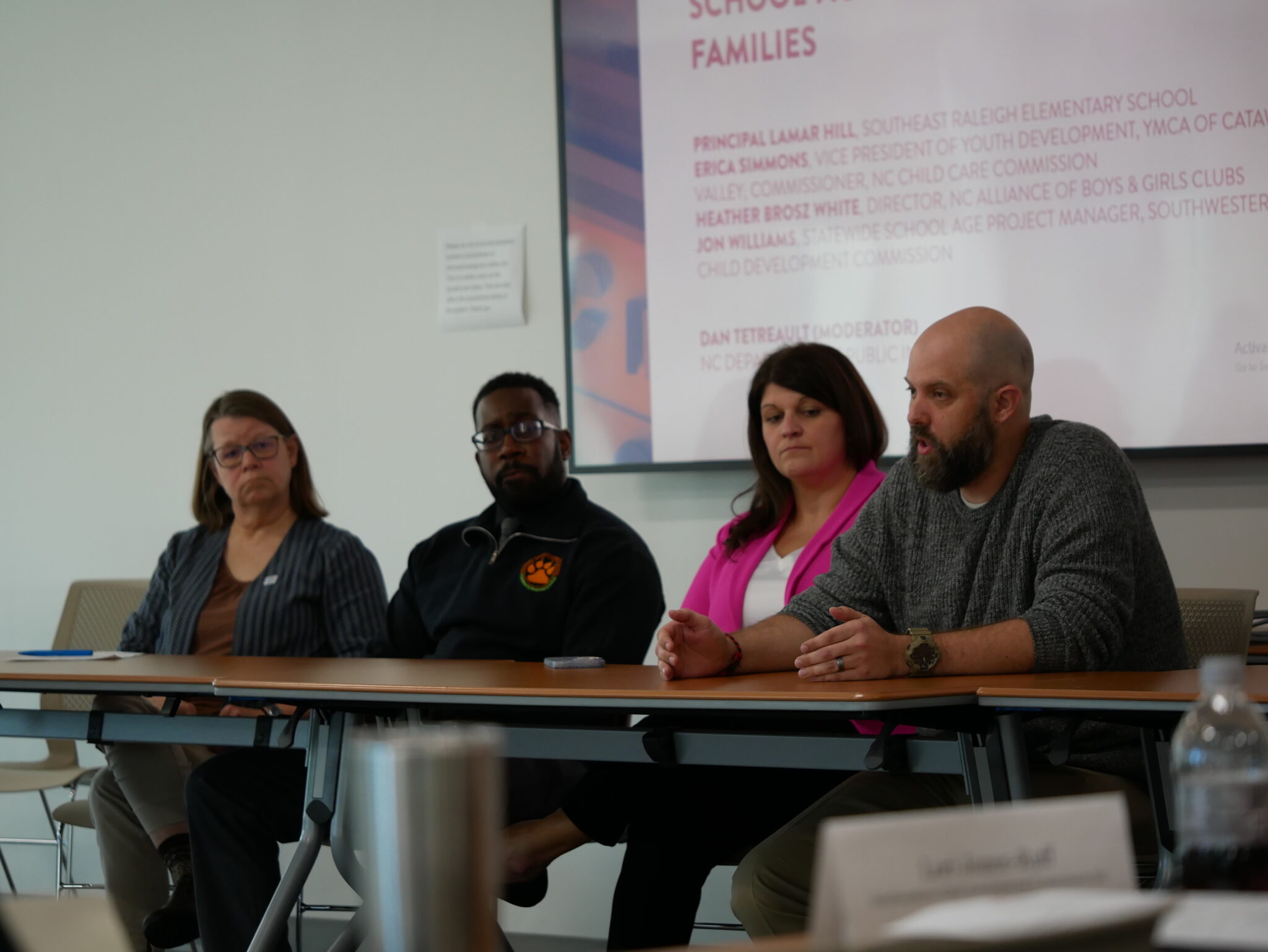
Erica Simmons, vice president of youth development at YMCA of Catawba Valley, shares her programs’ reach and barriers to that reach. (Liz Bell/EdNC)
Families need care that works with their schedules and engages students in activities that support them academically and socially, said Elizabeth Anderson, executive director of the North Carolina Center for Afterschool Programs, a nonprofit under the Public School Forum of North Carolina. That requires funding, workforce supports, transportation, and creative partnerships, Anderson and a panel of providers said.
“The more we can create a spectrum of opportunities for birth through grade 12, the more that children and families in our state are going to recognize the positive economic impacts of those investments,” Anderson said.
Report due in December on child care solutions ahead of short session
The governor’s task force will release a report by the end of December with recommendations on how the state should expand access to high-quality, affordable child care. Stein formed the group earlier this year as pandemic-era child care funding ran out and advocates across the state and country called for consistent public investment to meet families’ needs.
The state legislature did not allocate new funding for child care this year and did not pass a new comprehensive budget. Some new funding, though lower than advocates’ and state officials’ requests, was included in budget proposals from Stein’s office and the House and Senate, but those proposals were not ultimately passed.
The main child care legislation that was passed made regulatory changes to loosen staffing requirements and allow providers to serve more children in classrooms with appropriate space and teacher-to-child ratios.
The task force will meet again in February, though a date is not yet set. Ahead of next year’s short session, members on Monday discussed what role the group should play in moving policy solutions forward, including six recommendations in the group’s interim report released in June:
Set a statewide child care subsidy reimbursement rate floor.
Develop approaches to offer non-salary benefits to child care professionals.
Explore partnerships with the University of North Carolina System, N.C. Community Colleges System, and K-12 public school systems to increase access to child care for public employees and students.
Explore subsidized or free child care for child care teachers.
Link existing workforce compensation and support programs for early childhood professionals into a cohesive set of supports.
Explore the creation of a child care endowment to fund child care needs.
As the state faces many funding requests, federal funding uncertainty, and slim tax revenue, members said more legislators need to be aware of the state’s child care crisis and why it’s relevant to the state’s economy and future.
“Maybe we have some more work to do around actually educating and engaging members of the General Assembly to get this on their radar and build more champions,” said Susan Gale Perry, CEO of Child Care Aware of America and task force member.
Funding to address issues of access, quality, and affordability is needed, members said, and considering existing funding streams rather than new ones might be more politically feasible in the short term.
“Certain proposals about, ‘Let’s just go raise taxes,’ are probably not going to be something that is going to get across the aisle agreement, but it does create the opportunity to looking at areas where tax rates are already set, or certain revenue streams are already existing,” said Mary Elizabeth Wilson, task force member and the Department of Commerce’s chief of staff and general counsel.
Mary Elizabeth Wilson, task force member and the Department of Commerce’s chief of staff and general counsel, shares considerations for 2026. (Liz Bell/EdNC)
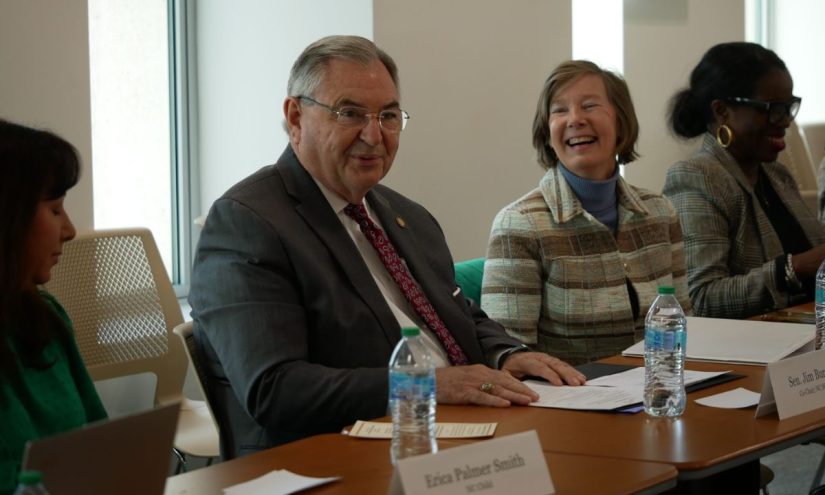
Sen. Jim Burgin, R-Harnett, who chairs the task force along with Lt. Gov. Rachel Hunt, said he and other legislators will be introducing legislation that would double the tax rates on sports gambling.
“If it’s for the children, everybody needs to support it,” Burgin said. “And I don’t believe in gambling … I’m doing it because we need the money.”
Child care fixes would also increase tax revenue, said Erica Palmer-Smith, executive director of nonprofit NC Child and task force member.
“(The generated revenue) would more than cover the overall cost that we would need to put in in the long run to fix the child care system,” Smith said.
‘The gap between 3 and 6 and between May and August’
Many families either do not have an after-school program nearby, do not have transportation to programs, or cannot afford programs, Anderson said in a presentation to the group Monday.
In 2025, 188,295 children participated in after-school programs, but 664,362 additional children would have if they had access, according to the presentation.
Programs are funded through a mix of private grant funding, public funding, and parent tuition. The two biggest funding sources are from the federal government: the Child Care Development Fund, which funds child care subsidies for young children and school-age children up through 12 years old, and 21st Century Community Learning Centers through the Department of Public Instruction.
After-school programs exist in all different types of facilities — community-based organizations, schools, faith-based organizations, and child care centers and home-based programs. Anderson described these programs as “folks stepping in to fill the gap between 3 and 6 and between May and August.”
Students benefit when they access out-of-school programs, she said. In the case of the 21st Century Community Learning Centers, 72% improved their attendance in the 2023-24 school year, 75% of students had decreased suspensions, and 90% improved their overall engagement in school.
Elizabeth Anderson, executive director of the North Carolina Center for Afterschool Programs, provides an overview of the demand for school-age care across the state. (Liz Bell/EdNC)
Anderson said the skills employers are seeking align with those that children are gaining from after-school programs, like problem-solving, teamwork and collaboration, communication, and leadership.
“We know that our after-school programs are an important place where children get to interact with one another and interact with mentors and positive adult figures that help them build these skills, which ultimately help them to become more successful, independent earners in the future,” she said.
Like child care programs in the early years, after-school programs not only help children, but allow parents to work. In a survey from the national report, 91% of parents said these programs help them be able to keep their job.
Families face particular challenges in the summer months. A national survey from LendingTree of more than 600 parents found this year that 66% of parents who seek summer care struggle to afford it, and 62% had taken on debt to pay for summer care.
Anderson said more conversations on child care should extend beyond the early childhood period. She pointed to research from the University of California that found educational and occupational attainment improvements were higher when children had access to both early care and education and out-of-school care once they entered school.
“It is something that parents need and want,” she said. “I think that we talk a lot about what happens for children birth to 5, but a child does not turn 5 years old and suddenly not need opportunity.”
Subsidy funding and reform would help, experts say
North Carolina is one of 23 states that does not have state level funding for after-school care, Anderson said. Anderson and panelists said funding is needed to retain teachers, increase access, provide transportation, and help families afford care.
Jon Williams, manager of the statewide School-Age Initiative at the Southwestern Child Development Commission, is focused on increasing the quality of out-of-school care across the state. He said the transient nature of school-age professionals disrupts consistency for children, families, and programs. A burdensome orientation process creates challenges for owners and directors constantly onboarding new people.
Williams said business training for after-school program directors would be helpful. Many have educational backgrounds and lack the business expertise to be successful in a challenging environment.
“They don’t have that financial background that is needed to run a business, and that creates a lot of financial instability,” Williams said. “If they don’t know how to orient or get new staffing in, that creates a huge problem.”
Jon Williams, manager of the NC School Age Initiative at the Southwestern Child Development Commission, says providers need funding and business training to improve the stability and quality of school-age care. (Liz Bell/EdNC)
A policy change that several panelists and task force members raised as a need is to align the eligibility requirements for child care subsidies across age groups. Right now, families who earn less than 200% of the federal poverty line are eligible for child care subsidies when their children are 5 years old or younger. But for school-age children, the threshold lowers: families must make less than 133% of the poverty line.
That disrupts care for families whose children need after-school care going to kindergarten or for families with multiple children of different ages who would prefer to send all of their children to one program.
A statewide subsidy floor, which is one of the policy priorities of the task force, would also help school-age care providers, said Erica Simmons, vice president of youth development at YMCA of Catawba Valley.
The floor would raise the per-child rate that child care programs receive to the state’s average rate. In cases where programs receive more than the average rate, they would continue receiving the same amount.
“(The floor) would make it a little more equitable,” Simmons said.
She said it costs similar amounts to provide care at her licensed programs in rural and urban communities. But the subsidy rates are much lower in rural areas.
“We have the same requirements for staff, we have the same programming requirements,” she said. “There’s no difference in the amount that we spend per program as an organization. However, there is a very big difference in what we are able to capture for subsidy. So there’s a big funding gap.”
Williams said there was a gap of $8,000 for one program just last month between the cost of services and the subsidy reimbursement. Annually, some programs in her network accrue around $100,000 in funding gaps for caring for children through subsidy.
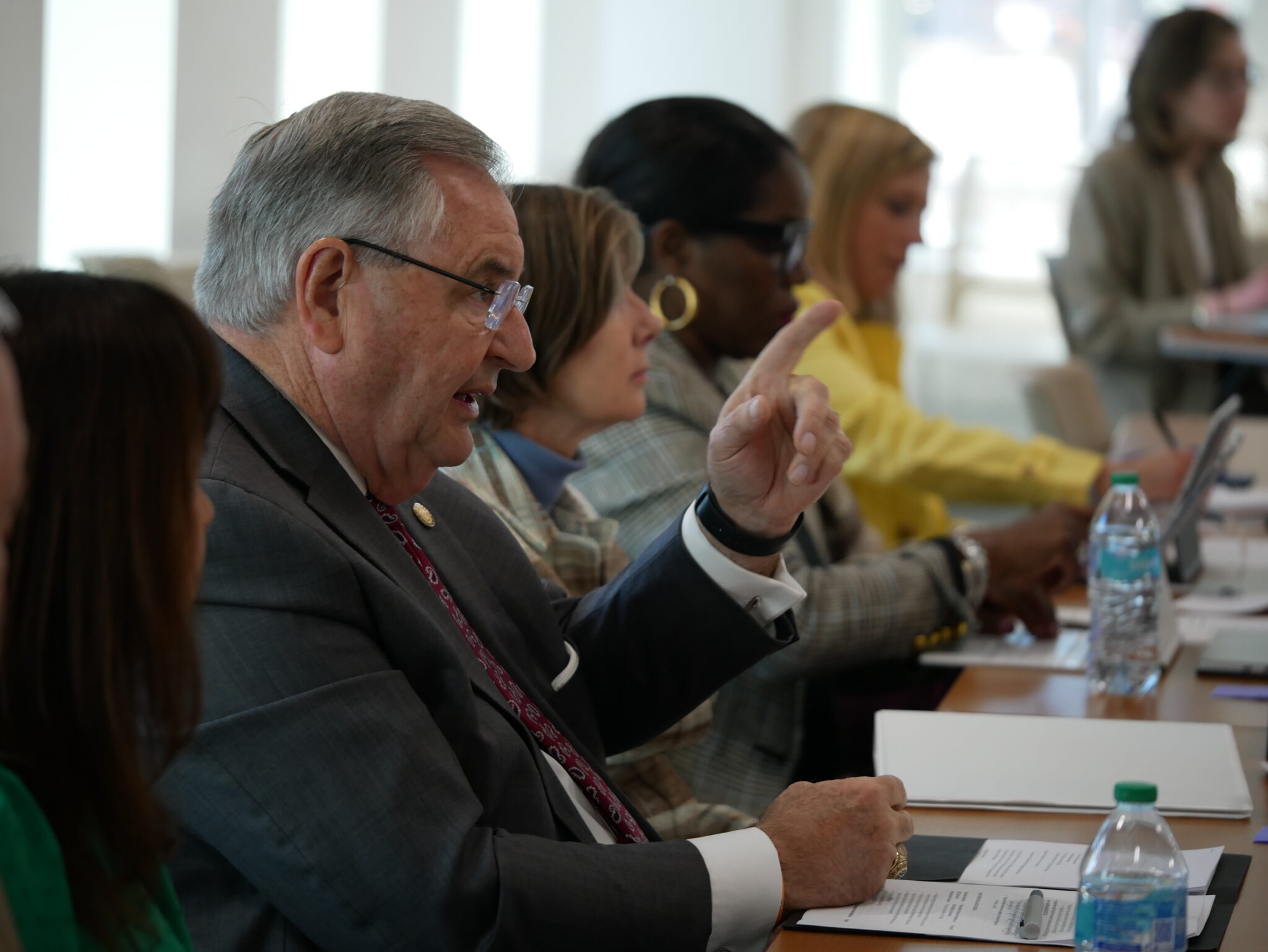
Burgin asks a question of after-school program experts. (Liz Bell/EdNC)
Programs also receive subsidy payments retroactively. Changing the timing of funding could relieve some of the financial burden from programs, Williams said.
“I get paid via subsidy after I provide the services, and that’s a huge problem if I’m already in the red,” he said.
“… When we think about the mental health of our administration and our directors, that just adds fuel to the flame,” Williams said. “And it creates another gap, a 30-day gap, where I can say, ‘I can’t do this anymore,’ and then that care drops off. So we have to rethink how we get that money out in the state. We have to rethink the rates at which they are given.”
Panelists also shared that liability insurance rates have risen drastically. Williams said her program’s rates have increased by 44% over the last year, a trend among child care providers overall. A 2024 survey from the National Association for the Education of Young Children (NAEYC) found 80% of respondents saw their liability insurance costs increase in the last year and 62% reported difficulty finding or affording it.
Updates on care for public employees, workforce supports, and funding models
The task force has been split up into three subgroups which have been studying how to move toward the group’s six recommendations.
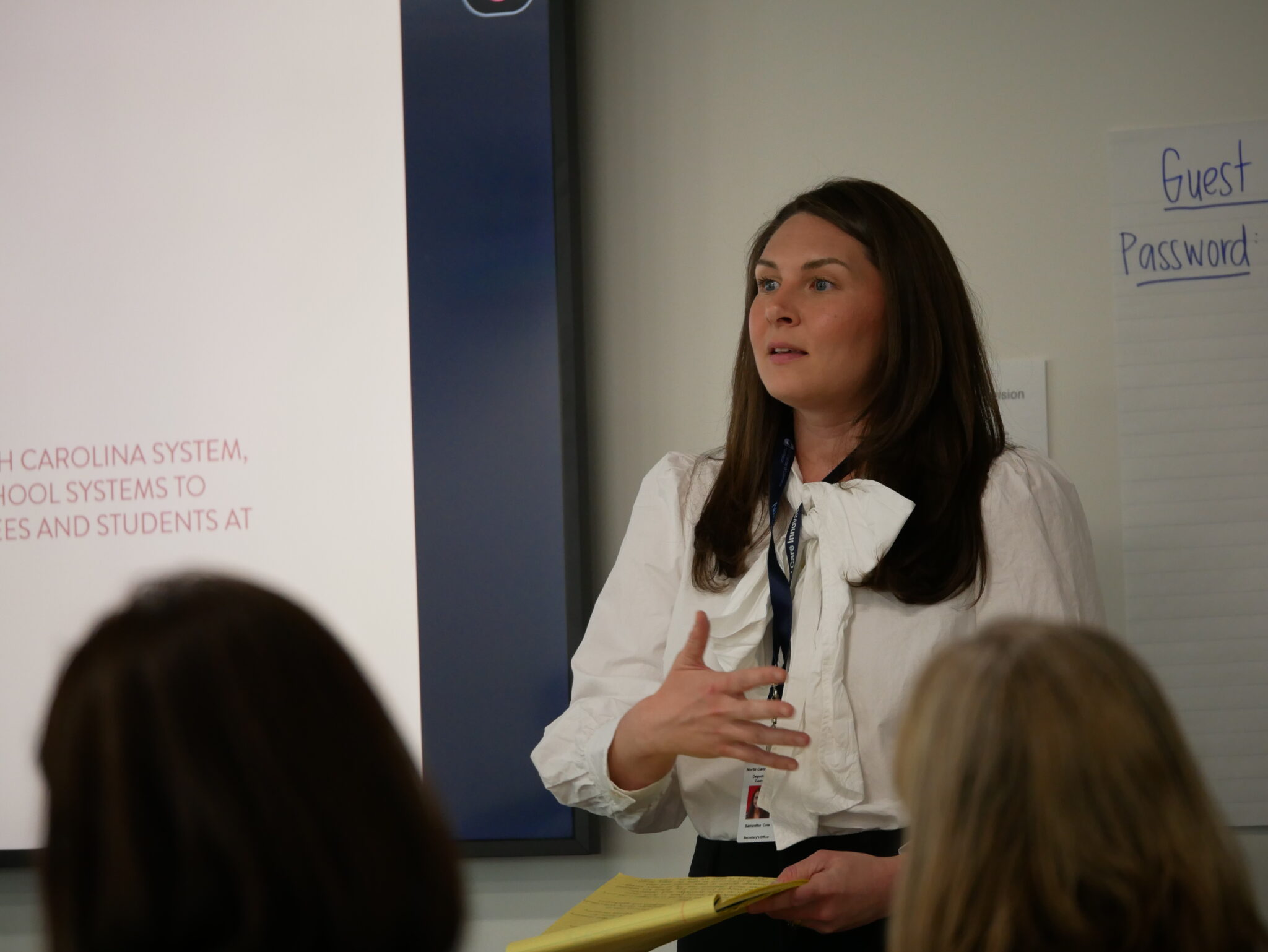
Samantha Cole, child care business liaison at the Department of Commerce, said a subgroup focusing on expanding child care access for public employees has looked at models across K-12, community college, and UNC-system schools to create child care solutions.
“We really see that there have been a lot of successes that have come about in these three examples and others, but they’re hyperlocalized,” Cole said. More external communication is needed for other campuses to understand how and why peer institutions are offering child care.
Madhu Vulimiri, senior advisor for health and families policy for Stein’s office, said the subgroup focused on workforce compensation and supports has been studying strategies to ensure early childhood teachers have access to non-salary benefits like health insurance.
They have studied the possibility of adding early childhood teachers as an eligible population for the State Health Plan, subsidizing ACA marketplace premiums through state dollars, and educating early childhood providers about the recently launched Carolina Health Works, which offers options for groups of small businesses.
The group is also studying how existing workforce supports like TEACH scholarships, child care academies, and apprenticeships could be more seamlessly tied together to strengthen the early childhood profession. They have requested that the Hunt Institute create a map to demonstrate what supports are available in what counties.
Samantha Cole, child care business liaison at the Department of Commerce, says some schools and colleges across the educational continuum have built models to provide child care specific to their local needs and resources. (Liz Bell/EdNC)
“That will help us see more holistically, where do we have resources and where are there gaps, and help us hopefully target future resources that we might have to expand those statewide,” Vulimiri said.
The third group, which is focused on financing, has been studying several states’ approaches to endowments and other funding mechanisms for child care, including Nebraska, Connecticut, Arizona, Montana, and Washington, D.C. They aim to develop a paper that weighs the options for North Carolina and analyses costs and benefits of each.
A judge ordered federal agencies Friday to end their “blanket policy of denying any future grants” to the University of California, Los Angeles, and further ruled that the Trump administration can’t seek payouts from any UC campus “in connection with any civil rights investigation” under Titles VI or IX of federal law.
The ruling also prohibits the Department of Justice and federal funding agencies from withholding funds, “or threatening to do so, to coerce the UC in violation of the First Amendment or Tenth Amendment.” In all, the order, if not overturned on appeal, stops the administration’s attempt to pressure UCLA to pay $1.2 billion and make multiple other concessions, including to stop enrolling “foreign students likely to engage in anti-Western, anti-American, or antisemitic disruptions or harassment” and stop “performing hormonal interventions and ‘transgender’ surgeries” on anyone under 18 at its medical school and affiliated hospitals.
The administration’s targeting of the UC system came to the fore on July 29. That’s when the DOJ said its months-long investigations across the system had so far concluded that UCLA violated the equal protection clause of the 14th Amendment and Title VI of the Civil Rights Act of 1964 in its response to alleged antisemitism at a spring 2024 pro-Palestinian protest encampment.
Federal agencies—including the National Institutes of Health, National Science Foundation and Department of Energy—quickly began freezing funding; UC estimated it lost $584 million. But UC researchers sued and, even before Friday’s ruling, U.S. District Court judge Rita F. Lin of the Northern District of California ordered the restoration of almost all of the frozen funding.
Friday’s ruling came in a case filed this fall by the American Association of University Professors, the affiliated American Federation of Teachers and other unions. Lin again was the judge.
“Defendants did not engage in the required notice and hearing processes under Title VI for cutting off funds for alleged discrimination,” she wrote.
“With every day that passes, UCLA continues to be denied the chance to win new grants, ratchetting [sic] up Defendants’ pressure campaign,” she wrote. “And numerous UC faculty and staff have submitted declarations describing how Defendants’ actions have already chilled speech throughout the UC system. They describe how they have stopped teaching or researching topics they are afraid are too ‘left’ or ‘woke,’ in order to avoid triggering further funding cancellations by Defendants. They also give examples of projects the UC has stopped due to fear of the same reprisals. These are classic, predictable First Amendment harms, and exactly what Defendants publicly said that they intended.”
When education leaders describe their institutions as being in “existential crisis” or on a “wartime footing,” you know that something important is happening.
A new report, “Securing educational excellence in higher education at a time of change,” from Wonkhe and Advance HE, based on roundtable discussions with 11 institutional leaders, 15 principal fellows of Advance HE, and three student representatives held in March 2025, explores institutional interpretation of and responses to change, and asks what measures should be taken to secure educational excellence for what could be quite a different future.
While institutions are understandably focused on managing their immediate pressures, with, in some cases, institutional survival at stake, sustainability means little without the long-term mission of inclusive, high-quality learning that prepares students for their future lives. While financial security would help, the changes higher education is navigating require a deeper consideration of how institutions make decisions, deploy expertise, and engage their communities.
The report maps four critical tensions that leaders are navigating across the political, economic, social and technological domains: public trust versus sector autonomy; public good versus private return on investment; traditional academic community versus new student models; pace of technological change versus institutional capacity. A fifth tension emerges from this complex environment: a need for distributed leadership that allows for a deep knowledge of the issues versus clear lines of accountability for decisions. These tensions play out daily in everything that higher education institutions do.
A wave of change
In the political dimension, higher education is implicated in broader losses of confidence in institutions. Though not technically public services, universities occupy a distinctive position in British civic life: historically connected to the state, still partly publicly funded, yet operating with considerable autonomy. That hybrid status leaves higher education uniquely vulnerable to simultaneous public and policymaker scrutiny.
Higher education institutions are not insulated from the broader political landscape. Student representatives in the research raised questions about institutional awareness: “Universities believe that students are exempt from the effects of public austerity…they believe we are creating a community of highly educated people, therefore they cannot fall for the tricks and stories that the media or certain political parties are trying to tell.”
The economic tension is similarly complex. Universities are expected to deliver public benefits without reliable public funding, creating what one participant called a “competing interest” space where higher education struggles for resources against health and compulsory education. Meanwhile, students increasingly question whether their investment yields genuine value. “Students are being taught how to meet learning objectives, but they’re not being taught how to transfer the skills that they get during their time at university, or sometimes it feels like they’re not even being taught the skills that they need just by meeting the learning objectives,” one student representative observed.
Principal fellows echoed some of this anxiety: “Students, particularly those from a widening participation background, can put generational money into getting an education which then doesn’t give them a job.” When the compact between investment and outcome seems to break down, trust may fracture, not just between students and institutions but also between society and the higher education project.
Socially, traditional higher education campus communities are under pressure, with students increasingly time-poor, working to afford their studies, and many commuting rather than living on campus. Participants observed that many students approach higher education more transactionally – not necessarily because they’re mercenary, but possibly because they’re exhausted. As one principal fellow observed, “student” seems to have shifted from being a core identity to something people do alongside other things.
Meanwhile, technology raises a host of strategic questions, not only in mustering the “right” response to generative AI but also in confronting how the pace of technological change reshapes the collective imaginary of how humans and machines interact in physical and digital spaces. This has implications for curriculum and pedagogy, equity and inclusion, and infrastructure and resources.
Staff communities appear to have fractured, too. Professional services are “somewhere else in the university,” quick informal conversations have disappeared, and academics feel “fed up and tired and exhausted.” One principal fellow described what they saw as a vicious cycle: “We do not have communities in our universities anymore, and that then impacts the students as well…we don’t have engagement from the students. But also we don’t have engagement from the academics, because they’re in a mood all the time.”
This fragmentation has strategic implications. When communities fragment, institutions may lose the collective capacity to sense problems, develop solutions, and sustain change. Everyone risks becoming reactive rather than proactive, protective rather than collaborative.
Change as a capability
Rather than seeking solutions or silver bullets, our conversations explored the institutional capabilities required to navigate these complex tensions and map out a sustainable way forward.
One key insight emerging was about the diversity and richness of knowledge and expertise held within institutions that may not be routinely accessed in efforts to think about the future. Small executive teams may struggle to retain a grip on every aspect of the changing landscape or simply become bogged down in maintaining the day-to-day flow of decisions that keep institutions running. Under this kind of pressure, it might not be surprising that, as one principal fellow put it, “Leaders often talk too much and listen too little.”
The report suggests leaders need to become curators of inclusive processes rather than authorities on every challenge. This would require the confidence to admit when situations are difficult and to seek help – a cultural shift that, if modelled from the top, could potentially reduce pressure on others to hide their struggles.
Student representatives echoed this sense that efforts to consult or engage, if not well conceived, can sometimes be more alienating than empowering. One student leader suggested involving students in shaping the collective understanding of problems from the beginning, at which their experience and knowledge are most likely to make a meaningful contribution, rather than asking student representatives to comment on pre-developed expert solutions. The same principle could apply to higher education staff and stakeholders.
There were also clear themes of the need for authenticity when professing an appetite for change and a pragmatic approach to resourcing it. Participants noted that institutions advertise for “innovators” and “change agents” but may not truly want them, or don’t adequately support them when they arrive. Change might require investment: stable contracts, professional development, and time for pedagogic innovation. “You can’t shift pedagogy if you don’t create time,” observed one principal fellow.
In the technological domain, where there may be a belief that the issues are fundamentally about resourcing and retaining technical expertise, part of the question has to be about how technology reshapes staff and student experience and sustains or fragments human connection. One principal fellow observed that higher education’s “killer service” might be personal connection, not consumer-grade content production in an attention economy. However, delivering that would require investing in people, not just platforms.
A question of purpose
Among education leaders, there was a real recognition that higher education staff are “the most precious resource,” as one put it. Yet the changing landscape for higher education seems to be broadening the range of possible purposes for higher education, along with the range of stakeholders who feel entitled to a view about what educational excellence looks like.
It is not hard to see how this changing dynamic can alienate academics working in disciplines who may perceive some of their core “knowledge stewardship” values and purposes as being under threat from political, economic, social, and technological changes in the external landscape driving different expectations of higher education.
With an unknowable future, the answer is less about seeking certainties to cling to as about finding collective ways to navigate uncertainty. That might open up some uncomfortable propositions: that higher education’s purpose itself may need rearticulating; that trade-offs between competing goods must be explicitly managed; that excellent pedagogy might require resource investment even when budgets are tight; and that sustainable change may emerge more from dialogue than from executive decision-making.
The full report repays careful reading, not just for its PEST analysis framework, which could help guide your own institutional conversations about change, but for the candour of participants grappling with genuine complexity. Higher education may face a “pivot point” – though the sector’s breadth, diversity, and expertise remain a considerable strength. Weathering the changes here right now and those on the horizon will depend to no small degree on institutional leadership capability to draw on that expertise to build a shared and collectively owned sense of educational excellence.
This HEPI guest blog was kindly authored by Emma Roberts, Head of Law at the University of Salford.
New figures from the Office for National Statistics (ONS) show that student suicide rates in England and Wales for the period 2016 to 2023 remain stable – but stability is no cause for complacency. The age-adjusted suicide rate among higher education students stands at 6.9 deaths per 100,000, compared with 10.2 per 100,000 for the general population of the same age group. Over the seven years of data collection, there were 1,163 student deaths by suicide – that is around 160 lives lost every year.
The rate being lower than the wider population is encouraging and may reflect the investment the sector has made in recent years. Universities have developed more visible wellbeing services, invested in staff training and created stronger cultures of awareness around mental health. The relative stability in the data can be seen as evidence that these interventions matter. But stability is not a resolution. Each student suicide is a preventable tragedy. The data should therefore be read not as reassurance, but as a call to sustain momentum and prepare for the challenges that lie ahead.
What the ONS data tells us
The figures highlight some familiar patterns. Male students remain at significantly higher risk than female students, accounting for nearly two-thirds of all suicides. Undergraduate students are at greater risk than postgraduate students, while students living at home have the lowest suicide rate. The data also shows that rates among White students are higher than for Black or Asian students, though the sample sizes are small, so these figures may be less reliable.
In terms of trend, the highest rate was recorded in the 2019 academic year (8.8 per 100,000). Since then, the rate has fallen back but remains stubbornly consistent, with 155 deaths recorded in the most recent year. The ONS notes that these figures are subject to revision due to coroner delays, meaning even the latest year may be under-reported.
The key point is that the problem is not worsening, but it is also not going away.
A changing student demographic
This year’s recruitment trends have introduced a new variable. Several high-tariff providers (universities with the highest entry requirements) have reduced entry requirements in order to secure numbers. This can open up opportunities for students who might otherwise not have had access to selective institutions. But it does raise important questions about preparedness.
Students admitted through lower tariffs may bring with them different kinds of needs and pressures: greater financial precarity, additional academic transition challenges, or less familiarity with the social and cultural capital that selective universities sometimes assume. These are all recognised risk factors for stress, isolation and, in some cases, mental ill-health. Universities with little prior experience of supporting this demographic may find their existing systems under strain.
Building on progress, not standing still
Much good work is already being done. Many universities have strengthened their partnerships with local National Health Service (NHS) trusts, introduced proactive wellbeing campaigns and embedded support more visibly in the student journey. We should recognise and celebrate this progress.
At the same time, the ONS data is a reminder that now is not the moment to stand still. Stability in the numbers reflects the effort made – but it should also prompt us to ask whether our systems are sufficiently flexible and resilient to meet new pressures. The answer, for some institutions, may well be yes. For others, particularly those adapting to new student demographics, there is a real risk of being caught unprepared.
What needs to happen next
There are several constructive steps the sector can take:
Stress-test provision: Assess whether wellbeing and safeguarding structures are designed to support the needs of the current, not historic, intake.
Broaden staff capacity: Ensure that all staff, not just specialists, have the awareness and training to spot early warning signs so that distress does not go unnoticed.
Strengthen partnerships: Align more closely with local NHS and community services to prevent students falling between two in-demand systems.
Share practice sector-wide: Collectively learn across the sector. Good practice must be disseminated, not siloed.
These are not dramatic or expensive interventions. They are achievable and pragmatic steps that can reduce risk while broader debates about legal and regulatory reform continue.
Conclusion
The ONS data shows that student suicide is not escalating. But the rate remains concerningly consistent at a level that represents an unacceptable loss of life each year. The progress universities have made should be acknowledged, but the danger of complacency is real. As recruitment patterns shift and new student demographics emerge, the sector must ensure that safeguarding and wellbeing systems are ready to adapt.
Every statistic represents a life lost. Stability must not become complacency – it should be a call to action, a chance to consolidate progress, anticipate new challenges and keep the prevention of every avoidable death at the heart of institutional priorities.
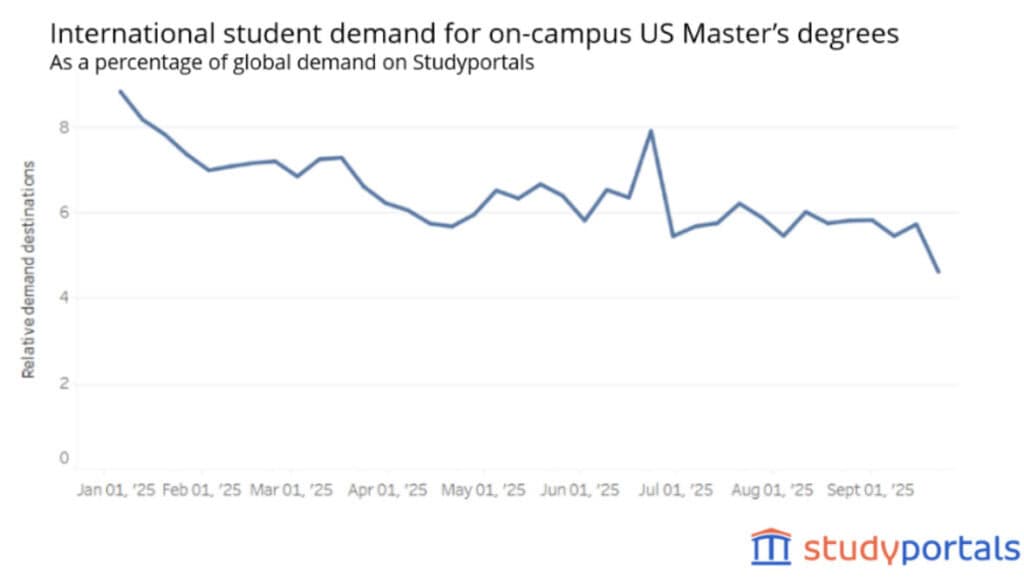
The data, collected from January 6 to September 28, aligns closely with the start of Donald Trump’s second presidential term and the ensuing uncertainty around student visas and post-graduation work opportunities. It is based on the search behaviour of over 50 million prospective students on Studyportals.
“Prospective international students and their families weigh not only academic reputation but also regulatory stability and post-graduation prospects,” said Studyportals CEO Edwin van Rest: “Right now, those factors are working against institutions.”
Studyportals said the steep decline – dropping more than 60% in less than nine months – corresponds to proposed and enacted policy changes impacting student visa duration, Optional Practical Training (OPT) and H-1B work authorisation in the US.
Last week, the Trump administration shocked businesses and prospective employees by hiking the H-1B visa fee to $100,000 – over 20 times what employers previously paid. Days later, the government announced proposals to overhaul the visa system in favour of higher-paid workers.
Sector leaders have warned that OPT could be the administration’s next target, after a senior US senator called on the homeland security secretary Kristi Noem to stop issuing work authorisations such as OPT to international students.
Such a move would have a detrimental impact on student interest in the US, with a recent NAFSA survey suggesting that losing OPT reduces enrolment likelihood from 67% to 48%.
Meanwhile, roughly half of current students planning to stay in the US after graduation would abandon those plans if H-1B visas prioritised higher wage earners, the survey indicated.
“Prospective students are making go/no-go enrolment decisions, while current students are making stay/leave retention decisions,” said van Rest.
“Policy changes ripple through both ends of the pipeline, reducing new inflow and pushing out existing talent already contributing to US research, innovation and competitiveness,” he added.
Data: Studyportals
The search data revealed a spike in interest at the beginning of July, primarily from Vietnam and Bangladesh, and to a lesser extent India and Pakistan. Experts have suggested the new Jardine-Fulbright Scholarship aimed at empowering future Vietnam leaders could have contributed to the rise.
Meanwhile, Iran, Nepal and India have seen the steepest drops in master’s demand, declining more than 60% this year to date compared to last.
While federal SEVIS data recorded a 0.8% rise in international student levels this semester, plummeting visa arrivals and anecdotal reports of fewer students on campus suggest the rise was in part due to OPT extensions – individuals who are counted in student totals but who are not enrolled on US campuses or paying tuition fees.
Beyond the immediate financial concerns of declining international enrolments for some schools, van Rest warned: “The policies we adopt today will echo for years in global talent flows.”
The UK and Ireland have gained the most relative market share of international interest on Studyportals – both up 16% compared to the same period in 2024. Australia, Austria, Sweden and Spain all experienced a 12% increase on the previous year.
In the US, international students make up over half of all students enrolled in STEM fields and 70% of all full-time graduate enrolments in AI-related disciplines, according to Institute of International Education (IIE) data.
The policies we adopt today will echo for years in global talent flows
Edwin van Rest, Studyportals
What’s more, universities with higher rates of international enrolment have been found to produce more domestic STEM graduates, likely due to greater investment in these disciplines, National Foundation for American Policy (NFAP) research has shown.
Last year, graduate students made up 45% of the overall international student cohort (including OPT), compared to undergraduate which comprised roughly 30%, according to IIE Open Doors data.
Universities with higher proportions of overseas students have been found to produce more domestic STEM graduates, likely due to greater investment in these disciplines, National Foundation for American Policy (NFAP) research has shown.
The news of plummeting international demand comes as domestic enrolments are declining, with less high school graduates entering college education and an overall demographic shrinking of university-age students.
In a recent survey by the American Council on Education (ACE), nearly three quarters of college leaders said they were concerned about enrolment levels this semester, with 65% moderately or extremely worried about immigration restrictions and visa revocations.
This audio is auto-generated. Please let us know if you have feedback.
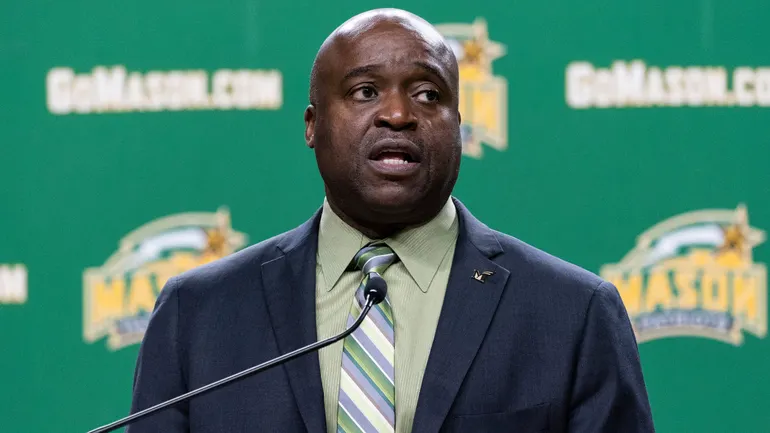
George Mason UniversityPresident Gregory Washington’s lawyer on Monday firmly repudiated the Trump administration’s allegations that thepublic Virginia institution had violated civil rights law.
Last week, the U.S. Department of Education’s Office for Civil Rights alleged that George Mason’s hiring and promotion practices violated Title VI, which bans federally funded institutions from discriminating based on race, color or national origin. An agency official singled out Washington as the leader of a “university-wide campaign to implement unlawful DEI policies that intentionally discriminate on the basis of race,” and the department demanded that he apologize.
In an 11-page letter to the college’s governing board sent on Washington’s behalf, his attorney Douglas Gansler called OCR’s allegations “a legal fiction,” and stressed that George Mason’sleadership has kept the university in compliance with federal law.“Far from needing to apologize, you all have a shared record to be proud of,” he wrote.
Since July, the Trump administration has opened at least four investigations into George Mason, targeting the large research institution over universitywide diversity initiatives, of which Washington has been a champion.
The Education Department’s findings came just six weeks after the agency opened the investigation, citing a complaint from “multiple professors at GMU” alleging that the university’s leaders had approved policies illegally giving certain underrepresented groups preferential treatment since 2020.
Gansler called out the brief length of the agency’s investigation and said OCR’s letter shows that federal officials “have not spent sufficient time finding critical and materials facts.”
“It is glaringly apparent that the OCR investigation process has been cut short, and ‘findings’ have been made in spite of a very incomplete fact-finding process, including only two interviews with university academic deans,” Gansler wrote.
The Education Department’s announcement last week focused much of its ire onWashington, alleging the university president’s prior statementswere proof of “support for racial preferencing.”
But some of the department’s evidence was out-of-context or “gross mischaracterizations of statements made by Dr. Washington”that didn’t lead to policy changes, Gansler wrote. And one contested policy would have predated Washington’s tenure, he argued.
In one example, the Education Department quoted a 2021 statement from Washington on adopting an inclusive hiring framework.
“If you have two candidates who are both ‘above the bar’ in terms of requirements for a position, but one adds to your diversity and the other does not, then why couldn’t that candidate be better, even if that candidate may not have better credentials than the other candidate?” Washington said at the time.
Gansler said the quote was pulled out of context and never resulted in a policy being enacted.
“His question was just that: a question, offered to provoke dialogue within the university community, as should be expected of a faculty member and academic leader of a university,” the attorney wrote. “The question does not suggest hiring minority candidates of lesser credentials, but rather considering how two equally qualified candidates may contribute differently to the campus.”
He added that Washington is not directly involved in evaluating candidates for faculty positions and that OCR would be unable to cite “any discriminatory hiring decision made based on it.”
It is glaringly apparent that the OCR investigation process has been cut short, and “findings” have been made in spite of a very incomplete fact-finding process.
Douglas Gansler
Attorney for George Mason University President Gregory Washington
The Education Department gave George Mason 10 days to voluntarily agree to a proposalit said would resolve the alleged violations. Part of that proposal would require Washington to publicly apologize to the university community “for promoting unlawful discriminatory practices in hiring, promotion, and tenure processes.”
In response, Gansler advised George Mason’s trustees against agreeing to the Education Department’s demand for an apology.
“If the Board entertains OCR’s demand that Dr. Washington personally apologize for promoting unlawful discriminatory practices in hiring, promotion, and tenure processes, it will undermine GMU’s record of compliance,” Gansler wrote. “An apology will amount to an admission that the university did something unlawful, opening GMU and the Board up to legal liability for conduct that did not occur under the Board’s watch.”
And while the proposed apology may help resolve the Education Department’s inquiry, it would not prevent other federal agencies from using that statement to penalize the university, the lawyer added.
Mike Fragoso, a lawyer representing the board, did not immediately respond to a request for comment Tuesday.
“Our sole focus is our fiduciary duty to serve the best interests of the University and the people of the Commonwealth of Virginia,” the board said in a Friday statement.
Publicly, George Mason’s board has said little as the Trump administration announced the litany of its investigations into the university. The response prompted George Mason’s chapter of the American Association of University Professors to approve a no-confidence resolution against the board last month and called on it to defend Washington.
There will be a short-pause in HEPI blogs as we undertake some work on the website. We look forward to delivering blogs to your inbox again later next week.
This HEPI blog was kindly authored by Justin Woods, Director UK of ApplyBoard
As the UK sector anticipates new policy requirements and tighter scrutiny around post-study pathways, aligning programme offerings with student demand has never been more important. Yet, international students bring a wide range of goals and preferences to their study decisions. How can institutions support under-enrolled programmes while continuing to attract high-quality applicants?
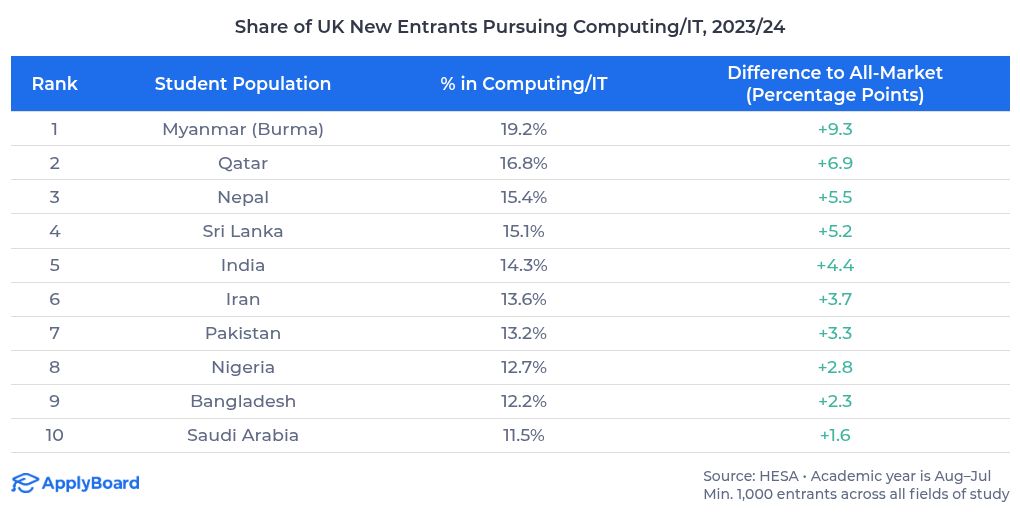
Entrant data from the 2023/24 academic year points to some clear shifts, including a higher proportion of international students enrolling in computing/IT and health and medicine.Examining these enrolment patterns by source market and field can help institutions stay aligned with evolving demand.
Computing and Health Made Up a Larger Share of Entrants to the UK in 2023/24
International student demand in the UK evolves in small but meaningful ways. In 2023/24, more students chose to begin their studies in computing/IT and health and medicine, fields that offer clear links to employment and future skill needs.
The overall field of study mix among international students in the UK has remained fairly stable since the pandemic, but subtle shifts are beginning to take shape. The share of entrants in computing/IT was up three percentage points in 2023/24 compared to 2019/20. While modest, this represents a change of several thousand more students choosing this field of study. Health and medicine also remained strong in 2023/24, accounting for more than 11% of new starters.
UCAS data for the June 30, 2025 deadline shows that 4,700 international undergraduate students applied for a nursing programme, 19% higher than the 2024 deadline.
Which Student Populations are Driving Demand in Computing/IT and Health and Medicine?
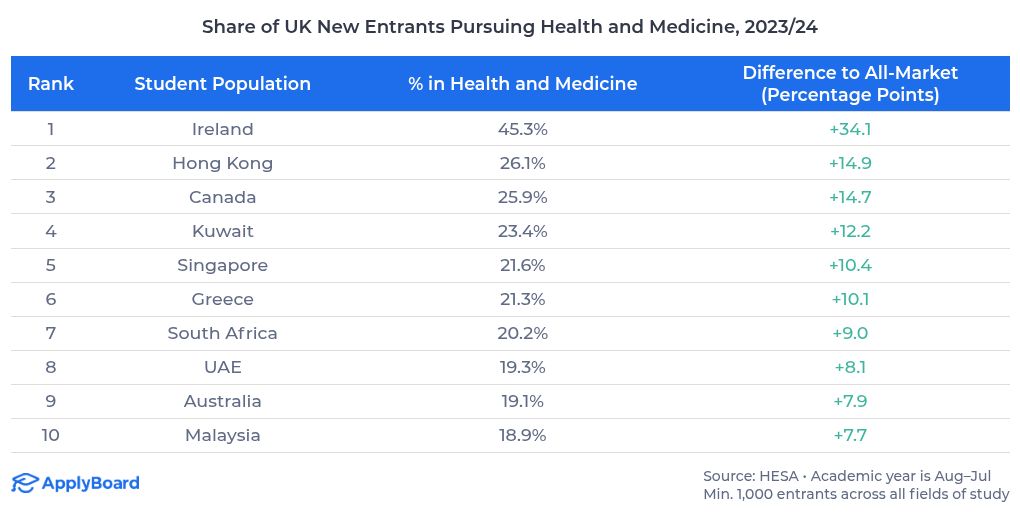
While computing/IT and health and medicine made up 10% and 11% of all international entrants in 2023/24, several student populations pursued these fields at significantly higher rates:
Computing/IT is a top study priority for several key student populations. Nearly one-in-five international students from Myanmar entering the UK in 2023/24 pursued a computing/IT field, more than double the all-market average. Other student populations with notably high engagement in this field of study include those from Qatar, Nepal, Sri Lanka, and India, all of which had 14% or more of their new UK entrants choose computing/IT. All told, these trends show a broad pattern of interest among students across South Asia, the Middle East, and Africa.
Some emerging markets (between 500 and 1,000 entrants in 2023/24) with a high proportion of students entering computing/ITinclude Algeria (23%), Uzbekistan (15%), Morocco (14%), and Bahrain (12%).
Health and medicine shows a comparable trend, with a different mix of student populations driving above-average interest:
Health and medicinedraws above-average interest from a globally distributed set of student markets. Students from Ireland, Hong Kong, and Canada were especially likely to enter health and medicine programmes in 2023/24, with one in four entrants from each market choosing this field. Other high-interest markets span the Middle East, Southeast Asia, and Southern Europe, underscoring a wide geographic appeal of health-related fields.
Some emerging markets (between 500 and 1,000 entrants in 2023/24) with a high proportion of students entering health and medicineinclude the Philippines (38%), Zimbabwe (30%), Jordan (19%), and Belgium (19%).
What Fields of Study do the UK’s Largest International Student Populations Pursue?
Field of study preferences don’t just vary by market. They also take on different significance when viewed through the lens of student volume. Looking at the UK’s largest international student populations helps reveal which programmes are driving demand at scale.
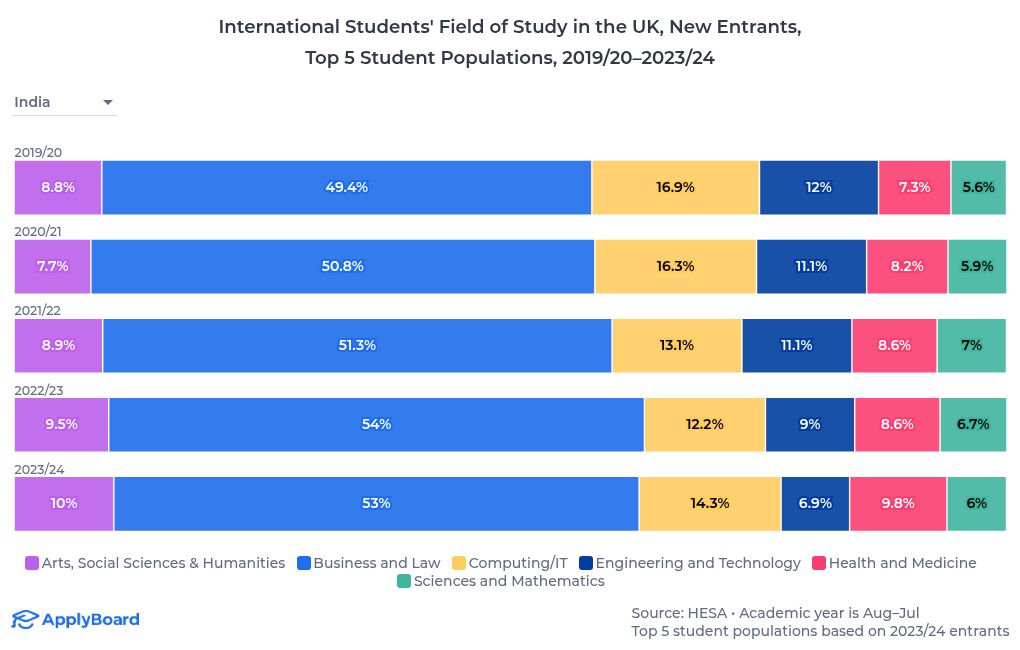
Business and law continues to dominate among high-volume source markets, particularly in South Asia. In 2023/24, over half of new students from India and Pakistan entered this field. For China, on the other hand, business and law enrolment has declined steadily. Instead, arts, social sciences, and humanities has become the top choice among students from China, accounting for nearly 38% of entrants in 2023/24.
Engineering and technology, once popular across multiple markets, has seen a notable decline. The field accounted for 12% of international entrants from India in 2019/20 but just 7% in 2023/24. A similar drop occurred among Pakistani students. However, with the UK launching a £54 million recruitment strategy to attract global research talent from the US in June, we expect this field to see somewhat of a rebound over the next couple of years.
Even ashealth and medicine has received increased attention across the UK sector, its performance among the largest student populations remains steady. Indeed, Nigeria and the US remain strong contributors, with 15% of new students entering this field. As institutions prepare for further sectoral reforms and anticipate post-White Paper adjustments, maintaining a steady corridor into healthcare-aligned programmes and post-graduate opportunities could prove especially important in safeguarding both student outcomes and national workforce goals.
Aligning Your Institution With What’s Next
Programme-level shifts in international demand rarely happen all at once, but they matter more than ever in today’s climate of policy change and increasing scrutiny. Institutions that respond early to evolving student priorities will be better positioned to sustain enrolment, diversify their cohorts, and meet labour-aligned goals.
Despite federal attitudes and policies toward international students, demand to study in the U.S. remains high.
Photo illustration by Justin Morrison/Inside Higher Ed | Getty Images
Advocates for international students are raising alarms that federal actions are limiting foreign-born learners’ ability to study in the U.S. But researchers say the trend isn’t an indication of international student interest or demand to study in the U.S.
A late July survey of 300 foreign-born students found 91 percent plan to study in the U.S., despite funding cuts and internal instability in the U.S. The reputation of U.S. institutions also has yet to take a hit, with 99 percent of respondents indicating they still trust the academic quality of U.S. institutions.
That’s not to say students are unaware of or undeterred by changes at the federal level. Fifty-five percent of survey respondents indicated some level of concern about pursuing their degree in the U.S., and 50 percent said they’re less excited about the opportunity now than they were previously. The top reason their sentiment has changed is international tensions or politics (54 percent), followed by worries about political instability in the U.S. (45 percent).
Brian Meagher, vice president at Shorelight, a higher education consulting group focused on international students, said at an Aug. 12 media roundtable that even students caught in the visa backlog haven’t shifted their gaze to other countries yet. Instead, they are deferring to the spring semester. May data from the U.S. Department of State shows 19,000 fewer students received a F-1 or J-1 visa that month compared to May 2024, which experts say is the first sign that a fraction of expected students will be coming to campus this fall.
“Most of them want [to study in] the U.S.—they’re not changing their minds to the U.K. or Canada or Australia,” Meagher said. “We do think there will be a longer-term impact on switching to other country destinations as a result of this.”
Others are taking classes online at their host institution or enrolling in a satellite campus elsewhere in the world for their first term, but those are less popular options, Meagher said.
“In talking with prospective students, I’d say the belief is that this is a temporary changeover at an unfortunate time that may result in missing a fall semester,” Shorelight CEO Tom Dretler said during the roundtable.
Long-Term Challenges Expected
While international students see the changes as a short-term setback, some market predictions forecast significant changes to U.S. higher education enrollment and revenue. At least the lack of visas could impact future applications to U.S. colleges, Dretler said.
Research by Holon IQ, a global intelligence agency, points to the U.S. as a top destination country for international students for decades, but since 2016—roughly the start of the first Trump administration—the country lost 10 percentage points of its share of international students.
Starting in 2016, “the U.S. became perceived by some as less welcoming or safe, did not recruit international students as energetically, and denied a substantial fraction of student visa applications, while governments and university sectors in the other countries acted in concert to grow international student numbers,” according to an August report from Holon IQ.
Modeling by Holon IQ finds that a variety of actions by the federal government, including visa policy changes, a crackdown on universities and new tariffs could create barriers to students in the U.S. as well as a climate of uncertainty for prospective students.
The agency predicts the most likely trajectory is there will be a short-term decline in U.S. international enrollment, with 1.12 million students in 2030, unchanged from 2023 levels. But possible scenarios range from an increase in students of 8.3 percent to a drop of 7.9 percent by 2030.
“I think what’s happening in the U.S. is a point in time as to whether the U.S. will continue to lead and for how long it will continue to remain the global leader for international student mobility and a desired study destination,” said Patrick Brothers, co-CEO of Holon IQ Global Impact Intelligence, during the media roundtable.
Paying the Price
Experts warn that a lack of students on campus could mean billions in lost tuition revenue for years to come.
NAFSA, the association of international educators, reported if the number of new international student enrollment declined between 30 and 40 percent, it would result in a 15 percent drop in overall international enrollment and result in a loss of $7 billion in revenue.
June data from Shorelight found even a 20 percent decline would result in a $1.7 billion annual loss in tuition revenue, or $5 billion over four years.
“We think it’s going to be something that is negative for the U.S. economy, negative from a jobs perspective and also very hurtful to colleges and universities, but not always the one that people think,” Dretler said. Top universities will be able to weather the financial hit, pulling students off their waiting lists, but regional and community colleges will experience greater losses, which could increase tuition rates for middle-class families.
States with high international student enrollment would be hit hardest by the changes. Among the top states for international students—California, New York and Texas—Shorelight anticipates a total loss of $566.6 million and NAFSA projects a loss of $2.39 billion, based on their respective data models.