Tag: demand

  • Cut Degrees in Low Demand

    Cut Degrees in Low Demand

    In the past, lawmakers have pressured colleges and universities to cut the number of degrees they offer through measures such as publicly criticizing institutions or simply slashing funding and letting institutions figure out where to cut.

    But at least three Republican-dominated states—Indiana, Ohio and Utah—passed specific laws this year that push institutions to eliminate degree programs that graduate few students. In a similar vein, Texas passed a law going after academic minors and certificate programs with low enrollments. It worries faculty and scholarly groups, who stress that the number of majors in a program isn’t the only or best way to gauge its worth.

    “Campuses are forced to respond to legislative mandates that have arisen from a narrow understanding of what higher education is,” said Paula Krebs, executive director of the Modern Language Association. Students who pursue public higher education will be “getting a reduced version of what a degree should be,” she said.

    Robert Kelchen, a professor of higher education at the University of Tennessee at Knoxville, said the move reflects the broader trend of “legislatures getting more involved in academic affairs issues that have historically been either done through shared governance or done through institutional leadership.”

    “It’s just another sign that the era of ‘trust the universities, they’re doing the right thing’ has long since passed,” Kelchen said.

    And Tom Harnisch, vice president for government relations at the State Higher Education Executive Officers Association (SHEEO), said these laws are “driven in part by the need to direct scarce resources to higher-demand programs in order to meet state workforce needs.” He said some humanities programs may be targeted for political reasons, but the laws are also the latest evolution of a long-standing discussion in higher ed over what programs to offer.

    “It’s a very difficult conversation to have, but what we’ve seen over this legislative session is that the state legislators have been more aggressive in trying to shape this conversation,” Harnisch said. “More states have been involved in the inner workings of academia—more so than any time in recent memory.”

    Minimum Requirements

    Ohio’s sprawling new public higher education overhaul law, Senate Bill 1, mandates a lot—from requiring institutions to post undergraduate course syllabi online to banning diversity, equity and inclusion offices. But amid its pages detailing requirements for faculty evaluations, post-tenure review and more lies a short section that could have an even bigger impact on faculty jobs and which degrees students can pursue.

    “A state institution of higher education shall eliminate any undergraduate degree program it offers if the institution confers an average of fewer than five degrees in that program annually over any three-year period,” the law says.

    Colleges and universities can appeal to Ohio’s higher education chancellor to save these programs, but even if the chancellor—appointed by the Republican governor—grants a waiver, he gets to set the terms under which the program “may conditionally continue.” Well before SB 1 took effect last month, the University of Toledo announced in April that, in order to comply, it will stop offering bachelor’s degrees in Africana, Asian, Middle East, religious, disability and women’s and gender studies, as well as degrees in Spanish, philosophy and data analytics.

    A month after Ohio’s General Assembly passed SB 1 in March, Indiana’s Legislature passed a state budget bill filled with higher ed provisions—including one similar to its Midwest neighbor’s. The Indiana law sets minimum thresholds for different degree programs to avoid termination. Associate programs must graduate an average of at least 10 students annually over three years, while the threshold is 15 students for bachelor’s degree programs, seven for master’s degree programs and three each for education specialist programs and doctorate programs.

    While the law, House Bill 1001, says institutions can ask the Indiana Commission for Higher Education for exceptions, that agency said universities already plan to eliminate or consolidate more than 400 programs—roughly one-fifth of their degree offerings statewide. The list of programs being cut at various institutions includes multiple K–12 teacher training programs, foreign languages and Africana, religious and women’s and gender studies degrees, as well as economics, math and electrical, mechanical and computer engineering.

    Utah took a more complex, but still blunt, approach. In March, its GOP-controlled Legislature passed House Bill 265, which cut 10 percent of public institutions’ state-funded instructional budgets—$60 million in total. But the law said colleges and universities could win the money back for “strategic reinvestment” in programs based on their enrollment, completion rates and “localized and statewide workforce demands,” among a few other factors.

    Last month, the flagship University of Utah, which says it’s shouldering more than a third of the initial $20 million in statewide cuts, announced it’s planning to cut 94 programs across 10 colleges and schools. According to a slideshow posted by the university, the losses will include master’s degrees in Middle East studies, educational psychology, modern dance, audiology, marketing, neurobiology and bioengineering.

    To earn back money from the Legislature, the university says it will reinvest in the “high impact” and “workforce-aligned” areas of biotechnology, engineering, “responsible AI,” behavioral health, nursing and simulation, and “civic engagement”—which the presentation described as including “new initiatives focused on American federalism and civic responsibility, and another on civic discussion and debate.”

    Utah Valley University, which offers traditional community college programs along with higher-level degrees, said in its presentation that it’s cutting a bachelor’s in aerospace technology management and an associate degree in cabinetry and architectural woodwork, among other offerings. At the same time, it’s reinvesting in an “applied AI institute,” engineering, chemistry, health, accounting, construction management, written communication and more.

    In Texas, the Legislature has passed the least direct of the laws targeting programs. Senate Bill 37 doesn’t demand that institutions make cuts to traditional majors, but it requires that they review minors and certificate offerings every five years “to identify programs with low enrollment that may require consolidation or elimination.”

    Weeding Out

    Mark Criley, a senior program officer in the Department of Academic Freedom, Tenure and Governance at the American Association of University Professors, said the laws are “part of a growing trend among state legislatures to insert themselves in university governance in ways that go beyond their expertise.”

    Criley compared these laws—which push program cuts without requiring faculty input on what should be cut—to someone walking into a garden and saying they’re going to pull up every plant under a certain height. He said some of those shorter plants may be important to the health of the whole garden, or “about to bloom into something fantastic.”

    “Without the opportunity for faculty involvement, what you’re doing then is, essentially, you’re pulling up all those plants while the gardener’s away,” Criley said. This “blunt instrument we’re talking about here isn’t a way of responsibly ensuring that universities serve their mission to the state.”

    But Ohio senator Jerry Cirino, who filed SB 1 and now chairs the state’s Senate Finance Committee, told Inside Higher Ed that circumventing shared governance and faculty unions is part of the law’s point. Shared governance slows changes, he said, and Ohio faculty unions are so committed to protecting their members that they rarely cooperate with institutions trying to cut classes or programs that aren’t graduating enough students in order to justify employing faculty—often tenured faculty.

    “How could the faculty be objective when it comes to making decisions that reduce faculty?” Cirino said, adding that more “business principles” should be practiced in universities.

    “It’s supply and demand,” he said. “All we’re asking is for our institutions to practice what they teach in their business schools.”

    But others criticized using simple metrics such as enrollment and number of graduates to decide which programs should be on the chopping block. Ohio and Indiana’s laws are based on average graduate numbers, while the Texas and Utah laws require institutions to look at enrollment.

    “If the major is the coin of the realm, then languages are an easy target,” said Krebs, the Modern Language Association executive director.

    Kelchen, the UT Knoxville professor of higher education, said that from a financial standpoint, what really matters is whether classes are full. A program with few majors could still attract students who are earning a minor or taking the classes for other reasons, such as to satisfy general education requirements.

    Kelchen and Krebs both pointed out that universities in other states have cut programs even without legislative mandates; they noted West Virginia University, where the administration and Board of Governors ordered degree programs slashed in 2023.

    “I think we can trace it back to West Virginia University and before, where it wasn’t a legislative mandate,” Krebs said of cuts to foreign language and other humanities programs.

    Harnisch, of SHEEO, suggested it goes back even further, noting “deep program cuts” amid the Great Recession of 2008. Over the past decade, he said, states have tried to keep college affordable, and a growing economy and COVID-19–related aid packages helped.

    But now, Harnisch said, multiple financial pressures are leading to “sharper program cuts and tuition increases.” After all, Indiana universities volunteered to eliminate 19 percent of degree offerings without requesting exemptions from the state, according to the Indiana Commission for Higher Education.

    “I only see this trend increasing in the years ahead,” he said.

    Source link

  • Branch campuses and the mirage of demand

    Branch campuses and the mirage of demand

    by Kyuseok Kim

    As US universities confront declining domestic enrolments, political instability, and intensified scrutiny over their financial and ideological foundations, a growing number are once again looking outward. International branch campuses (IBCs), once celebrated as symbols of academic globalism and later scrutinized as costly misadventures, seem to be returning to the strategic conversation, not only as diversification mechanisms but also as protective pivots in an era of unpredictability.

    Georgetown University’s decision to extend its Qatar campus for another decade and the Illinois Institute of Technology’s plan to launch a new campus in Mumbai are recent examples. Behind such moves lies a quiet but growing calculus: that global presence may serve as both brand amplifier and institutional hedge, especially in the face of resurging nationalism, culture wars, and regulatory constraints at home.

    South Korea’s Incheon Global Campus (IGC), a government-backed transnational education hub, is now preparing to welcome two additional foreign universities and one of them is American. But as the IGC experiment has already entered its second decade, its mixed results offer not a template but a cautionary tale. For any U.S. institution considering overseas expansion, IGC reminds us that expectations of seamless demand, regional magnetism, and reputational uplift often collide with complex realities.

    The pitfall of assuming “If you build it, they will come”

    At the heart of many US institutions’ international ventures lies a persistent assumption: that placing an American university within geographic proximity to large student markets will organically generate demand. IGC was envisioned as a Northeast Asian education magnet, ideally situated to recruit from China, Vietnam, Indonesia, and beyond. The notion was that Korea’s infrastructure, safety, and proximity, combined with US academic credentials, would make IGC highly attractive.

    But the numbers tell a different story. As of 2024, IGC’s five institutions, SUNY Korea (Home of Stony Brook University, Fashion Institute of Technology), George Mason University Korea (GMUK), University of Utah Asia Campus (UAC), Ghent University Global Campus (GUGC), enrol about 4,300 students, far short of the original 10,000 target. Among them, only 400 are international students, accounting for 9%. And of those, just around 20 are from China, the very country that was expected to be a key source of enrolments.

    This dearth is not for lack of infrastructure or academic rigor. Rather, it illustrates the limitations of relying on passive geographic logic. In an age where students and parents are increasingly sophisticated consumers of education, recruitment requires far more than proximity or even prestige. It demands clarity of value, strong brand presence, affordability, cultural alignment, and a persuasive post-graduation pathway.

    English-medium instruction as a double-edged sword

    US institutions often assume that English-medium instruction (EMI) automatically confers competitive advantage in Asia. At IGC, all programs are delivered entirely in English, and faculty are predominantly international; 188 of the 304 faculty members across the five campuses are foreign nationals. On paper, this aligns with global academic norms and affirms a commitment to international standards.

    However, EMI can paradoxically limit access. While affluent Korean students may see EMI as an elite advantage, students from Vietnam, China, and Indonesia often seek local cultural immersion, language acquisition, and regional relevance. For many Chinese students in particular, one of the draws of studying in Korea is precisely to learn Korean and gain access to Korean labour markets. EMI-only models thus alienate both local integration seekers and English-language learners.

    Moreover, when EMI is not paired with robust academic support services, such as English-language tutoring, multilingual advising, or transitional curriculum tracks, it can undermine retention and student success. IGC’s high leave-of-absence rate (26% of total enrolment) may in part reflect this challenge. The EMI strategy, while noble in intent, must therefore be contextualised. In transnational campuses, language policy is not just a delivery decision, it is a recruitment strategy.

    Misplaced confidence in institutional brand recognition

    American universities often overestimate their brand power abroad. SUNY Korea, anchored by Stony Brook University, and GMUK both represent reputable public institutions in the US academic ecosystem. Yet in East Asia, brand equity does not always travel well. Many students and parents in China, Southeast Asia, and even Korea struggle to distinguish among US institutions unless they are among the globally top-ranked or highly visible.

    In contrast, joint-venture universities such as NYU Shanghai or Duke Kunshan benefit from stronger recognition, thanks in part to the halo effect of globally prestigious parent institutions and active marketing within China. These institutions also benefit from location-based credibility; being within China, their offerings align more naturally with Chinese career and immigration aspirations.

    Geopolitical frictions and the fragility of demand

    US institutions frequently see international branch campuses as safe havens from domestic politics. Yet international expansion brings its own geopolitical risks. IGC’s failure to attract Chinese students cannot be separated from the lingering effects of the 2017 THAAD (Terminal High Altitude Area Defense) dispute – a regional conflict that emerged when South Korea agreed to deploy a US missile defense system on its soil. China strongly opposed it, viewing the system as a threat to its own strategic interests. In response, China imposed strong sanctions on South Korea, which led to the challenges in  educational diplomacy between two countries. Nor can it be divorced from the broader geopolitics of US-China relations, which makes Chinese families wary of American degrees, especially those delivered from politically allied countries like Korea.

    There is also the perception gap between a degree “from a U.S. university” and a degree “earned in Korea.” Even when academic standards and credentials are identical, students and employers may view transnational degrees as second-tier or less prestigious. For example, in Korea, IGC campuses are often viewed as a second choice in the stratified higher education structure locally. The reputational buffer that a US degree once offered is increasingly interrogated, especially in environments where political affiliations, social conditions, and post-graduation options matter more than branding. In this sense, branch campuses are not outside the storm; they are situated in a different part of it.

    A US-oriented reality check within the local contexts

    For US universities, the decision to open a branch campus abroad is no longer a question of academic vision alone; it is a financial and reputational calculation. The domestic context is sobering: declining birth rates are shrinking the college-aged population, public trust in higher education is waning, and federal support for research and student aid is increasingly politicised. Internationalisation is no longer just an opportunity; it is increasingly seen as a survival strategy.

    But survival strategies must be strategic, not reactionary. IGC’s challenges illustrate what happens when institutions pursue global expansion without first understanding the local education marketplace. Without granular market research, locally embedded partnerships, and nuanced branding strategies, even well-intentioned ventures become “white elephants”, costly and underutilized. A forthcoming US institution entering IGC would have an opportunity to learn from these lessons and chart a different path. But it must begin with humility and cross-cultural understanding.

    This concern is heightened by structural reforms driven by demographic decline and the growing uncertainly embedded in Korea’s higher education system. As competition for enrolment intensifies, some struggling institutions see IGC’s local recruitment as a threat, even calling it a “brain drain within Korean territory,” since most IGC students are Korean. While IGC claims it draws students who would have studied abroad, offering a net economic benefit, that argument may fall flat for universities fighting to stay afloat.

    Conclusion: toward a more grounded globalism

    The story of Incheon Global Campus is not one of failure, but rather a valuable case study. It reflects a potential disconnection between institutional ambition and market behaviour; between the idea of internationalisation and its on-the-ground execution. It reminds us of that proximity to students is not the same as access, and that transnational education requires more than exporting curricula across borders, it demands building relevance across cultures.

    For US universities hoping to extend their reach, the time for romantic notions of global campuses has passed. What is needed now is realism. That means conducting rigorous market analysis. It means understanding the competitive landscape; not just in Seoul or Shanghai, but in second-tier cities where price sensitivity and post-graduation pathways determine enrolment decisions. It means creating flexible programs that can respond to local aspirations and global uncertainties. It means designing campuses that feel anchored, not transplanted.

    The myth that a US branch campus in South Korea will become a magnet for students across Asia, particularly from China, has not materialised. With only a handful of Chinese students across IGC’s entire enrolment, it is clear that assumptions must be rethought. Transnational education remains a worthy goal. But if the next generation of branch campuses is to thrive, especially in East Asia, it must be forged not in the image of prestige, but in the crucible of strategy. It must be attentive, adaptive, and above all, aware.

    Kyuseok Kim (KS) is the inaugural Center Director of IES Abroad Seoul, where he leads strategic, academic, and operational initiatives while building partnerships with local institutions. He brings extensive experience in student recruitment, international relations, and business development, with prior roles at UWAY, M Square Media, SUNY Korea, and Sungkyunkwan University. KS is a Fulbright Scholar and a doctoral candidate in Educational Administration and Higher Education at Korea University. He holds an MBA from Sungkyunkwan University and a BA in English Language Education from Korea University. As a scholar-practitioner, he contributes regularly to both international and South Korean publications on global education topics. [email protected]  www.linkedin.com/in/ks-kim-intled

    Author: SRHE News Blog

    An international learned society, concerned with supporting research and researchers into Higher Education

    Source link

  • Second Straight Quarter of Stabilised International Student Demand for a UK Study Visa

    Second Straight Quarter of Stabilised International Student Demand for a UK Study Visa

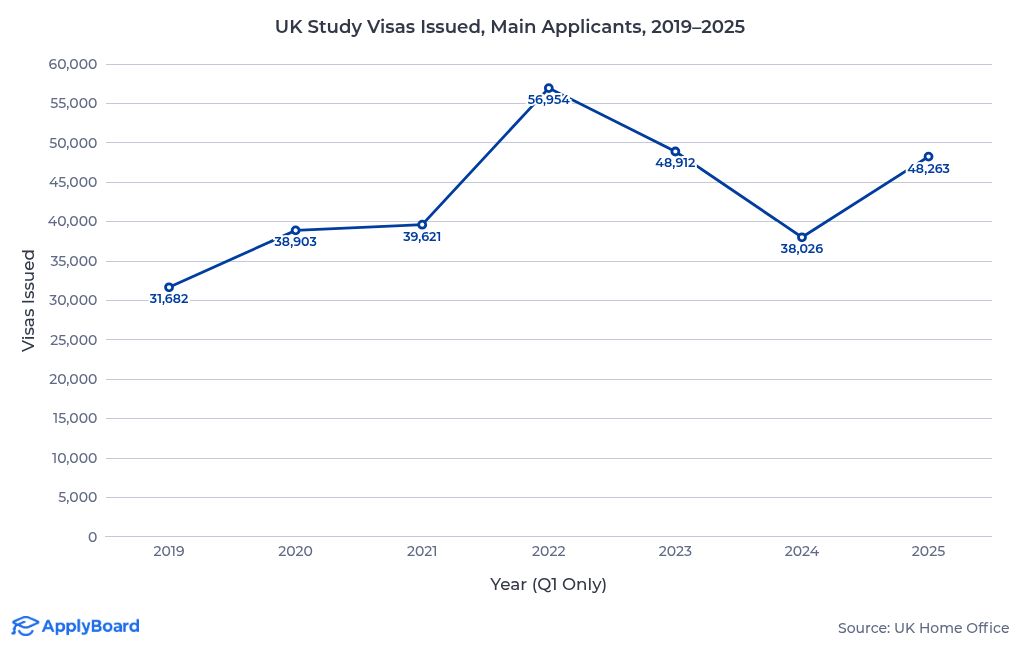
    The latest UK study visa application data, released in late May, shows that demand from main applicants recovered in calendar Q1 2025 (January through March). Applications from this cohort increased by 32% over Q1 2024 levels.[1] This is an encouraging signal of sector recovery, as applications in Q4 2024 were up 9% over Q4 2023, suggesting renewed student confidence in the UK as a study destination.

    UK Study Visa Applications and Issuances Up For Main Applicants in Q1 2025

    Nearly 47,000 main applicants submitted a UK study visa application in Q1 2025. This represents a 32% increase over Q1 2024:

    These gains build on the year-on-year growth seen in Q4 2024, suggesting that the UK international education sector is experiencing a broader rebound and stabilisation, rather than a one-off peak in Q4.

    Still, Q1 has historically made up just 8% to 10% of total annual applications from main applicants. With the bulk of applications and issuances typically occurring in Q3, the sector still has work to do to sustain renewed student confidence. Attention is especially important around addressing concerns and dispelling misconceptions stemming from the 2025 Immigration White Paper—a topic we will explore further below.

    As with applications, main applicant student visa issuances likewise rose in Q1 2025:

    chart visualization

    Over 48,000 international students were issued a study visa in Q1 2025, representing a growth of 27% over Q1 2024. The issuance rate in both of these quarters was 88%, meaning the increased number of issued visas reflects stronger demand rather than changes in approval rates.

    That said, tuition fees, visa charges, and the NHS surcharge have all risen in recent years, driving up the overall cost of studying in the UK. The White Paper’s proposed 6% levy on international tuition fee income risks adding to that burden, especially as institutions may need to pass the new financial pressures onto students. 83.5% of respondents in a recent survey cited cost of study as a top priority when choosing a destination, highlighting the potential impact of additional cost pressures. The Government’s own analysis projects an immediate drop of 14,000 international students, with a sustained decline of around half that figure over time.

    Also, due to the raised Basic Compliance Assessment (BCA) thresholds proposed in the 2025 White Paper, institutions will likely need to enhance their vetting processes moving forward before issuing confirmation of acceptance of studies. Likewise, institutions may look to diversify within lower-risk countries to minimise exposure to visa refusals.

    Where Did Demand Stabilise in Q1 2025?

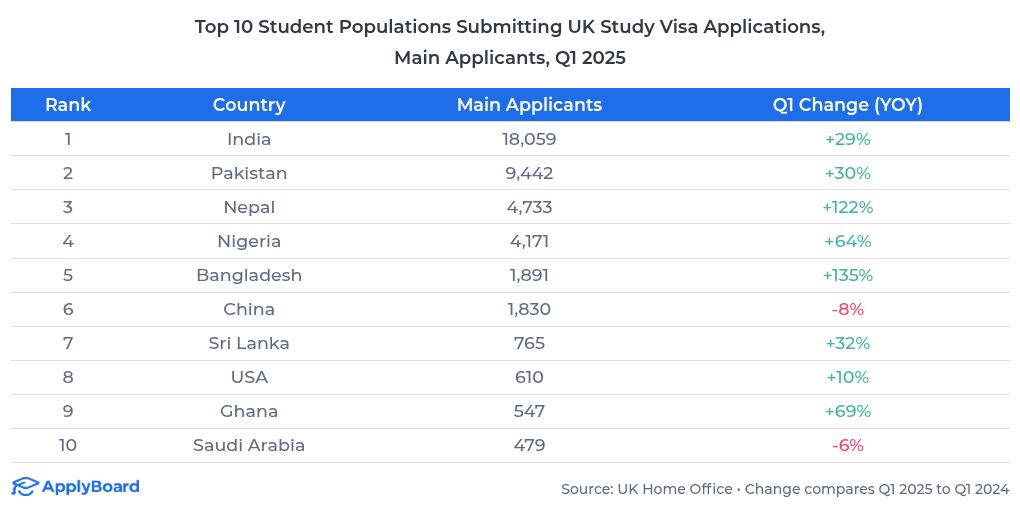
    A closer look at what made Q1 2025 a strong quarter reveals that the uptick in study visa applications was not limited to a handful of markets. Instead, demand recovered across a broad range of source countries. Of the 22 countries with 100 or more main applicants, 14 saw year-on-year growth—an encouraging sign that renewed student interest in the UK is present across multiple regions.

    table visualization

    India accounted for over 18,000 main applicant study visa submissions in Q1 2025, marking a 29% increase from the same period last year and making it the UK’s top source market that quarter. This recovery is particularly promising given that Indian student demand had softened across all four major English-speaking destinations in the latter half of 2023 and throughout 2024.

    This momentum may be bolstered by recent developments in the UK–India relationship. In May, the UK and India signed a long-anticipated Free Trade Agreement that, while not directly altering student visa policy, introduced mutual recognition of academic qualifications and greater clarity around post-study employment pathways. These developments could reinforce the UK’s appeal among Indian students, as long-term career prospects form an important part of prospective students’ decision-making process.

    Elsewhere, the 64% jump in Nigerian applications marks an encouraging recovery. Nigeria faces unprecedented economic challenges, and was also arguably the most affected by the UK’s dependant visa restrictions. However, Nigeria was among several countries, along with Pakistan and Sri Lanka, two other drivers of sustained demand this past quarter, where nationals may face increased scrutiny due to past asylum claim rates. This added layer of caution from UK authorities could temper future demand from these markets, especially if students perceive a higher risk of visa refusal or changing entry conditions despite their qualifications.

    What Student Populations Drove the Upward Visa Issuance Trend in Q1 2025?

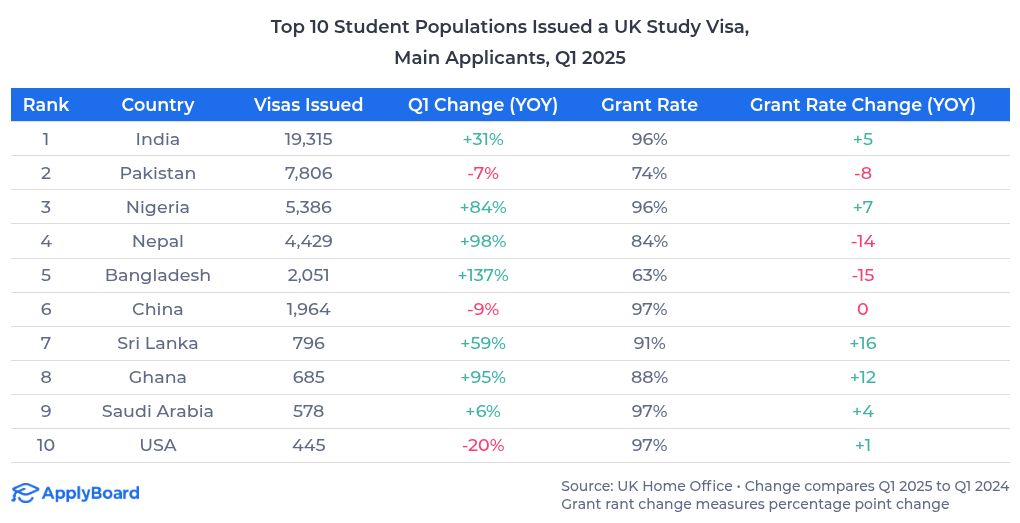
    Issuance trends offer additional insight into which student populations are successfully converting interest into study visas. These trends help us understand short-term momentum and assess key markets’ longer-term enrolment potential.

    table visualization

    The 19,300 Indian students issued a main applicant study visa in Q1 2025 represented a 31% increase over Q1 2024. Their grant rate also rose to 96%, an increase of five percentage points which is especially significant given the scale of the incoming Indian student population.

    Several other markets also demonstrated notable growth in UK study visa issuances this past quarter. The number of visas issued to main applicants from Nigeria increased by 84% compared to Q1 2024, with the grant rate rising by seven percentage points to 96%. Similarly, Sri Lanka and Ghana saw significant increases in visa issuances, with grant rates improving to 91% and 88%, respectively. These trends may reflect successful adjustments to new UK visa requirements and effective outreach efforts by institutions in these countries.

    Conversely, main applicants from Pakistan experienced a 7% decline in student visa issuances. Their 74% grant rate represents a year-on-year drop of eight percentage points. Nepalese and Bangladeshi main applicants also saw grant rates decline in Q1 2025—down 14 and 15 percentage points respectively—though issuances doubled for both student populations.

    Sustaining Momentum in the UK’s International Student Recovery

    Strong Q1 2025 results are a welcome sign for the UK’s international education sector, especially as they build on the encouraging Q4 2024. Together, these quarters point to a potential turning point in student sentiment, possibly signalling a broader recovery in demand if institutions and the wider international education community remain aligned, and if geopolitical relationships remain relatively cooperative.

    However, that stability is not guaranteed. With the release of the 2025 Immigration White Paper, institutions must proactively clarify recent policy changes and dispel myths that may deter prospective students.

    Two areas of particular concern within the White Paper are the proposed reduction of the Graduate Route’s duration from two years to 18 months, and the proposed 6% levy. These changes could impact the UK’s competitiveness in attracting international students, as post-study work opportunities are a significant factor in students’ decision-making processes. Moving forward, it will; be critical for institutions to emphasise that this post-study work pathway remains accessible for all eligible students and is a key differentiator for the UK in an increasingly competitive global landscape.


    [1] All data courtesy of the UK Home Office, unless otherwise stated. All timeframes in this article are by calendar year (January–December).

    Source link

  • Policy change can help manage the demand for graduate knowledge and skills

    Policy change can help manage the demand for graduate knowledge and skills

    “Our universities have a paramount place in an economy driven by knowledge and ideas.”

    These are the opening words of the 2016 white paper Success as a Knowledge Economy, which created the funding and regulatory architecture governing English higher education today. The arrangements are founded on a broad faith in the economic benefits of generating and communicating knowledge.

    This vision assumes that an increasing supply of university graduates and research, coupled with open markets that reward enterprise, leads to endogenous economic growth. That can happen anywhere because ideas are boundless and non-rivalrous, but particularly in England because our universities are among the best in the knowledge business.

    English higher education has grown by integrating the development of specific skills for the workplace alongside universally applicable knowledge. This is clear from the progress of most English universities from institutes established for professional and technical training towards university status, the absorption of training for an increasing range of professions within higher education, and the way in which universities can now articulate the workplace capabilities of all graduates, regardless of their discipline.

    Notwithstanding this, the reforms proposed in 2016 emphasised knowledge more than skills. By that time, most of the cost of teaching in English universities had been transferred to student tuition fees backed by income-contingent loans. So, the reforms mostly focused on providing confidence for the investments made by students and the risks carried by the exchequer. This would be delivered through regulation focused on issues important to students and the government, whilst positioning students as the pivotal influence on provision through competition for their choices.

    Universities would compete to increase and improve the supply of graduates. This would then enhance the capacity of businesses and public services to capitalise on innovation and new technologies, which would yield improved productivity and jobs requiring graduates. That is a crude characterisation, but it provides a starting point for understanding the new imperatives for higher education policy, which are influenced by challenges to this vision of nearly a decade ago.

    From market theory to experience in practice

    Despite an expansion of university graduates, the UK has had slow productivity growth since the recession of 2008–09. Rather than the economy growing alongside and absorbing a more highly educated workforce, there are declining returns for some courses compared with other options and concerns that AI technologies will replace roles previously reliant on graduates. Employers report sustained gaps and mismatches between the attributes they need and those embodied in the domestic workforce. Alongside this, ministers appear to be more concerned about people that do not go to university, who are shaping politics in the USA and Europe as well as the UK.

    These are common challenges for countries experiencing increasing higher education participation. The shift from elite to mass higher education is often associated with a “breakdown of consensus” and “permanent state of tension” because established assumptions are challenged by the scale and range of people encountering universities. This is particularly the case when governments place reliance on market forces, which leads to misalignment between the private choices made by individuals and the public expectations for which ministers are held to account. Universities are expected to embody historically elite modes of higher education reflected in media narratives and rankings, whilst also catering for the more diverse circumstances and practical skills needed by a broader population.

    In England, the government has told universities that it wants them to improve access, quality and efficiency, whilst also becoming more closely aligned with the needs of the economy and civil society in their local areas. These priorities may be associated with tensions that have arisen due to the drivers of university behaviour in a mass market.

    In a system driven by demand from young people, there has been improved but unequal access reflecting attainment gaps in schools. This might not be such a problem if increasing participation had been accompanied by a growing economy that improves opportunities for everyone. But governments have relied on market signals, rather than sustained industrial strategies, to align an increasing supply of graduates with the capabilities necessary to capitalise on them in the workplace. This has yielded anaemic growth since the 2007 banking crash, together with suggestions that higher education expansion diminishes the prospects of people and places without universities.

    In a competitive environment, universities may be perceived to focus on recruiting students, rather than providing them with adequate support, and to invest in non-academic services, rather than the quality of teaching. These conditions may also encourage universities to seek global measures of esteem recognised by league tables, rather than serving local people and communities through the civic mission for which most were established.

    Market forces were expected to increase the diversity of provision as universities compete to serve the needs of an expanding student population. But higher education does not work like other markets, even when the price is not controlled as for undergraduates in England. Competition yields convergence around established courses and modes of learning that are understood by potential students, rather than those that may be more efficient or strategically important for the nation as a whole.

    Navigating the new policy environment

    After more than a decade of reforms encouraging competition and choice, there appears to be less faith in well-regulated market forces positioning knowledgeable graduates to drive growth. Universities are now expected to become embedded within local and national growth plans and industrial strategy sectors, which prioritise skills that can be deployed in specific settings ahead of broadly applicable knowledge. This asks universities to consider the particular needs of industry, public services and communities in their local areas, rather than demand from students alone.

    Despite these different imperatives, English higher education will continue to be financed mostly by students’ tuition fees and governed by regulatory powers designed to provide confidence for their choices. We suggest four ingredients for navigating this, which are concerned with strategy, architecture, regulation and funding.

    The government has promised a single strategy for post-16 education and a new body, Skills England, to oversee it. A more unified approach across the different parts of post-compulsory education should encourage pathways between different types of learning, and a more coherent offer for both learners and employers. But it also needs to align factors that influence the demand for graduates, such as research and innovation, with decisions that influence their supply. That requires a new mindset for education policy, which has tended to prioritise national rules ahead of local responsiveness, or indeed coherence with other sectors and parts of government.

    Delivery of a unified strategy is hampered by the fragmented and complex architecture governing post-16 education. Skills England will provide underpinning evidence, both influencing and drawing on Local Skills Improvement Plans (LSIPs), but it remains uncertain how this will be translated into measures that influence provision, particularly in universities. A unified strategy demands structures for convening universities, colleges, employers and local authorities to deliver it in local areas across the country.

    That could be addressed by extending the remit of LSIPs beyond a shopping list of skills requirements and enhancing the role of universities within them. Universities have the expertise to diagnose needs and broker responses, aligning innovation that shapes products and services with the skills needed to work with them. They will, though, only engage this full capability if local structures are accompanied by national regulatory and funding incentives, so there is a unified local body responsible for skills and innovation within a national framework.

    Regulation remains essential for providing confidence to students and taxpayers, but there could be a re-balancing of regulatory duties, so they have regard to place and promote coherence, rather than competition for individual students alone. This could influence regulatory decisions affecting neighbouring universities and colleges, as well as the ways in which university performance is measured in relation to issues such as quality and access. A clear typology of civic impact, together with indicators for measuring it, could shift the incentives for universities, particularly if there is a joined-up approach across the funding and regulation of teaching, research and knowledge exchange.

    Regulation creates the conditions for activity, but funding shapes it. Higher education tends to be a lower priority than schools within the Department for Education, and research will now be balanced alongside digital technologies within the Department for Science, Innovation and Technology. A new Lifelong Learning Entitlement and reformed Growth and Skills Levy may provide new opportunities for some universities, but any headroom for higher education spending is likely to be tied to specific goals. This will include place and industry-oriented research and innovation programmes and single-pot allocations for some MSAs, alongside the substantial public and private income universities will continue to generate in sectors such as health and defence. In this context, aligning universities with the post-16 education strategy relies on pooling different sources of finance around common goals.

    Closer alignment of this kind should not undermine the importance of knowledge or indeed create divisions with skills that are inconsistent with the character and development of English higher education to date. The shift in emphasis from knowledge towards skills reframes how the contributions of universities are articulated and valued in policy and public debate, but it need not fundamentally change their responsibility for knowledge creation and intellectual development.

    This appears to have been recognised by ministers, given the statements they have made about the positioning of foundational knowledge within strategies for schools, research and the economy. We have, though, entered a new era, which requires greater consideration of the demand for and take-up of graduates and ideas locally and nationally, and a different approach from universities in response to this.

    Source link