
When it comes to politics, most of us have only two outlets: a voice and a vote.
Votes come, at best, once a year, the most consequential votes for national office every two and four years. We all only have one voice, though some of us also have the additional power of a megaphone to amplify that voice.
This column is my megaphone. It ain’t huge, but it’s something.
Because the Supreme Court has declared that money is speech, if you are fabulously wealthy, perhaps the CEO of a car company, a space company, a company that tortures monkeys by implanting stuff in their brains and the owner of a social media platform, your voice can get very loud indeed, drowning out the voices of others.
Some have genuine political power. Elected officials have political power. People with voices big enough to resonate with larger groups, or with enough money to purchase access to the levers of government, have political power. This is a fairly narrow class of people and organizations, and one of the things that has distressed me as of late is the refusal of some with genuine political power to use that political power in order to resist what I think is undeniable: that there is an ongoing attempt at an authoritarian takeover of our democracy.
I understand that there are differing minds around the likelihood of success of this attempted takeover, as well as the manner in which it is best resisted, but I’m reasonably certain that if you were to feed even a wee dram of truth serum to those attempting this takeover, they would admit that this is the case. They pretty much already have.
Voices are by no means meaningless. The recent “No Kings” protests, which brought out millions of people distributed all across the country to object to this takeover, demonstrated the capacity for collective voices to aggregate into something like political power.
But in this moment, when we are still more than a year away from our next consequential national election, the immediate power of resistance rests elsewhere, which is why the authoritarian threat has been busy trying to undermine and destroy democratic institutions like the free press and higher education.
This is why they have targeted Harvard. No one should seriously believe this is a principled dispute. The Trump administration does not care about genuinely fighting antisemitism, nor are they concerned about lax record-keeping regarding foreign students. The cancellation of NIH grants was done on a sweeping, ad hoc basis—pure destruction, no deliberation.
This is also why I declared that “We are all Harvard” now, a recognition that in this moment, we must express total solidarity in the fight against the authoritarian forces. Up to now, Harvard has been fighting admirably in both the courts and the world of public opinion, winning on both of these fronts. For example, just this week a judge ruled for Harvard in its motion to allow international students to continue to enroll.
But there are reasons to worry. A New York Times article clearly sourced to people inside Harvard—and (here I’m speculating) being used as a trial balloon to gauge public sentiment—ran under the headline “Behind Closed Doors, Harvard Officials Debate a Risky Truce With Trump.”
The article frames Harvard’s present dilemma this way: “Despite a series of legal wins against the administration, though, Harvard officials concluded in recent weeks that those victories alone might be insufficient to protect the university.”
It is clear that Harvard is suffering from these attacks. It is causing harm on all kinds of fronts, and the damage is real and probably lasting. It must be tempting if relief is promised to explore what it might take to realize that relief.
All this being true, and me obviously not being privy to any inside knowledge of Harvard, I still don’t think it is a difficult call to not engage in any kind of settlement with Trump.
There are two obvious reasons not to take the deal:
But there is an even bigger reason: Doing a deal with Trump legitimizes the authoritarian approach to government of using illegal intimidation to validate the power of the authoritarian. Long term, Harvard does not survive in an authoritarian state, because independent higher education institutions are not part of authoritarian states.
Maybe it’s unfair that Harvard, by virtue of its wealth and status, has become one of the levers of democracy by which authoritarianism can be resisted, but this is where we find ourselves. In better times, Harvard arguably disproportionately benefits from our system; now it is being disproportionately harmed. It should very much want to return as much as possible to the previous status quo, rather than attempting to reach an accommodation that may keep it atop a significantly diminished and consistently eroding pile.
If you merely see Trump and Trumpism as a temporary phenomenon that could be dispatched at the ballot box in three years, giving Trump a symbolic victory over Harvard (assuming anything Harvard gives in on will truly not be substantive) perhaps make sense.
How certain are we of this? How much of Harvard’s (and the country’s) future are we willing to gamble?
Because I still believe we are all Harvard, I hope it does the right thing and uses the power it possesses to defend our democracy.


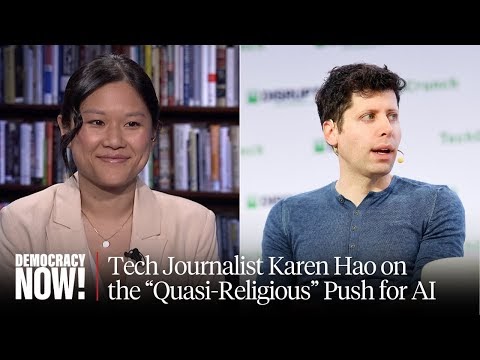
We spend the hour with acclaimed historian Greg Grandin discussing his new book, America, América: A New History of the New World, which spans five centuries of North and South American history since the Spanish conquest, including the fight against fascism in the 1930s. He examines the U.S.-Latin American relationship under Trump, with a focus on El Salvador, Panama, Ecuador and Cuba. Grandin also has a new piece for The Intercept that draws on the book, headlined “The Long History of Lawlessness in U.S. Policy Toward Latin America.” “If the United States really has given up its role as superintending a global liberal order and the world is reverting back to these kind of spheres of power competitions, then Latin America becomes, essentially, much more important,” says Grandin. We also continue to examine the legacy of the late Pope Francis, the son of Italian immigrants to Argentina and the first pope from Latin America. Grandin shares how the Catholic Church’s involvement in the conquest and colonization of the continent impacted the pope’s beliefs.
Democracy Now! is an independent global news hour that airs on over 1,500 TV and radio stations Monday through Friday. Watch our livestream at democracynow.org Mondays to Fridays 8-9 a.m. ET.
It was quite the paradox really.
Sat in a glorious space in Lisbon specifically designed for groups of students to organise events where they can eat (inexpensively) and talk together, we met a Medical student leader from Portugal and a Pharmacy student leader from Moldova who were both thinking hard about their future.
The first thing we noticed was how refreshing it was to meet student leaders from healthcare backgrounds – in systems where self-governing faculty and school communities are nurtured and valued, talented students from a broad range of disciplines go on to become policy actors that can change universities, communities, countries and even continents.
Freedom of movement had allowed Valeria to pursue both a bachelor’s and master’s in Pharmacy at the University of Lisbon – something that a funding system had helped her switch to after completing a first year in Human Resources management. But given the economic situation back home, she feels real pressure to stay.
Meanwhile Sofia – in the process of combining being a city-wide student leader with completing her fifth year in medical school – was looking at salaries for doctors across the EU and the world, and was wondering whether Portugal could ever offer the career conditions that would allow her to practice comfortably.
Portugal has a particularly acute version of a problem impacting countries across Europe, including the UK – a so-called demographic winter that combines a growing proportion of pension-age people that need to be supported by the tax revenues of a shrinking number of working-age people.
Around 30 per cent of young Portuguese people now live and work abroad, representing the highest emigration rate in Europe – and Portugal’s TFR (total fertility rate), the average number of children born per woman, has remained stubbornly below the replacement level of 2.1 since the 1980s.
It all creates a hugely difficult feedback loop – fewer young workers means declining tax revenues, which constrains public investment in services that might otherwise entice them to stay, which then prompts more to leave.
That means that governments need immigration – but despite political pleas to value diversity as an extension of the European ideal, the pace and volume of that immigration, coupled with the ageing of the electorate, then emboldens far-right parties like Portugal’s Chenga! (“Enough!”) – which has gone from securing just 1.3 per cent of the vote and a single seat in the Assembly of the Republic in 2019 to just under 20 per cent of the vote and 50 seats last year.
Despite Brexit ending formal freedom of movement with the EU, we are of course experiencing our own internal migration patterns that mirror these issues. Graduates from economically disadvantaged regions consistently flow toward London and other major economic hubs, rarely returning to their hometowns. Our internal “brain drain” exacerbates demographic decline in already struggling regions, with rural areas, post-industrial towns, and coastal communities particularly affected.
The prospect of university campus closures in our demographically challenged regions threatens to accelerate this pattern – creating a parallel to Portugal’s feedback loop but on a national scale. Without coordinated government planning to create and retain talent in these areas through strategic investment, improved infrastructure, and meaningful employment opportunities, the UK risks a deepening divide between its prosperous urban centres and increasingly hollowed-out regions and towns.
To get birth rates up, back in January we’d heard how Hungary’s populist President was implementing a pronatalist strategy using education policy – offering student loan forgiveness for female graduates who have children after studies, with full debt cancellation for mothers of three+ children, as well as lifetime income tax exemptions for women with four+ children.
But even if you set aside the politics of programmes like that, the big question is whether they work. Having previously offered returning expatriates tax reductions of up to 70 per cent for five years – 90 per cent for those relocating to the economically disadvantaged south – in Italy Giorgia Meloni’s government has been forced into a dramatic retreat, citing the unsustainable €1.3 billion annual cost and limited evidence of efficacy.
It puts all Portugal’s higher education sector in real difficulty. Both student and university leaders know that modernised higher education and skills systems are central to any country’s economic future. But if the expenditure involved only ends up boosting the Netherlands’ or Germany’s economies, sustaining low fees and circa 50 per cent participation rates will get harder and harder.
Just over a year ago, the centre-right minority coalition led by Prime Minister Luís Montenegro of the Social Democratic Party (PSD) and the CDS People’s Party (CDS–PP) responded with a multi-year graduate tax holiday – workers aged 18-26 (up to 30 for master’s/PhD holders) qualify for income tax exemptions over five years, and additional benefits exist for graduates moving to rural areas through the “Incentivo à Fixação de Jovens no Interior” program, including extra tax deductions and housing support.
But the benefits are pretty small when weighed against the rising cost of living, especially in major cities – base salaries remain uncompetitive, and they don’t fix the country’s acute housing problem, which sees students, graduates and migrants fighting for substandard housing in a country whose tourism-dependant economy has tended to turn much of its cities’ property portfolio into holiday lets.
And following the collapse of the coalition earlier this year, a fresh general election is to be staged – and pretty much all of the country’s student groups have the cost and availability of housing as a top priority.
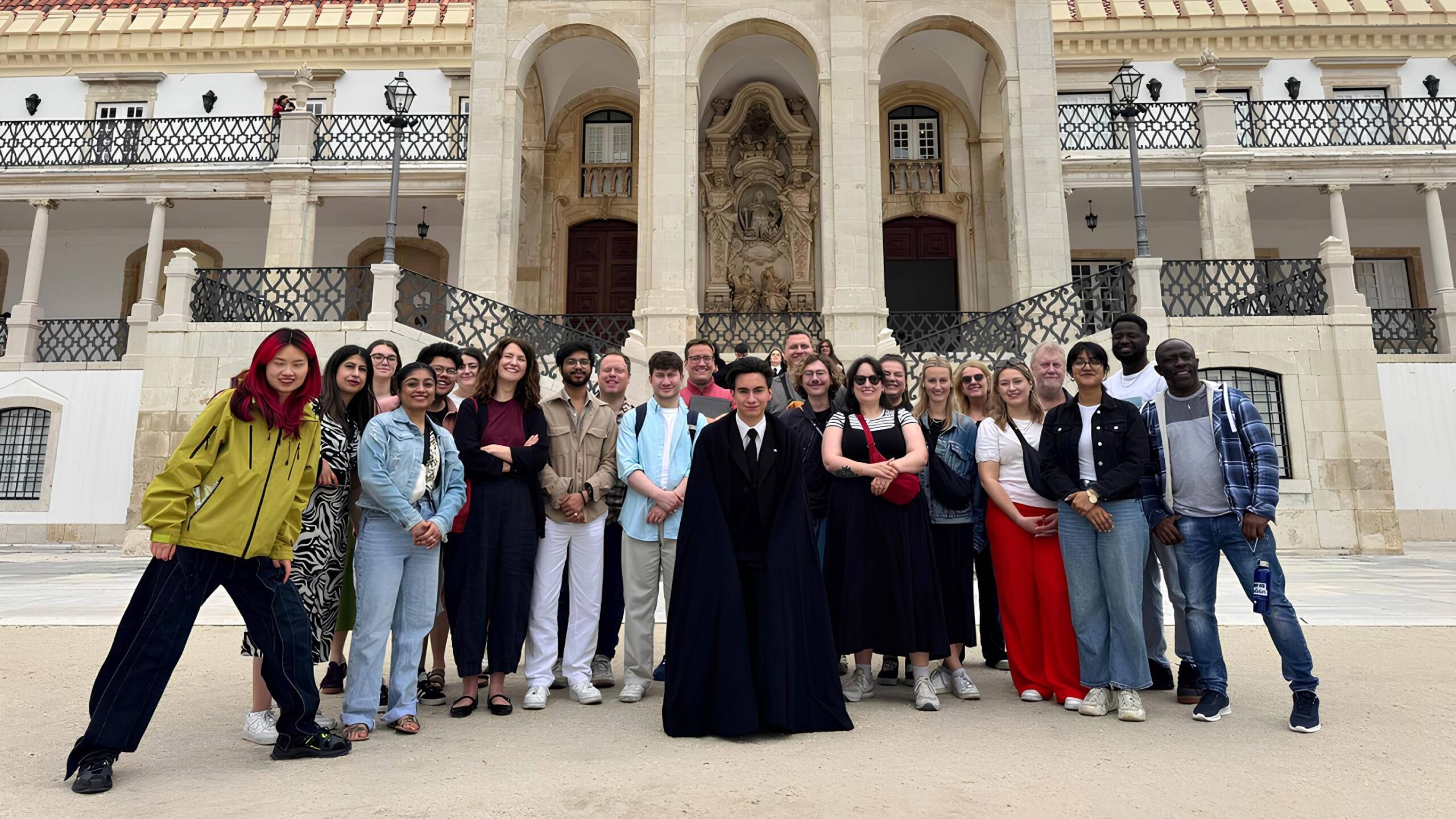
It was one of the many issues we ended up discussing on our two-day study tour to Portugal, where 30 UK student leaders (and the staff that support them) traversed Lisbon, Coimbra, Barcelos and Porto to build connections, share ideas and identify solutions to the problems besetting both students and the higher education systems in which they are partners.
So many of the issues faced by students sounded familiar – the obvious difference each time being that at least the Portuguese government is trying.
Its National Higher Education Accommodation Plan (PNAES) launched in 2022, and aims to deliver over 18,000 new student beds by 2026 with a €486 million investment. Then in September 2024, Prime Minister Luís Montenegro’s “Student Accommodation Now” emergency programme added 709 beds, and a €5.5 million credit line was established for universities to secure additional housing – all because the failure to provide housing “frustrates people’s efforts” and “stifles their ability to develop their talent”. The Prime Minister put it like this:
It is repugnant, from a civic point of view, that a student can battle for twelve years to enter higher education, only to find they cannot attend because they have nowhere to stay near the institution that accepted them.
In one of the groups I was in, one of the student leaders asked us what our own politicians had said about student housing and its role in educational opportunity, and what was in our countries’ student housing strategies. Our delegates’ faces turning blank, I had to admit that the the closest we’d got to a plan back home was former minister Robert Halfon repeatedly saying that it wasn’t his problem and was actually students’ fault:
…the government has no role in the provision of student accommodation…applicants who require student accommodation should take its availability into account when making decisions about where to study.
Housing isn’t the only thing they’ve been working on in Portugal. In 2022, the government set up an independent commission to evaluate the implementation of its Legal Framework for Higher Education Institutions (RJIES) – their equivalent to England’s Higher Education and Research Act.
Led by an 8-person panel that included two student reps, the commission’s recommendations included the creation of a single, consolidated legal instrument – a Statute for higher education students – that would define their rights and duties clearly and comprehensively, standardise protections across all institutions, and recognise the diversity of student profiles (including student workers, student parents, and students in volunteer roles).
Mental health was also prioritised – the Commission recommended strengthening support through dedicated student mental health services integrated into broader academic and social support strategies, and the revised RJIES now explicitly includes a duty for higher education institutions to contribute to student wellbeing, and specifically mentions their responsibility to guarantee mental health services. Universities will be also expected to hit psychologists:students ratios.
The Commission found that while student participation is formally recognised, in practice it can be marginal or symbolic – and recommended ensuring real, effective participation of students in institutional governance (General Councils, Academic Senates, Scientific and Pedagogical Councils), strategic planning processes, and evaluation and quality assurance activities.
The resulting arrangements will strengthen student voting power significantly – in the overhauled election process for rectors and presidents, students will hold at least 20 per cent of the weighted voting power.
And the new law explicitly details the competencies and election process for student ombudspeople – Portugal introduced university-level complaints adjudication in 2007 to tip the balance towards students, and will now mandate consistency in the role and broader student participation in their election.
Given the distance (both in time and governance) of the OIA from students and their problems, and the sorry state of independent adjudication in Scotland and NI, we really do now feel miles behind as a country on student rights protection.
After a visit to the (very) student city of Coimbra, the bus rolled into the Barcelos campus of the Polytechnic of Cávado and Ave – Portugal’s newest public higher education institution. IPCA had been formed as part of a national strategy to expand and decentralise higher education in Portugal – with regional provision aimed at driving regional development and addressing the need for skilled professionals in emerging industries.
The student leaders we met both from IPCA’s SU and FNAEESP (the National Federation of Polytechnic Higher Education Student Associations) were exercised about RJIES reform – partly because the status of polytechnics had become a key issue in the debate.
We tend to bristle at mentions of a binary divide, but Portugal maintains one – and FNAEESP reps were clear in their position, firmly favouring preservation with what they called “sharper clarification” to ensure polytechnics maintained their focus on vocational, technical education and practice-oriented research.
They also pushed for a “symmetrical structure” where both types of institutions would face equivalent requirements without compromising their distinct missions:
The polytechnic sector isn’t asking to become something it’s not… we’re asking for recognition of what we already are – institutions providing high-quality technical and professional education that drives regional development.
When we explained that our abolition of the binary had happened over thirty years ago, one of the reps perceptively asked us if that had raised the profile of the provision, or just hidden it. When we then explained the way in which large parts of the UK’s politics seem to ignore the technical and professional provision on offer in the sector – centring their critiques about “too many students at university” in assumptions about what a “university” is – we got a wry smile.
The upshots in Portugal are that the binary divide will be maintained but made more flexible, allowing polytechnics that offer doctoral programs to adopt the title “Polytechnic University” while preserving their focus on advanced technical education and applied research for regional development.
That will come with stricter requirements – including improved staff-to-student ratios (one PhD holder per 20 students instead of 30) and a broader range of degree offerings that maintain an applied, professional focus – and the updated RJIES framework will preserve the distinctive applied mission, partly to maintain public understanding and support for the investment that part of the system needs.
Even in huge universities like the University of Lisbon, the previous evening we’d seen a similar commitment to the prominent status of technical education. Opposite Team Wonkhe’s hotel was Técnico, which we’d only realised was the university’s Science and Technology faculty when leafing through a strategy brochure. The brand police would never let that happen in the UK.
Its stunning Alameda campus is located at the top of the hill overlooking Fonte Luminosa, and was designed just as António de Oliveira Salazar’s Estado Novo regime was keen to build symbols of national pride and progress.
But during the dictatorship, the SU building had become a central hub for meetings, discussions, and coordination of resistance to the authoritarian government – which forced anyone who wanted to work in academia to be vetted by the political police, who had the right to arrest anyone deemed to be against the regime.
For a long time higher education had not been an instrument for growth or for people to improve their lives and prospects, but was about maintaining the hegemony of the ruling upper class. Even when Estado Novo eventually opened up universities to a broader range of the population, centres of research were created outside the universities so that young people would not get any new ideas.
Fernando Rosas, one of the founders of the socialist party Bloco de Esquerda, recalls 4 December 1968, when students broke into a building and had a “political picnic” to protest against the terrible food in the cafeteria:
That day, I woke up politically. Until then I had not been interested in such matters. But I heard the speeches about nutrition and the colonial wars, became an activist and later one of the leaders of the student union… what we in the student union did was part of the foundation of the military movement that then led to the revolution. We trained them to be engineers but also taught them to fight for freedom.
Photos up around the building tell the tales of struggles to end daily oppression, ensure universal access to education, healthcare, and political rights, and build a fraternal, inclusive and participatory society. After the Carnation Revolution at Tecnico, students’ votes carried equal weight to teachers, with student groups collectively voting on grades despite teacher assessments being reduced to suggestions:
We gained freedom to design our own curricula and research without fear of imprisonment or censorship.
Today the demonstrations might be gone, and on Thursday’s evidence we can’t say that the food has got much better – but the spirit of democracy lives on. Reforms to the curriculum at Tecnico introduced amidst austerity (which we look at elsewhere on the site here) focus on interdisciplinarity and student choice, with student associative activity – sharing power with eachother and with the university – embedded carefully into every level of the student experience, from programme to faculty to university to city to country to continent.
At the central university level, three of Lisbon’s values are familiar – intellectual freedom and respect for ethics, societal innovation and development, and social and environmental responsibility – but when we spoke with vice-rector João Peixoto, a less familiar fourth emerged as something just as important:
Students are part of the power system – they have a say, they have votes, and we cannot ignore them…democratic participation is not just something we say; it’s something we do, every day, in every council, with every voice heard.
Students across the university have voting rights, sit on councils, shape curricula, and deliver through students’ associations a large part of what we’d give a professional services department to “provide” – not as guests or consumers, but as citizens of the university community:
Our history reminds us: students fought for democracy in Portugal, and today, they still have a seat in deciding its future.
The way that culture had paid forward into the future culture of the country was vivid in Portugal’s history. That culture’s relative weakness, dismissal and continued erosion in the UK’s system should cause us to worry a lot about our future.
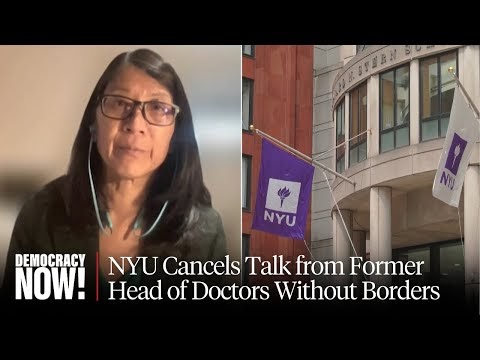
The former international head of Doctors Without Borders is speaking out after New York University canceled her presentation, saying some of her slides could be viewed as “anti-governmental” and “antisemitic” because they mentioned the Trump administration’s cuts to foreign aid and deaths of humanitarian workers in Israel’s war on Gaza. Dr. Joanne Liu, a Canadian pediatric emergency medicine physician, was scheduled to speak at NYU, her alma mater, on March 19 and had been invited almost a year ago to discuss the challenges of humanitarian crises. Censoring speech is “killing the essence of what the university is about,” says Liu. “I truly and strongly believe that universities are the temple of knowledge.”
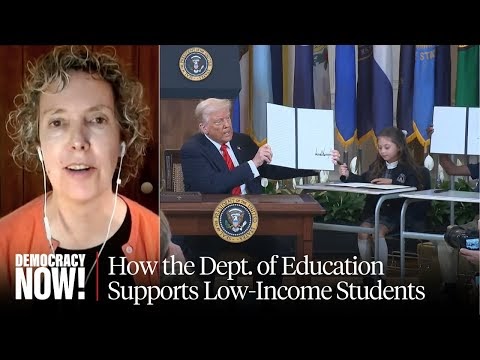
President
Donald Trump signed an executive order Thursday instructing Secretary
of Education Linda McMahon to start dismantling her agency, although it
cannot be formally shut down without congressional approval. Since
returning to office in January, Trump has already slashed the Education
Department’s workforce in half and cut $600 million in grants. Education
journalist Jennifer Berkshire says despite Trump’s claims that he is
merely returning power and resources to the states, his moves were
previewed in Project 2025. “The goal is not to continue to spend the
same amount of money but just in a different way; it’s ultimately to
phase out spending … and make it more difficult and more expensive for
kids to go to college,” Berkshire says. She is co-author of the book The
Education Wars: A Citizen’s Guide and Defense Manual and host of the
education podcast Have You Heard.

“The algorithm won’t push posts that aren’t dramatic enough,” Keller said. “If I want something to go viral, I need to communicate differently.”
Effects of algorithms can be seen all around the world. In Romania, the 2024 presidential election was annulled due to alleged disinformation on social media platforms. During the 2022 national election campaign in the Philippines, social media played a significant role in the rapid spread of disinformation narratives.
In Germany, social media significantly influenced the 10% increase in votes in the recent election for the far right party Alternative for Germany(AfD) compared to 2021. A notable factor was Elon Musk’s promotion of the AfD on Twitter.
In Switzerland, direct democracy allows citizens to vote directly on laws and policies. This system is a core part of its governance, with frequent referendums and initiatives shaping political decisions.
On average, there are 3-4 national votes per year, which could make the direct democracy even more susceptible to social media than other types of democracies, as people get to vote on smaller issues than presidential elections, which only happen once every four years. This makes the political processes more inclusive.
As online campaigns grow more popular, social media can play a larger role in votes. However, Switzerland still relies heavily on traditional media sources for political news consumption. A recent report by research and consulting firm Publicom AG found that 58% of voters form their opinions through radio, TV or print media. Most of these are neutral and based on the information given by the national news agency SRG. That means there is less polarization.
By contrast, only 16% actively turn to social media to establish a viewpoint. However, these numbers may be misleading. The popularity of social media has been on the rise; for instance, in 2017, just 12% of the population sourced their news from these platforms. It is also important to note that the study groups all voters into one category.
When focusing specifically on the younger demographic, aged 15–29, the shift is more pronounced. In this age group, social media usage for news has increased by 11 percentage points since 2020, now reaching 40%.
Despite the significant engagement of young people with news through social media, Switzerland’s democratic system remains largely unaffected. Keller said that the average voter in the country is approximately 55.
While the influence of social media in Switzerland right now may only be marginal, this could change in the future, once these younger generations, which heavily rely on social media for news, enter the political landscape.
Many of the students we go to school with acknowledged that social media shapes their beliefs. “It depends on how reliable the source is,” said one 16-year old who we spoke to. “But if a lot of people say the same thing and if I also hear it on multiple platforms, then I’ll probably start believing it too.”
A repeated theme seemed to be, appropriately, repetition. Our schoolmates seem to equate repetition with credibility. “I think it could [influence my beliefs], if I see the same information multiple times across multiple platforms,” said one student, aged 15.
Another said that he would question the information he sees but ultimately he would end up believing it. “If I see 10 posts about the CDU [German political party], for example, and they are all positive, I think about what their arguments are, and if they make sense, then yeah, I think I’d believe it,” he said.
So even though it might not be necessary to implement additional regulations regarding the usage of social media in political campaigns right now, it might become necessary in the future as social media continues to grow in importance.
Social media in the political process isn’t all about misinformation. It can also provide a platform for people to discuss political issues, regardless of their party. Keller sees social media as an opportunity.
“I’m more of an optimist than a pessimist,” Keller said.
For example, Keller said, if he wanted to start a referendum campaign, he could post about that and find other people to help organize it. That also allows people the opportunity to communicate directly with politicians.
“Nowadays a lot of them are on social media platforms,” he said. “You can tell them your opinion directly … and sometimes they even reply.”
For more about the power of repetition in news coverage check out this News Decoder Top Tip.
1. How can a single social media post affect an election?
2. What do the authors mean by politicians becoming “personalities”?
3. In what ways are you influenced by what you read or see on social media?

Fri. March 7 — 12:00pm-1:30pm:
“From Multiracial Democracy to Multiracial Fascism?:
What is the Future of the American Experiment?”
Guest Speakers:
Alexis McGill Johnson (she/her) – President and CEO,
Planned Parenthood Federation; Planned Parenthood Action Fund
Eric Ward (he/him) – Executive Vice President, Race Forward
Dorian Warren (he/him) – Co-President, Center for Community Change; Community Change Action
Moderator:
Alethia Jones (she/her) – Director, Civic Engagement and Leadership Development, CUNY School of Labor and Urban Studies