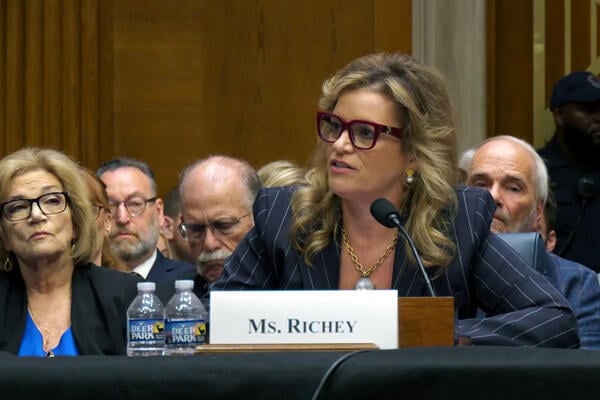
Kimberly Richey, a Florida education official, made her case Thursday about why she should lead the Education Department’s Office for Civil Rights, pledging “unwavering” support of the administration’s priorities such as protecting Jewish students.
“Should I be confirmed as assistant secretary for civil rights, I will proudly be joining an administration that will not allow students to be intimidated, harassed, assaulted or excluded from their institutions,” she said in her opening remarks.
But repeatedly throughout the hearing, Democratic senators interrogated her on how she plans to address a massive backlog in complaints—which one senator said has more than doubled since Trump took office, to 25,000—with a reduced staff.
“This administration has fired more than half of the staff at OCR, and President Trump is now asking, in his budget, to slash that by $49 million next year, so explain to me how those firings and that funding cut will help reduce that backlog? I want to understand how you’re going to square that circle,” Sen. Patty Murray, a Democrat from Washington, asked early on in the hearing.
Richey mostly avoided answering the questions, arguing that she had not yet assumed the role of assistant secretary and, therefore, had no say in the recent changes to OCR.
“As a nominee, I do not have access to information with regard to the decisions that are being made at the department,” Richey responded. “I’m not in communication with OCR leadership or the secretary. One of the reasons why this role is so important to me is because I am always going to advocate for OCR to have the resources it needs to do its job. I think that what it means is I’m going to have to be really strategic, if I’m confirmed, stepping into this role, helping come up with a plan where we can address these challenges.”
Several others doubled down on Murray’s line of questioning, including Sen. Andy Kim, a New Jersey Democrat, who asked Richey if antisemitism was getting worse in America. When she said it was, he questioned how cutting OCR staff is conducive to fighting antisemitism on college campuses. She reiterated her answer to Murray’s question, saying, “I can’t explain or provide information on decisions I wasn’t involved in.”
Richey was one of four people who testified Thursday before the Senate Health, Education, Labor and Pensions Committee. She and the nominee for deputy secretary of education, Penny Schwinn, fielded the bulk of the committee’s questions as lawmakers pressed for answers about the OCR’s operations and priorities, proposed budget cuts, and the president’s plans to dismantle the Education Department. The senators didn’t vote on whether to advance the nominations to the Senate floor; that step will likely occur at a later meeting.
Richey is currently senior chancellor for the Florida Department of Education and has twice served in OCR before, including a brief stint as acting secretary of civil rights at the end of Trump’s first term and the beginning of Biden’s presidency. Her confirmation hearing comes months after the Trump administration slashed more than half of OCR’s staff, including shuttering seven of the 12 regional offices dedicated to investigating complaints. The office has also reportedly begun prioritizing opening cases regarding trans women athletes and antisemitism since Trump’s second term began, letting other cases pile up and go unaddressed, according to multiple news reports.
In the confirmation hearing, Richey expressed strong support for those causes, stressing that she led OCR when it investigated one of the federal government’s earliest cases against a school for allowing a trans woman to play on a women’s sports team.
“I’m certainly committed to vigorously enforcing it and continuing to pursue these cases,” she said.
In response to a different question, though, she did say that OCR would investigate certain complaints of discrimination related to gender identity and sexual orientation—an answer that appeared to incense Republican senator Josh Hawley of Missouri.
“I want to be crystal clear on this—I think it’s a very dangerous thing to start allowing this into Title IX, which, as you know, it is a landmark statute, it is vitally important, and it has been under attack for four long years,” he said, asking her to confirm that OCR will “go after” colleges and universities that allow trans women to play women’s sports.
He also warned Richey that she should “rethink” her position that OCR can investigate discrimination based on gender identity.
Sen. Angela Alsobrooks, a Democrat from Maryland, pressed Richey on whether she would continue OCR’s new system of prioritizing cases regarding antisemitism and trans athletes, asking if all forms of discrimination should be treated with equal importance.
Richey told Alsobrooks she does believe “it’s important to vigorously enforce all of the federal laws that OCR is responsible for enforcing.” Later in the hearing, she noted that Education Secretary Linda McMahon is “prioritizing” removing trans women from women’s athletics, and she plans to do the same if confirmed.
Schwinn, who was formerly Tennessee’s commissioner of education, received most of the panel’s questions about the Trump administration’s efforts to dismantle the education department. In response a question from Sen. Jim Banks, an Indiana Republican, about what steps would be required to dismantle the department, she stated that she “would certainly work, if confirmed, with the secretary and with Congress on any actions related to the role of the department” and that she believes in equipping states with legislation and funding that will help them improve their own educational systems.
“A department or an agency in the federal government is not going to change the outcomes of students—the teacher in the classroom is going to teach the standards that are approved by that state. The parent is the parent of that child. What we need to do is ensure we’ve created a system that is going to drive outcomes,” she said. “That is not going to happen from the federal government, whether there is a Department of Education or not.”