Tag: Denied

  • NIH Approves 100s of Grant Applications It Shelved or Denied

    NIH Approves 100s of Grant Applications It Shelved or Denied

    The National Institutes of Health is deciding, per court agreements, whether to award or deny droves of grant applications that the agency previously either rejected or shelved. This funding was stalled last year amid the Trump administration’s blunt moves to restrict research into certain disfavored topics, such as diversity, equity and inclusion—though researchers and state attorneys general said officials shot down a greater range of projects, including ones that could save lives.

    The NIH’s agreements, laid out in court filings in two ongoing lawsuits, are already bearing fruit. A spokesperson for the Massachusetts attorney general’s office, which is leading one of the cases, said the agreement in that suit promises decisions on more than 5,000 grants nationally. On Dec. 29, the date of the agreement, the NIH issued 528 grant decisions, 499 of which were approvals, the spokesperson said.

    A spokesperson for the American Civil Liberties Union, which is leading the other case, said the agreement in that case involves about 400 grants. He said the NIH awarded at least 135 out of 146 applications in a batch of decisions on Dec. 29.

    The filings set a series of dates by which the NIH agreed to decide on awarding or denying other types of grants. The last deadline is July 31.

    The agreements are another example of the Trump administration reversing many of its sweeping cuts to research funding in response to litigation. Researchers and organizations filed suit after suit last year after the NIH and other federal funding agencies abruptly terminated previously awarded grants and sat on applications for new ones.

    In a news release, the ACLU said the grants that the NIH will now decide on “address urgent public health issues, including HIV prevention, Alzheimer’s disease, LGBTQ+ health, and sexual violence.” ACLU of Massachusetts legal director Jessie Rossman said in the release that the NIH’s “unprecedented” and “unlawful” actions put “many scientists’ careers in limbo, including hundreds of members of the American Public Health Association and the UAW union.”

    ACLU lawyers are among the attorneys representing those groups, Ibis Reproductive Health and individual researchers in a suit they filed in April against the NIH and the larger Health and Human Services Department for stalling and rejecting grant funding. Democratic state attorneys general filed a similar suit in the same court, the U.S. District Court of Massachusetts.

    The agencies agreed to decide these grant applications in exchange for the plaintiffs dismissing some of their claims. The agencies didn’t admit wrongdoing.

    In a news release, the Massachusetts attorney general’s office said the Trump administration “indefinitely withheld issuing final decisions on applications that had already received approval from the relevant review panels,” leaving the states that sued “awaiting decisions on billions of dollars.”

    The release said that, for example, when the suit was filed in April, the University of Massachusetts “had 353 applications for NIH funding whose review had been delayed, signifying millions in potential grant funding that would aid in lifesaving medical research.” Massachusetts attorney general Andrea Joy Campbell said in a statement that “lifesaving studies related to Alzheimer’s disease, cancer, and other devastating illnesses were frozen indefinitely—stealing hope from countless families across the country and putting lives at risk.”

    It’s unclear how much money the NIH may dole out in total. An HHS spokesperson told Inside Higher Ed that the “NIH cannot comment on the status of individual grant applications or deliberations.”

    “The agency remains committed to supporting rigorous, evidence-based research that advances the health of all Americans,” the spokesperson said. HHS and the NIH didn’t provide interviews or further comment.

    Meanwhile, a legal fight continues over grants that the NIH previously approved but later canceled.

    Lingering Questions

    In June, in these same two cases, U.S. District Judge William Young ordered the NIH to restore grants the agency had awarded but then—after Trump retook the White House—terminated midgrant.

    Young, a Reagan appointee, criticized the federal government for not formally defining DEI, despite using that term to justify terminating grants. He said at a hearing that he’d “never seen racial discrimination by the government like this” during his four decades as a federal judge.

    But, two months later, the U.S. Supreme Court, in a 5-to-4 preliminary decision, stayed Young’s ruling ordering restoration of the grants. Justice Amy Coney Barrett, a Trump appointee, wrote for the majority that Young “likely lacked jurisdiction to hear challenges to the grant terminations, which belong in the Court of Federal Claims.” However, STAT reported that the NIH had restored more than 2,000 terminated grants following Young’s ruling, and it didn’t reverse course after the Supreme Court decision.

    That question of whether researchers with canceled grants must ultimately try their luck before the Court of Federal Claims is now before the U.S. First Circuit Court of Appeals. There’s a hearing Tuesday in that matter.

    Questions linger about when the grant fight will really end. In a video interview with journalist Paul Thacker—released Wednesday and previously reported on by STAT—NIH director Jay Bhattacharya said that, despite the grant restorations, any grants dealing with DEI that come up for renewal this year won’t be funded. Bhattacharya distinguished between cutting a grant and not renewing it.

    He said that, “as best I can understand the legal aspects,” the courts have said his agency can’t cut restored grants. “But, when it comes to renewal, those grants no longer meet NIH priorities … so when they come up for renewal over the course of the year, we won’t renew them,” he said.

    Bhattacharya said the NIH’s DEI-related work “did not actually have any chance of improving the health of minority populations.” He said, “I think that the shift away from DEI is of a piece with the rest of what we’re trying to do at the NIH, which is to do research that actually makes the lives of people better.”


    Source link

  • Denied Emerita, Reid Named “Honorary Alum” at New College

    Denied Emerita, Reid Named “Honorary Alum” at New College

    Thomas Simonetti/The Washington Post/Getty Images

    Amy Reid, a former professor of French at New College of Florida, was granted “honorary alumni” status by the New College Alumni Association Board of Directors in a unanimous vote nearly three weeks after she was denied emerita status by college president Richard Corcoran.

    “I was honored when my colleagues nominated me for emerita status and when the New College Alumni Association adopted me as one of their own, in recognition of my long teaching career and my vocal advocacy for the College, its academic program, and for the position of gender studies in the liberal arts,” Reid said in a statement to Inside Higher Ed. “New College students have made their mark because they are fiercely independent and courageous learners. I’ll try to live up to their standards. To the Novo community: Honor & Respect.”

    The honorary designation, rarely bestowed, gives Reid the same “rights and privileges” as other New College alumni, including access to alumni events, according to the alumni association’s motion. Reid retired in August after teaching at New College for more than 30 years and now serves as interim director of PEN America’s Freedom to Learn program.

    Reid was also the founder of the now-defunct gender studies program at New College, which the then–newly appointed conservative board eliminated in 2023. The college was mired in controversy again the following summer when officials tossed books from its former Gender and Diversity Center in the trash.

    Despite what alumni association governance committee chair Chris Van Dyk described as “overwhelming recommendation” for emerita status, including from New College provost David Rohrbacher and leaders in the Division of Humanities, Corcoran denied Reid the emerita title because of her outspoken faculty advocacy and criticism of conservative leadership at New College.

    “Although I recognize Professor Reid’s contributions to New College in teaching and scholarship, I cannot concur with the Division and Provost that she be honored with the title of emeritus,” Corcoran wrote in an email to Rohrbacher. “When I became president with a mandate for change from the Board of Trustees, there was need for reasoned and respectful exchange between the faculty and administration. Regrettably, Professor Reid was one of the leading voices of hyperbolic alarmism and needless obstruction. In her letter of resignation, Professor Reid wrote that ‘the New College where I once taught no longer exists.’ She need not be burdened by further association with it.”

    After the former faculty representative to the New College Board of Trustees quit in protest, Reid was elected to fill the role in 2023. She and student representative Grace Keenan were the only two board members to vote against Corcoran’s appointment as permanent president, Florida Politics reported.

    Emeritus status is largely symbolic, but it does usually come with some concrete perks, including the continued use of institutional email accounts, library and athletic facilities access, and sometimes free campus parking.

    Source link

  • Sydney Uni denied more international students – Campus Review

    Sydney Uni denied more international students – Campus Review

    Australia is set to welcome 160,000 overseas students next year after the education minister revealed which universities will get the largest number of international enrolments.

    Please login below to view content or subscribe now.

    Membership Login

    Source link

  • Pro-Palestinian Journalism Professor Denied Tenure

    Pro-Palestinian Journalism Professor Denied Tenure

    Steven Thrasher, an assistant journalism professor who tried to block police from breaking up a pro-Palestinian encampment at Northwestern University last spring, announced he was denied tenure and will lose his job in August 2026, the end of the next academic year.

    “This has nothing to do with my scholarship or teaching,” Thrasher wrote in a statement he shared on Bluesky. “It is a political hit job over my support for Palestine and for trying to protect our student protesters last year from physical attack, by nonviolently subjecting my own body to assault by the Northwestern Police instead of our students.”

    The incident between Thrasher and campus police came up when Northwestern president Michael Schill went before Congress during a hearing on campus antisemitism. In a June 2024 letter, the House Committee on Education and the Workforce accused Schill of not fully answering members’ questions at the hearing, including about Thrasher.

    Thrasher was suspended from teaching last summer. According to an email from Medill School of Journalism dean Charles F. Whitaker, which Thrasher’s lawyer provided to Inside Higher Ed, the dean initiated disciplinary proceedings in response to complaints about Thrasher’s social media activity and allegedly sexist comments to students, as well as his failure to disclose major course changes and his comments about journalism standards that were “antithetical to our profession.”

    According to Thrasher’s statement, posted Thursday, Whitaker wrote in an explanation of the tenure denial that Thrasher’s teaching was “inadequate with serious concerns reported by some students.” Thrasher said he previously received a “glowing” mid-tenure review in 2023. He also said a university-wide ad hoc faculty committee “exonerated” him after a four-month investigation into issues, including student concerns.

    “I read the situation as a Plan B by Northwestern after Dean Whitaker tried (and failed) to exclude me through the disciplinary process,” Thrasher wrote. “I will appeal this decision at Northwestern and have much more to say.”

    In a statement to Inside Higher Ed, a university spokesperson wrote, “As policy, Northwestern does not comment on personnel matters. The University takes the tenure process very seriously and has adhered to the rules that govern that process. The University has full confidence in the decision-making process of our Medill faculty and dean.”

    Source link

  • Saint Augustine’s accreditation appeal denied again

    Saint Augustine’s accreditation appeal denied again

    The Southern Association of Colleges and Schools Commission on Colleges denied Saint Augustine’s University’s appeal to remain accredited, SAU announced Thursday.

    The decision is the latest blow to the embattled historically Black university in North Carolina, which has struggled to maintain its accreditation since December 2023, when SACSCOC voted to strip it of its membership due to compliance issues related to governance and finances. Following that decision, SAU lost an appeal to remain accredited; it won a reprieve in the courts last July but lost accreditation again in December. Now that SASCOC has denied SAU’s latest appeal, the university will again pursue a legal remedy, officials announced.

    “We have made substantial progress and are confident that our strengthened financial position and governance will ensure a positive outcome,” Board of Trustees chairman Brian Boulware said in a Thursday statement announcing plans to contest the accreditation decision in court. “SAU is resilient, and we are resolute in our commitment to academic excellence.”

    Beyond accreditation issues, Saint Augustine’s has navigated severe fiscal issues that left it teetering on the brink of closure for months as it pursued various financial lifelines. SAU recently attempted to lease its campus to 50 Plus 1 Sports, a fledgling Florida company. The $70 million deal to lease property for 99 years with development options would have provided much-needed funds for SAU, but following a review required by state law, North Carolina officials declined to sign off on the arrangement due to the transfer of nonprofit assets.

    SAU had unsuccessfully sought approval of the deal before its appeal to SACSCOC last month.

    The North Carolina attorney general’s office, which reviewed the deal, cited insufficient documentation and concerns that SAU was only receiving $70 million for property appraised at $198 million. Saint Augustine’s and 50 Plus 1 Sports have since restructured the terms of the deal.

    In Thursday’s statement, SAU announced it “secured up to $70 million in sustainability-focused funding at competitive market rates and terms,” which it expects to close later this month. It added that nondisclosure agreements “prevent SAU from publicly disclosing the partners’ names.”

    Source link

  • Denied vote on pro-BDS resolution, MLA members protest

    Denied vote on pro-BDS resolution, MLA members protest

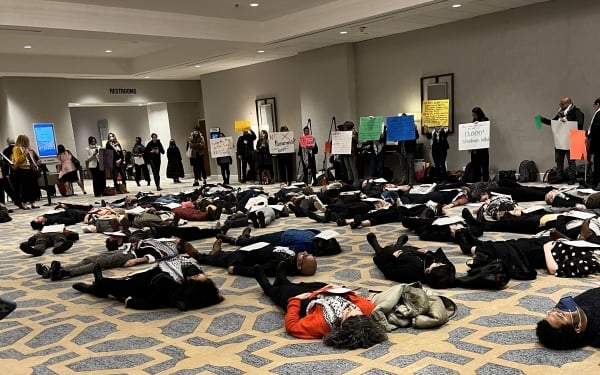
    A “die-in” protest at the MLA annual convention before Saturday’s Delegate Assembly meeting.

    As the Modern Language Association Delegate Assembly was beginning its meeting Saturday in New Orleans, audience members stood inside the hotel ballroom and chanted, “The more they try to silence us the louder we will be!” a video posted online shows. 

    The protesters, who made up a large number of the meeting’s attendees, read out a resolution endorsing the international boycott, divestment and sanctions movement against Israeli policy—the very resolution that the MLA’s elected Executive Council had blocked from going to the Delegate Assembly and the association’s full membership for a vote. Then the demonstrators walked out of the meeting. 

    It was one of multiple protests at this weekend’s annual MLA conference aimed at the Executive Council’s fall decision to reject the resolution without letting members vote on it.

    That resolution—like one that American Historical Association conference attendees overwhelmingly passed Jan. 5—also would have accused Israel of “scholasticide,” or the intentional eradication of an education system. But the AHA resolution didn’t endorse the BDS movement.  

    The demonstrations at the two conventions are the latest examples of scholarly associations and their members debating whether they should say anything as an organization about the ongoing war in Gaza at a time when politicians and people both inside and outside academe are criticizing scholars and institutions for expressing opinions on current events.  

    Anthony Alessandrini, an English professor at the City University of New York’s Kingsborough Community College, said he led a call and response demonstration. A few shouts of “Shame!” rang out.

    “Sometimes, this is what democracy looks like!” the demonstrators chanted in unison during the call and response. They raised hands or fists in the air, and some held signs that Alessandrini said bore the names of Palestinian academics killed in Gaza since October 2023. Protesters held a large banner that read, “MLA is Complicit in Genocide.”

    As they were walking out of the ballroom, protesters chanted “Free free Palestine!” and “You don’t have quorum!”—the minimum required numbers of attendees to conduct official business at a meeting. However, the MLA said quorum was maintained and the meeting continued.  

    The MLA Executive Council, an elected body, released a lengthy statement last month explaining its October decision to shoot down the resolution. The Council said it was concerned about “substantial” revenue loss if members endorsed the BDS movement, saying legal restrictions in many states on partnering with BDS-supporting organizations would end the MLA’s ability to contract with numerous colleges and universities and their libraries. It added that “some private institutions and major library consortia” also have such prohibitions.

    “Fully two-thirds of the operating budget of the MLA comes from sales of resources to universities and libraries, including the MLA International Bibliography,” the Council said.

    Dana Williams, president of the Executive Council and a professor of African-American literature at Howard University, told Inside Higher Ed Saturday that “the primary reason” for the council’s decision “was fiduciary.” But she also mentioned concerns about dividing the membership over endorsing the BDS movement, noting that “collegiality was one of many things that we were considering.”

    The Council’s statement in December suggested MLA members consider something short of endorsing the BDS movement. “Could not a motion calling for a statement protesting scholasticide in Gaza, while not focusing on BDS, be a powerful expression of solidarity?” it said.

    The fallout from the Executive Council’s decision included the resignation of two of its roughly 15 members, who were nearing the end of their terms. One was Esther Allen, a professor at the City University of New York’s Graduate Center and Baruch College.

    “The really don’t feel comfortable with any kind of member activism, they really don’t want it at all on any subject,” Allen told Inside Higher Ed.

    Williams said she supports members’ right to protest. “The association is the membership, we want to reiterate,” she said. What the members who walked out missed “was the one-hour open discussion [during the meeting] that … was really fruitful, thoughtful engagement with those delegates who were present that will inform the actions of the council going forward,” she added. The MLA didn’t provide a remote option for watching the meeting.

    The Council continues to believe that rejecting the resolution “was the right decision that would allow the association to continue to do its really important work to serve the members,” she said. “We had the benefit of a council that is bold enough and courageous enough to make very hard decisions.”

    MLA Members for Justice in Palestine is circulating a pledge for members to promise not to renew their memberships in protest. Alessandrini noted some other scholarly groups have endorsed the BDS movement.

    “My sort of forecast is a lot of people are going to move from organizations like the MLA and, I would add, the AHA [American Historical Association] if they don’t sort of endorse the will of the members—and towards the many organizations that have in fact taken the right stand,” he said. 

    Source link