
The Department of Education is expected to lay off nearly half its workforce as of Tuesday.
J. David Ake/Getty Images
The Education Department is moving to lay off nearly 50 percent of its more than 4,100 employees as of Tuesday evening, according to four sources inside the agency who were told about the plans.
It’s not yet clear what specific departments or positions were affected, though officials planned to tell affected employees this evening, sources told Inside Higher Ed. The department previously offered employees buyouts to cut down the workforce. The goal to reduce staff by 50 percent includes prior reductions. Those affected will receive 90 days’ severance and will have 10 days to transfer their job duties to another staffer or political appointee, according to a longtime staffer with inside knowledge of the reduction-in-force details.
The department said in its announcement that the employees will be placed on administrative leave, starting March 21, and that core programs such as distributing student loans and Pell Grants will continue.
“Today’s reduction in force reflects the Department of Education’s commitment to efficiency, accountability, and ensuring that resources are directed where they matter most: to students, parents, and teachers,” Secretary of Education Linda McMahon said in a statement. “This is a significant step toward restoring the greatness of the United States education system.”
The Washington Post reported that 1,315 employees would lose their jobs, in addition to the roughly 600 who took the buyouts. The reductions will bring the total workforce down to fewer than 2,200.
Earlier on Tuesday, the department told staff that D.C. offices will be closed Wednesday and reopen Thursday for “security reasons,” according to an email obtained by Inside Higher Ed. One staffer said they were told by department officials that the closure was due to the reduction in force.
The email instructed department staff to take their laptops home with them on Tuesday in order to telework Wednesday, and that they would “not be permitted in any ED facility on Wednesday, March 12th, for any reason.”
Some department staff were notified of the impending layoffs during meetings with top department officials—including an acting deputy secretary—on Tuesday afternoon, according to sources inside the department who spoke with Inside Higher Ed on background.
Sheria Smith, president of American Federation of Government Employees Local 252, which represents over 2,800 workers at the Department of Education, pledged to fight the cuts in a statement released Tuesday evening. Smith said that the Trump administration “has no respect for the thousands of workers who have dedicated their careers to serve their fellow Americans.”
“We will not stand idly by while this regime pulls the wool over the eyes of the American people,” Smith added. “We will state the facts. Every employee at the U.S. Department of Education lives in your communities—we are your neighbors, your friends, your family. And we have spent our careers supporting services that you rely on.”
The expected cuts are part of a governmentwide strategy to reduce the federal workforce. All federal agency officials were told last month to start preparing for a “large scale reduction in force” and to eliminate all “non-statutorily mandated functions.”
While the government layoffs are far-reaching, President Trump has frequently targeted the Education Department for cuts, even vowing to shut down the agency. That would require congressional action, but Trump and McMahon can make deep cuts to the agency even if they don’t abolish it altogether.
Trump is reportedly planning to sign an executive order directing McMahon to “take all necessary steps” to return authority over education to the states and facilitate closure of the Department of Education “to the maximum extent appropriate and permitted by law,” according to draft text reviewed by Inside Higher Ed.
Higher education groups and advocates have warned that cutting staff and programs at the department would be catastrophic for institutions and students, though critics say the agency is in need of a serious overhaul. State higher education officials, university administrators, nonprofit advocacy groups and students depend on the Education Department to oversee federal student aid, manage the student loan portfolio, investigate civil rights complaints and allocate billions of dollars in institutional aid, among other operations. The department, which has an $80 billion discretionary budget, issues about $100 billion in student loans every year and more than $30 billion in Pell Grants.
The massive personnel cuts—the largest in the department’s history—will likely impact most agencies and offices in the department, including the Office of Federal Student Aid, sources say. Within FSA, the cuts will be most severe among teams that work directly on policy and higher education oversight, including the Ombudsman Office, which investigates complaints into student loan practices and financial aid.
Staffers at the Education Department have been anticipating the reduction in force for the past week. Last Tuesday, department leaders called a meeting to discuss the impending layoffs but canceled at the last minute. Meanwhile, staff have been awaiting the executive order from Trump to close down the department since last Wednesday.
“Everyone’s ready,” one exhausted staffer told Inside Higher Ed.
Other federal agencies have started to lay off thousands of employees via a planned reduction in force, a process that should give them 60 days’ notice. At the Environmental Protection Agency, Trump expects 65 percent of the workforce to go, according to Government Executive, a trade publication tracking the layoffs. Last week, the Veterans Affairs Department said it was laying off 80,000 people.

Secretary of State Marco Rubio plans to use artificial intelligence to review and revoke visas of foreign students who appear to be Hamas sympathizers, Axios reported Thursday, citing State Department officials.
The “Catch and Revoke” initiative will use AI to review tens of thousands of student visa holders’ social media accounts, looking for signs that they supported Hamas’s Oct. 7, 2023, attack on Israel.
If officials find a social media post from an international student that appears to endorse the attack and looks “pro-Hamas,” that could be grounds for visa revocation, an official told Axios.
Officials also plan to check news reports of anti-Israel demonstrations and lawsuits brought by Jewish students that might indicate a foreign national engaged in antisemitic activity.
Axios reported that to launch Catch and Revoke, the department examined a database of 100,000 people in the Student Exchange Visitor System since October 2023 to see if any visas had been revoked but the student was allowed to stay in the country during the Biden administration.
“We found literally zero visa revocations during the Biden administration,” a State Department official said, “which suggests a blind eye attitude toward law enforcement.”
The official said, “It would be negligent for the department that takes national security seriously to ignore publicly available information about [visa] applicants in terms of AI tools … AI is one of the resources available to the government that’s very different from where we were technologically decades ago.”
“Under President Trump, the Immigration Nationality Act [sic] is great again,” the official added.
It’s been a whirlwind week at the Department of Education, and some career staffers are anguished over its bleak, uncertain future.
On Monday, the Senate confirmed Linda McMahon as the new secretary of education, and shortly afterward, she released a memo laying out department personnel’s “final mission”: “the elimination of bureaucratic bloat here at the Department of Education.”
The next day, department leaders scheduled a meeting to announce a major reduction in force, which current staffers say is rumored to include layoffs of nearly 50 percent of the workforce—but the meeting was canceled at the last minute, according to a department employee.
Then, on Wednesday, media outlets, citing sources in the administration, reported that President Trump would sign an executive order to abolish the Education Department as soon as Thursday, sending frenzied staffers scrambling to prepare.
When White House press secretary Karoline Leavitt announced Thursday morning on X that Trump wouldn’t be signing the order that day after all, one staffer said it felt like cruel misdirection.
“It’s definitely feeling like whiplash,” they said. “Folks had steeled themselves for today … Everyone seems ready to rip off the Band-Aid, and the delay feels like a game to torture people.”
Several current department employees, who spoke with Inside Higher Ed on background and on the condition of anonymity, offered a chaotic picture of upheaval and uncertainty within the department, with staff scrambling to prepare for the dissolution of their offices, even as the administration’s plans and timeline remain unclear.
One current employee told Inside Higher Ed that McMahon’s memo announcing the administration’s plan to downsize the department was “insulting and antagonizing.”
“The notion that we should be honored to undertake this ‘final mission’ is absurd,” they said. “It’s basically saying, ‘You should thank us for firing you.’”
One career staffer who’s been with the department for more than a decade said most employees are anxiously waiting for the other shoe to drop. Over the past few weeks, they said, anger and indignation have turned to heartbreak.
“Reality is sinking in everywhere … Folks are seriously depressed,” they said. “And yet, working to advance the goals of this administration may actually be worse than not having a job.”
Trump has advocated for eliminating the 45-year-old Education Department since the early days of his campaign. When he nominated McMahon as secretary, he said he hoped she would “put herself out of a job.” Still, many department employees were taken aback by the sudden escalation.
The longtime staffer said that when Trump was inaugurated, they anticipated some serious changes at the department. But the speed and wantonness of the move to abolish it has surprised them.
“I foolishly believed they’d try to take a studied approach to any changes, consult with seasoned career staffers with institutional knowledge and expertise,” they said. “Instead it’s slash and burn.”
Last week, the Office of Management and Budget and the Office of Personnel Management directed all federal agencies to prepare for “large-scale reductions in force” and the elimination of “non-statutorily mandated functions,” which could be a precursor to the Trump administration’s plans to heavily reduce the head count at Education Department as much as possible without congressional approval.
A draft of Trump’s forthcoming executive order, obtained by Inside Higher Ed, includes a two-paragraph guideline for winding down department activity and little else. James Kvaal, who served as under secretary of education under President Joe Biden, said the absence of a plan is revealing and concerning.
“[The document] reflects a lack of clarity within the Trump administration about what they’re trying to do, or even disagreement among certain elements,” Kvaal said.
Department staffers are concerned about the administration’s strategy for implementing its ambitious spending cuts. One employee who spoke with Inside Higher Ed was placed on administrative leave last month and said their experience was “chaotic and haphazard.” The staffer said cuts to programs, contracts and personnel have been largely left up to a small group of young Department of Government Efficiency employees, whose approach has been “like throwing spaghetti at the wall to see what they can get away with.”
They said that if the Trump administration’s approach to cuts at the department so far is any indication how they will handle plans to gut the department, it could exacerbate the impact on students and educational institutions.
“Nobody is going to know what’s happening, which means zero accountability,” they said. “It’s going to be a mess.”
DOGE has already canceled hundreds of millions of dollars in department contracts, including some that are essential to the operation of the Free Application for Federal Student Aid. And sources within the department say that hundreds of Federal Student Aid staff have either taken a buyout or been placed on leave.
A current department employee who specializes in higher education said they fear that the department’s closure—or the major cuts that precipitate it—will have a devastating impact on the sector, and on affordability and access in particular.
“There’s going to be a huge setback in the progress we’ve made even just in terms of who gets to go to college,” they said. “Universities are being put on such a high alert on every front … it’s a wholesale attack on the sector.”
Kvaal said that even under Biden, the department in general—and the student aid office in particular—were severely understaffed, a problem that he has said contributed to the bungled rollout of the new FAFSA last year. He added that further reductions could hobble agencies’ capacity to perform essential duties like student loan and aid disbursement.
“The department was thinly staffed even prior to these cuts, and as a result it was difficult to run programs smoothly and deliver benefits that students needed,” he said. “If there are, in fact, hundreds of people leaving FSA, that could put our progress with FAFSA at risk and upend our efforts to prevent student loan defaults. If nothing else, asking senior managers to focus on nudging their staff out the door and preparing for legislation that will never come is a real distraction.”
Both Kvaal and current employees are concerned that when the Trump administration does release concrete plans for distributing the department’s responsibilities, they will welcome the private sector into administering services like student loans and financial aid.
“It seems like the longer-term goal here would be to privatize the FSA, like they’re doing with Social Security,” one staffer said. “That’s a mess waiting to happen and would take way longer than four years. In the interim, the damage could be enormous.”
by CUPA-HR | March 3, 2025
On March 1, the Department of Education’s Office for Civil Rights (OCR) released a Frequently Asked Questions document providing further guidance on OCR’s February 14, 2025, “Dear Colleague” letter.
The “Dear Colleague” letter outlines OCR’s enforcement position with respect to the legal requirements “under Title VI of the Civil Rights Act of 1964, the Equal Protection Clause of the United States Constitution, and other relevant authorities,” in light of the Supreme Court’s 2023 ruling in Students for Fair Admissions v. Harvard (SFFA). The letter states SFFA “clarified that the use of racial preferences in college admissions is unlawful, sets forth a framework for evaluating the use of race by state actors and entities covered by Title VI.” OCR declares in the letter that, in accordance with SFFA, federal law “prohibits covered entities from using race in decisions pertaining to admissions, hiring, promotion, compensation, financial aid, scholarships, prizes, administrative support, discipline, housing, graduation ceremonies, and all other aspects of student, academic, and campus life.” The letter states that OCR will “take appropriate measures to assess compliance with the applicable statutes and regulations based on the understanding embodied in this letter beginning no later than 14 days from today’s date,” which was February 28. OCR also notes in the letter that institutions that fail to comply “face potential loss of federal funding.”
CUPA-HR joined the American Council on Education and dozens of other higher education associations in a February 25, 2025, letter to OCR noting that the language in the “Dear Colleague” letter is ambiguous and, as a result, campuses are confused about their compliance responsibilities. CUPA-HR, ACE and the other associations requested in the letter that the department rescind the “Dear Colleague” letter and “engage with the higher education community to ensure a clear understanding of their legal obligations in this area.”
The March 1, 2025, FAQ provides details on how to file a discrimination complaint, the department’s view on what type of activity is unlawful and the department’s approach to enforcement.
Enforcement
With respect to the department’s approach to enforcement, the FAQ states that if OCR “determines that a school failed to comply with the civil rights laws that it enforces, [it] will contact the school and will attempt to secure its willingness to negotiate a voluntary resolution agreement.” The FAQ then states that “if a school is unwilling to negotiate a resolution agreement, OCR will inform the school of the consequences, which may result in OCR initiating enforcement through administrative proceedings or referring the case to the Department of Justice for judicial proceedings.”
Unlawful Activity
OCR notes in the FAQ that OCR’s assessment of whether an institution’s policies and programs are lawful “depends on the facts and circumstances of each case,” but provides more details on specific activities that do or may violate the law. The FAQ notes that it regards the following activities as unlawful:
With respect to the last bullet, OCR states in determining “whether a school acted with a racially discriminatory purpose, [it] may analyze different types of circumstantial evidence that, taken together, raise an inference of discriminatory intent.” OCR provides the following “non-exhaustive list,” which may include:
The FAQ also describes activities that could be unlawful. Specifically, the FAQ notes that “extreme practices at a university — such as requiring students to participate in privilege walks, segregating them by race for presentations and discussions with guest speakers, pressuring them to participate in protests or take certain positions on racially charged issues, investigating or sanctioning them for dissenting on racially charged issues through DEI or similar university offices, mandating courses, orientation programs, or trainings that are designed to emphasize and focus on racial stereotypes, and assigning them coursework that requires them to identify by race and then complete tasks differentiated by race — are all forms of school-on-student harassment that could create a hostile environment under Title VI.”
DEI?
The FAQ notes, “whether a policy or program violates Title VI does not depend on the use of specific terminology such as ‘diversity,’ ‘equity,’ or ‘inclusion,’” but rather whether it discriminates “based on race, color, or national origin.” The FAQ notes that institutions “may not operate policies or programs under any name that treat students differently based on race, engage in racial stereotyping, or create hostile environments for students of particular races,” or programming that “discourages members of all races from attending, either by excluding or discouraging students of a particular race or races.”
The FAQ also notes, however, that “programs focused on interests in particular cultures, heritages, and areas of the world would not in and of themselves violate Title VI, assuming they are open to all students regardless of race.” OCR also states that “educational, cultural, or historical observances — such as Black History Month, International Holocaust Remembrance Day, or similar events — that celebrate or recognize historical events and contributions, and promote awareness,” are lawful “so long as they do not engage in racial exclusion or discrimination.”
CUPA-HR will continue to monitor and keep members apprised of any further developments.

WASHINGTON – Today, the U.S. Department of Education launched EndDEI.Ed.Gov, a public portal for parents, students, teachers, and the broader community to submit reports of discrimination based on race or sex in publicly-funded K-12 schools.
The secure portal allows parents to provide an email address, the name of the student’s school or school district, and details of the concerning practices. The Department of Education will use submissions as a guide to identify potential areas for investigation.
“For years, parents have been begging schools to focus on teaching their kids practical skills like reading, writing, and math, instead of pushing critical theory, rogue sex education and divisive ideologies—but their concerns have been brushed off, mocked, or shut down entirely,” said Tiffany Justice, Co-Founder of Moms for Liberty. “Parents, now is the time that you share the receipts of the betrayal that has happened in our public schools. This webpage demonstrates that President Trump’s Department of Education is putting power back in the hands of parents.”
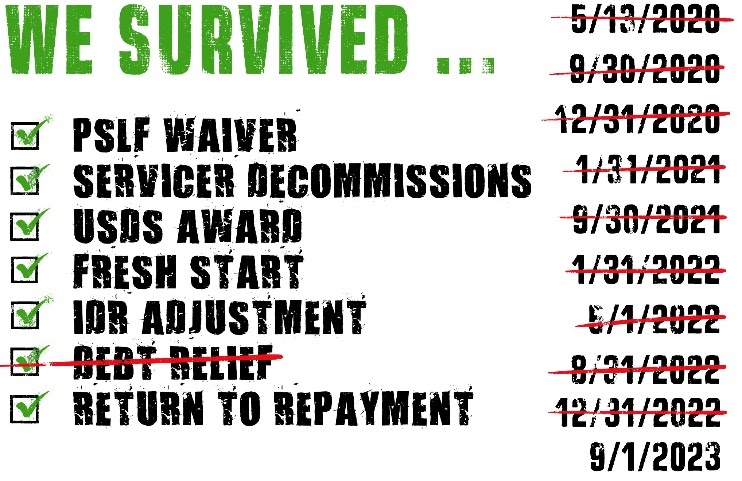
This graphic is part of an email from a US Department of Education official who was recently fired without good cause. Our experiences with this dedicated public servant were always excellent, something we cannot say about others in the DC crowd. The graphic displays a number of important measures that have been enacted by ED-FSA (Federal Student Aid) over the last six years–and one giant failure, general debt relief for more than 30 million citizens. We wish the best for those Department of Education workers who remain, and who may see their jobs made more difficult, privatized, or moved to other agencies. The work cannot be easy for anyone–especially those who care about the folks they serve–the consumers and their families who are less likely to receive justice in the coming months and years.
Related link:
Department of Education contract cuts spur ‘chaos and confusion’ (The Hill)
The Department of Education’s History Shows It is Essential (Time)
by CUPA-HR | February 18, 2025
On February 14, the Department of Education’s Office for Civil Rights (OCR) published a “Dear Colleague” letter “to clarify and reaffirm the nondiscrimination obligations of schools … that receive federal financial assistance” from the department. The letter specifically states that “Federal law … prohibits covered entities from using race in decisions pertaining to admissions, hiring, promotion, compensation, financial aid, scholarships, prizes, administrative support, discipline, housing, graduation ceremonies, and all other aspects of student, academic, and campus life” (emphasis added).
The department warns that “institutions that fail to comply with federal civil rights law may, consistent with applicable law, face potential loss of federal funding,” and cites the government’s authority to do so under “Title VI of the Civil Rights Act of 1964, the Equal Protection Clause of the U.S. Constitution, and other relevant authorities.”
The letter reiterates institutions’ existing legal requirements under federal antidiscrimination laws and is intended to provide clarity to institutions of their nondiscrimination obligations. However, in addition to pointing to existing federal antidiscrimination laws, OCR expands upon the Supreme Court’s decision in Students for Fair Admissions v. Harvard (SFFA) — which banned the use of race-conscious admissions practices at institutions of higher education — to apply more broadly to programs and practices at institutions. Specifically, OCR states that the court’s decision and applicable federal law prohibits covered entities “from using race in decisions pertaining to admissions, hiring, promotion, compensation, financial aid, scholarships, prizes, administrative support, discipline, housing, graduation ceremonies, and all other aspects of student, academic, and campus life.”
OCR provides a few examples of practices that would be illegal under federal antidiscrimination law. One example, which was prohibited in the text of the SFFA decision, is using “students’ personal essays, writing samples, participation in extracurriculars, or other cues” as a means to determine a student’s race to grant preferences to that individual. Additionally, the letter states that using proxies like the one just described is illegal on the systematic level, stating that it is unlawful for institutions to eliminate standardized testing to “achieve a desired racial balance or to increase racial diversity.” In both examples, OCR appears focused on the motive for the action rather than the action itself. Thus, an institution can choose to use or not use standardized tests or focus on certain criteria in applications as long it is not doing so for an impermissible reason.
The letter also says that other programs violate antidiscrimination laws in less direct ways. Specifically, the letter states that “DEI programs … frequently preference certain racial groups and teach students that certain racial groups bear unique moral burdens that others do not” and that “such programs stigmatize students who belong to particular racial groups based on crude racial stereotypes.” They assert that these programs ultimately deny students the ability to fully participate in “the life of a school.”
The letter states that the Department of Education will begin to assess institutional compliance with antidiscrimination law and regulations no later than 14 days after of the date of publication of the letter. In the letter, OCR advises schools to:
As noted above, the letter specifies using race in hiring, promotion and compensation decisions is prohibited under federal law, though the Department of Education does not provide examples of hiring and compensation practices that could be violations of such laws. While the primary federal laws prohibiting discrimination in employment are Title VII of the Civil Rights Act of 1964 and similar equal employment opportunity laws enforced by the Equal Employment Opportunity Commission (EEOC), Title VI can apply to employment decisions. It is unclear how the department intends to enforce this letter with respect to hiring, promotion and compensation practices and whether the Department of Labor or the EEOC will provide further guidance. CUPA-HR intends to seek clarification from the Education Department and the other agencies.
CUPA-HR is assessing the impact that this enforcement letter will have on institutions and will keep members apprised of further developments related to the Trump administration’s DEI orders.
Last week, the department canceled nearly $900 million in contracts at the Institute for Education Sciences.
J. David Ake/Getty Images
The U.S. Education Department has canceled 10 contracts with Regional Educational Laboratories totaling $336 million and a further $33 million of grants to Equity Assistance Centers.
The decision, announced Friday, appears to be another example of Elon Musk’s U.S. Department of Government Efficiency slashing the department’s activities and of anti–diversity, equity and inclusion activist Christopher Rufo’s continuing influence. The cuts also seem to part of the Trump administration’s crusade against programs that could be considered DEI-related, but it’s unclear what all the canceled contracts and grants were actually for.
Regional Educational Laboratories, or RELs, have been around for more than a half century. Among other things, they contribute “research on how experiences within the nation’s education system differ by context and student group, thereby impacting outcomes,” according to the website of the Institute of Education Sciences, which administers the 10 RELs.
On Feb. 10, the Trump administration said it canceled nearly $900 million in Institute of Education Sciences contracts. Then, on Thursday night—in a news release titled “U.S. Department of Education Cancels Additional $350 Million in Woke Spending”—the department announced the severing of the REL contracts.
“Review of the contracts uncovered wasteful and ideologically driven spending not in the interest of students and taxpayers,” the department said. It said REL Midwest “has been advising schools in Ohio to undertake ‘equity audits’ and equity conversations.”
But the release didn’t say how much REL Midwest was receiving for that work or further explain what the other canceled contracts were for. The department said in an email Friday that no further information was “cleared for release.”
President Trump has said he plans to close the Education Department, but the release suggested that these contract cancellations might not be part of a permanent reduction in spending. “The department plans to enter into new contracts that will satisfy the statutory requirements, improve student learning and better serve school districts, state departments of education and other education stakeholders,” the release said.
The release also said the department “terminated grants to four Equity Assistance Centers totaling $33 million, which supported divisive training in DEI, critical race theory and gender identity for state and local education agencies as well as school boards.” It didn’t hint at restoring this funding.
The Equity Assistance Centers were originally referred to as the Desegregation Assistance Centers program, according to the Education Department, and help to ensure “that all students have equitable access to learning opportunities, regardless of their child’s race, sex, national origin, or religion.”
On Thursday afternoon, Rufo, a senior fellow at the conservative Manhattan Institute, posted on X a few examples of what he had telegraphed as “a trove of insane videos, slides and documents from the Department of Education. The whole department functions like a Ponzi scheme for left-wing ideologies.”
Then, roughly three hours before the department announced the cuts, he posted, “I’m hearing murmurs that the @DOGE team is following my posts about the Department of Education.” About an hour before the announcement, he posted that the department’s “DOGE team has terminated $350 million in federal contracts to the DOE’s ‘regional education laboratories’ and ‘equity assistance centers.’ We expose corruption on X, then DOGE wipes it out in D.C.”
Rufo didn’t return requests for comment Friday. The Knowledge Alliance, a coalition advancing research that’s critical to solving education problems, said in a news release Friday that the REL contract cancellations continue “the unprecedented assault on learning and evaluation in the U.S. education system.”
“RELs provide research and technical assistance that is tailored to specific states and communities, helping schools and districts tackle the most pressing challenges they face,” the Knowledge Alliance release said. “Working in close partnership with educators, school leaders and policymakers, RELs help design and implement approaches that meaningfully improve outcomes for everyone in our school communities.”


