The U.S. Department of Education has issued a sweeping directive ordering educational institutions to eliminate race-based considerations from admissions, hiring, and other programs, sparking immediate opposition from civil rights organizations, educational leaders, and advocacy groups.
In a Dear Colleague Letter to schools receiving federal funding, the Department mandated the cessation of race preferences in areas ranging from admissions and hiring to scholarships and disciplinary actions. Schools that fail to comply within 14 days risk losing federal funding.
“With this guidance, the Trump Administration is directing schools to end the use of racial preferences and race stereotypes in their programs and activities,” said Acting Assistant Secretary for Civil Rights Craig Trainor, characterizing the move as “a victory for justice, civil rights laws, and the Constitution.”
The directive, which builds on last year’s Supreme Court decision in Students for Fair Admissions v. Harvard, extends far beyond college admissions to encompass elementary, middle, and high schools. It also targets diversity, equity, and inclusion (DEI) programs, which the Department claims have contributed to “widespread censorship” and a “repressive viewpoint monoculture” on campuses.
The Department’s action specifically prohibits race-based considerations in admissions processes, hiring and promotion decisions, compensation, scholarship and prize distributions, and disciplinary actions. Schools must now evaluate students “according to merit, accomplishment, and character,” according to the directive.
The sweeping nature of the order has raised serious concerns among education experts about its implementation timeline and scope. The 14-day compliance window, in particular, has drawn criticism from school administrators who argue that revamping entire systems of administration, hiring, and student life programs requires more time and careful consideration.
Critics of the directive argue that it represents an overreach of the Department’s authority and misinterprets the Supreme Court’s Harvard decision. While the Court ruled against race-conscious admissions programs at Harvard and the University of North Carolina, many legal experts contend that the ruling’s scope was more limited than the Department’s interpretation suggests.
The Department’s letter also takes aim at what it describes as a “DEI regime” in educational institutions, claiming these programs have fostered censorship through various mechanisms, including “deplatforming speakers who articulate a competing view” and using “bias response teams” to investigate those who object to a school’s racial ideology.
Educational institutions now face the complex task of reviewing and potentially overhauling numerous programs and policies to ensure compliance with the new directive. This includes examining everything from recruitment strategies and scholarship criteria to student organization funding and faculty hiring practices.
The Department has established a complaint system through its Office of Civil Rights for individuals who believe an institution has violated these new guidelines. However, education advocates warn that the rapid implementation timeline could lead to hasty decisions that might inadvertently harm educational equity and access.
As schools scramble to interpret and implement these changes, the directive’s long-term impact on educational equity and institutional diversity remains uncertain. The Department’s enforcement approach and how it will evaluate compliance are yet to be fully detailed, leaving many institutions in a challenging position as they attempt to navigate these new requirements while maintaining their educational missions and values.
The U.S. Department of Education laid off some civil servants on Wednesday, Politico reported, citing multiple people familiar with the matter.
It’s not yet clear how many employees were affected, but they worked for a range of offices within the department, from civil rights to federal student aid. Earlier that day, a federal judge approved the Trump administration’s plan to offer buyouts to vast swaths of the federal workforce.
The move is the latest personnel disruption at the agency. Earlier this month, dozens of employees were put on administrative leave after attending a diversity, equity and inclusion training during the first Trump administration.
Many of the terminated department employees were still in their probationary period, according to Politico, meaning they’d been on the job for less than a year and lacked full civil service protections, though nonprobationary employees were also affected. On Thursday, the Associated Press reported that the Trump administration had ordered all federal agencies to terminate their probationary employees, part of a broader effort to reduce the federal workforce.
The Education Department is considering terminating its contracts for thousands of call center employees hired to answer families’ questions about federal student aid, and may replace them with an artificial intelligence–powered chat bot, The New York Times reported Thursday.
Elon Musk’s Department of Government Efficiency apparently suggested the move, the Times reported, as part of a broader effort to reduce federal spending—which has already led to dozens if not hundreds of layoffs at the Education Department and the cancellation of hundreds of millions of dollars in contracts at the Institute for Education Sciences.
The call centers employ 1,625 people who answer more than 15,000 calls per day, according to an Education Department report. The department greatly increased staffing at their call centers after last year’s bungled launch of the new FAFSA led to an overwhelming influx of calls.
Last September, a Government Accountability Office investigation found that in the first five months of the rollout, three-quarters of calls went unanswered. Last summer, the department hired 700 new agents to staff the lines and had planned to add another 225 after the launch of the 2024–25 FAFSA in November.
One of the helplines DOGE is closely scrutinizing, according to the Times, is operated by the consulting firm Accenture. Accenture also operates the studentaid.gov website, which houses the online platform for the Free Application for Federal Student Aid. The department’s contract with the firm expires Feb. 19. According to sources in the Education Department who spoke with Inside Higher Ed, the department is considering significant reductions to its Accenture contract ahead of its renewal.
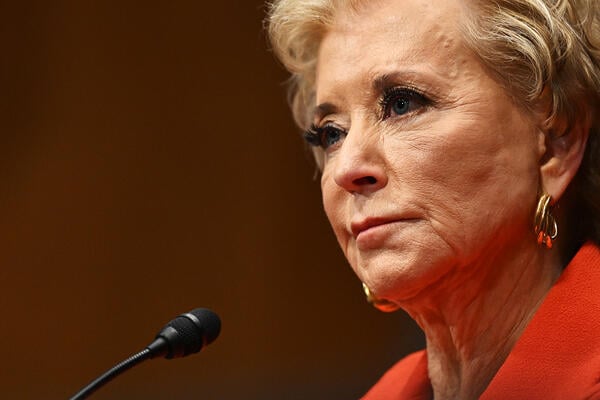
Linda McMahon told senators Thursday that she won’t shut down the Education Department without their approval, quelling any doubt that the majority Republicans may have had about whether she deserved to be appointed to President Donald Trump’s cabinet.
But that doesn’t mean that McMahon and the Trump administration aren’t still looking to make considerable changes to the agency’s programs and potentially dismantle it from the inside out. She said at her confirmation hearing that the department has to go, or at the very least is in need of a major makeover, because it’s rife with bureaucracy that fails to serve students well.
The goal, the former wrestling CEO told the Committee on Health, Education, Labor and Pensions, is to “reorient” the federal agency and ensure it “operate[s] more efficiently”—not defund education, as some critics have suggested.
“We’d like to do this right,” she said. “We’d like to make sure that we are presenting a plan that I think our senators could get on board with, and our Congress to get on board with.”
Questions about the department’s future and whether McMahon would stand up to President Trump if he tries to break the law dominated the nearly three-hour hearing. McMahon, a Trump loyalist and veteran of the first administration, weathered the hearing just fine and will likely be confirmed by the Senate. The committee will vote Feb. 20 on her nomination.
McMahon largely stuck by Trump and defended his actions so far. She also pledged to comply with and uphold the law, respecting Congress’s power over the purse strings by disbursing funds as lawmakers order. “The president will not ask me to do anything that’s against the law,” she later added.
McMahon’s comments break slightly from the president’s record so far. In the first three weeks alone, Trump and Elon Musk have entirely shut down the U.S. Agency for International Development, cut countless contracts and attempted to freeze all federal grants. The president has said he wants to get rid of the Education Department entirely, suggesting he didn’t need congressional action to do so.
During and after the hearing, the majority of Republicans praised McMahon as the right person for the job.
“It is clear that our current education system isn’t working. We have the status quo and that’s actually failing our kids,” Senator Katie Britt of Alabama said in her opening remarks. “Linda McMahon is someone who knows how to reform our education system.”
But for Democrats and Senator Susan Collins, a more centrist Republican from Maine, McMahon’s comments left quite a few questions still lingering and seemed to be, at times, self-contradictory.
“The whole hearing right now feels kind of surreal to me,” said Senator Maggie Hassan, a Democrat from New Hampshire. “It’s almost like we’re being subjected to a very eloquent gaslighting here.”
While many of the senators’ questions focused on special education, K-12, the separation of powers and getting rid of the Education Department, colleges and universities did come up a few times, offering some insight into McMahon’s plans as secretary.
Here are five key higher ed takeaways from the hearing:
Commitments but Few Specifics
Prior to the hearing, Trump’s comments suggested his Education Department would prioritize cutting red tape, returning education to the states, cracking down on campus antisemitism and banning what he calls “gender ideology,” among other things. But speculation swirled about what McMahon would put at the top of her agenda.
On Thursday she made it clear that she’s in lockstep with the president, saying in her opening remarks that “Trump has shared his vision and I’m ready to enact it.” She failed to provide much detail beyond that.
The business mogul, who has limited experience in education, indicated she’ll have some studying to do if she gets confirmed. When asked about topics like diversity, equity and inclusion programs or accreditation, she said, “I’ll have to learn more” or “I’d like to look into it further and get back to you on that.”
For example, when it came to addressing civil rights complaints filed by Jewish students, McMahon was quick to assure Republican lawmakers that colleges will “face defunding” if they don’t comply with the law. She also said that international students who participate in protests Trump deems antisemitic should have their visas revoked. But she didn’t provide further detail on how exactly either repercussion would be enforced.
Additionally, when asked about how she would address a backlog of cases at the Office for Civil Rights, which investigates complaints of discrimination, she said, “I would like to be confirmed and get into the department and understand that backlog.”
‘Pretty Chilling’ Approach to DEI
McMahon declined to say what specific programs or classes might violate Trump’s recent executive order banning diversity, equity and inclusion during a tense exchange with Senator Chris Murphy, a Democrat from Connecticut.
Policy experts said Trump’s executive order should have had little immediate impact on higher ed, as most of its provisions require agency action, but several colleges and universities moved quickly to comply after the order was signed Jan. 21, canceling events and scrubbing websites of DEI mentions.
Murphy highlighted one of those examples, telling McMahon that the United States Military Academy in West Point, N.Y., had shut down a number of its student affinity groups and clubs like the Society of Black Engineers.
He then went on to ask her, “Would public schools be in violation of this order, would they risk funding if they had clubs that students could belong to based on their racial or ethnic identity?” To which McMahon responded, “Well, I certainly today don’t want to address hypothetical situations.”
Murphy said that should be “a pretty easy question,” adding that her lack of response was “pretty chilling.”
“I think you’re going to have a lot of teachers and administrators scrambling right now,” he said.
McMahon did note, however, that all schools can and should celebrate Black History Month and Martin Luther King Jr. Day. She suggested that in saying individuals should be judged by “content of their character,” King was supporting a colorblind approach to policy and looking at all populations as the same, rather than addressing systemic inequities.
Dems Take Issue With DOGE
Several lawmakers had questions for McMahon about Trump’s efforts to cut spending via the Elon Musk–led Department of Government Efficiency, but she didn’t have many answers.
Democrats, in particular, took issue with recent reports that DOGE staffers have access to sensitive student data and recently canceled $881 million in contracts at the Institute of Education Sciences. The Education Department is just one of several agencies under DOGE’s microscope. The Trump administration is also laying off employees at the agency or putting them on administrative leave as part of a broader plan to shrink the federal workforce.
McMahon said she didn’t know “about all the administrative people who have been put on leave,” adding she would look into that. She also didn’t have more information about the IES cuts. But she defended DOGE’s work as an audit.
“I do think it’s worthwhile to take a look at the programs before money goes out the door,” she said.
But Democrats countered that Congress, not the executive branch, has the authority to direct where federal funds should go.
“When Congress appropriates money, it is the administration’s responsibility to put that out as directed by Congress, who has the power of the purse,” said Senator Patty Murray, a Washington Democrat. “If you have input, if you have programs you have looked at that you believe are not effective, then it is your job to come to us, explain why and get the support for that.”
Brief Mention of Accreditation
Despite Trump’s promise to fire accreditors, the accreditation system and the federal policies that govern it received little attention during the hearing—aside from one round of questions.
Senator Ashley Moody, a Florida Republican, said she thinks the current system is unconstitutional, echoing claims that she made as Florida attorney general. The state argued in a 2023 lawsuit that Congress ceded power to private accrediting agencies, violating the U.S. Constitution. A federal judge rejected those claims and threw out the lawsuit in October.
Currently, federal law requires that colleges and universities be accredited by an Education Department–recognized accreditor in order to receive federal student aid such as Pell Grants. But in recent years, Republican-led states—most notably Florida—have bristled at what they see as undue interference from the accreditors and their power to potentially take away federal aid. State lawmakers in Florida now require public colleges to change accreditors regularly. But that process has been sluggish, and officials blame the Education Department.
Moody asked McMahon to commit to review regulations and guidance related to colleges changing accreditors.
“I look forward to working with you on that,” McMahon said. “And there’s been a lot of issues raised about these five to seven accreditors … I think that needs to have a broad overview and review.” (McMahon didn’t specify, but she seemed to refer to the seven institutional accreditors.)
Support for Short-Term Pell
Throughout the hearing, McMahon also reiterated her support for expanding the Pell Grant to short-term workforce training programs that run between eight and 15 weeks, and bolstering other nontraditional means of higher education like apprenticeships.
The nominee noted multiple times that though “college isn’t for everyone,” there should be opportunities for socioeconomic mobility and career development for all. She believes promoting programs like short-term Pell “could stimulate our economy” by providing new routes to pursue skills-based learning and promote trade careers. This mindset could likely lead to less restriction on for-profit technical institutions like cosmetology schools.
One thing neither McMahon nor the Senate panel spent much time on, however, was the Office of Federal Student Aid, its botched rollout of a new application portal or how she would manage the government’s $1.7 trillion student loan portfolio. One of the few mentions of the student debt crisis came up in committee chair Dr. Bill Cassidy of Louisiana’s opening remarks.
“Too many students leave college woefully unprepared for the workforce while being saddled with overwhelming debt that they cannot pay off,” he said. “Your previous experience overseeing [Small Business Administration] loans will be a great asset as the department looks to reform its student loan program.”
The Department of Education is on the Trump chopping block. Details have not been fully released yet, but the president has signaled plans to dismantle it and move some of its key functions elsewhere. The department oversees student loans, federal funds for lower-income students, special education programs and more. Geoff Bennett discussed more with Laura Meckler of The Washington Post.
This audio is auto-generated. Please let us know if you have feedback.
Dive Brief:
The U.S. Department of Education abruptly canceled about $881 million in multiyear research contracts on Monday, sparking a storm of protest from groups concerned about a loss of data accuracy and the dissemination of evidence-based practices.
The temporary Department of Government Efficiency, led by billionaire Elon Musk, said the contracts terminated by the Education Department’s Institute of Educational Sciences include 29 related to diversity, equity and inclusion that total $101 million.
Activities involving the National Assessment of Educational Progress, the College Scorecard and the College Navigator were not impacted by the cancellations, a department spokesperson said in an email.
Dive Insight:
In total, 89 IES contracts worth nearly $900 million were canceled, according to DOGE and the Education Department. The Education Department did not respond to a request for a list of the canceled contracts or provide a reason for the terminations.
President Donald Trump has pledged to eliminate the Education Department, although that action would need congressional approval. As a first step, Trump is expected to issue an executive order in the near future limiting the department’s power and responsibilities.
Last month, the Education Department said it had “removed or archived” hundreds of DEI-related outward-facing documents — including guidance, reports and training materials — to comply with Trump’s executive order to end federal DEI activities. The Education Department also recently put employees charged with leading DEI efforts on paid leave.
As the education field was attempting to better understand the reach of the canceled contracts, several individuals and organizations expressed concern.
The “robust collection and analysis of data are essential for ensuring quality education,” according to a joint statement on Monday from the American Education Research Association and the Council of Professional Associations on Federal Statistics.
The organizations said the contract terminations will prevent the National Center for Education Statistics from participating in international assessments and reporting data on school, college and university finances. Also concerning will be the loss of future survey data to understand the extent of teacher shortages and chronic absenteeism in schools, they said.
Limiting NCES’ work “will have ramifications for the accuracy of national-level data on the condition and progress of education, from early childhood through postsecondary to adult workforce,” AERA and COPAFS said. As a result, “student learning and development will be harmed.”
EdTrust, a nonprofit that aims to eliminate racial and economic barriers in schools, said the abrupt cancellations jeopardize “our collective responsibility to identify and address” inequities affecting populations including students from low-income families, students of color, English language learners, students with disabilities, student parents, and rural students.
Sameer Gadkaree, president and CEO of the Institute for College Access & Success, pointed to a risk that “core Congressional mandates — including increasing transparency and improving student outcomes through evidence-based strategies — will be delayed and may not be possible.
“Without action, ongoing data collection efforts will be impaired and future availability of basic, up-to-date information will be at risk,” Gadkaree said in a statement Tuesday.
But some saw the move as a restart for federal education research.
Mark Schneider, director of the Institute of Education Sciences from 2017 to 2024 and currently a nonresident senior fellow at the American Enterprise Institute, addressed the matter during a LinkedIn conversation Tuesday with Bellwether, a nonprofit education research and analysis organization.
IES systems need to be re-evaluated and modernized, said Schneider, adding he wished he could have made large-scale reforms as director of IES. “Do I wish I had even a modicum of the power that that DOGE [has]? Yes, of course,” he said.
He said the federal education research arm needs significant rebuilding by people knowledgeable about research infrastructure.
“I think we have to understand that this is not a tragedy. This is not a catastrophe. This is an opportunity,” said Scheider.
This audio is auto-generated. Please let us know if you have feedback.
UPDATE: Feb. 12, 2025: The U.S. Department of Education on Tuesday agreed to temporarily block staffers of the Department of Government Efficiency, or DOGE, from accessing student aid information and other data systems until at least Feb. 17.
On that date, a federal judge overseeing the case is expected to rule on a student group’s request for a temporary restraining order to block the agency from sharing sensitive data with DOGE.
Dive Brief:
A group representing University of California students filed a lawsuit Friday to block the Elon Musk-led Department of Government Efficiency from accessing federal financial aid data.
The University of California Student Association cited reports that DOGE members gained access to federal student loan data, which includes information such as Social Security numbers, birth dates, account information and driver’s license numbers.
The complaint accuses the U.S. Department of Education of violating federal privacy laws and regulations by granting DOGE staffers access to the data. “The scale of intrusion into individuals’ privacy is enormous and unprecedented,” the lawsuit says.
Dive Insight:
President Donald Trump created DOGE through executive order on the first day of his second term, tasking the team, led by Tesla co-founder and Trump adviser Musk, with rooting out what the new administration deems as government waste.
DOGE has since accessed the data of several government agencies, sparking concerns that its staffers are violating privacy laws and overstepping the executive branch’s power. With the new lawsuit, the University of California Student Association joins the growing chorus of groups that say DOGE is flouting federal statutes.
One of those groups — 19 state attorneys general — scored a victory over the weekend. On Saturday, a federal judge temporarily blocked DOGE from accessing the Treasury Department’s payments and data system, which disburses Social Security benefits, tax returns and federal employee salaries.
The University of California Student Association has likewise asked the judge to temporarily block the Education Department from sharing sensitive data with DOGE staffers and to retrieve any information that has already been transferred to them.
The group argues that the Education Department is violating the Privacy Act of 1974, which says that government agencies may not disclose an individual’s data “to any person, or to another agency,” without their consent, except in limited circumstances. The Internal Revenue Code has similar protections for personal information.
“None of the targeted exceptions in these laws allows individuals associated with DOGE, or anyone else, to obtain or access students’ personal information, except for specific purposes — purposes not implicated here,” the lawsuit says.
The Washington Post reported on Feb. 3 that some DOGE team members had in fact gained access to “multiple sensitive internal systems,” including federal financial aid data, as part of larger plans to carry out Trump’s goal to eventually eliminate the Education Department.
“ED did not publicly announce this new policy — what is known is based on media reporting — or attempt to justify it,” Friday’s lawsuit says. “Rather, ED secretly decided to allow individuals with no role in the federal student aid program to root around millions of students’ sensitive records.”
In response to the Post’s Feb. 3 reporting, Musk on the same day posted on X that Trump “will succeed” in dismantling the agency.
Later that week, the Post reported that DOGE staffers were feeding sensitive Education Departmentdata into artificial intelligence software to analyze the agency’s spending.
The moves have also attracted lawmakers’ attention. Virginia Rep. Bobby Scott, the top-ranking Democrat on the House’s education committee, asked the Government Accountability Office on Friday to probe the security of information technology systems at the Education Department’s and several other agencies.
An Education Department spokesperson said Monday that the agency does not comment on pending litigation.
What happens now with the US Department of Education now that Elon Musk claims that it no longer exists? It’s hard to know yet, and even more difficult after removing career government workers that we have known for years.
We are saddened to hear of contacts we know, hard working and capable people, in an agency that has been understaffed and politicized.
We also worry for the hundreds of thousands of student loan debtors who have borrower defense to repayment claims against schools that systematically defrauded them–and have not yet received justice.
And what about all those FAFSA (financial aid) forms for students starting and continuing their schooling? How will they be processed in a timely manner?
Just last month, Lorena Tule-Romain was encouraging families with mixed citizenship to fill out the Free Application for Federal Student Aid. She and her staff at ImmSchools, a nonprofit dedicated to improving educational access for immigrants in Dallas, walked students and parents through the complicated federal aid process. Along the way, they offered reassurance that information revealing their undocumented status would be securely held by the Department of Education alone.
Two weeks ago, ImmSchools stopped offering those services. And Tule-Romain said they’re no longer recommending families fill out the FAFSA.
That’s because the Department of Government Efficiency, a White House office run by Elon Musk, now has access to Education Department data systems, potentially including sensitive student loan and financial aid information for millions of students, according to sources both outside and within the department who spoke with Inside Higher Ed.
With immigration officers conducting a blitz of deportations over the past few weeks—and the new possibility of ICE raids at public schools and college campuses—Tule-Romain is worried that applying for federal aid could put undocumented families in jeopardy. Instead of answering parents’ questions about the FAFSA contributor form, she’s hosting Know Your Rights workshops to prepare them for ICE raids.
“Before, we were doing all we could to encourage families to apply for federal aid, to empower students to break cycles and go to college,” she said. “Now we are not in a position to give that advice. It’s heartbreaking.”
Student data is technically protected by the Privacy Act of 1974, which prevents departments from sharing personally identifying information unless strict exceptions are met or a law is passed to allow it. The FUTURE Act, for example, gave the IRS access to financial aid data to simplify the FAFSA process.
Karen McCarthy, vice president of public policy and federal relations at the National Association of Student Financial Aid Administrators, told Inside Higher Ed that because DOGE has not said why they might be interested in department data or what data they have access to, it’s unclear if they’re acting in accordance with the law.
In the past, that law has been strictly enforced for federal employees. In 2010, nine people were accused of accessing President Barack Obama’s student loan records while employed for an Education Department contractor in Iowa. The charges levied against them in federal court were punishable by up to one year in prison and a fine of up to $100,000, according to the Associated Press.
On Thursday, Democratic Representative Bobby Scott of Virginia wrote to the Government Accountability Office requesting a review of the Education Department’s information technology security and DOGE’s interventions in the department in order to determine their legality and the “potential impact on children.” On Friday, a group of students at the University of California sued department officials for allowing potential privacy act violations.
“The scale of the intrusion into individuals’ privacy is massive, unprecedented, and dangerous,” the plaintiffs wrote.
In recent days, labor unions and other groups have sued to block DOGE”s access to databases at several federal agencies and have secured some wins. Early Saturday morning, a federal judge prohibited DOGE from accessing Treasury Department data, ordering Musk’s team to “immediately destroy any and all copies of material” from the department’s systems.
Concerns about DOGE’s use of private student data come as Musk and his staff take a hacksaw to agencies and departments across the federal government, seeking to cut spending and eliminate large portions of the federal workforce. The Trump administration has singled out the Education Department in particular, threatening to gut its administrative capacity or eliminate the department all together.
Spokespeople for DOGE did not respond to a list of questions from Inside Higher Ed. Madi Biederman, the Education Department’s deputy assistant secretary for communications, wrote in an email that DOGE staff “have the necessary background checks and clearances” to view department data and are “focused on making the department more cost-efficient, effective and accountable to the taxpayers.”
“There is nothing inappropriate or nefarious going on,” she added. She did not respond to questions about what data DOGE has access to or how they plan to use it.
A ‘Gaping Hole’ in Data Security
The Education Department’s student financial aid systems contain unique private information that families submit through FAFSA: not only social security numbers but also addresses of relatives, property taxes, sources of income and more. The National Student Loan Database, which tracks loan borrowers’ repayment history and which DOGE may also have access to, includes a wealth of personally identifying information for many more millions of current and former students.
A current department staffer provided Inside Higher Ed with a screenshot from the department’s email address catalog containing the names of 25 DOGE employees who may have access to student data—including a 19-year-old who, according to a Bloomberg report, was once fired by a cybersecurity firm for allegedly leaking internal data. And the Washington Post reported that DOGE employees fed sensitive education department data through artificial intelligence software.
“It could become a gaping hole in our cybersecurity infrastructure,” a former department official said. “I cannot stress enough how unusual it is to just give people access willy-nilly.”
Two former department officials told Inside Higher Ed it is unclear how the DOGE officials could have legally gained access to department data. McCarthy compared DOGE’s murky activity in the department to a “massive data breach within the federal government.”
“Normally, there’d be a paper trail telling us what they’ve requested access to and why,” she said. “We don’t have that, so there’s a lot of uncertainty and fear.”
A current department official told Inside Higher Ed that DOGE staff have been given access to PartnerConnect, which includes information about college programs that receive federal financial aid funding; and that they have read-only access to a financial system. Neither of those databases contain personally identifying information, but the official wasn’t sure DOGE’s access was limited to those sources—and said department staff are worried sensitive student information could be illegally accessed and disbursed.
“It just creates a kind of shadow over the work that everyone’s doing,” a prior department official said.
Fears of a FAFSA ‘Chilling Effect’
Families with mixed citizenship status were some of the hardest hit by the error-riddled FAFSA rollout last year, with many reporting glitches that prevented them from applying for aid until late last summer.
Tule-Romain said mixed-status families in her community had only just begun to feel comfortable with the federal aid form. In the past few weeks that progress has evaporated, she said, and high school counselors working with ImmSchools report a concerning decline in requests for FAFSA consultations from mixed-status students.
“If they weren’t already hesitant, they are extremely hesitant now,” Tule-Romain said.
It’s not just mixed-status families who could be affected if data is shared or leaked. McCarthy said that concerns about privacy could have a wide-spread “chilling effect” on federal aid applications.
“There have always been parents who are reluctant to share their information and the counterargument we always fall back on are the privacy laws,” she said. “A lot of Pell money could get left on the table, or students could be discouraged from going to college altogether.”
Kim Cook, CEO of the National College Attainment Network, said that after last year’s bungled FAFSA rollout, community organizations and government officials had worked hard to rebuild trust in the system and get completion rates back to normal. She worries that fears about privacy could set back those efforts significantly.
“Chaos and uncertainty won’t give us the FAFSA rebound we need,” she said.
The confusion could also affect current college students who need to renew their FAFSA soon. Tule-Romain said one undocumented parent who filled out her first form with ImmSchools last year came back a few weeks ago asking for advice.
She was torn: on the one hand, she didn’t trust Musk and Trump’s White House not to use the information on the form to deport her. On the other, if her son didn’t receive federal aid, he’d have to drop out of college. Ultimately, she chose to renew the application.
“If you came [to America] for a better life, you cannot let fear stop you from pursuing that,” Tule-Romain said. “Instead, you arm yourself with knowledge and you move forward—maybe with fear, but you move forward anyway.”
The Department of Education is ordering an end to all spending and programs that “promote gender ideology,” according to an internal email sent to all department employees and obtained by Inside Higher Ed.
The email lays out steps the department will take to uphold President Trump’s executive order “Defending Women from Gender Ideology Extremism and Restoring Biological Truth to the Federal Government.” Those steps include a “thorough review and subsequent termination of Departmental programs, contracts, policies, outward-facing media, regulations and internal practices that fail to affirm the reality of biological sex.”
The email also prohibits employee resource groups that “promote gender ideology” from meeting on government property or during work hours.
The email appears to be targeted primarily at internal department activities and spending, as opposed to schools and universities that receive federal funding. But the Trump administration has in recent days launched investigations into colleges over the participation of trans athletes in women’s sports, and Trump’s executive order attacking diversity, equity and inclusion could have wide-reaching effects on college programs and curricula.
A spokesperson for the department did not respond to Inside Higher Ed’s request for clarification or comment in time for publication.