This audio is auto-generated. Please let us know if you have feedback.
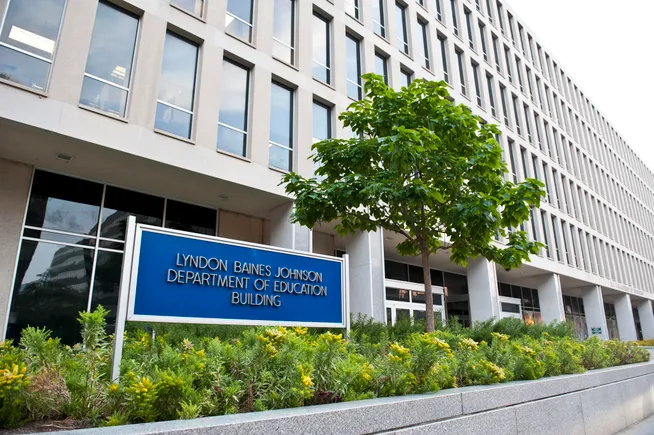
The U.S. Department of Education announced Thursday that it iseliminating its diversity, equity and inclusion initiatives, a move tied to President Donald Trump’s directives to purge DEI from the federal government.
The agency said it has “removed or archived” hundreds of outward-facing documents — including guidance, reports and training materials — that mention DEI. That includes links to resources encouraging educators to incorporate DEI in their classrooms, a department spokesperson said.
The department also put agency employees tasked withleading DEI initiatives on paid leave. A spokesperson declined to comment Friday on how many staff members were placed on leave, citing privacy concerns.
The move comes after Trump signed several executive orders on the first day of his presidency designed to dismantle the Biden administration’s DEI efforts. That includes an order directing all federal agencies to end their DEI programs and positions “under whatever name they appear.”
Additionally, the Education Department dissolved its Diversity & Inclusion Council. The agency has also canceled DEI training and service contracts for staff, totaling more than $2.6 million.
Department officials said they will continue reviewing the agency’s programs to identify other initiatives and groups “that may be advancing a divisive DEI agenda, including programs using coded or imprecise language to disguise their activity.”
This audio is auto-generated. Please let us know if you have feedback.
The U.S. Department of Education announced Thursday that it iseliminating its diversity, equity and inclusion initiatives, a move tied to President Donald Trump’s directives to purge DEI from the federal government.
The agency said it has “removed or archived” hundreds of outward-facing documents — including guidance, reports and training materials — that mention DEI. That includes links to resources encouraging educators to incorporate DEI in their classrooms, a department spokesperson said.
The department also put agency employees tasked withleading DEI initiatives on paid leave. A spokesperson declined to comment Friday on how many staff members were placed on leave, citing privacy concerns.
The move comes after Trump signed several executive orders on the first day of his presidency designed to dismantle the Biden administration’s DEI efforts. That includes an order directing all federal agencies to end their DEI programs and positions “under whatever name they appear.”
Additionally, the Education Department dissolved its Diversity & Inclusion Council. The agency has also canceled DEI training and service contracts for staff, totaling more than $2.6 million.
Department officials said they will continue reviewing the agency’s programs to identify other initiatives and groups “that may be advancing a divisive DEI agenda, including programs using coded or imprecise language to disguise their activity.”
Rachel
Oglesby most recently served as America First Policy Institute’s Chief
State Action Officer & Director, Center for the American Worker. In
this role, she worked to advance policies that promote worker freedom,
create opportunities outside of a four-year college degree, and provide
workers with the necessary skills to succeed in the modern economy, as
well as leading all of AFPI’s state policy development and advocacy
work. She previously worked as Chief of Policy and Deputy Chief of Staff
for Governor Kristi Noem in South Dakota, overseeing the implementation
of the Governor’s pro-freedom agenda across all policy areas and state
government agencies. Oglesby holds a master’s degree in public policy
from George Mason University and earned her bachelor’s degree in
philosophy from Wake Forest University.
Jonathan Pidluzny – Deputy Chief of Staff for Policy and Programs
Jonathan
Pidluzny most recently served as Director of the Higher Education
Reform Initiative at the America First Policy Institute. Prior to that,
he was Vice President of Academic Affairs at the American Council of
Trustees and Alumni, where his work focused on academic freedom and
general education. Jonathan began his career in higher education
teaching political science at Morehead State University, where he was an
associate professor, program coordinator, and faculty regent from
2017-2019. He received his Ph.D from Boston College and holds a
bachelor’s degree and master’s degree from the University of Alberta.
Chase Forrester – Deputy Chief of Staff for Operations
Virginia
“Chase” Forrester most recently served as the Chief Events Officer at America First Policy Institute, where she oversaw the planning and
execution of 80+ high-profile events annually for AFPI’s 22 policy
centers, featuring former Cabinet Officials and other distinguished
speakers. Chase previously served as Operations Manager on the
Trump-Pence 2020 presidential campaign, where she spearheaded all event
operations for the Vice President of the United States and the Second
Family. Chase worked for the National Republican Senatorial Committee
during the Senate run-off races in Georgia and as a fundraiser for
Members of Congress. Chase graduated from Clemson University with a
bachelor’s degree in political science and a double-minor in Spanish and
legal studies.
Steve Warzoha – White House Liaison
Steve
Warzoha joins the U.S. Department of Education after most recently
serving on the Trump-Vance Transition Team. A native of Greenwich, CT,
he is a former local legislator who served on the Education Committee
and as Vice Chairman of both the Budget Overview and Transportation
Committees. He is also an elected leader of the Greenwich Republican
Town Committee. Steve has run and served in senior positions on numerous
local, state, and federal campaigns. Steve comes from a family of
educators and public servants and is a proud product of Greenwich Public
Schools and an Eagle Scout.
Tom Wheeler – Principal Deputy General Counsel
Tom
Wheeler’s prior federal service includes as the Acting Assistant
Attorney General for Civil Rights at the U.S. Department of Justice, a
Senior Advisor to the White House Federal Commission on School Safety,
and as a Senior Advisor/Counsel to the Secretary of Education. He has
also been asked to serve on many Boards and Commissions, including as
Chair of the Hate Crimes Sub-Committee for the Federal Violent Crime
Reduction Task Force, a member of the Department of Justice’s Regulatory
Reform Task Force, and as an advisor to the White House Coronavirus
Task Force, where he worked with the CDC and HHS to develop guidelines
for the safe reopening of schools and guidelines for law enforcement and
jails/prisons. Prior to rejoining the U.S. Department of Education, Tom
was a partner at an AM-100 law firm, where he represented federal,
state, and local public entities including educational institutions and
law enforcement agencies in regulatory, administrative, trial, and
appellate matters in local, state and federal venues. He is a frequent
author and speaker in the areas of civil rights, free speech, and
Constitutional issues, improving law enforcement, and school safety.
Craig Trainor – Deputy Assistant Secretary for Policy, Office for Civil Rights
Craig
Trainor most recently served as Senior Special Counsel with the U.S.
House of Representatives Committee on the Judiciary under Chairman Jim
Jordan (R-OH), where Mr. Trainor investigated and conducted oversight of
the U.S. Department of Justice, including its Civil Rights Division,
the FBI, the Biden-Harris White House, and the Intelligence Community
for civil rights and liberties abuses. He also worked as primary counsel
on the House Judiciary’s Subcommittee on the Constitution and Limited
Government’s investigation into the suppression of free speech and
antisemitic harassment on college and university campuses, resulting in
the House passing the Antisemitism Awareness Act of 2023. Previously, he
served as Senior Litigation Counsel with the America First Policy
Institute under former Florida Attorney General Pam Bondi, Of Counsel
with the Fairness Center, and had his own civil rights and criminal
defense law practice in New York City for over a decade. Upon graduating
from the Catholic University of America, Columbus School of Law, he
clerked for Chief Judge Frederick J. Scullin, Jr., U.S. District Court
for the Northern District of New York. Mr. Trainor is admitted to
practice law in the state of New York, the U.S. District Court for the
Southern and Eastern Districts of New York, and the U.S. Supreme Court.
Madi Biedermann – Deputy Assistant Secretary, Office of Communications and Outreach
Madi
Biedermann is an experienced education policy and communications
professional with experience spanning both federal and state government
and policy advocacy organizations. She most recently worked as the Chief
Operating Officer at P2 Public Affairs. Prior to that, she served as an Assistant Secretary of Education for Governor Glenn Youngkin and worked
as a Special Assistant and Presidential Management Fellow at the Office
of Management and Budget in the first Trump Administration. Madi
received her bachelor’s degree and master of public administration from
the University of Southern California.
Candice Jackson – Deputy General Counsel
Candice
Jackson returns to the U.S. Department of Education to serve as Deputy
General Counsel. Candice served in the first Trump Administration as
Acting Assistant Secretary for Civil Rights, and Deputy General Counsel,
from 2017-2021. For the last few years, Candice has practiced law in
Washington State and California and consulted with groups and
individuals challenging the harmful effects of the concept of “gender
identity” in laws and policies in schools, employment, and public
accommodations. Candice is mom to girl-boy twins Madelyn and Zachary,
age 11.
Joshua Kleinfeld – Deputy General Counsel
Joshua
Kleinfeld is the Allison & Dorothy Rouse Professor of Law and
Director of the Boyden Gray Center for the Study of the Administrative
State at George Mason University’s Scalia School of Law. He writes and
teaches about constitutional law, criminal law, and statutory
interpretation, focusing in all fields on whether democratic ideals are
realized in governmental practice. As a scholar and public intellectual,
he has published work in the Harvard, Stanford, and University of
Chicago Law Reviews, among other venues. As a practicing lawyer, he has
clerked on the D.C. Circuit, Fourth Circuit, and Supreme Court of
Israel, represented major corporations accused of billion-dollar
wrongdoing, and, on a pro bono basis, represented children accused of
homicide. As an academic, he was a tenured full professor at
Northwestern Law School before lateraling to Scalia Law School. He holds
a J.D. in law from Yale Law School, a Ph.D. in philosophy from the
Goethe University of Frankfurt, and a B.A. in philosophy from Yale
College.
Hannah Ruth Earl – Director, Center for Faith-Based and Neighborhood Partnerships
Hannah
Ruth Earl is the former executive director of America’s Future, where
she cultivated communities of freedom-minded young professionals and
local leaders. She previously co-produced award-winning feature films as
director of talent and creative development at the Moving Picture
Institute. A native of Tennessee, she holds a master of arts in religion
from Yale Divinity School.
The Trump administration named 10 new Education Department appointees Thursday, four of whom have previously worked with the America First Policy Institute, a pro-Trump think tank formed in 2021 as the president ended his first term in office.
Education secretary nominee Linda McMahon was a co-founder of AFPI and served as the group’s president and CEO until she was selected to head the department.
Rachel Oglesby, a former AFPI chief state action officer, as chief of staff.
Jonathan Pidluzny, AFPI’s former director of higher education reform, as deputy chief of staff for policy and programs.
Virginia “Chase” Forrester, former AFPI chief events officer, as deputy chief of staff for operations.
Craig Trainor, a former congressional senior special counsel and AFPI senior litigation counsel, as deputy assistant secretary for policy in the Office for Civil Rights. (During his time at AFPI, Trainor worked under Pam Bondi, whom Trump has nominated as his attorney general.)
Steve Warzoha as White House liaison.
Tom Wheeler as principal deputy general counsel.
Madi Biedermann as deputy assistant secretary for the Office of Communications and Outreach.
Candice Jackson, who served in the first Trump administration, as deputy general counsel.
Joshua Kleinfeld as deputy general counsel.
Hannah Ruth Earl as director of the Center for Faith-Based and Neighborhood Partnerships.
National Advisory Committee on Institutional Quality and Integrity
FR Document: 2025-01459 Citation: 90 FR 7677 PDF Pages 7677-7679 (3 pages) Permalink Abstract: This notice sets forth the agenda, time, and instructions to access or participate in the February 19-20, 2025 meeting of NACIQI, and provides information to members of the public regarding the meeting, including requesting to make written or oral comments. Committee members will meet in-person while accrediting agency representatives and public attendees will participate virtually.
This audio is auto-generated. Please let us know if you have feedback.
Colleges could lose access to federal financial aid or face penalties if their external service providers mislead their students, the U.S. Department of Education said Tuesday.
That includes companies that help colleges launch and run online programs.Employees of online program managers, or OPMs, cannot represent themselves as working directly for colleges, including by having email addresses or signatures implying they’re employed by those institutions, according to the guidance.
OPM employees are also not allowed to represent a virtual program as equivalent to a college’s campus-based version if they have dissimilar admissions criteria, completion rates, faculty qualifications or other substantive differences.And workers in recruiting or sales roles can’t call themselves an “academic counselor” or use a similar title if it doesn’t accurately describe their position.
The guidance — issued in the waning days of the Biden administration — aims to add more oversight to colleges’ relationships with OPMs.Student advocacy groups have long called for stricter rules for these companies, which often help colleges launch online programs in exchange for a significant cut of their tuition revenue.
Carolyn Fast, director of higher education policy at The Century Foundation, a left-leaning think tank, praised the letter Wednesday.
“Today’s move by the Department of Education is a step in the right direction, affirming what we already know: OPMs commonly mislead students about the quality of their online programs and that is illegal,” Fast said in a statement. “This action will deter misconduct by OPMs and their college partners and will help protect online college students from the risks posed by predatory OPMs.”
What led to the guidance?
The guidance comes after the Biden administration’s other plans to add oversight to the OPM industry faltered.
In early 2023, the administration said it would review guidance that allows colleges to enter tuition-sharing deals with OPMs that provide recruiting help — so long as it is part of a larger bundle of services.Despite asking for public comment on the matter, the Education Department has not updated or rescinded the 2011 guidance.
At the same time it announced the review, the administration issued separate guidance that would designate OPMs and other organizations as third-party servicers.The change would have subjected them to regulations that would give the department insight into their contracts with colleges.
However, the Education Department quickly delayed the guidance — and eventually rescinded it altogether — amid widespread criticism that it would create burdensome requirements for the higher education sector.
“We finally have clarity, in the last days of the administration, what they’re actually going to do with the guidance around [third-party servicers]” and OPMs, said Phil Hill, an ed tech consultant. “It’s just been this soap opera for 2 1/2 years now.”
However, Hill described Tuesday’s guidance as “petulant rulemaking” from the Biden administration.
“This Dear Colleague letter is attempting to go down to the level of telling colleges and universities and vendors what words are allowable and what aren’t,” Hill said. “And this went through zero process, zero attempt to get input from schools.”
That includes whether the guidance will hamstring colleges from running online programs or whether the policies address the issues they’re trying to solve, Hill said.
Stephanie Hall, senior director for higher education policy at the Center for American Progress, a left-leaning think tank, took a different stance.
The Education Departmentreceived a “treasure trove of comments” when it sought public input in 2023 on policies that would have impacted the OPM sector, Hall argued.
“A lot was given over the past couple of years, and I see this guidance letter as just an extension or a conclusion of that process and not something new that didn’t take any input,” Hall said.
Whether the Trump administration will enforce the new guidance is another matter. But Hall said the guidance is likely to create changes either way.
“Schools are put on notice,” Hall said. “It’s something they take very seriously.”
The incoming Trump administration could also rescind the guidance altogether, though it’s unclear if OPM oversight is a priority issue to incoming officials.
“Are they aware of the impact this could have on online education, and is this going to be on their radars to take action and just immediately get rid of it?” Hill said.
The guidance could also draw legal challenges. The Biden administration’s now-rescinded 2023 guidance sparked a lawsuit from 2U, a prominent OPM.
“This is just waiting for a rescission or a lawsuit,” he said.
What’s in the guidance?
In Tuesday’s guidance, the Education Department listed several examples of statements that OPM employees could make that would likely qualify as misrepresentations. That includes OPM employees using email addresses or signatures that suggest they are directly employed by their college clients.
At least one prominent OPM has caught flak for using college email addresses — 2U. In 2022, The Wall Street Journal reported that the company used the “.edu” email addresses of its college clients in order to recruit prospective students into their online programs.
Hall noted that this is a widespread practice in the OPM industry.
“It’s wonderful that they’re addressing that and making it clear that that could be a substantial misrepresentation, and that schools would be held responsible for that,” she said.
A 2U spokesperson said that the company’s marketing and recruitment teams use university email addresses to reach out to prospective students and include transparent disclosures about their affiliation with the company.
2U is reviewing the Education Department’s letter to ensure the company remains aligned “with evolving regulatory guidance and best practices,” it said in a Thursday statement.
“Transparency has always been at the heart of our mission, and we remain steadfast in upholding this principle as we partner with universities to deliver transformative outcomes through high-quality online education,” 2U said.
Under the department’s new guidance, it could also be misleading for OPM recruiters or sales representatives to present themselves to students as academic counselors or other similar positions.
“Such practices create a high risk of misrepresentation since rewarding an individual based on sales indicates that individual’s role is not focused on impartially counseling prospective or enrolled students, but rather on securing a financial transaction,” the Education Department said.
The overall guidance focuses on disclosures to students, Hall said.
“The biggest change is really just disclosures, disclosures that are going to be coming from the contractor and overseen by the institution,” she said. “I don’t see this mocking the core of the actual online program itself, or its operations or its business model.”
The agency also warned against OPMs casting online programs as equivalent to their campus-based counterparts if they provide “distinct and substantively different” resources to students, including instructors, curricula and advisers.
In a footnote, the guidance cites a class-action lawsuit against the University of Southern California, which alleged that the institution presented its online master’s degree in social work as the same as a campus-based one, even though it outsourced “substantial aspects” of the virtual version to 2U.
2U was not named as a defendant in the case.
The company’s college partners retain full control over core functions of their degree programs, including tuition rates, faculty hiring, and admissions standards and decisions, a 2U spokesperson said. 2U’s clients also review and approve marketing materials for their programs, the spokesperson said.
However, USC and 2U announced in late 2023 plans to wind down their partnership on most of their online programs, including the social work master’s degree.2U continues to support a USC physical therapy program.
Project on Predatory Student Lending is helping represent the students in the lawsuit against the University of Southern California. In a statement Thursday, PPSL President and Executive Director Eileen Connor said she hoped the Trump administration would take the letter’s concerns seriously.
“This letter calls out just how dangerous the OPM industry is to our higher education system,” Connor said.
A running joke with my department chairs, when I was a dean, involved the awarding of merit badges for the accomplishment of a particularly thorny task that the outside world (outside of academia, that is) would not otherwise have known about. Generals rising in the ranks of the military accumulate ribbons. Why shouldn’t there be a similar accumulation of ceremonial badges for accomplishments on the way up the academic leadership ladder?
The granting of ribbons or merit badges will be ever more important in the AI era, in which leaders cannot simply speak about something but rather demonstrate and present the knowledge physically. As the Boy Scouts Merit Badge Hub states, “If it says ‘show or demonstrate,’ that is what you must do. Just telling about it isn’t enough. The same thing holds true for such words as ‘make,’ ‘list,’ ’in the field,’ and ‘collect,’ ‘identify,’ and ‘label.’”
For example: Consider details of just two of the 12 areas Scouts must master to earn the Boy Scout Bird Study Merit Badge:
Demonstrate that you know how to use a bird field guide. Show your counselor that you are able to understand a range map by locating in the book and pointing out the wintering range, the breeding range, and/or the year-round range of one species of each of the following types of birds:
Seabird
Plover
Falcon or hawk
Warbler or vireo
Sparrow
Observe and be able to identify at least 20 species of wild birds. Prepare a field notebook, making a separate entry for each species, and record the following information from your field observations and other references.
Note the date and time.
Note the location and habitat.
Describe the bird’s main feeding habitat and list two types of food that the bird is likely to eat.
Note whether the bird is a migrant or a summer, winter, or year-round resident of your area.
When scouts earn a Bird Study merit badge, you will know they know what they’re talking about and feel comfortable with those scouts running a birding outing. You will feel confident putting matters in their hands.
Wouldn’t this approach be helpful for showing department chair expertise as well?
The Basic Badges: Survival Skills for New Chairs
I propose the list below as standard merit badges any department chair should be working toward. Following the Bird Study merit badge model, the specific tasks involved in earning the first badge are listed in detail. Follow this model and logic if you decide to document and award any or all of these badges at your institution.
Meeting Management Merit Badge (for mastering the art of running efficient faculty meetings while maintaining collegiality and reaching actual decisions)
Show that you are familiar with the terms used to describe meetings by doing the following:
Sketch or trace a meeting room and then label 15 different aspects of a meeting.
Draw up a meeting agenda and label six types of agenda items.
Demonstrate that you know how to properly follow an agenda, use the AV equipment in the room and use the hybrid camera, plus monitor for virtual attendees:
Explain what the Roman numerals mean on an agenda.
Show how to present a PowerPoint to both present and virtual members.
Show how to see, in a timely manner, when a virtual hand is up.
Describe how to bring a latecomer up to speed on an agenda item already discussed.
Demonstrate that you know how to use Robert’s Rules of Order. Show your dean that you are able to understand each chapter in the book, pointing out the debate rules, the tabling-a-motion rules and the majority requirements for each of the following types of votes:
Motion to accept minutes.
Motion to object.
Motion to suspend consideration of an item.
Motion to call the question.
Motion to take up matter previously tabled.
Procedure to select a second when everyone’s hand is up.
Observe and be able to identify at least 20 types of meetings. Prepare a field notebook, making a separate entry for each species of meeting, and record the following information from your field observations and other references:
Note the date and time.
Note the location and room capacity.
Describe each attendee’s main feeding habitat and list two types of food that the attendees are likely to eat.
Note whether the attendee is a tenure-line professor, career-line or part-time/adjunct resident of your department.
Successfully defuse at least three of these common meeting scenarios:
The Filibuster Professor who “just has a quick comment” that turns into a 20-minute monologue.
The Side Conversation Insurgents who start their own parallel meeting.
The “Actually …” Interrupter who must correct every minor detail.
The Passive-Aggressive Email Sender who “just wants to follow up on some concerns.”
Do you not feel comfortable with any department chair who has earned a Meeting Management merit badge running a meeting? Following are some additional basic badges that one can earn for adept engagement in the everyday and more occasional department chair work.
Budget Detective Merit Badge (for successfully tracking down and reallocating mysterious fund transfers and finding hidden resources)
Schedule Tetris Merit Badge (for fitting 47 course sections into 32 available time slots while satisfying everyone’s preferences)
Diplomatic Relations Merit Badge (for mediating between feuding faculty members without taking sides or losing sanity)
Paperwork Expedition Merit Badge (for successfully navigating a minor curriculum change through six committees and three levels of administration)
Assessment Survival Merit Badge (for completing a program review cycle without uttering the phrase “this is meaningless”)
Email Endurance Merit Badge (for maintaining inbox zero while receiving 200-plus daily messages during registration week)
Faculty Development Sherpa Merit Badge (for successfully guiding junior faculty through the tenure process wilderness)
Student Crisis Navigation Merit Badge (for handling everything from grade appeals to mental health emergencies with grace—and documentation)
Accreditation Archive Merit Badge (for creating and maintaining the sacred assessment documents for the next site visit)
Interdepartmental Peace Treaty Merit Badge (for negotiating shared resources and cross-listed courses without starting a turf war)
Conference Room Warrior Merit Badge (for surviving 50 consecutive hours of committee meetings in a single semester while maintaining consciousness)
The Advanced Badges
As department chairs move toward the “seasoned category,” akin to Eagle Scouts’ level of capability, these are the advanced merit badges department chairs should be moving toward:
Everyone Remained Seated Merit Badge (for successfully hosting a controversial speaker event where the Q&A didn’t require campus police, no one stormed out, everyone actually asked questions instead of making speeches, and the dean didn’t have to issue a statement the next day)
Viewpoint Diversity Navigator Merit Badge (for successfully resolving ideological tensions between the “universities are too woke” faculty member and the “universities aren’t woke enough” faculty member, while keeping both the university counsel office and the campus newspaper uninterested in your department)
Social Media Firefighter Merit Badge (for managing department communications after a faculty member’s tweet goes viral, while upholding both academic freedom and institutional reputation)
Soft Landing Merit Badge (for compassionately guiding a struggling graduate student toward alternative career paths while avoiding lawsuits, maintaining departmental reputation for mentoring, preventing faculty infighting about “standards” and ensuring the student leaves with dignity and future options intact)
Side Hustle Tackler Merit Badge (for successfully filling out outside employment forms for a professor simultaneously consulting for Google, running a resale textbook start-up and offering expert testimony, while ensuring university compliance, managing jealous colleagues and preventing the local newspaper from running a “professors don’t work” exposé)
Advanced Curriculum Shepherding Merit Badge (for successfully shepherding an interdisciplinary, multimodal, study abroad–required curriculum through 17 different committees without having it transformed into “just add one elective to the existing major”)
Bonus points for maintaining revolutionary elements like “required internships,” “community-engaged capstone” and “two semesters abroad” through final approval, while fielding questions like “but how will student athletes do this?” and “what exactly do you mean by ‘transdisciplinary’?” and “have you checked with Risk Management?” and “will this impact our parking situation?”
Fresh Blood Without Bloodshed Merit Badge (for successfully integrating an outside chair into a department that has been “led” by the same three faculty trading the position since 1987; includes surviving the “but that’s not how we do it” phase, the “well, in my day as chair” phase and the “I’ll just CC the dean on this email to help you understand our culture better” phase)
Special recognition for preventing the emeritus faculty from creating a shadow government in the department’s second-floor conference room.
The King Has Voluntarily Left the Building Merit Badge (For masterfully orchestrating the graceful exit of a chair who has held the position since before email existed, memorized every bylaw and has an office containing 27 years of irreplaceable paper files organized in a system only they understand; successfully convince them that spending more time on research is a promotion, not a demotion, while ensuring they actually hand over the department credit card and graduate student admissions spreadsheet before leaving)
Bonus points if the outgoing chair willingly shares the password to the department’s social media accounts and reveals where they’ve been hiding the good coffee maker.
The “Reply All” Survivor Merit Badge (for maintaining composure during the dreaded accidental reply-all chain that encompasses the entire college)
And, finally (drum roll) the Ultimate Achievement: The Phoenix Chair Merit Badge (for successfully completing a term as chair and willingly agreeing to serve again)
This highest honor requires:
Completing all previous merit badges
Still believing in the mission of higher education
Retaining enough optimism to sign up for another term
Note: This badge has only been awarded twice in recorded higher education history.
Hollis Robbins is professor of English and former dean of humanities at the University of Utah.
The U.S. Department of Education has named the six inaugural winners of its Postsecondary Success Recognition Program, which were selected out of a pool of 200 institutions invited to apply, according to a Thursday news release.
The program, which was introduced last April, aims to reward institutions that “are enrolling underserved student populations, facilitating successful student transfers and completions, and equipping graduates for careers that lead to economic mobility,” Thursday’s announcement stated.
The winners include three associate degree–granting institutions—CUNY Hostos Community College, Miami Dade College and Salish Kootenai College—and three bachelor’s degree–granting institutions: San José State University, the University of South Carolina and the University of Texas at Arlington.
The department also granted a special “trailblazer” award to Georgia State University, for both its internal efforts to improve graduation rates and its National Institute for Student Success, which supports student success efforts at more than 100 campuses across the country.
The presidents of the winning institutions celebrated the achievement in statements shared by the department.
“As a community college in the South Bronx, the poorest congressional district in the United States, our mission is to provide social mobility through education and to create lifelong learners who will uplift their communities for generations to come,” said Hostos Community College president Daisy Cocco De Filippis. “We understand that for our students, the stakes are high, and the challenges can seem insurmountable. That is why we dedicate ourselves to relentlessly supporting our students and helping them get their degrees with a manos a la obra (all hands on deck) ethos that informs everything we do. While our students’ success is the highest reward, on behalf of the entire faculty and staff of Hostos Community College, I want to express our most sincere gratitude for this recognition of our efforts. Mil gracias y bendiciones.”
On September 24, the Department of Labor (DOL), along with the Partnership on Employment & Accessible Technology (PEAT), published the AI & Inclusive Hiring Framework. The framework is intended to be a tool to support the inclusive use of artificial intelligence in employers’ hiring technology, specifically for job seekers with disabilities.
According to DOL, the framework was created in support of the Biden administration’s Executive Order on the Safe, Secure and Trustworthy Development and Use of Artificial Intelligence. Issued in October 2023, the executive order directed the Secretary of Labor, along with other federal agency officials, to issue guidance and regulations to address the use and deployment of AI and other technologies in several policy areas. Notably, it also directed DOL to publish principles and best practices for employers to help mitigate harmful impacts and maximize potential benefits of AI as it relates to employees’ well-being.
The new AI Framework includes 10 focus areas that cover issues impacting the recruitment and hiring of people with disabilities and contain information on maximizing the benefit of using and managing the risks associated with assessing, acquiring and employing AI hiring technology.
Under each focus area, DOL and PEAT provide key practices and considerations for employers to implement as they work through the AI framework. It is important to note, however, that the framework does not have force of law and that employers do not need to implement every practice or goal for every focus area at once. The goal of the framework is to lead employers to inclusive practices involving AI technology over time.
DOL encourages HR personnel — along with hiring managers, DEIA practitioners, and others — to familiarize themselves with the framework. CUPA-HR will keep members apprised of any future updates relating to the use of AI in hiring practices and technology.
On May 7, the Department of Education’s Office for Civil Rights (OCR) issued a “Dear Colleague” letter to offer guidance on schools’ responsibilities to prevent and rectify discrimination based on race, color, or national origin, including shared ancestry or ethnic characteristics, under Title VI of the Civil Rights Act of 1964 and its implementing regulations. The guidance aims to provide examples to institutions to help them carry out their Title VI requirements.
In its letter, OCR explains that it has received an increase in complaints alleging discrimination based on race, color, or national origin at colleges and universities, as well as public reports of such discrimination. While it does not explicitly state that the guidance is in response to reports of antisemitism on campuses and protests regarding the Israel-Hamas war, the department emphasizes in the letter that Title VI’s “protections extend to students and school community members who are or are perceived because of their shared ancestry or ethnic characteristics to be Jewish, Israeli, Muslim, Arab, Sikh, South Asian, Hindu, Palestinian or any other faith or ancestry,” and that “Title VI’s protections against discrimination based on race, color and national origin encompass antisemitism.”
Additionally, the letter addresses First Amendment considerations, as well as two legal frameworks used by OCR and courts to assess whether schools have violated Title VI through discrimination: hostile environment and different treatment. The guidance illustrates nine examples that may prompt OCR to investigate an institution for possible Title VI violations within these two frameworks. Of particular importance for higher ed HR are the instances outlined in the letter when educators and other faculty members might engage in actions constituting harassment under Title VI, as well as schools’ obligations to address such incidents.
As OCR notes, the guidance lacks the authority of law and does not impose obligations on the public or establish new legal standards. Instead, its purpose is to provide clarity to institutions receiving federal financial assistance regarding their requirements under Title VI. CUPA-HR will continue to share resources regarding institutions’ obligations to address discrimination under federal law.