Tag: Department

  • IPEDS Data Collection Schedule (US Department of Education)

    IPEDS Data Collection Schedule (US Department of Education)

    The IPEDS data collection calendar for 2025-26 has now been posted and is available within the Data Collection System’s (DCS) Help menu, and on the DCS login page at: https://surveys.nces.ed.gov/ipeds/public/data-collection-schedule

    What is IPEDS?

    IPEDS is the Integrated Postsecondary Education Data System. It is a system of interrelated surveys conducted annually by the U.S. Department of Education’s National Center for Education Statistics (NCES). IPEDS gathers information from every college, university, and technical and vocational institution that participates in the federal student financial aid programs. The Higher Education Act of 1965, as amended, requires that institutions that participate in federal student aid programs report data on enrollments, program completions, graduation rates, faculty and staff, finances, institutional prices, and student financial aid. These data are made available to students and parents through the College Navigator college search Web site and to researchers and others through the IPEDS Data Center. To learn more about IPEDS Survey components, visit https://nces.ed.gov/Ipeds/use-the-data/survey-components.

    How is IPEDS Used?

    IPEDS provides basic data needed to describe — and analyze trends in — postsecondary education in the United States, in terms of the numbers of students enrolled, staff employed, dollars expended, and degrees earned. Congress, federal agencies, state governments, education providers, professional associations, private businesses, media, students and parents, and others rely on IPEDS data for this basic information on postsecondary institutions.

    IPEDS forms the institutional sampling frame for other NCES postsecondary surveys, such as the National Postsecondary Student Aid Study.

    Which Institutions Report to IPEDS?

    The completion of all IPEDS surveys is mandatory for institutions that participate in or are applicants for participation in any federal student financial aid program (such as Pell grants and federal student loans) authorized by Title IV of the Higher Education Act of 1965, as amended (20 USC 1094, Section 487(a)(17) and 34 CFR 668.14(b)(19)).

    Institutions that complete IPEDS surveys each year include research universities, state colleges and universities, private religious and liberal arts colleges, for-profit institutions, community and technical colleges, non-degree-granting institutions such as beauty colleges, and others.

    To find out if a particular institution reports to IPEDS, go to College Navigator and search by the institution name.

    What Data are Collected in IPEDS?

    IPEDS collects data on postsecondary education in the United States in eight areas: institutional characteristics; institutional prices; admissions; enrollment; student financial aid; degrees and certificates conferred; student persistence and success; and institutional resources including human, resources, finance, and academic libraries.

    Source link

  • How the 2025 U.S. Department of Education Reorganization Fulfills Grover Norquist’s Dream (Glen McGhee)

    How the 2025 U.S. Department of Education Reorganization Fulfills Grover Norquist’s Dream (Glen McGhee)

    In 2001, conservative activist Grover Norquist declared that his goal was to shrink government “to the size where I can drag it into the bathroom and drown it in the bathtub.” More than two decades later, under the leadership of Secretary Linda McMahon, the U.S. Department of Education’s March 2025 reorganization delivers on that radical vision—not with fire and fury, but with vacancies, ambiguity, and quiet institutional collapse.

    Vacant Seats, Hollow Power

    With dozens of senior leadership roles left vacant, enforcement functions gutted, and policymaking handed over to political allies and industry insiders, the Department no longer resembles a federal agency tasked with protecting students and public investment. Instead, it has become a hollowed-out vessel primed for deregulation, privatization, and corporate exploitation.

    The new organizational chart is littered with the word “VACANT.” From Chiefs of Staff and Deputy Assistant Secretaries to senior advisors in enforcement, civil rights, and postsecondary education, entire divisions have been effectively immobilized. The Office of Civil Rights is barely staffed at the top. The Rehabilitation Services Administration is leaderless. The General Counsel’s office lacks oversight in key regulatory areas. This is not streamlining—it is strategic self-sabotage.

    Federal Student Aid (FSA), overseeing over $1.5 trillion in loans, is run by an acting chief. Critical offices such as the Office of Postsecondary Education (OPE) are fragmented, missing key leadership across multiple branches—especially those charged with accreditation, innovation, and borrower protections.

    The Kent Controversy: A Symptom of Systemic Rot

    The collapse of federal oversight is not only evident in the vacancies—it is also embodied in controversial political appointments. As education policy watchdog David Halperin has reported, the Trump administration’s nominee for Under Secretary of Education, Nicholas Kent, epitomizes the revolving door between the Department of Education and the for-profit college industry.

    Kent’s career includes roles at Education Affiliates, which in 2015 paid $13 million to settle a Department of Justice case involving false claims for federal student aid, and later at Career Education Colleges and Universities (CECU), the lobbying group for the for-profit college sector. Under Kent’s policy leadership at CECU, the organization actively fought against borrower defense rules, gainful employment regulations, and other safeguards meant to protect students from exploitative educational institutions.

    Despite this record, the Senate Health, Education, Labor and Pensions (HELP) Committee advanced Kent’s nomination on May 22, 2025, in a party-line 12–11 vote—without a hearing. HELP Ranking Member Bernie Sanders objected, saying, “In my view, we should not be confirming the former lobbyist that represented for-profit colleges.” Advocates, including Halperin and six education justice organizations, sent a letter to Chairman Bill Cassidy calling for public scrutiny of Kent’s background and the Trump administration’s destructive higher education agenda.

    Among their concerns are the elimination of key enforcement staff and research arms at the Department, the cancellation of ongoing research contracts, the rollback of borrower defense and gainful employment protections, the $37 million fine reversal against Grand Canyon University for deceptive practices, and the Department’s silence on accreditation reform and oversight of predatory schools. These developments, the letter argued, mark a decisive return to the era of unchecked corporate education—where taxpayer dollars are funneled to dubious institutions and students are left with mountains of debt and worthless credentials.

    “Mission Accomplished” for the Privatization Movement

    This version of the Department of Education, stripped of its regulatory muscle and stocked with industry sympathizers, is not an accident. It’s the culmination of decades of libertarian, neoliberal, and religious-right agitation to disempower public education. The policy pipeline now flows directly from organizations like the Heritage Foundation and ALEC to appointed officials with deep ties to the industries they were once charged with policing.

    Rather than serving the public, the department’s primary role now appears to be facilitating the private sector’s conquest of higher education—through deregulation, outsourcing, and the erosion of civil rights protections.

    A Shrinking Federal Presence, an Expanding Crisis

    The consequences are far-reaching. Marginalized students—Black, brown, low-income, first-generation, disabled—depend disproportionately on federal guarantees, oversight, and funding. As these protections recede, so too does their access to meaningful educational opportunity. Instead, they are increasingly funneled into high-debt, low-return programs or shut out entirely.

    Meanwhile, the political vacuum left by this strategic dismantling is being filled by corporate actors, right-wing religious institutions, and profit-seeking “ed-tech” startups. The dream of public education as a democratic equalizer is being replaced by a market of extraction and exploitation.

    The Dream Realized

    Grover Norquist’s fantasy of drowning the government has now been partially fulfilled in the U.S. Department of Education. What remains is an agency in name only—a shell that no longer enforces its core mission. In the name of efficiency and deregulation, the department has abandoned millions of students and ceded its authority to those who view education as a commodity rather than a public right.

    The danger now is not only what’s been lost, but what is being built in its place. The Higher Education Inquirer will continue to monitor the ongoing capture of education policy and fight for a system that serves students, not shareholders.

    Sources:

    U.S. Department of Education, Organizational Chart, March 17, 2025

    David Halperin, Republic Report, “The Senate Shouldn’t Vote on Trump Higher Education Pick without a Hearing”

    U.S. Department of Justice press releases on Education Affiliates

    Politico Pro Education updates, May 2025

    Senate HELP Committee voting record, May 22, 2025

    Heritage Foundation and CECU policy recommendations

    Source link

  • Trump Education Department Delays Return of Laid-Off Workers Over Logistics – The 74

    Trump Education Department Delays Return of Laid-Off Workers Over Logistics – The 74


    Get stories like this delivered straight to your inbox. Sign up for The 74 Newsletter

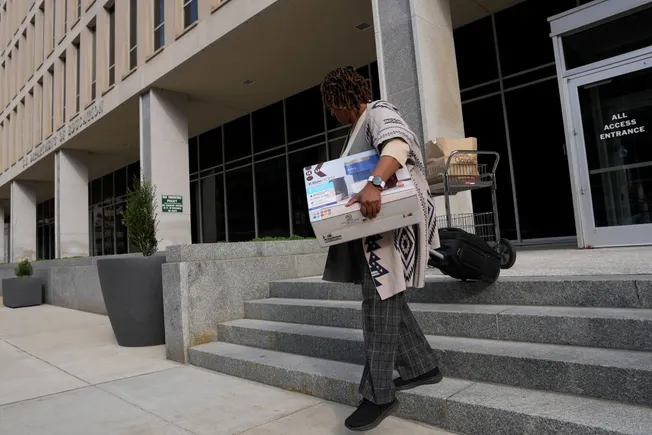
    Parking permits. Desk space. Access cards.

    Ordered to bring back roughly 1,300 laid-off workers, the U.S. Department of Education instead has spent weeks ostensibly working on the logistics. Meanwhile, the Trump administration wants the U.S. Supreme Court to decide they don’t have to restore those jobs after all.

    The legal argument over the job status of Education Department workers is testing the extent to which President Donald Trump and Education Secretary Linda McMahon can reshape the federal bureaucracy without congressional approval.

    The employees, meanwhile, remain in limbo, getting paid for jobs they aren’t allowed to perform.

    An analysis done by the union representing Education Department employees estimates the government is spending about $7 million a month for workers not to work. That figure does not include supervisors who are not part of the American Federation of Government Employee Local 252.

    “It is terribly inefficient,” said Brittany Coleman, chief steward for AFGE Local 252 and an attorney in the Office for Civil Rights. “The American people are not getting what they need because we can’t do our jobs.”

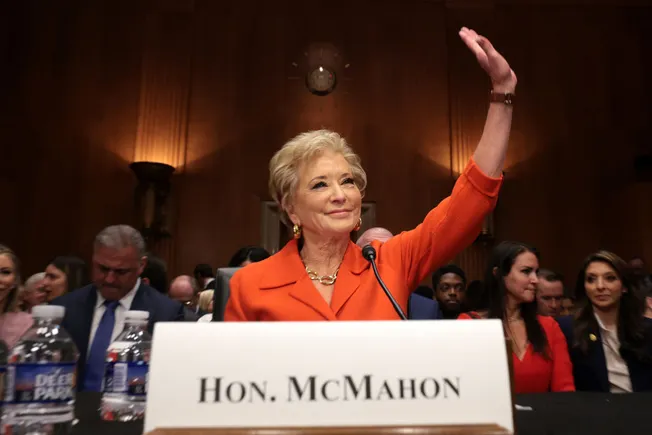
    McMahon announced the layoffs in March, a week after she was confirmed by the Senate, and described them as a first step toward dismantling the Education Department. A few days later, Trump signed an executive order directing McMahon to do everything in her legal authority to shut down the department.

    The Somerville and Easthampton school districts in Massachusetts, along with the American Federation of Teachers, other education groups, and 21 Democratic attorneys general sued McMahon over the cuts. They argued the layoffs were so extensive that the Education Department would not be able to perform its duties under the law.

    The layoffs hit the Office for Civil Rights, Federal Student Aid, and the Institute of Education Sciences particularly hard. These agencies are responsible for federally mandated work within the Education Department. By law, only Congress can get rid of the Education Department.

    U.S. District Court Judge Myong Joun agreed, issuing a sweeping preliminary injunction in May that ordered the Education Department to bring laid off employees back to work and blocked any further effort to dismantle or substantively restructure the department.

    The Trump administration sought a stay of that order, and the case is on the emergency docket of the Supreme Court, where a decision could come any day.

    In the administration’s request to the Supreme Court, Solicitor General John Sauer argued that the harms the various plaintiffs had described were largely hypothetical, that they had not shown the department wasn’t fulfilling its duties, and that they didn’t have standing to sue because layoffs primarily affect department employees, not states, school districts, and education organizations.

    Sauer further argued that the injunction violates the separation of powers, putting the judicial branch in charge of employment decisions that are the purview of the executive branch.

    “The injunction rests on the untenable assumption that every terminated employee is necessary to perform the Department of Education’s statutory functions,” Sauer wrote in a court filing. “That injunction effectively appoints the district court to a Cabinet role and bars the Executive Branch from terminating anyone.”

    The Supreme Court, with a conservative 6-3 majority, has been friendlier to the administration’s arguments than lower court judges. Already the court has allowed cuts to teacher training grants to go through while a lawsuit works its way through the courts. And it has halted the reinstatement of fired probationary workers.

    The Education Department did not immediately respond to a request for comment.

    Last week, Joun issued a separate order telling the Education Department that it must reinstate employees in the Office for Civil Rights. The Victims Rights Law Center and other groups had described thousands of cases left in limbo, with children suffering severe bullying or unable to safely return to school.

    Meanwhile, the Education Department continues to file weekly updates with Joun about the complexities of reinstating the laid-off employees. In these court filings, Chief of Staff Rachel Oglesby said an “ad hoc committee of senior leadership” is meeting weekly to figure out where employees might park and where they should report to work.

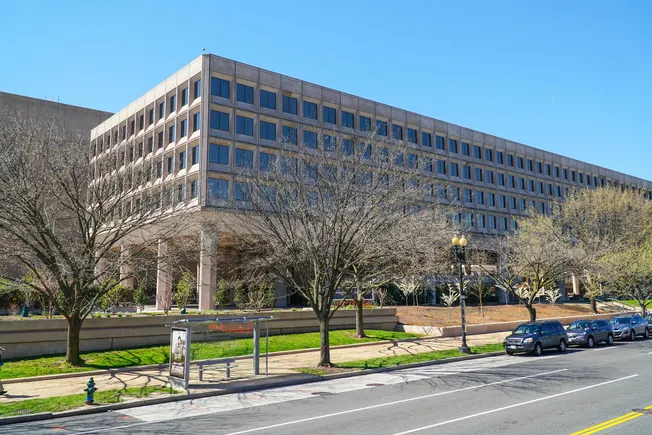
    Since the layoffs, the department has closed regional offices, consolidated offices in three Washington, D.C. buildings into one, reduced its contracts for parking space, and discontinued an interoffice shuttle.

    In the most recent filing, Oglesby said the department is working on a “reintegration plan.”

    Coleman said she finds these updates “laughable.”

    “If you are really willing to do what the court is telling you to do, then your working group would have figured out a way to get us our laptops,” she said.

    This story was originally published by Chalkbeat. Chalkbeat is a nonprofit news site covering educational change in public schools. Sign up for their newsletters at ckbe.at/newsletters.


    Get stories like these delivered straight to your inbox. Sign up for The 74 Newsletter

    Source link

  • Documents from Education Department (includes 90/10 Rule and Income-Driven Repayment)

    Documents from Education Department (includes 90/10 Rule and Income-Driven Repayment)

    Rules

    Classification of Revenue under Title IV

    FR Document: 2025-12554
    Citation: 90 FR 29734
    PDF Pages 29734-29737 (4 pages)
    Permalink
    Abstract: The U.S. Department of Education (Department) is revising its prior interpretation and clarifying its classification of revenue received by a proprietary institution of higher education under the Title IV Revenue and Non-Federal Education Assistance Funds regulations called the “90/10 Rule”.

    Notices

    Agency Information Collection Activities; Proposals, Submissions, and Approvals:

    Impact Aid Program—Application for Section 7002 Assistance
    FR Document: 2025-12529
    Citation: 90 FR 29854
    PDF Pages 29854-29855 (2 pages)
    Permalink
    Abstract: In accordance with the Paperwork Reduction Act (PRA) of 1995, the Department is proposing an extension without change of a currently approved information collection request (ICR).
    Impact Aid Program—Application for Section 7003 Assistance
    FR Document: 2025-12530
    Citation: 90 FR 29855
    PDF Page 29855 (1 page)
    Permalink
    Abstract: In accordance with the Paperwork Reduction Act (PRA) of 1995, the Department is proposing an extension without change of a currently approved information collection request (ICR).

    Income Driven Repayment Plan Request for the William D. Ford Federal Direct Loans and Federal Family Education Loan Programs; Correction

    Matching Documents

    Subscribe to Any Search Result

    Did you know that you can subscribe to any search result? After performing any search on FederalRegister.gov you can choose to receive any future documents that match your search via email. Just click the subscribe button on the right side of the search box.

    Subscribe to an Agency’s Documents

    From any agency page on FederalRegister.gov you can choose to receive email updates of new documents from that agency. Choices of subscriptions include Documents on Public Inspection, Newly Published Documents, and Documents Deemed Significant.

    Source link

  • Trump’s Department of Education Continues to Drag Feet on Borrower Defense

    Trump’s Department of Education Continues to Drag Feet on Borrower Defense

    On June 26th, the US Department of Education was brought to the Ninth District Court (and Judge Alsup) to show how many the Borrower Defense to Repayment cases that have been resolved per court order.  While we wait for a transcript of the latest episode of Sweet v McMahon, what we can tell you is that the Trump government continues to drag its feet in paying back debtors who have been defrauded.  

    Source link

  • Ed Department Announces FAFSA Changes, Oct. 1 Launch Date

    Ed Department Announces FAFSA Changes, Oct. 1 Launch Date

    Richard Stephen/iStock/Getty Images Plus 

    The Department of Education plans to launch this year’s Free Application for Federal Student Aid on Oct. 1, the agency announced Monday.

    It would be the first time since 2022 that the form is released by the traditional deadline date, after a major overhaul and technical issues pushed back the 2023–24 launch to January and the 2024–25 launch to late November.

    The department will also repeat a new beta-testing period that was piloted last fall. Officials plan to gradually roll out the FAFSA to a limited number of school districts and college-access organizations starting in August and will begin sending test Institutional Student Information Records to colleges at the same time.

    They’re also introducing a simplified process for inviting contributors to the form, a step that frustrated many families over the past two years and stymied completion of the new FAFSA. Instead of requiring a unique Contributor ID code, this year students can invite a parent or guardian to contribute to the form by entering their email, and contributors don’t have to be registered on StudentAid.gov beforehand.

    Source link

  • State Department Unveils Student and Exchange Visitor Visa Social Media Vetting Guidance – CUPA-HR

    State Department Unveils Student and Exchange Visitor Visa Social Media Vetting Guidance – CUPA-HR

    by CUPA-HR | June 24, 2025

    On June 18, the Department of State issued a cable to all U.S. diplomatic and consular posts formally expanding the screening and vetting process for applicants of F, M and J (FMJ) nonimmigrant visas. The State Department guidance resumes FMJ appointment scheduling after a previous announcement from the agency paused all student visa interviews as they prepared for the new social media screening and vetting guidance.

    Background

    At the end of May, the State Department announced that U.S. embassies and consular sections were pausing new student visa interviews as they awaited further guidance on new social media screening and vetting requirements. CUPA-HR joined the American Council on Education and other higher education associations on a letter to Secretary of State Marco Rubio requesting the agency quickly implement the new vetting measures to ensure new student visas could be efficiently processed before the 2025-2026 academic year. No further guidance was publicly announced between the announced pausing of student visa interviews and the cable sent out to all diplomatic and consular posts.

    New Screening and Vetting Guidance

    The cable directs consular sections to resume scheduling FMJ appointments after implementing the new vetting procedures. The guidance requires officers to conduct “a comprehensive and thorough vetting of all FMJ applicants, including online presence, to identify applicants who bear hostile attitudes toward our citizens, culture, government, institutions, or founding principles; who advocate for, aid, or support designated foreign terrorists and other threats to U.S. national security; or who perpetrate unlawful antisemitic harassment or violence.” The posts are directed to implement the new guidance within five business days.

    As explained in the cable, consular officers are directed to conduct intake and interviews in accordance with standard procedures, but once an FMJ applicant is otherwise eligible for the requested nonimmigrant status, officers must temporarily refuse the case under Section 221(g) of the Immigration and Nationality Act (INA). After refusing the case, officers must request the applicant set all social media accounts to “public,” after which the officer must examine “the applicant’s entire online presence — not just social media activity — using any appropriate search engines or other online resources.”

    The new vetting procedures could limit the consular officers’ ability to process student visa applications quickly and efficiently as the cable also mentions that consular sections should “consider the effect of this guidance on workload” when resuming the scheduling of FMJ appointments. Even with these concerns, the cable does request expedited appointments for certain FMJs, including J-1 physicians and F-1 students seeking to study at U.S. institutions where the international student body constitutes 15 percent or less of the total student population.

    While much of the advocacy from interested stakeholders on this issue revolves around students, individuals seeking J-1 visas to participate in cultural and educational exchange programs to conduct research or teach at institutions could be subject to an enhanced level of scrutiny. CUPA-HR will continue to monitor for updates related to the FMJ vetting processes.


    Source link

  • Do states have ‘statutory right’ to Education Department data and guidance?

    Do states have ‘statutory right’ to Education Department data and guidance?

    This audio is auto-generated. Please let us know if you have feedback.

    States suing the U.S. Department of Education over its mass layoffs claim the reduction in force is impacting the agency’s legally required functions, including research and grant distribution. But in documents submitted to the U.S. Supreme Court on Monday, the Education Department said states “have no statutory right to any particular level of government data or guidance.”

    The department is pushing the high court to let its massive RIF go through after being paused by both a federal district judge and the 1st U.S. Circuit Court of Appeals. In court documents, the agency said “it can carry out its statutorily mandated functions with a pared-down staff and that many discretionary functions are better left to the States.”

    Its request to carry through on the RIFs comes even as the agency notified “all impacted employees” on administrative leave in a June 6 email obtained by K-12 Dive that it is “actively assessing how to reintegrate you back to the office in the most seamless way possible” to comply with the court orders. 

    On June 16 — the same day as the agency’s latest Supreme Court filing —  it also emailed RIFed staff for information to help the department in “understanding potential reentry timelines and identifying any accommodations that may be needed.” 

    However, several of the more than 1,300 department employees put on administrative leave in March told K-12 Dive last week that they do not think the agency intends to actually bring them back. This is despite many of the employees having worked on legally required tasks the department has lagged on or trimmed down since the layoffs, as well as the department’s efforts to seemingly comply with the court orders. 

    “While they’re saying we’re coming back, they’re also still appealing the [RIF] process,” said one Education Department employee who is on administrative leave because of the RIF. “It feels like they’re slow-walking it.” 

    Employees ‘in limbo’ as department lags on statutory tasks

    The department is still paying all these employees’ salaries — amounting to millions of dollars — only for them to sit tight. 

    According to an email from American Federation of Government Employees Local 252, the union representing a majority of the laid-off employees, the Education Department is spending at least $7 million in taxpayer dollars per month to workers on leave.

    That amount is, in fact, only for 833 of the 962 laid-off Education Department workers that the union represents and whom it was able to reach for its analysis. Thus, much more than $7 million is actually being spent per month to keep the more than 1,300 laid-off employees on payroll. 

    Since March, the department has spent approximately $21.5 million on just those 833 employees, according to data provided by AFGE Local 252.

    While the Education Department emailed laid-off employees multiple times in the past month to gather information for “reintegration and space planning efforts” on government IDs, retirement plans and devices, among other things, several employees called this a superficial effort to comply with court orders. 

    In the meantime, employees are free to apply to other jobs, start their own organizations, and go on vacation if they so choose, according to employees K-12 Dive spoke with as well as an AFGE Local 252 spokesperson. 

    “We feel like we’re in limbo,” said an employee who has been on administrative leave since March. “They haven’t talked to us.” 

    This employee and the others who spoke to K-12 Dive asked to remain anonymous for fear that identification could negatively affect their employment status or severance terms.

    Condition of Education report falls behind

    This employee would have been working at the National Center for Education Statistics on data related to the Condition of Education Report, which is required by law — and for which the department missed its June 1 deadline “for the first time ever,” according to Sen. Patty Murray, D-Wash. 

    After leaving just a handful of employees in NCES, the department has so far released only a webpage titled “Learn About the New Condition of Education 2025: Part I,” which includes significantly less information than in previous years.

    “Now all we have is a bare-bones ‘highlight’ document with no explanation to Congress or to the public,” Murray said in a June 5 Senate Health, Education, Labor and Pensions Committee hearing. “And that is really unacceptable — students, families, teachers all deserve to see a full report.” 

    In 2024, the report was a 44-page document including new analysis, comparisons with past years, and graphs to visualize the data. It included over 20 indicators grouped by topics from pre-kindergarten through secondary and postsecondary education, labor force outcomes and international comparisons. Individual indicators ranged from school safety issues like active shooter incidents to recovery from the coronavirus pandemic. 
      
    This year, the department said it would be “updating indicators on a rolling basis” due to its “emphasis on timeliness” and would determine “which indicators matter the most.” More than two weeks after its missed June 1 deadline, however, the report still only includes a highlights page with five indicators linking to data tables, many of which had already been released. 

    Meanwhile, Democratic lawmakers have also expressed concerns that the department lagged on its statutory responsibilities to disburse key federal funds, including for Title I-A — which they said took three times as long to distribute than under the last administration. The delay in funding distribution gave states and districts less time to plan for helping underserved students, including those experiencing homelessness, lawmakers said.

    The U.S. Department of Education did not respond to K-12 Dive’s requests for comment on its missed June 1 deadline for the report or on how it will increase government efficiency and cut costs while spending millions on salaries for employees who are not working. 

    Sen. Patty Murray speaks into a microphone

    Senate Appropriations Committee ranking member Sen. Patty Murray, D-Wash., questions McMahon during a hearing about the proposed 15% cut to the Education Department’s budget on Capitol Hill June 3, 2025, in Washington, D.C. The budget was consistent with President Trump’s executive order to wind down the Education Department.

    Chip Somodevilla/Getty Images via Getty Images


    Department says RIF impacts are “speculative”

    However, in its Supreme Court filing on Monday, the department dismissed as “speculative allegations” states’ complaints of disruptions to services as a result of the RIFs.

    The states, in their filing last week seeking to block the RIFs, said that “collection of accurate and reliable data is necessary for numerous statutory functions within the Department that greatly affect the States.” 

    The department relies on this data “to allocate billions of dollars in educational funds among the States under Title I of the Elementary and Secondary Education Act,” the states said in their June 13 response to the administration’s plea to the Supreme Court to let its RIFs take effect. The department has given “no explanation of how such allocation can occur without the collection and analysis of underlying data, or of how the data can be collected or analyzed without staff,” their filing said.

    In its Monday response, the department maintained that it is not required by law to maintain “a particular quality of audit.” The states arguing to maintain the department’s previous staffing levels are trying to “micromanage government staffing based on speculation that the putative quality of statutorily mandated services will decline,” the agency said.

    However, when pressed by Sen. Murray in a budget hearing earlier this month, Education Secretary Linda McMahon said “no” analysis was conducted about how the firings would impact the agency’s functions or how it would continue its statutorily required responsibilities without much of its staff. The department did read “training manuals and things of that nature” prior to the layoffs, she said, and had conversations with “the department.” 

    But several laid-off staffers told K-12 Dive that they were never spoken to about how their responsibilities would continue to be fulfilled after their departure. 

    “They don’t understand what they’ve cut,” an employee said.

    Source link

  • State Department Screening Visa Applicants’ Social Media

    State Department Screening Visa Applicants’ Social Media

    John McDonnell/Getty Images

    The U.S. State Department is rolling out sweeping new rules for vetting student visa applicants using their social media presence, according to Politico.

    The new process will include screening for “any indications of hostility towards the citizens, culture, government, institutions or founding principles of the United States,” according to an internal State Department cable. 

    Department officials will also look for posts that signal “advocacy for, aid or support for foreign terrorists and other threats to national security” and “support for antisemitic harassment or violence,” specifically citing support for Hamas—a charge commonly levied against student protesters advocating for Palestinian rights—as grounds for rejection. The cable also directs officials to cull applicants who “demonstrate a history of political activism.”

    The news comes a few weeks after Secretary of State Marco Rubio paused all student visa interviews in order to implement a new screening policy focusing on students’ online activity. The Associated Press reported that the department rescinded the pause, but applicants who don’t allow the government to review their social media accounts could be rejected.

    The cable is the Trump administration’s latest effort to curtail the flow of international students to the U.S., as tens of thousands of foreign students await approval of their visas after months of delays and with only weeks until the start of the fall semester. 

    State Department spokespeople did not respond to a list of questions from Inside Higher Ed in time for publication. 

    Source link

  • As Cuts to Department of Veterans Affairs Loom, Our Commitment to Veterans Education Faces a Critical Test

    As Cuts to Department of Veterans Affairs Loom, Our Commitment to Veterans Education Faces a Critical Test

    “VA support isn’t a gift, it’s a debt.”

    That was the message displayed on signs across the National Mall on June 6, where thousands of veterans rallied against sweeping federal job cuts. With the Dropkick Murphys on stage and lawmakers like Sens. Tammy Duckworth (D-IL) and Ruben Gallego (D-AZ) in the crowd, the “Unite for Veterans, Unite for America” rally marked a striking show of both unity and frustration.

    While many agencies are facing delays or court injunctions, the Department of Veterans Affairs (VA) is moving forward with plans to eliminate approximately 83,000 positions, or about 15 percent of its workforce. Public attention has been understandably focused on the impact these cuts may have on veterans’ health care. But staffing losses could also disrupt access to veterans’ education benefits, just as even more veterans and service members may be turning to higher education and career training.

    Among the many education and training benefits administered by the VA, the Post-9/11 GI Bill is the cornerstone of financial aid for military learners, including veterans, service members, and their families. From 2009 to 2019, the federal government budgeted nearly $100 billion for the program, with 2.7 million enlisted veterans eligible to use those benefits over the next decade. And the return on investment is clear: Veterans who use their education benefits complete college at twice the rate of other independent students—those typically supporting themselves without parental aid—according to research by the American Institutes for Research.

    Despite the GI Bill’s importance, military learners often struggle to access the benefits they’ve earned. Eligibility rules can be confusing, and transferring benefits to spouses or dependents involves time-consuming red tape. Many students and the institutions that serve them rely on VA staff to interpret the rules, resolve disputes, and ensure benefits are processed on time. With fewer staff, that support system is at risk of breaking down.

    This strain comes amid a broader wave of federal downsizing that is hitting the veteran community especially hard. The federal government has long been the largest employer of veterans, and the current reduction in force across the federal government is disproportionately affecting them. In just one example, the Department of Defense is reportedly cutting 50,000 to 60,000 civilian jobs, many held by veterans.

    At the same time, the Army is considering reducing its active-duty force by as many as 90,000 troops, amid shrinking reenlistment options. Even senior military leadership have seen targeted cuts. The result is that more veterans and service members will be leaving military service and looking to build new careers. This in turn will increase the demand for VA education and training benefits, just as fewer staff may be available to help them access those benefits.

    For decades, support for military learners has united policymakers across party lines. In a time of significant change in Washington, we need to uphold our commitments to those who have dedicated their lives and careers to serving our nation. This includes a commitment to ensuring that the VA has the staffing and resources it needs to deliver on its promise—so every veteran can access the education benefits they’ve earned.


    If you have any questions or comments about this blog post, please contact us.

    Source link