NCAN said mixed-status families must make their own decision regarding whether they feel comfortable filling out the FAFSA.
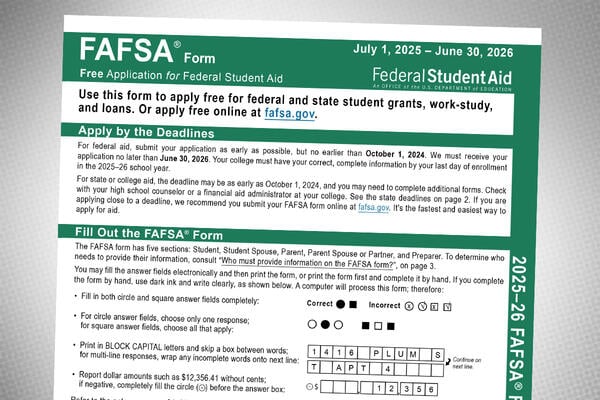
College access organizations are raising concerns about students from mixed-status families—families with members who hold different immigration statuses—who are filling out the Free Application for Federal Student Aid amid the Trump administration’s mass deportation campaign.
“Although the Higher Education Act prohibits the use of data for any purpose other than determining and awarding federal financial assistance, [the National College Attainment Network] cannot assure mixed-status students and families that data submitted to US Department of Education (ED), as part of the FAFSA process, will continue to be protected,” NCAN, which represents college access organizations across the nation, wrote in new guidance.
The organization added that the Office of Federal Student Aid has said the Education Department won’t share information that breaks the law.
But “we understand many families’ confidence in this statement may not be as certain under the current administration,” the organization continued. The post advised families to consider whether to submit a FAFSA on a “case-by-case basis.”
The organization had previously published similar guidance before President Donald Trump even took office but updated it after the 2026–27 FAFSA opened late last month. Zenia Henderson, chief program officer for NCAN, said the organization has received a slew of questions about the security of the personal information entered into the FAFSA, and many of its member organizations are reporting that some of the families they work with are forgoing the FAFSA out of fear.
The Trump administration has also attacked programs and initiatives that help undocumented students themselves access higher education. The administration has demanded states stop offering in-state tuition to undocumented students and has attempted to eliminate the Deferred Action for Childhood Arrivals program, which protects from deportation certain undocumented individuals who were brought to the country as children and has opened the door to higher education for this group.
Other experts and advocacy groups agreed that there is cause for concern among mixed-status families.
“Concerns are very much warranted in light of how cross-agency collaboration has been weaponized against immigrant families in recent months—including but not limited to the ostensible collusion between the Departments of Justice and Homeland Security to vacate active asylum cases when parents and children are lawfully appearing in immigration court, so that they can be apprehended on the premises by immigration enforcement and placed in detention,” wrote Faisal Al-Juburi, chief external affairs officer for RAICES, a nonprofit immigrant law center in Texas, in an email to Inside Higher Ed. “There is simply no indication that the Trump administration will adhere to legal precedent.”
Will Davies, director of policy and research for Breakthrough Central Texas, a college access organization, noted in an email to Inside Higher Ed that, even though the Trump administration’s immigration attacks have been especially worrying for mixed-status families, such families have long had to make difficult decisions about when to submit personal information to the government.
He also noted that FAFSA data is protected by the Privacy Act of 1974 and the Family Educational Rights and Privacy Act and said that, to his knowledge, no undocumented parent has ever been targeted using FAFSA data.
Cutting Off Access
For many families, the choice is not as clear-cut as simply not filling out the FAFSA. Most institutions and states calculate their financial aid offerings using the FAFSA’s formula and require students to fill out the FAFSA to take advantage of that aid. If mixed-status families do not complete the FAFSA, they are essentially cutting themselves off from almost all sources of assistance in paying for college.
“It has the potential to close a lot of doors in terms of accessing aid that’s needed, from last-dollar scholarships to merit-based scholarships,” Henderson said. “There are so many folks that ask for FAFSA information and that [the] application be competed in order to check eligibility, because they may not have their own systems or processes in place. FAFSA really is the default way to prove need.”
Three states—California, New York and Washington—have developed their own financial need calculation tools for individuals who want to be considered only for state and local aid. All three address privacy concerns, stating specifically that the data will not be provided to the federal government without a court order.
“The opportunity to pursue an education is highly valued, and financial aid is the only way many students can afford college or training,” the Washington Student Achievement Council wrote in a message, released days after Trump entered office, about aid applicant privacy. WSAC administers Washington’s state aid calculator.
“We sympathize deeply with anyone concerned about their privacy in applying for financial aid, and we support students and families in making decisions that best fit their educational goals and risk considerations. While WSAC cannot provide guidance on what a family should do in a specific situation, we do encourage students, families, educators, and advocates to review the following resources that may provide helpful information.”
Alison De Lucca, executive director of the Southern California College Attainment Network, told Inside Higher Ed in an email that her organization is working with several families who are uncertain if they will fill out the FAFSA this year; an estimated one in every five individuals under the age of 18 in California comes from a mixed-status family.
One SoCal CAN student opted to fill out just California’s state aid form, the California Dream Act Application, this year in order to protect her mother—even though she thought she might have benefited from federal aid.
In the lead up to her son’s birth, Jacqueline made plans to call 911 for an ambulance to pick her up from her North Florida home and transport her to a hospital about an hour away.
The second-time mom and Guatemalan immigrant, who has lived in the country for a decade, would have relied on her husband to drive her to the hospital. But a few months ago he was deported, leaving Jacqueline and her daughter without the family’s primary source of income, transportation and support.
One morning in March, Jacqueline said, her partner was pulled over on his way to work when law enforcement officials discovered he didn’t have a valid driver’s license. Jacqueline’s pregnancy was in its early stages. Her husband fought his case from detention for three months before U.S. Immigration and Customs Enforcement (ICE) removed him to Guatemala.
“He was deported and I was left behind, thinking, ‘What am I going to do?’” said Jacqueline, who requested that her last name not be published because she lacks permanent legal status. The couple shares an 8-year-old daughter who was born in, and is a citizen of, the United States.
This summer, as she entered the later stages of this pregnancy amid the Trump administration’s turbocharged immigration enforcement, Jacqueline found herself so fearful of being detained that she avoided leaving her home. Her husband’s car sits in the driveway, but there are no signs of him in the small room Jacqueline shares with her daughter. His belongings — tools, clothes, even personal photos — are with him in Guatemala. The only family pictures Jacqueline has are on her phone.
Her partner was the family’s main provider, rotating between picking strawberries or watermelon and packing pine needles for mulch, depending on the season.
Jacqueline struggled to get the most basic items to welcome a baby: Someone gifted her a used carseat and crib, which sit in the packed room along with onesies and other clothing items she’s collected inside a large plastic bag. She’s hoping that a federal assistance program will cover the cost of formula. A baby tub is still on her list.
Medical care in her rural area has been possible only because a small nonprofit organization nearby that provides prenatal care services offered to pay for Ubers so she could continue regular check-ups. Even if she wasn’t behind the wheel, Jacqueline says that just the act of leaving her home feels risky since her husband’s deportation.
“Things got really complicated. He paid our rent — he paid for everything,” she said. “Now, I’m always worried.”
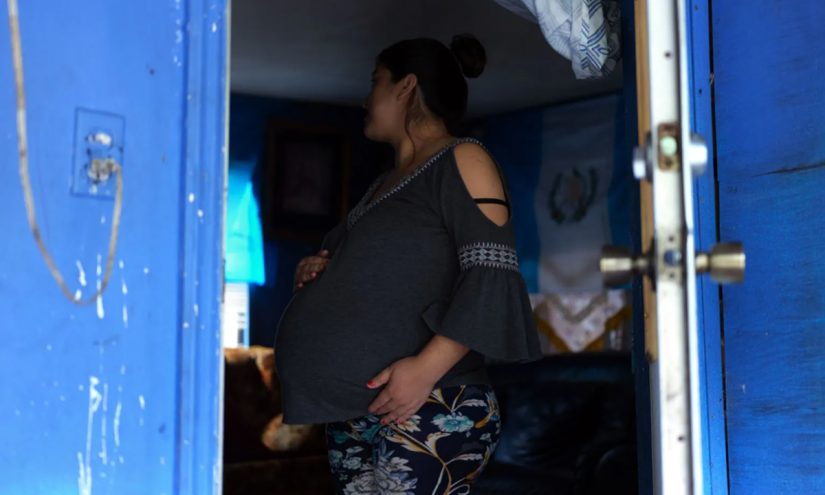
At her home in North Florida, Jacqueline looks at a photo of her husband and daughter on her phone. The only family pictures she has are on her phone; her husband’s belongings — tools, clothes, even personal photos — are with him in Guatemala. (Michelle Bruzzese for The 19th)
Medical care and support essential to a healthy pregnancy have become harder for people like Jacqueline to obtain following President Donald Trump’s inauguration. Many patients — nervous about encountering immigration officials if they leave their homes, drive on public roads or visit a medical clinic — are skipping virtually all of their pregnancy-related health care. Some are opting to give birth at home with the help of midwives because of the possible presence of ICE at hospitals.
Across the country, medical providers who serve immigrant communities said fewer patients are coming in for prenatal or other pregnancy-related care. As a result, patients are experiencing dangerous complications, advocates and health care providers told The 19th.
“Fear of ICE is pushing my patients and their families away from the very systems meant to protect their health and their pregnancies,” said Dr. Josie Urbina, an OB-GYN in San Francisco.
In January, Trump rescinded a federal policy that protected designated areas including hospitals, health clinics and doctors’ offices from immigration raids. ICE has recently targeted patients in hospital maternity wards and on their way home from prenatal visits.
A majority of Americans believe ICE should not be carrying out immigration enforcement at health centers. A new poll from The 19th and SurveyMonkey conducted in mid-September found that most Americans don’t think ICE should be allowed to detain immigrants at hospitals, their workplace, domestic violence shelters, schools or churches.
Women are more likely to oppose enforcement in these spaces than men. More than two-thirds of women said ICE shouldn’t be allowed to detain immigrants in hospital settings.
Enforcement is only expected to grow as the administration works to meet its ambitious deportation goals. The federal government is pouring more than $170 billion over the next four years into expanding immigration enforcement, the result of Trump’s signature tax-and-spending bill. About $45 billion has been directed to expanding detention facilities; $29.9 billion is to increase ICE activity.
That expansion could put even more births at risk. Approximately 250,000 babies are born every year to immigrants without permanent legal status. Already, research has shown these immigrants, who have higher uninsured rates, are less likely to seek prenatal care and are at risk of worse birth outcomes.
Major medical groups, including the American College of Obstetrics and Gynecologists, World Health Organization and the Centers for Disease Control and Prevention (CDC) recommend regular prenatal and postpartum care as a key tool to combat pregnancy-related death and infant mortality.
According to the federal Office of Women’s Health, infants born to parents who received no prenatal care are three times more likely to have a low birth weight and five times more likely to die than those born to parents who received regular care.
A CDC analysis published last year found infant mortality rates went up the later families began prenatal care: 4.54 deaths per 100,000 live births for families whose prenatal care began in the first trimester, compared with 10.75 in families whose prenatal care began in the third trimester or who did not receive any at all.
“A lot of patients aren’t going to get help,” said Yenny James, the founder and CEO of Paradigm Doulas in the Dallas-Fort Worth metro.
After her husband’s deportation, Jacqueline became so fearful of being detained that she avoided leaving her home. “He was deported and I was left behind, thinking, ‘What am I going to do?’” she said. (Michelle Bruzzese for The 19th)
James said she’s seeing an increasing number of emergency cesarean sections because of untreated gestational diabetes, or preeclampsia — a deadly pregnancy complication — that went unnoticed because of lacking prenatal care.
In Denver, OB-GYN Dr. Rebecca Cohen has delivered multiple babies this year for women who have told her that, because they fear endangering themselves or their families, they have received no prenatal care. Several have given birth to babies with fatal fetal anomalies that were never diagnosed because the women did not receive prenatal ultrasounds.
“They were willing to forgo care — their own health care — but to find out that something was devastatingly wrong with their child is when they feel like maybe they should have risked it,” Cohen said. “There’s a sound of a mother’s wail that anybody who has worked labor and delivery has known, and it will haunt you for the rest of your life. To hear that when it could have been prevented, it is just absolutely devastating.”
Early in her pregnancy, Jacqueline received free care at a local clinic. Shortly after her husband’s detention, she called the office to let them know she likely wouldn’t make her next appointment.
“I told them that I probably wouldn’t be able to make my appointments anymore, well, because I’m really afraid given what happened to my husband. And they offered to help,” she said.
Jacqueline and the nonprofit clinic worked out an arrangement: The day of her appointments, someone at the clinic called an Uber to her home, paid for by the clinic, and let her know when it would arrive so she could be ready.
Many people in her small town have come to rely on a single person who does have a valid driver’s license for transportation. That driver recently brought Jacqueline to an appointment with the local office that manages the Special Supplemental Nutrition Program for Women, Infants and Children (WIC), which she is relying on for baby formula and food. There were no guarantees that this driver would be available to take her in whenever she goes into labor.
The Biden administration directed ICE not to detain, arrest or take into custody pregnant, postpartum or breastfeeding people simply for breaking immigration laws, except under “exceptional circumstances.” The Trump administration has not formally reversed that policy. But despite the directive, reports from across the country confirm that ICE has detained numerous pregnant immigrants since Trump took office.
James said that until the Biden guidance is formally rescinded, she will continue to encourage pregnant immigrants to print it out and carry it with them.
“I told my doulas — have them print out this ICE directive, have them keep it with them, so that they know and these agents know that we know our rights, our clients know their rights,” James said.
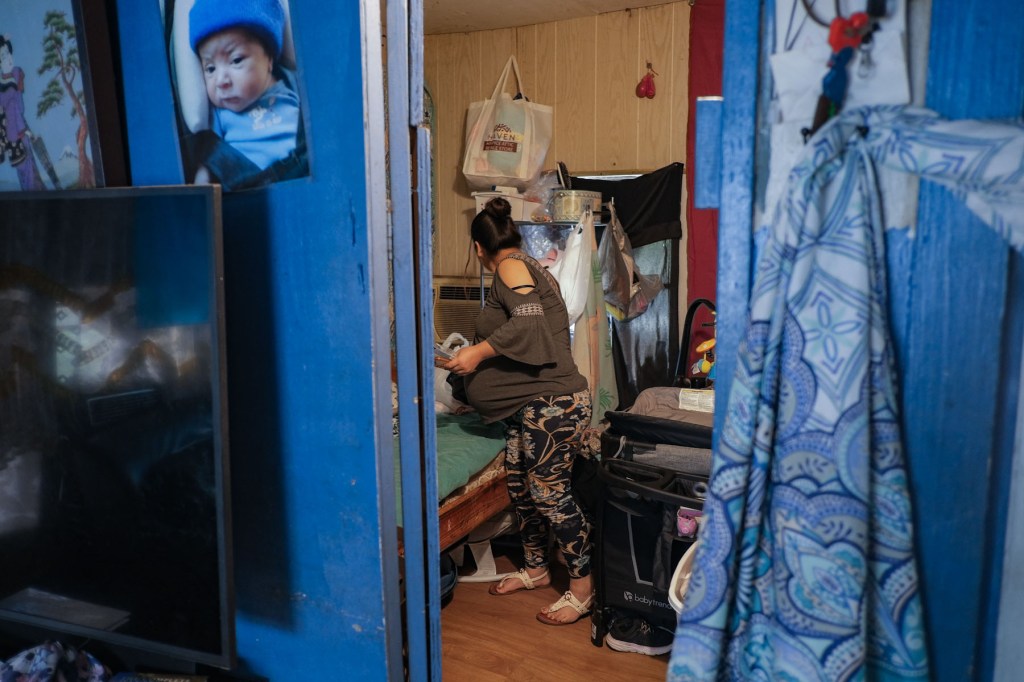
Jacqueline prepares for the birth of her second child in the room she shares with her daughter. Someone gifted her a used car seat and crib, which sit among the few items she’s collected inside a plastic bag to welcome the baby. (Michelle Bruzzese for The 19th)
It’s unclear exactly how many pregnant immigrants are being detained by ICE, or have been arrested by the agency. A May report from the office of Democratic Sen. Dick Durbin found 14 pregnant women in a single Louisiana detention facility at the time of staff’s visit.
Another report out of the office of Democratic Sen. Jon Ossoff published in late July found 14 credible reports of mistreatment of pregnant women in immigrant detention. The report cited an anonymous agency official who said they saw pregnant women sleeping on floors in overcrowded intake cells. The partner of a pregnant woman in federal custody said that she bled for days before she was taken to a hospital, where she miscarried alone. A pregnant detainee who spoke to Ossoff’s office said she repeatedly asked for medical attention and was told to “just drink water.” The office received several reports of clients waiting weeks to see a doctor, and that sometimes scheduled appointments were canceled. ICE has disputed the report.
“Pregnant women receive regular prenatal visits, mental health services, nutritional support, and accommodations aligned with community standards of care. Detention of pregnant women is rare and has elevated oversight and review. No pregnant woman has been forced to sleep on the floor,” ICE said in a statement posted on their website.
ICE did not respond to a request for comment.
Fear of being detained is a major contributor of stress for pregnant immigrants. Research shows that even when pregnant patients do receive medical care, prenatal stress puts many at greater risk of complicated births and poor outcomes, including premature birth and low infant birth weight. Babies born after an immigration raid are at a 24 percent higher risk of low birth weight, according to one study.
Monica, 38, is expecting her fourth child in November. The Tucson resident, who requested that her last name not be published out of fear of being detained, has lived in the United States for two decades but has no legal immigration status.
This pregnancy has been unlike the others, she said: While Monica has continued with her prenatal care appointments, her anxiety levels about her immigration situation have colored her experience. Her other children, who are in their teens, are U.S. citizens but grappling with the stress of their parents’ situation. Her husband also doesn’t have authorization to live in the country.
“We try to be out and about much less, and to take precautions,” she said. “Whenever we do leave the house, we have it in the back of our minds.”
Monica said she has seen reports of ICE being allowed inside hospitals, and she is worried about facing immigration officers while or following her birth. Her plan is to have her partner and a group of friends at the hospital to make sure she’s never alone.
“My biggest fear is going to the hospital,” she said.
Stress like Monica’s makes pregnancy more dangerous.
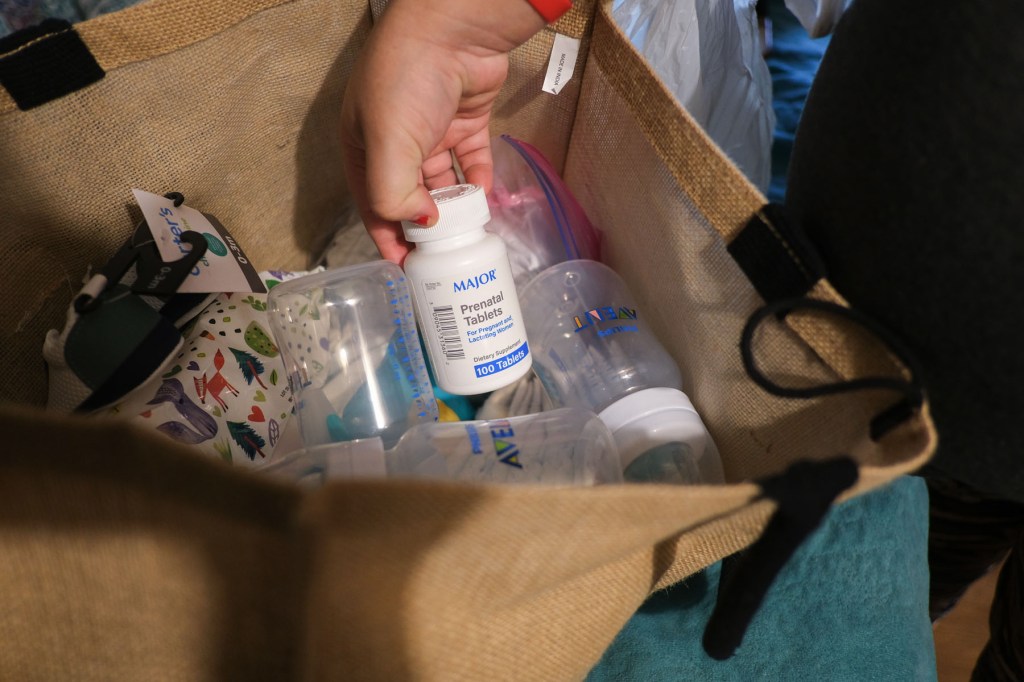
Jacqueline holds a bottle of prenatal vitamins at her home in North Florida. A small nonprofit clinic nearby has been paying for Ubers so she can continue her prenatal check-ups. (Michelle Bruzzese for The 19th)
“In our hospital, every doctor I’ve talked to — and these are doctors that have been there 20 years — all are saying these past six months they’ve seen worse obstetrics outcomes than ever in their career,” Dr. Parker Duncan Diaz, a family physician in Santa Rosa, California, whose clinic mostly cares for Latinx patients. That’s included more preterm labor and more pregnant patients with severe hypertension.
“I don’t know what’s causing it, but my bias is that it is the impact of this horribly toxic stress environment,” he added, specifically noting the stress caused by the threat of immigration enforcement.
In recent months, Dr. Caitlin Bernard, an Indiana-based OB-GYN, has seen a number of pregnant patients seeking emergency attention who have not received any prenatal health care. One was 31 weeks, approaching the end of her pregnancy. Another was more than 20 weeks pregnant when she came to Bernard’s office, having developed complications from a molar pregnancy — a rare condition that means a healthy birth is impossible and that without early treatment can result in vaginal bleeding, thyroid problems and even cancer.
“Anytime you’re not able to access that early prenatal care, we do see complications with that,” she said. “And many of these things can absolutely be life-threatening for both the moms and the babies.”
Dr. Daisy Leon-Martinez, a maternal-fetal medicine specialist in San Francisco, said she now regularly cares for patients in her labor and delivery ward who have been transferred to her hospital because of newly developed pregnancy complications. These are often their first doctors’ visits since becoming pregnant. Many of those patients have told her that they did not want to seek prenatal care for fear of encountering immigration officials.
During regular visits, she added, she has advised people with pregnancy complications that they would be best served by a hospital stay — only to be told that her patients no longer feel safe going to the hospital.
The current enforcement environment is challenging immigrant advocates, who are continuing to encourage immigrants to seek appropriate medical care while acknowledging that doing so is increasingly risky.
Lupe Rodríguez, the executive director of the National Latina Institute for Reproductive Justice, said her organization is urging pregnant immigrants to seek the health care that they need, and to be proactive about making plans for themselves and their families in the event that they are detained.
“We can’t know for certain about any given [health care center] whether or not it’s going to be safe. One of the things that we’ve been seeing is leadership at some of these health centers — big hospitals and clinics — have said that they will provide the kind of protection that folks need, that they don’t want folks to be afraid of care,” Rodriguez said.
While those statements signal the intentions of a hospital’s leadership, Rodriguez said, “we still know that there are individuals within some of those care centers that are part of the reporting mechanism or are intimidating people.”
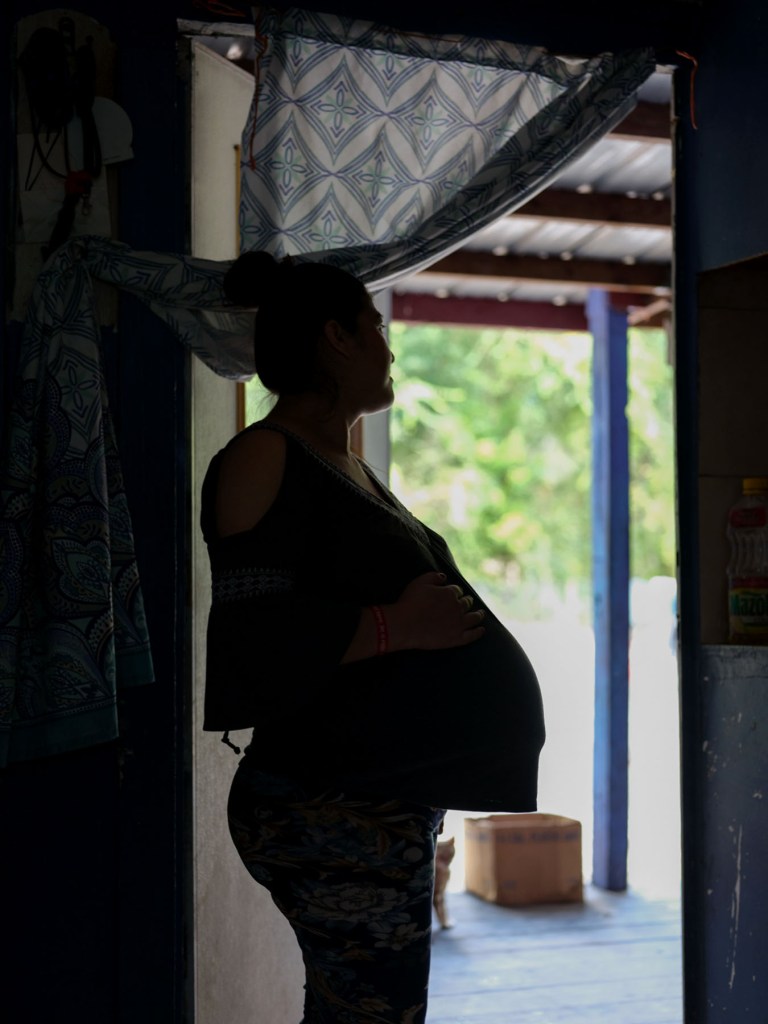
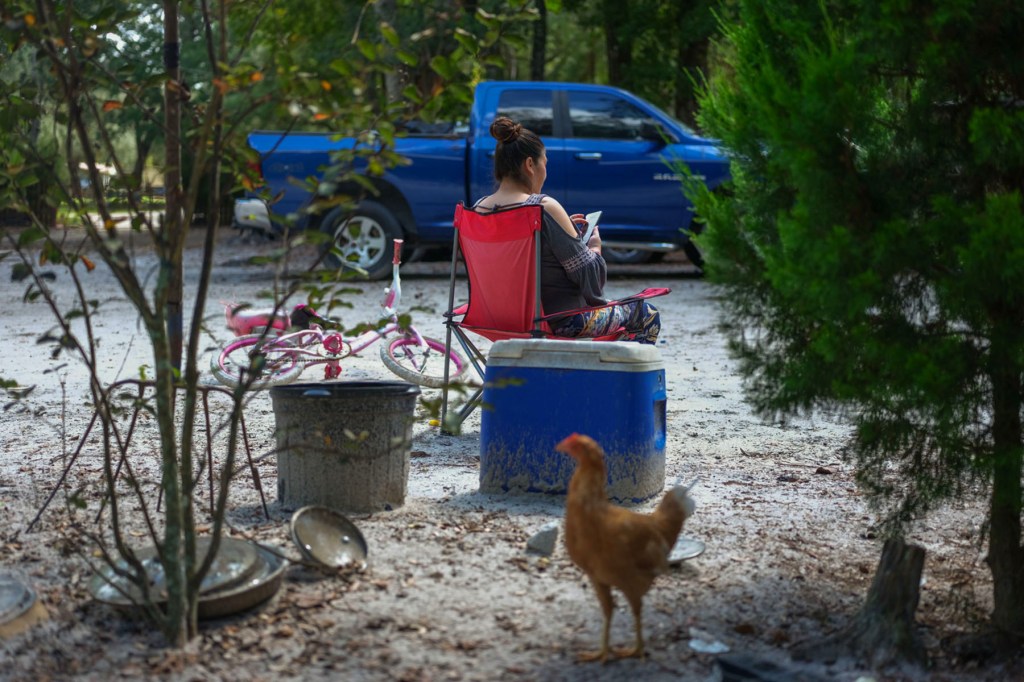
Outside her home in North Florida, Jacqueline sits in a red chair as a chicken wanders nearby. (Michelle Bruzzese for The 19th)
Jacqueline approached the last days of her pregnancy hopeful that the place she had chosen — a large university hospital that workers at her local clinic recommended — would be a safe place for her to give birth.
One night at the end of September, when labor pains grew too intense, she called for an ambulance and made it to the hospital. When she got there, she asked her providers if there were any ICE agents near the building. She had heard of a man at a local hospital being detained after having surgery. They told her there were none they were aware of.
She went on to deliver her baby under general anesthesia after a long, difficult labor. “I didn’t even hear him cry when they pulled him out,” she said. Her only relative left in the area was taking care of her daughter, so she recovered alone at the hospital for five days before heading home in an Uber that a social worker procured for her and her son.
“If my husband was here, he would have been there with me at the hospital,” Jacqueline said while recovering at home. “He would be here taking care of me, of us. I wouldn’t be worried about the things I still want to get for the baby.”
This story was originally reported by Mel Leonor Barclay and Shefali Luthra of The 19th. Meet Mel and Shefali and read more of their reporting on gender, politics and policy.
Today is the final day of the American Association of University Professors v. Rubio trial, in which the association, its chapters at Rutgers and Harvard Universities, and the Middle East Studies Association sued to stop the Trump administration from the “ideological deportation” of international students.
The lawsuit argues that the deportations violate international students’ right to free expression and their Fifth Amendment right not to have laws enforced against them arbitrarily or discriminatorily. It also claims that the arrests of student protesters chilled speech on campuses—something witnesses corroborated.
The trial, conducted during the last two weeks, revealed new details about the administration’s targeting of international students, including high profile cases like those of graduate students Mahmoud Khalil and Rümeysa Öztürk, who were detained by Immigration and Customs Enforcement in March. (Both have since beenreleased.)
Here are some of the key takeaways from the trial ahead of the parties’ closing statements.
1. Dossiers about the targeted students included information about their protest activities.
On Friday, John Armstrong, the most senior official at the State Department’s Bureau of Consular Affairs, testified that the memos written by state department officials recommending deportation actions and visa revocations contained details about student and faculty members’ activism.
The memos have been designated as for “attorneys’ eyes only”—the most restrictive possible designation for sensitive information in a trial, which prevents even the plaintiffs and defendants from viewing them. But attorneys and witnesses quoted excerpts of them during the trial.
The action memo for Öztürk highlighted an op-ed she had co-written supporting a call for her institution, Tufts University, to divest from companies with ties to Israel, Armstrong said, according to trial transcripts published by the Knight First Amendment Institute at Columbia University, which is representing the plaintiffs. But he insisted that the op-ed was not a “key factor” in the decision to revoke her visa and detain her.
Another memo, regarding Columbia student activist Mohsen Mahdawi, specifically noted that “a court may consider his actions inextricably tied to speech protected under the First Amendment,” according to an excerpt read by Alexandra Conlon, an attorney for the plaintiffs.
2. Investigators weren’t given guidance about what constitutes antisemitism.
The State Department hasn’t release any guidance as to what, exactly, should be considered antisemitism, Armstrong acknowledged on Friday. He also stated that, to his knowledge, the officials who have written action memos about protesters haven’t received any training about what constitutes antisemitism.
That’s significant, because at least one memo, Mahdawi’s, referred specifically to “antisemitic conduct.”
“I do know that there’s a common understanding in our culture, in our society of what antisemitism is,” Armstrong said.
When U.S. District Judge William G. Young pushed him to describe that “common understanding,” he responded: “In my opinion, antisemitism is unjustified views, biases, or prejudices, or actions against Jewish people, or Israel, that are the result of hatred towards them.”
3. ICE officials leaned on the Canary Mission website to find students and professors to target.
For over a decade, the anonymously operated site Canary Mission has been publishing the identities of students and professors they deem antisemitic. Several of those listed on the website, including Khalil, Mahdawi and Öztürk, have been targeted since the Trump administration began taking aim at student protesters.
On the third day of the trial, Peter Hatch, a senior ICE official, stated that “many of the names, even most of the names” on a list of noncitizen students presented to ICE’s “Tiger Team” for investigation came from the Canary Mission site.
Hatch said that other names came from Betar USA, the American chapter of an international Zionist organization, which the Anti-Defamation League has labeled an extremist group.
4. ICE agents said they prioritized the arrest of activists at the urging of their higher-ups.
ICE agents who oversaw the arrests of Öztürk, Khalil, Mahdawi, and Badar Khan Suri, a Georgetown University professor, said last Tuesday that the cases were unusual not just because of the legal grounds on which the activists were detained but also because the orders came from high-ranking officials in the organization.
Patrick Cunningham, an agent with ICE’s Homeland Security Investigations office in Boston, said that the agency’s leaders were “inquiring” about Öztürk’s case, leading his office to prioritize her arrest.
“I can’t recall a time that it’s come top-down like this with a Visa revocation, um, under my purview anyway,” Cunningham said, according to the transcript. “And so with the superiors that were, you know, inquiring about this, it made it a priority, because we worked for them.”
5. Students and faculty confirmed they stopped protesting out of fear.
Over the trial’s firsttwodays, five noncitizen faculty members took the stand to describe how news about activists being targeted had caused them to stop engaging in various political activities. They said they decided not to attend protests or sign statements related to Israel’s war in Gaza after hearing about Khalil’s and Öztürk’s arrests.
One Brown University professor, Nadje Al-Ali, said she cancelled longstanding plans to travel to Beirut and Baghdad for research into women artists and gender-based violence in the Middle East.
“Following the arrest and the detention and the threat of deportation of several students, graduate students, and also I think one post-doc—I mean, most prominently Mahmoud Khalil but others as well—I started to think that it is not a good idea,” she said. “I felt that it was too risky for me to do research in the Middle East, come back, and then my pro-Palestinian speech would be flagged. And as a green card holder and also as a prior director for the Center For Middle East Studies that had been under attack, and there are a lot of sort of false allegations about, I felt very vulnerable.”;
The fear also extended beyond speech related to the Middle East; Al-Ali also refrained from attending a protest on No Kings Day, a massive day of demonstration that opposed President Donald Trump’s policies in his second presidency, including cutting federal government offices, defunding research and social services, and his mass deportation campaign.
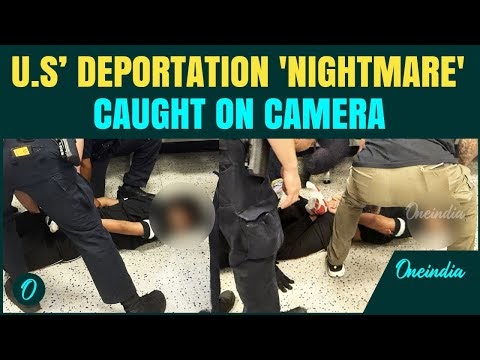
A shocking video from Newark Airport shows an Indian student in handcuffs, pinned to the ground by U.S. authorities before being deported. The clip, shared by Indian-American entrepreneur Kunal Jain, has sparked outrage online. Jain described the young man as crying and being treated like a criminal, despite arriving with valid documents. He urged the Indian Embassy to intervene. Jain also claimed that similar incidents are now occurring frequently—3 to 4 deportations daily—often due to students being unable to explain their purpose in the U.S. properly at immigration.
As President Donald Trump has ramped up deportations, some immigrant students across New York have been too afraid to attend class in person. In response, some school districts have turned to virtual learning, a move the state’s Education Department is sanctioning, officials revealed last week.
“I will tell you in the sense of a crisis, we do have some districts right now … that are taking advantage and providing virtual instruction to our children who are afraid to go to school,” Associate Education Commissioner Elisa Alvarez told state officials at May’s Board of Regents meeting.
Alvarez shared with the board a memo the state Education Department issued in March clarifying that districts have the flexibility to offer online instruction to “students who may be unable or averse to attending school, including during times of political uncertainty.”
The memo further specified schools can tap online learning for immigrant and migrant students “who may be affected and reluctant to attend school in person due to concerns about their personal safety and security.”
Alvarez didn’t disclose how many or which districts were using the approach and for how many students. A state Education Department spokesperson did not respond to follow-up questions.
New York City public schools already have virtual options available and aren’t doing anything different for immigrant students fearful of attending school, a spokesperson for the city’s Education Department said.
Still, the disclosure from state officials highlights the ongoing fears some immigrant students are facing four months into the Trump administration and raises fresh questions about how their school experiences are being affected.
Shortly after taking office, Trump rescinded longstanding guidance barring federal immigration agents from making arrests at “sensitive locations” including schools.
Migrant families staying in New York City shelters expressed acute fears during the week after Trump’s inauguration in January and stayed out of school in large numbers, likely contributing to lower citywide attendance rates that week (though Mayor Eric Adams later downplayed the attendance woes). Some city educators said they’ve seen attendance for immigrant students rebound since that first week.
City policy prohibits federal law enforcement agents, including Immigration and Customs Enforcement, from entering schools without a warrant signed by a judge, and Education Department officials have trained school staff on detailed protocols for how to respond.
At the state level, the Attorney General’s office and Education Department issued joint guidance in March reiterating that state and federal law both compel districts to only permit federal law enforcement to enter schools under very limited circumstances.
Many school leaders have worked hard to communicate those policies and reassure anxious families. And immigration enforcement inside of schools has remained rare.
But some high-profile raids have targeted school-age children, including one in the upstate New York hometown of Trump border czar Tom Homan that swept up three students in the local public schools, sparking fear and outrage. And there have been reports across the country of parents detained by immigration agents right outside schools during drop-off time.
Under those circumstances, virtual learning could give schools a way to keep up some connection with students or families who might otherwise completely disengage.
But some New York City educators said they’re still working hard to convince fearful immigrant students to come to school in person, noting that virtual learning was especially challenging for English language learners during the COVID pandemic.
Lara Evangelista, the executive director of the Internationals Network, which oversees 17 public schools in the five boroughs catering exclusively to newly arrived immigrant students, said none of her schools have made the “purposeful choice” to engage fearful students through virtual learning.
“Virtual learning for [English Learners] was really challenging during COVID,” she said.
Alan Cheng, the superintendent who oversees the international schools as well as the city’s dedicated virtual schools, said he hasn’t seen any significant changes in enrollment or interest in online learning due to fear of in-person attendance among immigrant students.
And while virtual learning might be able to offer a version of the academic experience of in-person school, it’s harder for it to replicate some of the other services that schools provide families.
“Our schools serve much more than just the academic environment,” Cheng said. “They are really community schools, they provide health care, they provide plenty of other resources.”
This story was originally published by Chalkbeat. Chalkbeat is a nonprofit news site covering educational change in public schools. Sign up for their newsletters at ckbe.at/newsletters.
School (in)Security is our biweekly briefing on the latest school safety news, vetted by Mark Keierleber. Subscribe here.
Tennessee state Sen. Bo Watson wants to eject undocumented students from public school classrooms. But first, he needs their data.
Watson seeks to require students statewide to submit a birth certificate or other sensitive documents to secure their seats — one of numerous efforts nationwide this year as Republican state lawmakers seek to challenge a decades-old Supreme Court precedent enshrining students’ right to a free public education regardless of their immigration status.
Some 300 demonstrators participate in a Waukegan, Illinois, rally on Feb. 1 to draw attention to an increase in Immigration and Customs Enforcement activity in the area. Privacy advocates warn student records could be used to assist deportations. (Scott Olson/Getty Images)
In my latest feature this week, I dive into why those efforts have alarmed student data privacy advocates, who warn that efforts to compile data on immigrant students could be used not just to deny them an education — it could also fall into the hands of Immigration and Customs Enforcement.
As the Trump administration ramps up deportations and tech billionaire Elon Musk’s Department of Government Efficiency reportedly works to create a “master database” of government records to zero in on migrants, data privacy experts warn that state and federal data about immigrant students could be weaponized.
In the news
Cybercriminals demanded ransom payments from school districts nationwide this week, using millions of K-12 students’ sensitive data as leverage after the files were stolen from education technology giant PowerSchool in a massive cyberattack late last year. The development undercuts PowerSchool’s decision to pay a ransom in December to keep the sensitive documents under wraps. | The 74
Gutted: Investigations at the Education Department’s civil rights office have trickled to a halt as the Trump administration installs a “shadow division” to advance cases that align with the president’s agenda. | ProPublica
Civil rights groups, students and parents have asked courts to block the Education Department’s civil rights enforcement changes under Trump, saying they fail to hold schools accountable for racial harassment and abuses against children with disabilities. | K-12 Dive
Among the thousands of cases put on the back burner is a complaint from a Texas teenager who was kneed in the face by a campus cop. | The 74
‘The hardest case for mercy’: Congratulations to Marshall Project contributor Joe Sexton, who was named a Pulitzer Prize finalist for his reporting on a legal team’s successful bid to spare the Parkland, Florida, school shooter from the death penalty. | The Marshall Project
The city council in Uvalde, Texas, approved a $2 million settlement with the families of the victims in the 2022 shooting at Robb Elementary School, the first lawsuit to end with monetary payouts since 19 children and two teachers were killed. | Insurance Journal
In Michigan, a state commission created in the wake of the 2021 school shooting at Oxford High School, which resulted in the deaths of four students, issued a final report calling for additional funding to strengthen school mental health supports. | Chalkbeat
Meanwhile, at the federal level, the Education Department axed $1 billion in federal grants designed to train mental health professionals and place them in schools in a bid to thwart mass shootings. | The 74
A high school substitute teacher in Ohio was arrested on accusations she offered a student $2,000 to murder her husband. | WRIC
Connecticut schools have been forced to evacuate from fires caused by a “dangerous TikTok trend” where students stab school-issued laptops with paper clips to cause electrical short circuits. | WFSB
Eleven high school lacrosse players in upstate New York face unlawful imprisonment charges on accusations they staged a kidnapping of younger teammates who thought they were being abducted by armed assailants. | CNN
Sign-up for the School (in)Security newsletter.
Get the most critical news and information about students’ rights, safety and well-being delivered straight to your inbox.
The Future of Privacy Forum has “retired” its Student Privacy Pledge after a decade. The pledge, which was designed to ensure education technology companies were ethical stewards of students’ sensitive data, was ended due to “the changing technological and policy landscape regarding education technology.” | Future of Privacy Forum
The pledge had previously faced scrutiny over its ability to hold tech vendors accountable for violating its terms. | The 74
New kid on the block: Almost simultaneously, Common Sense Privacy launched a “privacy seal certification” to recognize vendors that are “deeply committed to privacy.” | Business Wire
Google plans to roll out an artificial intelligence chatbot for children as the tech giant seeks to attract young eyeballs to its AI products. | The New York Times
Kansas schools plan to spend state money on AI tools to spot guns despite concerns over reports of false alarms. | Beacon Media
ICYMI @The74
A new report from the Department of Health and Human Services suggests gender-affirming health care puts transgender youth at risk but the report ignores years of research indicating otherwise. (Getty Images)
This afternoon, an immigration judge in Louisiana ruled that Mahmoud Khalil’s deportation could proceed under immigration law. But the fight over the constitutionality of that law continues.
The Immigration and Nationality Act gives the secretary of state nearly unchecked authority to deport a legal permanent resident on nothing more than his whim if the secretary believes the person poses “serious adverse foreign policy consequences.”
Below is FIRE’s statement, attributable to Legal Director Will Creeley:
Can expressing an opinion that the government doesn’t like justify a green card holder’s arrest, detention, and deportation? That’s what this case comes down to — and it’s a question the courts must answer. The government is holding up a provision of the Immigration and Nationality Act that purports to say “yes.” But the principles enshrined in the First Amendment say “no.”
Allowing a single government official sweeping and nearly unchecked power to pick and choose individuals to deport based on beliefs alone, without alleging a single crime, crosses a line that should never be crossed in a free society.
The only “crime” the government has offered was that Mahmoud Khalil expressed a disfavored political opinion. If that’s a crime in America, every single one of us is guilty.
Momodou Taal, the Cornell University graduate student who said his institution effectively tried to deport him in the fall over his pro-Palestine activism, announced Monday he’s leaving the U.S. of his own accord under threat from the Trump administration.
“I have lost faith I could walk the streets without being abducted,” Taal wrote on X. He added that “we are facing a government that has no respect for the judiciary or for the rule of the law.”
On March 15, Taal, his professor and another Cornell Ph.D. student sued President Trump, the Department of Homeland Security and Homeland Security secretary Kristi Noem, challenging executive orders that empowered immigration officials to deport noncitizens they deem national security threats. Immigration officers have targeted multiple international students suspected of participating in pro-Palestine protests. Taal is a U.K. and Gambian citizen.
A few days after he sued, Immigration and Customs Enforcement agents visited Taal in what Homeland Security acknowledged “was an attempt to detain him,” he said in a court filing. The State Department had revoked Taal’s visa, according to the lawsuit.
Now his lawyers have dismissed the case. “Trump did not want me to have my day in court and sent ICE agents to my home,” Taal wrote on X.
In an email to Inside Higher Ed Tuesday, an unnamed “senior” Homeland Security official called it “a privilege to be granted a visa to live and study” in the U.S.
“When you advocate for violence and terrorism, that privilege should be revoked, and you should not be in this country,” the official said. “We are pleased to confirm that this Cornell University terrorist sympathizer heeded Secretary Noem’s advice to self-deport.”
When asked for specifics on when Taal sympathized with terrorism, Homeland Security pointed to where Taal referenced in his Monday post the “Zionist genocide,” and wrote, “Long live the student intifada!” In his post, Taal wrote that the “repression of Palestinian solidarity is now being used to wage a wholesale attack on any form of expression that challenges oppressive and exploitative relations in the US.”
Taal added, “If you have been led to think that your safety is only guaranteed by state kidnap, repression, deportation, the slaughter of children, and the suppression of the global majority, then let Gaza’s shards of glass be your mirror.”
Tennessee lawmakers on Wednesday voted to advance a bill that would require public K-12 and charter schools to verify student immigration status and allow them to bar children who cannot prove they lawfully reside in the United States unless they pay tuition.
The 5-4 vote by the Senate Education Committee came despite the Legislature’s own fiscal analysis, which said the proposed legislation “may jeopardize federal funding to the state and to local governments” and violate the federal Civil Rights Act, which specifically prohibits discrimination based on national origin in programs receiving federal dollars. Three Republicans joined the committee’s sole Democrat in voting “no.”
Immediately after the vote was cast, shouts of “so shameful” and “that’s trash” erupted inside the hearing room. Others, including school-age children in attendance, streamed out of the room in tears.
The bill (HB793/SB836) by Sen. Bo Watson, a Hixson Republican, and House Majority Leader William Lamberth, a Portland Republican, says that local school districts and public charter schools “shall require” students to provide one of three forms of documentation: proof of U.S. citizenship, proof the student is in the process of obtaining citizenship or proof they have legal immigration status or a visa.
Students who lack one of the three forms of documentation could then be barred by their local school district from enrolling unless their parents paid tuition.
Watson, the bill’s sponsor, said he brought the measure in response to the increasing cost to the state of providing English-as-a-second-language instruction.
“Remember, we are not talking about people who are here lawfully,” Watson said. “What I’m trying to discuss here is the financial burden that exists with what appears to be an increasing number of people who are not lawfully here.”
In response to a question from Sen. Raumesh Akbari of Memphis, the sole Democrat on the panel, Watson said he had received no formal request from any school official to introduce the measure.
“In an official capacity, this is one of those issues people do not talk about,” Watson said. “This is a very difficult bill to present. It is very difficult to have all these eyes on you.”
“In an unofficial capacity at numerous events, have people mentioned this problem to me? Absolutely,” Watson said.
Akbari responded: “I’m from the largest school district in the state. I have not had those conversations.”
“I am offended by this legislation,” Akbari said. “I find that it is so antithetical to the very foundation of this country….This is saying that babies – you start school at five years old – that you do not deserve to be educated.”
The bill’s sponsors have acknowledged the measure is likely to face a legal challenge if enacted. The proposed legislation, they have said, is intended to serve as a vehicle to potentially overturn the Supreme Court’s Plyler v. Doe decision, which established a constitutional right to a public school education for all children. The 1982 decision was decided by a 5-4 vote, Watson noted.
“Many 5-4 decisions taken to the court today might have a different outcome,” Watson said.
The proposed legislation is part of an unprecedented slate of immigration-related bills introduced in the Tennessee legislature this year as Gov. Bill Lee and the General Assembly’s GOP supermajority seek to align with the Trump Administration’s immigration policies.
Lee last month signed into law legislation to create a state immigration enforcement office to liaise with the Trump administration, create distinct driver’s licenses for noncitizens and levy felony charges at local elected officials who vote in favor of sanctuary policies.
Among nearly three dozen other immigration-related bills still being considered is one to require hospitals that accept Medicaid payments to report on the immigration status of their patients. Another bill would open up charitable organizations, including churches, to lawsuits if they have provided housing services to an individual without permanent legal immigration status and that individual goes on to commit a crime.
Following Wednesday’s hearing in the Senate Education Committee, hundreds congregated in a hallway of the Legislature, chanting “education for all” and pledged to return as the bill winds through the committee process.
The bill “instills fear and hopelessness in these students,” said Ruby Aguilar, a Nashville teacher who testified against the bill during the hearing. “Education is not merely a privilege, it is a shared human right every child should have access to.”
Tennessee Lookout is part of States Newsroom, a nonprofit news network supported by grants and a coalition of donors as a 501c(3) public charity. Tennessee Lookout maintains editorial independence. Contact Editor Holly McCall for questions: [email protected].
Reports say that Indian Students in the US are becoming collateral damage amidst President Donald Trump’s Mass Deportation Drive. The Indian students entered the US legally, on valid visas. But they say they are now being subjected to more frequent questioning from US immigration officials. They say uniformed officers have been questioning them more frequently, and demanding to see their student IDs and documents. Is Trump’s deportation drive becoming an all out purge of migrants, irrespective of whether they’re in the US legally or not?