Tag: Deportations

  • Rubio sued over international student deportations

    Rubio sued over international student deportations

    The legal challenge takes aim at Rubio’s use of statutes to deport legal noncitizens, namely international students Mahmoud Khalil and Rümeysa Öztürk, for their speech alone. It was filed by the Foundation for Individual Rights and Expression (FIRE) on August 6.  

    “In the United States of America, no one should fear a midnight knock on the door for voicing the wrong opinion,” said FIRE attorney Conor Fitzpatrick: “Free speech isn’t a privilege the government hands out. Under our constitution it is the inalienable right of every man, woman and child.” 

    FIRE, a non-partisan advocacy group, is seeking a landmark ruling that the first amendment trumps the statutes that the government used to deport international students and other lawfully present noncitizens for protected speech earlier this year. 

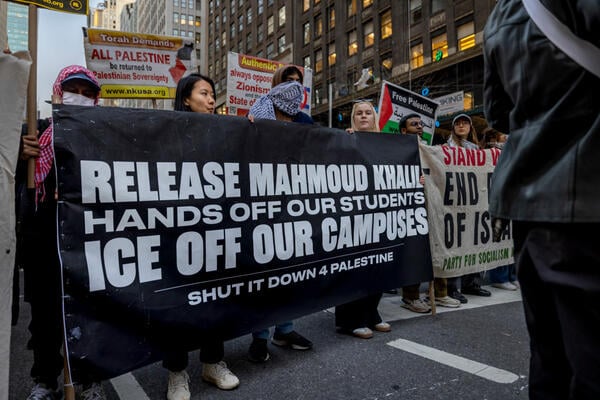
    It cites the case of Mahmoud Khalil, an international student targeted by the Trump administration for his pro-Palestinian activism, who was held in detention for three months after being arrested by plain clothed immigration officers in a Columbia University building.  

    The complaint also highlights the targeting of Tufts University student Rümeysa Öztürk, detained on the street and held for nearly seven weeks for co-authoring an op-ed calling for Tufts to acknowledge Israel’s attacks on Palestine and divest from companies with ties to Israel.  

    FIRE has said that that Rubio and Trump’s targeting of international students is “casting a pall of fear over millions of noncitizens, who now worry that voicing the ‘wrong’ opinion about America or Israel will result in deportation”.  

    This spring, thousands of students saw their visas revoked by the administration, after a speech from Rubio warning them: “We give you a visa to come and study to get a degree, not to become a social activist that tears up our university campuses”. 

    Free speech isn’t a privilege the government hands out

    Conor Fitzpatrick, FIRE

    Though the students’ statuses have since been restored following a court hearing deeming the mass terminations to be illegal, some students opted to leave the US amid fears of being detained or deported.  

    This summer, international student interest in the US fell to its lowest level since mid-pandemic, with new estimates forecasting a potential 30-40% decline in new international enrolments this fall following the state department’s suspension of new visa interviews.  

    Plaintiffs in the lawsuit include The Stanford Daily – the independent, student newspaper at Stanford University – and two legal noncitizens with no criminal record who fear deportation and visa revocation for engaging in pro-Palestinian speech.  

    “There’s real fear on campus and it reaches into the newsroom,” said Greta Reich, editor-in-chief of The Stanford Daily.  

    “I’ve had reporters turn down assignments, request the removal of some of their articles, and even quit the paper because they fear deportation for being associated with speaking on political topics, even in a journalistic capacity.  

    “The Daily is losing the voices of a significant portion of our student population,” said Reich.  

    The complaint argues that Rubio’s wielding of two provisions of the Immigration and Nationality Act is unconstitutional when used to revoke a visa or deport someone for the first amendment right of free speech. 

    “The first allows the secretary of state to render a noncitizen deportable if he ‘personally determines’ their lawful ‘beliefs, statements, or associations’ ‘compromise a compelling United States foreign policy interest’”, explains the document.  

    “The second allows the secretary ‘at any time, in his discretion, revoke’ a ‘visa or other documentation’”.  

    The complaint argues that both provisions are unconstitutional as applied to protected speech, based on the first amendment promise “that the government may not subject a speaker to disfavoured treatment because those in power do not like his or her message”. 

    In our free country, you shouldn’t have to show your papers to speak your mind

    Will Creeley, FIRE

    According to the claimants, Trump and Rubio’s targeting of international students is evidence of noncitizens not being afforded the same free speech protections as US nationals, which, they say, runs against America’s founding principles.  

    “Every person – whether they’re a US citizen, are visiting for the week, or are here on a student visa – has free speech rights in this country,” said FIRE. 

    “Two lawful residents of the United States holding the same sign at the same protest shouldn’t be treated differently just because one’s here on a visa,” said FIRE legal director Will Creeley.  

    “The First Amendment bars the government from punishing protected speech – period. In our free country, you shouldn’t have to show your papers to speak your mind.” 

    The lawsuit comes amid heightened scrutiny of international students in the US, with the state department ordering consular officers to ramp up social media screening procedures. 

    As of June 2025, US missions abroad will now vet students for instances of “advocacy for, aid, or support of foreign terrorists and other threats to US national security,” as well as any signs of “anti-Semitic harassment and violence” among applicants.  

    Source link

  • AAUP, Middle East Studies Group Sue Trump Over Deportations

    AAUP, Middle East Studies Group Sue Trump Over Deportations

    Accusing the Trump administration of creating a “climate of repression and fear on university campuses,” two faculty groups sued the federal government Tuesday to stop the president’s efforts to deport noncitizen students and faculty who have participated in pro-Palestinian protests.

    The Middle East Studies Association and the American Association of University Professors argue in the lawsuit that what they call Trump’s “ideological-deportation policy” violates the First and Fifth Amendments and the Administrative Procedure Act. They are asking a federal judge to rule that the policy is unconstitutional. This is the second lawsuit challenging the policy, though this legal action includes more faculty and students.

    The litigation comes after immigration officers have, over the past month, targeted international students and postdoctoral fellows for alleged participation in pro-Palestinian protests, raiding their dorm rooms and revoking their visas.

    Tuesday afternoon, a federal judge blocked the Trump administration from deporting a Columbia student, who moved to the United States from Korea when she was 7 but is now a legal permanent resident. The New York Times reported that the government argued Yunseo Chung’s “presence in the United States hinders the administration’s foreign policy goal of stopping the spread of antisemitism.”

    But the judge said Tuesday that “nothing in the record” showed that Chung posed a “foreign-policy risk,” according to the Times.

    Chung has not yet been detained. She’s just the latest student to come under fire from the administration’s crackdown on those who protested the Israel-Hamas war. That crackdown has included revoking the visas of students and faculty, giving universities names of students to target, and a social media surveillance program, according to the AAUP lawsuit.

    The MESA and AAUP lawsuit, filed in the U.S. District Court of Massachusetts, specifically cites the cases of Chung; Badar Khan Suri, a Georgetown University postdoc; and Mahmoud Khalil, a recent Columbia University graduate. Judges have also blocked the government from deporting both men.

    “While President Trump and other administration officials have described pro-Palestinian campus protests as ‘pro-Hamas,’ they have stretched that label beyond the breaking point to encompass any speech supportive of Palestinian human rights or critical of Israel’s military actions in Gaza,” the suit says. “They have left no doubt that their new policy entails the arrest, detention and deportation of noncitizen students and faculty for constitutionally protected speech and association.”

    Attorneys from the Knight First Amendment Institute at Columbia are among the lawyers representing the scholarly groups.

    MESA and the AAUP—along with the AAUP chapters at Harvard, New York and Rutgers Universities—filed the suit against the federal government, Trump, Secretary of State Marco Rubio, Homeland Security secretary Kristi Noem and Immigration and Customs Enforcement acting director Todd Lyons, plus their agencies.

    A DHS spokesperson said in a statement that “taking over buildings, defacing private property, and harassing Jewish students does not constitute free speech.”

    “It is a privilege to be granted a visa to live and study in the United States of America,” the spokesperson added. “When you advocate for violence and terrorism that privilege should be revoked, and you should not be in this country.”

    The White House provided a similar statement from a Justice Department spokesperson, who said, “This department makes no apologies for its efforts to defend President Trump’s agenda in court and protect Jewish Americans from vile antisemitism.”

    Beyond the immediate implications for students and faculty who face deportation, the policy has a broader chilling effect on campus free speech, the lawsuit argues.

    “Out of fear that they might be arrested and deported for lawful expression and association, some noncitizen students and faculty have stopped attending public protests or resigned from campus groups that engage in political advocacy,” the suit says. “Others have declined opportunities to publish commentary and scholarship, stopped contributing to classroom discussions, or deleted past work from online databases and websites. Many now hesitate to address political issues on social media, or even in private texts.”

    The lawsuit adds the policy harms the plaintiff associations “because they are no longer able to learn from and engage with noncitizen members to the extent they once did, and because they have had to divert resources from other projects to address the all-too-real possibility that their noncitizen members will be arrested, imprisoned, and deported for exercising rights that the Constitution guarantees.”

    Source link