While many of our conversations have focused on what generative AI means for student assignments and learning outcomes, there’s another question faculty are asking—often individually and quietly: How can we leverage AI in our own academic and administrative work? And more importantly, should we?
The answer, I believe, lies in using AI to help clear space for the work only we can do—the collaboration, connection, and critical guidance that makes education transformative.
That doesn’t mean that we simply use AI as a crutch for answering emails or summarizing meetings. In fact, I believe the true promise of AI comes from using it, in Ethan Mollick’s words, as a “genuine intellectual partner,” one that can enhance classroom discussions, assist with creating engaging instructional materials, and even help develop sophisticated problem sets or simulations that previously required extensive preparation time. As Mollick says, “the focus needs to move from task automation to capability augmentation.”
AI offers many potential applications for faculty work. While faculty should continue to prioritize the importance of maintaining human connection, empathy, and support in our teaching practice, we need to consider other ways AI can augment our work. Perhaps one way is in the design of our courses, the assignments and activities that chart student progress across content and outcomes. But rather than asking AI to develop prompts or notes for us, we can use AI as a tool to help develop our work in surprising ways.
Works in Theory, Wobbles in Practice
We’ve all fallen in love with that one key discussion question or written assignment prompt that just fizzles in the classroom. Despite our best intentions, we may not provide enough information, or we fail to anticipate a blind spot that leads students down fruitless paths. One of the challenges of course design is that all our work can seem perfectly clear and effective when we are knee-deep in the design process, but everything somehow falls apart when deployed in the wild. From simple misunderstandings to complex misconceptions, these issues typically don’t reveal themselves until we see actual student work—often when it’s too late to prevent frustration.
Bridging this gap requires iterative refinement—recognizing that what works in theory or in controlled conditions needs real-world testing, adaptation, and continuous improvement. It’s not just about designing something that works in the lab but ensuring our designs are resilient, adaptable, and responsive enough to thrive in the wild.
While there’s no substitute for real-world testing, I began wondering if AI could help with this iterative refinement. I didn’t want AI to refine or tweak my prompts. I wanted to see if I could task AI with modelling hundreds of student responses to my prompts in the hope that this process might yield the kind of insight I was too close to see.
The Process: AI-Assisted Assignment Stress Testing
After experimenting with systems like Claude and ChatGPT, I’ve discovered they can effectively analyze and refine writing prompts through the creation of simulated student responses. The basic approach works like this. First, provide the AI with information about your course and key characteristics of your student population. Then, share the assignment prompt. The AI internally generates multiple simulated student responses across different skill levels. After, it provides a comprehensive analysis identifying potential issues and opportunities.
You might specify that the analysis include common misinterpretations students might make or any structural or organizational challenges in the prompt. But the AI can also identify content development patterns and potential issues as well as population-specific concerns based on your student demographics. Finally, the AI can even suggest refinements to the prompt.
Seeing What You’re Not Seeing
To test this approach, I uploaded a personal narrative prompt that asks students to connect their life experiences to their academic goals—a common assignment in first-year writing courses.
The AI analysis revealed several blind spots in my prompt design. For instance, I hadn’t considered how non-traditional students might struggle with “choice of major” language, since many are career-changers. The AI modeled responses also revealed that students might have difficulty transitioning between personal narrative and academic analysis sections. Most valuable was seeing how different student populations might interpret the same instructions. Career-changers might focus too heavily on work experiences, while others might struggle with how much personal information to share. These insights allowed me to add clarifying language and support materials before any real students encountered these challenges.
The entire process took about 30 minutes but potentially saved hours of student confusion and faculty clarification emails. Of course, AI responses aren’t identical to human student responses, and we should be cautious about viewing AI as an infallible expert or source of absolute truth. But used as an additional lens when developing assignments, this approach can grant course designers a different perspective, one that triggers valuable insights and potentially reduces workload.
This process allowed me to develop targeted support materials for predicted problem areas before students struggle, building proactive scaffolding into course design from the beginning. And by sharing insights gained through AI analysis, departments could collectively improve assignment design practices—particularly valuable for multi-section courses where consistency matters. Over time, we could build a practical library of “what works” that faculty could draw from, including analyses explaining why certain assignments succeed with particular student populations and learning objectives.
AI-assisted assignment analysis offers a promising tool that respects our expertise while expanding our ability to anticipate student needs. While the technology isn’t perfect and will never replace insights gained from direct student interaction, it provides a valuable perspective that helps identify blind spots before students encounter them. This represents just one way thoughtfully implemented AI can help us do more of what matters: creating meaningful learning experiences. By using AI for the predictive work of assignment design, we free more time and energy for the deeply human work of guiding and connecting with our students—the work that only we can do.
Dr. Nathan Pritts is a leader in higher education, specializing in faculty development, instructional innovation, and the integration of emerging technologies in teaching and learning. As Professor and Program Chair for First Year Writing at the University of Arizona Global Campus, he has spearheaded initiatives in strategic implementation of online learning technologies, comprehensive faculty training programs, and the creation of scalable interventions to support both faculty and students in online environments. As author and researcher, Dr. Pritts has published widely on topics including digital pedagogy, AI-enhanced curriculum design, assessment strategies, and the future of higher education.
While many of our conversations have focused on what generative AI means for student assignments and learning outcomes, there’s another question faculty are asking—often individually and quietly: How can we leverage AI in our own academic and administrative work? And more importantly, should we?
The answer, I believe, lies in using AI to help clear space for the work only we can do—the collaboration, connection, and critical guidance that makes education transformative.
That doesn’t mean that we simply use AI as a crutch for answering emails or summarizing meetings. In fact, I believe the true promise of AI comes from using it, in Ethan Mollick’s words, as a “genuine intellectual partner,” one that can enhance classroom discussions, assist with creating engaging instructional materials, and even help develop sophisticated problem sets or simulations that previously required extensive preparation time. As Mollick says, “the focus needs to move from task automation to capability augmentation.”
AI offers many potential applications for faculty work. While faculty should continue to prioritize the importance of maintaining human connection, empathy, and support in our teaching practice, we need to consider other ways AI can augment our work. Perhaps one way is in the design of our courses, the assignments and activities that chart student progress across content and outcomes. But rather than asking AI to develop prompts or notes for us, we can use AI as a tool to help develop our work in surprising ways.
Works in Theory, Wobbles in Practice
We’ve all fallen in love with that one key discussion question or written assignment prompt that just fizzles in the classroom. Despite our best intentions, we may not provide enough information, or we fail to anticipate a blind spot that leads students down fruitless paths. One of the challenges of course design is that all our work can seem perfectly clear and effective when we are knee-deep in the design process, but everything somehow falls apart when deployed in the wild. From simple misunderstandings to complex misconceptions, these issues typically don’t reveal themselves until we see actual student work—often when it’s too late to prevent frustration.
Bridging this gap requires iterative refinement—recognizing that what works in theory or in controlled conditions needs real-world testing, adaptation, and continuous improvement. It’s not just about designing something that works in the lab but ensuring our designs are resilient, adaptable, and responsive enough to thrive in the wild.
While there’s no substitute for real-world testing, I began wondering if AI could help with this iterative refinement. I didn’t want AI to refine or tweak my prompts. I wanted to see if I could task AI with modelling hundreds of student responses to my prompts in the hope that this process might yield the kind of insight I was too close to see.
The Process: AI-Assisted Assignment Stress Testing
After experimenting with systems like Claude and ChatGPT, I’ve discovered they can effectively analyze and refine writing prompts through the creation of simulated student responses. The basic approach works like this. First, provide the AI with information about your course and key characteristics of your student population. Then, share the assignment prompt. The AI internally generates multiple simulated student responses across different skill levels. After, it provides a comprehensive analysis identifying potential issues and opportunities.
You might specify that the analysis include common misinterpretations students might make or any structural or organizational challenges in the prompt. But the AI can also identify content development patterns and potential issues as well as population-specific concerns based on your student demographics. Finally, the AI can even suggest refinements to the prompt.
Seeing What You’re Not Seeing
To test this approach, I uploaded a personal narrative prompt that asks students to connect their life experiences to their academic goals—a common assignment in first-year writing courses.
The AI analysis revealed several blind spots in my prompt design. For instance, I hadn’t considered how non-traditional students might struggle with “choice of major” language, since many are career-changers. The AI modeled responses also revealed that students might have difficulty transitioning between personal narrative and academic analysis sections. Most valuable was seeing how different student populations might interpret the same instructions. Career-changers might focus too heavily on work experiences, while others might struggle with how much personal information to share. These insights allowed me to add clarifying language and support materials before any real students encountered these challenges.
The entire process took about 30 minutes but potentially saved hours of student confusion and faculty clarification emails. Of course, AI responses aren’t identical to human student responses, and we should be cautious about viewing AI as an infallible expert or source of absolute truth. But used as an additional lens when developing assignments, this approach can grant course designers a different perspective, one that triggers valuable insights and potentially reduces workload.
This process allowed me to develop targeted support materials for predicted problem areas before students struggle, building proactive scaffolding into course design from the beginning. And by sharing insights gained through AI analysis, departments could collectively improve assignment design practices—particularly valuable for multi-section courses where consistency matters. Over time, we could build a practical library of “what works” that faculty could draw from, including analyses explaining why certain assignments succeed with particular student populations and learning objectives.
AI-assisted assignment analysis offers a promising tool that respects our expertise while expanding our ability to anticipate student needs. While the technology isn’t perfect and will never replace insights gained from direct student interaction, it provides a valuable perspective that helps identify blind spots before students encounter them. This represents just one way thoughtfully implemented AI can help us do more of what matters: creating meaningful learning experiences. By using AI for the predictive work of assignment design, we free more time and energy for the deeply human work of guiding and connecting with our students—the work that only we can do.
Dr. Nathan Pritts is a leader in higher education, specializing in faculty development, instructional innovation, and the integration of emerging technologies in teaching and learning. As Professor and Program Chair for First Year Writing at the University of Arizona Global Campus, he has spearheaded initiatives in strategic implementation of online learning technologies, comprehensive faculty training programs, and the creation of scalable interventions to support both faculty and students in online environments. As author and researcher, Dr. Pritts has published widely on topics including digital pedagogy, AI-enhanced curriculum design, assessment strategies, and the future of higher education.
Just under a year ago now, I was doing a keynote on student rights for course reps at a conference organised by a students union.
At the break, I was cornered by one of the delegates who’d been told that her school in the faculty of humanities had been earmarked for merger with another to “improve the student experience”.
This was one of those reps that goes beyond popping up in meetings to raise concerns (that nobody in said meeting can fix) about timetabling or heating in the library – a second year rep that had helped organise events and ensure that new students feel what the old NSS once described as “part of a community of staff and students”.
She, along with everyone else in the school, had been sent numerous emails full of euphemisms and non sequiturs about what would happen to her and her cohort as a result of the “exciting” proposals.
She was worried about the standing of her subject and worried for the staff she’s been working alongside. But chief among her concerns was that nobody seemed to be able to confirm that the modules that her and her cohort had already chosen to study in their third year – many of which had been key in their decision to choose that course – would actually be available by the time they re-enrolled in September.
She got back in touch last month to update me on what had happened. Obtaining information about what was going to happen had continued to be difficult throughout the spring – lecturers leading her chosen modules were either cagey or conspiratorial, suggesting it was somehow up to her to “save their jobs”.
Yet when she’d attempted to press layers of management about whether her modules would actually run – in part to help her her decide whether switching to another university for her third year was something she should look into – she’d been told that her interventions were inappropriate, and that “she should leave trade unionism to UCU” and “trust the process”.
She’d also been warned that optional modules were “not part of the student contract” – but that if there were changes, she’d be told in good time to enable her to make choices that would enable her to work towards her final award.
Deadlines were looming and the stress of the third term was getting the better of her. Then over the summer she watched, one by one, each of the lecturers that led her chosen modules (other than the dissertation) announce on social media that they were leaving the university.
The process not “complete”, emails to the school, the faculty and the central university either went unanswered or contained general reassurances similar to those already issued – the students’ union similarly unable to get official confirmation that module choices would be honoured. It was already too late to consider switching to a different university.
Then three weeks before the autumn term started, the inevitable news came in. As she’d predicted, all but the dissertation – worth a third of her second year – were no longer on offer. What was a catalogue of sixteen 20 credit modules had been trimmed to just six, although there were four new ones – one that would enable her to “enhance her employability”, another that would enable her to write a longer dissertation, and two that had been approved for the English award that had previously been exclusive for students in the history department.
The rep herself was plenty employable given her experience in the department, had no desire to deepen the stress of a longer dissertation when her chosen supervisor had left, and had no interest in the history modules on offer.
On enquiring, she was informed (via a letter with more legalese than usual) that she had signed a set of terms of conditions that had said that “course content may evolve to reflect student feedback and industry and academic changes” and that that “may involve an update to elective modules”. She asked for detail on the student feedback or industry and academic changes that had led to none of her choices being available. She never got a reply – and her third year has been “awful”.
She was also told that she could leave the university without penalty, although as the contract has been honoured, no compensation would be on offer or available.
In the air
Like trying to fix an aeroplane while in flight, it ought to be incredibly difficult to make cuts in expenditure while students are enrolled at a university.
It is of course not the case that departmental, campus or even institutional closures will never occur. Higher education providers are autonomous institutions, and as such are entitled to make their own decisions about any future business model or viability of any particular course or subject.
But students are making a considerable investment when they commit to a programme of study – investing their time, energy and money. It is important that they should be able to complete those studies, and that changes and closures do not adversely affect students and their ability to conclude their studies and obtain a degree.
Those last two paragraphs aren’t mine – they’re from the Department for Education’s (DfE) own consultation on the formation of the Office for Students (OfS) and what would be contained in its regulatory framework.
It noted that for prospective students, there are significant information asymmetries, and prospective students often make decisions with limited reliable information, which is why there was to be support for students to continue their studies if their provider can no longer deliver their course:
The creative destruction witnessed in more traditional markets, though still a powerful and relevant tool, has the potential to carry greater cost.
It promised that whilst OfS was to be a market regulator, it would also recognise the relationship between students and providers is about much more than a “rigid transaction”:
Higher education goes far beyond the exchange of goods and services for money; students collaborate and co-create their experiences, often forming strong, personal relationships with staff and providers themselves.
As a result:
Students need to be protected as they make potentially life changing decisions about higher education… change cannot and will not be at the expense of deep, trust-based higher education experiences.
So as providers went about their business running their “business”, five types of protection were to be on offer for students – which ironically I’d been explaining with a fairly straight bat in my talk to the reps.
The first was financial – if your course doesn’t lead to a large salary you’ll have a decent chunk of your debt written off.
For the rep in my DMs, salary was never a major driver – although since the DfE policy paper and the passage of the Higher Education and Research Act 2017, that protection has been neutered by extending the loan term to 40 years – most graduates will now pay back in full, with richer graduates relieved from funding that cushion via lower interest rates.
The second was that sufficient information – mainly about past performance – would mean students chose the right course and university for them.
Not all students make use of the tables and the data and or what used to be called the “Key Information Set”. For some it’s the weather on the Open Day and the vibes from the staff and ambassadors. But for this student, it very much had been about finding a course with modules on offer that she’d been passionate about when she got into reading as a kid – modules that were cut “to reflect student feedback and industry and academic changes”.
If nothing else, the staff-student ratio that was touted when she’d selected the course back in 2021 was some distance from the ratio she ended up experiencing in her third year.
The third was to make providers have a Student Protection Plan that was supposed to ensure the course and provider didn’t stop operating. That regime has proved to be utterly useless at dealing with both explosions (SPPs obviously won’t work if lots of providers are in trouble all at once) and implosions (where the course still runs but isn’t really the same course).
When the rep in my DMs had asked about the protection plan, she’d been told that because her course wasn’t closing, she had no entitlement to avail herself of what were pretty weak protections anyway.
The fourth was a strengthening of compliance with consumer protection law – summarised as “you’ll get what we promised”. A look at student contracts was promised in 2017, as it has then been repeatedly promised pretty much every year ever since. A look at her contract – especially the clauses giving the provider wide discretion to change or abolish pretty much anything marked up as “optional” – suggests that it is not compliant with consumer protection law. Still nothing gets done.
And even if she had rights, those rights are almost impossible to enforce, promised progress in this area conspicuous by its absence.
The fifth was transfer. It was supposed to become very easy to transfer university – so much so that OfS was required in HERA 2017 to monitor the availability of schemes for student transfers, monitor the extent to which the arrangements are utilised by students generally or students of a particular description, include in its annual report a summary of conclusions drawn by it from that monitoring, and facilitate, encourage, or promote awareness of the provision of arrangements for student transfers.
If literally any of that has been done since this was published in 2021 (largely covering transfers before OfS was set up), then I’ve missed it.
Sustainability priority
A couple of weeks ago now on a call with students and their reps, I’m told that OfS officials explained in some detail the context behind the current financial woes facing the sector – the freeze in fees, the increases in costs, and the work that OfS is doing to monitor the finances of providers.
I’m also told that OfS said that it had commenced a process of attempting to determine the impacts on the student experience of providers making savings, especially since OfS had started to put so much pressure on providers to make their numbers add up.
This isn’t to argue that the staff undertaking that work aren’t doing their level best, or that it is somehow wrong for OfS to have commenced that exercise – but isn’t it all a little late?
Just as during the pandemic, it appears to people like the rep in my DMs that the protections on offer to students don’t work. Even when people take time out to recognise that “giving students what they promised” is less an ideological, neoliberal drive towards consumerism and more about basic decency, it has often seemed that such protections are only really for the good times – and that in times like these, the top priority is to be solvent.
Just compare the emphasis on financial sustainability versus the potential impacts on students in this insight brief from last May. Nestled amongst the acres of material on provider finances, there’s one paragraph that says this:
Where universities and colleges are considering changes to secure their financial sustainability, they should consider their continued compliance with the OfS’s regulatory requirements, including maintaining high quality course delivery and protecting students’ interests. They must also ensure their ongoing compliance with consumer protection law.
Doubtless the provider thinks that in the long-run, it did the right thing to secure its ongoing viability. Hopefully new students will get what it is that they’re promised on the thinner webpages that accompany the rep’s course, and fingers crossed that it all pans out for them.
But for the student rep and those she represents, the introduction of fees and individual debt came with a deal – that while in the past pooled public funding meant courses and services were vulnerable to cuts, individual agreements were supposed to offer protection of the same sort when buying any other service.
They weren’t supposed to have to put up with collective utilitarianism – but in many ways, that’s precisely what has happened. And ironically, the fact that is seemingly so easy to do what has been done to her and her cohort is almost certainly why the government has been so slow at doing anything financially that might have helped avoid having to make the decisions that have been made.
She is no fool. Although she was never a full-time student leader, she understands how tough the country and the university’s finances are right now. But she and her students feel lied to, and badly let down – and no number of links to the OIA from me can convince her otherwise. She’s decided against doing a PGT – “in case it happens again”.
Have you ever wondered what makes a course highly effective? If you had to focus on one, two, or three essential factors, what would they be? Would you emphasize a supportive learning environment, cognitive and affective learning, pedagogical design, essential content, creating assessments, providing feedback, integrating technology, or something different? Reflecting on my years in academia, I find myself increasingly drawn to the challenge of designing the optimal class—one that not only engages students but also maximizes student learning. Why do some classes leave an indelible mark on students, while others quickly fade from memory? As you think about this task, I hope this exercise offers a stimulating intellectual endeavor: a chance to reflect and improve one’s teaching.
Perhaps I am taking the easy way out by emphasizing pedagogical design, as it could be argued that a well-designed course naturally incorporates all of the above factors. That said, what is it about an optimally designed class that resonates so deeply with my inner teacher? Simply, it is the way it combines cognitive and educational psychology—how people learn—with the scholarship of teaching and learning (SoTL), which focuses on how educators’ study and improve their teaching to increase student learning (McKinney, 2007). This convergence of theory and teaching practice offers one perspective for creating an optimal learning experience.
An Anticipatory Set
For me, a well-designed class begins with an anticipatory set and a review of prior learning. These activities work together to engage students, activate their prior knowledge, and prepare them for new content. An anticipatory set, for example, might ask students to brainstorm times when they applied knowledge in real-world settings. This approach not only sparks curiosity but also helps students connect the material to their personal experiences, facilitating affective learning. Following this, a review of prior learning solidifies what students have already learned and creates a transition to new material. By linking new content to existing knowledge, students move from learning in isolation to building meaningful connections. Together, these strategies reduce cognitive load (Sweller, Van Merrienboer, & Pass, 2019), allowing students to focus their mental energy on deeper understanding and application.
The Delivery
Next comes the delivery of new learning, which can be achieved through various methods such as assigned readings, live or pre-recorded lectures, class discussions, flipped classroom activities, or small group work. The key to presenting new material effectively is managing cognitive load—ensuring students are not overwhelmed by overly long or complex presentations. For instance, lecturing for extended periods without breaks, poorly structured group work, or using technology without a clear purpose can increase cognitive load and hinder learning. When students are required to concentrate for long periods or expend unnecessary mental energy, their ability to process and retain information decreases.
Present and Practice
After presenting new content, it is crucial to provide students with opportunities to practice what they have learned. This could take the form of a no-point or low-stakes quiz, a case study, group work, or even a reflective activity. These practice opportunities not only reinforce learning but also allow instructors to offer immediate feedback and guidance, helping students refine their understanding of the material.
Summary Statement
Finally, an effective class concludes with a strategy to summarize key points. This might involve asking students to write a summary statement, connect course concepts to learning outcomes, or collaborate to create mock exam questions. These activities encourage students to make meaningful connections between new and prior learning, solidifying their understanding and preparing them for future learning.
Approaching your course with an eye for cognitive load allows you to scaffold learning in ways that are both efficient and grounded in effective learning research. By carefully managing how new material is presented, providing opportunities for practice, and encouraging students to connect new knowledge to prior learning, you create a classroom environment where students can thrive. Moreover, adopting a SoTL mindset empowers educators to continually reflect on their teaching practices, identify what works, and make meaningful improvements—all with the goal of student learning.
Reflection
As you reflect on your own teaching, consider this: What small change could you make in your next class to better manage cognitive load or foster deeper connections between new and prior learning? Perhaps it is rethinking how you introduce new material, designing a low-stakes practice activity, or incorporating a summarization strategy at the end of a class. Whatever it may be, remember that teaching is an iterative process, and even small adjustments can have a positive impact on students. By embracing these principles and committing yourself to ongoing reflection and improvement, you not only enhance your teaching but also model for your students how to become lifelong learners.
Michael Kiener is a professor at Maryville University of St. Louis in their Clinical Mental Health Counseling program. For the past 10 years he has coordinated their Scholarship of Teaching and Learning Program, where faculty participate in a yearlong program with a goal of improved student learning. In 2012 and 2024 he received the Outstanding Faculty Award for faculty who best demonstrate excellence in the integration of teaching, scholarship and/or service. He has over thirty publications including a co-authored book on strength-based counseling and journal articles on career decision making, action research, counseling pedagogy, and active and dynamic learning strategies.
References
McKinney, K. 2007. Enhancing learning through the scholarship of teaching and learning: The challenges and joys of juggling. San Francisco: Jossey-Bass.
Sweller, J., Van Merriënboer, J. and Paas, F. 2019. Cognitive architecture and Instructional Design: 20 Years Later. Educational Psychology Review 31, (2): 261-292.
Have you ever wondered what makes a course highly effective? If you had to focus on one, two, or three essential factors, what would they be? Would you emphasize a supportive learning environment, cognitive and affective learning, pedagogical design, essential content, creating assessments, providing feedback, integrating technology, or something different? Reflecting on my years in academia, I find myself increasingly drawn to the challenge of designing the optimal class—one that not only engages students but also maximizes student learning. Why do some classes leave an indelible mark on students, while others quickly fade from memory? As you think about this task, I hope this exercise offers a stimulating intellectual endeavor: a chance to reflect and improve one’s teaching.
Perhaps I am taking the easy way out by emphasizing pedagogical design, as it could be argued that a well-designed course naturally incorporates all of the above factors. That said, what is it about an optimally designed class that resonates so deeply with my inner teacher? Simply, it is the way it combines cognitive and educational psychology—how people learn—with the scholarship of teaching and learning (SoTL), which focuses on how educators’ study and improve their teaching to increase student learning (McKinney, 2007). This convergence of theory and teaching practice offers one perspective for creating an optimal learning experience.
An Anticipatory Set
For me, a well-designed class begins with an anticipatory set and a review of prior learning. These activities work together to engage students, activate their prior knowledge, and prepare them for new content. An anticipatory set, for example, might ask students to brainstorm times when they applied knowledge in real-world settings. This approach not only sparks curiosity but also helps students connect the material to their personal experiences, facilitating affective learning. Following this, a review of prior learning solidifies what students have already learned and creates a transition to new material. By linking new content to existing knowledge, students move from learning in isolation to building meaningful connections. Together, these strategies reduce cognitive load (Sweller, Van Merrienboer, & Pass, 2019), allowing students to focus their mental energy on deeper understanding and application.
The Delivery
Next comes the delivery of new learning, which can be achieved through various methods such as assigned readings, live or pre-recorded lectures, class discussions, flipped classroom activities, or small group work. The key to presenting new material effectively is managing cognitive load—ensuring students are not overwhelmed by overly long or complex presentations. For instance, lecturing for extended periods without breaks, poorly structured group work, or using technology without a clear purpose can increase cognitive load and hinder learning. When students are required to concentrate for long periods or expend unnecessary mental energy, their ability to process and retain information decreases.
Present and Practice
After presenting new content, it is crucial to provide students with opportunities to practice what they have learned. This could take the form of a no-point or low-stakes quiz, a case study, group work, or even a reflective activity. These practice opportunities not only reinforce learning but also allow instructors to offer immediate feedback and guidance, helping students refine their understanding of the material.
Summary Statement
Finally, an effective class concludes with a strategy to summarize key points. This might involve asking students to write a summary statement, connect course concepts to learning outcomes, or collaborate to create mock exam questions. These activities encourage students to make meaningful connections between new and prior learning, solidifying their understanding and preparing them for future learning.
Approaching your course with an eye for cognitive load allows you to scaffold learning in ways that are both efficient and grounded in effective learning research. By carefully managing how new material is presented, providing opportunities for practice, and encouraging students to connect new knowledge to prior learning, you create a classroom environment where students can thrive. Moreover, adopting a SoTL mindset empowers educators to continually reflect on their teaching practices, identify what works, and make meaningful improvements—all with the goal of student learning.
Reflection
As you reflect on your own teaching, consider this: What small change could you make in your next class to better manage cognitive load or foster deeper connections between new and prior learning? Perhaps it is rethinking how you introduce new material, designing a low-stakes practice activity, or incorporating a summarization strategy at the end of a class. Whatever it may be, remember that teaching is an iterative process, and even small adjustments can have a positive impact on students. By embracing these principles and committing yourself to ongoing reflection and improvement, you not only enhance your teaching but also model for your students how to become lifelong learners.
Michael Kiener is a professor at Maryville University of St. Louis in their Clinical Mental Health Counseling program. For the past 10 years he has coordinated their Scholarship of Teaching and Learning Program, where faculty participate in a yearlong program with a goal of improved student learning. In 2012 and 2024 he received the Outstanding Faculty Award for faculty who best demonstrate excellence in the integration of teaching, scholarship and/or service. He has over thirty publications including a co-authored book on strength-based counseling and journal articles on career decision making, action research, counseling pedagogy, and active and dynamic learning strategies.
References
McKinney, K. 2007. Enhancing learning through the scholarship of teaching and learning: The challenges and joys of juggling. San Francisco: Jossey-Bass.
Sweller, J., Van Merriënboer, J. and Paas, F. 2019. Cognitive architecture and Instructional Design: 20 Years Later. Educational Psychology Review 31, (2): 261-292.
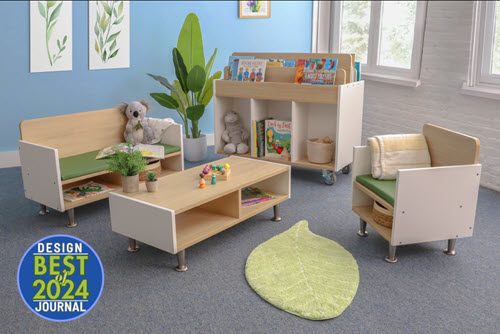
Keene, NH – Acclaimed furniture brand Whitney Brothers® today announced its new elevatED™ Collection of furniture for young learners received a BEST of 2024 award from Design Journal, a leading global trade resource for interior designers, architects and facility managers.
A Design Journal panel of 2,400 internationally renowned interior designers, architects and facility managers cited the elevatED™ Collection’s distinct contemporary style and its inventive adaptation across 46 individual pieces in the collection. Each piece is constructed in textured white oak and white melamine structural elements that form crisp, pleasing lines with refined contrasting color accents. Brushed nickel legs add design counterpoint and rich visual interest.
The elevatED™ Collection comprises 46 individual and modular pieces for young learner activities including art, STEM / sensory, literacy development, play, tables, seating, lockers and storage. Each piece is flexible, mobile or modular to enable furnishing a dynamic learning environment for young learners completely within the elevated™ Collection.
Technical attributes of the collection include FSC certified wood material and Eco-Certified Composite (ECC) certification, an exemplary commitment to sustainability and environmental stewardship. The finish on each piece includes proven antimicrobial properties, an important attribute that contributes to the health and well-being of young children.
“The Design Journal BEST of 2024 award recognizes how a fresh, modern expression of furniture can play a central role in creating a dynamic learning environment for our youngest learners,” said Mike Jablonski, president of Whitney Brothers®. “The elevatED™ Collection is another great example of our brand’s innovation and commitment to furnish learning environments that inspire and engage young children.”
About Design Journal Design Journal is a leading international trade resource for interior designers, architects and facility managers since 1988. The Design Journal awards program is one of the most prominent design recognition platforms in the world for the fields of architecture and design. Each year, a global advisory board of 2,400 internationally renowned industry professionals preside over a rigorous evaluation process to select projects and products that represent the highest standards of design excellence.
About Whitney Brothers® Founded in 1904, Whitney Brothers® is a 100% employee-owned producer of furniture for Early Learning and institutional childcare environments sold through educational distributors and dealers to schools, childcare centers, Head Start facilities, churches, libraries, museums and residential homes throughout North America and around the world. The brand’s rich 121-year history reflects old world craftsmanship blended with state of the art manufacturing technology to create products of uncompromising quality, design, innovation, safety, durability and value. Each product is UL GREENGUARD® Gold and antimicrobial certified, qualifies for LEED credits, meets or exceeds applicable CPSIA, ASTM and BIFMA requirements, supported by a Limited Lifetime Warranty and proudly made in America.
eSchool Media staff cover education technology in all its aspects–from legislation and litigation, to best practices, to lessons learned and new products. First published in March of 1998 as a monthly print and digital newspaper, eSchool Media provides the news and information necessary to help K-20 decision-makers successfully use technology and innovation to transform schools and colleges and achieve their educational goals.
As an industrial/organizational psychologist, work is always on my mind. Naturally, I am interested in understanding ways to make work better for others, but I also regularly apply research and theory to my own job. One long-standing approach to building better jobs is to make them more interesting for employees. Work that is interesting is inherently more motivating, more satisfying, and reduces turnover (Parker et al., 2017 for a summary).
The leading theory in job design is Job Characteristics Theory (JCT) (Hackman & Oldham, 1976). Specifically, JCT outlines that jobs facilitating 1) skill variety, 2) task identity, 3) task significance, 4) autonomy, and 5) feedback will be the most motivating and interesting. Importantly, building classes that contain these elements for both students and instructors can lead to benefits for all.
Below, I outline details about the five components and ideas for both students and instructors. As with all course design choices, these ideas are not required for success; you are welcome to choose what feels authentic to your style.
1. Skill Variety
Skill variety refers to jobs that require the use of several different skills or abilities. An example of a job that is low in skill variety is that of a typical manufacturing line. The same motion is used over and over again to perform the work. In a class, an example might be only having students submit a discussion board post for every assignment.
For students:
Allow for variety in the way students learn the information (e.g., reading, watching videos, discussing with peers).
Create a variety of activities and/or assessments such as an oral presentation, case study analysis, paper, or quiz. Where flexibility of how a project is completed can be given, encourage students to try something new or try a new technology to implement their idea.
Bloom’s taxonomy is also helpful here for allowing a variety of assessments and knowledge demonstration.
For instructors:
Consider what skills you currently would like to further develop and use your course to build accountability. For example, maybe there is a new software you’d like to learn. Have students also learn it in a course and you can work through skill development together.
Keep teaching fresh for yourself by incorporating different case studies, materials, videos, or guest speakers (when it makes sense!).
2. Task Identity
Task identity focuses on the ability to execute an entire project from start to finish. If a project requires each student to contribute something different and then put the pieces together, the project may be low on task identity as the individual members did not contribute to the entire process of the project.
For students:
Scaffolding naturally fits under task identity. Slowly build up knowledge and skills until students are able to fully engage in process or project from start to finish.
Occasionally zooming out and discussing how the topic fits within the entire semester, area of study, or career path can help students appreciate how what they are working on is part of a larger whole.
For instructors:
Reflect on your decision latitude to design your course from start to finish.
If you teach a course that fits within a large sequence, meeting with instructors to ensure the sequence makes sense. You are not beholden to conform to other’s choices, but building cohesion can benefit all involved.
If you have a TA for your course, considering ways to get them involved in whole processes (e.g., designing an assessment in addition to grading it).
3. Task Significance
Task significance facilitates finding meaning in one’s work. Specifically, task significance is high when a job has a clear impact on others. Teaching is inherently a job with high task significance, which is perhaps why many of us are drawn to it.
For students:
Connect class information to how it helps benefit others.
Create opportunities for students to interact with guest speakers, community members, or others who may benefit from their knowledge. A final project that supports a community group, for example, may be developed. Service learning is great here.
For instructors:
To help ensure you are having an impact, regularly and systematically collect information from students (e.g., surveys).
Track learning by measuring knowledge at the beginning and at the end of the semester. Inevitably so much growth occurs! Having evidence helps you see your impact, but also helps students appreciate how much they have grown too.
Create an inbox folder so save any and all positive emails you receive about your work.
Consider ways in which you can support new colleagues after you have settled into your position and have tips to share.
4. Autonomy
Autonomy is about the various ways in which individuals have a say in how, when, and where their work is completed. In the classroom, low autonomy might be a discussion board on a specific topic, under a specific word requirement that has to be completed in a short window of time.
For students:
Allow choices when it comes to topics, formats, or types of projects, as much as is reasonable.
Develop opportunities for students to become an expert within a specific area and then be responsible for sharing that expertise with peers.
For instructors:
Reflect on the various ways in which you have control over how to design and implement courses, select your courses, select the time you teach, and when you work on your class. For many instructors, autonomy is relatively high.
Develop your courses in a way that fit into the rest of your job duties. For example, remembering to execute the ability to schedule final paper due dates for a week that is different from conference deadlines.
Balance your autonomy with student autonomy. You can allow as much choice as you like, but make it make sense for you too.
5. Feedback
A high level of feedback is present when an individual is provided information about their performance in a clear and timely manner. Courses with multiple assessments throughout the semester that are scored with comments provide significant feedback.
For students:
Provide a rubric and include rubric comments to make it clear where students are doing well and where they still need work.
Provide summary-level feedback to the entire class.
Remind students to regularly access their grades and to review their feedback.
For instructors:
Provide ways for students to provide feedback to you throughout the semester through surveys, discussion, etc.
On end of semester evaluations, include open-ended questions directing them to share what went well about the course and what they would recommend changing next time. Framing questions this way can lead to more constructive feedback for you, rather than criticize.
Use assignments as feedback about how the material is landing with students. Re-visit topics or adjust as needed.
Conclusion
JCT provides five distinct areas instructors can focus on to evaluate opportunities to make their courses and their own work engaging and interesting. Adjusting these five levers can make the “job” of student as well as the job of instructor motivating and satisfying.
Of course, no theory is without limitations. One note is that individuals who have a high need for growth tend to benefit from this type of job design more than individuals who are not as concerned with growth. The original theory generally neglects social components, though more recent work has corrected that oversight (Humphrey et al., 2007; Oldham & Hackman, 2010). Finally, the limits of too much enrichment are not known. It is possible that maximizing all five components may produce a course that is more stressful than interesting. To combat any potential over-enrichment, instructors are advised to balance motivating course design with structure, routine, and clear expectations.
Overall, job design provides five clear areas to consider enhancing in your course design, both to the benefit of your job as instructor, and the ‘job’ of students as learners.
Sarina Maneotis, PhD is currently a teaching assistant professor at Kansas State University where she oversees K-State’s applied Master’s in Industrial and Organizational Psychology (MIOP) program. Prior to joining K-State in 2020, she worked in industry, advising on a variety of safety, leadership, and human resource data analysis projects. She earned her undergraduate degree in psychology at Colorado State University and her PhD in Industrial/Organizational Psychology at Pennsylvania State University. Her research focuses broadly on intersections of employee performance, wellbeing, and motivation. She is passionate about developing teaching practices that help students hone skills for translating research findings for organizational purposes and use scientific inquiry within the real-world parameters of organizations. She recently received K-State’s 2023 Global Campus Excellence in Online Teaching Award in recognition for her teaching practices.
References
Hackman, J. R., & Oldham, G. R. (1976). Motivation through the design of work: Test of a theory. Organizational behavior and human performance, 16(2), 250-279.
Humphrey, S. E., Nahrgang, J. D., & Morgeson, F. P. (2007). Integrating motivational, social, and contextual work design features: A meta-analytic summary and theoretical extension of the work design literature. Journal of Applied Psychology, 92(5), 1332-1356.
Oldham, G. R., & Hackman, J. R. (2010). Not what it was and not what it will be: the future of job design research. Journal of Organizational Behavior, 31, 463-479.
Parker, S. K., Morgeson, F. P., & Johns, G. (2017). One hundred years of work design research: Looking back and looking forward. Journal of Applied Psychology, 102(3), 403-420.
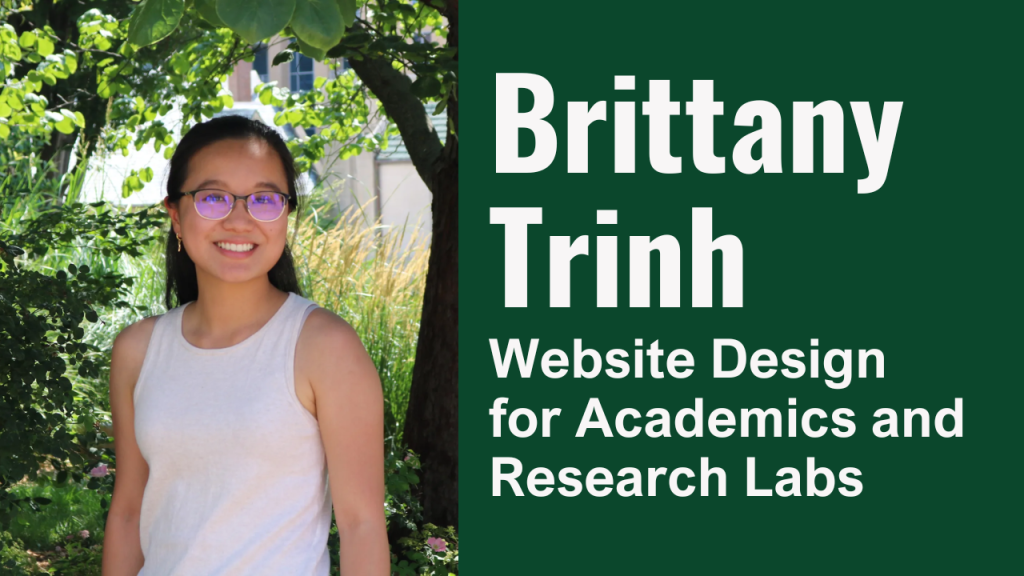
Brittany Trinh returns to The Social Academic featured interview series. We talk about how her thinking on websites for professors, scientists, and researchers has changed. We also talk about how her life has changed now that she’s back in grad school (and what that means for her online presence). Plus, hear about our Team VIP Day service for research lab websites. Read Brittany’s bio.
In this interview
Meet Brittany
Jennifer: Hi everyone. It is Jennifer van Alstyne. Welcome to The Social Academic. I’m here today with my friend and one of my business partners, Brittany Trinh. We’re talking about personal academic websites, research lab websites, websites for academics. Brittany, would you say hi and introduce yourself? Or, reintroduce yourself since you’ve already been a guest on our show?
Brittany: Hi everyone. My name is Brittany Trinh. Yeah, I feel like the last time I was on your show was maybe in like 2020 or something like that. It was a while ago.
Jennifer: Oh my goodness. It’s been that long and we’ve been friends ever since. I mean, Brittany, you were at my wedding this summer. I can’t believe how time has flown by and your life has changed. You’re back in grad school. Tell me about that.
Brittany: Yeah, so I was working and running my side business as a website designer at the time when we’ve met. Since then, I had started grad school in 2021. I am now a PhD candidate in Chemistry at the University of Wisconsin Madison.
Jennifer: Amazing. I really like how you reached out and introduced yourself to me in the very beginning. I felt like there wasn’t a need to be in competition with each other. It was so nice to be able to have someone to talk with about something that we both care about, which is having an online presence when you’re a scientist or someone who’s in academia. And also, we’ve been able to work together and partner together on some fun projects.
Brittany: When I first started getting in the online space and I heard about you. When I saw you at first, I was kind of thinking like, “Oh, we are kind of competitors in a sense that we have similar services” and things like that. But after I thought about it and kind of learned more about the space, I figured at that time we had slightly different audiences. You were still more targeting professors and people who were further along, whereas I was trying to target with graduate students and earlier career. But obviously since starting grad school, a lot of my side business web design stuff has kind of been put on the back burner. I’m still kind of working on it here and there, and I love collaborating with you as of late. So that has been a really good kind of easing back into the web design business.
Jennifer: That’s really fun. And I love hearing about your grad school experiences on social media. What was it like to start sharing that part of your new lifestyle in your online space that was kind of different from how you were showing up before?
Brittany: When I was showing up before, I was mostly just sharing a lot of tips and information on Twitter at the time. That worked for some time. But once I got to grad school, I thought, first of all, I don’t want to just be known for websites anymore. But I also had to take a break because I wasn’t really sure about my scientific identity yet because I just started grad school, and even though I had worked in industry for some time, starting grad school made me feel like a beginner again. And actually it took me probably the last three-ish years or so to finally feel a little bit more confident about posting things on social media regarding grad school.
Because for me personally, I just didn’t really want to be just a PhD influencer. There’s a lot of PhD influencers. I follow them too because I like their contents motivating and things like that, of course. But there’s just certain aspects of it that I didn’t really align with. And, I didn’t want to create that type of content. It took me a really long time up until maybe last year to finally figure out, “Oh, actually I still do want to talk about some things about grad school and about being a scientist, being in STEM and all that. But it just looks a little bit different than how a lot of people are currently doing it.” That’s because a lot of people are also science communicators, so they’re communicating their research, which is great. But for me personally, that wasn’t exactly something that I wanted to do.
Jennifer: Oh, that’s so interesting because the way that I see websites is part of science communication. At least for scientists, it’s a way to communicate who they are and what they’re doing. And that’s something you’re so great at. It’s totally okay that it’s not an interest of yours when it comes to the other areas of your life. That’s so interesting to me. I’m curious if you’re open to it, would you share with me what aspect of influencer life maybe didn’t appeal to you? Because there may be people who are listening to this who are considering the same thing and hearing your thoughts might be really helpful for them.
Brittany: Yeah, I guess for me, a lot of it was just hearing the over romanticizing the lifestyle was one thing that I wasn’t really a fan of, especially without context. I love the aesthetic. When I was in high school, I was obsessed with study aesthetic and everything. So, I get it. It’s very appealing to see that type of content. But I think that when you create that type of content and you share that without sharing the context in which a PhD program happens. I guess what goes on in a PhD program, it can be a bit deceiving to say the least, or just a little bit. I don’t know what the right word is, but I just didn’t feel like that’s something I wanted to do. I think that it’s a good thing that they’re inspiring younger people or anybody who wants to pursue a PhD. I think that’s good to be a source of inspiration. But I think that for me, I didn’t want it to just be an aesthetic look like a lifestyle.
Jennifer: Yeah, I absolutely understand that. And what’s interesting to me is that if I came across your channel and didn’t know that you didn’t want to be an influencer, I would think that you’re quite realist in what you share about your PhD life. And, you even have a podcast about what it’s like to be in grad school. I think that there’s a difference between influencer in terms of the intention of creating partnerships and brand deals and maybe even gaining a certain type of following for being an influencer in that space. And then also just having influence over a space because you are more open about sharing your story. And I think that your openness is really refreshing because you do share maybe some of the negative experiences too, some of the struggles and some of the highlights. It feels very real every time I check out your social media stories. Yeah, I don’t know. That’s so refreshing for me. What was that like for you to decide to actually start posting about these things?
Brittany: That was kind of hard, actually. For the first two years, I think the way I described it to people was that I felt like I was kind of ‘in a shell.’ I was very withdrawn because a lot of my PhD struggles took up a lot of my mental capacity. I just really didn’t have the desire at all to show up and to be seen, and honestly, to be that vulnerable to so many people online and to show them I’m struggling. Because a lot of people, again, like I mentioned, were set up the aesthetic. Everyone looks like, “Oh, they’re having such a good time in their PhD, they’re accomplishing so much. Why don’t I feel that way? Why am I not doing X, Y, Z?”
What I realized recently was that I guess I could go through those times, but I didn’t have to share it in real time. I can still share it now, which is what I’m learning to do right now, which is part of this project I’m working on for my podcast. I’m trying to write a series or make it episode, whatever series of episodes of all the different struggles I’ve kind of gone through. And sharing my thought process through that and what I did, what I wish I did differently, so that hopefully people who listen to the podcast or future people who encounter the podcast can learn from it. And can see, I wouldn’t say the bad side of things, but just these are things that people don’t want to openly talk about. And I think that it does take time to get over it so that you have fully processed it in a way that you can talk about it in a more meaningful way than just, I guess venting about it. Because I never really want to come off that way, even though in real life in the moment, I’m just like, “Oh my God, this was so stressful. Why are things like this?”
But when I talk to other people, younger students and things like that, I have to actively reframe it in my mind. How do I make this useful or helpful to them? Or what can I take away from it? How can I improve through this experience? Which has been happening a lot recently.
Jennifer: You’ve been doing more mentoring yourself, haven’t you?
Brittany: Yeah, a lot of mentoring in terms of in the lab. I’ve had four undergrads so far, and I have two right now. And then I also do some mentoring for first year students. So when they come in, they have a lot of questions about how do I join a group? How do I talk to a professor? Which group should I join and what are things I should look out for and stuff like that. Whenever I give advice, I always preface it with, this was my experience, because I never want to come off as I know everything. I’m just being like, I’m just sharing my experience, and you can take away what you want to take away from it. Honestly, I feel like that’s the same approach I have for my podcast as well.
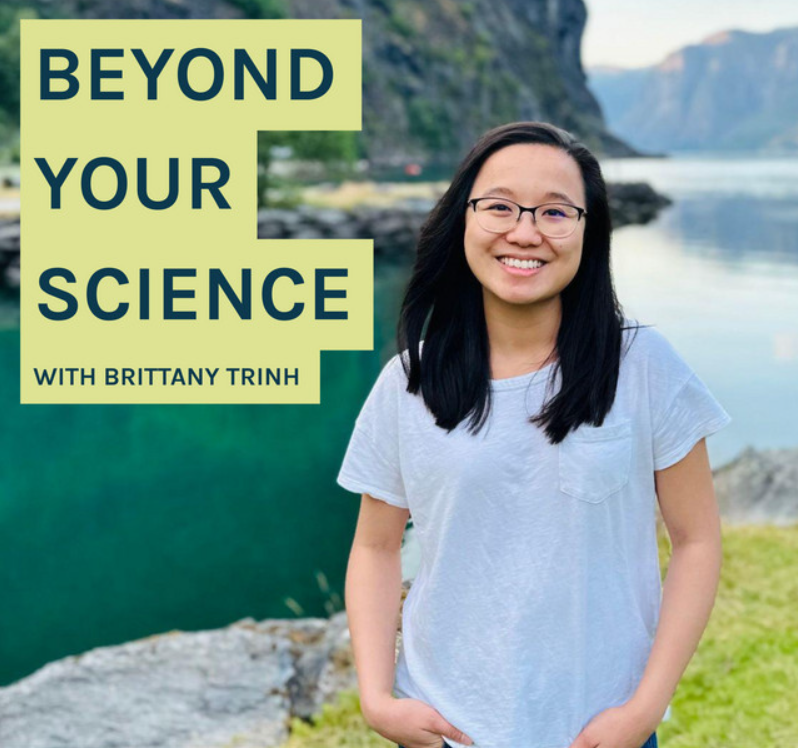
Beyond Your Science, a podcast for grad students and early career scientists
Jennifer: So who should subscribe to your podcast? What’s it called, and where can people find it?
Brittany: My podcast is called Beyond Your Science. It’s available on Apple Podcast and Spotify. It’s really for any graduate student or early career scientist who wants to explore the intersection between science, creativity, and entrepreneurship. And so those are some of the core pillars I talk about on my podcast. Grad school is just a part of it for now just because I’m in it, but that’s not giving advice on how to get into grad school or anything. One thing I really would love to focus on more in the future is kind of small businesses in STEM, just because I think that’s a really niche area that we don’t really hear a lot about when we’re in grad school. In grad school, we hear about becoming a professor or going to industry, and we also actually hear a lot about people going into startups and entrepreneurship and stuff.
But at least on the grad school level, I haven’t really heard a lot about people choosing a small business route after grad school. But because of getting to know so many academics on online over the years and seeing where they’ve gone, a lot of them have started their own businesses and things like that because of the flexibility, the freedom to do what they would like to pursue their own ideas. I think those are all things that we as graduate students, we really value. And so I kind of want to show more people that this is a possibility for you if you could consider it. Yeah.
How Brittany’s thinking about academic websites has changed
Jennifer: Oh, that’s so cool. That’s really exciting for me to hear. And that’s kind of the first time I’m hearing about this too. So I love that you shared that. Now, I’m curious, how has your thinking about websites changed since our last interview? It’s been a while. I know we’ve worked on websites together. Overall, how has maybe your thinking changed over time?
Brittany: Oh my God, that’s such a good question because let me tell you, when I first started, I had just gotten out of undergrad and I was starting my job. I was trying to convince grad students to create websites for their work. And at the time when I started four years ago before coming to grad school, I was just really baffled. I was like, why don’t you want to create websites for your work? Why aren’t you proud of your work? Because you’re doing cool stuff and you’re super qualified. But no amount of me encouraging them could really get them to change anything. So I would just be like, “Oh, well, whenever you’re ready, this information is here for you.” But now that I became a grad student, I understand why.
Jennifer: Oh, wait, wait. Tell me a couple of reasons why. Because there’s definitely grad students listening to this that are like, ‘I think that might be me.’
Brittany: Yeah. Okay. Because I have my website and my website has all my website design stuff, my podcast stuff. But for the longest time, I didn’t really want to talk about my research at all. I didn’t want to share it with people.
Jennifer: What’s your research on?
Brittany: My research is focused on polymer chemistry specifically. Right now, I’m learning or developing a method to make more make up this polymerization more environmentally friendly. Before that, I was learning about how polymers can be made stronger and tougher for high impact materials, aerospace equipment, military equipment, things like that. So I’m just really interested in polymers and how their mechanical properties are useful. But now, right now I’m mostly focusing on how to synthesize polymers in a more eco-friendly way.
Jennifer: I love that! And I love the environment, so that’s my favorite. What about that felt like you wanted to hold it back or hold that part of yourself back from sharing on your website, and have you shared it?
Brittany: I think it was because I just didn’t really have the tangible result to show: because I didn’t have a paper. I still don’t have a paper. I’m a fourth year student PhD candidate. I have no papers. It just reminded me of that Pride and Prejudice quote, “I’m 27 years old and I have no prospects.”
Jennifer: I love it. We’re both readers. We both love classical music. Brittany and I are good friends, and there’s so many reasons why.
Brittany: But seriously, that’s the reason why I feel so, I don’t want to say ashamed, but just a little bit hesitant to be like, ‘This is my research.” I haven’t published anywhere. I maybe presented at a conference, but that work is unpublished and I don’t know if that will be published anytime soon. All those reasons combined. Plus, just the way that just by the nature of the PhD experience. I just naturally feel more inadequate than before. Imposter syndrome, right? All those reasons combined makes me not want to own up to it. I guess at least professionally, it’s easy for me to just say, “I’m a Graduate Research Assistant, because that’s what I am on paper. But to be like, “I’m a scientist.” I don’t really know about that.
Jennifer: It feels like a stretch, even though that’s not true. You’re mentoring future scientists already [laughing].
Brittany: I’m doing science, more science than a normal person does. Even if I don’t feel that that way, I am already doing it. That’s kind of what I had to tell myself. Yeah.
Jennifer: So did you put it on your website?
Brittany: I finally did put it on my website.
Jennifer: Oh my goodness.
Brittany: Yeah, because I was like, oh, my bio has nothing about chemistry. So it’s just in my bio, it’s like a little blurb. It says, Brittany is a PhD candidate in chemistry. Her research focuses on synthesizing high impact polymers in a more eco-friendly way and leveraging their tough mechanical properties into industrial applications.
It was really hard to condense what I do into a couple of words that are easy to understand. On one hand, it felt like I was oversimplifying, but on the other hand, I was like, I’m not going to go into the details. If someone was really interested, they could ask. But that was also really hard because I was like, it makes it sound like what I do sounds really, I don’t know, noble and great? But I don’t feel that way on the day to day. You know what I mean? At least I assume a lot of graduate students probably feel some type of way about their research.
Jennifer: Oh my goodness. Professors feel that kind of way about their research. Let me tell you, that feeling of being unsure about how you’re talking about your research and the things you care about most? That doesn’t go away when you become a mid-career researcher or a senior researcher, and you might even struggle to talk about it the way that you feel when you’re retired. So I think that it’s something many people struggle with it. And I love that you shared what you wrote with us because it sounded great.
Brittany: Yeah. I used your tips from a previous podcast interview, I think with Dr. Echo Rivera.
Jennifer: Ooh. For anyone who is listening, we do talk about how to write an amazing conference speaker bio. That’s great for academics writing any kind of bio. So I hope you’ll check that out.
Updating her personal website
Jennifer: Now, your online presence has changed as your new life experiences and goals have popped up. One of the things that you did was redoing your website, and you just talked about adding in that bio. What prompted you to want to redo your website? I know as a website designer myself, that’s a project I’ve been putting off for so long. I need to do it. So what prompted you to do it?
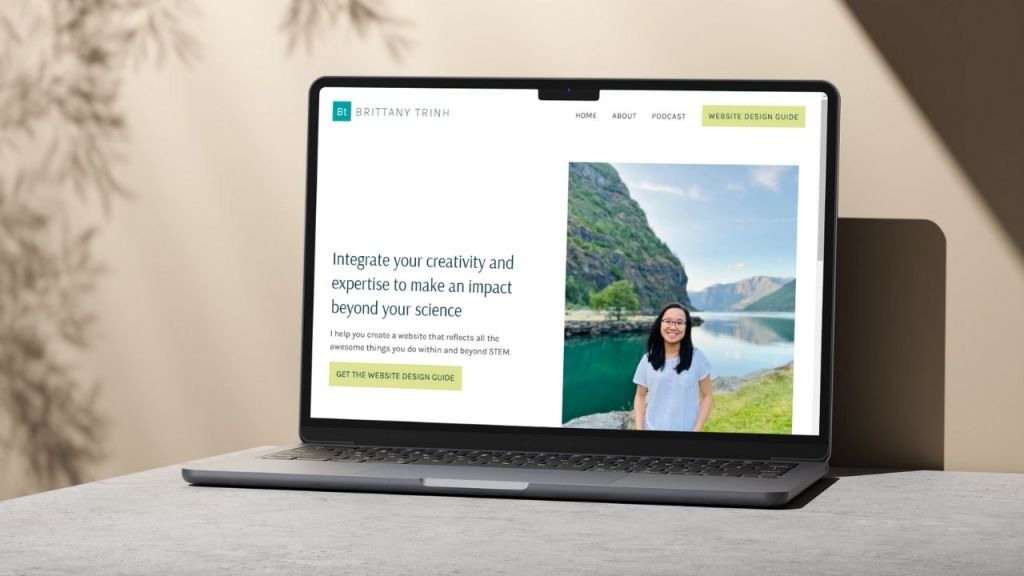
Brittany: Yeah. For the longest time, I had started with all my services about website design or workshops about website design. And then as I was realizing I don’t really have the capacity to do this anymore, I started making those pages hidden. I didn’t want to highlight that anymore. And then just throughout grad school, I realized I don’t really know if I want to just leave it open for website design right now. So I kind of want to just make it very clear that I’m trying to build my personal brand instead. That my personal brand still includes website design tips, but that I’m not actively soliciting new clients.
And I think that has really helped because now on my website, it’s just me featuring my podcast, which is my main mode of sharing and building my personal brand through the podcast and also LinkedIn newsletter. Then also kind of just repackaging some of the things I already had, some of the resources I had so that it’s still useful to people, but it’s more organized. I finally did that a couple months ago. And I also did a podcast episode where I talked about the process of me deciding to do that. But again, it was also something that I had put off for the longest time too. Because school, life, all the other things that come first.
Jennifer: Exactly. Sometimes we have to prioritize all the other things, and it’s okay to put off the thing with your online presence as long as you need to. I love that Brittany made that list because what she was ready, she knew what she wanted to do.
Best Personal Academic Websites Contest returns in 2025
Jennifer: Now we have done, since we last did our interview, two annual Best Personal Academic Website Contests. It was so fun to be able to share some amazing websites from grad students, postdocs, early career researchers, people who were in research labs. Oh my goodness. There were just so many people who were curious to submit to this contest. Would you be open to doing another one with me next year? What do you think?
Brittany: Yeah, I love doing it. I love seeing how people show their research, show themselves through their websites. It’s very interesting to see how people interpret also website tips and then implement it on their website too. And I think also because we do it with Owlstown. Owlstown is [a website builder] made for academics. I think it’s really fun to see how people still are able to customize it to their own needs.
Jennifer: Brittany and I are both designers, and so we’re thinking about every little detail, but for so many people, all you need is a website. And it is totally amazing that Dr. Ian Li has created Owlstown, a free academic website builder that you can easily make your website in. What is it? Like 15 minutes? I mean, it’s really fast. We did it on that call.
Brittany: Yeah, it’s very fill in the blank type of [website design]. That’s what I told this to the grad students in my department too. I was like, if you guys need a website, just use this. It’s so fast and easy. You don’t need to think about the design.
Jennifer: Even if you do eventually want that fully designed website in the future, if you know it’s not on your list this year or next, I mean make an Owlstown website, it will create a stronger online presence for you like today.
Brittany: Yeah. And I also met Ian, around the same time I met you or reached out to him around the same time. I also had to test it out for myself before I recommended it to people. When I tested it out, it was in its early stages, and even in its early stages, I was like, wow, this is really good. And then over time, he started developing more features and things and I was like, sold. This is so good now.
Jennifer: Right? I love how responsive he is. If you have a question about it or a suggestion, some kind of feature that you want to see, if he thinks it’ll help people, he’ll try and make that feature happen. It’s so cool.
Jennifer: Now, research lab and group websites, that is something we’ve been teaming up on for VIP days where professors get a done-for-you website in one day. I mean, seriously, we gather the materials in advance. We have a Planning Meeting. We talk about things like website aesthetics and colors and stuff and what you want. But then Brittany and I, and my husband, Matthew, we team up, we create the website for you in just one day. Oh my goodness. Brittany teaming up with you on this has been amazing. It’s been so transformative. I’m honestly shocked by how much we’ve been able to get done in one day.
Brittany: Yeah, me too. I think it’s really nice to work in a team like this because before I had just been working on my own. I think the workflow of gathering all the content beforehand helps so much. Because then you know what needs to go on the page, and it just makes everything go by so much faster.
Jennifer: Exactly. Now we can totally work together. If you’re looking for that bigger done-for-you research lab website [Strategic Website Design service]. Brittany, and I may still be able to help with that, but Team Website VIP days is what I recommend for most research labs, especially if this is going to be your first website. It’s not like a redesign. So we only have a couple days left in 2024, but please reach out about the new year. We would love to work with you and help your research lab or group. Brittany, what should people know about their research lab website or group website? Do they need one? Who should consider this kind of service?
Brittany: If you are a professor who’s actively recruiting students, you definitely need a website. I remember even when I was looking for groups and such, or even students now when they’re coming in and they’re looking at professors, they check the website. They go and see when was it last updated? Are students graduating? Is your group still active? Because the student is trying to prepare as much as they can to know about the professor so that when they meet the professor, they can talk about the research or ask about active projects and how they can get involved. Or, talk about what skills they bring to the table and things like that. But it’s going to be kind of hard for them to do that if there’s no website. Or, if you just have a very broad research statement on your faculty page or something.
The other thing is that students may be interested in the general area of research, but they may not know exactly what the research work entails. Maybe some people will be like, “Oh, just read the papers.” But in all honesty, a lot of students when they’re coming in, they’re very overwhelmed with enrolling in classes, teaching classes, looking for a group, acclimating to their new city. Trying to also parse out which papers are relevant to current projects at the moment is also very difficult. I really advocate for professors to have this on their website: a very clear or recently updated Projects page with publications that are most relevant or recent so that the student can easily pick out. “Okay, let me read the update on this and see where, what they’re doing right now, where could I fit in,” and things like that. So definitely professors of any age that wants to get students interested in their work. And, especially younger professors. I think now a lot of younger professors are, they’re trying to build a personal brand and everything in addition to the research.
Jennifer: This is a great use of startup funds. You can pay with your university monies. So please don’t hesitate to reach out if you are interested in having a VIP Day website for your research group or lab.
Jennifer: Brittany has been so much fun to have you back on The Social Academic podcast. Is there anything you’d like to chat about or add before we wrap up?
Brittany: No, thanks for having me. I really enjoyed working on the VIP days with you because it lets me still be a part of the helping academics with their websites, but kind of more on the back end of things. That just helps me as a graduate student right now because I’m just not able to do the front facing stuff at the moment.
Jennifer: Yeah, we’re perfect partners on this. And Dr. Makella Coudray, whose research lab website we did recently. We just had a workshop with her research group and she said that she now feels like her online presence is a 10 on a scale of 1 to 10. It’s a 10, and her website is a huge part of that. It makes her feel really good about her research and it makes her lab really excited to help share it. So I’m just so proud of the work that we’ve been able to do together so far, and excited for all the work to come.
Brittany: Yeah, me too.
Jennifer: Brittany, thank you so much for coming on today’s show.
Brittany Trinh is a Vietnamese-American website designer and chemist. She helps enterprising scientists, science communicators, and academic entrepreneurs create a website that integrates your creativity and expertise. Brittany knows when your website reflects the awesome things you do within and beyond STEM, it helps you forge your own path.
She hosts the Beyond Your Science Podcast, where she talks about integrating science, entrepreneurship, and creativity within and beyond STEM, from her own experiences and interviews with other scientists and small-business owners. Listen to the Beyond Your Science Podcast.
Brittany is a PhD candidate in Chemistry at the University of Wisconsin-Madison. Her research focuses on synthesizing high-impact polymers in a more eco-friendly way and leveraging their tough mechanical properties into industrial applications. She received her BS in Chemistry with a minor in Psychology from the University of Houston. Follow her research on Google Scholar.
When she’s not in the lab, she’s probably playing piano or violin, watching slice-of-life anime, or cooking some kind of noodle.
On 18 November I was ill. I recovered in time to travel to Helsinki for a symposium two days later, but winter storms shut down the airport, delayed flights and lost luggage, including mine. The symposium director Dr Timothy Smith (image 2 below, to the left) had to step in to act as my wardrobe assistant. Like many neurodivergent academics, Tim works across an astonishing range of knowledges, including political science, fine art, public policy and pedagogy. But I’m quite certain that sourcing for clothes to fit 155cm grumpy people isn’t part of their typical repertoire.
Image 2Image 3
Image 2: A symposium with person standing to the left holding a microphone; another in the middle, seated, in front of a projection with book cover and QR codes and next to a screen showing live captioning; more people in the foreground on different forms of seating and being
Image 3: Fidget toys placed on top of a paper file that reads ‘UNIARTS HELSINKI’, with a name tag with a lime green strap and name ‘KAI’.
Tim’s Neurodiversity in the Arts Symposium, which took two years of advocacy and planning, and draws on several more of research across neurodiversity and art education, took place at the University of the Arts Helsinki, modelling best practices for inclusivity, not just for neurodivergent folx. Universities, watch and learn. Yes it can be done. So, what does a symposium led by love look like in action? Let’s spell out a few ways how:
Programming not to neo-liberalist but ‘crip time’ (Kafer 2013), enabling us to process our thoughts, with 30 minute breaks between sessions, and a 2-hour lunch break;
Employment oflive professional CART (Communication Access Real-Time Translation) captioning – not the still racist AI captioning that does not grasp ‘non-standard’ accents (image 2, to the right);
Where divergent modes of being – including horizontally, in motion etc, not just seated or erect – are affirmed (image 2, foreground);
Inclusion of fidget toys in the goody bag (image 3);
Provision of quiet spaces – no, we’re not talking about a broom cupboard or first aid room doubling, but a (care-)fully decked out sensory rooms for group or solo use, with low lighting, different soft furnishings as well as more sensory objects for people to shut off, calm down and/or regroup (image 4);
Detailedmaps, diagrams and instructions for ‘walking or wheeling’ to venues; including for a dinner, at a five-star hotel, which was a delicious vegan spread – and entirely free of charge;
Priced at less than one-third the fee of a usual conference at €100 – and that’s for ‘participants receiving full institutional financial support’; otherwise, ‘please select the €0 fee option’;
Elevating and celebrating diverse body-minds-worlds whose research, creative and professional practice gather, collide and transcend disciplines, fields of knowledge, cultures, geopolitical borders, and specialisms and in the lineup. This includes shy*play, a pedagogical platform, collective, and art practice comprising teacher-researchers from Netherlands-Spain Antje Nestel and Aion Arribas, who invite us to ‘do neurodiversity’ (images 5a-5b); Estonian-UK PhD candidate Iris Sirendi discussing their Curating for Change curatorial fellowship at the Museum of Liverpool and urging – no, daring – the arts and cultural sector to step up and ‘crip the museum’ (image 6); US-Canadian-Polish feminist researcher and author of several books including Asexual EroticsProfessor Ela Przybylo disclosing their new identity/positionality of being autistic, and inviting responses Towards a Neuroqueer Conference Manifesto/a/x.
Image 4Image 5aImage 5b Image 6
Image 4: Sensory room, with low blue-green lighting, soft furnishings and soft toys
Image 5a: shy*play’s Antje Nestel and Aion Arribas, both holding microphones and reading from papers strewn on a long table
Image 5b: people ‘doing neurodiversity’ in different ways, including by displaying their creations on a wall that acts as a shared canvas
Image 6: Estonian-UK PhD candidate Iris Sirendi at a long desk speaking to a projection with a slide with the heading ‘What’s Next?’ and a logo that reads ‘The Neurodiverse Museum’
The above are just a few of the highlights from the in-person session on 22 November 2024, which complements an online symposium with a different programme a week prior on 15 November 2024 for those who prefer the digital interface, both of which are recorded with transcripts which all participants can freely access.
I’m not singing the praises of the Neurodiversity in the Arts Symposium because I was the keynote speaker.
I’m saying the above as I’ve been a keynote as well as participant in more than 100 conferences – and I’m still allergic to them, not least as someone who is hyperactive and literally cannot sit still. I’m also saying this as someone who’s curated several, including one on running as an arts and humanities discourse that a 2014 Guardian article said ‘other conferences could take a leaf out of’, for its 8-minute sprint formats and multi-modal approaches including film screening, meditation sessions and run-chats.
But Tim’s conference was way better. The symposium is prioritising not just neurodivergent and queer – neuroqueer (Walker 2021) – perspectives. Following the positionality of multiply-minoritised researchers in higher education Angel L. Miles, Akemi Nishida and Anjali J. Forber-Pratt at the University of Illinois at Chicago and Vanderbilt University as expressed in their powerful open letter to White disability studies and ableist institutions of higher education (2017), the symposium focuses on research that counter ‘white supremacy and racism; colonialism and xenophobia; ageism; sexism and misogyny; cisnormativity and transphobia; and heteronormativity and heterosexism’.
And I’m sure that Tim, like me, wants other conferences to come, to even better ours.
So, take our baton. Run with it.
Why neurodiversity? Why now?
‘Neurodiversity’ – broadly the coexistence of different ways of processing information, learning and being – has exploded as a buzzword in the past few years. If you didn’t know that 15-20% (Doyle 2020) of humans are autistic, with dyslexia, Tourettes, ADHD and other forms of neurodevelopmental processes, you will have run into the extensive media coverage, or seen your Gen-Z students or kids declaring their ‘neuro-spiciness’ on Tik Tok.
This year alone, I was external examiner for two creative PhDs by/for/with neurodivergence, and helped deliver one PhD candidate to the finish line and whom, since 28 November, can now add ‘Dr’ to their name, likely to the chagrin of those who think that only clinicians are ‘real’ doctors and experts. Collectively, these efforts are countering medicalised and deficit approaches to cognitive difference. By 2050, 1.94 billion of the 9.4 billion population will be neurodivergent – making neurodivergence far from a ‘niche’ phenomena or area of research, but one with substantive critical mass.
Those with social capital wear their difference as proud badges of honour. So far so ‘authentic’.
But surprise, surprise – for the multiply-minoritised, their difference continues to be demonised, pathologised, infantilised, and/or policed. This includes teachers and researchers who draw on their neurodivergence in their teaching and research. That’s also why many aren’t out – or have/want access to diagnosis (which themselves have long waiting lists, are costly and more), etc, and often aren’t reflected in the official figures and studies. It’s also only recently been understood in leadership studies that when a white heterosexual cis-man expresses his ‘true self’, it’s just not acceptable, or even laudable. For those who are not straight, not white, not of the right class, or the right skin tone etc – authenticity comes at a high cost – including literally so. Being dyslexic, I struggle with normative approaches to reading and writing – but reading and writing are literally bread and butter for an academic! Disclosing that you cannot read or write would be tantamount to career-suicide, especially if you are on a fixed-term contract – if you have been able to survive the ableist, racist and sexist HE system at all, that is.
Harvard, World Economic Forum, NESTA and other global bodies have been selling neurodivergence as the ‘next talent opportunity in the workplace’, ‘competitive advantage’ and a ‘neuroleadership’ antidote to in tackling wicked challenges for the Fourth Industrial Revolution — but without neurodivergent voices in this discussion, isn’t this objectifying and othering?
Then, there’s a certain cartoon-tycoon who has been dominating the headlines. When not firing their critics from their factories and firms, or firing rockets to colonise the moon and Mars, this person is firing spats on social media — before buying up the site to make it their temple for ‘unmoderated toxicity’. After firing pot-shots at child-free cat ladies, they’re asking ‘high-IQ revolutionaries’ to work for no pay for an incumbent government. The latter call is interesting because this person had announced that they are ‘with Aspergers’, using the outdated terminology still instrumentalised by certain ‘high-functioning’ autistic people, to denote that they are a genius — ie a high-IQ revolutionary themselves!
Why neurodiversity, love and HE art and design?
As an autistic child-free cat lady, it’s my duty to ask other neurodivergent artists, academics, activists and allies within Higher Education (HE) to do more and do better, to call out on dangerous neurodivergent figures and approaches, and to counter that with love. If Machiavellian misfits and messiahs weaponise their neurodivergence, so must neurodivergent movers and shakers dis-arm them.
Image 7
Caption: Love-led guidelines for to make spaces more inclusive, in diagram form with 8 blocks of texts. From Tan, Kai Syng. Neurodiversity In/& Creative Research Network shared, LIVE, CO-CREATED Community Guidelines since 2022
For several years, I’ve researched into and discussed the need to dismantle harmful narratives of neurodiversity. Through an art-psychiatry project, founding of a global 435-member network for neurodivergent innovators, I’ve urged for a decolonial — ie shift of focus away from knowledge and practices in the West and global north — and intersectional — ie consideration of a how multiple, complex contexts interact and intersect — approach. We’ve come up with love-led guidelines for activities (image 7). I’m editing a publication with a major academic publisher, which is possibly the first book with openly neurodivergent academics ranging from early career researchers to established, newly-‘out’ professors, to discuss our research through the prisms of neurodivergence and creativity (c2027). Along the way, we are introducing and foregrounding neurodivergent approaches to knowledge, creative research and writing with play, lived experience and more, thus challenging the dominant, normative habits demanded by the academic publishing industrial complex that emphasise the linear, causal, and ‘neutral’.
On this SRHE platform, I’ve previously discussed a neurodivergence-inspired pedagogical approach to transform HE culture, illustrating how this isn’t just an armchair exercise or a theoretical pontification from the ivory tower, with examples I have led, such as a four-day festival for Black History Month 2020 in Manchester. To mark Valentines’ day this year, I discussed the need to build love into HE curricula – standing on the shoulders of great artists, activists and teachers before us, like bell hooks, Paulo Friere and James Baldwin.
My keynote at the Neurodiversity in the Arts Symposium was entitled ‘Neuro-Futurism and Reimagining Leadership’. My performance-lecture was based on my book of the same title, subtitled ‘An A-Z Towards Collective Liberation’. Grasping how systemic oppressions are interconnected and how liberatory approaches to education must be joined up is vital in this discussion. I postulate a new intellectual agenda and action plan for ‘leadership’ as discourse and practice anchored in visual arts and arts education. Re-claiming the subject from business or arts management, and away from a trait/talent hinged on individualism, hierarchy, genes or luck, the book – and my performance – entangles critical leadership studies with socially-engaged art and relational aesthetics, embedding neuro-queering, futurity, and Chinese Daoist cosmology for the first time, to introduce ‘neuro-futurism’ as a beyond-colonial, (co-)creative change-making framework.
The participants of the symposium grasped this, responding by describing the performance-lecture as ‘phenomenal’. Brazilian artist-researcher Fran Trento, a postdoctoral researcher at the Department of Geosciences and Geography at the University of Helsinki, even took live notes and pictures to add to their mobile participatory art installation, and wheeled it around, further spreading love in HE – literally (Image 8). If it hadn’t been snowing so heavily, Fran would have wheeled their installation outside, beyond the ivory tower, to make visible what the abstract yet very simple four-letter word – love – can look like.
Image 8Image 9
Image 8: Dr Fran Trento standing next to their mobile installation that comprises a jacket onto which participants can make marks onto, scrolls of film, and a pail with cameras and other creative and critical tools to dismantle harmful narratives and approaches
Image 9: A signboard ‘Neurodiversity in the Arts Symposium’ covered in snow, in a street raging with a snow-storm with cars passing by in front of a building across the road
And love is critical if we want to dis-arm and dismantle violent master (sic) narratives and approaches of neurodivergence. If neurodivergence is a superpower — a trope I have also critiqued as, while useful, it can be reductive/fetishistic, and capitalised by the ‘high-functioning’ to self-select into an elitist club that excludes others — then there are also villains and Machiavellian messiahs who abuse their (super)power. The irony is — and yes, autistic people can grasp irony — is that these self-proclaimed ‘anti-establishment’ ‘outsiders’ are often the very personification and product of the system,as poster boys of capitalism and more. Remember the call for ‘weirdos and misfits’ outside the Oxbridge set to join Number 10 – by figures whose pedigrees were archetypal of the ruling class — private education, Oxford degree, political strategist to a prime minister similarly outfitted?
Now that’s weird!
Braving storms ahead
My luggage got lost – again – on my way back to the UK, but academic and arts and cultural workers must lose neither our focus or hope. As hatred becomes even more mainstreamed and normalised, minoritised body-minds and approaches will remain hardest hit. There will be storms ahead (image 9). We – and that includes you – must step forward and step up. As US author Octavia E Butler (1947–2006) warns, unless we build ‘different leadership’ by ‘people with more courage and vision’, we’ll ‘all go down the toilet’. That’s why the Black science-fiction bestseller, who was also dyslexic, wrote story after story that reimagined different, better realities.
To not go down the toilet, we must disarm those who weaponise their neurodivergence. Here are some of the things that neurodivergent academics, artists, activists and allies can do:
Shift your curricula to elevate and celebrate efforts that are truly leader-ful, joy-ful and equitable, and directed towards collective liberation. I’ve named several in this article. No excuses.
Stop the hierarchy of normality – within neurodiversity groups in and beyond HE too – that props up antics that are white supremacist, patriarchal, misogynist, racist, transphobic, homophobic, xenophobic, colonialist, capitalist, ableist and extractive. Stop fuelling the misfits and messiahs with ill-intentions.
Instead, invest in and donate your time, energy and skills to support love-led efforts. If you have a voice/ platform and can afford to, mobilise it to push back against the violence. People in senior management paygrades, make use of your position/proximity to the top of the food-chain to action positive change beyond lip service or generic policy statements about the civic duty of HE, and bring to life its promises about equity, social justice and inclusion.
On that latter note, I’m seeking to curate a 3-day international summit in 2026 that re-imagines HE art and design as a change-making and future-making force through neuroqueer, social justice and leadership prisms. This welcomes anyone with a stake in the arts and culture, higher education, social change and inclusive futures, to get together to explore the coexistence of different ways to (un-)learning and being in the world, to share best practices about inclusion, and to collectivise and co-create action plans for more inclusive futures within and beyond the art school and HE. Through quickfire provocations, transdisciplinary speed-dating, reverse-mentoring, co-creation of toolkits, skateboarding tours, running-discourses and other embodied forms of engagement, we will not just learn about ways to make ‘reasonable’ adjustments for neuro-divergent students and staff, but to learn about their innovative approaches, and thus reimagine ways to understand and do ‘leadership’, so as to make positive changes, within and beyond art and design and HE. This shift in paradigm to position art and design higher education is aligned with – and can amplify – other ongoing efforts in the sector, such as the Creative Education Manifesto. Get in touch if you’re keen to help do the work.
All that said, clearly, neither Tim’s symposium or my proposed summit are the only or last word in this matter. You, too, can lead with love, if you don’t already.Prioritise an intersectional approach to neuroqueer the curricula, towards dis-arming stories and approaches that are white supremacist, racist, colonialist, xenophobic, ageist, sexist, misogynistic, classcist, transphobic and heteronormative.
CREDITS: Photographs by Kai. Photograph of Kai by neurodivergent artist-curator-activist-PhD-candidate Aidan Moseby
Kai Syng Tan is an artist, academic, author, and agitator who adores cats and alliteration. Their bookNeuro-Futurism and Re-Imagining Leadership: An A-Z Towards Collective Liberation re-imagines leadership as a co-creative, neuro-queered practice centring anti-oppression and futurity: it was published in Summer 2024. See here to join the book tour. Sign up here to participate in the CHEAD Leadership Programme taster entitled What’s love got to do with leadership? led by Kai as a new CHEAD Trustee, which will feature a response by Pascal Matthias, Associate Vice President EDI and Social Justice, University of Southampton and Co-Founder at FACE (Fashion Academics Creating Equality). Kai is Associate Professor in Arts and Cultural Leadership, University of Southampton, UK. All views here are their own.
There is a looming skills deficit across all disciplines currently being taught in Universities today. The vast majority of degree programmes are, at best, gradual evolutions of what has gone before. At their worst they are static bodies of knowledge transmission awaiting a young vibrant new member of faculty to reignite them. Internal reviews are too often perfunctory exercises, seldom challenging the future direction of graduates as long as pass rates are sustained. That is until is to late and failure rates point to a ‘problem’ at a fundamental level around a degree design.
We, collectively, are at the dawn of a new knowledge-skills-cognition revolution. The future of the professionals has been discussed for some years now. It will be a creeping, quiet, revolution (Susskind and Susskind, 2017). Although we occasionally hear about some fast food business firing all of its front-of-house staff in favour of robotic manufacturing processes and A.I. Ordering services, the reality is that in the majority of contexts the intelligent deployment of A.I. to enhance business operations requires humans to describe how these systems operate with other humans. This is because at present none of these systems score highly on any markers or Emotional Intelligence or EQ.
Image generaed by Windows Copilot
Arguably it has become increasingly important to ensure that graduates from any and all disciplines have been educated as to how to describe what they do and why they do it. They need to develop a higher degree of comfort with articulating each thought process and action taken. To do this we desperately need course and programme designers to desist from just describing (and therefore assessing) purely cognitive (intellectual) skills as described by Bloom et.al, and limit themselves to one or two learning outcomes using those formulations. Instead they need to elevate the psychomotor skills in particular, alongside an increasing emphasis on interpersonal ones.
Anyone who has experimented with prompting any large language model (LLM) will tell you the language used falls squarely under the psychomotor domain. At the lowest levels one might ask to match, copy, imitate, then at mid-levels of skill deployment one might prompt a system to organise, calibrate, compete or show, rating to the highest psychomotor order of skills to ask A.I. systems to define, specify, even imagine. This progressive a type of any taxonomy allows for appropriate calibration of input and output. The ability to use language, to articulate, is an essential skill. There are some instructive (ad entertaining) YouTube videos of parents supporting their children to write instructions (here’s a great example), a skill that is seldom further developed as young people progress into tertiary studies.
Being able to assess this skill is also challenging. When one was assessing text-based comprehension, even textual analysis, then one could get away with setting an essay question and having a semi-automated process for marking against a rudimentary rubric. Writing instructions, or explanations, of the task carried out, is not the same as verbally describing the same task. Do we imagine that speech recognition technology won’t become an increasingly part of many productive job roles. Not only do courses and programmes need to be designed around a broader range of outcomes, we also need to be continuously revising our assessment opportunities for those outcomes.
References
Susskind, R., & Susskind, D. (2017). The Future of the Professions: How Technology Will Transform the Work of Human Experts (Reprint edition). OUP Oxford.