
Tag: Designed

  • Designed with purpose: Why campus restrooms should reflect the school behind them

    Designed with purpose: Why campus restrooms should reflect the school behind them

    Restrooms don’t have to be showpieces — but they also shouldn’t be an afterthought.

    Across campuses, every space tells a story. The student center. The admissions office. The lecture hall. Each one reflects the institution’s priorities, personality and pride. But too often, the restroom is left out of that story — treated as a utility rather than a touchpoint.

    That’s starting to change.

    Forward-thinking colleges and universities are reimagining what restrooms can contribute to the campus experience. Whether they blend quietly into the background or become a branded statement — they’re being designed with intention.

    To reinforce school spirit. To align with campus standards. To simplify operations across varied facilities. And most of all, to support a seamless experience for students, staff and guests.

    Because the restroom may not be the centerpiece of campus life — but it still reflects the care behind it.

    A Daily Experience That Deserves Design

    Restrooms are among the most frequently visited and most visibly judged spaces on campus by prospective students, visiting families, faculty, alumni, donors and staff. Their condition, look and functionality can either reinforce the university’s values…or quietly undermine them.

    In fact, nearly 60% of people say a poorly maintained restroom negatively affects their perception of an organization.¹ And while universities don’t compete on toilet paper, they do compete on experience, reputation and pride.

    That makes restrooms more than a maintenance checklist — they’re part of the brand.

    One Standard. Many Spaces.

    From dorms to arenas to academic halls, no two campus buildings are exactly alike. But consistency still matters for both the brand and the teams behind it.

    A welcome center might feature subtle brand cues or custom faceplates. A student union might highlight school spirit or student accomplishments. An admin wing may favor quieter design that blends in. The point isn’t sameness; it’s cohesion.

    So how do universities achieve that without adding complexity?

    They’re working from a flexible foundation — systems that adapt to each building’s needs while maintaining a cohesive experience across campus.

    That might mean:

    • High-capacity towel systems in athletic centers to reduce servicing during peak hours
    • Touchless, ADA-compliant dispensers in classrooms and libraries to support accessibility
    • Customizable faceplates in front-facing spaces to reflect branding or student life
    • Smart technology that tracks supply levels and helps janitorial staff focus where it’s needed most

    By choosing tools that support both visual customization and operational ease, campuses are creating restrooms that feel thoughtful, consistent and easy to maintain — no matter the setting.

    It’s not one-size-fits-all. It’s one strategy applied intentionally.

    Built to Work — and Work Hard

    Restrooms can look great — but if they’re hard to service, the system breaks down fast. On a busy campus with lean facility teams, every efficiency matters.

    Elevated doesn’t mean complex. In fact, the best elevated solutions simplify operations with:

    • Refill systems designed to reduce changeouts and user error
    • Configurations that match space and capacity without overloading custodial teams
    • Smart restroom monitoring that helps direct staff where they’re needed most
    • Soft-close and touchless features that create quieter, more seamless experiences

    The result: less downtime, fewer complaints, smoother campus operations. And all of it happening behind the scenes — just as it should.

    A restroom shouldn’t steal the spotlight. But it should reflect your standards.

    Whether you’re reimagining a flagship student space or refreshing legacy buildings, intentional restroom design can help bring your brand and your operations into better alignment — and create a more consistent experience, one space at a time. 

    Because small details send big signals — to students, staff and everyone who walks your halls.

    Explore what elevated could look like for your campus.


    Sources:

    1Bradley Corporation. (2023, February 28). Bradley survey illustrates why clean restrooms are good for business. https://www.bradleycorp.com/news/bradley-survey-illustrates-why-clean-restrooms-are-good-for-business

    Source link

  • Designed in California but made … all over the world

    Designed in California but made … all over the world

    Most of us spend a good part of our lives glued to our iPhone or other similar devices. It seems as if we cannot survive without being connected to cyberspace.

    It turns out that Apple, a U.S.-based company which makes the iPhone and depends on its sale, cannot survive without being connected to China, which is a key partner in the production of most every iPhone that people use. And that puts the iPhone at the center of the great power struggle underway between the United States and China.

    One of the earliest insights into iPhone production came along in 2010 thanks to research by economists Yuqing Xing and Neal Detert. They lifted the veil off the mystery behind the iPhone label “Designed by Apple in California, Assembled in China”.

    The iPhone model 3G was indeed designed in Cupertino, California, by Apple. But the vast majority of components were sourced from Japan, South Korea, Germany and elsewhere in the United States.  All iPhone components were then shipped for assembly to Foxconn, a Taiwanese contract manufacturer based in Shenzhen, China.

    Less than 4% of the iPhone manufacturing value came from the assembly in China.

    Manufacturing capability

    The iPhone was only first launched in 2007, and iPhones were not sold in China until late 2009. At the time, there was no production of Chinese smartphones. Since those days, the iPhone and other smartphones have become ubiquitous in modern life. Apple now sells 230 million iPhones annually, each one of which has one thousand components and about 90% of them are produced in China.

    Financial Times journalist Patrick McGee, in his recent book “Apple in China“, explained how Apple began assembling iPhones in China for its cheap labour costs but that came with a different cost: China’s labour was not of high quality.

    In contrast to the general impression, China does not have great vocational training systems. So Apple became China’s vocational school.

    Although Apple did not own any factories, it assumed close control over the factories of Foxconn and other companies to ensure its traditional perfectionist quality control. This included sending over planeloads of high-level engineers from the United States to train Chinese workers and investing in machinery for production lines.

    Further, while components from foreign companies are still used in Apple products, these companies are now increasingly based in China. Over time Chinese companies have played a growing role in the production of the iPhone and other devices. Workers from all these companies have also been trained by Apple engineers.

    Over the past decade, Apple invested some $55 billion a year for staff training and machinery. Since 2008, 28 million Chinese have received training from Apple — a figure larger than the workforce of California.

    Human capital

    But there is more to China’s human capital than training offered by Apple. A key element has been China’s investment in human capital more generally, notably education and health.

    Chinese students participating in the OECD’s Programme for International Student Assessment — from Beijing, Shanghai, Jiangsu and Zhejiang, collectively home to nearly 200 million people — have outperformed the majority of students from other education systems, including the United States.

    China has also made extraordinary progress in lifting its life expectancy, which is now the same as that of the United States at 78 years, even though the gross domestic product per capita in the United States  — a key measure of the economic health of a country — at $83,000, is more than six times that of China. For the first time, China has overtaken the United States in healthy life expectancy at birth,  according to World Health Organization data.

    Apple CEO Tim Cook has said that there is a popular conception that companies come to China because of low labour cost. Cook argues that the truth is China stopped being a low labor cost country many years ago.

    He insists that Apple is motivated by the quantity and type of skill that China offers. For example, while it requires really advanced tooling engineers, Cook is not sure the United States could fill a room with such engineers, while in China you could fill multiple football fields. Such vocational expertise is now very, very deep in China.

    India and the United States

    U.S. President Donald Trump insists that Apple must “reshore” its production to the United States. This is not realistic. The United States does not have the capacity to produce Apple’s products at scale and at competitive cost. It most certainly does not have the same competitive cost, well-trained engineering workforce as China, which has some three million people working in Apple’s supply chain.

    Under Trump 1.0, Apple made a commitment to build “three big, beautiful factories” (in Trump’s words) in the United States. But that was just hot air, as none were built. Now, Trump has threatened to impose a 25% tariff on iPhones if they are not made in the United States.

    In response, Apple said that phones sold there would be labelled “Made in India” (although this is unacceptable for Trump), and has pledged to invest $500 billion in the United States. What this pledge means in reality is still unclear. Apple may ultimately need to build a token factory or two, with limited production functions, to pander to Trump.

    Many commentators are suggesting India as an alternative production base for Apple. And some assembly functions are indeed being shifted to India. But these are just the very final assembly phase of production, which are sufficient to justify attaching an “Assembled in India” label.

    All the pre-assembly activities remain in China. At this stage, India is not a viable option for replacing China because of deficiencies in human capital, infrastructure and logistics systems.

    A close partnership

    In many ways, modern China and Apple have made each other.

    Technology and knowledge transfer have underpinned China’s growing contribution to the iPhone and other Apple products — as well as the Chinese smartphone brands like Huawei, Xiaomi and Oppo, which now dominate world markets. Moreover, Chinese engineers are capable of building all sorts of electronic products, some of which could be used in military conflicts.

    In sum, Apple has made a major contribution to the rise of China as a technological powerhouse. China has been a key factor in the rise of Apple as one of the world’s most successful companies. Apple has a Chinese system for producing the iPhone and other products that works like a song.

    No other country has the human capital, and production and logistics systems for producing Apple products at scale and at a competitive cost. Thus, Apple is in a way now trapped in China, which makes it vulnerable to coercion from China’s authoritarian government.

    It should try to make greater efforts to de-risk itself from China, although that is not easy and might provoke the ire of the Chinese authorities.

    Apple now finds itself caught between a rock and a hard place — meaning President Xi and President Trump.


    Questions to consider:

    1. Where is the iPhone made?

    2. What would make a device that is made outside the United States more expensive to buy in the United States?

    3. Should people be able to buy anything from anywhere without any extra costs from governments? Why?


    Source link

  • How we designed a space where our students connect, collaborate, and flourish

    How we designed a space where our students connect, collaborate, and flourish

    Key points:

    Our charter school, Westbrook Academy, has been serving middle and high school students in the South Los Angeles area for the past six years and stands as a beacon of opportunity for our community. With a student body comprising nearly 99 percent Black and Latinx individuals hailing from historically under-resourced communities, we confront the realities of poverty and the accompanying insecurities head-on.

    Despite the odds, our 400 students consistently demonstrate remarkable resilience and a profound capacity for excellence. Our institution is supported by generous donors and funding sources. Operated and managed by the education nonprofit LA Promise Fund, which provides students with academic and enrichment opportunities that support our mission to spark passion, empower leadership, and prepare them for their chosen college and career paths.

    At one point, our high school students were learning in a church because we didn’t have a traditional classroom set-up. We also lacked the equipment that a traditional high school might have. This changed when we moved into our forever home in South Gate, where an on-campus Empowerment Center serves as a modern, welcoming “student hub.”

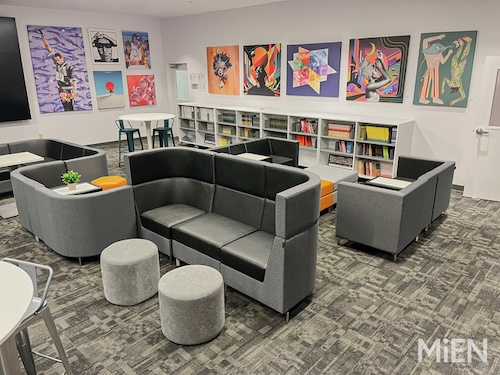
    Designed and outfitted by MiEN and Meteor Education, the Empowerment Center is where kids go to hang out, collaborate, and/or participate in school club activities. The hub is also set up with two wellness rooms where students can go to debrief and disconnect from a long day or just the stresses of being a student. It’s there for the students’ use.

    Here are the steps we took to create a space that consistently makes jaws drop and impresses parents who never thought their children would have access to such a warm, welcoming communal space on campus:

    • Add some flexibility into the process. Our original goal was to open the Empowerment Center’s doors in time for the 2023-24 school year, but getting it done the right way would require a bit more time. Our partners were willing to listen to us in terms of what we wanted to create, but within the realistic timelines. That was really cool.
    • Acknowledge the financial limitations. We largely relied on fundraising for this project and knew that some things just weren’t going to be realistic. To other schools in similar situations, I’d recommend staying flexible enough to hit the timelines and get all of the bases covered while keeping student needs in mind. We can have all the bells and whistles, but at the end of the day, if the car runs, the car runs. We know we can always add a new paint job later.
    • Get the right partners onboard early. As we went through the steps of designing the Empowerment Center, we learned a lot about architecture, planning, and construction. Through it all, having the right partners in its corner helped the school achieve its goals within budget and on time. It was really great to have our design and furniture partners sharing their best practices and other insights with us. We knew what we wanted to do, and a lot of the ideas came from our families and students. We just needed them to show us how we could get those ideas as close to reality as possible.
    • Make it personal. Special features we wanted in our Empowerment Center included a huge, interactive flatscreen TV that students, teachers, and guest speakers use to interact and work together. There’s also a large selection of donated books, the latest technology tools, and artwork that was personally selected by an art curation team. They were able to secure artists from the LA community to create and share visuals that our students are really familiar with. For example, some of the artwork spotlights female empowerment (i.e., with photos of authors like Octavia Butler) and the importance of acknowledging indigenous people. Everything in the hub is meant to spark curiosity. 
    • Brace yourself for some jaw-dropping moments. At our ribbon-cutting ceremony last year, our parents’ jaws were on the floor. They just never thought these resources would be available to their kids. A lot of them grew with us being in the church and a co-located space, and then we asked them to trust us to deliver on our promise, and now we’re able to show that as the reward for supporting us. We feel really proud that our parents were just over the moon about it.

    Hitting it out of the park

    Reflecting on the process we put in place to get our modern student hub designed, built, and open for business, I can say that the end result is an engaging, collaborative space that can be used for hanging out, structured learning, or a little of both. I think we really hit the ball out of the park with this innovative space.

    Student, teacher, and family feedback on the Empowerment Center has been extremely positive. Everyone loves it, and students are always excited to come and spend time in the modern, comfortable space that’s equipped with the technology and tools they need to be able to learn and engage.

    Latest posts by eSchool Media Contributors (see all)

    Source link

  • Three Examples of Interactive Syllabi (Designed with Open Educational Resources from a University Library)

    Three Examples of Interactive Syllabi (Designed with Open Educational Resources from a University Library)

    Last week, I had the opportunity to present at the Open Education Conference. It was virtual and the content was definitely interesting! 

    My session was held on Monday, October 18 • 3:45pm – 4:25pm and it was titled, “Designing an Interactive OER Syllabus as an Equitable Practice”. 

    During the session, I talked about my interactive OER syllabus and I had the opportunity to network with some amazing colleagues. One of the amazing faculty members from my institution attended as well – shout out to Dr. Trina Geye!

    I am passionate about open educational resources and I like fact that OERs can save students money. This is very important for our Texas college students. Open Educational Resources are equitable resources!

    Here are the notes from the presentation:

    I know some of you are wondering WHY I incorporate OERs instead of textbooks for my courses…. This is why…

    • Day-One Access/No-Cost (Equitable)
    • Easier for the Student
    • Mobile Access
    • Linkable to Canvas
    • Easier for the Professor (Updates/Changes)

    I always emphasize partnering with the library to find additional educational resources. Here are some starting points!

    • Podcast Links
    • Guides from Prior Semesters (Student Approved Work)
    • YouTube Videos
    • Database Article Links
    • E-Books
    • Lib Guides

    As you transition from semester-to-semester, I always recommend this checklist for “refreshing” your OER syllabus:

    • Check Your Links
    • Check for More Relevant Resources
    • Develop a Pre and Post Semester Checklist
    • Integrate Your OER Endeavors with Research

    In fact, here’s a copy of my OER syllabi:

    I also design a syllabus and Canvas tour for my students to help them become more familiar with the content.

    Students in my classes (both graduate and undergraduate students) REALLY enjoy the free resources and they are also “more up-to-date” than a traditional textbook.

    Have any questions about OERs? Contact me.

    ***

    Enjoy!

    Check out my book – Retaining College Students Using Technology: A Guidebook for Student Affairs and Academic Affairs Professionals.

    Remember to order copies for your team as well!

    Thanks for visiting! 


    Sincerely,


    Dr. Jennifer T. Edwards
    Professor of Communication

    Executive Director of the Texas Social Media Research Institute & Rural Communication Institute

    Source link