As AI increasingly automates technical tasks across industries, students’ long-term career success will rely less on technical skills alone and more on durable skills or professional skills, often referred to as soft skills. These include empathy, resilience, collaboration, and ethical reasoning–skills that machines can’t replicate.
This critical need is outlined in Future-Proofing Students: Professional Skills in the Age of AI, a new report from Acuity Insights. Drawing on a broad body of academic and market research, the report provides an analysis of how institutions can better prepare students with the professional skills most critical in an AI-driven world.
Key findings from the report:
75 percent of long-term job success is attributed to professional skills, not technical expertise.
Over 25 percent of executives say they won’t hire recent graduates due to lack of durable skills.
COVID-19 disrupted professional skill development, leaving many students underprepared for collaboration, communication, and professional norms.
Eight essential durable skills must be intentionally developed for students to thrive in an AI-driven workplace.
“Technical skills may open the door, but it’s human skills like empathy and resilience that endure over time and lead to a fruitful and rewarding career,” says Matt Holland, CEO at Acuity Insights. “As AI reshapes the workforce, it has become critical for higher education to take the lead in preparing students with these skills that will define their long-term success.”
The eight critical durable skills include:
Empathy
Teamwork
Communication
Motivation
Resilience
Ethical reasoning
Problem solving
Self-awareness
These competencies don’t expire with technology–they grow stronger over time, helping graduates adapt, lead, and thrive in an AI-driven world.
The report also outlines practical strategies for institutions, including assessing non-academic skills at admissions using Situational Judgment Tests (SJTs), and shares recommendations on embedding professional skills development throughout curricula and forming partnerships that bridge AI literacy with interpersonal and ethical reasoning.
Arizona State University has received a $50 million donation to launch the Global Institute for the Future of Energy, a collaboration between its Julie Ann Wrigley Global Futures Laboratory and the Thunderbird School of Global Management that seeks to promote education and innovation regarding energy production and use.
The gift comes from Bob Zorich, who earned his master’s degree in international management in 1974 from Thunderbird’s predecessor, the American Graduate School of International Management.
“ASU has long been a pioneer in building bold, pragmatic solutions for the future,” said Zorich, founder and managing partner of the Texas-based private equity firm EnCap Investments. “President Michael Crow has taken a visionary and action-oriented approach to positioning the university as a leading center for research, educational excellence and global influence. For these reasons, I was excited to fund the formation of this energy institute at ASU because of the university’s unique ability to scale and reach a global audience.”
Zorich’s gift will help the institute recruit a chair and staff and start developing curriculum for students, executives and the public. In the second year, the institute aims to launch a fellowship and executive-in-residence program, as well as a series of public programs, including lectures, summer camps and a global energy conference.
In addition, some of the funds will support Energy Switch, a point-counterpoint show on Arizona PBS that brings together experts from government, NGOs, academe and industry to debate energy-related topics.
“Energy is central to nearly every facet of our daily lives, and we have to prepare now for an evolving energy future,” Crow said in a statement. “With the rapid growth of AI and other fast-moving innovations, we have a responsibility to ready the next generation of energy leaders and solutions. Bob Zorich’s visionary investment will empower our global understanding of energy, our vital literacy and how we can work together to develop the best paths forward.”
It can be tempting for department chairs to think about their role as a series of tasks on a to-do list: managing faculty and staff reviews, running department meetings, implementing a new university policy, dealing with unexpected emergencies. After all, it’s an ever-changing list that demands attention.
But focusing only on tasks misses the ways that chairs shape how department members interact with one another and the quality of relationships that result. Meetings are a common example. Chairs have choices about how to organize meetings, help staff feel included or excluded, coach new assistant professors about participation norms, and assign people to committees. How chairs do these routine tasks can have powerful effects on how department members relate to one another and the quality of relationships that develop. Cumulatively, small moments of interaction have a profound influence on a department and its culture and can be an important ingredient in helping to make departments healthier places to work.
However, many chairs aren’t used to noticing all the ways their everyday chair work impacts work relationships. To take advantage of the opportunity to positively impact relationships in departments, chairs need to develop their relational attention, or ability to notice opportunities to impact how people connect. Two years ago, I developed a six-part workshop series, Healthy Relationships at Work Fellowship, for chairs at University of Massachusetts Amherst, for a small cohort to work on just this issue. By engaging with research-based practices, they were able to develop competence and confidence as leaders while improving the quality of relationships in their departments.
Below, I describe four ways chairs can develop their relational attention and increase the occurrence of positive, inclusive relationships in their department. In describing these four suggestions, I share examples from two cohorts of chairs I’ve had the pleasure to work with.
Invest in one-on-one relationships with department members.
It is easy for department chairs to take for granted that they know the faculty and staff in their departments—and that they know you. After all, as a faculty member you have likely had many casual conversations and sat in many meetings with them. But relying on your past knowledge can leave chairs with an incomplete view. We all inevitably have some faculty or staff we favor and those we avoid, leaving us with uneven relationships and information about their work, motivations and lives. Similarly, faculty and staff may have a hard time viewing you as an impartial department chair unless you take the time to demonstrate it. After all, making visible efforts to cultivate relationships is a cornerstone of inclusive leadership.
One important way to create the foundations for positive inclusive relationships with your department members is to re-establish your relationships with them. You can do this by holding 30-minute one-on-one meetings with every member of your department. Given that chairs often have very little idea about what staff do and how they contribute to the department, it is important to meet with staff as well as faculty. In some departments, it may be important to meet with students as well.
Before beginning these one-on-one conversations, try to get in a mindset of openness, humility and genuine curiosity, no matter your relationship history. Ideally these meetings can occur in their workspace (versus your own office) so you convey that you are interested in them and are willing to come to their space. Ask open-ended questions about their interests, their motivations and their jobs. In smaller departments, these meetings can happen over the course of a month, while in larger departments it may require a whole semester. In larger departments, where one-on-one meetings seem impractical, you can hold meetings with small groups of people in similar roles or ranks. These meetings demonstrate that you want to hear from everyone, no matter your past relationships.
You may also learn new things that you can use to make your department a healthier place. For example, you may learn that two faculty unknowingly have a shared research or teaching interest. By connecting them, you can help to strengthen the connections within the department and potentially spark new collaborations.
What you learn in these meetings can also help to address unhealthy relationships. For example, one chair learned new information about a curmudgeonly faculty member who frustrated his colleagues (including the new chair!) because he had a reputation for not pulling his weight on committees. When the new chair asked him, “How do you want to contribute to the department?” she learned that the one thing he cared about was graduate education. With this new information, she placed him on a committee that matched his interests, and he contributed to the committee fully. By crafting his job to his interests, the faculty member was more intrinsically motivated to participate, and his colleagues were no longer annoyed by his behavior on committees.
Learn about the diversity of your faculty, staff and students and demonstrate your interest in learning from them.
Departments, like all organizations, are diverse in visible (race and gender) and invisible (political, neurodiversity) ways. While there is lots of debate about DEI these days, learning about the diversity of your faculty and staff helps you become a better leader because you can understand how to help everyone succeed. To develop positive inclusive relationships, chairs have to make visible effort to demonstrate respect and express genuine interest in people different from themselves.
To build chairs’ foundational knowledge, you can learn about the experiences of diverse groups in your department, school or university by reading institutional resources, such as climate surveys, or by having a conversation with college or university-level experts. For example, a conversation with a school DEI leader can speak to the experiences of your faculty, staff and students. A university’s international office can provide insight into immigration-related issues, which may be useful for understanding the complexity of managing immigration for international faculty, staff and students.
Bolstering your own knowledge can help contextualize issues that come across your desk. For example, if a student comes to you to complain about a faculty member’s teaching, and you have learned that members of that group have to fight for respect in your university’s classrooms, your knowledge about the broader climate can help you think of this complaint in light of the larger context as you consider what an appropriate response might be.
If you have more confidence in your knowledge, skills and abilities to manage DEI, you can connect more publicly. For example, if there are on-campus employee resource groups or off-campus community organizations, reach out and tell them you would like to learn from them; ask if there are any events that would be appropriate for you to attend. Given your stronger foundation in terms of the local DEI landscape, you can offer to connect marginalized faculty and staff with on-campus mentors and communities.
The ability of chairs to engage publicly with DEI issues will depend both on their own expertise and their institutional and local contexts, as DEI work grows more fraught in many parts of the country. Some chairs who have expertise in DEI or related topics may be comfortable hosting activities in their departments. For example, one chair hosts a monthly social justice lunch and learn, a voluntary reading group for faculty and staff. Given her expertise, she chooses the article and is comfortable facilitating the discussion herself.
Chairs can also create opportunities for critical feedback for the department. For example, if there is tension between groups within the department, instead of ignoring it, create a game plan for how to receive critical feedback about what’s causing the tension and how it might be addressed. Faculty and staff exert a lot of energy withstanding such tension; finding ways to address it can be a huge relief and release of energy.
Remember, faculty and staff evaluate a leader’s inclusivity based not just on one-time events, but instead search for patterns in terms of the leader’s efforts around inclusion. You don’t have to have all the answers about how to serve the diversity of members in your department, but you can strengthen your networks to include those with knowledge and expertise.
View committees as connection opportunities.
Chairs can use committees, meetings and other routine ways that faculty and staff gather as opportunities to build higher-quality connections. By focusing your relational attention on these routine interactions, you can improve relationship quality. For example, people often don’t know why they’ve been placed on a committee or task force, nor do they know what other people bring to the table. As a chair, you can use introductions strategically. Publicly communicating your view of faculty and staff strengths and potential contributions to committees, task forces and meetings helps them feel respected and makes it more likely others will view them that way. This can increase the chances that these routine ways of interacting will result in positive connections.
Committees and meetings are also opportunities to create greater inclusion of staff and to spread knowledge about their work. University staff too often feel like second-class citizens and that faculty don’t know or care about their expertise. To counter this tension, one chair introduces staff members as experts in their respective areas and provides them with opportunities to present in their areas of expertise in meetings. This chair reported that these innovations created new positive connections between faculty and staff; faculty had a new appreciation for staff work, and the staff felt seen and valued.
Design social events as connection opportunities.
We are in a moment in which many people want, and some have, the ability to work remotely. At the same time, faculty and staff desire more connection from work. As an architect of social relationships, chairs have the opportunity to hold meaningful social events that will bring people together. There is no one-size-fits all for designing such events: The goal should be to make events magnets, not mandates.
To start, think creatively about what will bring people together in your specific department. For example, one department chair knew all faculty would come together to support their students. In his department, faculty wanted their undergraduates to have a good experience in the major because they genuinely valued undergraduate education. Accordingly, the chair organized an open house event for faculty and students. In the process of connecting with students, faculty also deepened their connections to each other.
Another chair created a social event around the dreaded faculty annual reviews. The day before the reviews were due, she reserved a conference room and brought snacks so that faculty could trade tips about how to complete the cumbersome form. Still others hosted department parties at their homes, used departmental funds to host monthly lunches or upgraded the department’s shared space to make it more conducive to shared interactions.
Improving the quality of relationships through social events in a department doesn’t have to rely on the chair alone; it can also be the work of a culture committee that can brainstorm social events that will resonate. Ideally, these events will become part of the rhythm of the department. One caveat: It is not advisable to use workplace socializing to try to repair relationships between warring internal factions. In fact, it can make things worse.
Each of these four approaches can help chairs invest in and improve the health of relationships in their departments. It is, of course, also important to contain and manage negative relationships in them (that is another topic I address in the Healthy Relationships at Work program). But taking advantage of these everyday opportunities through strategically investing in your relationships, your knowledge and the ways people connect provides important sustenance to support departmental relationships and ultimately a positive departmental culture.
Emily Heaphy is a professor of management, a John F. Kennedy Faculty Fellow and an Office of Faculty Development Fellow at the University of Massachusetts Amherst. She developed the Healthy Relationships at Work Fellowship for department chairs when she was a Chancellor’s Leadership Fellow affiliated with OFD in 2023–24.
Why College Student Personas Are Critical for Enrollment Marketing Success
Every message has an audience. Even this article was written with you in mind: someone navigating the complexities of higher ed marketing and looking for a smarter way to connect with students.
In the competitive world of college and university marketing, developing comprehensive college student personas is essential. A well-crafted persona helps you move beyond generic outreach and into the realm of meaningful engagement, putting you in the shoes of your prospective students to tell the story of:
Where they’ve been
Where they’re headed
How your program can help them get there
A story-driven, persona-based approach allows you to lower acquisition costs, boost student engagement, and reinforce your institution’s mission. But more importantly, it helps students feel seen. When students feel welcomed and understood, real connection happens.
That’s when a prospect takes a first step toward becoming a future graduate.
What Are Student Personas?
College student personas are fictional, research-based profiles that represent key segments of your institution’s prospective audience.
A persona can help you understand an audience group’s motivations, goals, challenges, backgrounds, and even decision-making behaviors. Rather than marketing to a broad, faceless group, personas allow you to tailor your messaging to be more relevant and compelling.
A well-detailed student persona might include details such as:
Age range
Academic interests
Career goals
Financial concerns
Preferred communication channels
Ideally, each persona will be grounded in data from multiple sources including surveys, interviews, feedback from admissions, and digital marketing analytics, if available.
How Personas Enhance the Student Journey
Student personas are a critical jumping-off point for marketing and enrollment efforts in higher education. Persona identification should occur early in the brand development process to ensure that the brand, messaging, and story align with each audience — whether it is career changers, veterans pursuing education in civilian life, or working nurses looking to advance in their careers.
A persona-driven approach focuses on a multifaceted view of your college or university’s core audiences, primarily consisting of their demographics, psychographics, and behavioral attributes.
While developing multiple custom personas for all your degree programs may seem daunting and can be time consuming, the effort will pay off in the long run in terms of enrollment and student success.
Aligning all key stakeholders involved in developing and deploying the story and identity of a brand around key student personas is also critical to creating a more cohesive and clear experience for students throughout their journey. These personas should inform and influence all teams and stakeholders in their strategies — from paid media ads and targeting, to blog content, to website copy and landing pages, to nurture campaigns.
No matter where students are in their educational journey, having a seamless experience across all channels and touchpoints is more important than ever before.
Utilizing various forms of primary and secondary research in the form of interviews, focus groups, market research, historical student data, and more, we at Archer Education are able to craft a deeper and more comprehensive understanding of what prospective students care about and how to most effectively reach and engage with them.
Steps to Create College Student Personas
Creating college student personas starts with research. Whether your enrollment marketing team does the research itself or relies on secondary sources (we suggest using a combination of both) the information-gathering process for developing student personas is essentially the same. Enrollment marketers will want to begin by gathering a lot of information from a wide range of sources.
1. Conduct Discovery Interviews
Interviews with key institutional stakeholders including program directors, enrollment and admissions teams, faculty, alumni, and current students are an important source of information for understanding student aspirations and goals, challenges and pain points, and even lifestyle circumstances.
We recommend speaking with as many stakeholders as possible to gather diverse insights and perspectives through one-on-one discussions, group interviews, and focus groups to inform robust college student personas. The interviewer’s goals are to:
Learn who students are by gathering demographic and psychographic data. Psychographics focuses on understanding students’ values, goals, interests, and emotions to gain a complete and accurate picture of them as individuals.
Discover why students want to enroll in a particular program.
Explore why they’re attracted to a particular institution.
Learn what challenges or pain points they face.
Find out what they want to accomplish after graduation.
Stories and examples gathered during interviews with current students and alumni about how your program helped them achieve their educational or career goals are especially effective for connecting with prospective students.
2. Mine Historical Student Data
Existing student demographic data (if available) including age, gender, prior education (degree type and level), and job title can help provide very tangible and relevant information for student personas. Institutions that consistently track and report data have an advantage, while brand-new programs that lack historical data may need to lean more heavily on other sources.
Student or alumni reports or survey results, if available, can provide great supplemental information for getting to know prospective, current, and former students better.
3. Conduct Market Research
Many students today, and nontraditional adult learners in particular, are hyperfocused on outcomes and looking for a return on investment in their chosen degree program. Marketing tools and resources enrollment marketers can use to make their program’s case to prospective students include:
Government data on job growth and salaries from the U.S. Bureau of Labor Statistics
Insights from sources such as Lightcast, an aggregator of economic, labor market, demographic, education, profile, and job posting data
Industry-specific articles that highlight opportunities and motivate students to enroll
4. Leverage Audience Intelligence Tools
The ability to gather insights into audiences through social listening and other data sources — known as audience intelligence — is gaining traction with marketers as tools become more advanced. At Archer, one tool that our team uses is Sparktoro, an audience research tool that crawls millions of social profiles and web pages to learn what (and who) your audience reads, listens to, watches, follows, shares, and talks about online. This is a helpful supplemental tool that can help provide a clearer picture of your audiences across various data points and attributes.
If you’re not in a position to pay for audience intelligence tools, some free tools are available, such as CareerOneStop, which is sponsored by the U.S. Department of Labor. This tool is more limited to demographic information, but it can be helpful for learning more about certain industries or occupations that relate to a given student persona.
Facebook Audience Insights is another free tool that we have leveraged in the past to gain a better understanding of users connected to our partners’ pages, as well as to learn about the interests and affinities of a given audience. The tool has become more limited as Facebook has tightened up its access to users’ data and profile attributes, but it still may be worth checking out — especially if Facebook is one of your primary marketing channels.
5. Synthesize Research and Outline Personas
When discovery interviews are complete and market, audience, and other research has been gathered, it’s time to begin synthesizing what you’ve found and outlining your data-informed personas.
Depending on the scope of your project and goals, the structure and template you decide to use for college student personas may look quite different. Personas developed for the entire graduate school of an institution, for example, will probably look very different from personas created for one specific program.
Regardless of the scope and subsequent approach, you should ensure that you’ve covered your bases across the spectrum of core audiences while trying to make each as distinct as possible from one another — either in terms of shared interests and goals, or in terms of demographic factors such as incoming occupation (such as being a working nurse) or lifestyle circumstances (such as being a stay-at-home parent returning to school).
Once you’ve identified the distinct student personas you want to focus on, it’s time to build them out in greater detail. The more in-depth information you’ve gathered, the easier it will be to create distinct, detailed personas that are applicable. When creating personas, make sure to honor your institution’s commitment to diversity, equity, and inclusion by representing students of different races, ethnicities, gender identities, and abilities. Don’t let your personas reinforce stereotypes.
There are many different templates and approaches you can use to develop personas — and there is no “right” way. Again, it really depends on your specific goals and how you can make the personas as applicable and actionable as possible.
At Archer, our teams find that including areas such as skills, interests, incoming occupations, age, education, media usage, and more are important. Also, we highly recommend including a “story” section (as in the examples below) to humanize your fictional student and create a clearer picture of who this persona is and what they care about.
College Student Persona Examples
When we are tasked with creating personas across multiple programs and verticals, we like to create a persona architecture with overarching personas and subpersonas so we can plug them in across various programs, depending on our partner’s needs and goals. This gives our enrollment marketing teams options to target student personas on a broader or more granular level, depending on what makes the most sense for the program.
The persona examples for students below feature overarching personas for a mix of tech/coding bootcamp programs with detailed subpersonas for each target beneath.
Technology is a broad field with opportunities for individuals who come in with a diverse mix of experience, education, interests, and skills. Developing a broader overarching persona (with subpersonas underneath) can help provide a high-level snapshot into a broader group of individuals who still share important commonalities. You can include things such as an overview and some of the top motivations that are most relevant to that audience, in addition to other elements that help showcase who this audience is and what they care about.
Then drill down using the data and stories you’ve collected in your research to animate your multiple subpersonas. Below is a subpersona we created for a partner’s tech bootcamp degree program.
The next example below is a program-specific persona created for a single degree program. Programmatic personas typically include more in-depth and detailed information than personas designed to encompass more than one program. Notice the inclusion of sample job titles and skills.
Developing student personas will not only help your institution attract the right students, it will help your marketing teams, enrollment specialists, and administrators identify and better understand your students’ needs and goals — a win-win for educators and students alike.
Creating Student Personas to Drive Enrollment
Persona-based marketing is a tried-and-true tool for customer acquisition, and higher education is no exception. When exploring colleges or degree programs, students want to know which one will be a good fit for them. Recognizing themselves in your marketing materials can make the difference between their moving forward in the enrollment funnel and moving on to a competitor.
At Archer Education, we partner with dozens of institutions to craft story-driven, persona-based approaches to student acquisition. Request more information and see what Archer can do to help you connect with and enroll the right students.
It’s Employee Learning Week — a great reminder for employers to showcase their commitment to talent development by highlighting development opportunities available to employees. Whether you’re an HR practitioner in search of professional development ideas for yourself and your HR peers, or you’re looking for ideas to engage and develop other employees at your institution, here are several tools, tips and resources to help you take the next step.
Professional Development Tools for the HR Pro
CUPA-HR Learning Framework — A tool that assists in defining HR practitioners’ knowledge, skills and attributes and then helps create an action plan for growth and set developmental goals. Jump start your development by using the quick start guide, then build your skills further by diving deeper into the framework competencies.
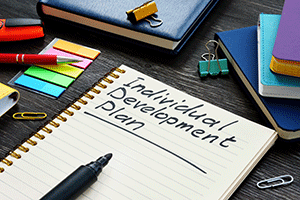
Creating Your Individual Development Plan — A must-have for anyone who wants to map out a strategy for career success in higher ed HR. This free CUPA-HR e-learning course provides an introduction to individual development plans (IDPs) and will guide you through the process of creating your plan, discussing your career with your leaders and implementing your strategy for success. CUPA-HR e-Learning is sponsored by PageUp.
Ideas for the Higher Ed Community
Apart from their own professional development, HR pros often create and help facilitate professional development opportunities for employees at their institutions. Here are some jump-start ideas from the article Optimize Your Hybrid or Remote Work Workforce — Considerations for Higher Ed HR Leaders, featured in the fall issue of Higher Ed HR Magazine.
Encourage managers to use an employee’s development plan to guide regular coaching calls.Gallup suggests ongoing coaching conversations — rather than annual performance reviews — can be of great benefit to both the employee and the employer. These meaningful conversations highlight the organization’s commitment to employee engagement, which can help retain employees for the long-haul. Encourage managers to use employees’ development plans during coaching calls as a guide to the conversation. Setting up the right systems and processes to help employees perform their best from any location is a great operational step, but reorienting managers to think about performance and productivity around outcomes instead is an important strategy.
Get creative with your learning and professional development offerings. William Paterson University’s HR team created a university-wide development program so all 600 non-faculty employees had a chance to participate. Their unique approach to talent development demonstrated institutional support for professional development, provided a platform for employees to engage and collaborate, and inspired additional ways to support employees, such as mentorship programs, goal setting and career advancement. Read more about the program in the special awards issue of Higher Ed HR Magazine to learn how the HR team adapted it to a virtual format — a great alternative for employees working in a hybrid or remote setting!