
Tag: Development

  • December Policy Roundup: Paid Leave Policy, Pregnant Workers Fairness Act Regulations, and Workforce Development Initiatives – CUPA-HR

    December Policy Roundup: Paid Leave Policy, Pregnant Workers Fairness Act Regulations, and Workforce Development Initiatives – CUPA-HR

    by CUPA-HR | January 10, 2024

    Through December and into the new calendar year, federal government leaders kept busy with Congressional hearings and markups, new legislation, and proposed and final rules focusing on issues that may be of significance to higher education HR professionals. CUPA-HR tracked several actions from both Congress and federal agencies on issues including paid family leave, short-term Pell Grants, the Pregnant Workers Fairness Act, and workforce development.

    House Education and Workforce Committee Markup

    On December 12, 2023, the House Committee on Education and the Workforce held a full committee markup on H.R. 6585, the Bipartisan Workforce Pell Act, and H.R. 6655, A Stronger Workforce for America Act.

    The Bipartisan Workforce Pell Act aims to amend the Higher Education Act of 1965, allowing students to use Pell Grants for eight-week or longer educational programs. This bill also establishes quality control measures for Pell initiatives, enabling higher education institutions to participate if they meet specific criteria. The committee voted to move the legislation out of committee with 37 members voting in favor and 8 members voting against the bill.

    The next bill, A Stronger Workforce for America Act, seeks to renew and enhance the Workforce Innovation and Opportunity Act (WIOA). Originally established in 2014, WIOA has been extended through yearly appropriations since fiscal year 2021. The bill incorporates multiple measures to modernize WIOA, bolstering the country’s workforce development to better equip and retain workers. The bill passed through the committee with bipartisan support; 44 members voted in favor of and only one member voted against it.

    Paid Leave Request for Information

    On December 13, the Congressional Bipartisan Paid Family Leave Working Group published a Request for Information (RFI) for diverse stakeholder input to aid in the expansion of access to paid parental, caregiving, and personal medical leave nationwide. The members encouraged interested stakeholders to submit letters that answer these ten questions on the role the federal government can play in creating a national paid leave program.

    Responses must be submitted by January 31, 2024, and can be directed to [email protected], [email protected], [email protected], and [email protected]. CUPA-HR will continue to track developments and intends to collaborate with associate organizations to submit feedback on an as-needed basis.

    National Apprenticeship System Enhancement Proposed Rule

    On December 14, the Department of Labor (DOL) unveiled a proposed rule to modernize the regulations for Registered Apprenticeship programs. The 779-page proposal focuses on provisions to create “safeguards for apprentices to ensure that they have healthy and safe working and learning environments as well as just and equitable opportunities throughout their participation in a registered apprenticeship program,” while also creating baseline requirements for career and technical education apprenticeships, which would target high school and postsecondary students to programs that align more closely with programs found at institutions of higher education.

    DOL is providing a 60-day comment period for the proposed rule, which will commence once the regulation is posted in the Federal Register. CUPA-HR is analyzing the rule and will coordinate with other higher education associations as needed to file comments.

    Federal Transit Authority General Directive on Assaults on Transit Workers

    On December 20, the Department of Transportation (DOT)’s Federal Transit Administration (FTA) proposed a General Directive to address the ongoing national safety risk concerning assaults on transit workers. Transit agencies falling under FTA’s Public Transportation Agency Safety Plans directive would be instructed to conduct safety risk assessments, identify mitigation strategies, and report discoveries to FTA. Per the Bipartisan Infrastructure Law, transit agencies operating in urban areas must collaborate with the joint labor-management safety committees to reduce safety hazards.

    The deadline for submitting comments in the Federal Register is February 20, 2024, but late submissions may be considered. CUPA-HR is working with members and other higher education associations to determine the impact that this directive may have on transportation and HR services at institutions of higher education.

    Regulations to Implement the Pregnant Workers Fairness Act

    On December 27, the Equal Employment Opportunity Commission (EEOC) sent its final rule to implement the Pregnant Workers Fairness Act (PWFA) to the Office of Information and Regulatory Affairs (OIRA) for review prior to its publication in the Federal Register. The final rule will likely look very similar to the proposed rule that was issued in August 2023, which provides a framework for how the EEOC plans to enforce protections granted to pregnant workers under the PWFA.

    The EEOC was tasked by law with finalizing regulations to implement the PWFA by December 29, 2023. Given the missed deadline, OIRA may move quickly on its review of the regulations, and we could see the final rule published sometime between late January and late February. CUPA-HR is continuing to monitor for any updates and will keep members apprised of any new details that may arise in the final rule.



    Source link

  • Trends in Higher Ed Employee Learning and Development – CUPA-HR

    Trends in Higher Ed Employee Learning and Development – CUPA-HR

    by CUPA-HR | February 1, 2023

    Employee learning and development (L&D) offerings at higher ed institutions have changed significantly over the last three years. To find out what other institutions are doing in this area, Krista Vaught, assistant director of employee learning and engagement at Vanderbilt University, conducted a survey in the summer of 2022. Survey responses from L&D professionals at 115 institutions reveal the following trends in program delivery, attendance, topics and outcomes.

    Program Delivery

    Since 2020, synchronous online sessions have been offered by most (89) institutions, followed by self-paced modules (85). Some institutions indicated that at certain points, employees were limited to online learning and self-paced only, as they did not host live workshops.

    Prior to the pandemic, synchronous, in-person workshops were the primary delivery method at most institutions. Now, synchronous online is the primary method at 35 percent of institutions surveyed, asynchronous online at 30 percent of institutions, synchronous in-person at 18 percent of institutions and hybrid at 17 percent of institutions.

    Attendance

    Attendance and participation have fluctuated. In the early 2020 shift to remote work, there was a sense that employees had newfound time to pursue L&D, at least initially. From March 2020 to December 2021, 31 percent of institutions surveyed saw increased participation, while 27 percent said it was mixed or hard to tell. Eighteen percent said it increased then decreased, and 17 percent said it decreased.

    What did institutions see in 2022? Results were mixed again. Twenty five percent said attendance and participation were about the same as prior to 2022, 23 percent said it decreased, 21 percent said it increased and 27 percent said it was mixed or hard to tell.

    What’s causing the fluctuations and challenges in attendance and participation?

    • Time and availability
    • Burnout
    • Increased workload as employees transition back to more on-campus work or take on additional responsibilities because of turnover, leaving less time to pursue learning
    • Unsupportive supervisors who see learning as taking away time from work rather than part of work
    • Employee preference for different delivery methods (in-person versus virtual)
    • Learning opportunities are not always prioritized, resulting in last-minute no-shows

    Topics

    According to respondents, the most popular workshop topics fall under management and leadership, and wellness and communication.

    Assessing Outcomes

    Follow-up surveys are the most popular tool for assessing outcomes of workshops, followed by attendance and participation numbers.

    Prioritizing Learning and Development 

    In the ongoing competition for talent, L&D can be a game changer, both in attracting new talent and retaining the talent you already have. By investing in and prioritizing programs to support managers, develop leaders and promote better communication, institutions can create a workplace that’s hard to leave.

    Interested in more data and insights HR pros can use when brainstorming L&D initiatives, making a case for those initiatives, and designing them and assessing them? Head over to the full article, Higher Education Learning and Development Trends in 2022 – Where We Are now and Where We’re Headed (members-only) in the winter issue of Higher Ed HR Magazine.

    To learn how one institution launched a multi-faceted retention initiative, including manager and leadership development opportunities, watch the recording of the recent CUPA-HR webinar Solving the Retention Puzzle.

    Related Resources:

    CUPA-HR Learning Framework and Resources

    Management and Supervisor Training Toolkit (CUPA-HR Knowledge Center)

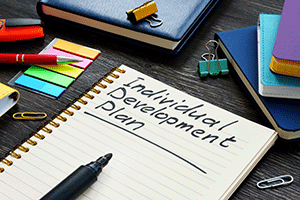
    Creating Your Individual Development Plan (E-Learning Course)

    Understanding Higher Education (E-Learning Course)


    Source link

  • Develop to Retain: Tools and Resources for Higher Ed Professional Development – CUPA-HR

    Develop to Retain: Tools and Resources for Higher Ed Professional Development – CUPA-HR

    by CUPA-HR | December 7, 2021

    It’s Employee Learning Week — a great reminder for employers to showcase their commitment to talent development by highlighting development opportunities available to employees. Whether you’re an HR practitioner in search of professional development ideas for yourself and your HR peers, or you’re looking for ideas to engage and develop other employees at your institution, here are several tools, tips and resources to help you take the next step.

    Professional Development Tools for the HR Pro

    • CUPA-HR Learning Framework — A tool that assists in defining HR practitioners’ knowledge, skills and attributes and then helps create an action plan for growth and set developmental goals. Jump start your development by using the quick start guide, then build your skills further by diving deeper into the framework competencies.
    • Creating Your Individual Development Plan — A must-have for anyone who wants to map out a strategy for career success in higher ed HR. This free CUPA-HR e-learning course provides an introduction to individual development plans (IDPs) and will guide you through the process of creating your plan, discussing your career with your leaders and implementing your strategy for success. CUPA-HR e-Learning is sponsored by PageUp.

    Ideas for the Higher Ed Community

    Apart from their own professional development, HR pros often create and help facilitate professional development opportunities for employees at their institutions. Here are some jump-start ideas from the article Optimize Your Hybrid or Remote Work Workforce — Considerations for Higher Ed HR Leaders, featured in the fall issue of Higher Ed HR Magazine.

    • Encourage managers to use an employee’s development plan to guide regular coaching calls. Gallup suggests ongoing coaching conversations — rather than annual performance reviews — can be of great benefit to both the employee and the employer. These meaningful conversations highlight the organization’s commitment to employee engagement, which can help retain employees for the long-haul. Encourage managers to use employees’ development plans during coaching calls as a guide to the conversation. Setting up the right systems and processes to help employees perform their best from any location is a great operational step, but reorienting managers to think about performance and productivity around outcomes instead is an important strategy.
    • Get creative with your learning and professional development offerings. William Paterson University’s HR team created a university-wide development program so all 600 non-faculty employees had a chance to participate. Their unique approach to talent development demonstrated institutional support for professional development, provided a platform for employees to engage and collaborate, and inspired additional ways to support employees, such as mentorship programs, goal setting and career advancement. Read more about the program in the special awards issue of Higher Ed HR Magazine to learn how the HR team adapted it to a virtual format — a great alternative for employees working in a hybrid or remote setting!


    Source link